Socket Weld Flanges — ASME B16.5 Manufacturer & Exporter
Tesco Steel & Engineering manufactures socket weld flanges — the small-bore connection that seats the pipe in a machined counterbore for a single external fillet weld, with the socket handling alignment and the matched bore keeping flow smooth. We produce NPS 1/2″ to 4″ in ASME B16.5 Class 150–1500 (higher classes on request), with raised face (SWRF), flat face (SWFF) and ring joint (SWRTJ) facings, in 50+ material grades — carbon steel A105, LTCS, stainless steel, duplex & super duplex, alloy steel F5–F91, Monel, Inconel, Incoloy, Hastelloy, titanium, copper nickel and more. EN 10204 3.1/3.2 certified; NACE, PED and IBR on request. ISO 9001:2015, made in Mumbai, India — exported worldwide.
ASME B16.5 · NPS 1/2″ – 4″
Class 150 – 1500
SWRF · SWFF · SWRTJ
One Fillet Weld · Smooth Bore
50+ Material Grades
NACE MR0175 · PED · EN 10204 3.1/3.2
ISO 9001:2015 · Exported Worldwide
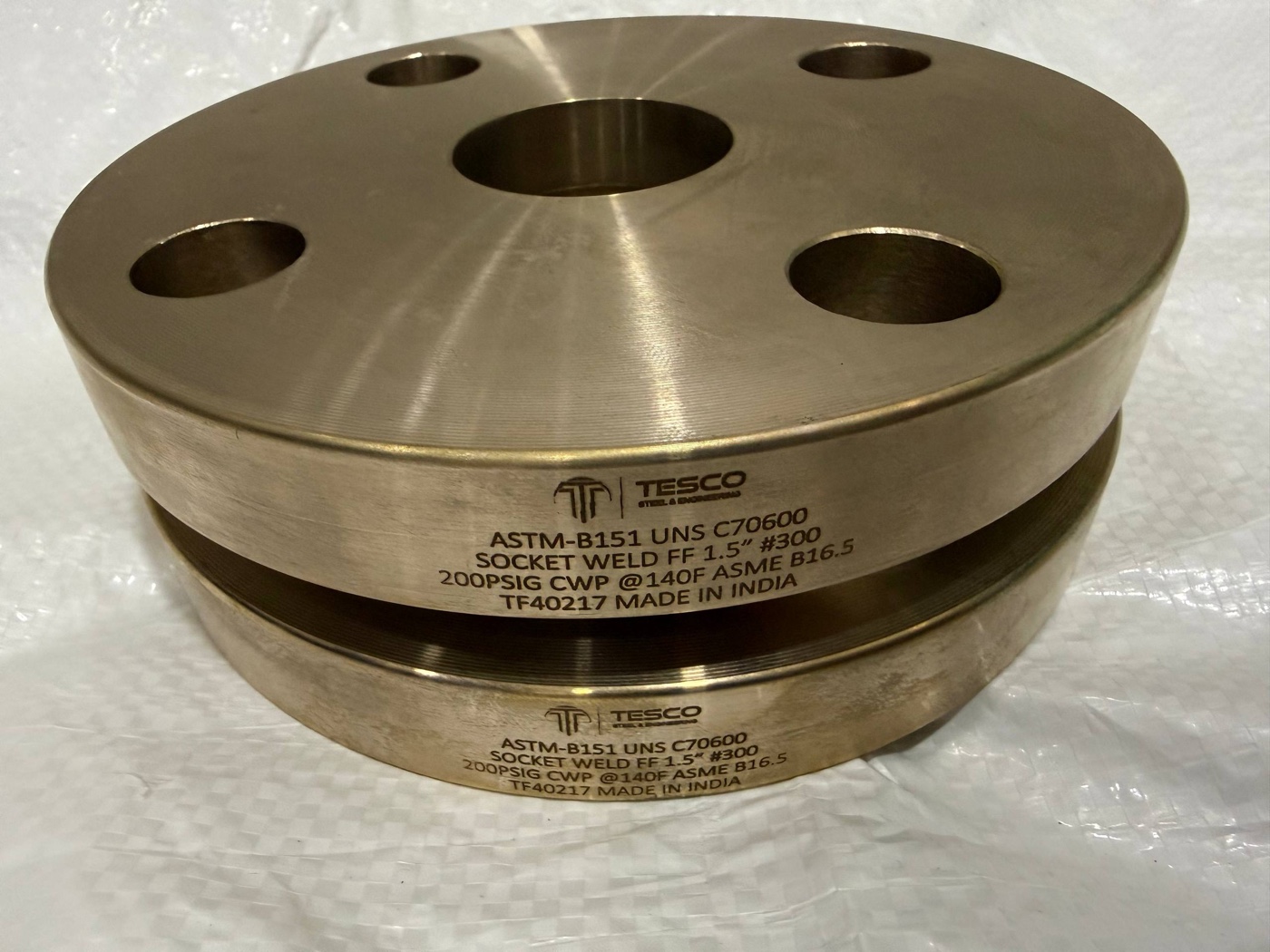
Tesco C70600 Socket Weld FF 1½″ × 300# — Laser-Marked, Made in India
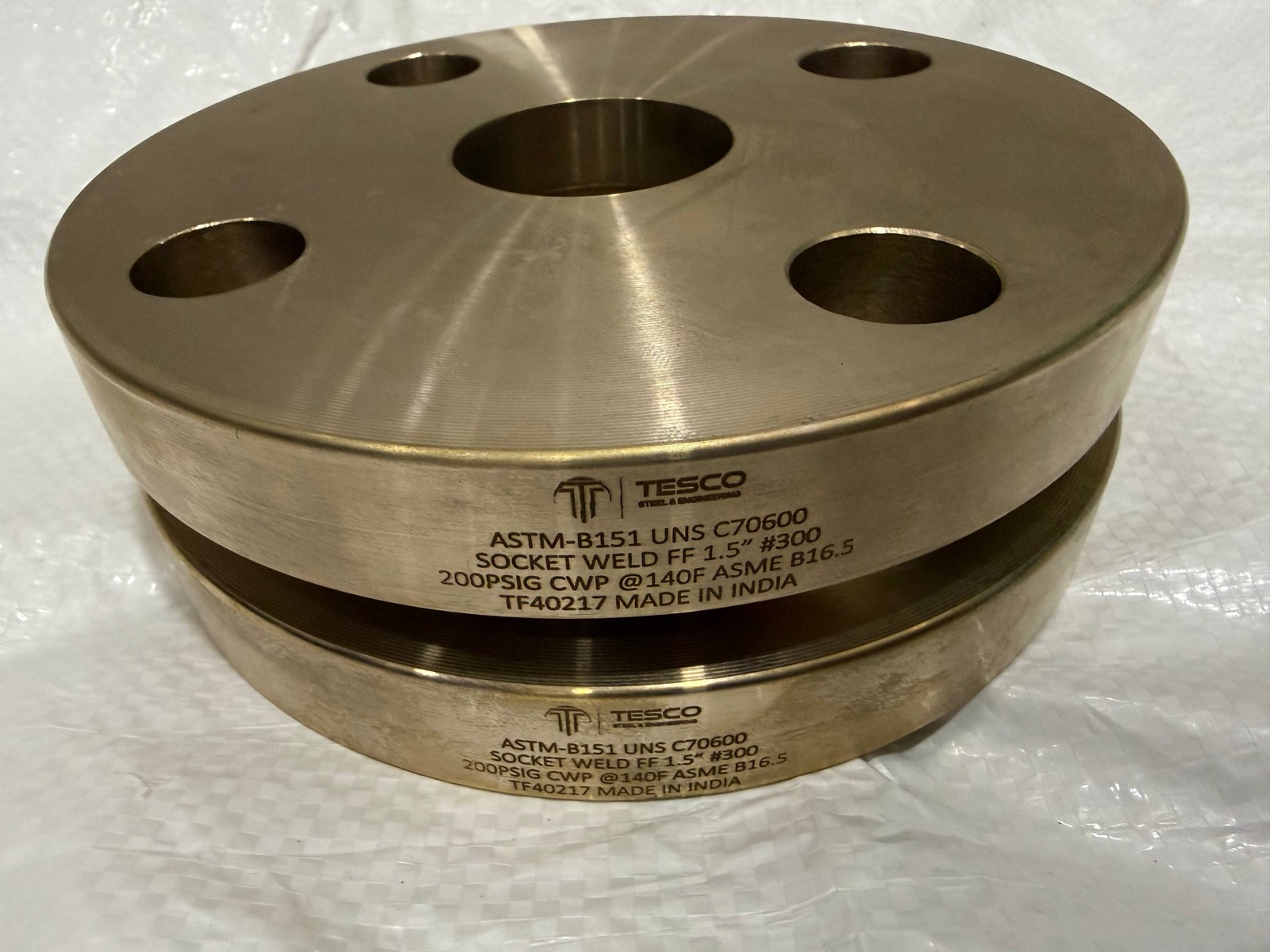
Copper Nickel C70600 Socket Weld FF Flanges — 1-1/2″ Class 300
What is a Socket Weld Flange?
A socket weld flange is a pipe flange with a machined counterbored socket into which the pipe end is inserted before a single external fillet weld is applied around the hub. Standardised under ASME B16.5 for small-bore piping — NPS 1/2″ to 4″ — it centres the pipe automatically, needs no bevelling or butt-weld fit-up, and its bore matches the pipe bore for smooth, turbulence-free flow.
Against the alternatives, the trade-offs are clean. A slip-on flange needs two fillet welds and leaves an internal step; the socket weld takes one weld and leaves none. A threaded flange avoids welding but lives at the mercy of its threads under vibration; the fillet weld is permanent and pressure-tight. A weld neck flange beats the socket weld only where bores grow beyond small-bore territory, where radiography of the joint is mandatory, or where severe cyclic loading calls for a butt-welded tapered hub — the comparison table below puts the four side by side.
The 1/16″ gap rule: seat the pipe fully in the socket, then withdraw it about 1.6 mm before welding — required by ASME B31.3. The gap gives the pipe room to expand under welding heat and thermal cycling; omitting it builds residual stress at the socket root and is one of the most common causes of socket weld cracking in the field.
Facings: the same body is supplied as
SWRF — raised face (the process-piping default),
SWFF — flat face (for cast iron, bronze and FRP mating), or SWRTJ — ring type joint for the highest ratings. Each facing has its own detailed page.
Why Socket Weld Flanges for Small-Bore Piping
Precise Bore Alignment
The counterbored socket centres the pipe automatically — no line-up clamps, no misalignment — and the matching bore gives turbulence-free flow, critical for instrumentation and dosing lines.
Single Fillet Weld, Faster Assembly
One external weld instead of the slip-on's two: less welding time, less heat input, less distortion — while meeting the same ASME B16.5 pressure ratings as any flange of the class.
High-Pressure Integrity
Available through Class 1500 (2500 on request), socket weld flanges carry the same pressure-temperature envelope as weld necks of equivalent material — at home in high-pressure steam and hydraulic systems.
Compact Form Factor
Without the weld neck's long tapered hub, face-to-face dimensions shrink — ideal for instrument manifolds, valve stations and packaged equipment with tight envelopes.
50+ Grades, Ready Stock
From A105 utility flanges to Hastelloy C276 acid service, with common sizes in SS 304/316, A105 and LTCS held in ready stock for dispatch within days — all with EN 10204 3.1/3.2 certificates.
How Our Socket Weld Flanges Are Manufactured
1
Forging — cut billet of certified heat is hot-forged into the flange blank, keeping full heat traceability from raw material to despatch.
2
Heat treatment — normalizing for carbon steel, solution annealing for stainless and nickel grades, with the thermal record retained per heat.
3
Machining — faces, hub and bolt holes to ASME B16.5, then the defining feature: the socket bore with its internal shoulder, machined to accept the pipe OD with the depth that sets up the 1/16″ expansion gap at fit-up.
4
Facing & finish — raised face serrations (stock finish per ASME B16.5), flat face, or RTJ groove as ordered.
5
Testing & marking — mechanical and chemical verification against the heat, PMI where specified, then permanent laser marking: grade, size, class, standard and traceability number — exactly as visible on the photos on this page.
6
Certification & packing — EN 10204 3.1 MTC (3.2 witnessed on request), faces protected, export-packed.
Socket Weld Flange Specifications
| Socket Weld Flanges — Full Specification Range |
|---|
| Size Range | NPS ½″ to 4″ (DN 15 to DN 100) per ASME B16.5; larger sizes on request |
| Pressure Class | Class 150, 300, 600, 900, 1500, 2500 (ASME B16.5) |
| PN Rating | PN 6, PN 10, PN 16, PN 25, PN 40, PN 64, PN 100, PN 160, PN 250, PN 400 |
| Facing Types | Raised Face (RF / SWRF), Flat Face (FF / SWFF), Ring-Type Joint (RTJ / SWRTJ) |
| Governing Standard | ASME B16.5 |
| Carbon Steel | ASTM A105 |
| LTCS Socket Weld Flanges | ASTM A350 LF2 |
| Stainless Steel Socket Weld Flanges | ASTM A182 F304 / F304H / F304L / F316 / F316H / F316L / F316Ti / F309 / F310 / F317 / F317L / F321 / F347 / F904L |
| Alloy Steel Socket Weld Flanges | ASTM A182 F5 / F9 / F11 / F12 / F21 / F22 / F91 |
| Duplex & Super Duplex Socket Weld Flanges | ASTM A182 F51 (UNS S31803), F53 (S32750), F55 (S32760), F60 (S32205) |
| Nickel Alloy Socket Weld Flanges | UNS N02200, UNS N02201 |
| Monel Socket Weld Flanges | UNS N04400 (Monel 400), UNS N05500 (Monel K500), Alloy 20 |
| Inconel / Incoloy Socket Weld Flanges | UNS N06600, N06601, N06625, N08800, N08810, N08825 |
| Hastelloy Socket Weld Flanges | UNS N10276 (C276), N06022 (C22), N10665 (B2), N06455 (C4) |
| Copper Nickel Socket Weld Flanges | C70600 (90/10 CuNi), C71500 (70/30 CuNi), C71640 |
| Titanium Socket Weld Flanges | Grade 1, Grade 2, Grade 3, DTH 3.7035, DTH 3.7055 |
| Surface Coatings / Treatments | Hot-Dip Galvanizing (GI), Sand Blasting, Shot Peening, Epoxy Coating, FBE Coating |
| Certifications | ISO 9001:2015, PED 2014/68/EU, NACE MR0175, EN 10204 3.1 / 3.2 Mill TC, IBR |
Socket Weld vs Weld Neck vs Slip-On vs Threaded
| Factor | Socket Weld | Weld Neck | Slip-On | Threaded |
|---|
| Governing Standard | ASME B16.5 | ASME B16.5 | ASME B16.5 | ASME B16.5 |
| Typical NPS Range | ½″ – 4″ | ½″ – 24″+ | ½″ – 24″+ | ½″ – 4″ |
| Welds Required | 1 fillet weld | 1 butt weld | 2 fillet welds | None (threaded) |
| Bore Match to Pipe | ✓ Yes | ✓ Yes (tapered) | ✗ No | ✗ Partial |
| Radiographic Weld Inspection | ✗ Not possible | ✓ Full | ✗ Limited | ✗ N/A |
| Space (Face-to-Face) | ✓ Compact | ✗ Longer hub | ✓ Short | ✓ Compact |
| Crevice Corrosion Risk | ✗ Moderate | ✓ None | ✗ Moderate | ✗ Moderate |
| Cyclic / Fatigue Service | Acceptable | ✓ Best | Limited | ✗ Avoid |
| Cost vs Weld Neck | ✓ Lower | Higher | ✓ Lowest | ✓ Low |
Industries & Applications
| Industry | Typical Socket Weld Flange Application |
|---|
| Oil & Gas | Instrument impulse lines, chemical injection headers, wellhead small-bore connections |
| Petrochemical | Catalyst transfer lines, corrosive process streams in SS or Hastelloy, utility headers |
| Power Generation | Boiler auxiliary piping, steam conditioning headers, feedwater control circuits (F91 alloy) |
| Pharmaceutical & Food | Hygienic small-bore lines in SS 316L; smooth bore prevents product contamination |
| Marine & Offshore | Seawater cooling, hydraulic control lines in Copper Nickel 90/10 or Duplex |
| Cryogenics / LNG | Instrument lines in LTCS (A350 LF2) or austenitic SS down to −196 °C |
| Chemical Processing | Acid service in Hastelloy C276 or Titanium; amine treating in F316L |
Socket Weld Flange Dimensions — ASME B16.5
Each chart below covers flange OD, thickness, hub diameter, bolt circle, bolting and socket bore per ASME B16.5 for its pressure class:
Browse by Type, Material & Grade
Price List & How to Order
Socket weld flange pricing depends on size, class, facing, material grade and quantity — and moves with raw material markets, so we quote live rather than publish a static list. Standard sizes in A105, LTCS and SS 304/316 dispatch from ready stock within 2–5 working days. To get a firm quotation, usually within 24 hours:
1
List your requirement — size (NPS or DN), class, facing (SWRF / SWFF / SWRTJ), material grade, pipe schedule (the socket bore is machined to suit), and quantity.
2
Add any extras — NACE MR0175, PED or IBR documentation, 3.2 certification, seal-weld preparation, coatings or special marking.
Global Export Destinations
Tesco Steel & Engineering exports socket weld flanges to the GCC and Middle East (UAE, Saudi Arabia, Kuwait, Qatar, Oman, Bahrain, Iraq), the Americas (USA, Canada, Mexico, Colombia, Peru), Europe and CIS (Germany, Italy, Netherlands, UK, Turkey, Kazakhstan), Africa (Nigeria, South Africa, Kenya, Tanzania, Angola), and Asia-Pacific (Malaysia, Thailand, Indonesia, Philippines, Vietnam, Singapore, Australia) — alongside full domestic coverage of India's industrial centres.
Socket Weld Flanges — Frequently Asked Questions
What is a socket weld flange?
A socket weld flange is a pipe flange with a machined counterbored socket into which the pipe end is inserted before a single external fillet weld is applied around the hub. Standardised under ASME B16.5, it is the connection of choice for small-bore piping — NPS 1/2 to 4 inch — where bore alignment, compact dimensions and clean flow matter. The socket centres the pipe automatically, and because the flange bore matches the pipe bore, flow passes through with no turbulence.
How is a socket weld flange installed, and what is the 1/16 inch gap rule?
The pipe is inserted until it bottoms in the socket, pulled back approximately 1/16 inch (1.6 mm), and then fillet welded around the hub. ASME B31.3 requires this expansion gap: it gives the pipe room to grow as welding heat and operating cycles expand it. Without the gap, differential thermal growth between pipe end and socket floor builds residual stress and fatigue cracks at the socket root — one of the most common field failures in socket weld piping.
Which standard governs socket weld flange dimensions?
ASME B16.5 (Pipe Flanges and Flanged Fittings) is the governing standard — it defines socket bore, socket depth, hub geometry, flange OD, thickness, bolt circle, drilling and facing dimensions per pressure class and size. Socket weld fittings such as tees, elbows and couplings are covered separately under ASME B16.11. Flange OD, drilling and bolting are shared with other B16.5 flanges of the same class, so socket weld flanges bolt up interchangeably.
What pressure classes are available for socket weld flanges?
Per ASME B16.5: Class 150, 300, 600, 900, 1500 and 2500, with the working pressure of each class set by the material group and temperature in the B16.5 rating tables. The Class 3000, 6000 and 9000 designations belong to socket weld fittings under ASME B16.11, not to flanges — a distinction worth checking when a requisition mixes the two.
What is the difference between SWRF, SWFF and SWRTJ flanges?
They share the same socket weld body and differ only in facing. SWRF (raised face) carries a raised gasket pad — 1.6 mm high on Class 150/300, 6.35 mm on Class 400 and above — that concentrates bolt load for a tighter seal, and is the default in process piping. SWFF (flat face) is machined flush for full-face gaskets, required when mating to cast iron, bronze or non-metallic flanges. SWRTJ has a precision groove for a solid metal ring gasket, used at very high pressures and temperatures.
When should I use a socket weld flange instead of a weld neck flange?
Use socket weld when the line is small bore (typically 2 inch and under), space is tight, and the piping specification does not demand radiographic examination of the joint — the fillet weld cannot be radiographed the way a butt weld can. Choose a weld neck flange for larger bores, severe cyclic loading, lethal or highly corrosive service, and wherever full volumetric weld inspection is mandatory.
What is the advantage of a socket weld flange over a slip-on flange?
One weld instead of two, and a smooth bore. A slip-on flange slides over the pipe and normally takes fillet welds at both front and back, leaving an internal step at the joint; a socket weld flange takes a single external fillet while the socket handles alignment, and the matched bore leaves no step. The result is faster fit-up, lower heat input and roughly 50% better fatigue performance than slip-on construction.
How does a socket weld flange compare with a threaded flange?
Both are compact small-bore options, but the threaded flange relies on tapered threads for both strength and sealing — vulnerable to vibration loosening, thread leakage and temperature cycling. The socket weld's fillet weld makes a permanent, pressure-tight metal joint with a smoother internal profile. Threaded flanges keep the advantage only where welding is prohibited, such as some galvanized systems or hazardous areas where hot work is not permitted.
What sizes do socket weld flanges come in, and why only small bore?
The practical range is NPS 1/2 to 4 inch, with 1/2 to 2 inch the overwhelming majority. As bore grows, the fillet weld area stops scaling with the pressure load, handling gets heavy, and the economics tip to butt-welded weld neck joints — which is why ASME B16.5 socket weld coverage and industry practice both stop at small bore. State the pipe schedule in your order, because the socket bore is machined to suit the pipe OD and wall.
What materials are available for socket weld flanges?
Over 50 grades across every family we forge: carbon steel A105, LTCS A350 LF2, stainless steel F304/304L, F316/316L, F316Ti, F310, F317/317L, F321, F347 and 904L, 254 SMO, duplex F51/F60 and super duplex F53/F55, alloy steel F5, F9, F11, F12, F22 and F91, Monel 400/K500, Inconel 600/601/625, Incoloy 800/800H/800HT/825/925, Hastelloy C276/C22/B2, titanium Gr. 1/2/3, copper nickel 90/10 and 70/30, nickel 200/201 and Alloy 20 — browse the grade-wise pages linked on this page for each one.
Can socket weld flanges be used in corrosive or cryogenic service?
Yes, with material selection and one design caveat. The annular gap between pipe OD and socket bore is a potential crevice, so for severely corrosive media — hot chlorides, acids, sour service — a butt-welded weld neck joint is often preferred; an internal seal weld can eliminate the crevice where the spec requires it. For cryogenic service the joint itself is no limitation: LTCS A350 LF2 serves to −46 °C and austenitic grades like 304L/316L to −196 °C, with impact testing certified.
Can I get an internal seal weld on socket weld flanges?
The seal weld itself is applied at installation by the piping contractor, but we prepare for it: socket depth, land and bore finish are machined to suit seal-welded service on request, and the material certification supports the welding procedure you plan to qualify. Specify seal-welded service in the enquiry and the flanges arrive ready for it.
What testing and certification do you supply with socket weld flanges?
Every lot ships with EN 10204 3.1 mill test certificates covering chemical analysis and mechanical properties, with 3.2 certification witnessed by Lloyd's, DNV, BV or TÜV on request. We also offer PMI (positive material identification), dye penetrant examination, impact testing for low-temperature grades, NACE MR0175 / ISO 15156 compliance for sour service, PED 2014/68/EU and IBR documentation. Heat-number traceability is marked on every flange.
Do you keep socket weld flanges in stock? What is the lead time?
Standard sizes and materials — SS 304/316, A105 and LTCS in NPS 1/2 to 3 inch, Class 150, 300 and 600 — are held as ready stock and typically dispatch within 2 to 5 working days. Non-standard grades such as Hastelloy, titanium and super duplex, or large-quantity orders, are manufactured and exported within 4 to 8 weeks. Send your list for a firm delivery commitment.
What information should I include in a socket weld flange enquiry?
Six things: size (NPS or DN), pressure class, facing (SWRF, SWFF or SWRTJ), material grade, pipe schedule — the socket bore is machined to match — and quantity. Add certification needs (3.1 or 3.2, NACE, PED, IBR), seal-weld preparation or special marking, and we return a firm quotation with price and lead time, usually within 24 hours.
Do you export socket weld flanges outside India?
Yes. Tesco Steel & Engineering is an ISO 9001:2015 certified manufacturer based in Mumbai, exporting socket weld flanges to EPC contractors, OEMs and distributors across the Middle East, Europe, Africa, Southeast Asia, the Americas and Australia. Export packing is seaworthy, faces are protected, and every flange carries marked heat-number traceability from raw material to finished part.

