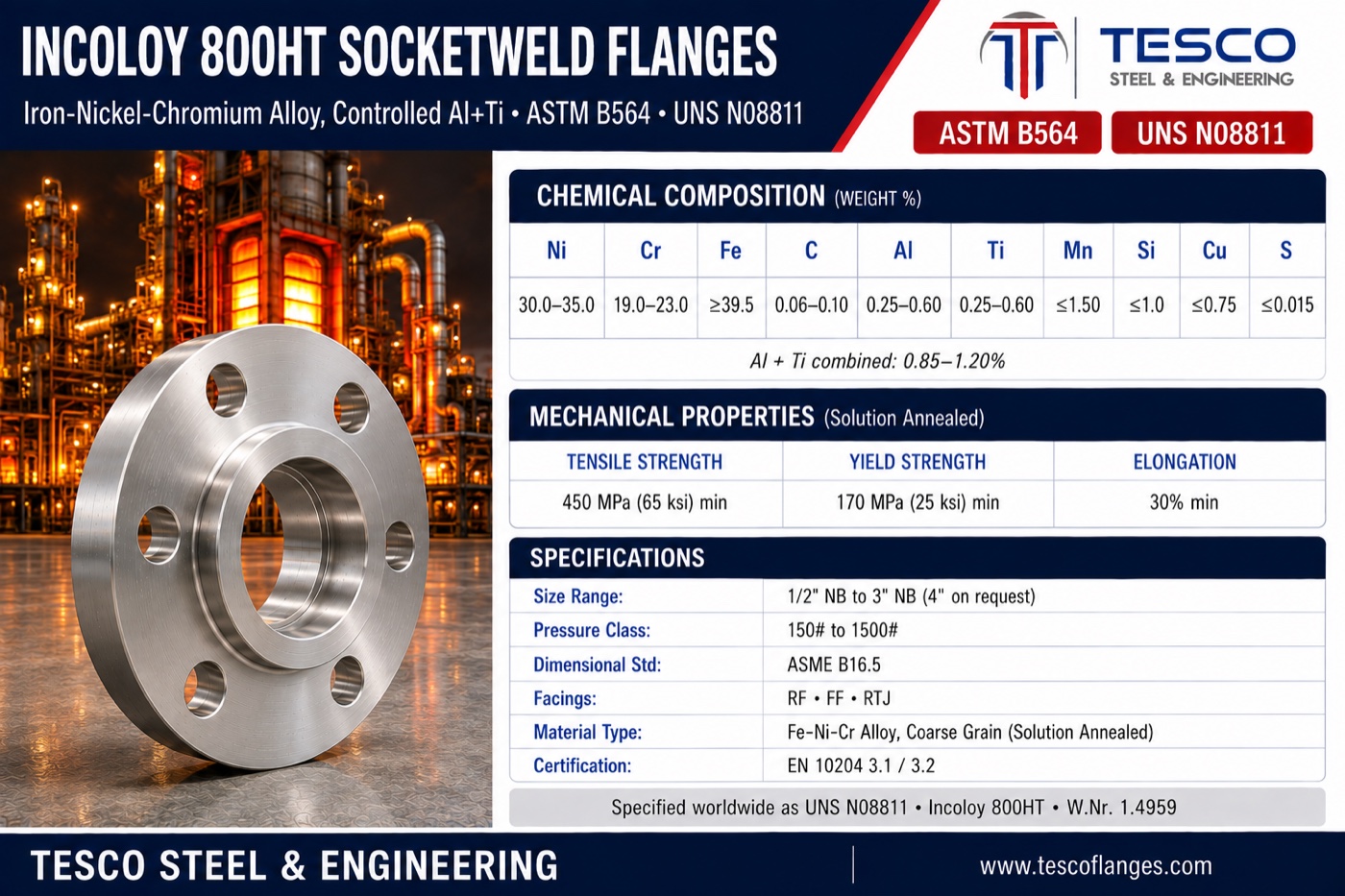
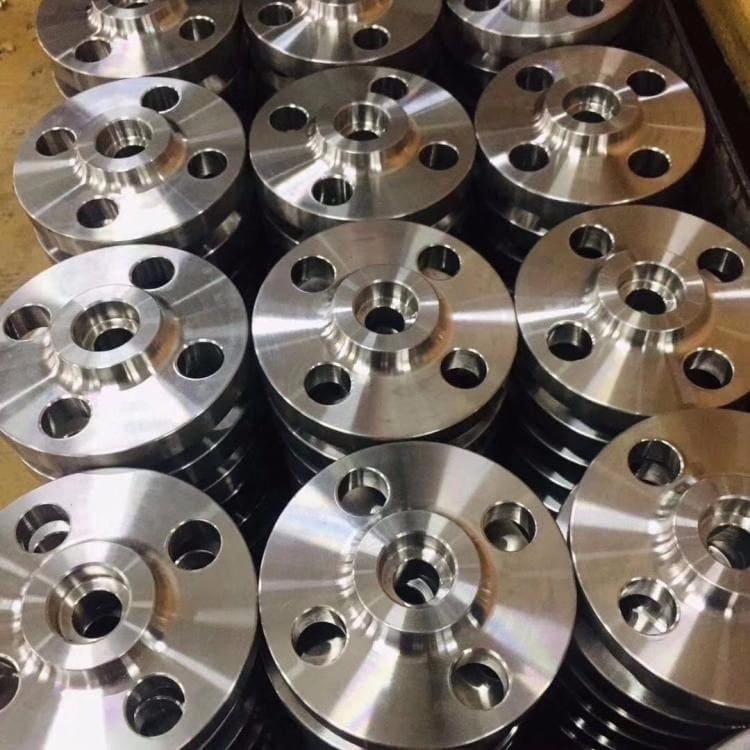
Tesco Steel & Engineering manufactures Incoloy 800HT socketweld flanges — the top of the family's dial: ASTM B564, UNS N08811, W.Nr. 1.4959 — to ASME B16.5 from ½″ to 3″ NB in Classes 150–1500. 800HT takes 800H's creep recipe and tightens every screw: carbon 0.06–0.10%, aluminium and titanium given real floors, and the combined Al+Ti window of 0.85–1.20% — a measured dose of gamma-prime strengthening dispersed through the grains, on top of the carbide pinning and coarse grain the H certificate already carries. The result is the family's hottest creep certificate, toward 760 °C and beyond — ethylene-cracker and pyrolysis country. The honesty carries over: the room-temperature certificate is identical to 800H's (450/170 MPa) — the premium lives entirely above ~600 °C; below 593 °C, plain 800 beats both; and unless the spec names N08811, 800H or dual-certified material usually serves. Welded with ERNiCr-3 or 617-type filler — no preheat, no PWHT. Facings: SWRF, SWFF, SWRTJ. Every lot with EN 10204 3.1/3.2 MTC. ISO 9001:2015, made in Mumbai, India — exported to 50+ countries.
Incoloy 800HT · B564 · N08811 · 1.4959C 0.06–0.10% · Al+Ti 0.85–1.20%Gamma-Prime on Top of the CarbidesThe Hottest Certificate — Toward 760 °C+450 / 170 MPa — Same as H at 20 °CEthylene-Cracker & Pyrolysis CountryASME B16.5 ½″–3″ · Class 150–1500EN 10204 3.1 / 3.2 · ISO 9001:2015
Incoloy 800HT Socketweld Flanges — Specifications at a Glance
What is an Incoloy 800HT Socketweld Flange?
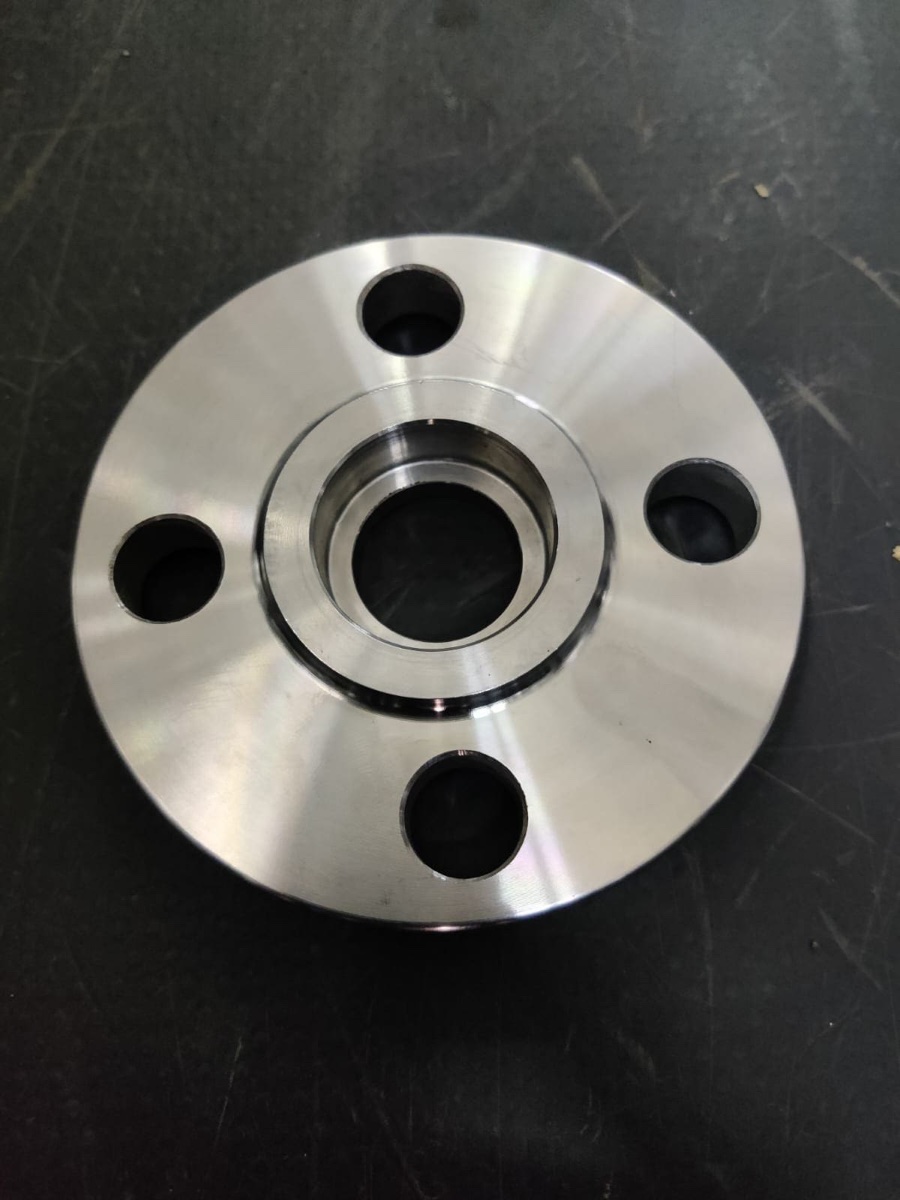
The top of the dial in the small-bore pattern. A forged Incoloy 800HT flange (ASTM B564 / UNS N08811 / W.Nr. 1.4959) with a machined socket: pipe seated square by geometry, one external fillet weld — no preheat, no PWHT — through-bore matched to the pipe schedule. The family recipe with every screw tightened: C 0.06–0.10%, Al and Ti floored at 0.25%, Al+Ti summed to 0.85–1.20% — carbides pin the coarse-grained structure and gamma-prime strengthens the grains themselves — carrying code creep service toward 760 °C and beyond. Tensile ≥450 MPa, yield ≥170 MPa, elongation ≥30% — identical to 800H at room temperature; the premium lives above 600 °C. Sized by ASME B16.5 at ½″–3″ NB, Classes 150–1500; EN 10204 3.1 with grain-size records on every lot.
Also searched as: Alloy 800HT socket weld flange, N08811 SW flange, 1.4959 socket weld flange, controlled Al+Ti 800 flange — all the same product family. Related pages: the facings — SWRF / SWFF / SWRTJ — the socketweld hub, the other Incoloy 800HT types — blind, weld neck, slip-on — the siblings 800 / 800H / 825 socketweld, and the summit alloys Inconel 600 / 601 beyond it.
Three separate UNS numbers — N08800, N08810, N08811 — three separate certificates, not substitutable. The same dial the stainless bench turns at 304H, here turned to its last stop. Much modern mill material is dual-certified 800H/800HT — say so if your documentation accepts either.
What the Tightened Recipe Buys
The Combined Window — Gamma-Prime
Al+Ti 0.85–1.20% precipitates fine gamma-prime through the grains at service temperature — the age-hardened superalloys' strengthener, dosed modestly enough to keep welding simple. Strength inside the grains, on top of the carbides at the boundaries.
The Tightened Carbon
0.06–0.10% guaranteed — the family's highest carbide reserve, certified, pinning the coarse-grained structure through decades of hot dwell.
The Hottest Certificate
Code creep service toward 760 °C and beyond — ethylene crackers, pyrolysis furnaces, reformer outlets: the hottest structural duty the Incoloy bench certifies.
Honesty About the Middle
Mid-band creep duty is 800H's job at the same room-temperature certificate and a friendlier price — order HT where the spec names N08811 or the duty genuinely tops the range.
Incoloy 800HT Chemical Composition (UNS N08811)
Element
Ni
Cr
Fe
C
Al
Ti
Mn
Si
Cu
S
Weight %
30.0–35.0
19.0–23.0
≥39.5
0.06–0.10
0.25–0.60
0.25–0.60
≤1.50
≤1.0
≤0.75
≤0.015
Al + Ti combined: 0.85–1.20% — the HT signature, specified as a sum because the two elements build the gamma-prime precipitate together. Read the dial: plain 800 has no carbon floor and 0.15% Al/Ti floors; 800H floors carbon at 0.05%; 800HT tightens both dials at once. Grain size — typically ASTM No. 5 or coarser — travels on the certificate. PMI confirms every piece.
Mechanical Properties (Solution Annealed)
Property
ASTM B564 N08811 Requirement
Tensile Strength
≥ 450 MPa (65 ksi) — identical to 800H at room temperature; the HT premium is invisible at 20 °C and decisive at 700 °C
Yield Strength (0.2%)
≥ 170 MPa (25 ksi)
Elongation
≥ 30% — fully austenitic, no ductile-brittle transition
Condition
Solution Annealed, coarse grain — furnace charts and grain-size records certified
Temperature Span
The family's hottest certificate — creep-governed service toward 760 °C and beyond; oxidation scale sound to ~850 °C; below 593 °C plain 800 serves better
Rating
B16.5 nickel-alloy tables govern the joint — gasket-limited before metal-limited; stated per class on our quotations
One Socket, Three Facings — and the Hot-Joint Note
At the top of the creep range the sealing system and the bolting are the joint's real design problem — standard studs creep long before an 800HT flange notices. State the actual joint temperature; sealing and bolting guidance ride with the quotation.
Incoloy 800HT Socketweld Flange Specifications
Incoloy 800HT Socketweld Flanges are available in the following specifications:
Material Grade
Incoloy 800HT, ASTM B564 (UNS N08811), W.Nr. 1.4959 — dual-certified 800H/800HT material supplied where documentation accepts it
Heat Treatment
Solution annealed, coarse grain (typically ASTM No. 5 or coarser) — furnace charts and grain-size records certified
Size
1/2"NB to 3"NB per ASME B16.5; 4″ and larger to order; EN 1092-1 patterns to order
Class
150#, 300#, 600#, 900#, 1500# (900# shares 1500# dimensions in most sizes) — the hottest trim lives in 150/300
Facings
Raised Face (SWRF), Flat Face (SWFF), Ring Type Joint (SWRTJ) with groove per B16.20
Bore
Socket bore to pipe OD; through-bore matched to pipe schedule
Welding
Single external fillet with 1/16″ expansion gap; ERNiCr-3 filler (617-type at the top of the range); sulphur-clean practice; no preheat, no PWHT
Service Span
The family's hottest creep duty toward 760 °C+ — ethylene crackers, pyrolysis, reformer outlets; mid-band creep to 800H, below 593 °C to plain 800; halogens and caustic to 600; acids to 825 — see the notes
Tension & chemistry per heat; PMI on every piece; grain size verified; socket depth and bore gauged
Certification
EN 10204 3.1 with solution-anneal and grain-size records (standard) / 3.2 witnessed
Specification Notes — Getting Alloy 800HT Sockets Right
Four honest notes.The wrong certificate twice over on the cold side: below 593 °C, 800HT reads weaker than plain 800 and costs more than 800H — order down the dial. Sensitisation honesty: the family's highest deliberate carbon means grain-boundary carbides through long hot service are a design fact — aqueous duty after hot service deserves case-by-case review. The chemistry limits carry over: halogens and caustic stay with 600, the aggressive acid bench with 825 and Alloy 20. And the certificates are not substitutable: N08800, N08810 and N08811 are three specifications — where a design names N08811, only the HT certificate satisfies it; where it accepts either creep grade, dual-certified supply is the efficient answer.
How Our Incoloy 800HT Socketweld Flanges Are Manufactured
1
Forging — cut billet of the spectro-verified N08811 heat — carbon and the Al+Ti sum confirmed in the windows — is hot-forged into the flange blank with full heat traceability and segregated nickel-alloy handling.
2
Solution annealing — the high anneal sets the coarse grain the creep certificate is built on; furnace charts and grain-size measurements retained against the heat number.
3
Machining — faces, OD and drilling to ASME B16.5 on dedicated stations with sulphur-free lubricants; socket counterbore and depth gauged piece by piece, through-bore matched to the ordered schedule.
4
Facing — RF serrations, flat face or RTJ groove per B16.20.
5
Testing & marking — tension and chemistry per heat; PMI and grain-size verification; laser-marked with grade, size, class, schedule and heat number.
6
Certification & packing — EN 10204 3.1 MTC with solution-anneal and grain-size records (3.2 witnessed on request); WPS guidance included; packed sea-worthy with no carbon-steel contact.
Where Incoloy 800HT Socketweld Flanges Are Used
At the top of the family's range: ethylene-cracker and pyrolysis furnace small bore, steam-reformer outlet and transfer-line adjacent connections, the hottest heat-treatment and industrial furnace trim, hot-gas and flue systems running deep into the creep band, and petrochemical plant standardised on N08811 for its hottest circuits. Production below:
Socket weld flange dimensions are class-governed per ASME B16.5 — identical across material grades (pressure-temperature ratings follow the nickel-alloy group). Full charts:
How to Specify & Order an Incoloy 800HT Socketweld Flange
Six elements — the specification names the certificate:
1
Size & standard — e.g. 1″ NB ASME B16.5, or DN25 EN 1092-1 to order.
2
Pressure class & facing — 150#–1500#; SWRF (the default), SWFF or SWRTJ — with the design and joint temperatures, which govern the rating, the sealing guidance and the grade itself.
3
Pipe schedule — the through-bore is matched to the pipe ID.
4
Grade line — Incoloy 800HT / B564 / N08811 / 1.4959, or state that dual-certified 800H/800HT is acceptable; if the duty sits mid-band, 800H may be the honest order — our quotation will say so.
5
Certification — EN 10204 3.1 with solution-anneal and grain-size records (our standard) / 3.2 witnessed, PMI as applicable.
An Incoloy 800HT socketweld flange is a forged iron-nickel-chromium alloy flange at the top of the Alloy 800 family's dial — 30-35% nickel and 19-23% chromium on an iron base of at least 39.5%, with carbon tightened to 0.06-0.10% and aluminium plus titanium controlled to a combined 0.85-1.20%, ASTM B564, UNS N08811, W.Nr. 1.4959 — whose back carries a machined socket: the pipe end seats inside, self-aligned square to the face, and is secured with a single external fillet weld. 800HT is the family's hottest creep certificate, built for code service toward 760°C and beyond — ethylene-cracker and pyrolysis country. Dimensioned to ASME B16.5 for ½" to 3" NB in Classes 150 to 1500.
What does the combined Al+Ti window of 0.85-1.20% actually do?
It adds a second strengthening mechanism on top of the H grade's two. 800H resists creep with coarse grain (fewer boundaries) and guaranteed carbon (carbides pinning the boundaries that remain). 800HT's raised aluminium and titanium — each floored at 0.25%, summed to 0.85-1.20% — go further: at service temperature they precipitate fine gamma-prime, the same nickel-aluminium-titanium intermetallic that strengthens the age-hardened superalloys, dispersed through the grains themselves. The dose is deliberately modest — enough to lift creep and stress-rupture strength measurably above 800H's in the hottest band, not enough to turn the alloy into an age-hardened material with welding complications. That measured step is the entire difference between the H and HT certificates, and it is why the HT window is specified as a sum: the two elements build the precipitate together.
What makes 800HT different from 800H?
Three tightenings of the same recipe. Carbon: 0.06-0.10% against 800H's 0.05-0.10% — a slightly higher guaranteed floor for the carbide reserve. Aluminium and titanium: each raised from a 0.15% floor to 0.25%, with the combined 0.85-1.20% window that plain 800 and 800H do not carry — the gamma-prime reserve. And the same coarse-grain solution anneal, certified with grain-size records. The room-temperature certificate is identical to 800H's (450/170 MPa) — the difference lives entirely above roughly 600°C, where 800HT's allowable stresses and rupture life pull ahead, earning it the family's hottest duty toward 760°C and beyond. Separate UNS number (N08811), separate W.Nr. (1.4959), separate certificate — and much modern mill material is dual-certified to both grades at once.
What is the chemical composition of Incoloy 800HT (UNS N08811)?
Nickel 30.0-35.0%, chromium 19.0-23.0%, iron ≥39.5% — the family's deliberate iron floor — carbon 0.06-0.10%, aluminium 0.25-0.60% and titanium 0.25-0.60% with the combined aluminium-plus-titanium window of 0.85-1.20% that is the grade's signature, manganese ≤1.50%, silicon ≤1.0%, copper ≤0.75%, sulphur ≤0.015%. Read the dial across the family: plain 800 caps carbon at 0.10% with no floor and Al/Ti at 0.15-0.60 each; 800H floors carbon at 0.05%; 800HT floors carbon at 0.06% and doses the Al+Ti sum for gamma-prime. Grain size — coarse, typically ASTM No. 5 or coarser — travels on the certificate alongside the chemistry. Verified per heat, PMI-confirmed on every piece, EN 10204 3.1 MTC.
What are the mechanical properties of Incoloy 800HT socketweld flanges?
In the solution-annealed condition ASTM B564 requires tensile strength 450 MPa (65 ksi) minimum, yield strength 170 MPa (25 ksi) minimum and elongation 30% minimum — exactly the same room-temperature certificate as 800H, and deliberately below plain 800's 520/205, for the same coarse-grain reason. The HT premium is invisible at 20°C and decisive at 700°C: higher creep and stress-rupture strength in the hottest band, which is what ASME's creep-governed allowable stresses reward. The structure stays fully austenitic and tough, grain size is certified, and B16.5's nickel-alloy pressure-temperature tables govern the flange rating — with the gasket and bolting retiring the joint long before the metal, as every hot page in this series repeats.
How hot can Incoloy 800HT actually go?
It carries the family's deepest certificate: creep-governed code service toward 760°C and beyond, with oxidation resistance — the 19-23% chromium scale with the aluminium and titanium assisting — sound to roughly 850°C and excursions above. That covers ethylene-cracker and pyrolysis furnace hardware, reformer outlet systems and the hottest heat-treatment plant the Incoloy bench serves. Above it, the metallurgy changes family: 601's alumina scale takes the cycled oxidising summit toward 1200°C, and 617-class alloys take the highest-strength heat. The joint keeps its own honest ceiling — B16.5 tables and the sealing system govern far below the metal — so 800HT sockets live on furnace-adjacent small bore where the pipe demands the certificate and the joint sits within the flange envelope. State both temperatures on the enquiry.
Incoloy 800HT or 800H — which should be ordered?
Let the specification decide, and be honest when it is silent. If the design documentation names N08811 — common in ethylene, pyrolysis and the hottest reformer service — order 800HT and the certificate follows exactly. If the duty sits in the broad 593-700°C band, 800H covers it and is the more commonly stocked certificate; the HT premium buys nothing you will use. And a large share of modern mill material is dual-certified 800H/800HT — meeting the carbon, Al+Ti and grain requirements of both — so if your documentation accepts either grade, saying so on the enquiry simplifies supply and often shortens delivery. The one wrong answer is upgrading to HT for prestige on a line that never leaves the middle of the creep band — the certificate costs more and serves identically there.
Is there any reason to order 800HT below 593°C?
Almost never — and the family's own pages say so. Below 593°C the code's allowable stresses are tensile-governed, where the coarse-grained creep grades read weaker than plain 800's fine-grained 520/205 certificate; the gamma-prime reserve does nothing useful at those temperatures; and the deliberate carbon is a mild sensitisation liability in aqueous service with no compensating benefit. Plain Alloy 800 — the bridge grade — is better and cheaper on the cold side of the boundary, with the same chloride-SCC immunity and the same iron-floor economy. The only common exception is fleet standardisation: a plant that stocks one certificate for maintenance across mixed-temperature systems sometimes standardises on the creep grade knowingly. Do it as a decision, not a default.
Incoloy 800HT or the Inconels?
The same split the 800H page draws, one rung higher. 800HT's franchise is certified creep strength at the top of the family's range on an iron-floor price — and in the 650-760°C structural band it is very hard to beat commercially. Inconel 600 brings no creep advantage there; its case is chemistry — halogens, caustic — and oxidation headroom toward 1095°C. Inconel 601 takes the cycled oxidising summit toward 1200°C with its clinging alumina scale. 617-class nickel-chromium-cobalt-molybdenum alloys take the highest-strength gas-turbine-adjacent heat beyond everything on this bench. The honest rule: creep-certified structural duty to 760°C — 800HT; halogen or caustic chemistry — 600; the cycled summit — 601; and when the enquiry reads like a gas turbine, it has outgrown this page.
What are Incoloy 800HT's honest weaknesses?
Four, named plainly. The cold-side giveaway, doubled: below 593°C it reads weaker than plain 800 and costs more than 800H — the wrong certificate twice over; order down the dial. Sensitisation honesty: the family's highest deliberate carbon plus long hot service means grain-boundary carbides are a design fact — aqueous-corrosion duty after hot service deserves case-by-case review. The chemistry limits carry over unchanged: 30-35% nickel is not the halogen-and-caustic ≥72%, which stays with 600, and with no molybdenum the aggressive acid bench belongs to 825 and beyond. And hot reducing sulphur attacks the nickel matrix as everywhere — the high iron moderates it, the enquiry should still name the atmosphere. None of these touch the top-of-the-dial franchise it was certified for.
How is an Incoloy 800HT socketweld flange welded?
With nickel-family practice and the creep-range disciplines of its sibling, slightly sharpened. Geometry is standard: pipe bottomed in the socket, withdrawn 1/16" (1.6 mm) to leave the expansion gap, single external fillet weld — no preheat, no PWHT. Filler follows service temperature: ERNiCr-3 serves general fabrication, and 617-type consumables are the honest choice for joints working at the top of the HT range, where deposit rupture strength must keep pace with a base metal bought specifically for it. The raised aluminium and titanium ask clean, well-shielded arcs — comfortably short of age-hardened-alloy fussiness. Sulphur-clean housekeeping is non-negotiable for weldments headed above 700°C: sulphur-free lubricants, dedicated brushes, no carbon-steel contact. Solution-annealed with grain-size records; WPS guidance travels with every supply.
What sizes and pressure classes do Incoloy 800HT socketweld flanges come in?
ASME B16.5 standardises socket weld flanges from ½" to 3" NB in Classes 150, 300, 600, 900 and 1500 — Class 900 sharing Class 1500 dimensions in most small-bore sizes — with 4" and Class 2500 made to order. The hottest creep-range small bore lives almost entirely in Classes 150 and 300 — cracker and furnace-adjacent purge, instrument and steam trim where temperature, not pressure, drives the specification. All three facings are available: SWRF the default, SWFF for cast and lined mates, SWRTJ where the rating demands it — with the high-temperature sealing and bolting guidance that top-of-the-range joints need riding on the quotation. Put the pipe schedule on the enquiry — the through-bore is matched to the pipe ID — and the design temperature, which sets the governing B16.5 rating; our quotations state it per class.
What details are needed to get an accurate Incoloy 800HT socketweld flange quotation?
Six elements plus commercial terms: (1) size — ½" to 3" NB; (2) pressure class — 150 to 1500, with the design temperature, which governs the rating and — decisively at this end of the family — the grade; (3) facing — SWRF, SWFF or SWRTJ with ring number; (4) the pipe schedule, so the through-bore matches the pipe ID; (5) the grade line — Incoloy 800HT, ASTM B564, UNS N08811 or W.Nr. 1.4959 all name the same metal — or state that dual-certified 800H/800HT is acceptable, which simplifies supply; if the duty sits mid-band, our quotation may honestly suggest 800H; (6) certification — EN 10204 3.1 with solution-anneal and grain-size records (our standard) or 3.2 witnessed, PMI as applicable. Add quantity and destination; quotations normally within 24 hours.
Who manufactures Incoloy 800HT socketweld flanges in India?
Tesco Steel & Engineering is an ISO 9001:2015 certified flange manufacturer based in Mumbai, India, producing Incoloy 800HT (ASTM B564, UNS N08811) socket weld flanges from ½" to 3" NB (larger to order) in Classes 150-1500 — each forged from certified heats meeting the tightened carbon and Al+Ti windows, solution-annealed with furnace charts and grain-size records against the heat number, machined on dedicated nickel-alloy stations with sulphur-free lubricants, gauged socket depth and schedule-matched bore, PMI-checked, and laser-marked with grade, size, class, schedule and heat number. Supplied with EN 10204 3.1/3.2 certification and WPS guidance, alongside the plain 800, 800H, 825 and 925 siblings and the full nickel-alloy socketweld range this series covers. Exported to more than 50 countries.