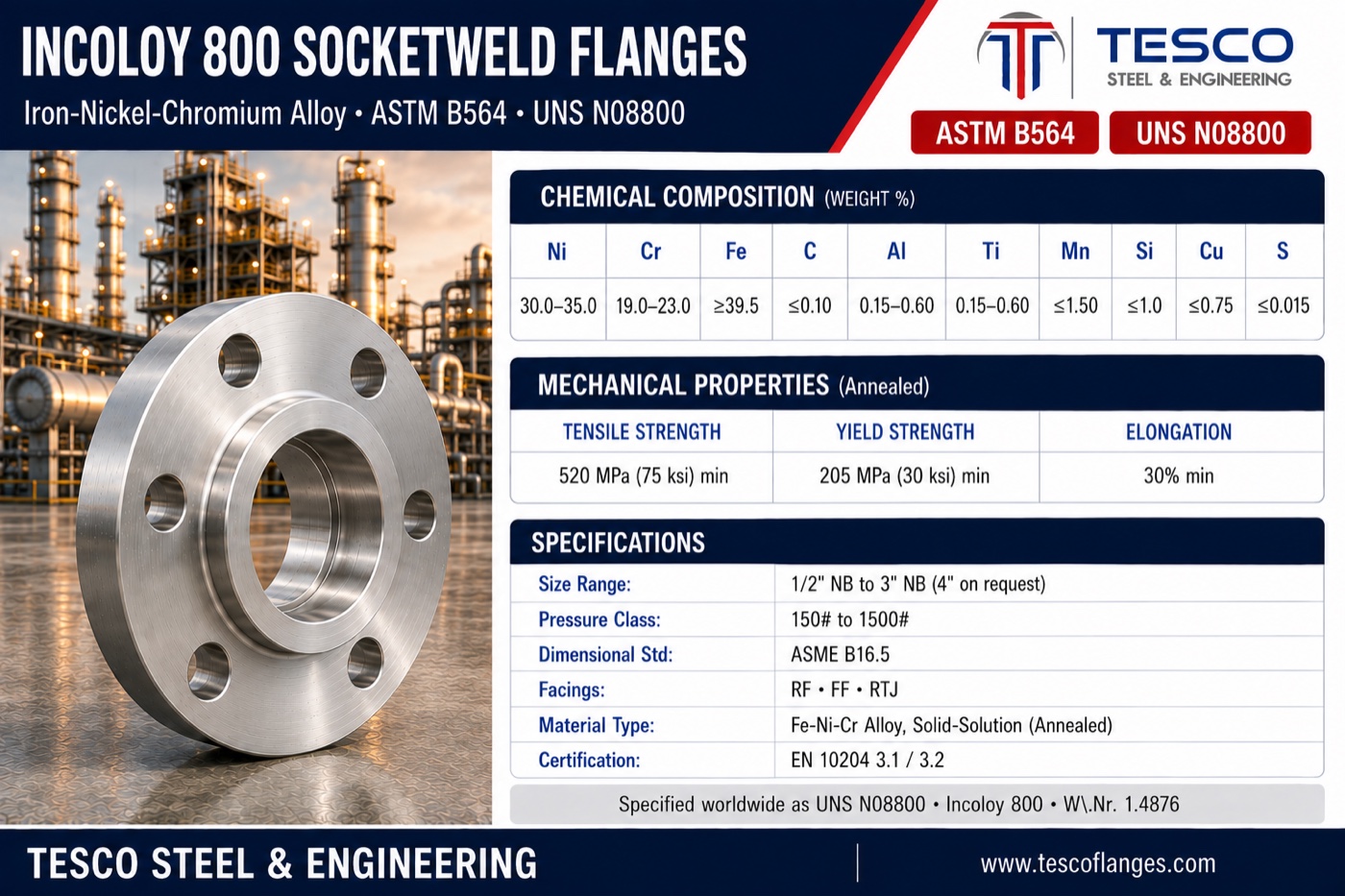
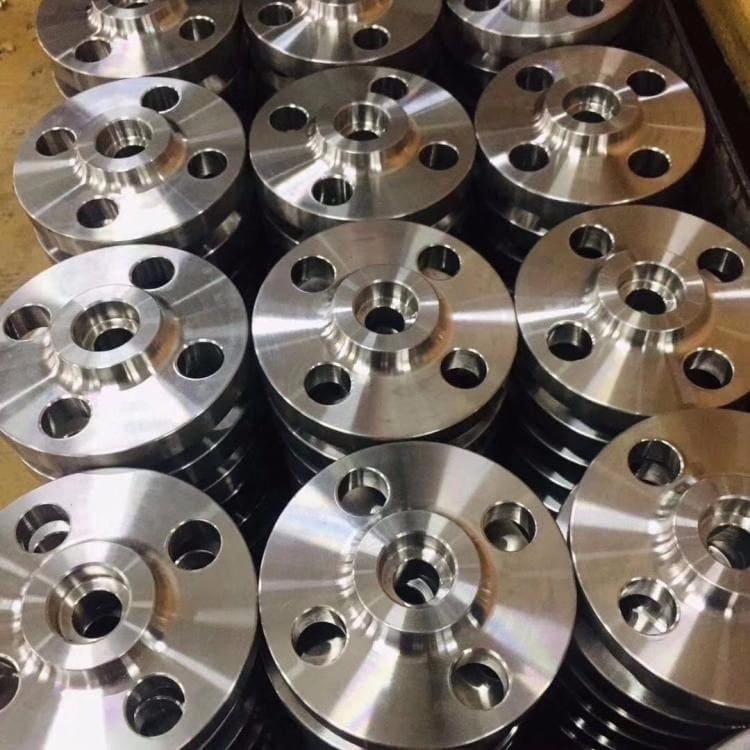
Tesco Steel & Engineering manufactures Incoloy 800 socketweld flanges — the bridge between stainless and Inconel: ASTM B564, UNS N08800, W.Nr. 1.4876 — to ASME B16.5 from ½″ to 3″ NB in Classes 150–1500. The name declares the recipe: Incoloy — iron — the only grade in this series whose iron carries a floor, ≥39.5%, and that floor is what keeps the price sensible. The 30–35% nickel is spent where it matters: on the safe side of the Copson curve, designing out the hot-chloride stress-corrosion cracking that retires 316L and its bench, and holding a stable, carburisation-resistant austenite through hot service. Above it the family ladder is honest: creep duty past 593 °C belongs to 800H/800HT, acids to 825, halogens and caustic to Inconel 600. Welded with ERNiCr-3 or matching filler — no preheat, no PWHT. Facings: SWRF, SWFF, SWRTJ. Every lot with EN 10204 3.1/3.2 MTC. ISO 9001:2015, made in Mumbai, India — exported to 50+ countries.
Incoloy 800 · B564 · N08800 · 1.4876Ni 30–35% · Cr 19–23% · Fe ≥39.5%The Iron Floor — Nickel Duty, Sensible PriceChloride SCC: Designed Out520 / 205 MPa · 30% ElongationThe Bridge: Stainless → 800 → InconelASME B16.5 ½″–3″ · Class 150–1500EN 10204 3.1 / 3.2 · ISO 9001:2015
Incoloy 800 Socketweld Flanges — Specifications at a Glance
What is an Incoloy 800 Socketweld Flange?
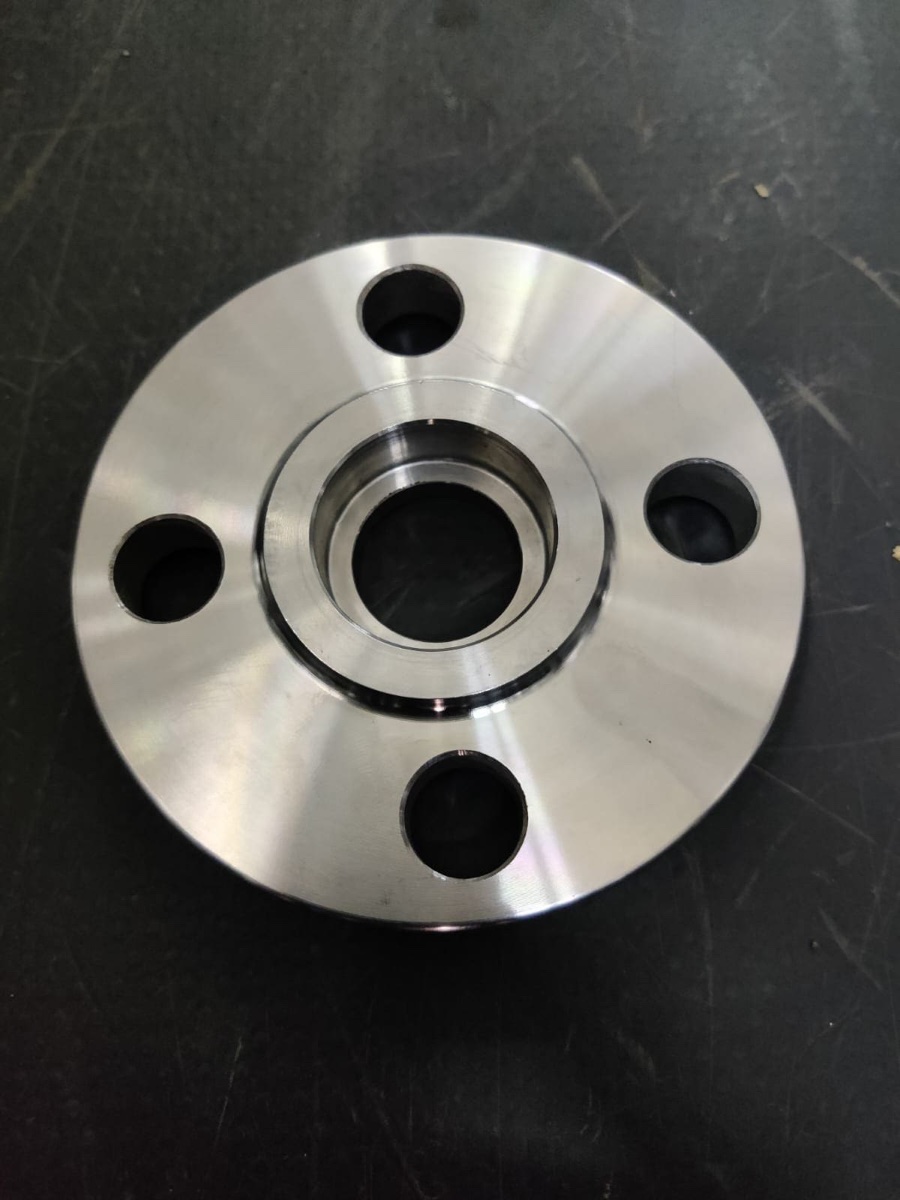
The bridge alloy in the small-bore pattern. A forged Incoloy 800 flange (ASTM B564 / UNS N08800 / W.Nr. 1.4876) with a machined socket: pipe seated square by geometry, one external fillet weld — no preheat, no PWHT — through-bore matched to the pipe schedule. Ni 30–35% on an iron base of ≥39.5%: enough nickel to sit on the safe side of the Copson curve — hot-chloride SCC designed out — and to resist carburising atmospheres; enough iron to price near heat-grade stainless. Cr 19–23% with Al and Ti 0.15–0.60% holds a sound scale to ~800 °C. Tensile ≥520 MPa, yield ≥205 MPa, elongation ≥30%, annealed. Sized by ASME B16.5 at ½″–3″ NB, Classes 150–1500; EN 10204 3.1 on every lot.
Also searched as: Alloy 800 socket weld flange, N08800 SW flange, 1.4876 socket weld flange, X10NiCrAlTi32-20 flange, Fe-Ni-Cr socket weld flange — all the same product family. Related pages: the facings — SWRF / SWFF / SWRTJ — the socketweld hub, the other Incoloy 800 types — blind, weld neck, slip-on — the siblings 800H / 800HT / 825 / 925 socketweld, and the Inconel 600 socketweld above it.
The rule of the bridge: pay for the nickel the duty actually needs. Dry clean heat — stainless on price; wet heat, chlorides, carburising gas — 800; halogens, caustic, the summit — the Inconel family.
What the Iron Floor and the Nickel Buy
The Iron Floor
Fe ≥39.5% — the only iron minimum in this series. Iron is the deliberate base, not an impurity — and it is what keeps 800's price closer to heat-grade stainless than to a full nickel alloy.
The Copson-Curve Position
30–35% nickel sits on the safe side of the curve: the hot chloride-bearing water and steam that crack the 300-series leave 800 alone — the career that put Alloy 800 into nuclear steam-generator tubing.
The Stable Austenite
Cr 19–23% with small Al and Ti holds a sound scale to ~800 °C, resists carburising atmospheres that penetrate iron-base stainless, and shrugs at the sigma phase that stalks 310's long dwells.
Honesty About the Ladder
Creep certificates above 593 °C belong to 800H/800HT, acids to 825, halogens and caustic to 600. 800 is the workhorse below and between — and says so.
Incoloy 800 Chemical Composition (UNS N08800)
Element
Ni
Cr
Fe
C
Al
Ti
Mn
Si
Cu
S
Weight %
30.0–35.0
19.0–23.0
≥39.5
≤0.10
0.15–0.60
0.15–0.60
≤1.50
≤1.0
≤0.75
≤0.015
Iron is a floor, not a cap — the alloy's base and its economy. The aluminium and titanium are dosed small — structure-steadying, not hardening. And the carbon cap is the family's fork: plain 800 keeps C ≤0.10% with no minimum; the controlled-carbon creep grades 800H (0.05–0.10%) and 800HT (0.06–0.10%, Al+Ti 0.85–1.20%) are separate specifications. PMI confirms the chemistry on every piece.
Mechanical Properties (Annealed)
Property
ASTM B564 N08800 Requirement
Tensile Strength
≥ 520 MPa (75 ksi)
Yield Strength (0.2%)
≥ 205 MPa (30 ksi)
Elongation
≥ 30% — fully austenitic, tough from cryogenic temperatures up
Condition
Annealed, fine-grained — the aqueous and intermediate-temperature optimum; coarse-grained creep certificates belong to 800H/800HT
Temperature Span
Cryogenic to ~593 °C as plain 800; oxidation scale sound to ~800 °C — creep-governed service above 593 °C is 800H/800HT's brief
Rating
B16.5 nickel-alloy tables govern the joint — gasket-limited before metal-limited; stated per class on our quotations
At 800's typical steam and hot-process temperatures, graphite-filled systems serve most joints — state the actual joint temperature and the sealing recommendation rides with the quotation. NPT-tapped variants are machined and certified at the works.
Incoloy 800 Socketweld Flange Specifications
Incoloy 800 Socketweld Flanges are available in the following specifications:
Material Grade
Incoloy 800, ASTM B564 (UNS N08800), W.Nr. 1.4876 — certificates carry the designations your documentation uses
Heat Treatment
Annealed, fine-grained, with furnace records certified — 800H/800HT coarse-grain creep certificates on their own pages
Size
1/2"NB to 3"NB per ASME B16.5; 4″ and larger to order; EN 1092-1 patterns to order
Class
150#, 300#, 600#, 900#, 1500# (900# shares 1500# dimensions in most sizes) — exchanger and steam trim lives in 150/300
Facings
Raised Face (SWRF), Flat Face (SWFF), Ring Type Joint (SWRTJ) with groove per B16.20
Bore
Socket bore to pipe OD; through-bore matched to pipe schedule
Welding
Single external fillet with 1/16″ expansion gap; ERNiCr-3 or matching filler; sulphur-clean practice; no preheat, no PWHT
Service Span
Hot water, steam and chloride-bearing process to ~593 °C; carburising atmospheres; creep duty to 800H/800HT, acids to 825, halogens and caustic to 600 — see the notes
Tension & chemistry per heat; PMI on every piece — Fe-Ni-Cr confirmed; socket depth and bore gauged
Certification
EN 10204 3.1 with anneal records (standard) / 3.2 witnessed
Specification Notes — Getting Alloy 800 Sockets Right
Four honest notes.Above 593 °C, order the creep grades: plain 800's fine grain is the wrong certificate for code creep service — 800H and 800HT exist precisely there, and the three UNS numbers are not substitutable. Halogens and caustic are not its franchise: 30–35% nickel is not the nickel rule's ≥72% — hot chlorine, HCl gas and strong caustic stay with 600. Reducing acids pass it by: no molybdenum, minimal copper — sulphuric and the aggressive wet bench belong to 825 and Alloy 20. And hot reducing sulphur attacks every nickel-bearing alloy — 800's high iron tolerates it markedly better than the high-nickel Inconels, but name the atmosphere on the enquiry.
How Our Incoloy 800 Socketweld Flanges Are Manufactured
1
Forging — cut billet of the spectro-verified N08800 heat is hot-forged into the flange blank with full heat traceability and segregated nickel-alloy handling.
2
Annealing — sets the fine-grained austenitic structure plain 800 serves best with; furnace charts retained against the heat number.
3
Machining — faces, OD and drilling to ASME B16.5 on dedicated stations with sulphur-free lubricants; socket counterbore and depth gauged piece by piece, through-bore matched to the ordered schedule.
4
Facing — RF serrations, flat face or RTJ groove per B16.20.
5
Testing & marking — tension and chemistry per heat; PMI on every piece; laser-marked with grade, size, class, schedule and heat number.
6
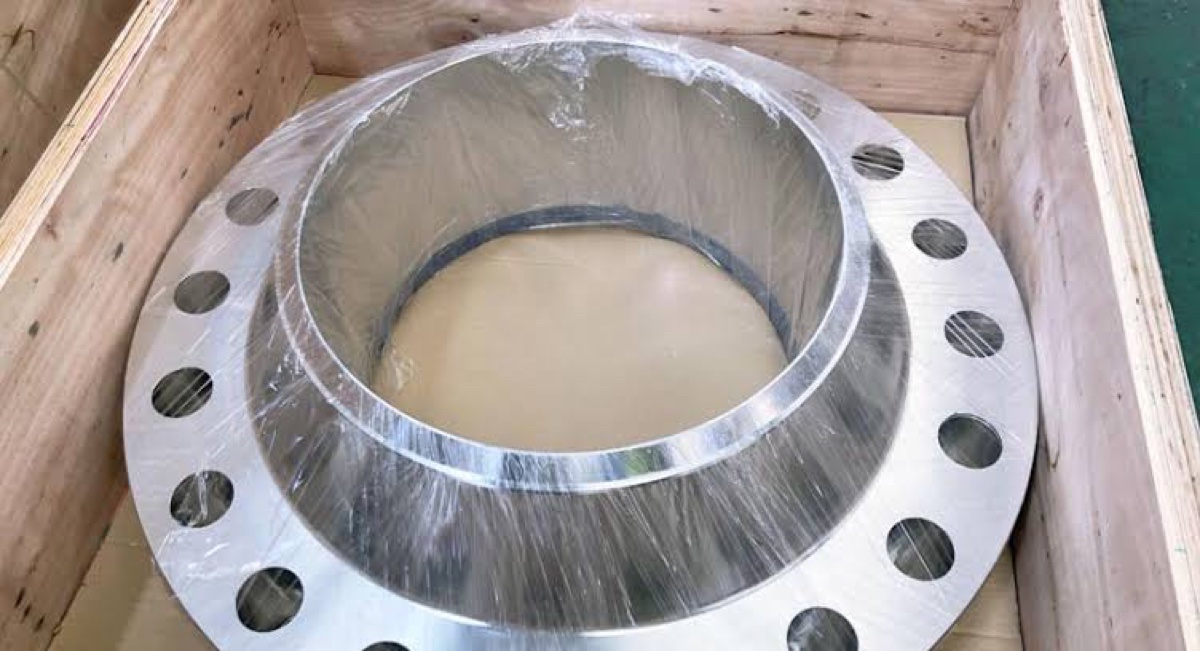
Certification & packing — EN 10204 3.1 MTC with anneal records (3.2 witnessed on request); WPS guidance included; packed sea-worthy with no carbon-steel contact.
Where Incoloy 800 Socketweld Flanges Are Used
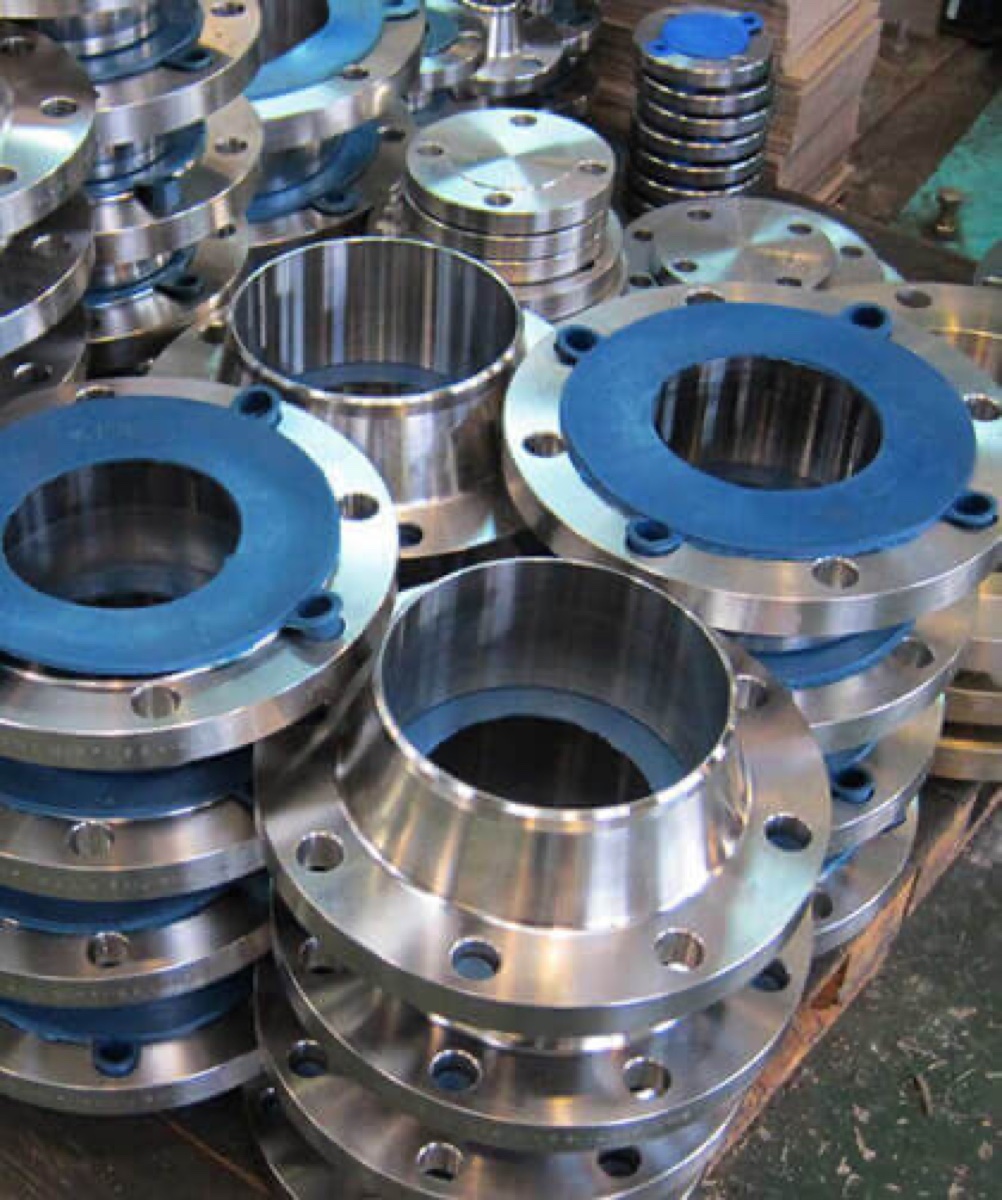
Where hot, wet and chloride-bearing meet: heat-exchanger and condenser connections, steam and hot-water systems, reformer-plant and fired-heater adjacent small bore, carburising and heat-treatment furnace trim, petrochemical process piping in the 500–600 °C band, and power-plant duties that inherited the alloy from its steam-generator career. Production below:
Socket weld flange dimensions are class-governed per ASME B16.5 — identical across material grades (pressure-temperature ratings follow the nickel-alloy group). Full charts:
How to Specify & Order an Incoloy 800 Socketweld Flange
Six elements — the design temperature decides the grade:
1
Size & standard — e.g. 1″ NB ASME B16.5, or DN25 EN 1092-1 to order.
2
Pressure class & facing — 150#–1500#; SWRF (the default), SWFF or SWRTJ — with the design temperature, which governs the B16.5 rating and, in this family, the grade itself.
3
Pipe schedule — the through-bore is matched to the pipe ID.
4
Grade line & service — Incoloy 800 / B564 / N08800 / 1.4876; the service stated (hot water, steam, chlorides, carburising, acid) — it decides between 800, 800H/800HT, 825 and the Inconels more often than price does.
5
Certification — EN 10204 3.1 with anneal records (our standard) / 3.2 witnessed, PMI as applicable.
An Incoloy 800 socketweld flange is a forged iron-nickel-chromium alloy flange — 30-35% nickel and 19-23% chromium on a deliberate iron base of at least 39.5%, with small additions of aluminium and titanium, ASTM B564, UNS N08800, W.Nr. 1.4876 — whose back carries a machined socket: the pipe end seats inside, self-aligned square to the face, and is secured with a single external fillet weld. 800 is the bridge between the stainless bench and the Inconel family: enough nickel to design chloride stress-corrosion cracking out and hold a stable austenite through hot service, enough iron to keep the price closer to heat-grade stainless than to a full nickel alloy. Dimensioned to ASME B16.5 for ½" to 3" NB in Classes 150 to 1500 — the heat-exchanger and reformer-plant workhorse, in the small-bore pattern.
Why does iron carry a minimum in Incoloy 800?
The name says it before the datasheet does: Incoloy — iron — as opposed to Inconel. UNS N08800 is the only grade in this socketweld series whose iron carries a minimum, ≥39.5%: iron is not an impurity here but the deliberate base of the alloy, and it is precisely what makes 800 affordable. The metallurgy is a considered trade: 30-35% nickel buys the properties that matter — chloride SCC immunity, a stable austenite, carburisation resistance — while the iron base keeps billet cost far below the high-nickel Inconels. When the duty needs those specific nickel virtues but not nickel's full price, 800 is the honest specification — and when it needs more, the family ladder above it (800H and 800HT for creep, 825 for acids, 600 for halogens and caustic) says exactly where to go.
What is the chemical composition of Incoloy 800 (UNS N08800)?
Nickel 30.0-35.0%, chromium 19.0-23.0%, iron ≥39.5% — a floor, not a cap — carbon ≤0.10%, aluminium 0.15-0.60% and titanium 0.15-0.60%, manganese ≤1.50%, silicon ≤1.0%, copper ≤0.75%, sulphur ≤0.015%. The aluminium and titanium are dosed small — enough to tie up carbon and nitrogen and steady the structure, not the hardening doses of the age-hardened alloys. Note what the carbon cap means: plain 800 keeps carbon at or below 0.10% with no minimum — the controlled-carbon creep grades 800H (0.05-0.10%) and 800HT (0.06-0.10% with tightened Al+Ti) are separate specifications, and the difference decides high-temperature service. Chemistry is verified per heat, PMI-confirmed on every piece, and travels on the EN 10204 3.1 MTC.
What does 800's 30-35% nickel actually buy?
It buys immunity from austenitic stainless steel's most notorious failure mode. The Copson curve — the classic plot of chloride stress-corrosion cracking resistance against nickel content — shows susceptibility at its worst around the 8-12% nickel of the 300-series stainlesses and falling steeply as nickel rises; by roughly 30% nickel, cracking resistance is, for practical purposes, restored. Alloy 800's 30-35% nickel sits deliberately on the safe side of that curve: hot chloride-bearing water and steam that crack 304 and 316 leave 800 alone. That is why the alloy built its career in heat-exchanger tubing and steam service — including nuclear steam-generator tubing, one of the most conservative material selections in industry — and why an 800 socket weld flange is the small-bore answer where hot water, chlorides and stress meet.
What are the mechanical properties of Incoloy 800 socketweld flanges?
In the annealed condition ASTM B564 requires tensile strength 520 MPa (75 ksi) minimum, yield strength 205 MPa (30 ksi) minimum and elongation 30% minimum — stainless-familiar numbers from a stainless-familiar structure, fully austenitic and tough from cryogenic temperatures up. Standard-grade 800 is supplied fine-grained, which serves aqueous corrosion and intermediate temperatures best; the coarse-grained creep certificates belong to 800H and 800HT, ordered as such. B16.5's nickel-alloy pressure-temperature tables govern the flange rating, and — the two-ceilings honesty of every hot page in this series — the gasket and the rating retire a bolted joint long before the metal's own limits arrive.
Incoloy 800, 800H or 800HT — which should be ordered?
By design temperature, with 593°C (1100°F) as the working boundary. Plain 800 — carbon ≤0.10%, fine grain — is the grade below it: best aqueous and intermediate-temperature properties, our standard socketweld supply. 800H holds carbon in a deliberate 0.05-0.10% window and is solution-annealed to coarse grain, trading ambient refinement for creep strength above 593°C. 800HT tightens the recipe further — carbon 0.06-0.10% with aluminium-plus-titanium controlled at 0.85-1.20% — for the highest creep duty toward 760°C and beyond. The three are separate UNS numbers (N08800, N08810, N08811) and separate certificates: a flange certified 800 cannot be substituted into an 800H creep application. If the line runs hot enough for code creep rules, order the H or HT page — both have their own socketweld pages here — and say the design temperature on the enquiry.
How hot can Incoloy 800 actually go?
Two answers, as always. Oxidation: the 19-23% chromium with the aluminium and titanium holds a sound scale through continuous service around 800°C and excursions above — comfortably past the stainless bench's cycling limits, short of the Inconels' summit. Structure: plain 800's fine grain is optimised below roughly 593°C; above that, ASME's creep-governed rules effectively hand the duty to 800H and 800HT, which exist for exactly that band. The joint: B16.5 ratings and gasket systems govern far below the metal's ceiling. So the practical brief for an 800 socket weld flange: hot water, steam, chloride-bearing process and heat-exchanger small bore to ~593°C — with the H/HT pages and the Inconel pages named the moment the duty climbs.
Incoloy 800 or the heat-grade stainlesses?
The stainless bench serves heat honestly — 321 and 347 stabilised to their scaling limits, 310's 25% chromium toward 1100°C in steady dry air — but it carries iron-base weaknesses 800 was designed to fix: 8-12% nickel sits at the bottom of the Copson curve, so hot chlorides crack it; carburising atmospheres penetrate it; and long hot dwell embrittles the high-chromium grades through sigma phase. 800's 30-35% nickel solves the cracking, resists the carbon, and holds a stabler structure — at a price between the two benches. The honest rule: dry, steady, clean heat — stainless keeps the order, 310 on price; wet heat, chlorides, carburising gas or cycling — 800 earns its premium. Both directions are written on the respective pages.
Incoloy 800 or Inconel 600?
A price-and-chemistry ladder, honestly climbed. 600's ≥72% nickel buys franchises 800 cannot touch: hot dry halogens, concentrated caustic to the nickel rule's standard, and the higher oxidation ceiling toward 1095°C. But a large share of nickel-alloy duty needs none of those — it needs SCC immunity, carburisation resistance and stable hot strength in the 500-800°C world, and there 800 does the work at a fraction of the billet cost, its iron floor doing the saving. The practical split: general hot process, heat exchangers, steam and reformer-adjacent small bore — 800 first; halogens, caustic, or the last 200 degrees — 600. And above both, 601's alumina scale takes the summit. All three pages link each other for exactly this decision.
What is Incoloy 825 to Incoloy 800?
What 625 is to 600 — the wet-chemistry upgrade of the same base. Incoloy 825 takes 800's iron-nickel-chromium frame, raises the nickel, and adds molybdenum, copper and titanium — the acid bench's instincts: molybdenum for pitting and reducing acids, copper for sulphuric, stabilisation against sensitisation. The result serves sulphuric and phosphoric acid plant, sour gas and aggressive chemical duty where plain 800's clean-service chemistry runs out. On this site the pattern repeats deliberately: each family has its fire side and its wet side — 600 and 601 versus 625 in the Inconels, 800/800H/800HT versus 825 in the Incoloys — and our 825 socketweld page carries that half of the story. If the enquiry says acid, start there; if it says heat, stay here.
What are Incoloy 800's honest weaknesses?
Four, named plainly. Creep certificates: plain 800 is the wrong grade above 593°C — the H and HT grades exist precisely there; order them, not this page, for code creep service. Halogens and caustic: 30-35% nickel is not the nickel rule's ≥72% — hot chlorine, HCl gas and strong caustic stay with 600 and its family. Reducing acids: no molybdenum and minimal copper — sulphuric duty and the aggressive wet bench belong to 825, Alloy 20 and beyond. And sulphidation: like every nickel-bearing alloy, hot reducing sulphur attacks it — though the high iron makes 800 markedly more tolerant than the high-nickel Inconels, the duty still wants case-by-case honesty. None of these dent the core franchise: hot, wet, chloride-bearing and carburising service at a bridge price.
How is an Incoloy 800 socketweld flange welded?
With nickel-family practice and forgiving habits. Geometry is standard: pipe bottomed in the socket, withdrawn 1/16" (1.6 mm) to leave the expansion gap, single external fillet weld. No preheat, no PWHT. Filler: ERNiCr-3 — the Inconel-family wire — is the classic choice, over-matching the base and keeping joints tough across the service range; matching 800-type consumables serve general duty, and the H/HT creep grades carry their own filler disciplines on their own pages. The austenite is stable and the aluminium and titanium doses are too small to complicate the arc; sulphur-clean housekeeping remains the nickel-bench rule — sulphur-free lubricants, dedicated brushes, no carbon-steel contact. Our flanges arrive annealed with records, and WPS guidance travels with every supply.
What sizes and pressure classes do Incoloy 800 socketweld flanges come in?
ASME B16.5 standardises socket weld flanges from ½" to 3" NB in Classes 150, 300, 600, 900 and 1500 — Class 900 sharing Class 1500 dimensions in most small-bore sizes — with 4" and Class 2500 made to order. 800's order book lives mostly in Classes 150 and 300: heat-exchanger connections, steam and hot-water trim, instrument and purge small bore around reformer and furnace plant, where temperature and chemistry rather than pressure drive the specification — with the higher classes serving hot high-pressure steam and process duty. All three facings are available — SWRF the default, SWFF for cast and lined mates, SWRTJ where the rating demands it. Put the pipe schedule on the enquiry — the through-bore is matched to the pipe ID — and the design temperature, which sets the governing B16.5 rating; our quotations state it per class.
What details are needed to get an accurate Incoloy 800 socketweld flange quotation?
Six elements plus commercial terms: (1) size — ½" to 3" NB; (2) pressure class — 150 to 1500, with the design temperature, which governs both the B16.5 rating and — more importantly for this family — the grade itself; (3) facing — SWRF, SWFF or SWRTJ with ring number; (4) the pipe schedule, so the through-bore matches the pipe ID; (5) the grade line — Incoloy 800, ASTM B564, UNS N08800 or W.Nr. 1.4876 all name the same metal — with the service stated (hot water, steam, chlorides, carburising, acid): it decides between 800, 800H/800HT, 825 and the Inconels more often than price does; (6) certification — EN 10204 3.1 with anneal records (our standard) or 3.2 witnessed, PMI as applicable. Add quantity and destination; quotations normally within 24 hours.
Who manufactures Incoloy 800 socketweld flanges in India?
Tesco Steel & Engineering is an ISO 9001:2015 certified flange manufacturer based in Mumbai, India, producing Incoloy 800 (ASTM B564, UNS N08800) socket weld flanges from ½" to 3" NB (larger to order) in Classes 150-1500 — each forged from certified heats, annealed with furnace records against the heat number, machined on dedicated nickel-alloy stations with sulphur-free lubricants, gauged socket depth and schedule-matched bore, PMI-checked — the iron-nickel-chromium chemistry confirmed on every piece — and laser-marked with grade, size, class, schedule and heat number. Supplied with EN 10204 3.1/3.2 certification and WPS guidance, alongside the 800H, 800HT, 825 and 925 siblings and the full nickel-alloy socketweld range this series covers. Exported to more than 50 countries.