Incoloy 800 Blind Flanges — UNS N08800 Bridge-Alloy Blind Manufacturer
Tesco Steel & Engineering forges Incoloy 800 blind flanges — ASTM B564, UNS N08800, EN 1.4876 — to ASME B16.5 Class 150–2500 from ½″ to 24″ NB and to ASME B16.47 up to 60″. Incoloy is the iron-based cousin of Inconel, and 800 is the bridge between the worlds: 32% nickel buys the three things that retire stainless from hot process duty — chloride-SCC immunity, structural stability with no sigma anxiety, and carburization resistance — while iron at a specified minimum of 39.5% (the only iron floor in our range) keeps the invoice civil. The steam-reformer standard for two generations of ammonia, methanol and hydrogen plants, with the coarse-grained 800H and 800HT siblings carrying the code creep ratings. Hotter oxidising duty: Inconel 601. Wet & sour chemistry: Incoloy 825. Facings: BLRF, BLFF or BLRTJ. Every lot with EN 10204 3.1/3.2 MTC. ISO 9001:2015, made in Mumbai, India — exported to 50+ countries.
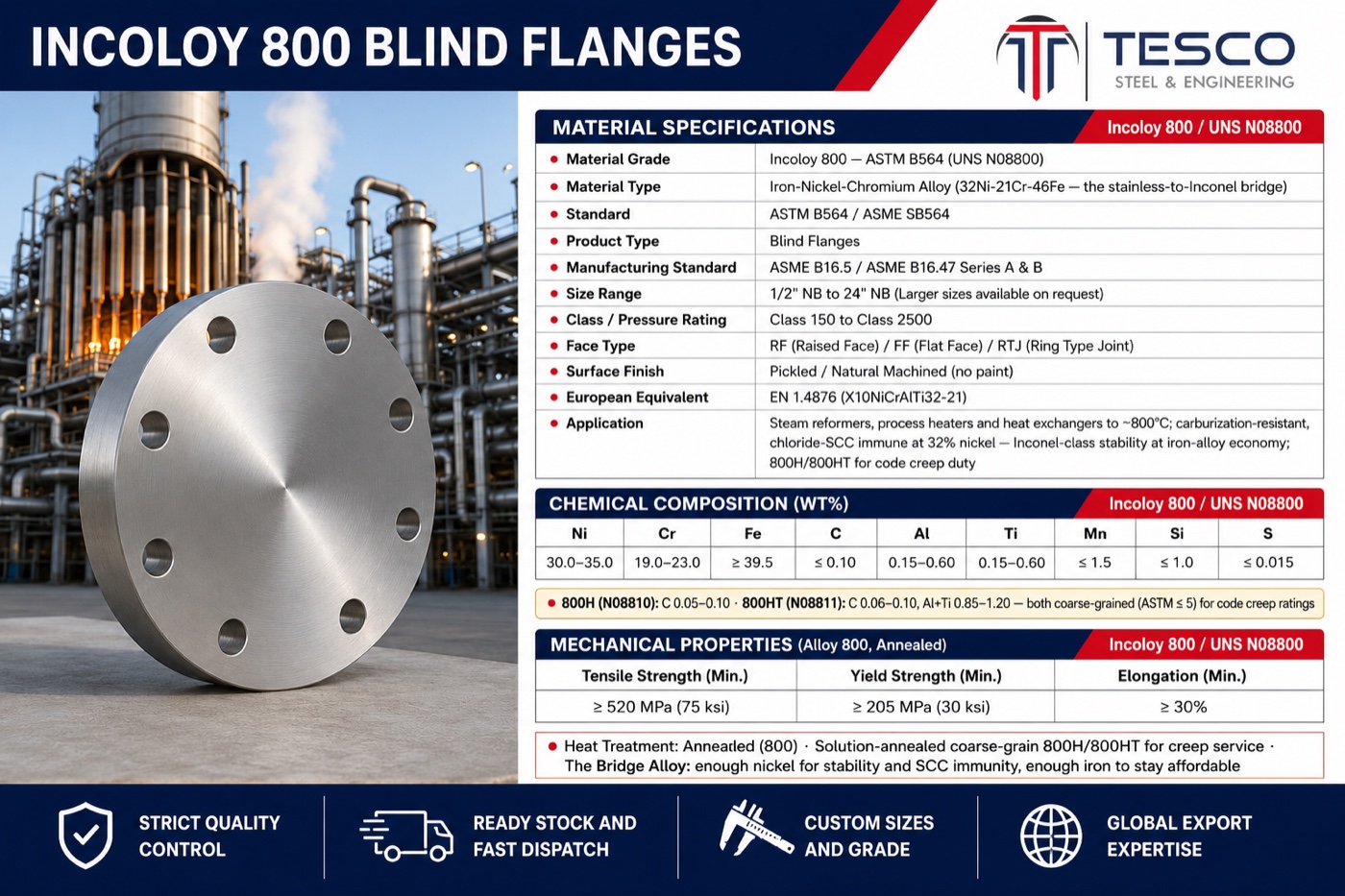
Incoloy 800 · ASTM B564 · UNS N08800EN 1.4876 · X10NiCrAlTi32-21The Stainless-to-Inconel BridgeSCC-Immune · Carburization-ResistantThe Steam-Reformer Standard800H / 800HT Creep Grades In RangeASME B16.5 ½″–24″ · Class 150–2500EN 10204 3.1 / 3.2 · ISO 9001:2015
Incoloy 800 Blind Flanges — Specifications at a Glance
What is an Incoloy 800 Blind Flange?
The bridge alloy. A solid forged disc of iron-nickel-chromium alloy (ASTM B564 / UNS N08800 / EN 1.4876) with no bore — Ni 30–35%, Cr 19–23%, Fe ≥39.5% — closing steam reformers, process heaters and hot exchangers to ~800°C. Enough nickel for SCC immunity, sigma-free stability and carburization resistance; enough iron to stay affordable. Mechanicals 520/205 MPa annealed; the coarse-grained 800H/800HT siblings carry the code creep ratings. Dimensions per ASME B16.5 / B16.47 in RF, FF and RTJ facings; EN 10204 3.1 certified.
Also searched as: Alloy 800 blind flange, N08800 blind, 1.4876 blind flange, X10NiCrAlTi32-21 blind, SB564 800 blind, reformer blind flange — all refer to the product on this page. See also the creep siblings Incoloy 800H / 800HT blind flanges, the wet-corrosion cousin Incoloy 825, the family neighbours Inconel 601 / F310, and the facing pages BLRF / BLFF / BLRTJ.
Enough Nickel, Enough Iron
What the 32% Nickel Buys
Three permanent advantages over any stainless: chloride-SCC immunity (closed off above ~30% Ni), no sigma anxiety in decades of hot service, and carburization resistance in reformer and heat-treat atmospheres that embrittle 300-series hardware within campaigns.
What the Iron Floor Guarantees
Fe ≥39.5% — the only iron minimum in our range. The floor keeps the alloy what it was designed to be: an economical iron-rich composition with predictable behaviour. Even the EN number tells the story — 1.4876 is a 1.48xx steel-series designation: the bridge made official in the paperwork.
What the Trio Adds
The 800 → 800H → 800HT ladder is the H-grade logic perfected: carbon windows plus a coarse-grain clause (ASTM ≤5) plus, for HT, a controlled Al+Ti sum — the machinery behind the code creep allowables reformer design runs on.
All three are stocked and forged in our range with dedicated pages — the design code picks the variant, and the certificate carries the grain size for the creep grades.
Incoloy 800 Chemical Composition (UNS N08800)
Element
Ni
Cr
Fe
C
Al
Ti
Mn
Si
S
Weight %
30.0–35.0
19.0–23.0
≥39.5
≤0.10
0.15–0.60
0.15–0.60
≤1.5
≤1.0
≤0.015
The structural signature: iron with a floor, not a cap — unique in our range. The small Al and Ti additions are functional, not residual: they form fine strengthening and stabilising phases, and their controlled sum defines the 800HT variant. No molybdenum — wet chemistry belongs to 825. Our PMI reads the Ni-Cr-Fe signature on every piece.
Mechanical Properties & The Service Span
Property
ASTM B564 N08800 Requirement (Annealed)
Tensile Strength
≥ 520 MPa (75 ksi)
Yield Strength (0.2%)
≥ 205 MPa (30 ksi)
Elongation
≥ 30%
Hardness
No B564 limit — annealed condition
Condition
Annealed (800); solution-annealed coarse-grain for the H/HT creep grades — stated on certificate
Service Span
Working heart ~550–850°C; oxidation toward 980°C; code creep above ~600°C via 800H/800HT; hotter oxidising duty — 601
High-pressure hydrogen & syngas practice — ring softer than groove
Incoloy 800 Blind Flange Specifications
Incoloy 800 / UNS N08800 Blind Flanges are available in the following specifications:
Material Grade
Incoloy 800 — ASTM B564 / ASME SB564 (UNS N08800); 800H (N08810) & 800HT (N08811) on their own pages; EN 1.4876 designation where required
Heat Treatment
Annealed — stated on certificate; solution-annealed coarse-grain for H/HT with grain size reported
Size
1/2"NB to 24"NB per ASME B16.5; 26"–60" per ASME B16.47; EN 1092-1 to order
Class
150#, 300#, 400#, 600#, 900#, 1500#, 2500# — rated on the grade's own nickel-alloy B16.5 lines
Facings
Raised Face (BLRF), Flat Face (BLFF), Ring Type Joint (BLRTJ) with groove per B16.20
Service Span
Reformer, heater & exchanger duty ~550–850°C; carburizing & hydrogen-rich atmospheres; sulphur-bearing hot gas — state the fuel analysis at enquiry
Surface Finish
Pickled or natural machined — no paint; segregated alloy handling throughout
Modifications
NPT-tapped centre (thermocouple / test / vent), lifting provisions — machined & certified at the works
Testing
Tension & chemistry per heat — nickel window, chromium window and the iron floor verified; PMI routine
Certification
EN 10204 3.1 (standard) / 3.2 witnessed
Why Incoloy 800 Blind Flanges Are Specified
The Reformer Wrote the Line Class
Two generations of ammonia, methanol and hydrogen plants run their manifolds, pigtails and headers in the 800 family — the closure carries the same certificate through the same decades.
The Failure Modes That Retire Stainless
Chloride SCC, sigma embrittlement and carburization are exactly what ends 300-series service in hot process plant — and exactly what 32% nickel closes off.
Code Creep, One Family
Where the design code demands rated creep strength, 800H/800HT carry allowables written into reformer practice by name — same family, same works, certificate to match.
Inconel Stability, Iron Economy
The bridge position is the value proposition: alloy-class behaviour at a price the vast middle of hot process plant can specify by default.
Know the Map
Clean hot air at stainless cost: F310 — and we will say so. Oxidation past 1100°C: 601. Wet, sour or acid duty: 825 / 625. Facings: BLRF / BLFF / BLRTJ.
Specification Notes — Getting 800 Right
Three details buyers miss.Straight 800 is not the creep grade: code duty above ~600°C belongs to 800H/800HT with their coarse-grain certificates — hopeful substitution fails the audit, and below the creep range straight 800's finer grain is actually the better choice. Verify the iron floor: Ni and Cr windows plus Fe ≥39.5% are read together on every heat — the floor is part of the specification, not a formality. No molybdenum means no wet duty: brines, acids and sour service belong to 825 — the family name misleads buyers into treating them as variants; they are different tools, and the sulphur rule of the nickel family applies to hot fuel gases here as everywhere.
How Our Incoloy 800 Blind Flanges Are Manufactured
1
Forging — cut billet of the spectro-verified N08800 heat — nickel and chromium windows and the 39.5% iron floor confirmed — is hot-forged into the solid disc blank with full heat traceability and segregated alloy handling.
2
Annealing — the standard 800 anneal; solution-annealed coarse-grain cycles for H/HT orders with grain size verified and reported; furnace charts retained against the heat number.
3
Machining & facing — faces, OD and drilling to ASME B16.5 / B16.47; RF serrations, flat face or RTJ groove gauged per B16.20; NPT taps machined where ordered.
4
Testing — tension test and chemistry against the heat; PMI on every piece reads the Ni-Cr-Fe signature with the Al/Ti additions.
5
Pickling — the clean bare-metal surface, with marking of standard, grade (800 / 800H / 800HT), size, class and heat number.
6
Certification & packing — EN 10204 3.1 MTC (3.2 witnessed on request), grain size included for creep grades; faces protected, palletised or crated sea-worthy — no carbon-steel contact in transit.
Where Incoloy 800 Blind Flanges Are Used
The hot heart of the process industries: steam-methane reformers and manifolds in ammonia, methanol and hydrogen plants; process heaters and hot headers; high-temperature exchangers and superheaters; carburizing and heat-treatment equipment; power-plant heat-transfer circuits. Production below:
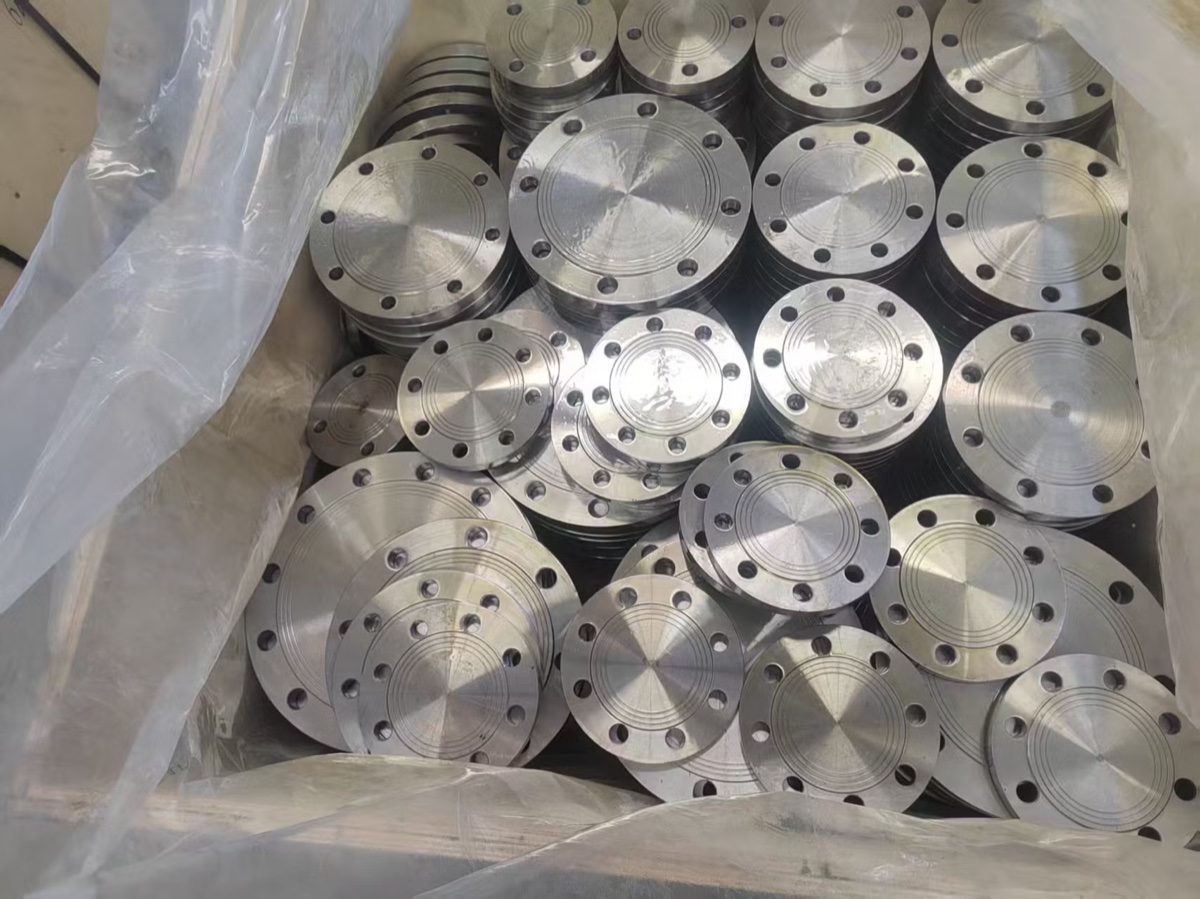
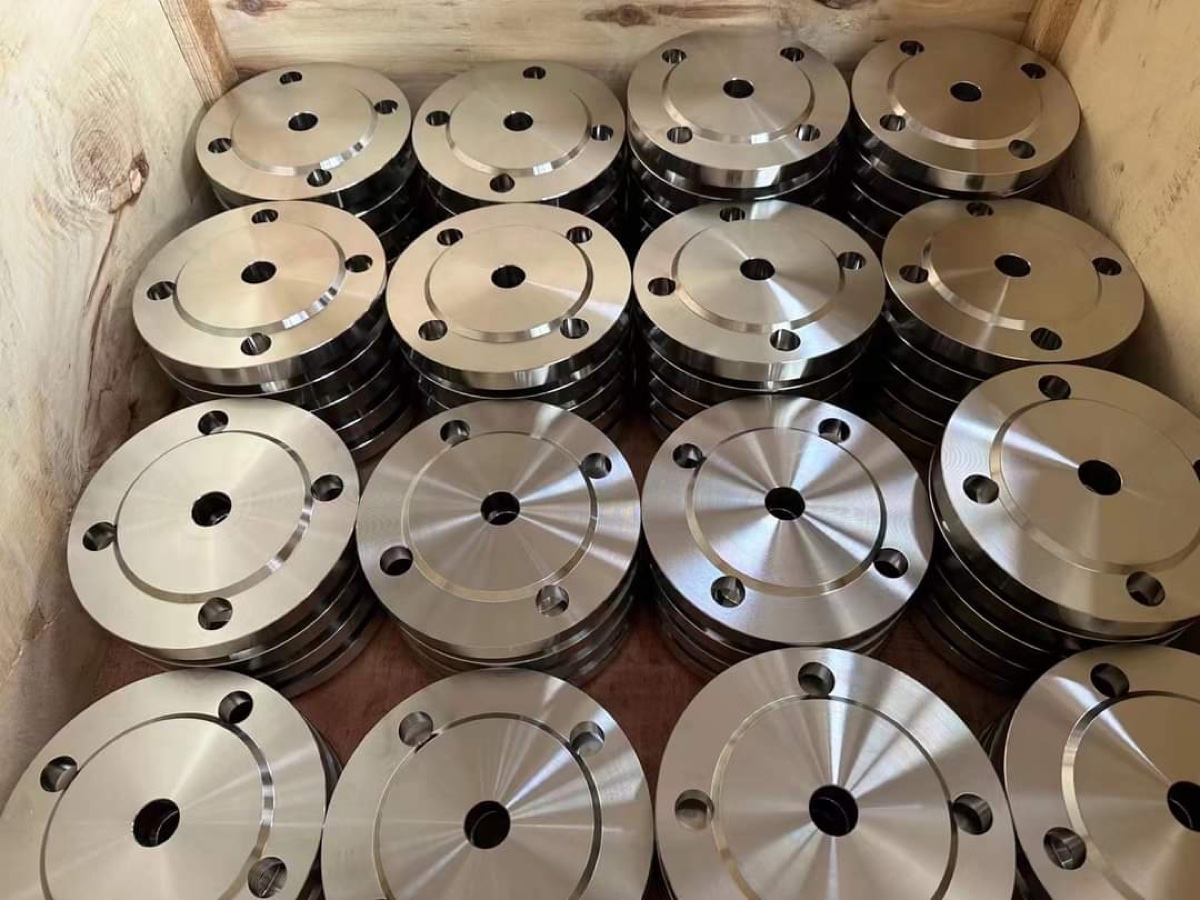
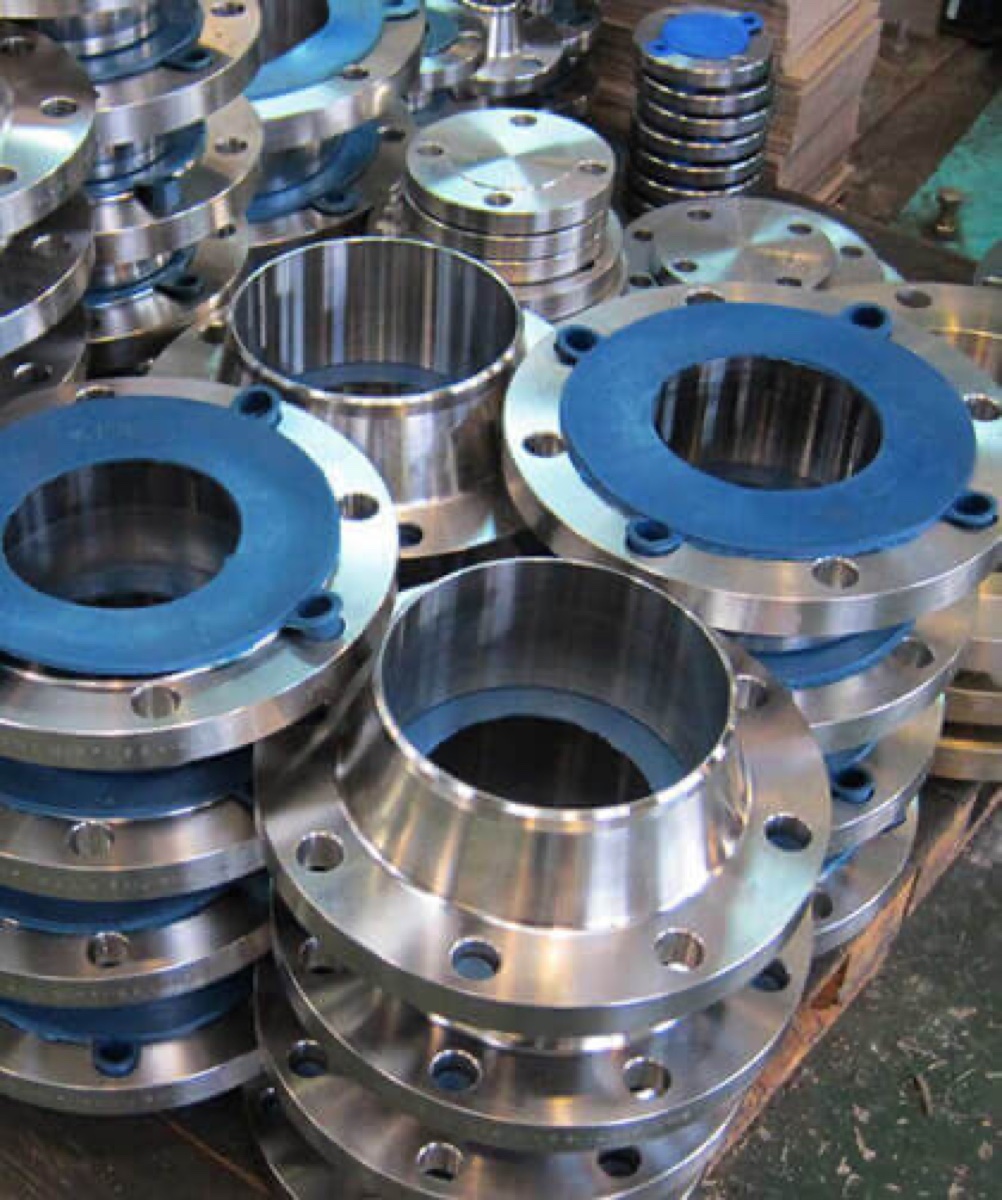
8″ Class 300 Blind Flange — Machined at Our WorksForged Blind Flanges — Ready for DispatchIncoloy 800 Flanges — Same Grade, Protected Stock
Incoloy 800 Blind Flange Dimensions
Blind dimensions are class-governed — identical across material grades. Full charts:
How to Specify & Order an Incoloy 800 Blind Flange
Five elements — the variant choice is the 800-specific one:
1
Size & standard — e.g. 6″ NB ASME B16.5, or the B16.47 series for 26″ and above.
2
Pressure class & facing — Class 150–2500; RF, FF or RTJ (with ring number) to match the mating flange.
3
Grade & variant — ASTM B564 UNS N08800 (Incoloy 800), or N08810/N08811 (800H/800HT) where the design temperature crosses the creep line; EN 1.4876 designation where required.
4
Service & certification — state design temperature and atmosphere (air / syngas / carburizing / sulphur-bearing); NPT tap size if a thermocouple or test blind; PMI or 3.2 witnessing as specified; EN 10204 3.1 standard.
An Incoloy 800 blind flange is a solid forged disc of iron-nickel-chromium alloy — roughly 32% nickel, 21% chromium on an iron base, certified to ASTM B564 as UNS N08800, EN 1.4876 — drilled to the standard bolt pattern with no bore. It is the bridge between the stainless world and the Inconels: enough nickel for austenitic stability, chloride-SCC immunity and carburization resistance, enough iron to stay affordable — the standard alloy of steam reformers, process heaters and hot exchangers to around 800°C. Dimensions follow ASME B16.5 from ½ inch to 24 inch and ASME B16.47 beyond, in raised face, flat face and ring joint facings.
What does it mean that Incoloy 800 is the bridge alloy?
The name itself says it: Incoloy is the iron-based cousin of Inconel — same maker, same design school, iron doing the economy work. 800 sits precisely between the worlds: above the heat-resisting stainlesses in nickel (32% against 310's 20%), below the true Inconels (601's 60%), with properties to match — more stability and chemical tolerance than any stainless, at a fraction of nickel-alloy cost. Even the European number tells the story: EN 1.4876 is a 1.48xx designation, filed among the steels — the bridge made official in the paperwork.
Why does the specification set a minimum for iron?
Because in this alloy the iron is a design decision, not a leftover. Every other sheet in our range treats iron as the base (the steels), the balance (601) or a capped impurity (625, Monel) — N08800 is the only specification that writes it as a floor: at least 39.5%. The floor guarantees the alloy stays what it was designed to be — an economical iron-rich composition with predictable behaviour — rather than drifting nickel-rich with the melt. A certificate reader checking an 800 heat verifies three numbers together: nickel in its window, chromium in its window, and iron above its floor.
What is the difference between Incoloy 800, 800H and 800HT?
The H-grade logic of our stainless pages, perfected — with a grain-size clause added. Alloy 800 (N08800, C ≤0.10%) is the general-purpose grade for service below the creep range. 800H (N08810) narrows carbon to 0.05-0.10% and requires a coarse solution-annealed grain (ASTM 5 or coarser) — both aimed at creep strength. 800HT (N08811) goes further: carbon 0.06-0.10% plus a controlled Al+Ti sum of 0.85-1.20%, buying the best stress-rupture numbers of the trio. Code design above roughly 600°C specifies H or HT by name — and both have dedicated pages and dedicated stock in our range.
What is the chemical composition of Incoloy 800 (UNS N08800)?
Nickel 30.0-35.0%, chromium 19.0-23.0%, iron 39.5% minimum, carbon ≤0.10%, aluminium 0.15-0.60%, titanium 0.15-0.60%, manganese ≤1.5%, silicon ≤1.0%, sulphur ≤0.015%. The small aluminium and titanium additions are functional, not residual — they form fine strengthening and stabilising phases, and their controlled sum defines the 800HT variant. No molybdenum: wet-corrosion duty belongs to the 825 cousin. Our PMI reads the Ni-Cr-Fe signature with the Al/Ti additions on every piece.
What are the mechanical properties of Incoloy 800 blind flanges?
Per ASTM B564 in the annealed condition: tensile strength 520 MPa (75 ksi) minimum, yield strength 205 MPa (30 ksi) minimum, elongation 30% minimum — solid austenitic numbers with good retention as temperature climbs. The trio's real mechanical story lives above 600°C, where the coarse-grained 800H and 800HT variants carry the ASME creep allowables that reformer and heater codes are written around; straight 800's finer grain actually serves better below the creep range, which is why the split exists. The certificate states grade and grain size either way.
What temperature range does an Incoloy 800 blind flange cover?
The working heart is roughly 550-850°C — the reformer and process-heater window — with oxidation resistance extending toward 980°C and no meaningful cold-end limit. The internal split matters: below about 600°C, straight 800 serves with its better fine-grain toughness; above it, code design moves to 800H/800HT for their creep ratings. At the extremes the family hands off: hotter oxidising duty to Inconel 601, and the fiercest creep-plus-heat combinations to the specialised superalloys. For the vast middle of hot process plant, the 800 trio is the standard answer.
Why is Incoloy 800 the steam-reformer alloy?
Because reformer duty is a checklist of everything the grade does well. Steam-methane reformers run 700-900°C in a carburizing, hydrogen-rich atmosphere with decades-long design lives — demanding creep strength (800H/HT's franchise, written into the pigtail and manifold codes by name), carburization resistance (the 32% nickel), and freedom from the SCC and sigma problems that would retire stainless. Outlet manifolds, pigtails, headers and their closures have run in the 800 family for two generations of ammonia, methanol and hydrogen plants — the service record that anchors the specification.
Incoloy 800 or 310 stainless — when do I step up?
By failure mode, not temperature alone. 310 holds steady oxidising heat to ~1150°C at stainless cost and remains the honest choice for furnace-air duty. 800 takes the specification when the atmosphere or the decades matter: carburizing and hydrogen-rich process gas, sustained service where sigma would embrittle 310, chloride-SCC exposure, and any code-governed creep design — where 800H/HT carry allowables that 310 lacks. The two overlap around 800-1000°C in clean air, and there the cheaper grade wins; in process gas and code territory, the bridge alloy earns its premium.
How does Incoloy 800 relate to Incoloy 825?
Same iron-nickel-chromium family, opposite enemies. 825 (UNS N08825) takes the 800 base, raises nickel to ~40% and adds molybdenum and copper — converting it into a wet-corrosion alloy for sulphuric and phosphoric acids, sour brines and chloride chemistry, essentially an economical cousin of the acid alloys. 800 keeps the clean high-temperature brief. The names mislead buyers into thinking they are variants; they are different tools sharing a family name. Hot and dry: 800. Wet and sour: 825 — which has its own blind flange page in our range.
What service conditions does Incoloy 800 dislike?
The nickel family's standing list, moderated by its iron. Sulphur-bearing hot gases attack it — though the 46% iron makes it more tolerant than the high-nickel Inconels, fuel analysis still belongs on the enquiry. Wet chloride pitting is not its game: no molybdenum, so brines and marine duty go to 825 or the duplex world. Long service in the 550-700°C window can age the alloy modestly — a design-around note, familiar from every grade in this class. And straight 800 is not the creep grade: code duty above ~600°C belongs to its H/HT siblings, not to hopeful substitution.
What facings are Incoloy 800 blind flanges made with?
All three: raised face (BLRF) — the default — flat face (BLFF) for mating flat-faced and lined equipment, and ring type joint (BLRTJ) where high-pressure practice calls for it, the ring chosen softer than the groove. Each facing has its own page on this site. At reformer temperatures the gasket system is the joint's limiting member — graphite and mica selections carry their own ceilings, and thermal cycling deserves bolt-load attention. NPT-tapped thermocouple and test blinds are machined and certified at the works.
Where are Incoloy 800 blind flanges used?
The hot heart of the process industries: steam-methane reformers and their manifolds in ammonia, methanol and hydrogen plants; process heaters and hot headers; high-temperature heat exchangers and superheaters; carburizing and heat-treatment equipment; and power-plant and HTGR heat-transfer circuits with the 800 family written into their codes. Incoloy 800 blinds close those systems as isolations, spare-nozzle blanks and tapped test points — with the H/HT siblings supplied wherever the line class carries a creep rating.
Which standards cover Incoloy 800 blind flanges?
The material standard is ASTM B564 (UNS N08800) with ASME SB564 as the boiler-code twin — the nickel-alloy forging standard — alongside B408 for rod and B409 for plate in the same family, and EN 1.4876 / X10NiCrAlTi32-21 as the European designation; 800H and 800HT certify as N08810 and N08811. Dimensions follow ASME B16.5 for ½"-24" and ASME B16.47 for 26"-60". A complete specification reads: 'Blind Flange, RF, 6", ASME B16.5 Class 300, ASTM B564 UNS N08800 (Incoloy 800)' — with the H or HT designation where the design code requires it — and our EN 10204 certificates state it exactly that way, grain size included for the creep grades.
Who manufactures Incoloy 800 blind flanges in India?
Tesco Steel & Engineering is an ISO 9001:2015 certified flange manufacturer based in Mumbai, India, forging Incoloy 800 / ASTM B564 / UNS N08800 / EN 1.4876 blind flanges — with the 800H (N08810) and 800HT (N08811) creep grades and the 825 wet-corrosion cousin on their own pages — from ½" to 24" NB per ASME B16.5 in Classes 150-2500 and to 60" per ASME B16.47, annealed, pickled, PMI-verified with the Ni-Cr-Fe signature read on every piece, certified to EN 10204 3.1/3.2 on every lot, in raised face, flat face and ring joint facings — alongside the full Inconel, Monel and nickel-alloy blind range. Exported to more than 50 countries.