Blind Flanges Manufacturer & Exporter — India
ASME B16.5 / B16.47 | API 605 / 6A |
EN 1092-1 / DIN 2527 / JIS / AS / AWWA |
Class 150 – 2500 & up to 20,000 PSI | ISO 9001:2015
✓ ASME B16.5 & B16.47
✓ API 605 / 6A
✓ EN 1092-1 / DIN 2527
✓ Class 150 – 2500
✓ BLRF & BLFF
✓ 50+ Materials
✓ NACE MR0175
✓ EN 10204 3.1/3.2 MTC
✓ ISO 9001:2015
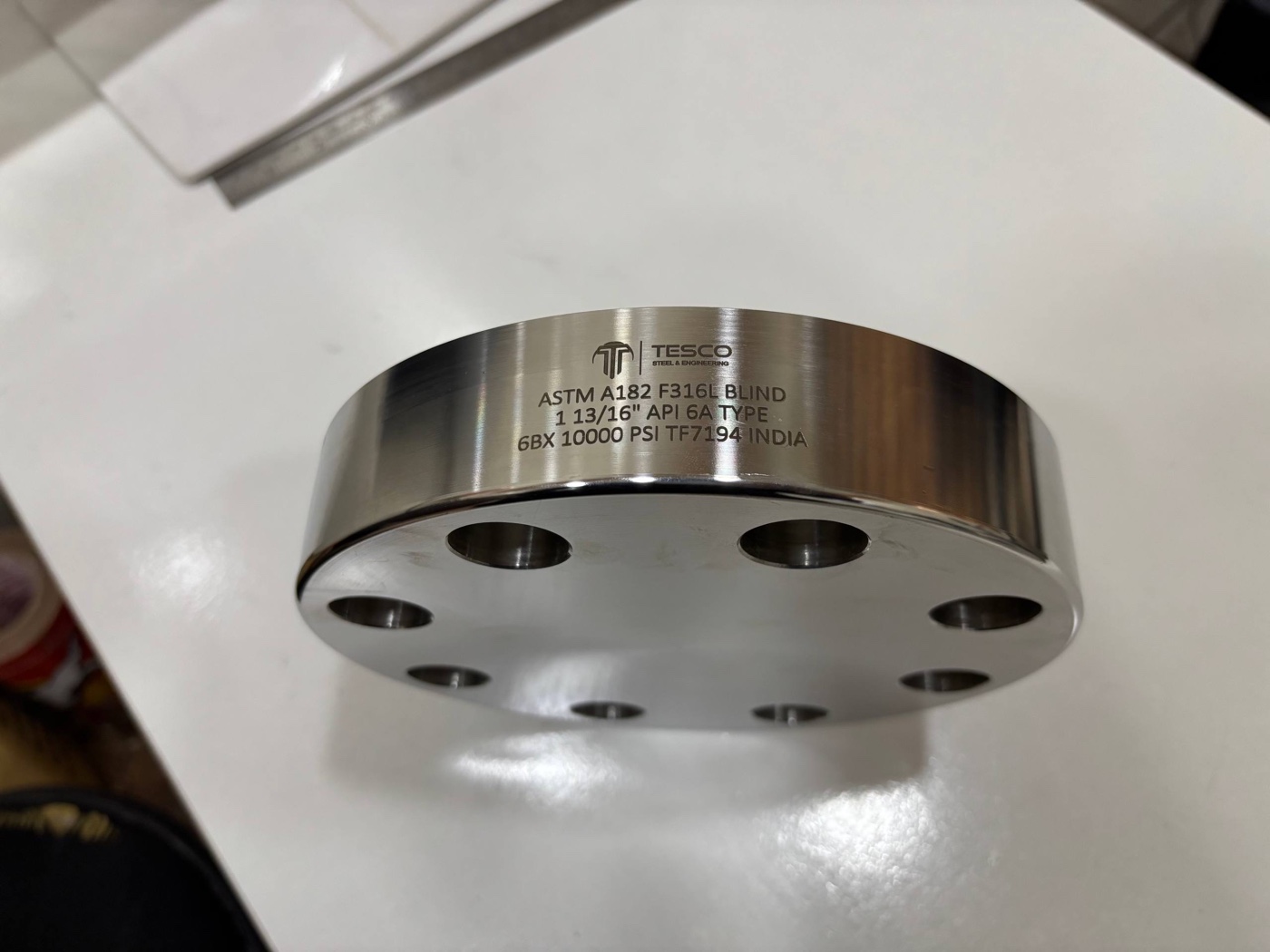
Tesco A182 F316L Blind — 1-13/16″ API 6A Type 6BX 10,000 PSI — Laser-Marked, Made in India
A blind flange is a solid disc — unlike all other flange types, it has no bore opening. It is used to seal, close, or isolate the end of a pipe run, pressure vessel nozzle, or valve outlet. Bolted directly to the mating flange with a gasket, a blind flange can withstand full system pressure while remaining removable — allowing quick access for inspection, maintenance, line pigging, or future branch extensions. Tesco Steel & Engineering, an ISO 9001:2015-certified manufacturer in Mumbai, India, produces blind flanges to the widest range of international standards in the industry: ASME B16.5, ASME B16.47, API 605, API 6A (including 20,000 psi), EN 1092-1, DIN 2527, JIS, AWWA C207, AS 2129/4087, SABS/SANS 1123, GOST 12836, NFE 29203, UNI, MSS SP-44, NS, and VSM 18703.
Blind flanges are manufactured from plate or forged discs and are machined to the same face standards as other flanges: raised face (BLRF), flat face (BLFF), or ring-type joint (BLRTJ). For high-pressure wellhead and subsea applications, API 6A Type 6BX blind flanges with lens or octagonal ring grooves are available up to 20,000 psi (1,380 bar). All flanges ship with full material traceability — EN 10204 3.1 or 3.2 Mill Test Certificates, dimensional inspection reports, and hydrostatic test certificates where required.
At a glance: a blind flange = a solid disc with no bore that bolts to any mating flange to seal a line end, nozzle or valve outlet at full system pressure — removable in minutes for inspection, pigging or future extension. It is the only flange type ordered without a pipe schedule (there is no bore). Specify it by four things: size, pressure class, facing (RF/FF/RTJ) and material grade.
Why Tesco Steel Blind Flanges Are Specified Worldwide
▶ Widest Standard Coverage
17 international standards in a single source — from ASME B16.5 Class 150 for utilities to API 6A 20,000 psi for deepwater wellheads. No need to split your order across multiple suppliers.
▶ Full Pressure Rating Range
From Class 150 (PN 20) at ambient temperature to API 6A 20,000 psi for critical wellhead service — every pressure class is available. ASME B16.5 pressure-temperature ratings per Group 1.1–3.3 material tables are fully supported.
▶ Pressure Testing Ready
Blind flanges are the standard method for hydrostatically testing pipe systems per ASME B31.3. Tesco Steel maintains ready-stock test blinds in A105 and SS 316L for immediate dispatch, avoiding project delays at critical pre-commissioning stages.
▶ Future-Proofed Connections
Blinded nozzles and pipe ends are the simplest way to provide for future branch connections. A blind flange can be unbolted and replaced with a weld neck or slip-on flange at any time, without cutting or welding on the main pipe.
▶ 50+ Material Grades
From ASTM A105 carbon steel for low-cost utility services to Hastelloy C276 for severe acid duty and Titanium Grade 2 for seawater and chemical environments — every alloy available in forged or plate form, all with EN 10204 3.1/3.2 certification.
▶ NACE & Sour Service
Blind flanges for H₂S-containing (sour) service manufactured and tested per NACE MR0175 / ISO 15156 hardness limits. Available in A105 NACE, SS 316L, Duplex F51/F53, and Alloy 625 for upstream oil and gas applications.
How Our Blind Flanges Are Manufactured
1
Forging or plate cutting — certified heats are hot-forged into discs (or profiled from certified plate where the standard permits), keeping full heat traceability from raw material to despatch.
2
Heat treatment — normalizing for carbon steel, solution annealing for stainless and nickel grades, with the thermal record retained per heat.
3
Machining — both faces and the bolt-hole circle to the dimensional standard; blind thickness is the critical dimension, since the solid disc carries full line pressure in bending.
4
Facing & finish — raised face serrations (stock finish per ASME B16.5), flat face, or precision RTJ / API 6A 6BX ring groove as ordered.
5
Testing & marking — mechanical and chemical verification against the heat, PMI and NACE hardness surveys where specified, then permanent laser marking: grade, size, rating, standard and traceability number — exactly as visible on the photo on this page.
6
Certification & packing — EN 10204 3.1 MTC (3.2 witnessed on request), faces protected, export-packed.
Blind Flange Specifications
| Blind Flanges — Full Specification Range |
|---|
| Size Range | NPS ½″ to 60″+ (DN 15 to DN 1500+); larger sizes on request per customer drawing |
| ASME B16.5 Class | 150, 300, 400, 600, 900, 1500, 2500 |
| ASME B16.47 Series | Series A Class 150–900; Series B Class 75–900 (NPS 26″–60″) |
| API Rating | API 605 Class 75–900; API 6A Type 6B (2,000–5,000 psi); API 6A Type 6BX (2,000–20,000 psi) |
| PN Rating | PN 2.5, 6, 10, 16, 25, 40, 63, 100, 160, 250, 320, 400 |
| Facing Types | Raised Face (RF / BLRF), Flat Face (FF / BLFF), Ring-Type Joint (RTJ / BLRTJ) |
| Governing Standards | ASME B16.5, B16.47, API 605, API 6A, EN 1092-1, DIN 2527, JIS, BS 4504, AS 2129/4087, AWWA C207/C228, SABS 1123, MSS SP-44, GOST 12836, NFE 29203, UNI 6092/6093, NS 2545–2547, VSM 18703 |
| Carbon Steel | ASTM A105; A516 Gr.60/70 (plate) |
| LTCS Blind Flanges | ASTM A350 LF2 |
| Stainless Steel Blind Flanges | ASTM A182 F304 / F304H / F304L / F316 / F316H / F316L / F316Ti / F309 / F310 / F317 / F317L / F321 / F347 / F904L |
| Alloy Steel Blind Flanges | ASTM A182 F5 / F9 / F11 / F12 / F21 / F22 / F91 |
| Duplex & Super Duplex | ASTM A182 F51 (UNS S31803), F53 (S32750), F55 (S32760), F60 (S32205) |
| Nickel Alloy Blind Flanges | UNS N02200, UNS N02201 |
| Monel Blind Flanges | UNS N04400 (Monel 400), UNS N05500 (Monel K500), Alloy 20 |
| Inconel / Incoloy Blind Flanges | UNS N06600, N06601, N06625, N08800, N08810, N08825 |
| Hastelloy Blind Flanges | UNS N10276 (C276), N06022 (C22), N10665 (B2), N06455 (C4) |
| Copper Nickel Blind Flanges | C70600 (90/10 CuNi), C71500 (70/30 CuNi), C71640 |
| Titanium Blind Flanges | Grade 1, Grade 2, Grade 3, DTH 3.7035, DTH 3.7055 |
| Surface Treatments | Hot-Dip Galvanizing (GI), Sand Blasting, Shot Peening, Epoxy Coating, FBE Coating |
| Certifications | ISO 9001:2015, PED 2014/68/EU, NACE MR0175, EN 10204 3.1 / 3.2 Mill TC, IBR, API monogram |
Blind Flange Types — BLRF vs BLFF vs BLRTJ
| Feature |
BLRF (Raised Face) |
BLFF (Flat Face) |
BLRTJ (Ring Joint) |
| Face Description | Raised concentric ring | Entirely flat face | Octagonal/oval groove |
| Gasket Type | Spiral-wound or ring | Full-face elastomer | Metal ring (R, RX, BX) |
| Raised Height | 1/16″ (Cl150/300); ¼″ (Cl600+) | None | Recessed groove |
| Typical Application | General process piping | Cast iron / GRP mating flanges | High-pressure, high-temp |
| ASME Class Range | 150 – 2500 | 150 – 2500 | 300 – 2500; API 6A to 20 kpsi |
| Most Common? | ✓ Most common | Specialty use | HP/HT and wellhead |
Industries & Applications
| Industry | Blind Flange Application |
|---|
| Oil & Gas Upstream | Wellhead nozzle closures (API 6A), BOP stack blinds, manifold end caps, sour service isolation |
| Oil & Gas Downstream | Refinery vessel nozzle blanking, pipeline section isolation, hydrostatic pressure test ends |
| Petrochemical | Reactor nozzle blinding during turnaround, corrosive service in Hastelloy or Duplex |
| Power Generation | Boiler drum nozzle closures (F91 alloy for high-temp steam), turbine inlet blanking |
| Water & Wastewater | Pipeline future tap-off blanking (AWWA C207), large-bore water main end caps in GI or A105 |
| Offshore & Subsea | Subsea connector blinds, umbilical termination closures in Duplex or 625; HIPPS isolation |
| Pharmaceutical / Food | Hygienic nozzle blanking in SS 316L with EHEDG-compliant flat face; CIP system isolation |
Blind Flange Dimensions by Standard
Note: Click any link below to view the full dimension table for that standard and class. All tables include flange OD, bolt circle diameter, bolt count & size, flange thickness, and face finish per the applicable standard.
ANSI / ASME B16.47 (Large Diameter)
JIS (Japanese Industrial Standard)
Australian Standard (AS 2129 & AS 4087)
SANS / SABS 1123 (South African Standard)
NFE 29203 (French Standard)
Browse by Material & Grade
Global Export Destinations
Tesco Steel & Engineering exports blind flanges to over 80 countries including: UAE, Saudi Arabia, Kuwait, Qatar, Oman, Bahrain, Iraq (Middle East); USA, Canada, Mexico, Venezuela, Colombia, Peru, Brazil, Chile, Ecuador, Trinidad & Tobago (Americas); Germany, Italy, Netherlands, UK, France, Spain, Turkey, Russia, Norway, Denmark, Finland, Romania, Poland, Ukraine, Kazakhstan (Europe & CIS); Nigeria, South Africa, Kenya, Tanzania, Zambia, Angola, Congo, Sudan, Ghana, Egypt, Morocco, Mozambique, Namibia, Gabon, Libya, Algeria (Africa); India, Malaysia, Thailand, Indonesia, Philippines, Vietnam, Singapore, China, Japan, South Korea, Taiwan, Sri Lanka (Asia-Pacific); and Australia, New Zealand, Israel, Jordan, Afghanistan, Pakistan, Yemen.
How to Specify & Order a Blind Flange
A complete blind flange specification has four elements — one fewer than other flange types, because there is no bore and therefore no pipe schedule to state:
1
Size & standard — nominal size and dimensional standard, e.g. 6″ NB ASME B16.5, DN300 EN 1092-1 Type 05, 30″ ASME B16.47 Series A, or 1-13/16″ API 6A.
2
Pressure class or PN rating — Class 150/300/600/900/1500/2500, PN 6–PN 400, AWWA Class B/D/E/F, or API 6A 2,000–20,000 psi.
3
Facing — RF (BLRF, default), FF (BLFF, for cast iron / GRP mates), RTJ (BLRTJ, state ring number) or API 6A 6B/6BX groove.
4
Material grade & certification — e.g. ASTM A105, A182 F316L, A350 LF2, B564 N06625 — plus EN 10204 3.1 or 3.2, NACE MR0175, PED or IBR. Then quantity and destination, sent to
sales@tescosteel.com or the
inquiry form.
Example of a complete line item: “Blind Flange, 10″ NB, ASME B16.5 Class 300, RF, ASTM A105, EN 10204 3.1 — 12 pcs.”
Frequently Asked Questions — Blind Flanges
What is a blind flange? ▼
A blind flange is a solid disc flange with no bore. It is bolted to the open end of a pipe, vessel nozzle, or valve using the standard bolt pattern and a gasket, completely sealing the connection. Unlike other flange types, a blind flange does not connect to a pipe — it terminates it. Standardised under ASME B16.5 (Class 150–2500, NPS ½″–24″) and ASME B16.47 (NPS 26″–60″), blind flanges are also produced to EN 1092-1 Type 05, DIN 2527, JIS, API 6A, and many other international standards.
What is the difference between a blind flange and a blank flange? ▼
The terms are often used interchangeably but technically differ: a blind flange is a pressure-rated forged or plate disc manufactured to a formal standard (ASME B16.5, EN 1092-1, etc.) with a machined face, specific thickness, and full material certification. A blank flange (or blanking plate) typically refers to a simple flat plate used for temporary isolation, often shop-fabricated without a standard pressure rating. For permanent service or any pressure-rated application, a proper blind flange to an applicable standard is required.
What ASME standard covers blind flange dimensions? ▼
ASME B16.5 covers blind flanges NPS ½″–24″ in Class 150, 300, 400, 600, 900, 1500, and 2500. ASME B16.47 Series A (formerly MSS SP-44) and Series B (formerly API 605) cover NPS 26″–60″. For wellhead and high-pressure service, API 6A Type 6B and 6BX cover 2,000–20,000 psi. European equivalent is EN 1092-1 Type 05; German standard is DIN 2527.
What are the main uses of blind flanges? ▼
Key applications: (1) Permanent end closure of pipe runs or vessel nozzles not currently in use; (2) Isolation of a branch or section of pipeline from the rest of the system; (3) Hydrostatic or pneumatic pressure testing — the blind is bolted to the test end to allow the system to be pressurised; (4) Access ports — removing the blind allows inspection, pigging, or cleaning of the pipe interior; (5) Future connections — blinded nozzles can be brought into service later without cutting the main pipe.
What is the difference between BLRF and BLFF blind flanges? ▼
BLRF (Blind Raised Face): The flange face has a concentric raised ring — 1/16″ high for Class 150 and 300; 1/4″ for Class 600 and above. This concentrates bolt load on the gasket contact area for reliable sealing. Most common for process piping with spiral-wound or ring gaskets.
BLFF (Blind Flat Face): Entirely flat face using a full-face gasket covering bolt holes. Used when mating to cast iron, ductile iron, GRP, or non-metallic flanges to prevent bending stress that could crack the brittle mating component. Also standard for AWWA water service blinds.
Can blind flanges be used for pressure testing? ▼
Yes — pressure testing is one of the primary applications. Per ASME B31.3, a hydrostatic test at 1.5× design pressure (or pneumatic at 1.1× design pressure) requires the piping system to be sealed. Blind flanges are bolted to open ends to create this seal. The blind must be rated for the test pressure at the test temperature. Tesco Steel maintains ready-stock A105 and SS 316L test blinds in standard sizes for immediate dispatch. Permanent service blinds are supplied with full dimensional and material certification.
What materials are available for blind flanges? ▼
Tesco Steel manufactures blind flanges in: Carbon Steel (ASTM A105, A516 Gr.60/70 plate); LTCS (A350 LF2); Stainless Steel (A182 F304/304L/316/316L/321/347/904L); Alloy Steel (A182 F5/F9/F11/F22/F91); Duplex & Super Duplex (F51/F53/F55); Monel (N04400/N05500); Inconel/Incoloy (N06600/N06625/N08825); Hastelloy (C276/C22); Titanium (Gr.1/Gr.2); and Copper Nickel (C70600/C71500). All with EN 10204 3.1 or 3.2 MTC.
What are API 6A blind flanges and when are they used? ▼
API 6A (Wellhead and Christmas Tree Equipment) governs high-pressure flanges for oil and gas wellhead and Christmas tree applications. Type 6B flanges cover 2,000–5,000 psi with raised face or RTJ groove. Type 6BX flanges cover 2,000–20,000 psi using a pressure-energised BX ring gasket in a precision-machined groove — suitable for HPHT (high pressure, high temperature) deepwater and surface wellhead applications. API 6A blind flanges are specified to cap wellhead outlets, BOP connections, and high-pressure manifold ends where ASME B16.5 pressure ratings are insufficient.
How much does a blind flange weigh? ▼
For a given size and class, a blind is the heaviest flange type — it is a solid disc with no bore removed. As working approximations for carbon steel ASME B16.5 blind flanges: a 2" Class 150 weighs about 3 kg, a 6" Class 150 about 12 kg, a 12" Class 150 about 38 kg, and a 24" Class 300 roughly 350 kg — with large B16.47 and AWWA sizes quoted case by case. Stainless and nickel alloys weigh essentially the same as carbon steel. The complete size-by-size table is on our
Flange Weight Chart page, and every quotation states the exact unit weight.
What is the difference between a blind flange and a spectacle blind? ▼
A blind flange is a bolted end closure — it terminates a line at a flange joint and must be unbolted and removed to restore flow. A spectacle blind (figure-8 blank) is an in-line isolation device installed between two mating flanges: one end is a solid blank, the other an open spacer ring, and the assembly is swung from one position to the other to blind or open the line without separating the joint completely. Use a blind flange to close a line end or nozzle; use a spectacle blind for routine positive isolation inside a running line. Tesco manufactures both — see the
Spectacle Blind page.
Can a blind flange be drilled and tapped later? ▼
Yes — this is a common and code-recognised practice. A blind flange can be centre-drilled and tapped (typically NPT) to create a threaded outlet for instruments, vents, drains or future small-bore connections, or bored and counter-welded to accept a nozzle. The remaining thickness must be verified against the pressure-temperature rating per ASME B16.5 rules, so state the intended tapping size when ordering and we supply the blind with the tapping drawing approved — or deliver it ready-tapped and plugged.
Which gasket is used with a blind flange? ▼
The same gasket as the mating flange's facing dictates. Raised face (BLRF) blinds seat spiral wound, compressed non-asbestos (CNAF) or PTFE gaskets to ASME B16.20/B16.21; flat face (BLFF) blinds use full-face gaskets covering the bolt holes, protecting brittle cast iron or GRP mates; ring-type joint (BLRTJ) blinds take solid metal ring gaskets, and API 6A blinds use the corresponding 6B/6BX ring. State the service medium and temperature and we can advise the gasket style alongside the flange quotation.
What details are needed to get an accurate blind flange quotation? ▼
Four specification elements plus commercial terms: (1) size and dimensional standard — e.g. 10" NB ASME B16.5, DN300 EN 1092-1 or 1-13/16" API 6A; (2) pressure class or PN rating; (3) facing — RF, FF, RTJ (with ring number) or API 6A 6B/6BX; (4) material grade and certification — e.g. ASTM A105, A182 F316L, A350 LF2, with EN 10204 3.1 or 3.2, NACE MR0175, PED or IBR stated. No pipe schedule is needed — a blind has no bore. Add the quantity and destination and we return price, weight and delivery — normally within 24 hours.
Who manufactures blind flanges in India? ▼
Tesco Steel & Engineering is an ISO 9001:2015 certified flange manufacturer based in Mumbai, India, producing blind flanges across the full material range — carbon steel A105, LTCS A350 LF2, stainless and duplex A182 grades, chrome-moly F5-F91, and nickel alloys, Hastelloy, titanium and copper-nickel. Blinds are made to 17 international standards from ASME B16.5 and B16.47 through API 6A at 20,000 psi, supplied with EN 10204 3.1/3.2 certification, and exported to more than 50 countries across the Middle East, Europe, Africa, Asia and the Americas.
Get a Quote for Blind Flanges
Specify NPS, pressure class or API rating, standard, material, facing, and quantity — we respond within 24 hours.
Send Inquiry
WhatsApp Us

