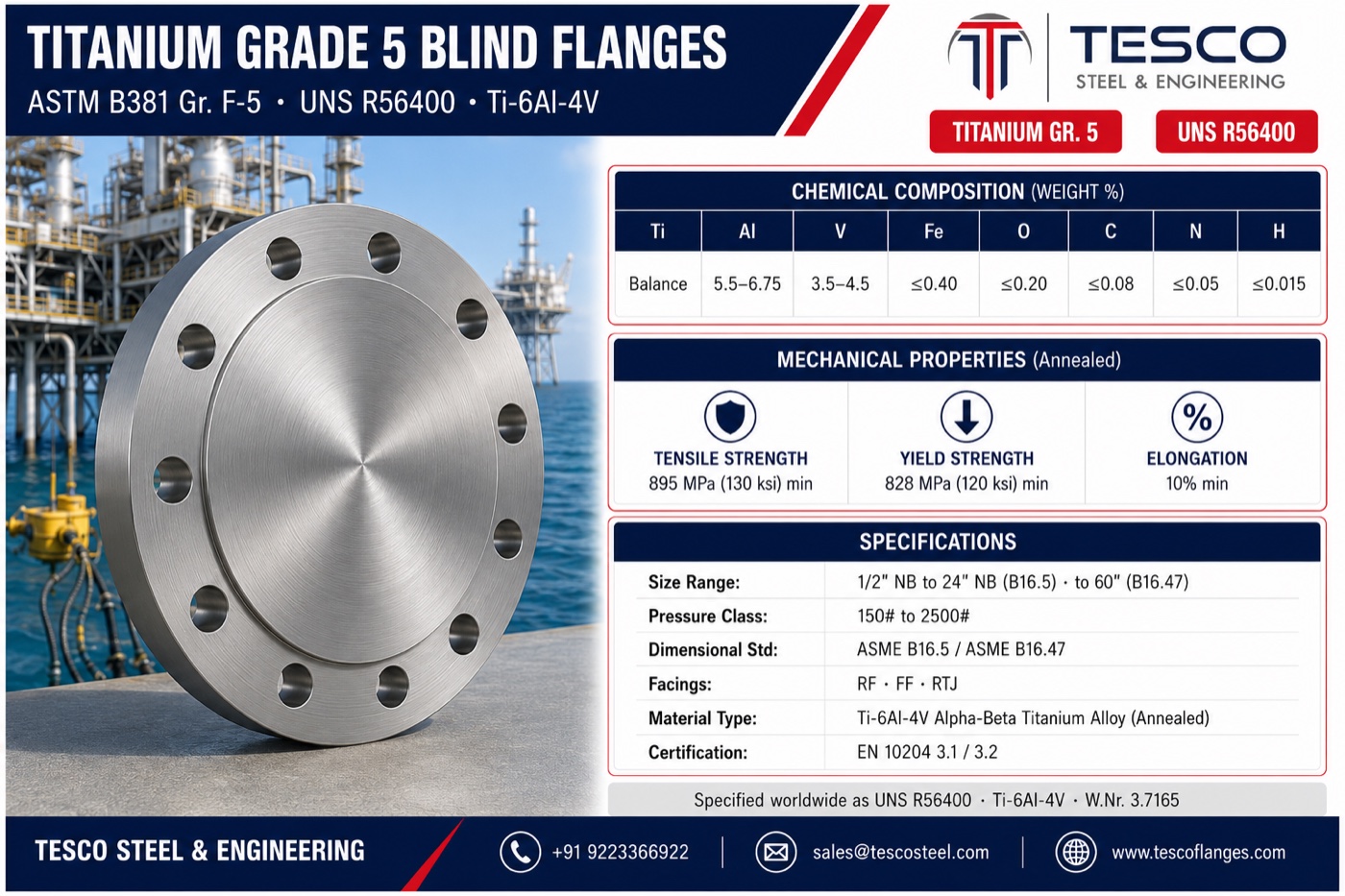
Tesco Steel & Engineering forges Titanium Grade 5 blind flanges — Ti-6Al-4V, ASTM B381 Gr. F-5, UNS R56400, W.Nr. 3.7165 — to ASME B16.5 Class 150–2500 from ½″ to 24″ NB and to ASME B16.47 up to 60″. This is the world's most-produced titanium alloy — roughly half of all titanium tonnage, the alpha-beta workhorse of airframes, engines and implants — and the strongest material in our entire blind range: 828 MPa yield, above 925 and K-500, at 4.43 g/cm³ — the best strength-to-weight of any flange metal. Aerospace ground equipment, subsea and ROV hardware, naval systems, Ti-6-4 skids wanting matching closures. Two honest notes up front: for corrosion-led duty, Grade 2 is the better titanium (and we will say so), and standard B16.5 closures gain weight savings, not thickness savings — the full argument is below. Facings: BLRF, BLFF or BLRTJ. Every lot with EN 10204 3.1/3.2 MTC. ISO 9001:2015, made in Mumbai, India — exported to 50+ countries.
Titanium Gr. 5 · ASTM B381 F-5 · UNS R56400Ti-6Al-4V · W.Nr. 3.7165The World's Titanium Workhorse828 MPa Yield — Tops Our Range4.43 g/cm³ — Best Strength-to-WeightAlpha-Beta — No Ageing WindowsAerospace · Subsea · NavalASME B16.5 ½″–24″ · Class 150–2500EN 10204 3.1 / 3.2 · ISO 9001:2015
Titanium Grade 5 Blind Flanges — Specifications at a Glance
What is a Titanium Grade 5 Blind Flange?
The strength grade of the titanium family. A solid forged disc of Ti-6Al-4V (ASTM B381 Gr. F-5 / UNS R56400 / W.Nr. 3.7165) with no bore. Where Grade 2 is purity, Grade 5 is chemistry: 6% aluminium + 4% vanadium holding a two-phase alpha-beta structure worth 895 MPa tensile / 828 MPa yield — the strongest certificate in our blind range — at 4.43 g/cm³, the best strength-to-weight of any flange material. Annealed, single condition, no ageing windows. Dimensions per ASME B16.5 / B16.47 in RF, FF and RTJ; EN 10204 3.1 on every lot.
Also searched as: Ti-6Al-4V blind flange, Ti 6-4 blind, Grade 5 titanium blind flange, R56400 blind flange, B381 F5 blind, 3.7165 blind flange — all refer to the product on this page. See also the corrosion-led Titanium Grade 2 blind flanges, the other Grade 5 types — weld neck, slip-on, socketweld — the titanium hub with Grade 1 / Grade 7, and the facing pages BLRF / BLFF / BLRTJ.
Top of the yield column at half the density column — per kilogram, nothing else in the catalogue is close.
What Al + V Buy
Two Phases, One Engine
Aluminium (5.5–6.75%) stabilises alpha, vanadium (3.5–4.5%) stabilises beta — the two crystal structures coexist and strengthen each other's boundaries. Not carbon, not nitrogen, not ageing: a crystal architecture, stable as supplied.
Half the World's Titanium
Airframes, engine fans, implants, rockets: Ti-6-4 is ~50% of all titanium tonnage. Mills know it best, stock exists in every form, and a B381 F-5 certificate is as routine as titanium paperwork gets.
Strength Without Ageing Paperwork
828 MPa in the annealed condition — no ageing windows, no hardness ceilings, no condition statements to police between quotations. The aged nickel grades' one administrative burden, absent.
Titanium Grade 5 Chemical Composition (UNS R56400)
Element
Ti
Al
V
Fe
O
C
N
H
Weight %
Balance
5.5–6.75
3.5–4.5
≤0.40
≤0.20
≤0.08
≤0.05
≤0.015
Two-part logic: the Al-V pair is the deliberate alloying; the interstitials stay fenced — oxygen tighter than Grade 2's (0.20 vs 0.25), because in an alloy this strong extra interstitial hardening only costs toughness. Hydrogen stays the certificate watch-item. Our PMI reads the Al-V signature on every piece — Grade 5 and Grade 2 can never mix in either direction.
Mechanical Properties (Annealed)
Property
ASTM B381 Gr. F-5 Requirement
Tensile Strength
≥ 895 MPa (130 ksi)
Yield Strength (0.2%)
≥ 828 MPa (120 ksi) — the strongest certificate in our blind range
Elongation
≥ 10% — the range's lowest; high strength behaves like high strength
Condition
Annealed — single, stable condition; STA practice belongs to bar and fasteners, not pressure flanges
Specific Strength
828 MPa over 4.43 g/cm³ — roughly 4× carbon steel's, beyond every nickel alloy
The high-pressure engineered systems where Grade 5 most often lives
Titanium Grade 5 Blind Flange Specifications
Titanium Grade 5 / UNS R56400 Blind Flanges are available in the following specifications:
Material Grade
Titanium Grade 5 — ASTM B381 Gr. F-5 (UNS R56400, Ti-6Al-4V), W.Nr. 3.7165; plate B265 and bar B348 belong on mill paperwork, the flange certificate reads B381
Heat Treatment
Annealed — furnace records certified; hydrogen reported per heat
Size
1/2"NB to 24"NB per ASME B16.5; 26"–60" per ASME B16.47; compact and custom closures machined to drawing
Class
150#, 300#, 400#, 600#, 900#, 1500#, 2500#
Facings
Raised Face (BLRF), Flat Face (BLFF), Ring Type Joint (BLRTJ) with groove per B16.20
Service Span
Ti-6-4 system closures, weight-critical and engineered joints; corrosion-led duty directed to Grade 2, hot-brine crevice to Grade 7 or the C-family
Surface Finish
Natural machined — no paint, no steel contact; titanium-dedicated handling throughout
Modifications
NPT-tapped test and injection blinds; matching spectacle blinds, spades and bleed rings; Grade 23 (ELI, R56401) quoted where specified
Testing
Tension & full chemistry per heat including hydrogen; PMI reads the Al-V signature on every piece
Certification
EN 10204 3.1 (standard) / 3.2 witnessed
Why Titanium Grade 5 Blind Flanges Are Specified
The System Is Already Ti-6-4
Subsea hydraulics, aerospace test stands, naval hardware built in Grade 5 want closures that match alloy-for-alloy — one material on the certificate file, no odd member in the joint.
Every Kilogram Is Priced
Same B16.5 envelope, 56% of the steel weight — on equipment that is lifted, flown or carried subsea, density is the argument entire.
The Joint Is Engineered, Not Tabular
Compact flanges and custom closures designed by stress analysis let 828 MPa yield shrink the whole joint — we machine them to drawing from the same certified stock.
Strength Without Condition Paperwork
Top of our strength ladder in a single annealed condition — none of the ageing-window administration the high-strength nickel grades carry.
Know the Map
Corrosion-led titanium duty: Grade 2. Hot brine or reducing acid: Grade 7 or the C-family. Fracture-critical ELI specs: Grade 23 quoted to order. Facings: BLRF / BLFF / BLRTJ.
Specification Notes — Getting Grade 5 Right
Three honest notes.Grade 5 is not a corrosion upgrade over Grade 2: the film is still titanium's, but the crevice threshold in hot chlorides sits lower, reducing acids bite harder, and fluoride-bearing streams are less forgiven — corrosion-led duty belongs to Grade 2, and an up-grade in number is a down-grade in margin. The class tables do not reward yield: a standard B16.5 blind in Grade 5 is lighter, not thinner — the strength pays off in engineered and compact joints, and our quotation will say which case yours is. And ductility is finite: 10% elongation is the lowest in our range — assembly practice (bolt lubrication, controlled torque, no drift-pinning) deserves the same care the strength deserved.
How Our Titanium Grade 5 Blind Flanges Are Manufactured
1
Forging — cut billet of the verified R56400 heat — Al-V windows and interstitials including hydrogen confirmed — is hot-forged in the alpha-beta window into the solid disc blank with full heat traceability.
2
Annealing — the anneal that sets the fine two-phase structure; furnace charts retained against the heat number.
3
Machining & facing — faces, OD, drilling and any NPT taps cut on titanium-dedicated stations — sharp tooling, positive feeds, no steel contact; RF serrations, flat face or RTJ groove gauged per B16.20.
4
Testing — tension test and full chemistry against the heat, hydrogen included; PMI reads the Al-V signature — Grade 5 and Grade 2 can never mix.
5
Finishing — natural machined finish; marked with standard, grade, size, class and heat number.
6
Certification & packing — EN 10204 3.1 MTC (3.2 witnessed on request) with anneal records; faces protected, palletised or crated sea-worthy — segregated from ferrous cargo.
Where Titanium Grade 5 Blind Flanges Are Used
Where strength-per-kilogram rules: aerospace ground support equipment and propulsion test stands, subsea and ROV hydraulic and injection systems, naval hardware, high-pressure water-jet and hyperbaric equipment, motorsport and high-performance packages, and Ti-6-4 process skids wanting alloy-matched closures. Production below:
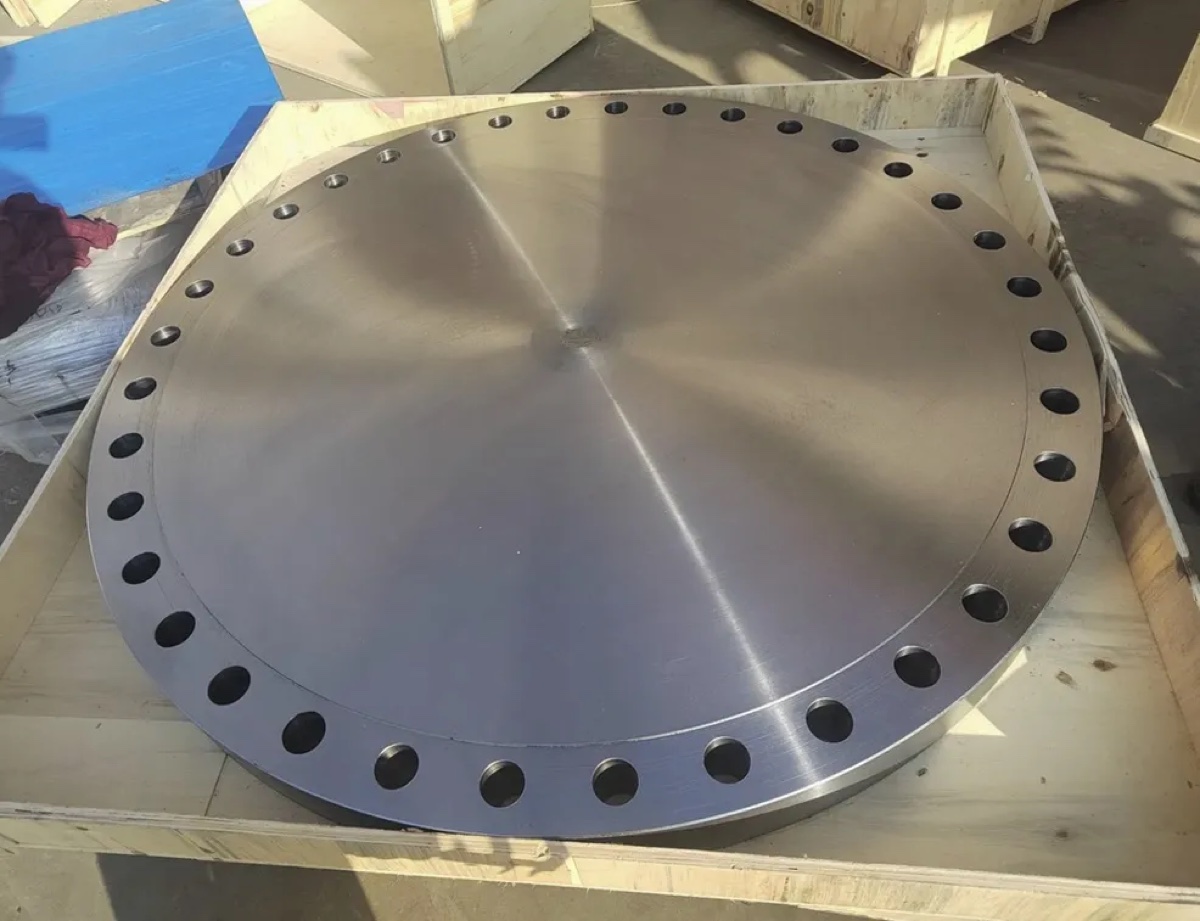
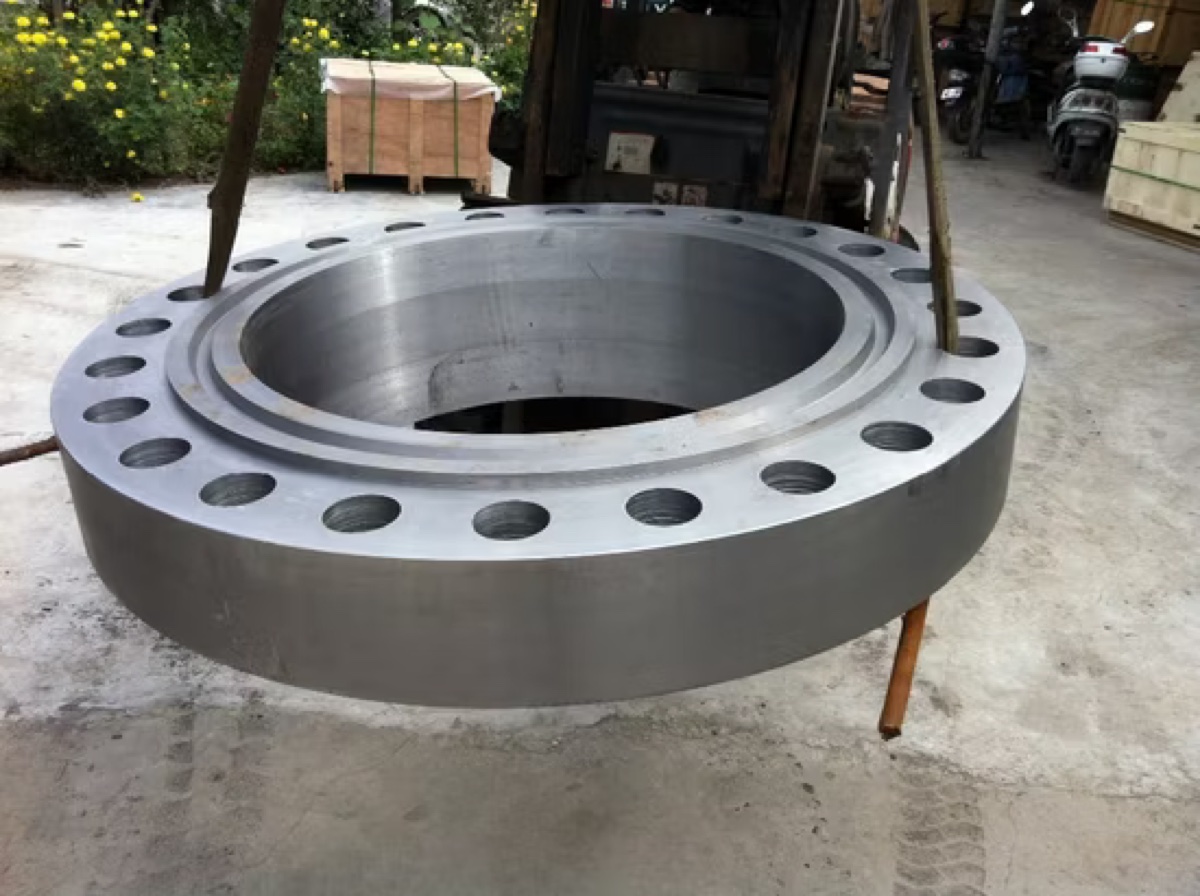
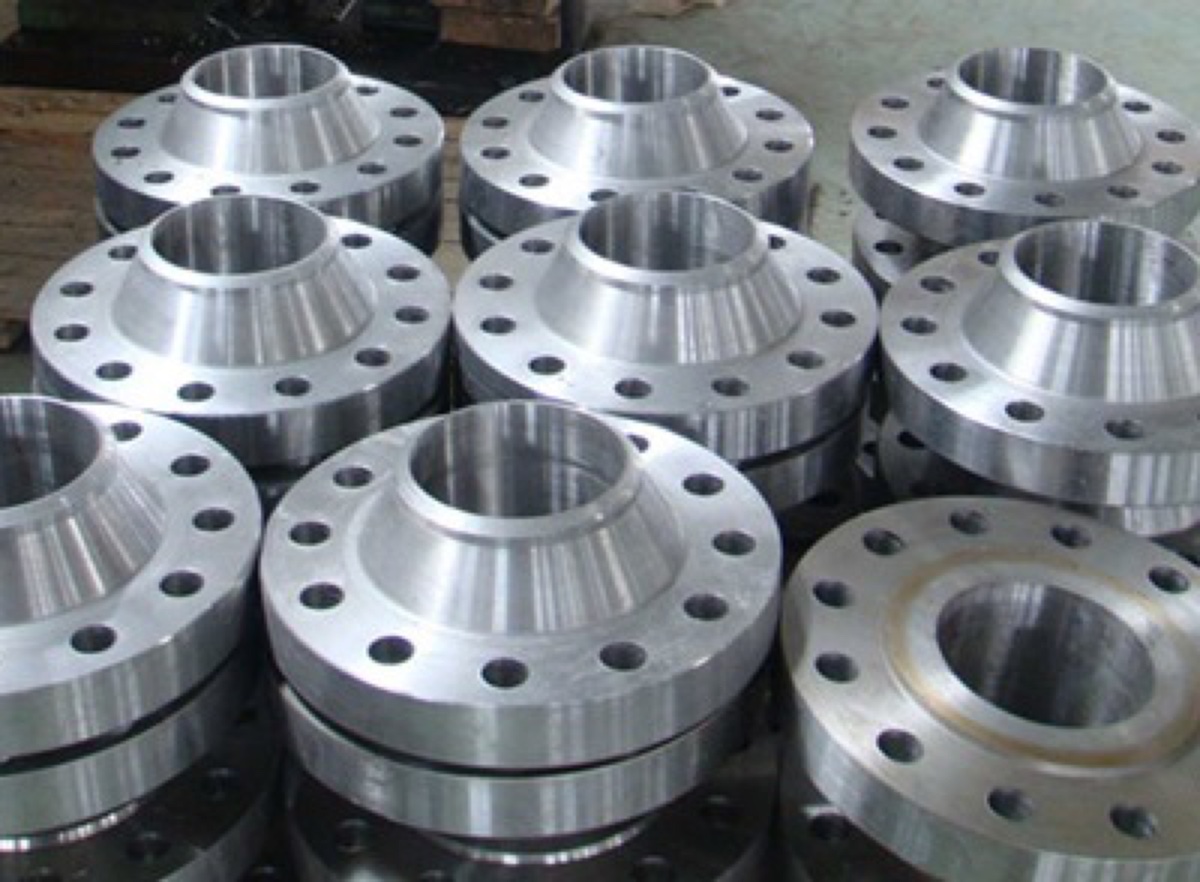
Large Machined Blind — Crated for ExportRTJ Groove Machining — Class 600Titanium Grade 5 — Segregated Stock
Titanium Grade 5 Blind Flange Dimensions
Blind dimensions are class-governed — identical across material grades (the weight, at 56%, is not). Full charts:
How to Specify & Order a Titanium Grade 5 Blind Flange
Five elements — and tell us the system alloy: the match-the-system check is free:
1
Size & standard — e.g. 4″ NB ASME B16.5, the B16.47 series for 26″ and above, or the drawing for compact and engineered closures.
2
Pressure class & facing — Class 150–2500; RF, FF or RTJ (with ring number — titanium or soft compatible ring) to match the mating flange.
3
Grade — ASTM B381 Gr. F-5 (UNS R56400, Ti-6Al-4V), annealed; W.Nr. 3.7165 where the European designation is required. ELI specification? State Grade 23 / R56401. Corrosion-led duty? Grade 2.
4
Service declarations & certification — subsea CP regime if cathodically protected; isolation kit needs for mixed-metal joints; NPT tap size if a test blind; PMI or 3.2 witnessing as specified; EN 10204 3.1 — our standard.
A Titanium Grade 5 blind flange is a solid forged disc of Ti-6Al-4V — the titanium alloy carrying 6% aluminium and 4% vanadium, ASTM B381 Grade F-5, UNS R56400, W.Nr. 3.7165 — drilled to the standard bolt pattern with no bore, used to close flanged connections in systems built from the same alloy or engineered around its extraordinary strength-to-weight ratio. Where Grade 2 is purity, Grade 5 is chemistry: the aluminium-vanadium alpha-beta structure delivers 895 MPa tensile and 828 MPa yield — the strongest material in our entire blind flange range — at 4.43 g/cm³, a little over half the density of steel. Dimensions follow ASME B16.5 from ½ inch to 24 inch and ASME B16.47 beyond, in raised face, flat face and ring joint facings.
Why is Ti-6Al-4V the world's most-produced titanium alloy?
Because it hit the sweet spot so squarely that industries stopped looking. Developed in the 1950s for airframes, Ti-6Al-4V today accounts for roughly half of all titanium tonnage produced: jet engine fans and compressor stages, airframe structure, rocket hardware, orthopaedic implants, racing components, subsea equipment. The recipe balances everything at once — high strength, low density, fatigue endurance, fracture toughness, corrosion resistance inherited from the titanium film, and (by titanium standards) manufacturability. For the flange buyer the consequence is practical: Ti-6-4 is the titanium alloy the world's mills know best, stock exists in every product form, and a B381 F-5 forging certificate is as routine as titanium paperwork gets.
What do the aluminium and vanadium in Grade 5 actually do?
They each sponsor one of titanium's two crystal structures. Aluminium (5.5-6.75%) stabilises and strengthens the alpha phase — the hexagonal structure CP titanium has at room temperature — while vanadium (3.5-4.5%) stabilises the beta phase, the cubic structure titanium normally shows only near its transformation temperature. With both present the alloy holds a fine two-phase alpha-beta microstructure at room temperature, and that mixture is the strength engine: the phases strengthen each other's boundaries, and thermomechanical processing can tune the balance. It is a different strengthening philosophy from anything else in our blind range — not carbon, not nitrogen, not gamma-prime ageing, but a two-phase crystal architecture — which is why the strength arrives with no ageing windows or hardness ceilings to manage in supply.
What is the chemical composition of Titanium Grade 5 (UNS R56400)?
Titanium balance, aluminium 5.5-6.75%, vanadium 3.5-4.5%, with interstitial ceilings: iron ≤0.40%, oxygen ≤0.20%, carbon ≤0.08%, nitrogen ≤0.05%, hydrogen ≤0.015%. Note the two-part logic: the Al-V pair is the deliberate alloying that builds the alpha-beta structure, while the interstitials are still fenced — oxygen actually tighter than Grade 2's 0.25% ceiling, because in an alloy this strong extra interstitial hardening only costs toughness. Hydrogen remains the certificate watch-item. Our PMI reads the Al-V signature on every piece — a Grade 5 disc cannot be confused with CP Grade 2 on our shelves, in either direction.
What are the mechanical properties of Titanium Grade 5 blind flanges?
In the annealed condition ASTM B381 Grade F-5 requires tensile strength 895 MPa (130 ksi) minimum, yield strength 828 MPa (120 ksi) minimum and elongation 10% minimum. That yield tops our entire blind flange range — above Incoloy 925's 725 MPa, above K-500's 690, at roughly half their density. The honest counterpart is the 10% elongation floor, the lowest ductility figure in the range: Ti-6-4 is a high-strength alloy and behaves like one. Unlike the aged nickel grades, the strength needs no precipitation treatment in our supply — B381 annealed is a single, stable condition — though the alloy also exists in solution-treated-and-aged forms for bar and fastener applications outside flange practice.
What does the strength-to-weight ratio actually buy in a flange?
At 828 MPa yield over 4.43 g/cm³, Grade 5 has the highest specific strength of any material in our catalogue — roughly four times carbon steel's and well beyond every nickel alloy's. In standard B16.5 closures, where thickness is fixed by the class tables, the benefit appears as weight: the same blind at 56% of the steel figure, valuable on aerospace ground equipment, ROVs, weight-budgeted topsides and anything lifted often. In engineered hardware — compact flanges, custom closures, subsea connectors designed by stress analysis rather than by table — the benefit appears as size: designers can shrink the whole joint. Both arguments explain why Ti-6-4 hardware exists; matching those systems with a certified closure is what this page supplies.
Titanium Grade 5 or Grade 2 — which blind flange should I order?
Grade 2, unless the system itself answers otherwise. For a standard ASME B16.5 closure the flange thickness comes from the class tables, not from yield strength, so Grade 2's superior corrosion margin, easier machining and lower price make it the default titanium blind — that page carries our full seawater and chlorine story. Grade 5 is the right order in three cases: the piping or equipment is already Ti-6Al-4V and the closure should match alloy-for-alloy on the certificate; the joint is engineered rather than tabular — compact, custom or subsea — and strength sets the geometry; or weight dominates every other consideration. When the enquiry does not say which, we ask about the system alloy first — matching it is the rule that never misleads.
How does Grade 5 corrosion resistance compare with Grade 2?
Excellent, but with a narrower margin — the film is still titanium's, and in ambient seawater, oxidizing chlorides and nitric chemistry Grade 5 performs essentially like CP titanium. The differences appear at the edges: its crevice corrosion threshold in hot chlorides sits meaningfully lower than Grade 2's, its tolerance for reducing acids is poorer still, and the aluminium-vanadium chemistry is less forgiving of contaminated or fluoride-bearing streams. The practical rule: buy Grade 5 for strength and match-the-system reasons, buy Grade 2 for corrosion-led duty, and never up-grade from 2 to 5 expecting a corrosion improvement — it runs the other way. Hot brine crevice duty in titanium belongs to the palladium grades — see our Grade 7 page — or returns to the C-family nickel alloys.
What condition are Grade 5 blind flanges supplied in?
Annealed, per ASTM B381 Grade F-5 — a single, stable, weldable-with-care condition whose 895/828 MPa minimums are already the strongest certificate in our range. Ti-6Al-4V can also be solution treated and aged to higher strengths, but STA practice lives in the bar, fastener and aerospace-forging world, with section-size limits and toughness trade-offs that make it wrong for pressure-boundary flanges; B16.5 ratings and B381 flange practice are built on the annealed condition. The useful consequence for buyers mirrors the solid-solution nickel alloys: no ageing windows, no hardness ceilings, no condition statements to police between quotations — the annealed certificate is the whole story.
What is Grade 23 (Ti-6Al-4V ELI) and when is it specified instead?
Grade 23 (UNS R56401) is Ti-6Al-4V ELI — Extra Low Interstitials — the same aluminium-vanadium alloy with oxygen capped near 0.13% and other interstitials trimmed. The purification buys fracture toughness and damage tolerance at a modest strength cost, which is why Grade 23 is named for fracture-critical duty: medical implants, cryogenic hardware, deep-sea pressure hulls, aerospace parts certified by damage-tolerance analysis. In flange work it appears when a subsea or cryogenic specification carries the ELI designation through the whole bill of materials. If your specification says R56401 or 'ELI', we quote to it; if it says Grade 5 / R56400, this page's standard chemistry is the correct and more economical supply.
What facings are Titanium Grade 5 blind flanges made with?
All three: raised face (BLRF) — the default — flat face (BLFF) where the mating equipment requires it, and ring type joint (BLRTJ) for the high-pressure engineered systems where Grade 5 most often lives, with the ring specified in titanium or a soft compatible metal so the groove outlives the gasket. The galvanic notes from our Grade 2 page carry over unchanged: titanium sits at the noble end of the series, so mixed-metal joints in electrolyte want isolation gasket kits, while titanium-to-titanium joints take plain PTFE or elastomer-faced gaskets. NPT-tapped test and injection blinds are machined and certified at the works.
Where are Titanium Grade 5 blind flanges used?
Wherever Ti-6Al-4V systems need closing: aerospace ground support equipment and test rigs, launch and propulsion test stands, subsea and ROV hydraulic and injection systems, naval hardware, high-pressure water-jet and hyperbaric equipment, motorsport and high-performance skids, and desalination or offshore packages where a designer has already paid for Ti-6-4's strength and wants the flange bill of materials to match. The closure logic is the same as every page in this series: the blind should match the system's alloy so the joint has no odd member — neither a corrosion weak point nor a galvanic couple — and the certificate file reads one material from end to end.
Which standards cover Titanium Grade 5 blind flanges?
The forging standard is ASTM B381, Grade F-5 (UNS R56400) — titanium's own forging specification; plate is B265 and bar is B348, mill-paperwork numbers that do not belong on a flange certificate, and neither A182 (steels) nor B564 (nickel alloys) covers titanium. The designation reads Ti-6Al-4V, W.Nr. 3.7165 in European paperwork. Dimensions follow ASME B16.5 for ½"-24" and ASME B16.47 for 26"-60". A complete specification reads: 'Blind Flange, RF, 4", ASME B16.5 Class 600, ASTM B381 Gr. F-5 (UNS R56400, Ti-6Al-4V), annealed' — and our EN 10204 certificates state it exactly that way, with the Al-V chemistry and full interstitials including hydrogen reported per heat.
Why order a Grade 5 blind if B16.5 thickness is set by the class tables?
Three honest reasons survive that objection. Matching: a Ti-6-4 system closed with a different alloy puts an odd member in the joint — different certificate, different galvanic character, different inspection line-item — and critical-system owners simply do not allow it. Weight: the table fixes the thickness but not the density; the Grade 5 blind weighs 56% of its steel twin, and on equipment that is lifted, flown or carried subsea that is the argument entire. Engineered joints: much Grade 5 hardware is not tabular B16.5 at all but compact and custom closures designed by analysis, where 828 MPa yield genuinely shrinks the joint — we machine those to drawing from the same certified stock. What we will not do is sell Grade 5 as a corrosion upgrade over Grade 2 — it is not one, and the quotation will say so.
Who manufactures Titanium Grade 5 blind flanges in India?
Tesco Steel & Engineering is an ISO 9001:2015 certified flange manufacturer based in Mumbai, India, forging Titanium Grade 5 / ASTM B381 Gr. F-5 / UNS R56400 (Ti-6Al-4V) blind flanges from ½" to 24" NB per ASME B16.5 in Classes 150-2500 and to 60" per ASME B16.47 — annealed with furnace records certified, machined on titanium-dedicated stations fully segregated from steel, PMI-verified with the Al-V signature read on every piece, certified to EN 10204 3.1/3.2 with full chemistry including hydrogen — in raised face, flat face and ring joint facings, alongside Titanium Grades 1, 2 and 7 and the complete stainless, duplex and nickel-alloy blind range. Exported to more than 50 countries.