

'SHAPING INDUSTRIES WITH THE FINEST STEEL'
'SHAPING INDUSTRIES WITH THE FINEST STEEL'
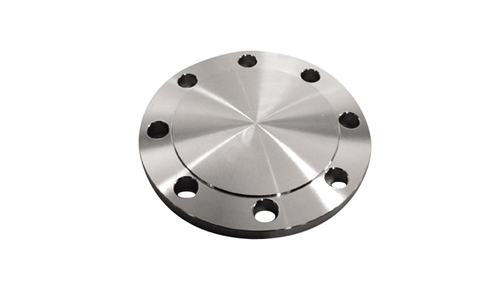
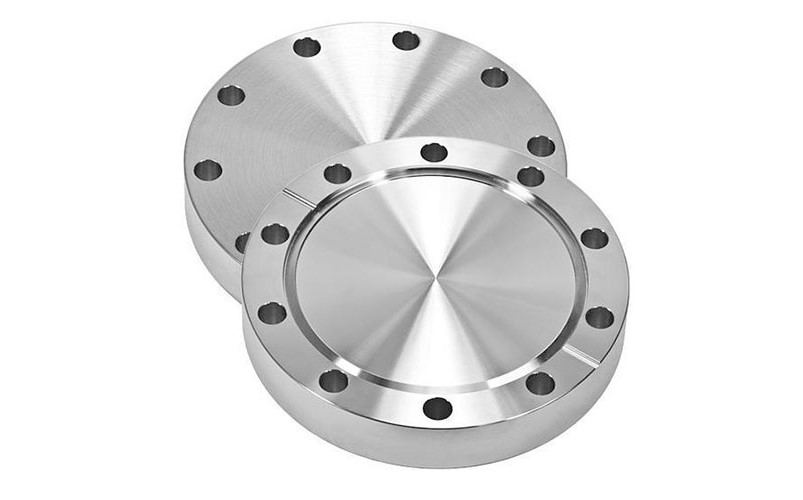
Tesco Steel & Engineering manufactures ASME B16.47 Series B Class 150 blind flanges — solid disc forgings in the compact Series B (formerly API 605) pattern, the removable closure for pipeline ends, tank and vessel nozzles, large valve connections, hydrotest and isolation. Sizes NPS 26–60 (DN 650–1500), raised face 2 mm standard with FF or RTJ on request, plain or with tapped vent / drain connections. This page is the complete reference: the full 18-size dimension chart in mm with bolt circles, bolting and weights, the rating explained, installation practice for blinds that weigh tonnes, and every material grade we produce — from A105 and A694 pipeline grades to SS 316 and duplex. ISO 9001:2015 certified, made in Mumbai, India — exported worldwide.
Above NPS 24 the blind flange becomes a forging project: a Series B Class 150 blind spans up to 1725 mm and weighs up to 1775 kg, a solid disc carrying full line pressure on its unsupported centre — which is why B16.47 tabulates blind thickness separately and usually thicker than the matching weld neck. Series B, inherited from API 605, is the compact pattern of more, smaller bolts on a tighter circle, which pays off in solid discs even more than in rings: the closure of choice for tank farms, process plants and offshore topsides — pipeline ends and tie-ins, tank and vessel manways, large valve and pump nozzles, hydrotest and isolation.
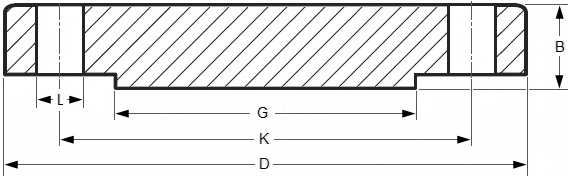
The blind must match the mating flange in series, class, size and facing — Series A and B drilling differ at every size in this class. Installation is rigging work: lifting lugs for handling, jack-screw holes for break-out, cross-pattern tightening in at least three steps, and a tapped vent so the line depressurises safely before the joint opens. The chart below carries every dimension against the lettered figure, with weights.

“Class 150” (also written 150 lb or #150, roughly PN 20) is a pressure–temperature rating class, and B16.47 adopts the ASME B16.5 Table 2 ratings for it:
| Temperature °C | Group 1.1 — A105 / A350 LF2 / A216 WCB | Group 2.1 / 2.2 — A182 F304 / F316 |
|---|---|---|
| −29 to 38 | 19.6 | 19.0 |
| 100 | 17.7 | 16.2 |
| 150 | 15.8 | 14.8 |
| 200 | 13.8 | 13.7 |
| 250 | 12.1 | 12.1 |
| 300 | 10.2 | 10.2 |
| 350 | 8.4 | 8.4 |
| 400 | 6.5 | 6.5 |
| 450 | 4.6 | 4.6 |
Working pressure in bar (gauge) per ASME B16.5 Table 2, as adopted by B16.47. A694 high-yield grades rated per Group 1.1 unless otherwise agreed. The solid centre is rated for full class pressure; confirm bolting, gasket and hydrotest pressure for the same duty.
All dimensions in mm per ASME B16.47-2020 Series B. Letters follow the figure: D = flange outside diameter, B = flange thickness (including the 2 mm raised face), G = raised face diameter, K = bolt circle (PCD), L = bolt hole diameter. Prefer it on paper? Download the full Series B Class 150 blind flange datasheet (PDF) — the same chart with the drawing, ratings, installation practice and ordering notes, ready for the workshop.
Blind Flange Dimension Reference — ASME B16.47 Series B
| Size in Inch | Size in mm | Flange OD | Thickness | RF Diameter | PCD | No. of Studs | Hole Ø | Stud Size | Approx Weight (kg) |
|---|---|---|---|---|---|---|---|---|---|
| D | B | G | K | — | L | — | |||
| 26 | 650 | 785 | 44.5 | 711 | 744.5 | 36 | 22.2 | 3/4 | 169 |
| 28 | 700 | 835 | 47.8 | 762 | 795.3 | 40 | 22.2 | 3/4 | 206 |
| 30 | 750 | 885 | 50.9 | 813 | 846.1 | 44 | 22.2 | 3/4 | 246 |
| 32 | 800 | 940 | 54.2 | 864 | 900.1 | 48 | 22.2 | 3/4 | 294 |
| 34 | 850 | 1005 | 57.2 | 921 | 957.3 | 40 | 25.4 | 7/8 | 355 |
| 36 | 900 | 1055 | 58.8 | 972 | 1009.6 | 44 | 25.4 | 7/8 | 404 |
| 38 | 950 | 1125 | 63.6 | 1022 | 1070.0 | 40 | 28.6 | 1 | 494 |
| 40 | 1000 | 1175 | 66.9 | 1080 | 1120.8 | 44 | 28.6 | 1 | 566 |
| 42 | 1050 | 1225 | 68.4 | 1130 | 1171.6 | 48 | 28.6 | 1 | 632 |
| 44 | 1100 | 1275 | 71.4 | 1181 | 1222.4 | 52 | 28.6 | 1 | 716 |
| 46 | 1150 | 1340 | 74.8 | 1235 | 1284.3 | 40 | 31.8 | 1 1/8 | 827 |
| 48 | 1200 | 1390 | 77.8 | 1289 | 1335.1 | 44 | 31.8 | 1 1/8 | 928 |
| 50 | 1250 | 1445 | 81.1 | 1340 | 1385.9 | 48 | 31.8 | 1 1/8 | 1036 |
| 52 | 1300 | 1495 | 84.1 | 1391 | 1436.7 | 52 | 31.8 | 1 1/8 | 1155 |
| 54 | 1350 | 1550 | 87.5 | 1441 | 1492.2 | 56 | 31.8 | 1 1/8 | 1292 |
| 56 | 1400 | 1600 | 90.5 | 1492 | 1543.0 | 60 | 31.8 | 1 1/8 | 1426 |
| 58 | 1450 | 1675 | 93.5 | 1543 | 1611.3 | 48 | 34.9 | 1 1/4 | 1615 |
| 60 | 1500 | 1725 | 96.8 | 1600 | 1662.1 | 52 | 34.9 | 1 1/4 | 1775 |
| Closure | How It Works | Character |
|---|---|---|
| Blind Flange (this page) | Bolts to the end flange | Removable, reusable, full class rating |
| Spade / Spacer Blind | Inserted between two flanges | Positive isolation; B16.48 to NPS 24, larger to drawing |
| Pipe Cap (B16.9) | Butt-welded to the pipe end | Permanent closure — no reopening without cutting |
B16.47 Series B Class 150 blind flanges are produced in the material families below — forged bars, billets or disc forgings, each with EN 10204 3.1 mill certificates, heat-number traceability and PMI on request:
| Material Family | Typical Flange Grades | Best suited to |
|---|---|---|
| Carbon Steel | ASTM A105 / A105N; A266 Cl.2 / Cl.4 disc forgings | General large-bore closures |
| High-Yield Pipeline | ASTM A694 F42–F65 | Matched to API 5L pipeline systems |
| LTCS | ASTM A350 LF2 Cl.1 / Cl.2 | Low-temperature service, impact tested |
| Stainless Steel | A182 F304/L, F316/L, F321, F347 | Corrosive process service |
| Alloy Steel | A182 F5, F9, F11, F12, F22, F91 | High-temperature steam & refinery service |
| Duplex / Super Duplex | A182 F51 (2205), F53 (2507), F55 | High strength + chloride resistance, offshore |
| Monel / Inconel / Hastelloy / Cu-Ni | 400, 600/625, C276, 90/10 — on request | Severe corrosion & seawater |
| EN / DIN Equivalents | P250GH (1.0460), 1.4301, 1.4401, 1.4404, 1.4571 | European specifications — on request |
Large diameter blinds are manufactured to order — use the Ask for Quote button or the inquiry form for today’s price and delivery position.
| Pressure Class | Series B (ex API 605) | Series A (ex MSS SP-44) |
|---|---|---|
| Class 75 | Series B Class 75 Blind | — (no Series A Class 75) |
| Class 150 | Series B Class 150 Blind (this page) | Series A Class 150 Blind |
| Class 300 | Series B Class 300 Blind | Series A Class 300 Blind |
| Class 400 | Series B Class 400 Blind | Series A Class 400 Blind |
| Class 600 | Series B Class 600 Blind | Series A Class 600 Blind |
| Class 900 | Series B Class 900 Blind | Series A Class 900 Blind |
Below NPS 26, see our ASME B16.5 Class 150 blind flange chart. Related references: Blind Flanges overview · Series B Class 150 Weld Neck · All Flange Dimension Charts · Flange Weight Chart.
Series B reaches the same rating as Series A with a smaller, lighter disc — a saving that multiplies in solid blinds, where every extra millimetre of diameter is steel through the full thickness.
B16.47 tabulates blind thickness separately — usually above the weld neck of the same size — because a flat disc carries pressure less efficiently than a hubbed ring. This chart is the one to specify from.
Lifting lugs, jack-screw holes and tapped vents turn a multi-tonne disc into a safe, serviceable closure.
Tank farms and API 650/620 nozzles, process plants and offshore topsides, pipeline ends and tie-ins, large valve and pump nozzles, vessel and separator manways, hydrotest and isolation.
What is a B16.47 Series B Class 150 blind flange?
A solid forged disc with ASME B16.47 Series B drilling and facing and no bore — the removable closure for pipeline ends, tank and vessel nozzles, large valve connections, hydrotest and isolation. Series B, formerly API 605, is the compact B16.47 bolting pattern: smaller OD and more, smaller bolts than Series A. Because the disc carries full pressure on its unsupported centre, B16.47 makes most blinds thicker than the matching weld neck flange.
What are the dimensions of a B16.47 Series B Class 150 blind flange?
They are tabulated in ASME B16.47-2020 and reproduced in full in the chart above: for each size, the flange OD, thickness, raised face diameter, bolt circle and bolting — all in millimetres — plus the approximate weight. A 36 in Series B Class 150 blind, for example, is 1055 mm OD and 58.8 mm thick on a 1009.6 mm bolt circle with 44 studs of 7/8 in, at about 404 kg.
What pressure can a Series B Class 150 blind flange handle?
B16.47 adopts the ASME B16.5 Table 2 ratings, so Class 150 rates 19.6 bar (roughly 285 psig) at 38 °C for Group 1.1 materials such as A105, derating with temperature — the full bar table for carbon and stainless groups is on this page. The solid centre is rated for full class pressure; confirm the rating at your design temperature, including hydrotest.
Is a B16.47 blind the same thickness as the weld neck flange?
Not always — and this is where B16.47 differs from B16.5. The large-diameter standard tabulates blind flange thickness separately, and in most sizes the blind is thicker than the weld neck of the same class and size, because a flat disc carries pressure less efficiently than a hubbed ring. Use the B column of this chart, not the weld neck table, when specifying a blind.
Series A or Series B — which do I need?
Match the mating equipment. Series B (ex API 605) is the compact pattern, common on storage tanks, process plants and offshore topsides; Series A (ex MSS SP-44) is the heavier pipeline pattern. When in doubt, compare the bolt count and bolt circle of the mating flange against the chart.
Are Series A and Series B Class 150 blind flanges interchangeable?
No — at every size from 26 to 60 in, the two series differ in OD, bolt circle, bolt count and bolt size, so a Series B blind never bolts to a Series A joint, nor to any B16.5 or B16.1 drilling. The series must be stated on every enquiry and drawing — "36 in Class 150 B16.47" alone is not a complete description.
What is API 605 and how does it relate to B16.47 Series B?
API 605 was the American Petroleum Institute's standard for large-diameter carbon steel flanges on refinery and tank-farm piping — compact, economical patterns for moderate pressures. When ASME consolidated large diameter flanges into B16.47 in 1990, API 605 became Series B, dimension for dimension. Drawings still call up API 605 regularly, and a blind made to our chart mates with it exactly.
Can a blind flange be drilled and tapped?
Yes — tapped blinds with an NPT or socket-weld connection are common for vents, drains, gauges and chemical injection; specify the connection size and type with the order. The tapping reduces the rating only if it exceeds the reinforcement limits of B16.47 and B31.3, which a single small-bore tap in a disc this thick rarely does.
How should a large blind flange be installed?
Match series, class, size and facing to the mating flange, fit a new gasket of the same type, and tighten the studs in a cross pattern in at least three steps. These blinds weigh hundreds of kilograms to tonnes — specify lifting lugs for handling and jack-screw holes for break-out, and fit a tapped vent so the line depressurises safely before the joint is opened.
Can these blinds be used for hydrotest?
They are the standard large-bore hydrotest closure — bolted on, tested against, removed. Confirm the class rating covers the test pressure (typically 1.5 times design), use fresh gaskets, and fit a tapped vent and drain for controlled filling and depressurising. We supply test blinds tapped to order.
Does the thickness in the chart include the raised face?
Yes — for Class 150 the tabulated thickness B includes the 2 mm raised face. Our charts follow the ASME B16.47 convention on every page and say so under each table.
How much does a Series B Class 150 blind flange weigh?
From the weight column in our chart: a 26 in weighs about 169 kg, a 36 in about 404 kg and a 60 in about 1775 kg — large blinds are rigging jobs, not hand lifts. Weights are approximate, carbon steel, solid and untapped.
What materials are available for large diameter blind flanges?
Carbon steel ASTM A105/A105N, with A266 Cl.2/Cl.4 for large disc forgings and A694 F42-F65 matched to pipeline systems; A350 LF2 for low temperature. Stainless A182 F304/L, F316/L, F321 and F347, alloy F5-F91, duplex F51 and super duplex F53/F55 — plus Monel, Inconel, Hastelloy and copper-nickel on request. EN equivalents such as P250GH, 1.4301 and 1.4404 are available — all with EN 10204 3.1 certificates, 3.2 on request.
What facing do these flanges come with?
A 2 mm raised face as standard, serrated to 125-250 microinch Ra (3.2-6.3 micrometre); flat face and RTJ are available on request. The facing must match the mating flange — state it with the enquiry.
Which gasket and bolts are used?
Spiral wound gaskets to ASME B16.20 with inner ring at these diameters, or non-metallic gaskets to B16.21, with stud bolts and heavy hex nuts — A193 B7 / A194 2H for carbon steel, B8M Class 2 for stainless flanges. Counts, hole sizes and stud sizes per flange size are in the chart; each hole is drilled 3.2 mm larger than its stud.
How are your B16.47 blind flanges tested and certified?
Forged from certified bars, billets or disc forgings, normalised, quenched-and-tempered or solution annealed per the material specification. Dimensional inspection follows ASME B16.47 tolerances, face finish per MSS SP-6 and marking per B16.47 and MSS SP-25 including "B16.47 SER. B"; UT of disc forgings per ASTM A388 is available on request. Every batch ships with EN 10204 3.1 certificates; MPI/DPT, PMI, NACE MR0175, IBR and PED compliance and 3.2 endorsement on request.
What other names does this flange go by?
ANSI B16.47 Series B 150 lb blind flange, API 605 Class 150 blind, large diameter 150# blank flange and 26-60 in BLRF all describe the same product, at roughly PN 20 in metric terms. ANSI and ASME B16.47 are the same standard — custodianship moved to ASME but the old names, API 605 especially, persist on drawings.
How much lighter is Series B than Series A at Class 150?
Substantially — the compact API 605 pattern pays off in solid discs even more than in rings. A 26 in Series B Class 150 blind weighs about 169 kg against roughly 318 kg for Series A, and a 60 in about 1775 kg against 2791 kg. Across a tank farm or an offshore topside, that difference in steel, deck load and crane time is why Series B exists.