Slip On Flanges Manufacturer & Exporter — India
ASME B16.5 / B16.47 | EN 1092-1 / DIN / JIS / BS / AS / AWWA |
Class 150 – 2500 | ½″ – 80″ | ISO 9001:2015 Certified
✓ ASME B16.5 & B16.47
✓ EN 1092-1 / DIN / JIS
✓ Class 150 – 2500
✓ ½″ – 80″ NB
✓ SORF & SOFF
✓ 50+ Materials
✓ NACE MR0175
✓ EN 10204 3.1/3.2 MTC
✓ ISO 9001:2015
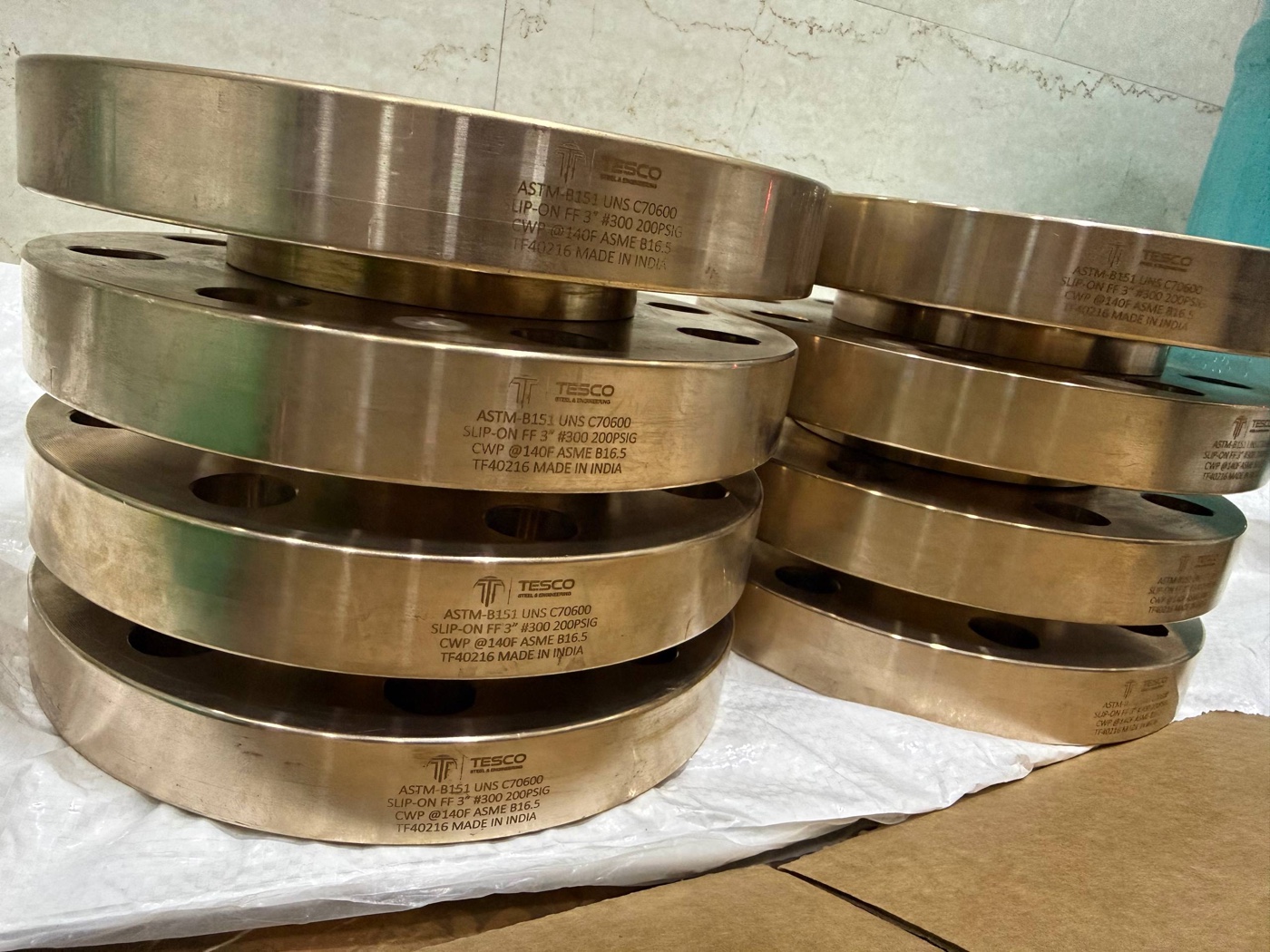
Tesco ASTM B151 UNS C70600 Slip-On FF 3″ × 300# ASME B16.5 — Laser-Marked, Made in India
Slip on flanges are the most widely used flange type in industrial piping worldwide. A slip on flange has a bore slightly larger than the pipe's outer diameter, allowing it to slide over the pipe end before being secured with two fillet welds — one on the hub (outside) and one on the bore (inside). Standardised under ASME B16.5 for NPS ½″–24″ and ASME B16.47 for NPS 26″–60″ (and up to 80″ on request), they offer a cost-effective, structurally sound connection for general-purpose process piping. Tesco Steel & Engineering, an ISO 9001:2015-certified manufacturer in Mumbai, India, produces slip on flanges in 50+ material grades to nine international standards — supplying EPC contractors, distributors, and OEMs across 50+ countries.
Compared with weld neck flanges, slip on flanges are lighter, easier to align on site (cut length accuracy is less critical), and typically 20–30% less expensive in material and fabrication cost. Their low hub profile makes them ideal for large-bore water, utility, and process piping. Tesco Steel supplies slip on flanges with raised face (SORF), flat face (SOFF), and ring-type joint (SORTJ) facing options, with all surface finishes per ASME B16.5 or equivalent international standards.
At a glance: a slip on flange = a bored flange that slides over the pipe + two fillet welds (hub outside, bore inside) with the pipe set back 1/8″ from the face. It is the most economical hubbed flange — 20–30% cheaper than weld neck, forgiving of pipe cut length, available to 80″ NB. Specify it by five things: size, pressure class, facing (RF/FF/RTJ), material grade and standard.
Why Choose Slip On Flanges for Your Piping System
▶ Lower Cost Than Weld Neck
Slip on flanges require less machining than weld neck flanges — no long tapered hub to bore and turn. Shorter hub also means less material weight. This results in 20–30% lower per-unit cost, making slip ons the economical choice for large-volume or large-bore piping projects.
▶ Easy On-Site Fit-Up
The flange slides over the pipe end before welding, so precise pipe cut length is not critical. This simplifies field assembly, reduces re-cutting, and accelerates installation — especially on large bore water treatment, HVAC, and structural piping where accurate cuts are difficult.
▶ Widest Size Range
Available from NPS ½″ to 80″, slip on flanges cover every bore size from instrument-scale to large-diameter water mains. Tesco Steel produces slip ons to ASME B16.5, B16.47, EN 1092-1, DIN, JIS, BS, AS, AWWA, SABS, and NFE standards — the broadest multi-standard availability in our range.
▶ Dual Weld for Structural Integrity
Two fillet welds (hub and bore) give the joint comparable strength and leak resistance to a butt-welded connection. The bore weld seals the annular gap between pipe OD and flange bore, preventing fluid ingress and crevice corrosion at the interface.
▶ SORF & SOFF Options
Raised face (SORF) for standard spiral-wound gaskets and most process applications; flat face (SOFF) for pairing with cast iron, ductile iron, or GRP flanges where a raised face would impose bending stress. Both available in all pressure classes and materials.
▶ Ready Stock — Fast Delivery
Tesco Steel maintains ready stock of SORF and SOFF flanges in NPS ½″–24″, Class 150–600, SS 304/316 and A105. Custom sizes, higher classes, and exotic alloys are manufactured on order. Mill Test Certificates per EN 10204 3.1/3.2 ship with every order.
How Our Slip On Flanges Are Manufactured
1
Forging or plate cutting — certified heats are hot-forged (or profiled from certified plate for large-bore AWWA sizes), keeping full heat traceability from raw material to despatch.
2
Heat treatment — normalizing for carbon steel, solution annealing for stainless and nickel grades, with the thermal record retained per heat.
3
Machining — faces, hub and bolt holes to the dimensional standard; the bore machined slightly over pipe OD per the standard's slip-on bore tolerance so the flange slides over the pipe cleanly.
4
Facing & finish — raised face serrations (stock finish per ASME B16.5), flat face, or RTJ groove as ordered.
5
Testing & marking — mechanical and chemical verification against the heat, PMI where specified, then permanent laser marking: grade, size, class, standard and traceability number — exactly as visible on the photos on this page.
6
Certification & packing — EN 10204 3.1 MTC (3.2 witnessed on request), faces protected, export-packed.
Slip On Flange Specifications
| Slip On Flanges — Full Specification Range |
|---|
| Size Range | NPS ½″ to 80″ (DN 15 to DN 2000); ASME B16.5 up to NPS 24″; ASME B16.47 up to NPS 60″+ |
| Pressure Class | Class 150, 300, 400, 600, 900, 1500, 2500 (ASME B16.5); Class B, D, E, F (AWWA C207) |
| PN Rating | PN 2.5, PN 6, PN 10, PN 16, PN 25, PN 40, PN 63, PN 100, PN 160, PN 250, PN 320, PN 400 |
| Facing Types | Raised Face (RF / SORF), Flat Face (FF / SOFF), Ring-Type Joint (RTJ / SORTJ) |
| Governing Standards | ASME B16.5, ASME B16.47, EN 1092-1, DIN, JIS, BS 4504, BS 10, AS 2129, AS 4087, AWWA C207, SABS 1123, NFE 29203 |
| Carbon Steel | ASTM A105 |
| LTCS Slip On Flanges | ASTM A350 LF2 |
| Stainless Steel Slip On Flanges | ASTM A182 F304 / F304H / F304L / F316 / F316H / F316L / F316Ti / F309 / F310 / F317 / F317L / F321 / F347 / F904L |
| Alloy Steel Slip On Flanges | ASTM A182 F5 / F9 / F11 / F12 / F21 / F22 / F91 |
| Duplex & Super Duplex Slip On Flanges | ASTM A182 F51 (UNS S31803), F53 (S32750), F55 (S32760), F60 (S32205) |
| Nickel Alloy Slip On Flanges | UNS N02200, UNS N02201 |
| Monel Slip On Flanges | UNS N04400 (Monel 400), UNS N05500 (Monel K500), Alloy 20 |
| Inconel / Incoloy Slip On Flanges | UNS N06600, N06601, N06625, N08800, N08810, N08825 |
| Hastelloy Slip On Flanges | UNS N10276 (C276), N06022 (C22), N10665 (B2), N06455 (C4) |
| Copper Nickel Slip On Flanges | C70600 (90/10 CuNi), C71500 (70/30 CuNi), C71640 |
| Titanium Slip On Flanges | Grade 1, Grade 2, Grade 3, DTH 3.7035, DTH 3.7055 |
| Surface Coatings / Treatments | Hot-Dip Galvanizing (GI), Sand Blasting, Shot Peening, Epoxy Coating, FBE Coating |
| Certifications | ISO 9001:2015, PED 2014/68/EU, NACE MR0175, EN 10204 3.1 / 3.2 Mill TC, IBR |
Slip On vs Weld Neck vs Socket Weld vs Blind — Comparison
| Factor |
Slip On |
Weld Neck |
Socket Weld |
Blind |
| NPS Range | ½″ – 80″ | ½″ – 60″+ | ½″ – 4″ | ½″ – 60″+ |
| Welds Required | 2 fillet welds | 1 butt weld | 1 fillet weld | No weld (blind) |
| Pipe Cut Accuracy | ✓ Forgiving | ✗ Precise | ✗ Precise | N/A |
| Radiographic Inspection | ✗ Limited | ✓ Full RT | ✗ Not possible | N/A |
| Cost vs Weld Neck | ✓ ~20–30% lower | Baseline | ✓ Lower | Higher |
| Cyclic / Fatigue Service | Acceptable | ✓ Best | Acceptable | ✓ Good |
| Large Bore (>24″) | ✓ Yes (B16.47) | ✓ Yes (B16.47) | ✗ No | ✓ Yes |
| Line Closure / Isolation | ✗ No | ✗ No | ✗ No | ✓ Yes |
Industries & Applications
| Industry | Typical Slip On Flange Application |
|---|
| Oil & Gas | Crude oil transfer headers, tank farm piping, utility water lines on onshore facilities |
| Petrochemical | Process plant utility headers, cooling water systems, non-critical process lines in A105 or SS 316L |
| Water & Wastewater | Large-bore water mains (AWWA C207), sewage piping, desalination plant headers in duplex or CuNi |
| Power Generation | Cooling water, condensate, and auxiliary steam systems; ash slurry in epoxy-coated A105 |
| Construction & HVAC | Building services chilled water, fire protection, compressed air; galvanized slip ons for structural pipe supports |
| Shipbuilding & Marine | Ballast water systems, fuel oil lines, seawater cooling in Copper Nickel 90/10 per BS 4504 |
| Food & Pharmaceutical | Clean utilities (CIP/SIP) in SS 316L; hygienic flat face flanges mating with PTFE-lined pipe |
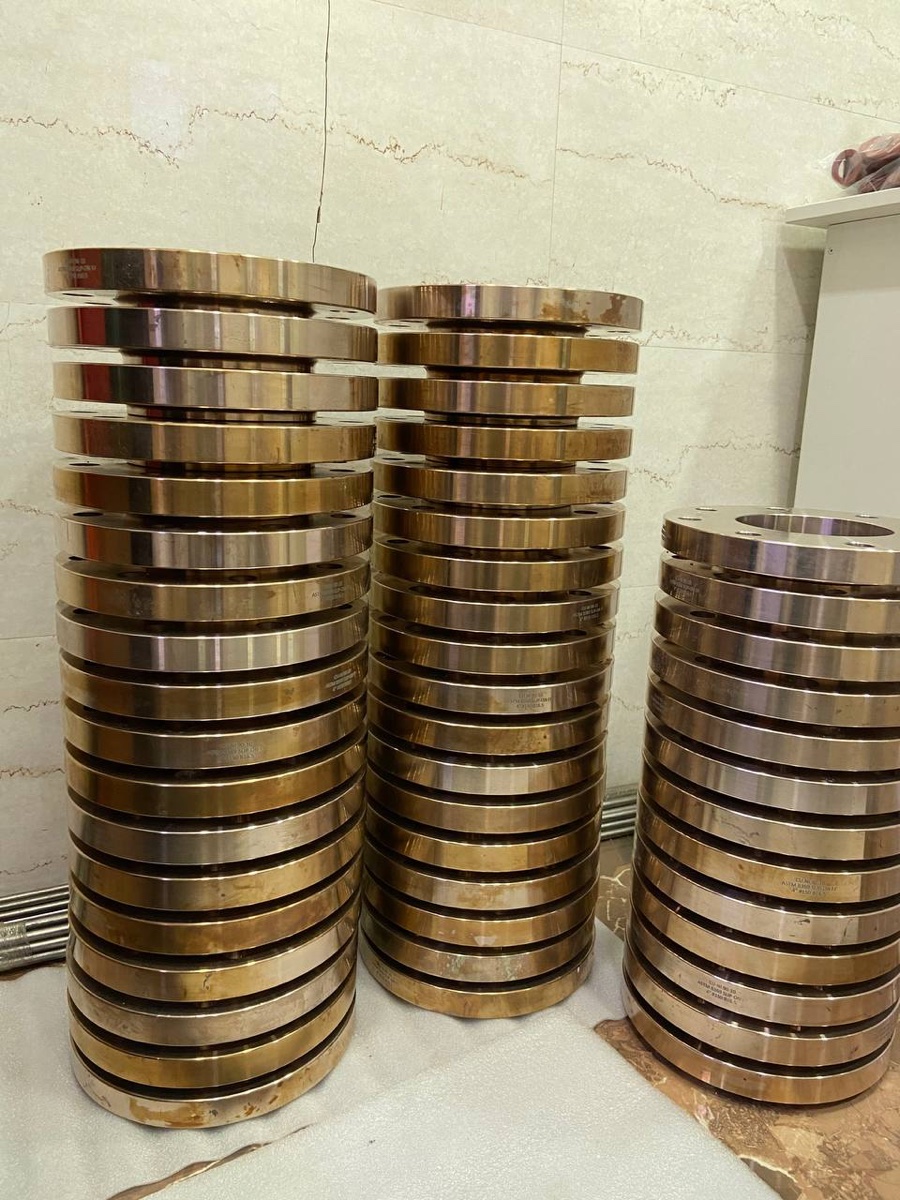
Copper-Nickel Slip On Flanges in Production — Marine & Seawater Duty — see C70600 Slip On Flanges
Slip On Flange Dimensions by Standard
Note: Click any link below to view full dimension tables. All tables include flange OD, bolt circle, bolt hole count and size, flange thickness, hub OD, and bore dimensions per the respective standard and pressure class.
JIS (Japanese Industrial Standard)
Australian Standard (AS 2129 & AS 4087)
NFE 29203 (French Standard)
SANS / SABS 1123 (South African Standard)
Browse by Material & Grade
Global Export Destinations
Tesco Steel & Engineering exports slip on flanges to: UAE, Saudi Arabia, Kuwait, Qatar, Oman, Bahrain, Iraq (GCC & Middle East); USA, Canada, Mexico, Venezuela, Colombia, Peru (Americas); Germany, Italy, Netherlands, UK, Turkey, Russia, Kazakhstan (Europe & CIS); Nigeria, South Africa, Kenya, Tanzania, Zambia, Angola, Congo, Sudan (Africa); India, Malaysia, Thailand, Indonesia, Philippines, Vietnam, Singapore, China, Japan (Asia-Pacific); and Australia, Israel, Jordan, Afghanistan, Pakistan, Yemen. Domestic supply covers all major industrial hubs across India.
How to Specify & Order a Slip On Flange
A complete slip on flange specification has five elements. State all five and any supplier in the world can quote it without a single clarification email:
1
Size & standard — nominal bore and dimensional standard, e.g. 6″ NB ASME B16.5, DN200 EN 1092-1 Type 01, or 30″ AWWA C207.
2
Pressure class or PN rating — Class 150/300/600/900/1500, PN 6–PN 40 for European patterns, or AWWA Class B/D/E/F for water mains.
3
Facing — RF (SORF, default), FF (SOFF, for cast iron / GRP mates) or RTJ (SORTJ).
4
Material grade — e.g. ASTM A105, A182 F316L, A350 LF2, B151 C70600 — the slip-on bore suits the pipe OD, so no schedule is needed for the bore, though stating the pipe spec helps us verify.
5
Certification & quantity — EN 10204 3.1 or 3.2, NACE MR0175, PED or IBR as required, plus quantity and destination — sent to
sales@tescosteel.com or the
inquiry form.
Example of a complete line item: “Slip On Flange, 8″ NB, ASME B16.5 Class 150, RF, ASTM A182 F316L, EN 10204 3.1 — 40 pcs.”
Frequently Asked Questions — Slip On Flanges
What is a slip on flange? ▼
A slip on flange (also abbreviated SORF for raised face, or SOFF for flat face) is a pipe flange with a bore slightly larger than the pipe OD, allowing it to be slipped over the pipe end. It is then secured with two fillet welds — one at the hub (outside face) and one at the bore (inside). Standardised under ASME B16.5 for NPS ½″–24″ and ASME B16.47 for larger sizes, slip on flanges are the most widely used and cost-effective flange type in industrial piping worldwide.
How is a slip on flange welded to a pipe? ▼
Slip on flange welding requires two fillet welds: (1) an outside hub fillet weld at the front face of the hub, and (2) an inside bore fillet weld at the back of the bore. Per ASME B31.3, the pipe should be set back approximately 1/8″ (3 mm) from the flange face before tack welding to provide room for the inside fillet. Minimum weld size per ASME B16.5 is equal to the pipe wall thickness, but not less than 3/16″ (5 mm). Both welds must be inspected per the applicable piping code (visual, PT, MT, or RT as required).
What ASME standard governs slip on flange dimensions? ▼
ASME B16.5 (Pipe Flanges and Flanged Fittings, NPS ½ through 24) covers slip on flanges in Class 150 through 2500. ASME B16.47 covers large-diameter slip on flanges in NPS 26 through 60 (Series A per MSS SP-44 and Series B per API 605). European equivalents: EN 1092-1 Type 01. Other standards: DIN, JIS, BS 4504, BS 10, AS 2129, AS 4087, AWWA C207, SABS/SANS 1123, NFE 29203.
What is the difference between SORF and SOFF flanges? ▼
SORF (Slip On Raised Face): The flange face has a concentric raised ring — 1/16″ high for Class 150 and 300; 1/4″ for Class 600 and above — that focuses bolt preload on the gasket seating area, improving sealing efficiency. Most common facing for process piping with spiral-wound or ring gaskets.
SOFF (Slip On Flat Face): The entire face is flat, mating with a full-face gasket covering bolt holes. Required when connecting to cast iron, ductile iron, or GRP flanges where a raised face would impose bending stress and risk cracking the mating flange. Also used in AWWA water supply piping per standard practice.
When should I choose slip on flanges over weld neck flanges? ▼
Choose slip on flanges for: general process and utility piping where cost savings matter; large-bore water, cooling, or HVAC lines; applications where pipe cut length accuracy is difficult; and services where radiographic weld inspection is not mandatory.
Choose weld neck flanges for: severe cyclic or fatigue service; cryogenic pipelines; ASME B31.3 Category M fluids; applications where radiographic inspection is required; high-pressure steam or hydrogen service. The butt weld of a weld neck gives lower stress concentration and is fully inspectable by RT — advantages a slip on cannot match.
What materials are available for slip on flanges? ▼
Tesco Steel manufactures slip on flanges in: Carbon Steel (ASTM A105); LTCS (A350 LF2); Stainless Steel (A182 F304/304L/316/316L/321/347/904L); Alloy Steel (A182 F5/F9/F11/F22/F91); Duplex & Super Duplex (F51/F53/F55/F60); Monel (N04400/N05500); Inconel/Incoloy (N06600/N06625/N08825); Hastelloy (C276/C22); Titanium (Gr.1/Gr.2); and Copper Nickel (C70600/C71500). All grades ship with EN 10204 3.1 or 3.2 Mill Test Certificates.
What weld size is required for a slip on flange? ▼
Per ASME B16.5 and ASME B31.3, both the hub fillet weld and the bore fillet weld must have a throat size equal to the pipe wall thickness (schedule), but not less than 3/16″ (approximately 5 mm). Weld procedure qualification per ASME Section IX applies. The pipe end must be set back 1/8″ (3 mm) from the flange face before the inside weld is applied. Over-welding (excessively large fillets) can distort the flange face and compromise gasket seating.
Can slip on flanges be used on large bore piping above 24 inches? ▼
Yes. ASME B16.5 covers slip on flanges to NPS 24″. For NPS 26″ through 60″, ASME B16.47 Series A (formerly MSS SP-44) and Series B (formerly API 605) define large-diameter flange dimensions, including slip on types. Tesco Steel manufactures slip on flanges up to 80″ NB in carbon steel, stainless steel, and alloy grades per customer drawings or applicable standards. AWWA C207 covers slip on flanges for water mains up to very large diameters in Class B, D, E, and F.
How much does a slip on flange weigh? ▼
Less than the equivalent weld neck flange, because there is no long tapered hub. As working approximations for carbon steel ASME B16.5 slip on flanges: a 2" Class 150 weighs about 2 kg, a 6" Class 150 about 8 kg, a 12" Class 150 about 24 kg, and a 24" Class 300 roughly 150 kg — with large AWWA and B16.47 sizes quoted case by case. Stainless and nickel alloys weigh essentially the same as carbon steel. The complete size-by-size table is on our Flange Weight Chart page, and every quotation states the exact unit weight.
What is the difference between a slip on flange and a plate flange? ▼
A slip on flange is a forged flange with a short hub, made to pressure-class standards (ASME B16.5 Class 150-2500) and attached with two fillet welds. A plate flange is a flat ring cut or forged without any hub, used at low pressures — typically to EN 1092-1 Type 01 PN 6/PN 10/PN 16 or DIN 2573/2576 patterns — for water, air and non-critical utility lines. The slip on's hub adds stiffness and a second weld path, giving it a higher pressure capability; the plate flange answers with the lowest possible cost. Tesco manufactures both types.
Are slip on flanges suitable for high-pressure service? ▼
ASME B16.5 dimensions slip on flanges through Class 1500 (and Class 2500 in small bores), so they are available for high ratings — but engineering practice increasingly favours weld neck flanges from Class 600 upward, and most piping specifications mandate weld necks for severe cyclic service, hydrogen, category M fluids and wherever radiographic weld examination is required, because the slip on's fillet welds cannot be radiographed. In practice slip ons dominate Class 150 and 300 general service, and weld necks take over as pressure, temperature and consequence rise.
Which gasket is used with a slip on flange? ▼
The facing decides. Raised face (SORF) flanges seat the same gaskets as any RF flange — spiral wound with inner/outer rings, compressed non-asbestos (CNAF) sheet, or PTFE — sized to ASME B16.20/B16.21. Flat face (SOFF) flanges use a full-face gasket that covers the entire face including the bolt holes, protecting brittle cast iron or GRP mating flanges from bending stress. Ring-type joint (SORTJ) versions take solid metal ring gaskets. State the service medium and temperature and we can advise the gasket style alongside the flange quotation.
What details are needed to get an accurate slip on flange quotation? ▼
Five specification elements plus commercial terms: (1) size and dimensional standard — e.g. 8" NB ASME B16.5 or DN200 EN 1092-1 Type 01; (2) pressure class or PN rating; (3) facing — RF, FF or RTJ; (4) material grade — e.g. ASTM A105, A182 F316L, A350 LF2, B151 C70600; (5) certification — EN 10204 3.1 or 3.2, NACE MR0175, PED or IBR as applicable. Add the quantity and destination and we return price, weight and delivery — normally within 24 hours.
Who manufactures slip on flanges in India? ▼
Tesco Steel & Engineering is an ISO 9001:2015 certified flange manufacturer based in Mumbai, India, producing slip on flanges across the full material range — carbon steel A105, LTCS A350 LF2, stainless and duplex A182 grades, chrome-moly F5-F91, and nickel alloys, Hastelloy, titanium and copper-nickel. Flanges are made to ASME B16.5, B16.47, EN 1092-1, DIN, JIS, BS, AS 2129/4087, AWWA C207 and SABS standards, supplied with EN 10204 3.1/3.2 certification, and exported to more than 50 countries across the Middle East, Europe, Africa, Asia and the Americas.
Get a Quote for Slip On Flanges
Specify NPS, pressure class, standard, material, facing, and quantity — we respond within 24 hours with price and lead time.
Send Inquiry
WhatsApp Us

