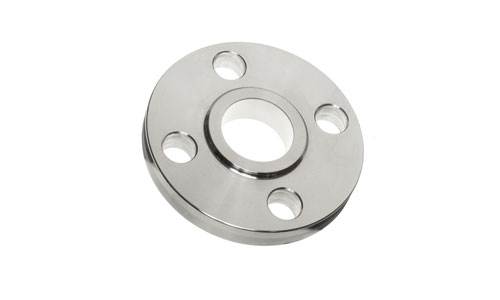
Tesco Steel & Engineering forges ASTM A182 F51 slip on flanges — duplex stainless steel 2205, the 22Cr-5Ni-3Mo-N grade whose half-austenite, half-ferrite structure delivers roughly twice the yield strength of 316L plus resistance to chloride pitting and stress-corrosion cracking — to ASME B16.5 Class 150–2500 from ½″ to 24″ NB, larger patterns to order. The workhorse of offshore oil & gas, seawater, brine and chemical duty, supplied solution annealed, faced SORF (flat face or RTJ where specified), commonly dual-certified S31803/S32205, with F53 and F55 super duplex from the same forge. NACE MR0175 supply on request; every lot with EN 10204 3.1/3.2 MTC. ISO 9001:2015, made in Mumbai, India — exported to 50+ countries.
ASTM A182 F51 · SA182 · S31803Duplex 2205 · 1.4462 · PREN ≈ 34ASME B16.5 Class 150–2500½″ – 24″ NB · SORF620 MPa TS / 450 MPa YS minNACE MR0175 / ISO 15156EN 10204 3.1 / 3.2 · ISO 9001:2015
ASTM A182 F51 Duplex Steel Slip On Flange — Raised Face (SORF)
What is an ASTM A182 F51 Slip On Flange?
F51 = duplex 2205, the chloride workhorse.ASTM A182 F51 (UNS S31803) is a duplex stainless steel: half austenite, half ferrite, 22Cr-5Ni-3Mo-N, PREN ≈ 34. It brings ~2.5× the yield strength of 316L and shrugs off the chloride pitting and stress-corrosion cracking that retire austenitic stainless in seawater and brine. As a slip-on, it installs with two fillet welds using ER2209 filler and controlled heat input — no preheat, no PWHT.
Also searched as: duplex slip on flange, 2205 slip on flange, S31803 slip on flange, F51 SORF flange, SA182 F51 slip on flange, 1.4462 slip on flange, duplex steel SORF — all refer to the product on this page.
Super duplex with Cu+W — severe seawater & sour duty
PREN (Pitting Resistance Equivalent Number = %Cr + 3.3×%Mo + 16×%N) ranks chloride pitting resistance — the duplex family's ladder is climbed by water chemistry and temperature, not pressure.
ASTM A182 F51 (UNS S31803) Chemical Composition
C
Mn
Si
P
S
Cr
Ni
Mo
N
Fe
0.030 max
2.00 max
1.00 max
0.030 max
0.020 max
21.0-23.0
4.5-6.5
2.5-3.5
0.08-0.20
Bal
Values in weight % per ASTM A182 for UNS S31803. The Cr-Mo-N trio sets the pitting resistance (PREN ≈ 34); the modest nickel keeps duplex more price-stable than high-nickel austenitics. The tightened S32205 (F60) sits in the upper half of these ranges — most modern heats certify to both.
ASTM A182 F51 Mechanical Properties
Tensile Strength, MPa (ksi)
Yield Strength, Min, MPa (ksi)
Elongation % min (2")
Hardness, HB max
620 (90) min
450 (65) min
25
290
That yield is roughly 2.5× the 170 MPa of 316L — the property that lets duplex systems run thinner walls and lighter components for the same pressure. Supplied solution annealed; values demonstrated per heat on the EN 10204 certificate, hardness verified for NACE lots.
A182 F51 Slip On Flange Specifications
ASTM A182 F51 Slip On Flanges are available in the following specifications:
Material
ASTM A182 F51 / ASME SA182 F51 (UNS S31803, Duplex 2205); dual-certified S32205/F60 where the heat qualifies
Size
1/2"NB to 24"NB per ASME B16.5; larger patterns and EN 1092-1 duplex flanges to order
Class
150#, 300#, 400#, 600#, 900#, 1500#, 2500#
Facing
Raised Face (SORF) — default; Flat Face or RTJ where the piping class specifies
Heat Treatment
Solution annealed per ASTM A182, thermal record retained
Service
Chloride, seawater, brine & sour duty — typically -50 °C to +250 °C per project specifications
Installation
Two fillet welds (hub + bore), pipe set back 1/8"; ER2209 filler, controlled heat input, no preheat, no PWHT
Sour Service
NACE MR0175 / ISO 15156 listed material — supplied with hardness verification within the standard's limits
Certification
EN 10204 3.1 (standard) / 3.2 witnessed
Equivalent Grades of ASTM A182 F51
Standard
ASME
UNS
Werkstoff Nr.
EN
Common Name
ASTM A182 F51
SA182 F51
S31803
1.4462
X2CrNiMoN22-5-3
Duplex 2205
System partners: ASTM A790 duplex pipe and A815 fittings in the same UNS number — the duplex trio of seawater and process lines. Certificates always state the actual grade forged, including dual S31803/S32205 certification where the heat qualifies.
Why A182 F51 Slip Ons Are Specified
2.5× the Yield of 316L
450 MPa minimum yield lets designers run thinner walls and lighter flanges for the same pressure — strength that partially pays back the alloy premium.
Shrugs Off Chloride SCC
The ~50% ferrite interrupts the crack path that retires 304/316 in warm coastal and brine service — the failure mode duplex was invented to stop.
PREN 34 Pitting Resistance
Cr-Mo-N chemistry holds its passive film in produced water, brine and most chloride process streams where 316L pits within seasons.
Sour-Service Listed
Duplex 2205 is a NACE MR0175 / ISO 15156 listed material — the standard flange of produced-water and wet sour systems within the code's limits.
Know the Handoffs
Hot seawater and the harshest offshore duty: super duplex F53/F55 (PREN ≥ 40). Mild indoor duty: 316L stays cheaper. Critical RT-mandated lines: F51 weld necks.
How Our A182 F51 Slip On Flanges Are Manufactured
1
Forging — cut billet of certified A182 F51 heat is hot-forged into the flange blank, keeping full heat traceability from raw material to despatch.
2
Solution annealing — heated and quenched per ASTM A182 to restore the balanced ~50/50 austenite-ferrite structure and dissolve any deleterious phases; furnace record retained.
3
Machining — hub, faces and bolt holes to ASME B16.5; the bore machined slightly over pipe OD per the slip-on tolerance.
4
Facing & finish — SORF raised face with serrated stock finish, flat face or RTJ groove; pickled and passivated on request.
5
Testing & marking — mechanical, chemical and hardness verification against the heat (corrosion and ferrite testing where the order specifies), then permanent marking of grade, size, class and heat number.
6
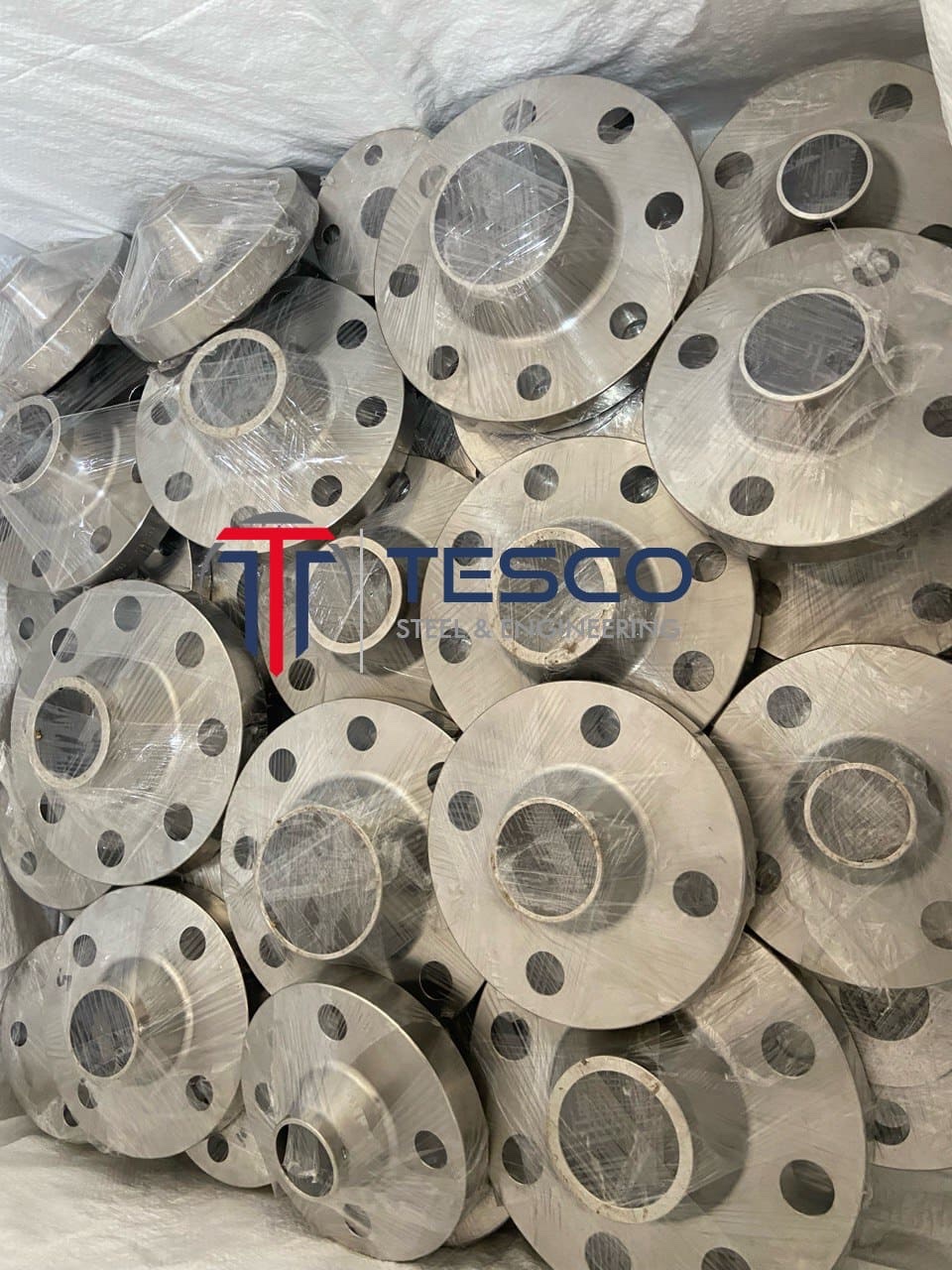
Certification & packing — EN 10204 3.1 MTC (3.2 witnessed on request), export-packed as pictured on this page.
Where A182 F51 Slip On Flanges Are Used
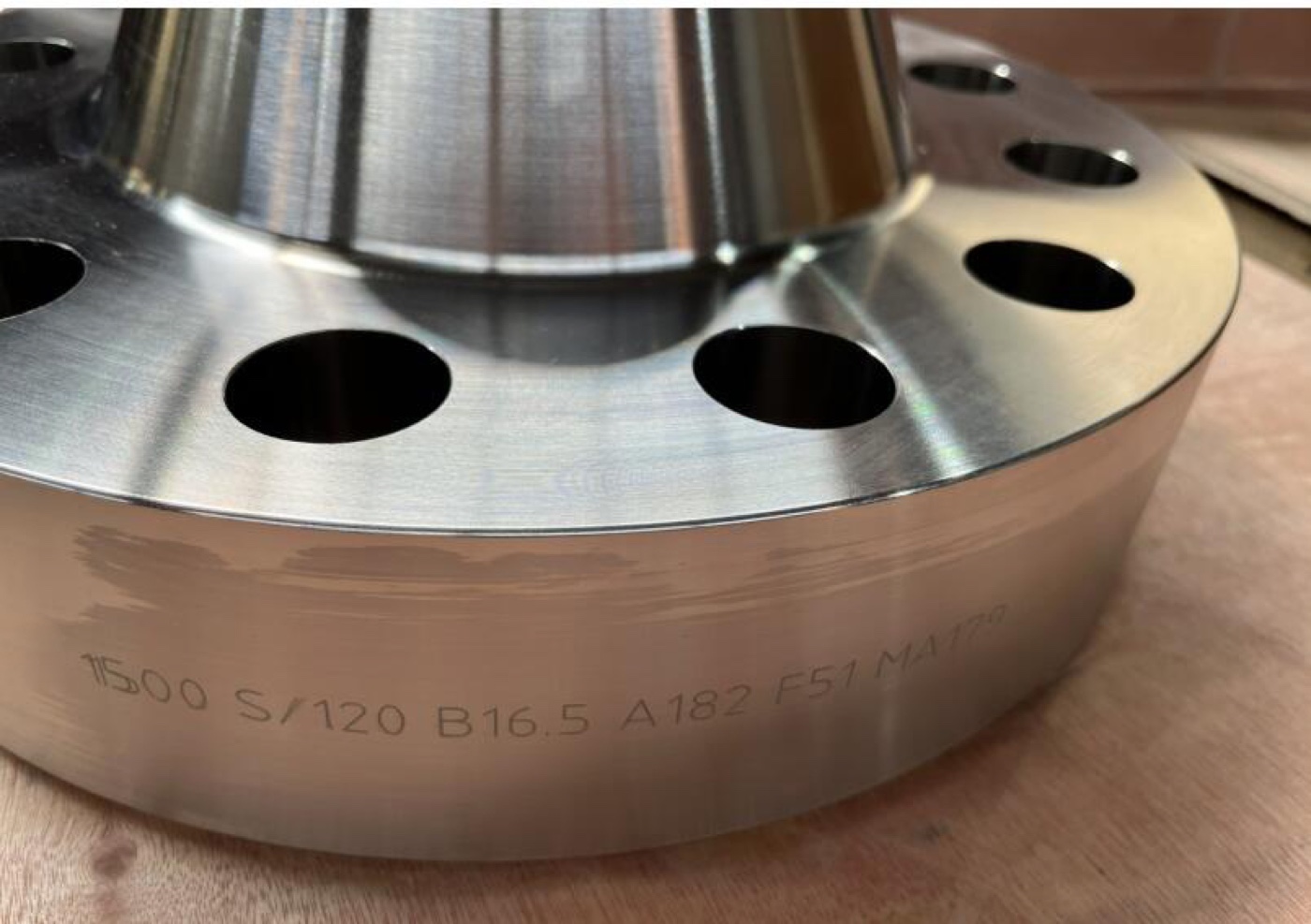
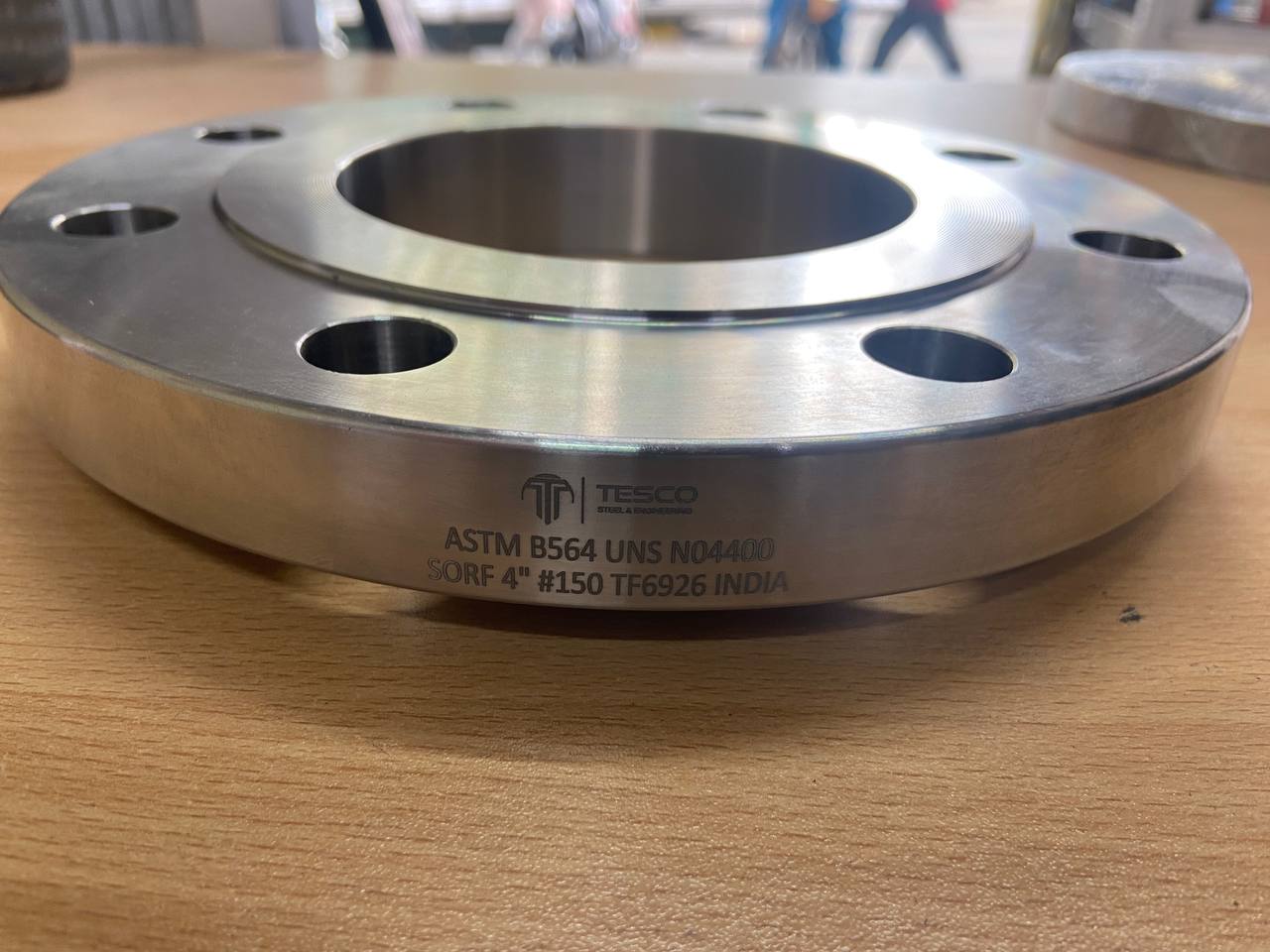
Wherever chlorides retire ordinary stainless: offshore oil and gas process and produced-water systems, seawater cooling and intake lines, desalination plants, chemical tankers and cargo systems, brine and chlor-alkali service, flue-gas desulfurization, pulp and paper, and coastal plants where 316L keeps failing. Our duplex production and packing below:
A182 F51 Flanges — 6″ Class 1500, RTJ FacingF51 Duplex Flanges — Packed for DispatchF51/F60 Duplex Slip On SORF — 4″ Class 150, Laser-Marked
A182 F51 Slip On Flange Dimensions
F51 slip-on dimensions follow the ASME B16.5 slip-on tables — identical for every material. Full charts by class:
Example: “Slip On Flange, 4″ NB, ASME B16.5 Class 150, RF, ASTM A182 F51 (S31803/S32205 dual), EN 10204 3.1 — 30 pcs.” Quotations normally within 24 hours with price, unit weight and delivery.
ASTM A182 F51 Slip On Flanges — Frequently Asked Questions
What is an ASTM A182 F51 slip on flange?
It is a slip-on flange forged from ASTM A182 F51 — duplex stainless steel 2205 (UNS S31803) — dimensioned to ASME B16.5. The flange slides over the pipe end and is secured with two fillet welds, and the 22Cr-5Ni-3Mo-N duplex chemistry delivers roughly twice the yield strength of 316L together with resistance to chloride pitting and stress-corrosion cracking. It is the workhorse corrosion-resistant flange of offshore oil and gas, seawater and brine service.
What is duplex stainless steel?
A stainless steel solidified as roughly half austenite, half ferrite — hence 'duplex'. The two-phase structure combines the best of both families: the ferrite contributes high strength and resistance to chloride stress-corrosion cracking, the austenite contributes toughness and weldability, and the nitrogen-boosted chemistry resists pitting. The balance is set in the mill by chemistry and solution annealing, which is why heat input during welding must be controlled to preserve it.
What is the chemical composition of ASTM A182 F51?
Per ASTM A182 for UNS S31803: carbon 0.030% max, manganese 2.00% max, silicon 1.00% max, phosphorus 0.030% max, sulphur 0.020% max, chromium 21.0-23.0%, nickel 4.5-6.5%, molybdenum 2.5-3.5% and nitrogen 0.08-0.20%. The chromium-molybdenum-nitrogen trio sets the pitting resistance (PREN about 34); the modest nickel is what makes duplex more price-stable than high-nickel austenitics.
What are the mechanical properties of A182 F51 slip on flanges?
Per ASTM A182: tensile strength 620 MPa (90 ksi) minimum, yield strength 450 MPa (65 ksi) minimum, elongation 25% minimum in 2", and hardness 290 HB maximum. That yield is roughly 2.5 times 316L's 170 MPa — the property that lets duplex systems run thinner walls and lighter flanges for the same pressure. Values are demonstrated per heat on the EN 10204 certificate.
When is F51 duplex chosen over 316L stainless steel?
When chlorides threaten or strength pays. 316L pits in warm chloride water and cracks by chloride stress corrosion above about 60 °C; F51's higher chromium, molybdenum and nitrogen resist the pitting and its duplex structure resists the cracking. Add 2.5 times the yield strength — thinner, lighter components — and F51 is the standard upgrade for seawater, brine, produced water and coastal plants where 316L keeps failing.
What is the difference between F51 (S31803) and F60 (S32205)?
S32205 is the tightened modern version of the same 2205 alloy: its chromium (22.0-23.0%), molybdenum (3.0-3.5%) and nitrogen (0.14-0.20%) minimums sit in the upper half of S31803's ranges, guaranteeing the corrosion performance that a lean S31803 heat might miss. Most modern duplex heats are dual-certified S31803/S32205, so F51/F60 flanges commonly carry both designations. Where a specification names S32205 or F60 explicitly, we certify accordingly.
What is the difference between duplex F51 and super duplex F53/F55?
Pitting resistance. F51 (2205) carries a PREN around 34 — ample for brine, produced water and most chloride process duty. Super duplex F53 (S32750) and F55 (S32760) push chromium, molybdenum and nitrogen to a PREN of 40 or more, plus roughly 550 MPa yield — the grades for hot seawater, firewater ring mains and the harshest offshore service. Where F51 survives, it is the more economical choice; the water chemistry and temperature decide.
What temperature range can F51 duplex slip on flanges handle?
Roughly -50 °C to +250 °C in common specification practice — deliberately narrower than austenitic stainless. Above about 300 °C the ferrite phase embrittles (the '475 °C embrittlement'), and extended exposure near 700-900 °C precipitates sigma phase, so codes and project specs cap duplex service temperature. At the cold end, toughness is impact-verified rather than assumed. Inside that window, duplex is hard to beat for chloride duty.
Why does duplex resist chloride stress-corrosion cracking?
Because of the ferrite. Chloride SCC propagates readily through austenite — which is why 304/316 piping cracks in warm coastal and brine service — but the roughly 50% ferrite in duplex interrupts the crack path and carries load even if the austenite is attacked. Combined with the nitrogen-boosted pitting resistance that prevents the initiating pits in the first place, F51 survives chloride environments that retire austenitic stainless early.
How is an A182 F51 slip on flange welded to pipe?
With two fillet welds — hub outside, bore inside, pipe set back 1/8" (3 mm) — using over-alloyed ER2209 filler and controlled heat input, typically 0.5-2.5 kJ/mm with interpass below about 150 °C. The controls protect the austenite-ferrite balance: too cold a weld leaves excess ferrite, too hot risks sigma phase. No preheat and no PWHT are used — post-weld heat treatment other than full solution annealing harms duplex rather than helping it.
What is the equivalent of ASTM A182 F51 in other standards?
ASME SA182 F51 is the boiler-code twin; UNS S31803 the designation; EN X2CrNiMoN22-5-3 (Werkstoff 1.4462) the European equivalent — all describing duplex 2205. System partners specified alongside it: ASTM A790 duplex pipe and A815 fittings in the same UNS number. Certificates always state the actual grade forged, including dual S31803/S32205 certification where the heat qualifies.
Is A182 F51 suitable for sour service under NACE MR0175?
Yes — duplex 2205 is a listed material in NACE MR0175 / ISO 15156, widely used for produced water and wet sour hydrocarbon systems, subject to the standard's grade-specific limits on hardness, H2S partial pressure, chloride level and temperature. Solution-annealed forgings with verified hardness fit naturally within those limits. State the NACE requirement and the service conditions on the enquiry, and the flanges ship documented accordingly.
What sizes and classes are A182 F51 slip on flanges available in?
From ½" to 24" NB per ASME B16.5 in Classes 150 through 2500, with larger patterns and DIN/EN 1092-1 duplex flanges forged to order. Duplex is project material with volatile alloy pricing, so flanges are typically forged against the order — standard sizes normally dispatch within a few weeks with EN 10204 3.1 certification. State the required delivery on the enquiry and we confirm the schedule with the quotation.
What details are needed to get an accurate A182 F51 slip on flange quotation?
Five elements plus commercial terms: (1) size and standard — e.g. 4" NB ASME B16.5; (2) pressure class — 150 through 2500; (3) facing — SORF (raised face) default, flat face or RTJ where specified; (4) grade — ASTM A182 F51 (S31803), dual-certified S32205/F60 where required, NACE MR0175 where sour; (5) certification — EN 10204 3.1 or 3.2. No pipe schedule is needed for the slip-on bore. Add the quantity and destination and we return price, weight and delivery.
Who manufactures ASTM A182 F51 slip on flanges in India?
Tesco Steel & Engineering is an ISO 9001:2015 certified flange manufacturer based in Mumbai, India, forging ASTM A182 F51 duplex 2205 slip on flanges from ½" to 24" NB per ASME B16.5 — alongside F60 and the super duplex grades F53 and F55 — in solution-annealed condition with full heat traceability and EN 10204 3.1/3.2 certification on every lot. Flanges are marked with grade, size, class and heat number and export to more than 50 countries.