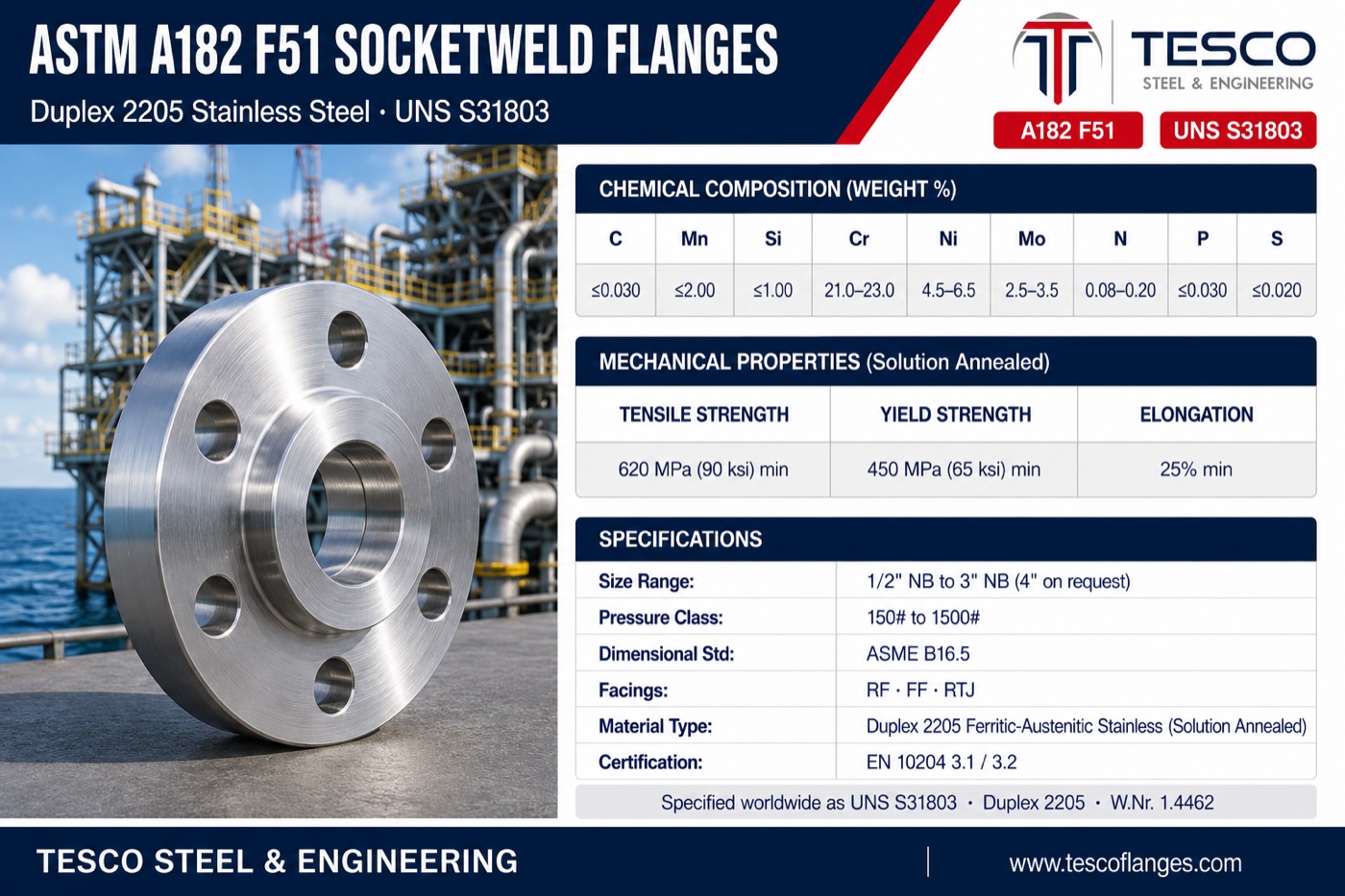
Tesco Steel & Engineering manufactures ASTM A182 F51 socketweld flanges — duplex 2205 stainless steel, UNS S31803, W.Nr. 1.4462 — to ASME B16.5 from ½″ to 3″ NB in Classes 150–1500. Duplex is the grade that rewrote offshore small bore: half ferrite, half austenite, 450 MPa yield — nearly double 316L — with PREN >34 and near-immunity to the chloride stress corrosion cracking that retires austenitics at 60 °C. Nitrogen-alloyed with a deliberate floor, extra-low carbon, solution annealed. Welding is a heat-input discipline, not a preheat one — and PWHT is prohibited, explained below; and the socket's built-in crevice deserves its own honest paragraph in duplex chloride service. Dual S31803/S32205 certification routine. Facings: SWRF, SWFF, SWRTJ. Hotter brine? F53 super duplex. Every lot with EN 10204 3.1/3.2 MTC. ISO 9001:2015, made in Mumbai, India — exported to 50+ countries.
A182 F51 · UNS S31803 · W.Nr. 1.4462Duplex 2205 — Half Ferrite, Half Austenite450 MPa Yield — ~2× 316LPREN >34 · Chloride SCC Off the MapDual S31803 / S32205 CertificationNo Preheat — No PWHT (Prohibited)ASME B16.5 ½″–3″ · Class 150–1500EN 10204 3.1 / 3.2 · ISO 9001:2015
ASTM A182 F51 Socketweld Flanges — Specifications at a Glance
What is an ASTM A182 F51 Socketweld Flange?
Duplex strength in the small-bore pattern. A forged duplex 2205 flange (ASTM A182 F51 / UNS S31803) with a machined socket: pipe seated square by geometry, one external fillet weld under duplex heat-input discipline, through-bore matched to the pipe schedule. Half ferrite, half austenite: 450 MPa yield with PREN >34 and chloride SCC essentially off the failure map — the offshore small-bore workhorse. Tensile ≥620 MPa, elongation ≥25%, solution annealed, N with a deliberate floor. Service band ~−50 to 300 °C. Sized by ASME B16.5 at ½″–3″ NB, Classes 150–1500; EN 10204 3.1 on every lot.
Also searched as: duplex 2205 socket weld flange, S31803 SW flange, F51 SWRF flange, 1.4462 socket weld flange, duplex stainless SW flange — all the same product family. Related pages: the facings — SWRF / SWFF / SWRTJ — the socketweld hub, the other F51 types — blind, weld neck, slip-on, F51 grade hub — the family neighbours F53 / F55 super duplex and the duplex hub.
Two Phases, Each Covering the Other's Weakness
Austenitic (316L)
Duplex 2205 (F51)
Super Duplex (F53/F55)
Yield
~205 MPa
450 MPa
550 MPa
PREN
~24
>34
≥40
Chloride SCC
Cracks from ~60 °C
Essentially immune
Essentially immune
Home duty
Clean chemistry, cryogenic
Brackish, produced water, process chlorides
Hot seawater, worst brines
Ferrite brings strength and SCC resistance; austenite brings toughness and weldability — the 50/50 balance is engineered by chemistry and preserved by solution annealing.
What the Duplex Recipe Buys
Nearly Double the Yield
450 MPa from the ferrite half plus nitrogen in the austenite half — Class 600–1500 chloride-service small bore without exotic alloys.
Nitrogen With a Floor
N 0.08–0.20% — a minimum, not a cap: it balances the phases and multiplies in the PREN formula at 16×. The little element that makes modern duplex work.
SCC Off the Failure Map
The failure that quietly retires 316L in warm chloride service — chloride stress corrosion cracking — is essentially removed by the ferrite half.
Welding Without PWHT — By Rule
Duplex takes no preheat and no PWHT ever — stress relief would embrittle it. The discipline is heat input and phase balance, and it belongs to the fabricator; details below.
ASTM A182 F51 Chemical Composition (UNS S31803)
Element
C
Mn
Si
Cr
Ni
Mo
N
P
S
Weight %
≤0.030
≤2.00
≤1.00
21.0–23.0
4.5–6.5
2.5–3.5
0.08–0.20
≤0.030
≤0.020
The design intent: Cr + Mo + 16×N give PREN >34; nickel deliberately rationed to a third of an austenitic's so half the structure stays ferrite; carbon extra-low for clean welds. Dual certification to S32205 (F60) is routine where the heat qualifies — see the FAQ. PMI reads the Cr-Ni-Mo-N signature on every piece.
ASTM A182 F51 Socketweld Flanges are available in the following specifications:
Material Grade
ASTM A182 F51 (UNS S31803), W.Nr. 1.4462 — duplex 2205; dual S31803/S32205 certification routine where the heat qualifies
Heat Treatment
Solution annealed — furnace records certified; no site heat treatment is ever permitted on duplex
Size
1/2"NB to 3"NB per ASME B16.5; 4″ and larger to order
Class
150#, 300#, 600#, 900#, 1500# (900# shares 1500# dimensions in most sizes); 2500# on request
Facings
Raised Face (SWRF), Flat Face (SWFF), Ring Type Joint (SWRTJ) with groove per B16.20
Bore
Socket bore to pipe OD; through-bore matched to pipe schedule (Sch 40/80/160 — 80/160 dominate offshore small bore)
Welding
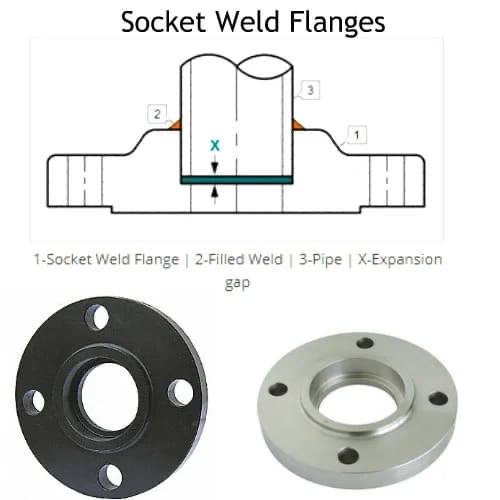
Single external fillet with 1/16″ expansion gap; duplex discipline — controlled heat input, 2209-type filler, no preheat, no PWHT
Service Span
Chloride process, produced water, firewater and offshore utility small bore, ~−50 to 300 °C; wet-chloride crevice caution applies — see the honest notes
Testing
Tension & chemistry per heat; PMI (Cr-Ni-Mo-N) on every piece; socket depth and bore gauged
Certification
EN 10204 3.1 with solution-anneal records (standard) / 3.2 witnessed; NACE MR0175 declaration where specified
Specification Notes — Getting Duplex Sockets Right
Four honest notes — the first is the big one.The socket crevice vs duplex chloride limits: crevice corrosion is exactly how chloride duty tests duplex, and the socket's built-in gap hands it the opening — offshore classes commonly butt-weld duplex wet-chloride lines and keep sockets for hydraulic, instrument, injection and gas duty; where the service is hot seawater under a gasket, the F51 weld neck or the super duplex family is the honest recommendation. Never heat treat duplex on site: stress relief between ~300–1000 °C grows embrittling phases — PWHT is prohibited, not optional. Respect both temperature walls: ~−50 °C below (ferrite goes brittle) and ~300 °C above (475 °C embrittlement window begins). And the 1/16″ gap stands — expansion against a bottomed socket cracks weld roots in any alloy.
How Our A182 F51 Socketweld Flanges Are Manufactured
1
Forging — cut billet of the spectro-verified F51 heat — Cr, Ni, Mo windows and the nitrogen floor confirmed — is hot-forged into the flange blank with full heat traceability and segregated stainless handling.
2
Solution annealing — the anneal-and-quench that sets the 50/50 phase balance; furnace charts retained against the heat number.
3
Machining — faces, OD and drilling to ASME B16.5; socket counterbore and depth gauged piece by piece, through-bore matched to the ordered schedule; RF serrations, flat face or RTJ groove per B16.20.
4
Testing — tension and full chemistry per heat; PMI reads the Cr-Ni-Mo-N signature on every piece — duplex and austenitic can never mix on our shelves.
5
Finishing & marking — pickled or natural machined finish; laser-marked with grade, size, class, schedule and heat number.
6
Certification & packing — EN 10204 3.1 MTC with solution-anneal records (3.2 witnessed on request); dual S31803/S32205 stated where the heat qualifies; packed sea-worthy with no carbon-steel contact.
Where ASTM A182 F51 Socketweld Flanges Are Used
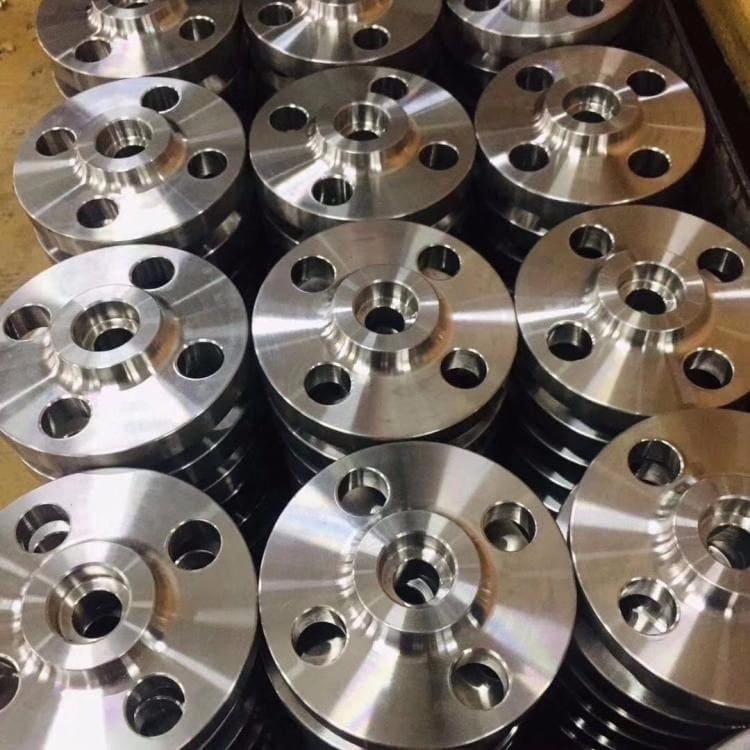
Offshore and chloride-side small bore: hydraulic and instrument systems on platforms and FPSOs, chemical injection points, produced-water and firewater auxiliaries, gas systems, brackish cooling circuits, desalination utility connections, and the chloride-bearing process small bore of chemical and fertiliser plants — wherever the line itself is 2205 and the class permits socket joints. Production below:
Socket weld flange dimensions are class-governed per ASME B16.5 — identical across material grades (pressure-temperature ratings follow the duplex material group). Full charts:
An ASTM A182 F51 socketweld flange is a forged duplex 2205 stainless steel flange — UNS S31803, W.Nr. 1.4462 — whose back carries a machined socket: the pipe end seats inside, self-aligned square to the face, and is secured with a single external fillet weld made under duplex welding discipline. Duplex 2205 is the half-ferrite, half-austenite grade that rewrote offshore piping: 450 MPa yield — nearly double 316L's — with a pitting resistance number above 34 and near-immunity to the chloride stress corrosion cracking that retires austenitic stainless. Dimensioned to ASME B16.5 for ½" to 3" NB in Classes 150 to 1500, in raised face, flat face and ring joint facings.
What does 'duplex' actually mean in duplex 2205?
A microstructure that is deliberately half ferrite, half austenite — two stainless crystal structures sharing every grain boundary. Each phase covers the other's weakness: ferrite brings the strength and chloride-SCC resistance austenite lacks, austenite brings the toughness and weldability ferrite lacks. The balance is engineered by chemistry — chromium and molybdenum stabilise ferrite, nickel and the deliberate nitrogen addition stabilise austenite — and preserved by solution annealing. The payoff on a flange certificate: 450 MPa yield with 25% elongation and a PREN above 34, from a grade that costs far less than the nickel alloys it displaces in chloride service.
What is the chemical composition of ASTM A182 F51 (UNS S31803)?
Carbon ≤0.030%, manganese ≤2.00%, silicon ≤1.00%, chromium 21.0-23.0%, nickel 4.5-6.5%, molybdenum 2.5-3.5%, nitrogen 0.08-0.20%, phosphorus ≤0.030%, sulphur ≤0.020%. Read the design intent: high chromium and molybdenum for the pitting number (PREN = %Cr + 3.3×%Mo + 16×%N comes out above 34), nickel deliberately rationed to about a third of an austenitic's so half the structure stays ferrite, and nitrogen specified with a floor — it is both the austenite former that balances the phases and a potent pitting fighter. Extra-low carbon keeps welds clean. Chemistry is verified per heat and travels on the EN 10204 3.1 MTC.
What are the mechanical properties of A182 F51 socketweld flanges?
In the solution-annealed condition A182 requires tensile strength 620 MPa (90 ksi) minimum, yield strength 450 MPa (65 ksi) minimum and elongation 25% minimum — the strength that makes duplex famous: nearly double an austenitic stainless flange's 205-240 MPa yield, from the ferrite half of the structure and the nitrogen in the austenite half. On small bore that strength shows up as margin: Class 600-1500 instrument and injection connections in chloride service that would demand exotic alloys otherwise. Where a design needs still more — hotter brines, higher pitting numbers — the super duplex grades F53 and F55 continue the family at 550 MPa yield, each with its own pages here.
F51, S32205 and F60 — what is the relationship?
Three names around one alloy, 2205. F51 = UNS S31803 is the original composition band. Experience showed the corrosion-critical elements were better held toward the top of that band, so S32205 (A182 F60) was defined inside it — chromium, molybdenum and especially nitrogen with higher floors. Most modern duplex mill product actually meets both, and dual-certified S31803/S32205 supply is routine: our F51 flanges are quoted with dual certification where the heat qualifies, which satisfies specifications written either way. If your document names F60 or S32205 exclusively, say so on the enquiry and the certificate will state it explicitly — the two designations are close kin, but an auditor reads them literally.
F51 or 316L — when does duplex earn its premium?
Whenever chlorides and stress meet. 316L's two weaknesses are exactly duplex's strengths: its 2% molybdenum pits in warm chlorides where F51's PREN above 34 holds, and — the killer — austenitic stainless cracks by chloride stress corrosion at temperatures as low as 60°C, a failure mode duplex's ferrite half essentially removes. Add the doubled yield strength and F51 often costs less per joint than 316L once wall thickness and service life are counted. 316L keeps its ground in clean, chloride-free chemistry, cryogenic duty (duplex stops around -50°C) and hot service above roughly 300°C, where duplex's embrittlement window rules it out. Both families ship as socket welds from our works.
F51 or the super duplex grades F53/F55?
By chloride severity and pressure, via the pitting numbers. F51 (PREN ≥34) carries brackish water, produced water, firewater and most process chloride duty economically. The super duplexes — F53 (S32750) and F55 (S32760), PREN ≥40, 550 MPa yield — take over in hot seawater, high-chloride brines and the offshore services specified around the 40-PREN threshold. The practical division offshore is often written straight into piping classes: 2205 for utility and process chloride duty, super duplex for seawater systems. All three ship from our works, and our F53 and F55 page families carry their stories; when an enquiry names the service, the quotation names the economical grade.
How is an F51 socketweld flange welded — the duplex rules?
With heat-input discipline instead of preheat-and-PWHT. The joint geometry is standard — pipe bottomed, withdrawn 1/16" (1.6 mm), single external fillet — but duplex welding is about preserving the phase balance: controlled heat input and interpass temperature so the weld zone neither freezes too fast (excess ferrite, lost toughness) nor lingers hot (intermetallic phases, lost corrosion resistance), typically with slightly over-alloyed 2209-type filler. Two things carbon-steel habits must unlearn: duplex takes no preheat beyond dryness, and post-weld heat treatment is prohibited rather than required — any stress relief in the 300-1000°C range risks embrittling phases, and only a full solution anneal (a mill operation, not a site one) resets the structure. Our flanges arrive solution annealed with records; the joint's phase balance is the fabricator's craft.
Does the socket crevice matter more in duplex chloride service?
Yes — and this is the most honest paragraph on the page. The gap between pipe end and socket shoulder is a built-in crevice, and crevice corrosion is precisely the mechanism by which chloride service tests duplex: F51's crevice temperature threshold sits well below its pitting threshold, so a socket joint gives warm chloride duty its easiest point of attack. Offshore and marine piping classes therefore commonly butt-weld duplex lines in wet chloride service and reserve socket joints for dry, clean or intermittent duties — hydraulic and instrument systems, chemical injection, gas service. Where your class permits duplex sockets, this page supplies them; where the service is hot seawater under a gasket, our F51 weld neck page — or the super duplex family — is the honest recommendation.
What are the temperature limits of duplex 2205?
Roughly -50°C to +300°C — a band, with real walls on both sides. Cold: the ferrite half undergoes a ductile-brittle transition, so duplex is not a cryogenic material; design codes and NORSOK practice draw the line around -46 to -50°C, below which austenitic stainless or nickel steels take over. Hot: between roughly 350°C and 550°C the ferrite slowly decomposes ('475°C embrittlement'), and above 600°C sigma phase forms rapidly — both destroy toughness and corrosion resistance — so sustained service caps near 300-315°C and no stress-relieving heat treatment is ever applied. Inside the band, duplex is at its best; specifications that push either wall get an honest grade change on our quotation.
What facings are A182 F51 socketweld flanges made with?
All three, each with its own page on this site: raised face (SWRF) — the default, with PTFE or graphite-filled spiral wound gaskets by service — flat face (SWFF) for GRP and lined mates common in offshore utility systems, and ring type joint (SWRTJ) for high-pressure wellhead-adjacent duty, with rings in soft iron, low-carbon steel or matching stainless per the class. Gasket choice in chloride duty deserves care: the joint should not add a second crevice to the one the socket already owns — solid or inner-ring-fitted spiral wounds and proper seating stress are part of the corrosion design, not just the sealing design.
What sizes and pressure classes do F51 socketweld flanges come in?
ASME B16.5 standardises socket weld flanges from ½" to 3" NB in Classes 150, 300, 600, 900 and 1500 — Class 900 sharing Class 1500 dimensions in most small-bore sizes — with 4" and Class 2500 made to order. Duplex small bore spans the classes: utility and injection duty in 150-600, wellhead-adjacent and high-pressure process in 900-1500, where the 450 MPa yield earns its keep. As with every socket flange, put the pipe schedule on the enquiry — Sch 80 and 160 dominate offshore small bore — so the through-bore matches the pipe ID. B16.5 pressure-temperature ratings for the duplex material group govern the limits; our quotations state them per class.
Is A182 F51 suitable for NACE MR0175 sour service?
Yes, within the environmental limits ISO 15156-3 sets for duplex stainless steels. Solution-annealed 2205 is a listed CRA with defined ceilings on H2S partial pressure, chloride level and temperature — considerably more capable than austenitic stainless in mildly sour produced fluids, though not the open qualification the C-alloys enjoy. Compliance is a matter of supply discipline: solution-annealed condition, hardness within the duplex limits, and the declaration on the certificate. State NACE MR0175 on the enquiry and our quotation and EN 10204 certificate carry it explicitly; where your sour envelope exceeds the duplex limits, the honest escalation is super duplex within its own limits, or the nickel-alloy pages of this site.
What details are needed to get an accurate F51 socketweld flange quotation?
Six elements plus commercial terms: (1) size — ½" to 3" NB; (2) pressure class — 150 to 1500; (3) facing — SWRF, SWFF or SWRTJ with ring number; (4) the pipe schedule — Sch 40, 80 or 160, so the through-bore matches the pipe ID; (5) grade detail — F51/S31803, dual-certification with S32205 if desired (routine), NACE MR0175 declaration if sour; (6) certification — EN 10204 3.1 with solution-anneal records (our standard) or 3.2 witnessed, PMI as applicable. Add quantity and destination and we return price, weight and delivery — normally within 24 hours.
Who manufactures ASTM A182 F51 socketweld flanges in India?
Tesco Steel & Engineering is an ISO 9001:2015 certified flange manufacturer based in Mumbai, India, producing ASTM A182 F51 duplex 2205 socket weld flanges from ½" to 3" NB (larger to order) in Classes 150-1500 — each forged from certified heats, solution annealed with furnace records, machined with gauged socket depth and schedule-matched bore, PMI-checked with the Cr-Ni-Mo-N signature read on every piece, and laser-marked with grade, size, class, schedule and heat number. Supplied with EN 10204 3.1/3.2 certification, dual S31803/S32205 certification where the heat qualifies, and NACE MR0175 declaration where specified — alongside the super duplex F53/F55 families and the complete socket weld range. Exported to more than 50 countries.