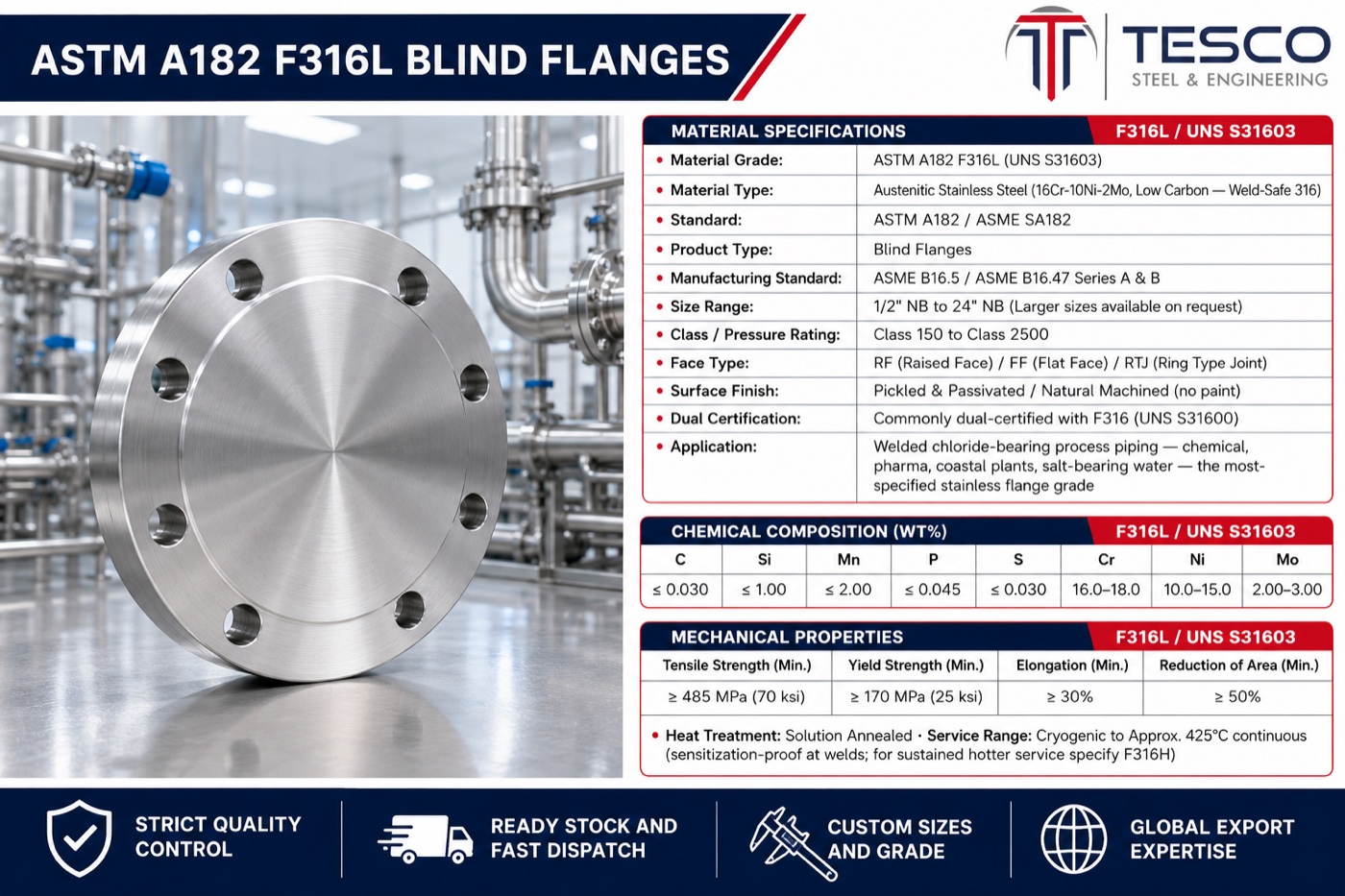
Tesco Steel & Engineering forges ASTM A182 F316L blind flanges — UNS S31603, the most-specified stainless flange grade in the world — to ASME B16.5 Class 150–2500 from ½″ to 24″ NB and to ASME B16.47 up to 60″. It wins by sitting at the intersection: molybdenum for the chloride duty most corrosive plants carry, carbon capped at 0.030% so the welds those plants are built from cannot sensitize, and nickel widened to 10–15% to keep the austenite — and the cryogenic capability — intact. Gentler mechanicals than F316, answered by F316/F316L dual-certification; sustained heat belongs to F316H, seawater to duplex. Facings: BLRF, BLFF or BLRTJ. Every lot with EN 10204 3.1/3.2 MTC. ISO 9001:2015, made in Mumbai, India — exported to 50+ countries.
ASTM A182 F316L · UNS S31603 · EN 1.4404The Most-Specified Stainless Flange GradeMo for Chlorides + Low C for WeldsF316/F316L Dual-CertificationASME B16.5 ½″–24″ · Class 150–2500RF · FF · RTJ FacingsEN 10204 3.1 / 3.2 · ISO 9001:2015
ASTM A182 F316L Blind Flanges — Specifications at a Glance
What is an ASTM A182 F316L Blind Flange?
The default closure of corrosive process piping. A solid forged disc of low-carbon molybdenum stainless (UNS S31603) with no bore, closing pipes, valves and nozzles in welded chloride-bearing systems. Two designed features do the work: 2–3% molybdenum against chloride pitting, and carbon ≤0.030% so weld heat-affected zones cannot sensitize — with nickel widened to 10–15% keeping the structure austenitic and cryogenic-capable. Tensile ≥485 MPa, yield ≥170; commonly F316/F316L dual-certified. Dimensions per ASME B16.5 / B16.47 in RF, FF and RTJ facings; EN 10204 3.1 certified.
Also searched as: SS 316L blind flange, 316L blind, S31603 blind, SA-182 F316L blind (the ASME boiler-code twin), 1.4404 / X2CrNiMo17-12-2 blind (the EN equivalent), F316/F316L dual-cert blind — all refer to the product on this page. See also the stainless steel hub, the F316L slip on flanges, siblings F316 / F316H / F304L blind flanges, and the facing pages BLRF / BLFF / BLRTJ.
Why 316L Runs the Corrosive World
Most corrosion-resistant piping is welded. Much of it carries some chloride exposure. 316L is the one certificate that answers both at once:
Molybdenum for the Chlorides
The 2–3% Mo defends the passive film where chlorides attack — pits and crevices — carrying stainless into coastal plants, salt-bearing water and process chemistry, exactly as on the F316 page.
Low Carbon for the Welds
Below 0.030% carbon there is nothing consequential to precipitate in the 425–815 °C weld band — heat-affected zones stay as corrosion-resistant as parent metal, no post-weld anneal required.
Nickel to 15% Holds It Together
Lost carbon and added molybdenum both push toward ferrite — the specification answers with the family's widest nickel window, keeping the structure fully austenitic, tough and cryogenic-capable. The 15.0 on the certificate is design, not typo.
Rate against the right line. The L grades sit in their own, slightly lower group of the B16.5 stainless tables — a joint class-checked at its limit should be checked against the L-grade line. Where the margin matters, order F316/F316L dual-certified: strength of the standard grade, chemistry of the L, one certificate. The H corner stands alone — its carbon minimum cannot coexist with the L cap.
F316L Chemical Composition (UNS S31603)
Element
C
Si
Mn
P
S
Cr
Ni
Mo
Weight %
≤0.030
≤1.00
≤2.00
≤0.045
≤0.030
16.0–18.0
10.0–15.0
2.00–3.00
Three bold columns tell the design: carbon suppressed, nickel extended, molybdenum kept — the weld-safe edition of the chloride grade.
Mechanical Properties & The Service Span
Property
ASTM A182 F316L Requirement
Tensile Strength
≥ 485 MPa (70 ksi)
Yield Strength (0.2%)
≥ 170 MPa (25 ksi)
Elongation
≥ 30%
Reduction of Area
≥ 50%
Hardness
No A182 limit — typically soft as annealed
Condition
Solution annealed — mandatory
Service Span
Cryogenic (LNG, LN2) to ~425 °C continuous — sustained hotter duty passes to F316H
ASTM A182 F316L Blind Flanges are available in the following specifications:
Material Grade
ASTM A182 F316L (UNS S31603); F316/F316L dual-certification standard where the melt qualifies; EN 1.4404 to order
Heat Treatment
Solution annealed — mandatory; condition stated on certificate
Size
1/2"NB to 24"NB per ASME B16.5; 26"–60" per ASME B16.47; EN 1092-1 to order
Class
150#, 300#, 400#, 600#, 900#, 1500#, 2500# — rated per the L-grade stainless lines
Facings
Raised Face (BLRF), Flat Face (BLFF), Ring Type Joint (BLRTJ) with groove per B16.20
Service Span
Cryogenic to ~425 °C continuous — weld-safe chloride duty throughout; continuous seawater excluded (duplex territory)
Surface Finish
Pickled & passivated or natural machined — no paint; segregated stainless handling throughout
Modifications
NPT-tapped centre (hydrotest / vent / drain / gauge), lifting provisions — machined & certified at the works
Testing
Tension & chemistry per heat — molybdenum verified; PMI routine; IGC (A262) where specified
Certification
EN 10204 3.1 (standard) / 3.2 witnessed — dual F316/F316L designation on request
Why F316L Blind Flanges Are Specified
The Volume Leader for a Reason
Welded + chloride-exposed describes most corrosive process piping on earth — and 316L is the one grade built for exactly that intersection. Its blinds are our fastest-moving stainless closures.
The Pharma Convention
Validated pharmaceutical and biotech systems specify 316L by long-standing convention — pickled, passivated, paint-free, with the certificate trail those industries audit.
Weld-Safe Without Ceremony
No post-weld anneal, no HAZ worry when the adjacent spool is modified years later — the corrosion resistance survives fabrication by chemistry.
Dual-Cert Practicality
F316/F316L on one certificate: weld-safe like an L, rateable like a standard grade — one stock for both paperwork worlds.
Three details buyers miss.Check ratings against the L line: the L grades carry a slightly lower rating group — at a marginal class check, dual-certified material closes the gap. 316L is still not seawater-proof: the low carbon fixes welds, not crevice corrosion — continuous seawater and brine belong to duplex, exactly as for standard 316. Not a hot grade: above ~425 °C sustained, missing carbon is missing creep strength — that duty belongs to F316H, and no dual-cert can bridge it.
How Our F316L Blind Flanges Are Manufactured
1
Forging — cut billet of the spectro-verified S31603 heat — carbon confirmed below 0.030%, molybdenum confirmed in range — is hot-forged into the solid disc blank with full heat traceability and segregated stainless handling.
2
Solution anneal — restoring the uniform austenite the grade's corrosion resistance depends on; furnace charts retained against the heat number.
3
Machining & facing — faces, OD and drilling to ASME B16.5 / B16.47; RF serrations, flat face or RTJ groove gauged per B16.20; NPT taps machined where ordered.
4
Testing — tension test and chemistry against the heat; PMI on every piece; intergranular-corrosion (ASTM A262) and other tests where specified.
5
Pickling & passivation — the restored chromium-oxide skin and hygienic finish, with marking of standard, grade (dual F316/F316L where certified), size, class and heat number.
6
Certification & packing — EN 10204 3.1 MTC (3.2 witnessed on request); faces protected, palletised or crated sea-worthy — no carbon-steel contact in transit.
Where F316L Blind Flanges Are Used
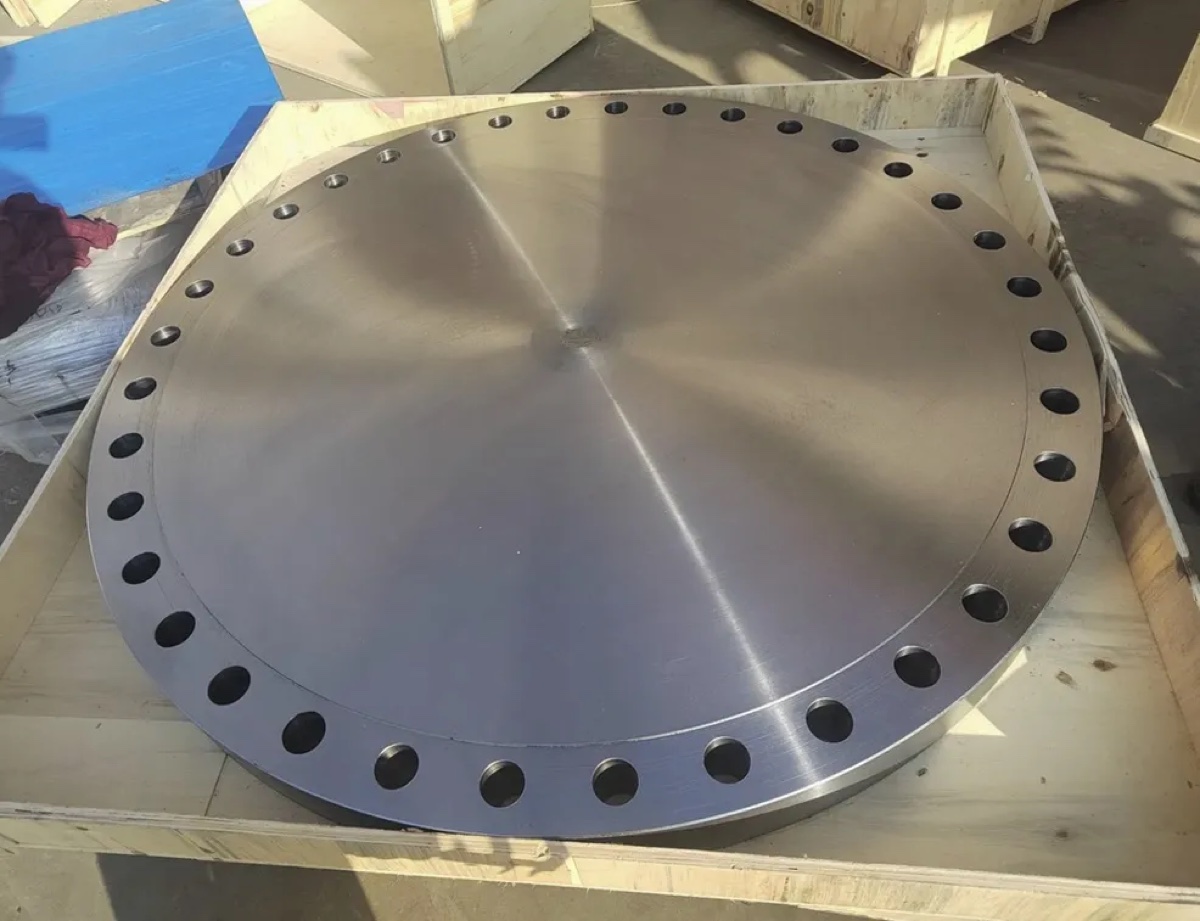
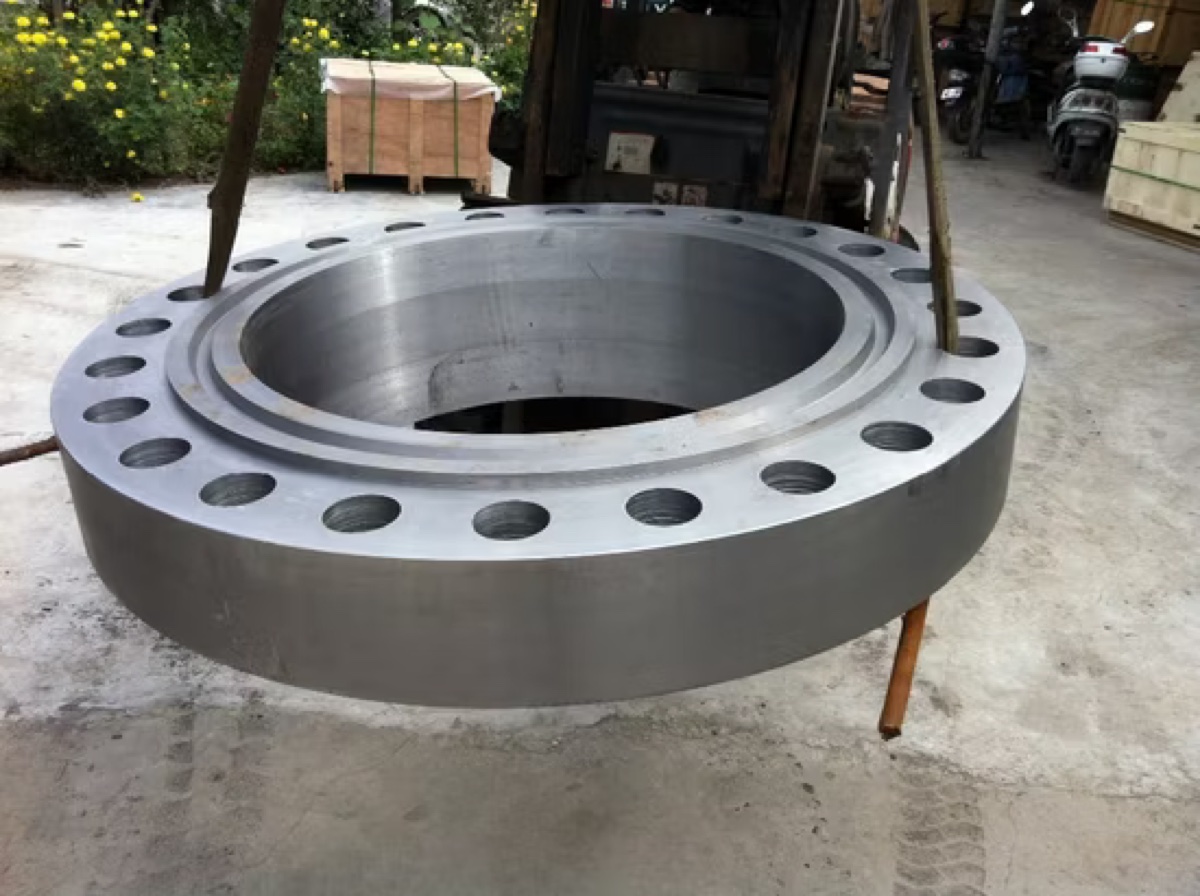
Across the welded corrosive world: chemical and petrochemical chloride streams, pharmaceutical and biotech systems specifying 316L by validated convention, food and beverage plants, coastal utilities, salt-bearing water treatment, and pulp and paper. Production below:
Large Machined Blind Flange — Crated for ExportLarge-Diameter Flange — Ring Groove Machined
F316L Blind Flange Dimensions
Blind dimensions are class-governed — identical across material grades. Full charts:
An ASTM A182 F316L blind flange is a solid forged disc of low-carbon molybdenum-bearing stainless steel — UNS S31603, the weld-safe member of the 316 family — drilled to the standard bolt pattern with no bore, used to close pipes, valves and vessel nozzles in welded chloride-bearing systems: chemical and pharmaceutical process piping, coastal plants, salt-bearing water. Carbon is capped at 0.030% so heat-affected zones cannot sensitize. Dimensions follow ASME B16.5 from ½ inch to 24 inch and ASME B16.47 beyond, in raised face, flat face and ring joint facings.
Why is 316L the most-specified stainless flange grade?
Because it sits at the intersection of the two biggest demands. Most corrosion-resistant piping is welded, which calls for the low-carbon L chemistry; and much of it carries some chloride exposure, which calls for 316's molybdenum. 316L answers both in one certificate — which is why chemical, pharmaceutical, coastal and marine-adjacent line classes default to it, and why an unqualified 'stainless flange' enquiry more often means 316L than anything else. Its blinds are the fastest-moving stainless closures we produce.
Why does the L grade exist?
Because welding is where standard grades get hurt. Every weld drags nearby metal through the 425-815°C sensitization range, where carbon precipitates as chromium carbides and primes the heat-affected zone for intergranular corrosion. The L grade removes the ammunition: below 0.030% carbon there is too little to precipitate consequentially, so welded joints stay as corrosion-resistant as the parent metal — molybdenum benefits included. In chloride service, where 316 lives, that assurance matters doubly.
What does F316L give up for its weld safety?
Strength — honestly and measurably. Carbon strengthens austenite, so the L grade's minimums drop to 485 MPa tensile and 170 MPa yield against F316's 515/205, and the flange rating tables place the L grades in a slightly lower group. For a class-governed blind the practical impact is modest, but a joint class-checked at its limit should be checked against the L-grade line — or ordered as F316/F316L dual-certified, which meets the higher strength while keeping the low carbon.
Why does F316L's nickel range extend to 15 percent?
Deliberate compensation, one point further than the 304 family needed. Carbon stabilises austenite, and its removal must be offset; molybdenum, a ferrite former, pushes the same direction. F316L answers both by letting nickel run 10.0-15.0% — wider than F316's 10.0-14.0 and higher than F304L's 13.0 cap. The number looks like a typo against every neighbouring grade and is instead the design: the widened window is what keeps the structure fully austenitic, tough and cryogenic-capable.
What is the difference between F316, F316L and F316H?
Carbon, which is to say duty. F316 (≤0.08%) is the general-purpose chloride grade. F316L (≤0.030%) — this page — is the welded-corrosion-duty choice and the volume leader. F316H (0.04-0.10%, minimum enforced) is the creep-rated hot variant, melted to order and unable to dual-certify with L. The molybdenum chemistry is common to all three; the carbon decides which certificate the service needs. Our F316 and F316H blind flange pages cover the other corners.
What does F316/F316L dual certification mean?
One forging satisfying both specifications on one certificate — carbon low enough for L, strength high enough for standard 316. The dual-cert forging is weld-safe like an L grade and rateable like a standard grade, serving line classes written around either designation from one stock. Most of our austenitic production qualifies; state the requirement on the enquiry and the certificate reads accordingly.
What are the mechanical properties of F316L blind flanges?
Tensile strength 485 MPa (70 ksi) minimum, yield strength 170 MPa (25 ksi) minimum, elongation 30% minimum and reduction of area 50% minimum, in the solution-annealed condition — A182 specifies no hardness limit. These are the gentle L-grade numbers; dual-certified material meets standard 316's 515/205 while keeping the L chemistry. The toughness is the quiet asset: ductile to cryogenic temperatures with no impact-test question, molybdenum protection included.
What temperature range does an F316L blind flange cover?
Cryogenic — LNG, liquid nitrogen — up to roughly 425°C continuous. The cold end it serves outright, with a 316-specific bonus: chloride-bearing environments around cold flanged connections favour the molybdenum grade even below zero. The hot end is where it steps aside — above ~425°C sustained, missing carbon means missing creep strength, and the duty passes to F316H. Between those bounds lies most of the world's corrosive process piping, which is precisely the grade's home.
A blind flange isn't welded — why specify L at all?
Fair question, honestly answered: the forged blind itself never sees a welding arc, so sensitization is not its personal risk. The L specification earns its place at system level — one material of construction across pipe, fittings and flanges keeps certificates, welding procedures and future modifications simple; the blind may later be replaced by a welded spool at the same joint; and mixed 316/316L stock invites substitution errors. When the line class says 316L — and most corrosive line classes do — the closure says 316L.
304L or 316L — how do I choose?
The same chloride question as their parents, asked of the weld-safe grades. Fresh water, food-adjacent chemistry, inland general duty: 304L is the economical answer. Coastal atmospheres, salt-bearing or brackish water, process chlorides, and the pharmaceutical convention that specifies 316L by habit: this page's grade earns its premium. Serious chlorides — warm seawater, brine — jump past both to duplex. Our F304L blind flange page covers the other side of the choice.
What facings are F316L blind flanges made with?
All three: raised face (BLRF) — the process-industry default — flat face (BLFF) for mating GRP and lined systems, and ring type joint (BLRTJ) for high-pressure duty, the ring chosen softer than the groove. Each facing has its own page on this site. The forging is common to all three; the mating flange governs the choice, and for RTJ the ring number follows from size and class. NPT-tapped test blinds are machined and certified at the works.
Where are F316L blind flanges used?
Across the welded corrosive world: chemical and petrochemical process piping with chloride-bearing streams, pharmaceutical and biotech systems that specify 316L by validated convention, food and beverage plants, coastal and marine-adjacent utilities, water treatment with salt-bearing water, and pulp and paper. F316L blinds serve the usual closure duties — isolations, future connections, tapped test blinds — with the pickled, paint-free finish hygienic industries expect.
Which standards cover F316L blind flanges?
The material standard is ASTM A182 grade F316L (UNS S31603), with ASME SA-182 as its boiler-code twin and EN 1.4404 / X2CrNiMo17-12-2 as the European equivalent; dimensions follow ASME B16.5 for ½"-24" and ASME B16.47 for 26"-60", with the L grades carrying their own rating group in the stainless tables. A complete specification reads: 'Blind Flange, RF, 4", ASME B16.5 Class 150, ASTM A182 F316L (or F316/F316L dual)' — and our EN 10204 certificates state it exactly that way.
Who manufactures ASTM A182 F316L blind flanges in India?
Tesco Steel & Engineering is an ISO 9001:2015 certified flange manufacturer based in Mumbai, India, forging ASTM A182 F316L / UNS S31603 blind flanges from ½" to 24" NB per ASME B16.5 in Classes 150-2500 and to 60" per ASME B16.47 — solution annealed, pickled and passivated, PMI-verified with the molybdenum read on every piece, F316/F316L dual-certified where required, certified to EN 10204 3.1/3.2 on every lot — in raised face, flat face and ring joint facings, alongside F316, F316H, the F304 family, duplex and nickel-alloy blinds. Exported to more than 50 countries.