

Tesco Steel & Engineering manufactures bleed rings (also called test rings or drip rings) — spacer rings inserted between two flanges with a tapped radial hole that connects to the pipe bore. The tapping lets the line be vented, drained, injected, sampled, or pressure-tested at the flanged joint without breaking it open. The open bore keeps full flow while the ring sits in the line. Made to the matching ASME B16.5 flange in A105, SS 304/316/321, Duplex, Monel, Inconel, and Hastelloy. Class 150 to 2500, PN1 to PN400. ISO 9001:2015 certified. Made in India.
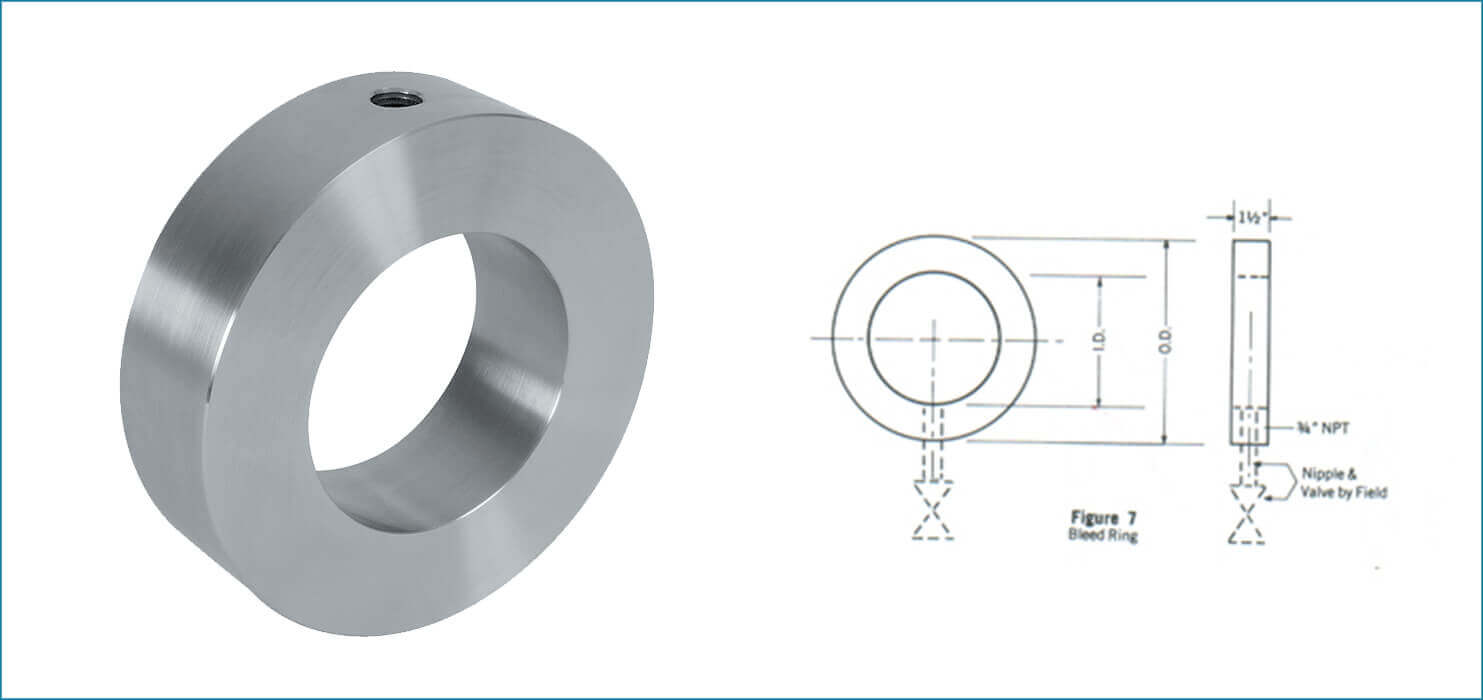
Bleed Ring (Test / Drip Ring)
Bleed rings are a simple, permanent way to add a vent, drain, test, or injection point at a flange. Tesco Steel & Engineering manufactures bleed rings, drip rings, ring spacers, and paddle spacers to the matching flange standard — dimensioned per the table below; see the flange dimensions charts.
| Use | How the Bleed Ring Does It |
|---|---|
| Venting | Tapping at the top lets trapped gas/air be released from the line |
| Draining | Tapping at the bottom lets liquid or condensate be drained off |
| Pressure testing | A test connection is screwed in to pressurise/monitor the section (hence “test ring”) |
| Injection / purging | Chemical, inhibitor, or purge fluid is injected into the bore through the tapping |
| Sampling / instruments | A sample valve, gauge, or probe is fitted to access the process |
| Item | Bore | Function |
|---|---|---|
| Bleed Ring (test/drip ring) | Open bore + tapped radial hole | Keeps flow open AND adds a vent/drain/test/inject point |
| Ring / Paddle Spacer | Open bore (no tapping) | Keeps the line open & fills the flange gap |
| Spectacle Blind | Solid disc + open ring (figure-8) | Flip to isolate or open the line |
A bleed ring is an open-bore spacer with a tapped connection; a plain ring spacer has no tapping; a spectacle blind isolates rather than provides access.
| Bleed Rings are available in the following specifications: | |
|---|---|
| Size | 1/2"NB to 56"NB |
| Class | 150#, 300#, 3000#, 6000#, 9000# |
| Sch (Schedule) | XS, XXS, STD & Schedule 20, 40, 80, 160 |
| Pressure Ratings | PN 1 - PN 400 |
| Stainless Steel Bleed Rings | ASTM A 182 F - 304 / 304H / 304L / 316 / 316H / 316L / 316Ti, 309, 310, 317L, 321, 347, 904L |
| Duplex Steel Bleed Rings | ASTM A 182 - F 51, F 53, F 55 |
| Alloy Steel Bleed Rings | ASTM A 182 - F5, F9, F11, F21, F22 & F91 |
| Carbon Steel Bleed Rings | ASTM A 105 |
| Low Temp. Carbon Steel Bleed Rings (LTCS Bleed Rings Flanges) | A 350 LF2 |
| Copper Nickel (Cu-Ni) Bleed Rings | C70600, 90/10, C71500, 70/30, C71640 |
| Nickel Bleed Rings | UNS N02200, UNS N02201 |
| Monel Bleed Rings | UNS N04400, UNS N05500, Alloy 20 |
| Inconel Bleed Rings | UNS N06600, UNS N06601, UNS N06625, UNS N08800, UNS N08810, UNS N08825 |
| Hastelloy Bleed Rings | UNS N10276, UNS N06022, UNS N10665, UNS N06455 |
| Titanium Bleed Rings | Gr. 1, Gr. 2, Gr. 3, DTH 3.7035, DTH 3.7055 |
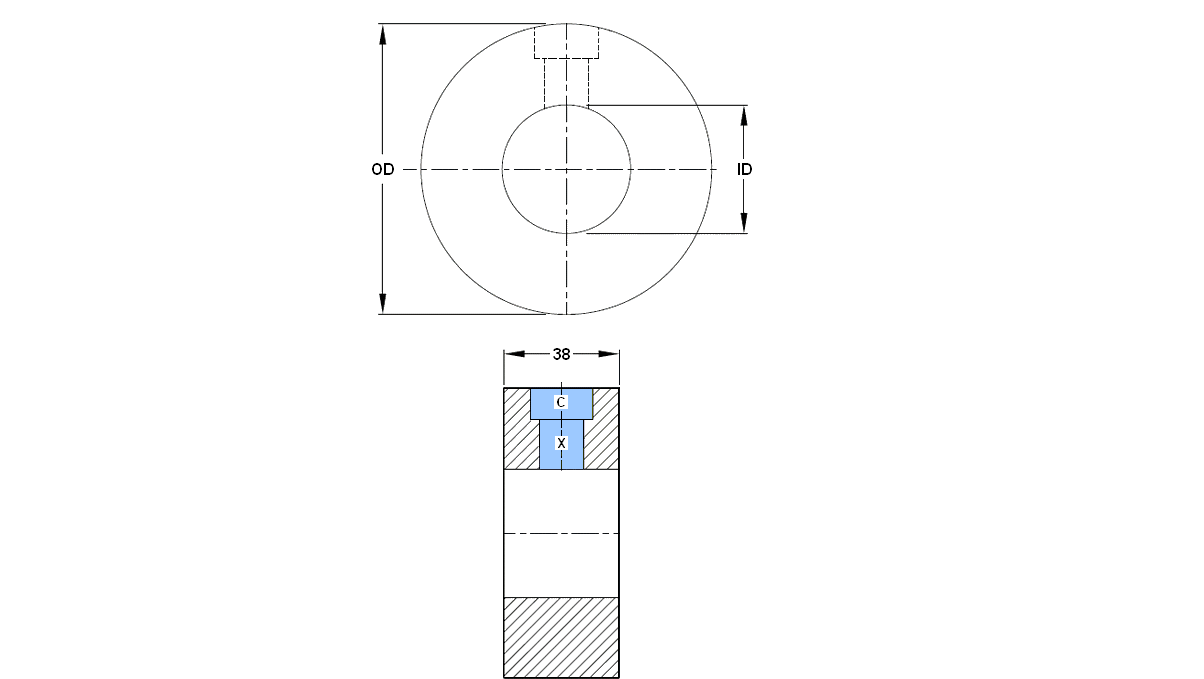
Bleed Ring Dimension Diagram
| NPS | ID | OD by Pressure Class | ||||
| 150 | 300 | 600 | 900 | 1500 | ||
| 1 | 28.6 | 63.5 | 69.9 | 69.9 | 76.2 | 76.2 |
| 1.1/2 | 41.3 | 82.6 | 92.1 | 92.1 | 95.3 | 95.3 |
| 2 | 54 | 101.6 | 108 | 108 | 139.7 | 139.7 |
| 2.1/2 | 63.5 | 120.7 | 127 | 127 | 161.9 | 161.9 |
| 3 | 79.4 | 133.4 | 146.1 | 146.1 | 165.1 | 171.5 |
| 4 | 104.8 | 171.5 | 177.8 | 190.5 | 203.2 | 206.4 |
| 6 | 155.6 | 219.1 | 247.7 | 263.5 | 285.8 | 279.4 |
| 8 | 203.2 | 276.2 | 304.8 | 317.5 | 355.6 | 349.3 |
| 10 | 257.2 | 336.6 | 358.8 | 396.9 | 431.8 | 431.8 |
| 12 | 304.8 | 406.4 | 419.1 | 450.9 | 492.1 | 514.4 |
A single ring adds a vent, drain, pressure-test, injection, or sampling point at a flange without breaking the joint.
The bore matches the pipe ID, so the ring stays in the line permanently with no flow restriction.
Sized to the matching ASME B16.5 flange and facing, with the tapping size and position to suit the duty.
A105, SS 304/316/321, Duplex, Monel, Inconel, and Hastelloy for corrosive and high-temperature service.
One or more radial tappings (e.g. vent at top, drain at bottom) machined to your specification.
Manufactured to the matching flange standard or your drawing, certified with EN 10204 3.1 MTC.
| Material | Properties | Typical Use |
|---|---|---|
| A105 Carbon Steel / A350 LF2 (LTCS) | Strong, economical; LF2 for low temp | Non-corrosive & low-temperature lines |
| SS 304 / 316 / 321 | Good corrosion resistance; 321 high-temp | Process, chemical & high-temperature lines |
| Duplex 2205 / Super Duplex 2507 | High strength & chloride resistance | Seawater & offshore service |
| Monel 400 / Inconel | Excellent in HF, marine & high-temp | HF, seawater & high-temperature lines |
| Hastelloy | Superior acid resistance | Aggressive chemical service |
| Industry | Typical Use | Why Bleed Ring |
|---|---|---|
| Oil & Gas | Vent/drain & test points at flanges | Access the line without breaking the joint |
| Refinery & Petrochemical | Drains, vents & chemical injection | Permanent open-bore access; full material range |
| Power Generation | Steam & condensate drains | SS 321 high-temperature service |
| Chemical Plants | Injection, sampling & purge points | Monel / Inconel / Hastelloy |
| Pipelines | Pressure-test & drain connections | Test ring at flanged joints |
| Pharmaceutical / Process | Sampling & drain access | Clean SS 316 rings |
| Offshore & Marine | Vent/drain & injection | Duplex / alloy corrosion resistance |
| Water & Utilities | Drain & test points | Economical open-bore access |
Q1. What is a bleed ring?
A bleed ring (test ring or drip ring) is a spacer ring fitted between two pipe flanges with a tapped radial hole that connects to the pipe bore. A small valve, plug, or instrument screwed into the tapping lets the line be vented, drained, pressure-tested, injected, or sampled at the flanged joint without dismantling it. The open bore keeps flow unrestricted.
Q2. What is a bleed ring used for?
Venting trapped gas (tapping at top), draining liquid or condensate (tapping at bottom), connecting a pressure-test line, injecting chemical or purge fluid, and sampling or fitting instruments — all through the radial tapping, while the open bore keeps the process flowing.
Q3. Why is a bleed ring also called a test ring or drip ring?
It is called a test ring when the tapping is used for a pressure-test connection, and a drip ring when used to drain (drip off) liquid or condensate. They are the same component — an open-bore flange spacer with a tapped hole — named for how the tapping is used.
Q4. Does a bleed ring restrict flow?
No. Its bore matches the pipe inside diameter, so the process flows through unrestricted while the ring stays permanently in the line. Only the small radial tapping connects to the bore for the vent/drain/test/inject function.
Q5. What is the difference between a bleed ring and a ring spacer?
Both are open-bore spacers fitted between flanges. A ring spacer simply fills the flange gap with no connection; a bleed ring has a tapped radial hole into the bore so it also provides a vent, drain, test, or injection point. Choose a bleed ring when you need access into the line.
Q6. What sizes, classes, and materials are available?
Bleed rings are made to match ASME B16.5 flanges in Class 150 to 2500 (PN1 to PN400), sized 1/2" to 56", in A105/LTCS, SS 304/316/321, Duplex, Monel, Inconel, and Hastelloy — with the tapping size and position to suit the duty.
Q7. Where should the tapping be positioned?
For venting gas the tapping is positioned at the top of the ring so trapped gas escapes; for draining liquid or condensate it is at the bottom so liquid drains. Multiple tappings (e.g. top and bottom) can be machined when both vent and drain are needed. We set the position to your requirement.
Q8. Can bleed rings be supplied to our drawing and certified?
Yes. We supply bleed rings, drip rings, and ring spacers to the matching flange standard or your drawing — size, class, facing, material, and tapping detail — with EN 10204 3.1 material test certificates on request. Send your line details and the function required for a quote.