Tesco Steel & Engineering manufactures spectacle blinds (figure-8 blinds), spades and spacers per ASME B16.48 — positive isolation you can see: one solid disc, one open ring, joined by a web and rotated between the line flanges, with the exposed half showing the line's status at a glance — the device audits itself. The safety logic is the franchise: valves leak; a solid plate rated for full line pressure does not — which is why permit systems worldwide specify blinding, not valving, for confined-space entry, hot work and equipment removal. Made in ½″–24″ NPS, Classes 150–2500, raised face and RTJ line blanks — with the spade-and-spacer pattern taking over where a figure-8's weight and swing become unmanageable, and thickness verified 100% against the B16.48 tables on every piece. Every family blinds alike: from A105 and F91 RTJ line blanks through stainless, duplex, Monel, Inconel and Hastelloy — the range table below links every grade. Every lot with EN 10204 3.1/3.2 MTC. ISO 9001:2015, made in Mumbai, India — exported to 50+ countries.
ASME B16.48 · Classes 150–2500½″–24″ NPS · Larger to DrawingPositive Isolation — Full Line PressureStatus Readable at a GlanceFigure-8s + Spades & SpacersRF & RTJ Line Blanks100% Thickness VerificationEN 10204 3.1 / 3.2 · ISO 9001:2015
Spectacle Blinds — Manufactured at Our Mumbai Works per ASME B16.48
What is a Spectacle Blind?
Positive isolation you can see. A spectacle blind (figure-8 blind) is one solid disc and one open ring joined by a web, installed permanently between a pair of line flanges: ring in the line — it flows; disc in the line — positively isolated by a solid plate rated for full line pressure. The exposed half shows the status from across the pipe rack — the device audits itself. For larger sizes the duty splits into the two-piece spade (paddle blank) + spacer. Per ASME B16.48, ½″–24″ NPS, Classes 150–2500, RF and RTJ, in every material family. EN 10204 3.1 with 100% thickness verification.
Also searched as: figure 8 blind, fig-8 blind, spec blind, line blind, line blank, paddle blank (the spade), paddle spacer / spacer ring, blinding plate — all this page's family. Related pages: the fixed cousin — blind flanges (bolted dead-ends, not in-line isolation) — the type bench — weld neck / slip-on / lap joint — the references — face types guide / RTJ size chart / dimension charts.
The Line Blank Family — Figure-8, Spade & Spacer
Spectacle Blind (Figure-8)
Spade + Spacer
Pieces
One — disc and ring joined by a web
Two — solid paddle blank + ring, exchanged
Status change
Swing on the pivot bolt — joint never fully opens
Exchange pieces — joint briefly fully open
Self-recording?
Yes — the exposed half is the record
Diluted — the ‘other’ piece must be stored and tracked
Weight handled
Both halves at once
One piece at a time — roughly half
Clearance needed
Swing room beside the joint
None beyond the spread
Common split
Through the sizes one fitter can swing
Larger sizes and higher classes
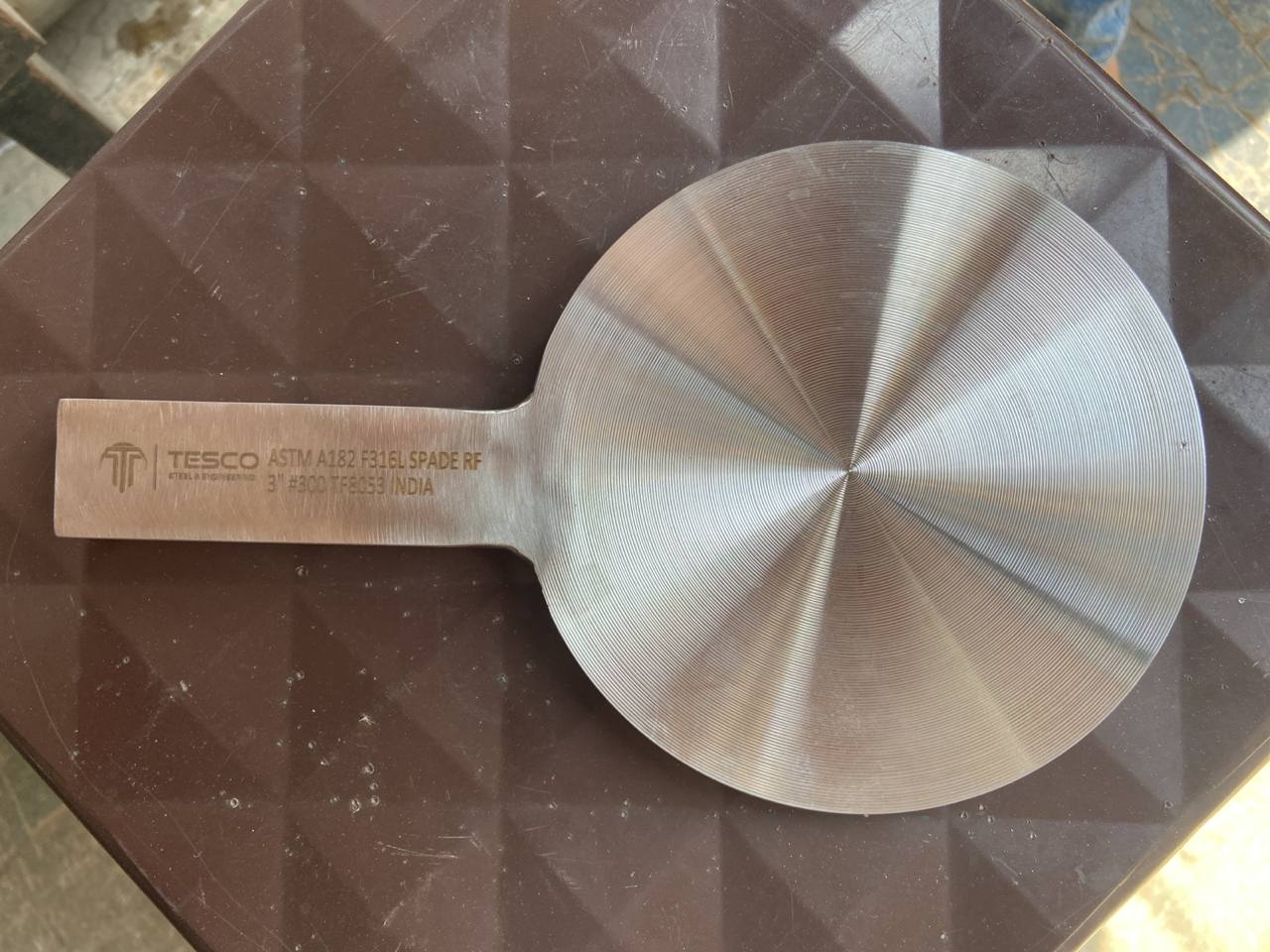
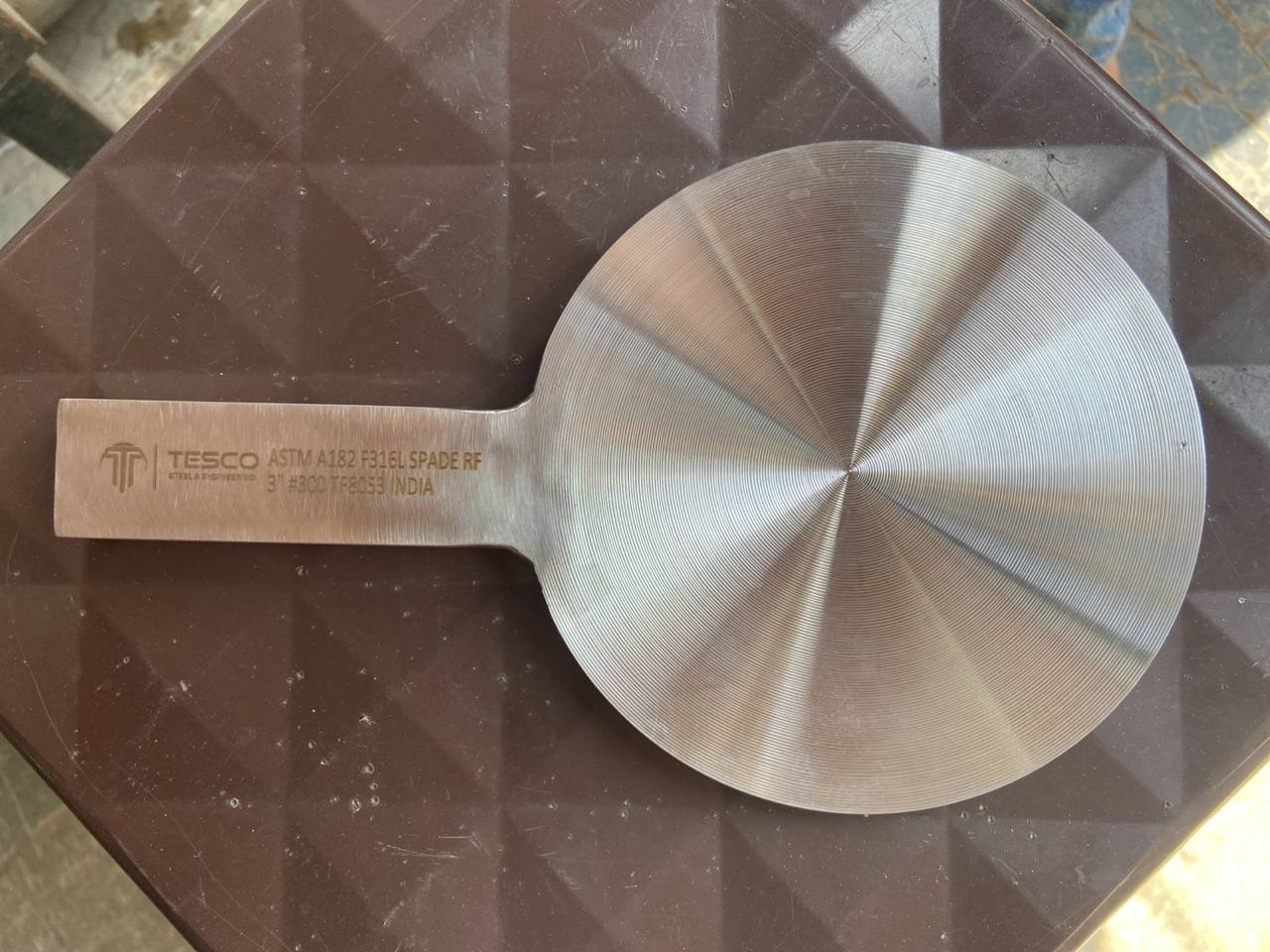
F316L Spade (Paddle Blank), 3″ Class 300 RF — the two-piece pattern's solid half
What the Blind Buys That a Valve Cannot
Absolute Isolation
A solid plate rated for full line pressure — nothing to leak through, nothing to fail open: the isolation the permit book accepts for confined-space entry and hot work.
The Status That Shows Itself
Ring showing — line blinded; disc showing — line open: readable from across the rack, auditable on a walk-down, impossible to misremember.
Never Mislaid
It lives in the joint — unlike a loose slip plate, the figure-8 can never be left in the wrong store, and its swing changes state without fully opening the line.
A Pressure Part, Not a Plate
B16.48's thickness tables make it a rated component — verified 100% on our supply, so the ‘what pressure will it really see?’ conversation never happens.
The Honest Boundaries — When Blinds Are the Wrong Tool
Three boundaries, stated plainly.Frequent operation: a blind change is a joint break — gaskets renewed, bolts torqued, leak test on remake — so daily isolation belongs to double-block-and-bleed valve arrangements, with the blind reserved for the occasions demanding absolute proof. Weight and clearance: above the sizes one fitter can swing, specify spades and spacers — and check nozzle loads where heavy blinds cantilever on rack piping. Thermal cycling: the blind adds a thick plate and two gaskets to the joint's stack — hot cycling lines deserve gasket-stack attention. None of these retire the pattern — they route it: the spectacle blind is the plant's occasional, absolute isolator, and inside that role it has no substitute.
How Our Spectacle Blinds Are Manufactured
1
Material — certified plate or forged blanks in the ordered grade, heat-number transfer before the first cut; alloy stock segregated by family.
2
Profiling — the figure-8, spade or spacer shape with web, handle and pivot hole per B16.48's dimensions.
3
Machining — both faces flat and parallel; RF serrations both sides, or RTJ grooves both sides per B16.20.
4
Thickness verification — 100% against the B16.48 table for size and class — the number that makes the blind a pressure part; recorded on the certificate.
5
Testing & marking — PMI on every alloy piece; marked with size, class, material, heat number and the B16.48 reference.
6
Certification & packing — EN 10204 3.1 MTC (3.2 witnessed on request) recording chemistry, mechanicals and thickness together; faces protected, packed sea-worthy.
Where Spectacle Blinds Are Used
At every point where the permit book says ‘prove it’: battery-limit isolation at unit edges, exchanger channels and vessel nozzles ahead of maintenance entry, pump and compressor suction/discharge for equipment removal, tank farms and loading systems where custody demands visible proof, and the utility and flare headers that must never dead-leg by accident. Valves run the process; blinds prove the isolation. Production and supply below:
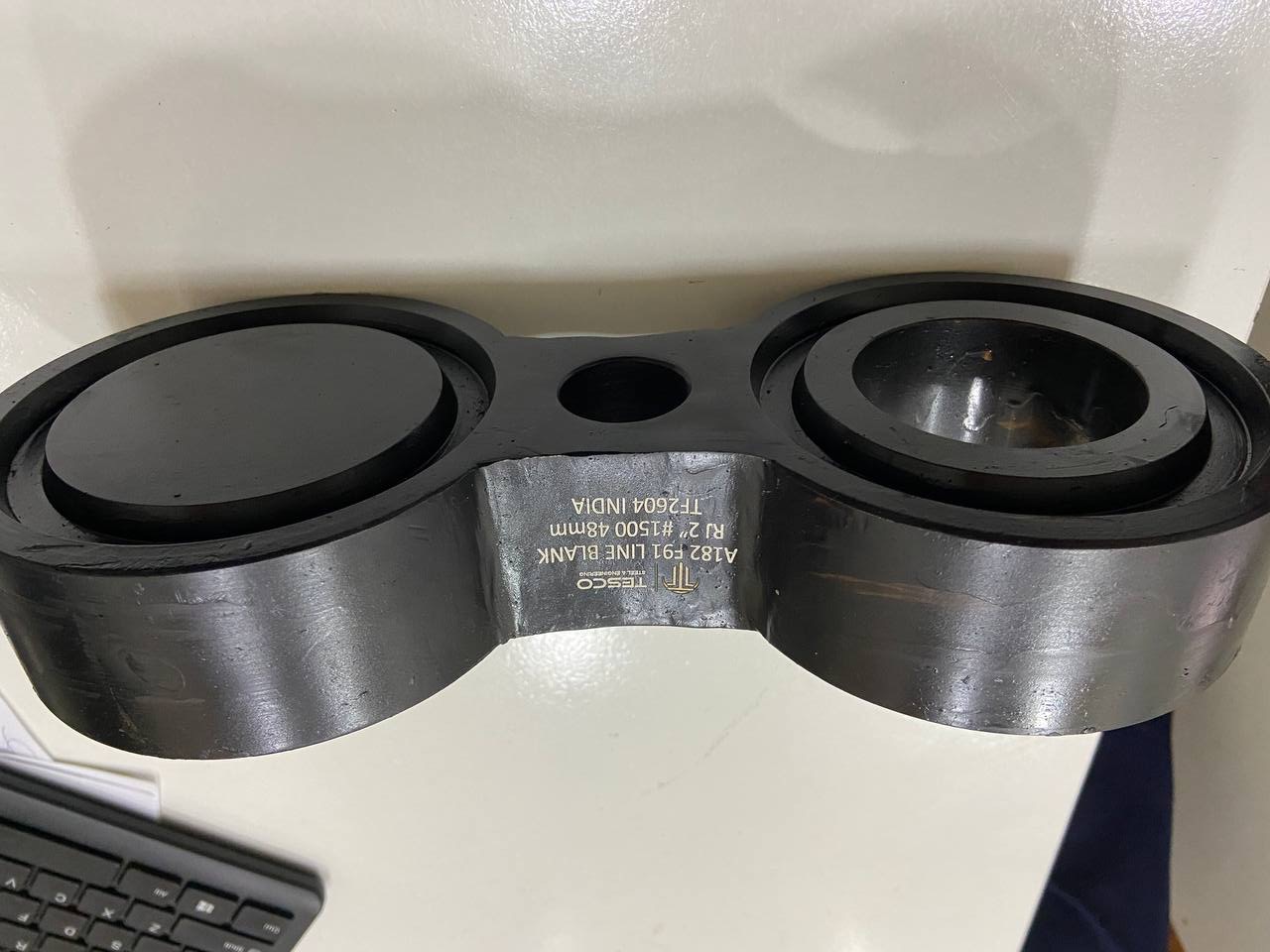
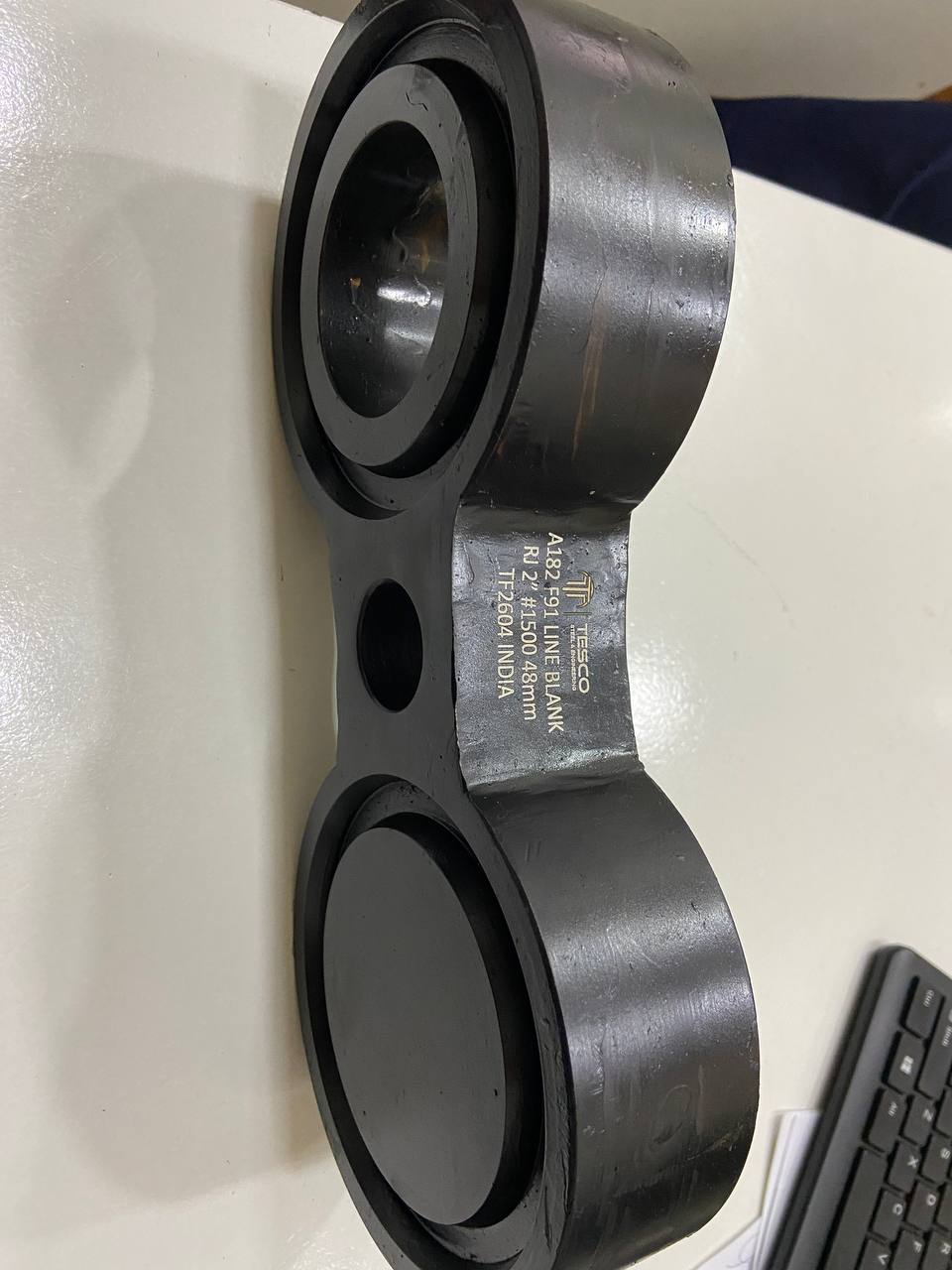
A105 High-Pressure RTJ Line Blank — Grooves Both FacesF91 Line Blank, 2″ Class 1500 RTJ — The High-Energy SpecialtyMonel 400 Spade, 3″ Class 300 RF — The Nickel Bench Blinds Alike
Spectacle Blind Dimensions — ASME B16.48
Outside diameters, webs and minimum thicknesses per ASME B16.48, dimensioned to mate B16.5 flanges. Full class-by-class charts:
Six elements — the pattern and the facing decide the piece:
1
Pattern — spectacle blind (figure-8), or spade + spacer as a set, or spade only / spacer only for stock replacement.
2
Size & class — e.g. 6″ Class 300 per ASME B16.48 (B16.47 or drawing drilling for larger).
3
Facing — RF (serrated both faces) or RTJ with ring number (grooves both faces).
4
Material grade — matching the line: A105, LF2, an A182 grade or any nickel-bench designation.
5
Service notes — temperature for gasket-stack advice; sour or hydrogen duty where it steers the grade; bolt-length guidance on request (we state thickness + gasket allowance on the offer).
6
Certification & commercials — EN 10204 3.1 / 3.2 with 100% thickness verification; quantity and destination to sales@tescosteel.com or the inquiry form.
Example: “Spectacle Blind, 4″ Class 300 RF per ASME B16.48, ASTM A182 F316L, battery-limit isolation, EN 10204 3.1 — 6 pcs; plus 8″ Class 300 spade + spacer sets, same grade — 2 sets.” Quotations normally within 24 hours with price, unit weight and delivery.
Spectacle Blinds — Frequently Asked Questions
What is a spectacle blind (figure-8 blind)?
A spectacle blind is a line-isolation device shaped like a figure-8 or a pair of spectacles: one half is a solid disc (the blind), the other an open ring (the spacer), joined by a narrow web. It installs permanently between a pair of line flanges. With the ring half between the flanges, the line flows normally; swing the blind half in, and the line is positively isolated — sealed by a solid plate rated for full line pressure. The signature virtue is visibility: whichever half is not in the line sticks out beside the flanges, so anyone walking the pipe rack can read the line's status at a glance — open ring showing means the line is blinded, solid disc showing means it flows. Manufactured per ASME B16.48 in ½" to 24" NPS, Classes 150 to 2500, raised face and RTJ, in every material family this site carries, with EN 10204 3.1/3.2 certification.
Why use a spectacle blind instead of just closing a valve?
Because valves leak and blinds do not — and the difference is written into every plant's safety rules. A closed valve is a mechanical device with seats that wear, scale that holds them open a crack, and no visible proof of its internal state: process-safety practice treats it as flow control, not isolation. A spectacle blind is a solid plate: nothing to leak through, nothing to fail open, and its status readable from across the rack. That is why positive isolation for the jobs where a leak kills — confined-space entry, hot work on the line, equipment removal, long shutdowns — is specified as blinding, not valving, in refinery and chemical-plant permit systems worldwide. The spectacle blind's improvement over a loose slip plate is permanence: it lives in the joint, can never be mislaid or forgotten, swings between its two states without ever fully opening the line to atmosphere, and records its own position.
What is the difference between a spectacle blind and a spade with spacer?
The same duty, one piece against two. The spectacle blind joins its solid disc and open ring with a web — elegant, self-recording, but its swing needs clearance beside the joint and its whole weight hangs on the line at every size. As diameter and class climb, that one piece becomes unmanageable: a 12" Class 600 figure-8 is a two-man lift, and a 24" one is crane work. So the pattern splits: the spade (also called a paddle blank — the solid disc with a handle) and the spacer (the matching ring, also with a handle) become two separate pieces, exchanged one for the other when the line's status changes. The trade-offs are honest: spades halve the handled weight and need no swing clearance, but the exchange briefly opens the joint fully and the 'other' piece must be stored and tracked — the self-recording virtue is diluted. Common practice splits by weight: spectacle blinds through the sizes one fitter can swing, spades and spacers above — both patterns dimensioned by the same ASME B16.48 and both supplied by this page.
What is ASME B16.48 — the line blank standard?
The dedicated standard for line blanks — the family name covering spectacle blinds, spades (paddle blanks) and spacers (paddle spacers). ASME B16.48 sets the outside diameters and web dimensions to suit B16.5 flanges, the facing details for raised face and ring joint, and — the heart of the standard — the minimum thickness tables: for every size and class, the plate thickness that carries full line pressure with the standard's design margin, which is why a B16.48 blind is a pressure-rated component, not a fabricated plate. It covers NPS ½ through 24 in Classes 150, 300, 400, 600, 900, 1500 and 2500, with materials referenced to the flange specifications — A105, A350, A182 and the nickel-alloy standards alike. Larger blinds for B16.47 flanges and drilled-to-drawing blinds sit outside the standard and are made to calculation. The order line reads 'spectacle blind per ASME B16.48' with size, class, facing and material — and the thickness follows from the tables, verified on every piece we supply.
What thickness is a spectacle blind — and is it rated for full line pressure?
Full line pressure is the whole point, and the thickness follows from ASME B16.48's tables. The standard sets minimum plate thickness per size and class — representative Class 150 figures run from roughly 6 mm at 1" to roughly 22 mm at 12" and past 30 mm at 24", climbing steeply with class: a 6" Class 900 blind runs roughly 40 mm, and Class 2500 blinds at mid sizes approach plate-forging territory. The engineering behind the table is a flat circular plate in bending under full differential pressure with the standard's margin — which is why a proper B16.48 blind never needs a 'what pressure will it really see?' conversation: it carries what its mating flanges carry. Two practical notes ride along: the thickness plus two gaskets sets the extra bolt length the joint needs (the installation FAQ's arithmetic), and on RTJ blinds the grooves add their depth to the plate. We verify thickness on every piece against the standard, recorded on the certificate.
What facings are available — RF and RTJ line blanks?
Both of the high-pressure world's facings, machined per the standard. Raised-face blinds carry the serrated gasket finish on both faces of the blind half (and both faces of the spacer ring), seating standard gaskets against each mating flange — the common pattern through Class 600. Ring-type-joint line blinds carry RTJ grooves machined into both faces, seating the metallic ring gaskets of Class 900-and-up practice — the pattern of our F91 and A105 high-pressure line blank photographs on this page, and the standard choice in hydrogen, sour and high-energy service where RTJ flanges rule. The RTJ blind's grooves live in the blind's own material, so on alloy systems the blind is solid alloy — there is no economising with a cheaper core, exactly as with RTJ flange grooves. Flat-face blinds are machined to order for the cast-iron-adjacent duties, and the full facing story is on our flange face types guide.
What materials are spectacle blinds made in?
Every family on the site's bench, because the blind must match the line's metallurgy — it is a fully wetted pressure part on both faces. A105 carbon steel is the volume standard, with A350 LF2 for impact-tested low-temperature systems. The A182 chrome-moly grades — F11, F22, F91 — serve refinery and power isolation, with F91 RTJ line blanks a specialty of our high-pressure work. The stainless wing runs 304/304L, 316/316L, 321, 347, 310, 317L and 904L; duplex F51 and the super duplex twins serve chloride service — our duplex spade photographs on this page show the pattern. And the nickel bench blinds alike: Monel 400, Inconel 600/625, Incoloy 800/825, Alloy 20, Hastelloy C-276/C-22 and copper-nickel — every grade page on this site has a spectacle blind sibling, linked in the range table. PMI on every alloy piece, heat-number marking, EN 10204 3.1/3.2 certification throughout.
How is a spectacle blind installed and swung?
It lives between two flanges and turns on one bolt. At installation the joint is made up with the blind between the flanges — gaskets on both faces — and bolt length is ordered for the extra grip: blind thickness plus the second gasket, a dimension the fitter must know before the scaffold goes up. To change status, the line is depressurised and drained, the bolts slackened, and the flanges spread — jackscrews, flange spreaders or wedges opening just enough clearance — then the blind swings on its pivot bolt from ring to disc or back, and the joint remakes with fresh gaskets. The design details that make this easy are worth specifying: a jackscrew boss on one flange, a dedicated pivot bolt hole in the blind's web (standard on our supply), and swing clearance checked on the piping layout — a figure-8 needs room beside the joint equal to its own diameter. Where clearance or weight forbids the swing, the spade-and-spacer pattern takes over, as its FAQ explains.
Where should spectacle blinds NOT be used — the honest boundaries?
Three boundaries, stated plainly. Frequent operation first: a blind change is a joint break — gaskets renewed, bolts torqued, leak test on remake — so a line that must isolate daily belongs to a proper isolation valve arrangement (double block and bleed), with the blind reserved for the occasions that demand absolute proof. Weight and clearance second: the figure-8's swing needs space and its mass hangs on the line — above the sizes one fitter can handle, specify spades and spacers, and check nozzle loads where heavy blinds cantilever on rack piping. Thermal cycling third: the blind adds a thick plate and two gaskets to the joint's stack — on high-temperature cycling lines the joint's relaxation behaviour deserves attention, and long-term hot installation favours reviewing gasket type. None of these retire the pattern — they route it: the spectacle blind is the plant's occasional, absolute isolator, and inside that role it has no substitute.
How much does a spectacle blind weigh?
More than intuition suggests, because B16.48 thickness climbs fast. Representative carbon steel spectacle blind (figure-8) weights: 2" Class 150 roughly 2 kg, 4" Class 150 roughly 6 kg, 6" Class 300 roughly 15 kg, 8" Class 300 roughly 25 kg, 12" Class 600 roughly 90 kg — and the high-pressure classes multiply from there. The weight arithmetic drives the pattern choice of the spade FAQ: common practice swings figure-8s while one fitter can manage them and splits to spades above, halving the handled mass. For freight, remember the figure-8 counts both halves in one piece while the spade-and-spacer set ships as two — our quotations state unit and consignment weights per line item, and alloy densities (nickel and copper-nickel families above steel) adjust the figures grade by grade. The site's weight chart carries flange references; blind weights are quoted per B16.48 dimensions on the offer.
Where are spectacle blinds used in a plant?
At every point where the permit book says 'prove it'. Battery limits first: the blind at a unit's edge is how a shutdown isolates from a live neighbour — the classic position, often specified into the piping class itself. Equipment isolation second: exchanger channels, vessel manhole-adjacent nozzles, pump and compressor suction/discharge — anywhere maintenance entry or removal happens against a system that stays live. Tank farms and loading systems third, where product segregation and custody demand visible proof. Utility and flare headers fourth — the lines that must never be dead-legged by accident carry blinds that show their state. And across refineries, gas plants, chemical and pharmaceutical works, the pattern is the same: valves run the process, blinds prove the isolation. The rack-walk readability — ring showing, line blinded; disc showing, line open — is the feature that makes the device an institution: it audits itself.
How are your spectacle blinds manufactured?
From certified plate and forgings, to the standard's letter. Material is cut from certified stock in the ordered grade — plate for the common sizes, forged blanks for high-class and alloy work — with heat-number transfer before the first cut. Profiling brings the figure-8 or spade/spacer shape with the web and handle per B16.48's dimensions; machining faces both sides flat and parallel, then applies the facing — raised-face serrations both sides, or RTJ grooves both sides per B16.20. Thickness is verified 100% against the B16.48 table for the size and class — the number that makes the blind a pressure part — and the pivot hole and any jackscrew clearances are drilled to the pattern. Alloy pieces are PMI-checked; every piece is marked with size, class, material, heat number and the B16.48 reference; and the EN 10204 3.1 certificate (3.2 witnessed on request) records chemistry, mechanicals and the thickness verification together.
What details are needed to get an accurate spectacle blind quotation?
Six elements plus commercial terms: (1) pattern — spectacle blind (figure-8), or spade and spacer as separate pieces, or spade only / spacer only for stock replacement; (2) size and class — e.g. 6" Class 300, dimensioned per ASME B16.48 to suit B16.5 flanges (state B16.47 or drawing drilling for larger); (3) facing — RF (serrated both faces) or RTJ with ring number (grooves both faces); (4) material grade with specification — A105, A350 LF2, an A182 grade or any nickel-bench designation, matching the line; (5) service notes where they help — operating temperature for gasket-stack advice, and sour or hydrogen service where it steers the grade; (6) certification — EN 10204 3.1 (our standard) or 3.2 witnessed, with 100% thickness verification recorded. Add quantity and destination — and where bolt-length guidance is wanted, say so: we state blind thickness plus gasket allowance on the offer so the joint's studs can be ordered right the first time. Quotations normally within 24 hours.
Who manufactures spectacle blinds in India?
Tesco Steel & Engineering is an ISO 9001:2015 certified manufacturer based in Mumbai, India, producing spectacle blinds (figure-8 blinds), spades and spacers per ASME B16.48 from ½" to 24" NPS in Classes 150-2500 — raised face and RTJ line blanks alike — with larger and drilled-to-drawing blinds made to calculation. Each piece is cut from certified plate or forged stock with heat-number transfer, profiled and machined both faces, faced with serrations or RTJ grooves per B16.20, thickness-verified 100% against the B16.48 tables, PMI-checked on alloy grades, and marked with size, class, material and heat number. The full material range is supplied: A105 and LF2 carbon steels, the A182 chrome-moly and stainless grades including F91 RTJ line blanks, duplex and super duplex, Monel, Inconel, Incoloy, Alloy 20, Hastelloy and copper-nickel — every grade with its own spectacle blind page on this site. Supplied with EN 10204 3.1/3.2 certification alongside the complete flange range. Exported to more than 50 countries.