

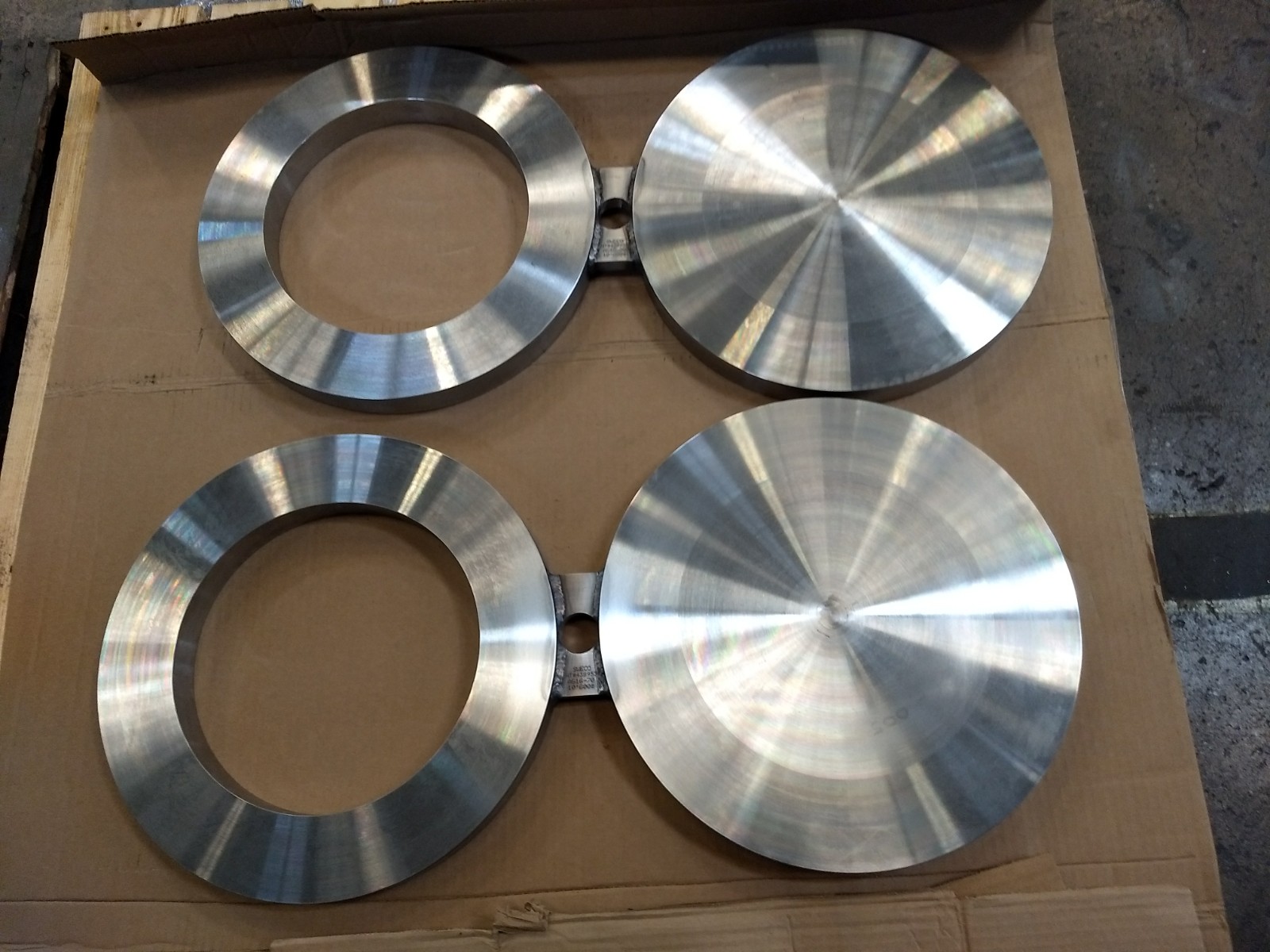
Inconel 625 Spectacle Blind Flanges (UNS N06625 / Werkstoff Nr. 2.4856) are precision-machined safety isolation devices manufactured from one of the most corrosion-resistant nickel superalloys available. The spectacle blind — also widely called a figure-8 blind or spec blind — is a figure-8 shaped assembly comprising two circular discs (one solid blind plate and one open ring) joined by a connecting web. It is permanently bolted between two pipe flanges and provides positive, visually-verifiable isolation of piping sections, equipment, and vessels — the most reliable and failsafe isolation method in process piping.
Manufactured in Inconel 625, the alloy's Ni-Cr-Mo-Nb composition delivers a combination of properties that no other commonly available alloy matches: excellent resistance to pitting and crevice corrosion in seawater, immunity to chloride stress corrosion cracking, high strength, and outstanding weldability. These attributes make Inconel 625 spectacle blinds the go-to choice for offshore platforms, subsea pipelines, FPSO topsides, chloride-rich chemical plants, and flue gas desulfurisation (FGD) systems where carbon steel or stainless steel would corrode unacceptably fast.
Tesco Steel & Engineering manufactures Inconel 625 spectacle blind flanges in all ASME B16.48 and DIN EN 1092-1 pressure classes, from NPS ½ to 60 inch, with full traceability documentation and third-party inspection capability, supplying EPC contractors, oil & gas operators, and process plant builders across 96+ countries.
A spectacle blind flange is a one-piece isolation device shaped like a pair of spectacles or the number "8". It consists of:
The critical advantage over isolation valves is positive visual confirmation: any worker can see from the side of the pipe whether the blind disc or the open ring is in service — there is no ambiguity about valve position or seat leakage. For this reason, spectacle blinds are mandated by process safety management (PSM) regulations and OSHA standards for equipment isolation prior to maintenance entry.
| Feature | Spectacle Blind (Figure-8) | Paddle Blind + Spacer | Slip Blind (Line Blank) |
|---|---|---|---|
| Standard | ASME B16.48 | ASME B16.48 | ASME B16.48 |
| Construction | One-piece figure-8; blind + ring joined permanently | Two separate pieces: solid paddle and open ring spacer | Single solid disc, no attached ring |
| Switching Method | Loosen bolts, rotate 180°, retighten — no disassembly | Remove all bolts, swap paddle/spacer, reassemble | Remove all bolts, install or remove disc, reassemble |
| Maintenance Frequency | Ideal for frequent open/close switching | Suitable for infrequent switching | For long-term permanent blind only |
| Visual Confirmation | Always visible which end is in service (spectacle handle) | Paddle handle sticks out to confirm position | No open-ring option; blind only |
| Best For | Small to medium bore (up to ~NPS 12–16); frequent switching | Large bore (>NPS 16) where figure-8 weight is impractical | Permanent long-term isolation or construction tie-in |
| Inconel 625 Use Case | Offshore process isolation, subsea piping, FPSO topsides | Large-bore seawater headers, offshore riser isolation | Tie-in blinds for subsea and offshore new construction |
| Element | Min % | Max % | Role in Alloy Performance |
|---|---|---|---|
| Nickel (Ni) | 58.0 | Balance | Primary matrix; base corrosion resistance, ductility & toughness |
| Chromium (Cr) | 20.0 | 23.0 | Forms protective Cr₂O₃ oxide layer; resists oxidising acids & high-temp oxidation |
| Molybdenum (Mo) | 8.0 | 10.0 | Key element — dramatically improves pitting & crevice corrosion resistance (high PREN) |
| Niobium + Tantalum (Nb+Ta) | 3.15 | 4.15 | Key element — precipitation strengthening; improves creep resistance & stabilises against sensitisation |
| Iron (Fe) | — | 5.0 | Minor constituent; no significant effect at these levels |
| Carbon (C) | — | 0.10 | Low carbon limits carbide precipitation; prevents sensitisation after welding |
| Manganese (Mn) | — | 0.50 | Deoxidiser |
| Silicon (Si) | — | 0.50 | Minor deoxidiser |
| Sulphur (S) | — | 0.015 | Controlled low to prevent hot cracking during welding |
| Aluminium (Al) | — | 0.40 | Deoxidiser; minor hardening contribution |
| Titanium (Ti) | — | 0.40 | Grain refiner; minor strengthening |
The high molybdenum (8–10%) and niobium (3.15–4.15%) content are the defining characteristics of Inconel 625 that distinguish it from other Inconel grades and drive its superior pitting and crevice corrosion resistance.
| Property | Value (Typical / Minimum) | Standard |
|---|---|---|
| Tensile Strength (UTS) | ≥ 930 MPa (135 ksi) | ASTM B564 / ASME SB-564 |
| 0.2% Proof Stress (YS) | ≥ 517 MPa (75 ksi) | ASTM B564 |
| Elongation | ≥ 30% (in 50 mm gauge) | ASTM B564 |
| Hardness | ≤ 220 HB | ASTM E10 |
| Density | 8.44 g/cm³ | — |
| Melting Range | 1290–1350 °C (2354–2462 °F) | — |
| Thermal Expansion (20–100 °C) | 12.8 μm/m·°C | — |
| Thermal Conductivity (at 100 °C) | 10.1 W/m·K | — |
| Modulus of Elasticity | 207 GPa (30.0 × 10⁶ psi) | — |
| PREN (Pitting Resistance Equivalent) | > 45 | Cr + 3.3×Mo + 16×N formula |
The high PREN (>45) confirms Inconel 625 spectacle blinds withstand the most aggressive seawater and chloride environments where duplex steel (PREN ~34–40) and even super duplex (PREN ~38–45) may face pitting risk.
| Trade Name | UNS | Werkstoff Nr. | JIS | BS | GOST | AFNOR | EN |
|---|---|---|---|---|---|---|---|
| Inconel 625 | N06625 | 2.4856 | NCF 625 | NA 21 | ХН75МБТЮ | NC22DNB4M / NiCr22Mo9Nb | NiCr22Mo9Nb |
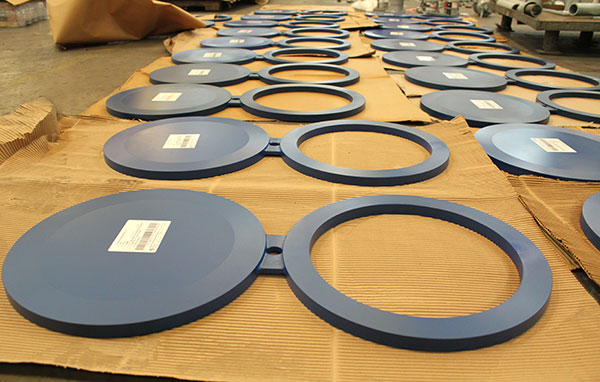
| Inconel 625 Spectacle Blind Flanges — Complete Range | |
|---|---|
| Material Standard | ASTM B564 / ASME SB-564 (Forgings) · UNS N06625 · DIN 2.4856 · ISO NW6625 |
| Dimensional Standard | ASME B16.48 (Line Blanks / Spectacle Blinds) · ASME B16.5 (for mating flanges) · DIN EN 1092-1 · BS 4504 |
| Size Range | ½″ NB to 60″ NB (DN 15 to DN 1500) |
| Pressure Classes (ASME) | Class 150, 300, 600, 900, 1500, 2500 |
| Pressure Ratings (DIN/EN) | PN 6, PN 10, PN 16, PN 25, PN 40, PN 64, PN 100, PN 160, PN 250, PN 320, PN 400 |
| Schedule / Wall Thickness | Spectacle blind thickness calculated per ASME B16.48 formula (function of NPS, class, and material allowable stress). Available in Sch 40 / STD / 80 / XS / 160 / XXS bore equivalents. |
| Face Types Available | Raised Face (RF) · Flat Face (FF) · Ring Type Joint (RTJ) · Tongue & Groove (T&G) |
| Manufacturing Process | Precision forged ring rolling or machined from hot-rolled disc/bar; then CNC machined to ASME B16.48 profile |
| Heat Treatment | Solution annealed at 1066–1177 °C (1950–2150 °F), rapid water quench, per ASTM B564 |
| Surface Finish | Mill finish · Pickled & passivated · Electropolished · Custom Ra per specification |
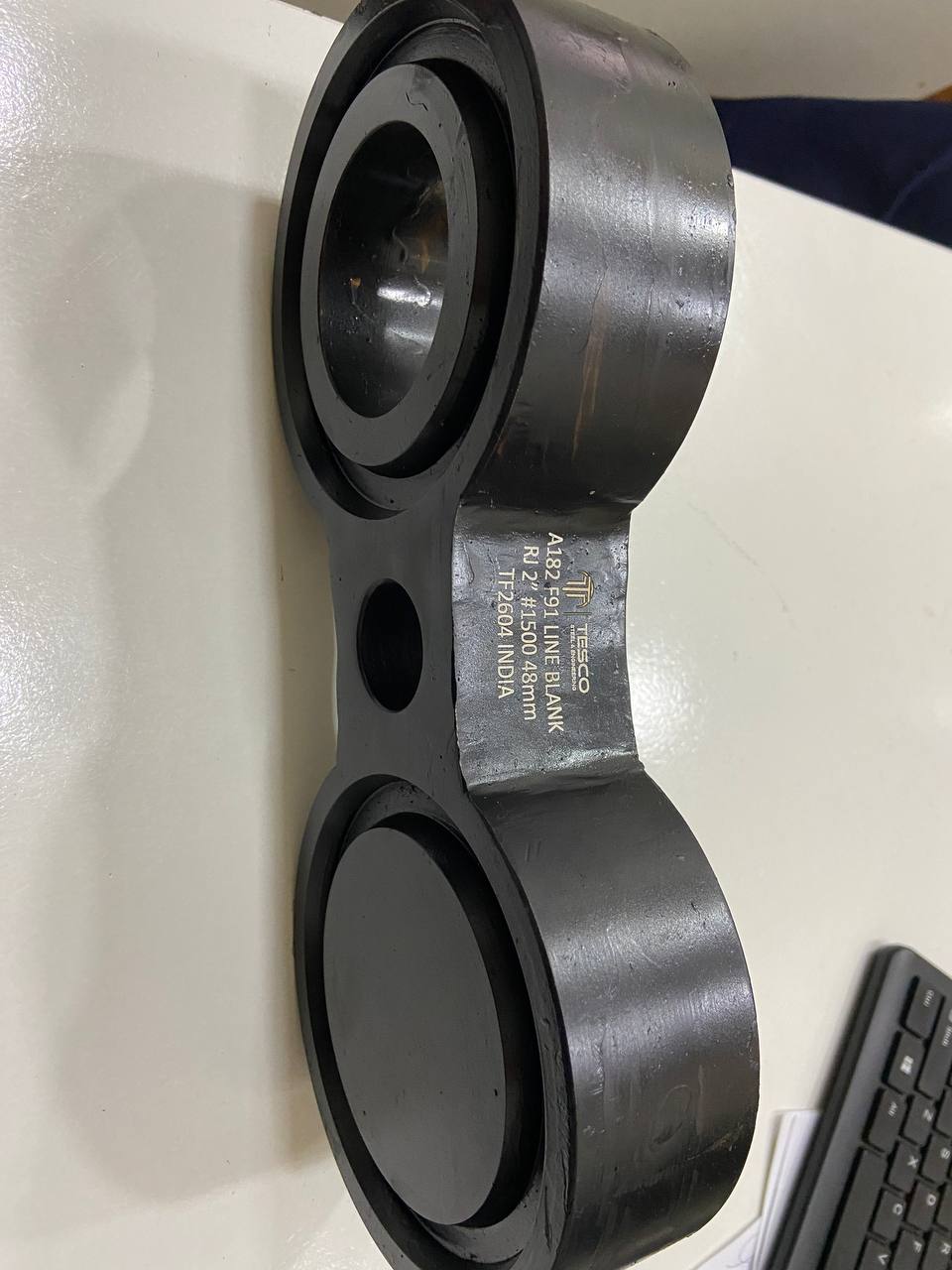
| Handle / Tab Identification | Handle tab marked "BLIND" or "OPEN" / "RING"; blind side clearly identified per project specification |
| Special Services | Sand blasting (Sa 2.5) · Shot peening · Epoxy coating · FBE coating · Electropolishing for chloride environments |
Chloride Pitting & Crevice Corrosion Resistance
The 8–10% molybdenum in Alloy 625 is the primary contributor to its pitting resistance. With a PREN >45 (vs. ~26 for 316L, ~35 for duplex 2205, and ~42 for super duplex 2507), Inconel 625 spectacle blinds resist chloride-induced pitting even in stagnant seawater, heated seawater (50–90 °C), and high-salinity brines where super duplex steel may still be at risk. This makes them the standard material in NORSOK M-630 and Shell DEP offshore spectacle blind specifications.
Stress Corrosion Cracking (SCC) Immunity
Chloride stress corrosion cracking (Cl-SCC) — which causes catastrophic failure of austenitic stainless steels in hot seawater and heated cooling water — does not occur in Inconel 625. The alloy is essentially immune to Cl-SCC at all practical temperatures and concentrations, making it the correct material for spectacle blinds in hot seawater injection, firewater, and cooling water systems on offshore installations.
Crevice Corrosion Under Gaskets
Spectacle blinds are permanently installed under gaskets and bolt loads, creating potential crevice geometry. In seawater or chloride-laden environments, this crevice can concentrate aggressive ions and cause localised attack in 316L or duplex steels. Inconel 625 resists crevice corrosion even in the most aggressive offshore seawater conditions, ensuring the spectacle blind remains functional throughout the service life of the pipeline.
Flue Gas Desulphurisation (FGD) & Acid Services
In FGD scrubber systems, spectacle blinds are exposed to dilute sulphuric acid, sulphurous acid, chloride-bearing condensates, and acidic slurry. Inconel 625 outperforms all stainless and duplex alternatives in these environments, and is routinely specified for FGD absorber inlet/outlet isolation and reheat piping spectacle blinds in power stations.
High-Temperature Performance
Inconel 625 retains its mechanical strength and corrosion resistance up to ~980 °C in oxidising atmospheres, and its yield strength remains well above 250 MPa at 650 °C — making it suitable for spectacle blinds in hot process lines where carbon steel or stainless steel would creep or scale.
| Industry / System | Typical Location / Service | Why Inconel 625? |
|---|---|---|
| Offshore Oil & Gas | Seawater injection headers, produced water, firewater mains, FPSO topsides | Chloride pitting & crevice corrosion immunity; NORSOK M-630 specified |
| Subsea Pipelines & Manifolds | Pipeline isolation, manifold block valve bypass, subsea pig launcher/receiver isolation | Seawater exposure; PREN >45 required; compatible with cathodic protection |
| Flue Gas Desulphurisation (FGD) | Absorber inlet/outlet blinds, booster fan isolation, slurry piping | Resistance to dilute H₂SO₃, HCl, and chloride/fluoride-bearing condensates |
| Chemical Processing | HCl, HF, mixed acids, phosphoric acid, organic acids at elevated temperatures | Superior mixed-acid resistance vs. stainless or duplex; long service life |
| Power Generation | Condenser cooling water isolation, supercritical steam systems, nuclear auxiliary piping | High-temp strength; chloride SCC immunity in seawater-cooled condensers |
| Desalination (SWRO / MSF) | High-pressure seawater isolation valves, RO membrane train blinds | No corrosion in aggressive hot brine and chlorinated seawater environments |
| Marine & Naval | Ballast water treatment, hull fittings, shipboard systems | Excellent resistance to marine environment; minimal maintenance |
| LNG & Cryogenic | LNG loading arm isolation, liquid nitrogen / oxygen spectacle blinds | Retains ductility and fracture toughness at cryogenic temperatures |
When specifying an Inconel 625 spectacle blind flange, the following parameters must be defined:
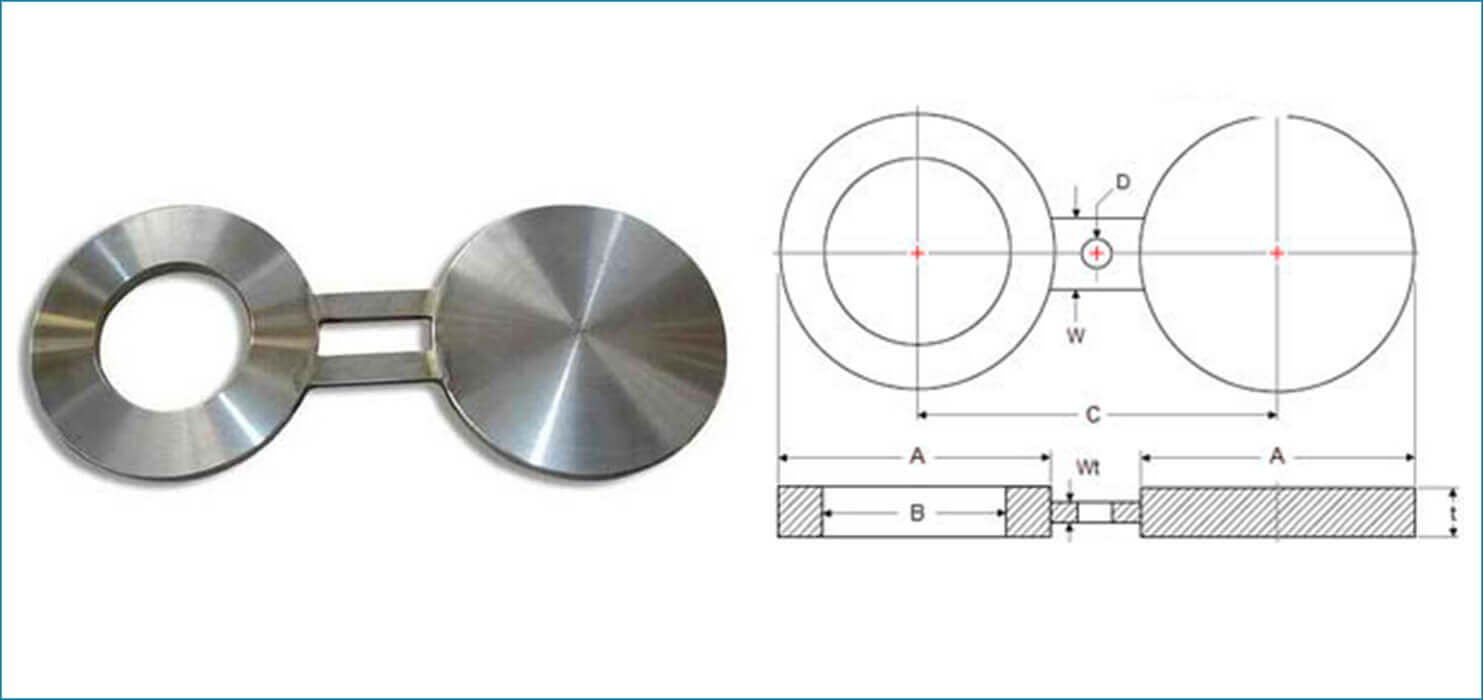
Dimension tables for Inconel 625 spectacle blind flanges follow the same bolt-hole pattern and OD as the equivalent ASME B16.5 flange class. Blind disc thickness increases with pipe size and pressure class per the ASME B16.48 formula. Click the links below for complete dimension tables:
Q: What is the governing standard for spectacle blind flanges?
Spectacle blind flanges (line blanks) are dimensioned to ASME B16.48, which defines the OD, bolt-hole pattern, blind thickness, and face finish for Classes 150 through 2500. ASME B16.48 is designed for use with ASME B16.5 flange assemblies. DIN EN 1092-1 governs European PN-rated equivalents.
Q: Why does Inconel 625 have better pitting resistance than 316L or Super Duplex?
Pitting resistance is quantified by the PREN formula: Cr + 3.3×Mo + 16×N. Inconel 625 achieves a PREN >45 (Cr~21%, Mo~9%) versus ~26 for 316L (Cr~17%, Mo~2.5%), ~34–36 for duplex 2205, and ~40–43 for super duplex 2507 (Cr~25%, Mo~4%). The 8–10% molybdenum in 625 — more than double that of super duplex — is the primary driver of its superior pitting resistance in chloride environments.
Q: Can Inconel 625 spectacle blinds be used in sour service (H₂S)?
Yes. Inconel 625 (UNS N06625) complies with ISO 15156 / NACE MR0175 for sour service (H₂S-containing oil and gas environments) in the annealed condition, with hardness ≤ 40 HRC (typical for forged and annealed 625 is well below this). The alloy's high nickel content also provides resistance to hydrogen embrittlement at ambient temperatures.
Q: What gasket should be used with Inconel 625 spectacle blind flanges?
For Raised Face (RF) spectacle blinds, use spiral-wound gaskets with Inconel 625 winding wire and graphite or PTFE filler (ASME B16.20). In high-chloride seawater environments, avoid spiral-wound gaskets with 316L stainless windings — use Inconel 625 windings throughout to prevent galvanic corrosion at the gasket-blind interface. For RTJ faces, use soft-iron or Alloy 625 ring gaskets. For flat-face low-pressure utility applications, PTFE-encapsulated or compressed non-asbestos gaskets are acceptable.
Q: Is Inconel 625 compatible with cathodic protection in subsea applications?
Yes. Inconel 625 is a noble alloy with a naturally high electrochemical potential. In cathodically protected systems (e.g., aluminium anode CP on subsea structures), Inconel 625 components do not require additional protection and will not be preferentially corroded. However, the noble potential of Inconel 625 can cause galvanic corrosion in less noble adjacent metals (carbon steel, aluminium) — this coupling must be evaluated during system design.
Q: What is the weight of an Inconel 625 spectacle blind compared to carbon steel?
Inconel 625 has a density of 8.44 g/cm³ versus 7.85 g/cm³ for carbon steel — approximately 7.5% heavier for the same volume. However, because Inconel 625's higher yield strength (517 MPa vs. ~250 MPa for A105) allows thinner blind discs per the ASME B16.48 thickness formula, the actual installed weight of an Inconel 625 spectacle blind may be similar to or lighter than an equivalent carbon steel or stainless steel blind in the same class.
Q: How do I identify whether a spectacle blind is currently in the "open" or "blind" position?
The connecting tab or handle of the spectacle blind will indicate the position. On Tesco Steel spectacle blinds, the solid blind side is marked "BLIND" and the open ring side "OPEN" on the handle tab. In the "open" position, the ring is in line and the blind disc is accessible from the side. In the "blind" position, the solid disc is in line and the ring is accessible. This visual confirmation is the key safety advantage over a closed valve.
Inconel 625 spectacle blind flange prices depend on NPS, pressure class, quantity, face type, and prevailing nickel and molybdenum commodity prices. As a Ni-Cr-Mo-Nb specialty alloy, Alloy 625 spectacle blinds are priced at a significant premium over carbon or stainless alternatives — but the elimination of corrosion-related maintenance, inspection, and replacement costs over the service life typically delivers a far better total cost of ownership.
For a competitive, factory-direct price list with current stock status, please fill in the Inquiry Form or reach us on WhatsApp at +91 92233 66922. Our technical sales team will respond within 24 hours.
Countries We Export Inconel 625 Spectacle Blind Flanges To: Kuwait, UAE, Saudi Arabia, Germany, West Africa, Iraq, Congo, Mexico, Bahrain, Canada, Philippines, Thailand, Kenya, Oman, Malaysia, Turkey, Qatar, Sudan, Netherlands, Nigeria, Lithuania, Gabon, Russia, Vietnam, Angola, Bolivia, Indonesia, UK, Yemen, Italy, United States, Venezuela, Spain, Iran, Estonia, Kazakhstan, Algeria, Jordan, Ecuador, Portugal, Colombia, Libya, Chile, Peru, South Africa, Bangkok, Namibia, Jeddah, Afghanistan, Israel, Zambia, Macau, Morocco, Denmark, Taiwan, Norway, Belarus, North Macedonia, Lebanon, Sri Lanka, Bhutan, Bulgaria, Albania, Ukraine, Belgium, Finland, Slovakia, Romania, France, Brazil, Trinidad & Tobago, Fiji, Tunisia, Gambia, Hungary, Zimbabwe, Mongolia, Ghana, Egypt, Czech Republic, Azerbaijan, Poland, Greece, Costa Rica, New Zealand, Croatia, Tanzania, Somalia, Australia, Singapore, Japan, South Korea.
Domestic Supply — Inconel 625 Spectacle Blind Flanges in India: Mumbai, Delhi, Bangalore, Hyderabad, Ahmedabad, Chennai, Kolkata, Surat, Pune, Jaipur, Lucknow, Kanpur, Nagpur, Visakhapatnam, Indore, Thane, Bhopal, Pimpri-Chinchwad, Patna, Vadodara, Ghaziabad, Ludhiana, Coimbatore, Agra, Andhra Pradesh, Arunachal Pradesh, Assam, Bihar, Chandigarh, Chhattisgarh, Goa, Gujarat, Haryana, Himachal Pradesh, Jammu & Kashmir, Jharkhand, Karnataka, Kerala, Madhya Pradesh, Maharashtra, Manipur, Meghalaya, Mizoram, Nagaland, Odisha, Punjab, Rajasthan, Sikkim, Tamil Nadu, Telangana, Tripura, Uttar Pradesh, Uttarakhand, West Bengal.