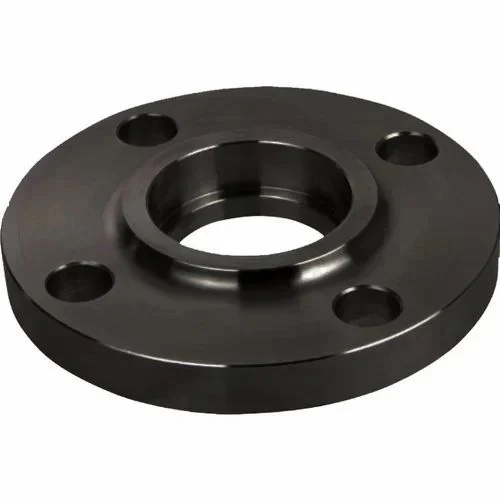
Tesco Steel & Engineering manufactures ASTM A105 socketweld flanges to ASME B16.5 from ½″ to 3″ NB in Classes 150–1500 (2500 and 4″ to order). This is where the piping world's default material meets its default small-bore joint: A105 — the forged carbon steel grade every specification assumes, 485/250 MPa, −29 °C to 425 °C — in the socket weld pattern that owns instrument taps, drains, vents and injection points: pipe seated in a machined socket, one external fillet weld, schedule-matched bore. All three facings — SWRF, SWFF, SWRTJ — plus galvanizing and A105N normalized supply to order. Colder than −29 °C? A350 LF2. Hotter than 425 °C? Chrome-moly. Stocked by the pallet, every lot with EN 10204 3.1/3.2 MTC. ISO 9001:2015, made in Mumbai, India — exported to 50+ countries.
ASTM A105 / A105N Forged Carbon SteelASME B16.5 ½″–3″ · Class 150–1500485 / 250 MPa · ≤187 HB−29 °C to 425 °CSWRF · SWFF · SWRTJSchedule-Matched BoresBlack or Galvanized · Ready StockEN 10204 3.1 / 3.2 · ISO 9001:2015
The workhorse grade in the small-bore pattern. A forged ASTM A105 carbon steel flange whose back carries a machined socket: the pipe seats inside, self-aligned square to the face, and takes one external fillet weld. A105 is the grade every specification assumes — tensile ≥485 MPa, yield ≥250 MPa, −29 °C to 425 °C — and the socket weld owns small bore, so this is the default flange of carbon steel instrument, drain, vent and injection connections. Sized by ASME B16.5 at ½″–3″ NB, Classes 150–1500, through-bore matched to the pipe schedule; EN 10204 3.1 on every lot.
Also searched as: A105 socket weld flange, A105N SW flange, carbon steel SWRF flange, CS socket weld flange, forged socket weld flange — all the same product family. Related pages: the facings — SWRF / SWFF / SWRTJ — the socketweld hub, the other A105 types — blind, weld neck, slip-on — and the temperature neighbours LTCS A350 LF2 and chrome-moly.
Why A105 × Socket Weld Owns Carbon Steel Small Bore
The Default Meets the Default
Most small-bore process piping is carbon steel; A105 is carbon steel's forging grade of record; the socket weld is small bore's joint of record. The intersection is the most-ordered small-bore flange on earth — which is why it ships from ready stock.
Welds With Nothing Exotic
Plain C-Mn chemistry: standard consumables, code-book preheat rules only for heavy walls or cold weather, no PWHT drama at these sections. Fabricators price A105 sockets lower for a reason.
The Socket Is the Jig
Seated square by geometry, one external weld, no internal fillet anyone would have to make inside a ¾″ bore — faster and truer fit-up than any other small-bore joint.
Priced to Be Everywhere
The cheapest flange material in the catalogue, in the smallest sizes of the range — instrument taps and drains multiply by the hundred per unit, and A105 keeps that line-item honest.
ASTM A105 Chemical Composition
Element
C
Mn
Si
P
S
Cu
Ni
Cr
Mo
V
Weight %
≤0.35
0.60–1.05
0.10–0.35
≤0.035
≤0.040
≤0.40
≤0.40
≤0.30
≤0.12
≤0.08
A plain carbon-manganese forging steel — nothing deliberately alloyed, which is its whole virtue: predictable welding, easy machining, unbeatable price. The residual ceilings (Cu, Ni, Cr, Mo, V) protect weldability and are verified on every heat.
Mechanical Properties
Property
ASTM A105 Requirement
Tensile Strength
≥ 485 MPa (70 ksi)
Yield Strength (0.2%)
≥ 250 MPa (36 ksi)
Elongation
≥ 22%
Hardness
≤ 187 HB — doubles as a welding and sour-service safeguard
ASTM A105 Socketweld Flanges are available in the following specifications:
Material Grade
ASTM A105 forged carbon steel; A105N (normalized) on request — heat treatment mandatory above Class 300 per the specification
Size
1/2"NB to 3"NB per ASME B16.5; 4″ and larger to order; DN15–DN80 per EN 1092-1 Type 03
Class
150#, 300#, 600#, 900#, 1500# (900# shares 1500# dimensions in most sizes); 2500# on request; PN16–PN100
Facings
Raised Face (SWRF), Flat Face (SWFF), Ring Type Joint (SWRTJ) with groove per B16.20
Bore
Socket bore to pipe OD; through-bore matched to pipe schedule (Sch 40/80/160) — state the schedule at enquiry
Welding
Single external fillet per B16.5/B31.3; 1/16″ expansion gap before welding — see the FAQ
Surface Finish
Black oil-coated (stocking standard), hot-dip galvanized or epoxy to order
Service Span
−29 °C to 425 °C; NACE MR0175 sour duty within A105's standard hardness ceiling
Testing
Tension & chemistry per heat; socket depth and bore gauged piece by piece
Certification
EN 10204 3.1 (standard) / 3.2 witnessed
Specification Notes — Getting A105 Sockets Right
Four honest notes.The 1/16″ gap is not optional: pipe bottomed hard against the socket shoulder cracks the weld root under thermal expansion — B31.3's set-back exists for a reason. Know the temperature fences: below −29 °C the specification hands over to impact-tested A350 LF2; above 425 °C sustained duty belongs to chrome-moly — A105 between them, and nothing richer than the duty needs. Fillet welds cannot be radiographed: severe cyclic, lethal-service and mandatory-RT line classes escalate to the small-bore weld neck. And galvanize after fabrication where you can: zinc must come off the weld zone anyway — bare-weld-then-galvanize is the cleaner sequence, and we supply either way.
How Our A105 Socketweld Flanges Are Manufactured
1
Forging — cut billet of the certified A105 heat is hot-forged into the flange blank with full heat traceability.
2
Heat treatment — as-forged supply where the specification permits (Class 300 and below); normalized above Class 300 and for all A105N orders; furnace records retained.
3
Machining — faces, OD and drilling to ASME B16.5; the socket counterbore and depth gauged piece by piece, through-bore matched to the ordered pipe schedule.
4
Facing — RF serrations, flat face or RTJ groove per B16.20, serrated stock finish standard.
5
Testing & marking — tension and chemistry per heat; laser-marked with grade (A105 or A105N), size, class, schedule and heat number.
6
Finishing, certification & packing — black oil-coat, galvanize or epoxy as ordered; EN 10204 3.1 MTC (3.2 witnessed on request); packed sea-worthy.
Where ASTM A105 Socketweld Flanges Are Used
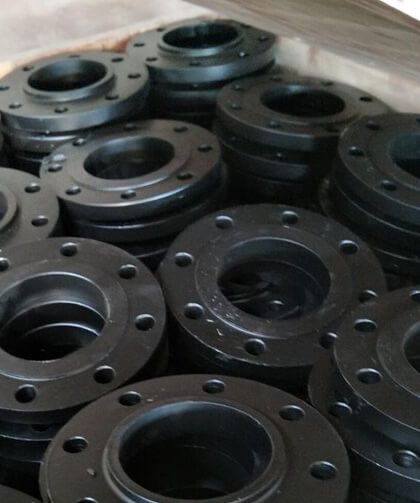
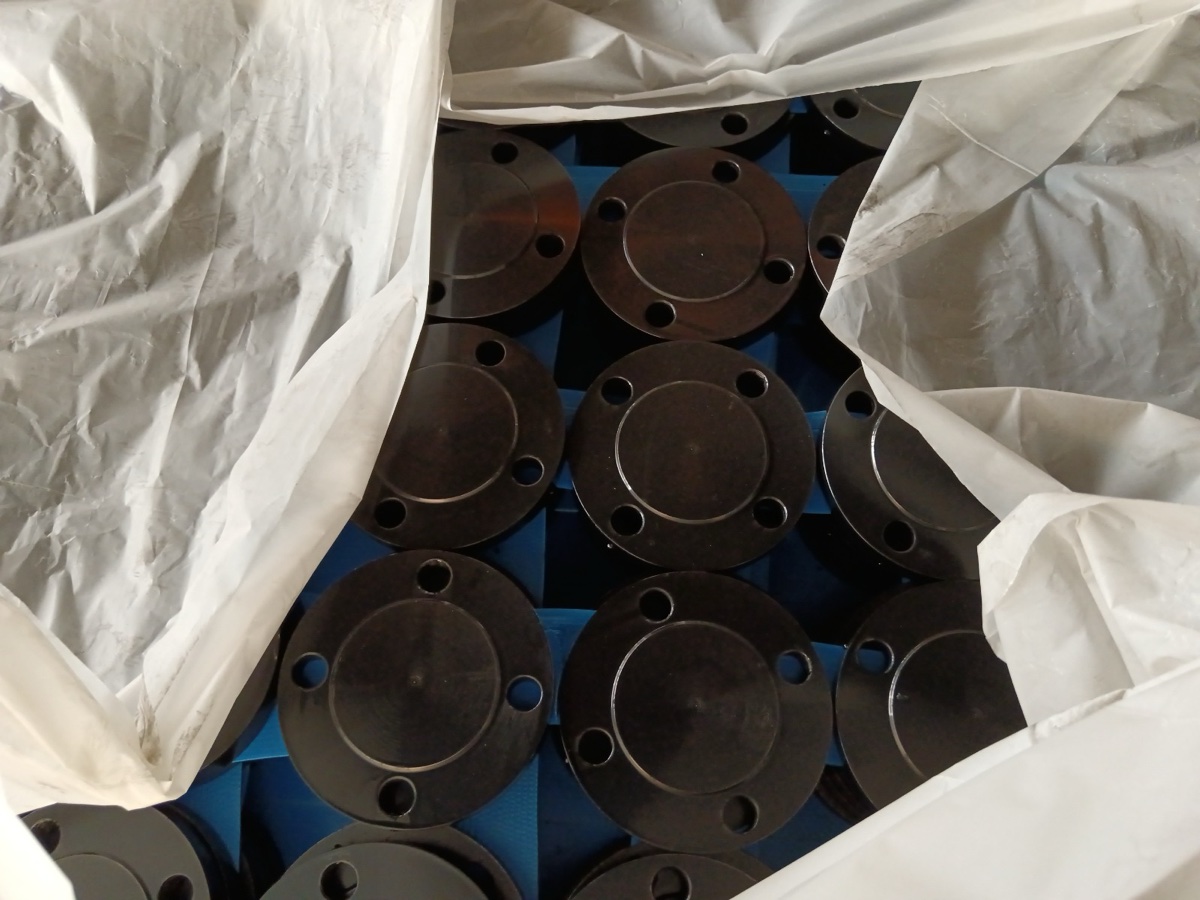
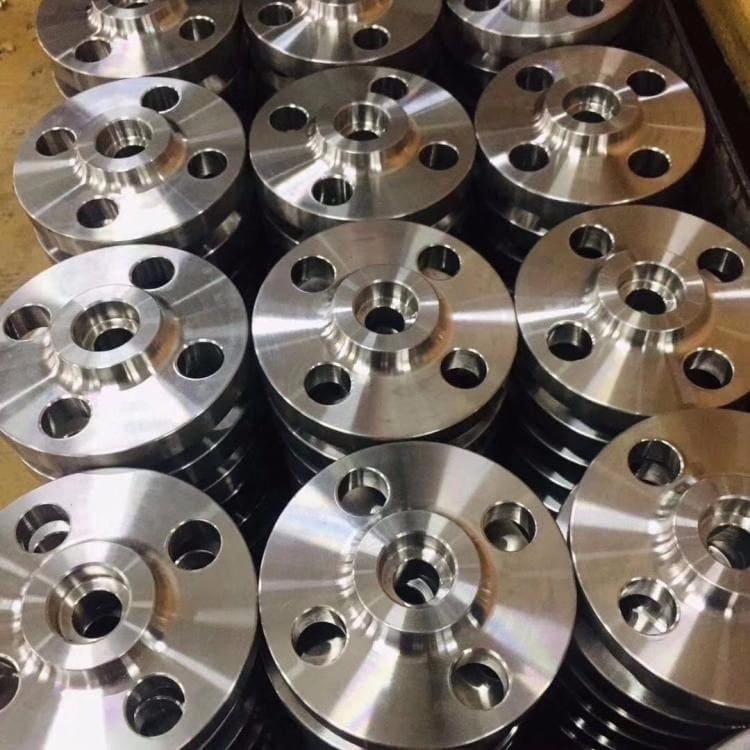
Everywhere carbon steel small bore lives: instrument and gauge connections, chemical injection and sampling points, drains, vents and bleeds, steam trap stations, fuel and lube-oil skids, compressor and pump auxiliaries, boiler and utility piping — across refineries, petrochemical plants, power stations, water infrastructure and general industry. Production below:
Carbon Steel Flanges — Black-Coated, Crated (A694 F52)A105 Flanges — Packed & Black-Coated for DispatchSocket Weld Flanges — Machined Batch at Our Works
A105 Socketweld Flange Dimensions
Socket weld flange dimensions are class-governed per ASME B16.5. Full charts:
An ASTM A105 socketweld flange is a forged carbon steel flange whose back carries a machined socket (counterbore): the pipe end seats inside it, self-aligned square to the face, and is secured with a single external fillet weld. A105 is the grade every piping specification assumes for ambient and moderate temperatures — tensile 485 MPa and yield 250 MPa minimum, service from -29°C to 425°C — and the socket weld is the small-bore specialist pattern, so this page is where the piping world's default material meets its default small-bore joint. Dimensioned to ASME B16.5 for ½" to 3" NB in Classes 150 to 1500, in raised face, flat face and ring joint facings.
Why is A105 the default grade for socket weld flanges?
Because the overwhelming majority of small-bore process and utility piping is carbon steel, and A105 is carbon steel's forging grade of record. Its simple C-Mn chemistry welds without exotic procedures, machines cleanly, forges soundly, costs the least of any flange material, and its 485/250 MPa numbers comfortably cover what the B16.5 class tables ask of a flange body. Every instrument tap, drain, vent and injection point on a carbon steel line defaults to an A105 socket weld flange unless temperature, corrosion or code says otherwise — which is why we stock them by the pallet in the common sizes and classes, ready to ship.
What is the chemical composition of ASTM A105?
Carbon ≤0.35%, manganese 0.60-1.05%, silicon 0.10-0.35%, phosphorus ≤0.035%, sulphur ≤0.040%, with residual ceilings of copper ≤0.40%, nickel ≤0.40%, chromium ≤0.30%, molybdenum ≤0.12% and vanadium ≤0.08%. It is a plain carbon-manganese forging steel — nothing deliberately alloyed — which is exactly its virtue: predictable welding with standard consumables and preheat rules, easy machining, and a price no alloy approaches. The residual caps matter for weldability and are verified on every heat's chemistry, which travels on the EN 10204 3.1 certificate.
What are the mechanical properties of A105 socketweld flanges?
Tensile strength 485 MPa (70 ksi) minimum, yield strength 250 MPa (36 ksi) minimum, elongation 22% minimum and hardness capped at 187 HB — comfortable, ductile numbers for a flange body whose thickness the ASME B16.5 class tables already fix. The hardness ceiling doubles as a welding and sour-service safeguard. Each heat is tension-tested and chemistry-verified, and where NACE MR0175 sour duty applies, A105's standard hardness limit sits inside the NACE ceiling — state the requirement and the certificate will say so.
What is the temperature range of A105 socket weld flanges?
The working band is -29°C to 425°C. Below -29°C, impact-tested LTCS takes over — ASTM A350 LF2, the same flange with guaranteed Charpy toughness at -46°C; our LF2 socket weld flanges are the laser-marked units you will find pictured on our SWRF page. Above roughly 425°C, sustained service moves to the chrome-moly grades (A182 F11, F22 and upward), because plain carbon steel loses strength and begins to graphitize with long exposure. Between those boundaries — the vast middle of process and utility piping — A105 is the economical right answer, and specifying anything richer wastes money.
How is an A105 socketweld flange welded — and why the 1/16" gap?
The pipe is inserted until it bottoms against the socket shoulder, withdrawn approximately 1/16" (1.6 mm), and secured with a single external fillet weld — the set-back required by ASME B31.3 so the pipe's thermal expansion cannot drive against the socket shoulder and crack the weld root; cracked socket welds in steam service almost always trace to a missing gap. The weld throat must be at least the pipe wall thickness and not less than 3 mm. A105 needs no exotic procedure — standard carbon steel consumables, preheat only for heavy walls or cold weather per code — and the external fillet is visually and MT/PT inspectable, though not radiographable.
What facings are A105 socketweld flanges made with?
All three, each with its own page on this site. Raised face (SWRF) is the overwhelming default for steel-to-steel small-bore joints — the raised ring concentrates bolt load onto a spiral wound or sheet gasket. Flat face (SWFF) mates the cast iron pumps, GRP and lined equipment that cannot tolerate a raised ring, using a full-face gasket. Ring type joint (SWRTJ) serves high-pressure lines with a metal ring gasket in a machined groove. The socket and welding practice are identical across all three — only the gasket face changes — and the mating flange decides which you order.
What sizes and pressure classes do A105 socketweld flanges come in?
ASME B16.5 standardises socket weld flanges from ½" to 3" NB in Classes 150, 300, 600, 900 and 1500 — with Class 900 small-bore flanges sharing Class 1500 dimensions in most sizes, and Class 2500 or 4" sockets made to order. One detail unique to socket flanges belongs on every enquiry: the pipe schedule. The socket bore suits the pipe OD, but the through-bore is machined to match the pipe's inside diameter — Sch 40, 80 or 160 — so the flow path stays smooth. A105 stock concentrates in Class 150-600 across all sizes; Class 800-equivalent small-bore fittings territory (B16.11) is a different product family.
A105 socket weld or A105 threaded flange — which one?
If the line is welded, socket weld — nearly always. The threaded flange's tapered threads thin the pipe wall, concentrate stress, loosen and weep under vibration and thermal cycling, and corrode in the thread crevices; codes progressively exclude them as pressure, temperature and hazard rise. The socket weld replaces the threads with fused metal: stronger, permanent, no helical leak path, and in Classes 600-1500 instrument and injection duty it is the standard answer. Threaded A105 flanges keep their legitimate territory where hot work is impossible or forbidden — galvanized utility headers, hazardous-area retrofits, temporary connections — and our threaded flange page covers them honestly.
When should I escalate from a socket weld to a weld neck?
When consequence or code demands a butt weld. The weld neck's full-penetration joint can be radiographed and fatigue-rated; the socket weld's fillet cannot be volumetrically examined, its root concentrates stress, and the socket's internal gap is a crevice. So: severe cyclic or vibrating service, lethal and high-hazard line classes, mandatory radiography, and corrosion-sensitive or stagnant duties all move to the small-bore weld neck — see our WNRF page. Everywhere else on carbon steel small bore, which is the overwhelming majority of instrument, drain, vent and injection connections, the socket weld does the same job faster and cheaper, and the code asks no more.
Can A105 socketweld flanges be galvanized or coated?
Yes — hot-dip galvanizing is a routine option for water, utility and outdoor small-bore systems, and black oil-coated supply (the mill finish pictured on this page) is the stocking standard that paints over cleanly. Epoxy and other coating systems are applied to order. Two practical notes: galvanized flanges destined for welding need the zinc removed at the weld zone — or order the flanges bare and galvanize after fabrication, which is better practice; and if the line is stainless or alloy downstream, do not let galvanized hardware touch it during storage. State the coating on the enquiry and it arrives on the certificate.
Is A105 heat treated — and what does A105N mean?
The specification makes heat treatment mandatory for flanges above Class 300 and for special cases; at Class 300 and below, as-forged supply is permitted. A105N on a purchase order means normalized — a full austenitize-and-air-cool that refines the forged grain, evens out properties and improves toughness — and many refinery and offshore specifications simply write A105N for every class to remove the question. We normalize higher-class flanges as standard practice and supply certified A105N on request at any class; the heat-treatment condition is stated on the EN 10204 certificate either way. If your specification says A105N, quote it that way and the certificate will match.
What details are needed to get an accurate A105 socketweld flange quotation?
Six elements plus commercial terms: (1) size — ½" to 3" NB; (2) pressure class — 150 to 1500; (3) facing — SWRF, SWFF or SWRTJ with ring number; (4) the pipe schedule — Sch 40, 80 or 160, so the through-bore matches the pipe ID; (5) material condition and coating — A105 or A105N, black, galvanized or epoxy; (6) certification — EN 10204 3.1 (our standard) or 3.2, PMI, NACE MR0175 where applicable. Add quantity and destination and we return price, weight and delivery — normally within 24 hours, with common sizes quoted from ready stock.
Who manufactures ASTM A105 socketweld flanges in India?
Tesco Steel & Engineering is an ISO 9001:2015 certified flange manufacturer based in Mumbai, India, producing ASTM A105 and A105N socket weld flanges from ½" to 3" NB (larger to order) in Classes 150-1500 — each forged from certified heats, machined with gauged socket depth and schedule-matched bore, laser-marked with grade, size, class, schedule and heat number, and shipped with EN 10204 3.1/3.2 certification. Common sizes and classes are held in ready stock in black and galvanized finish, alongside the full socket weld range in LTCS, stainless, duplex and nickel alloys, and exported to more than 50 countries.