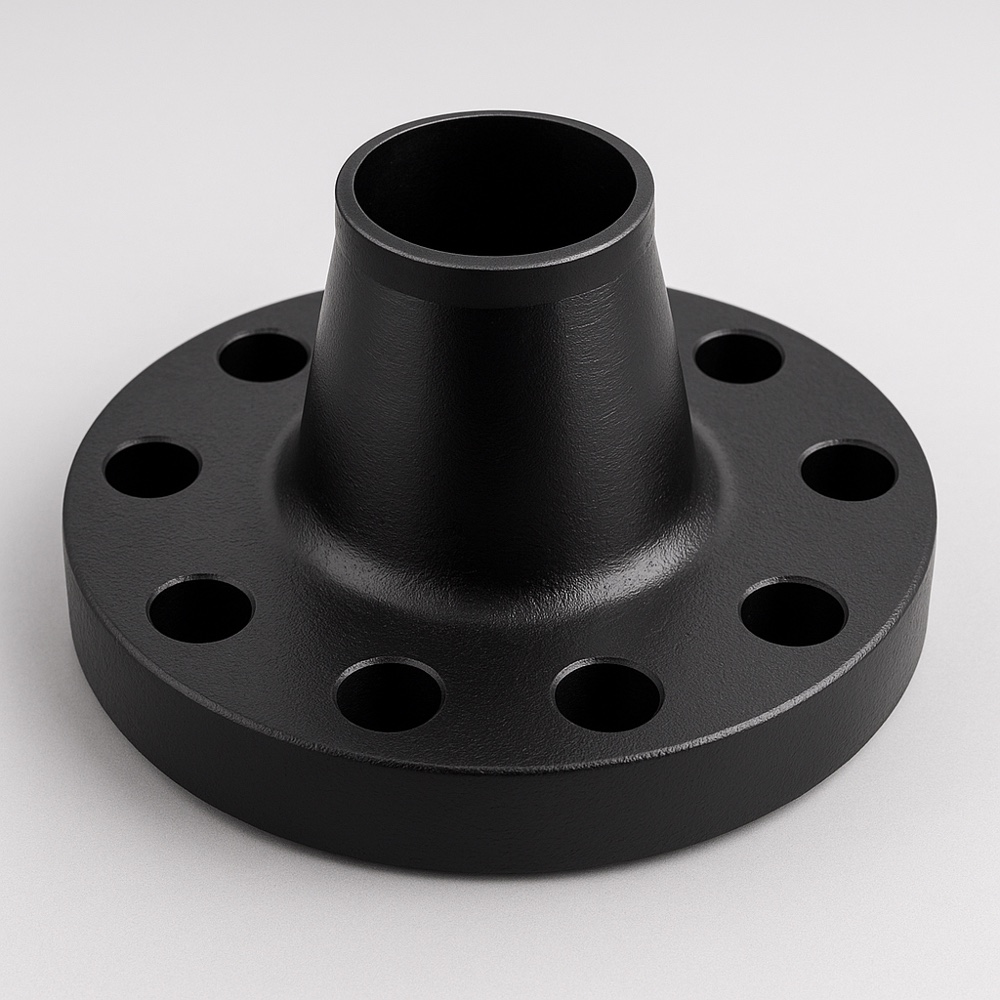
Tesco Steel & Engineering forges ASTM A105 weld neck flanges — the carbon steel workhorse of world piping — from 1/2″ NB to 56″ NB, in ASME B16.5 Class 150–2500, ASME B16.47 Series A & B, EN 1092-1 Type 11, DIN and BS 4504. Supplied as-forged or normalized (A105N), raised or flat face, bores matched to your pipe schedule, and finished bare, hot-dip galvanized, epoxy or FBE coated. Rated −29 °C to ~425 °C, the natural partner of A106 Gr B pipe in oil & gas, refinery, power and water systems — with NACE MR0175, IBR and EN 10204 3.1/3.2 on request. ISO 9001:2015, made in Mumbai, India — exported worldwide.
ASTM A105 Carbon Steel Weld Neck Flange — Black Coated, Raised Face
What is an ASTM A105 Weld Neck Flange?
ASTM A105 is the standard carbon steel forging specification for piping flanges in ambient- and high-temperature service — the grade a piping class means when it names no other material. An A105 weld neck flange pairs it with the strongest flange design: a long tapered hub butt-welded to the pipe, bore matched to the pipe schedule, joint fully radiographable. It is the highest-volume flange item in world piping.
The weld neck earns its place wherever pressure, temperature or cycling gets serious: the tapered hub feeds stress gradually into the pipe wall for roughly twice the fatigue life of a slip-on joint, the matched bore keeps flow smooth, and the full-penetration butt weld takes radiography — the inspection backbone of hydrocarbon piping codes. Mated with A106 Grade B or API 5L pipe and E7018 consumables, it forms the default joint of refinery and pipeline construction.
Specify the condition your project needs: as-forged A105 for general service, or normalized A105N where refined grain and guaranteed toughness are called for. Below −29 °C, step to impact-tested LTCS A350 LF2; above ~425 °C, to alloy steel F11/F22/F91 — both forged in-house.
Also searched as: A105 WNRF flange, SA105 weld neck flange, carbon steel weld neck flange, A105N flange, CS WNRF flange — all refer to the product on this page.
Chemical Composition of ASTM A105
C
Mn
P
S
Si
Cu
Ni
Cr
Mo
V
0.35 max
0.60-1.05
0.035 max
0.040 max
0.10-0.35
0.40 max
0.40 max
0.30 max
0.12 max
0.08 max
Specification notes: (1) The sum of copper, nickel, chromium, molybdenum and vanadium shall not exceed 1.00%. (2) The sum of chromium and molybdenum shall not exceed 0.32%. For each reduction of 0.01% below the specified carbon maximum (0.35%), an increase of 0.06% manganese above the specified maximum (1.05%) will be permitted, up to a maximum of 1.35%.
Mechanical Properties of ASTM A105
Tensile Strength, MPa [ksi]
Yield Strength, Min, MPa [ksi]
Elongation % min.
Reduction of Area % min.
Hardness HB max
485 [70]
250 [36]
22
30
187
The 250 MPa yield minimum out-muscles austenitic stainless grades at a fraction of the price — and the 187 HB hardness ceiling keeps standard A105 inside the NACE MR0175 limit for sour service without special processing.
ASTM A105 Weld Neck Flange Specifications
ASTM A105 Weld Neck Flanges are available in the following specifications:
Size
1/2"NB to 56"NB
Class
150#, 300#, 400#, 600#, 900#, 1500#, 2500#
Sch (Schedule)
XS, XXS, STD & Schedule 20, 40, 80, 160
Pressure Ratings
PN 2.5 - PN 400
Standards
ASME B16.5, ASME B16.47 Series A & B, EN 1092-1 Type 11, DIN 2631–2635, BS 4504
Condition
As-forged A105 or Normalized A105N
Other Services
Hot Dip Galvanized (GI) ASTM A105 Weld Neck Flanges Sand Blasting on ASTM A105 Weld Neck Flanges Shot Peening on ASTM A105 Weld Neck Flanges Epoxy Coating on ASTM A105 Weld Neck Flanges FBE Coating on ASTM A105 Weld Neck Flanges
Why A105 for Carbon Steel Flanged Joints
The Default of World Piping
When a piping class names no material, it means A105 — matched to A106 Gr B pipe, E7018 consumables and every fabricator's standard procedures. No qualification surprises, anywhere.
Strength Per Rupee
250 MPa minimum yield beats austenitic stainless at a fraction of the cost — compact bolted joints in Class 600, 900 and above without exotic-material budgets.
Coat It Any Way You Like
Hot-dip galvanizing for water and outdoor duty, epoxy and FBE for buried and pipeline service, blasting and anti-rust oil for yard stock — carbon steel takes them all, faces protected.
Sour-Service Ready
The 187 HB ceiling sits under the NACE MR0175 hardness limit, so H2S service certification is a paperwork step, not a special product.
A Weld You Can Prove
The full-penetration butt weld radiographs cleanly — the inspection backbone of hydrocarbon piping codes, and the reason weld necks dominate critical carbon steel lines.
Production, Stock & Packing
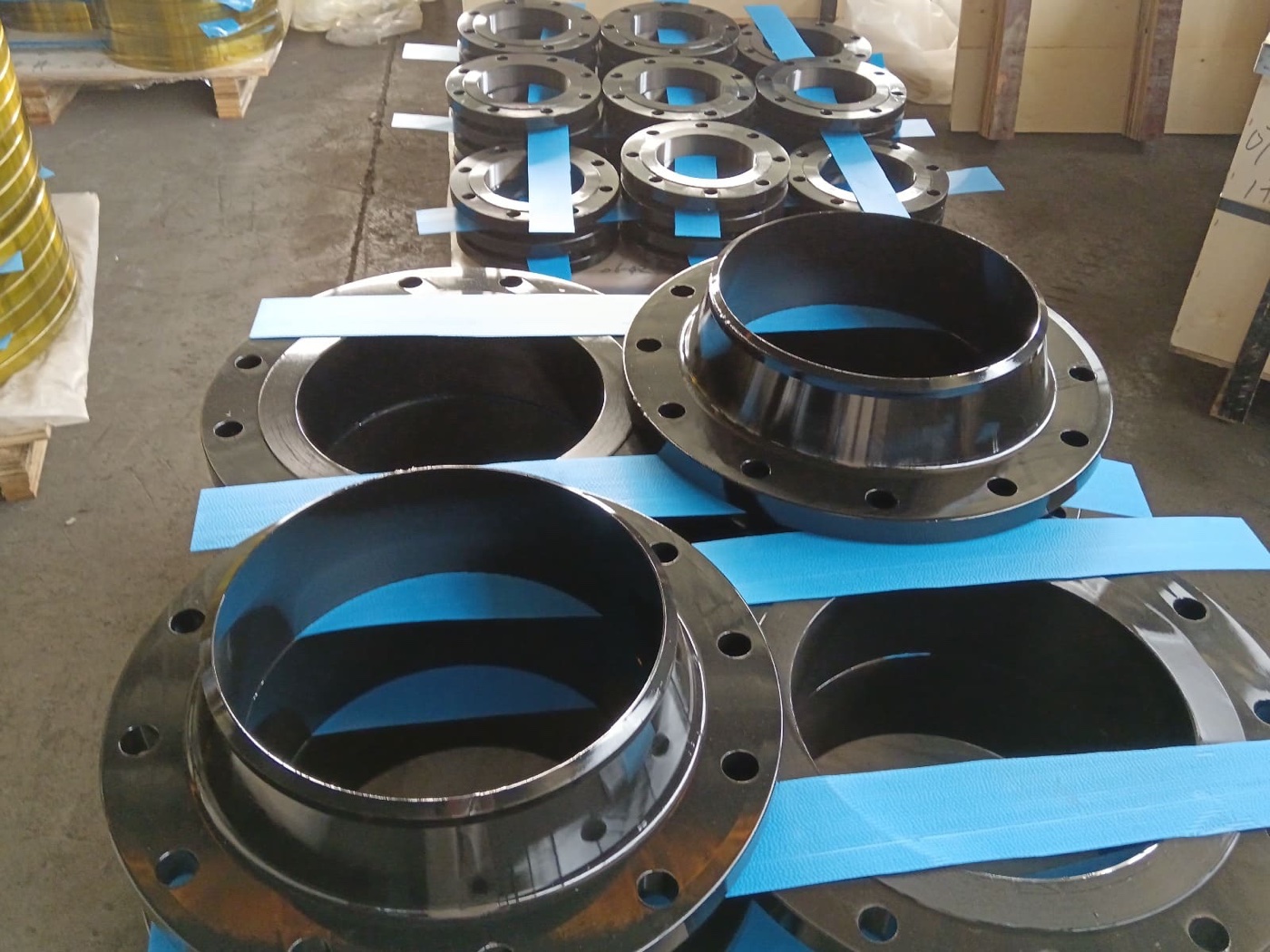
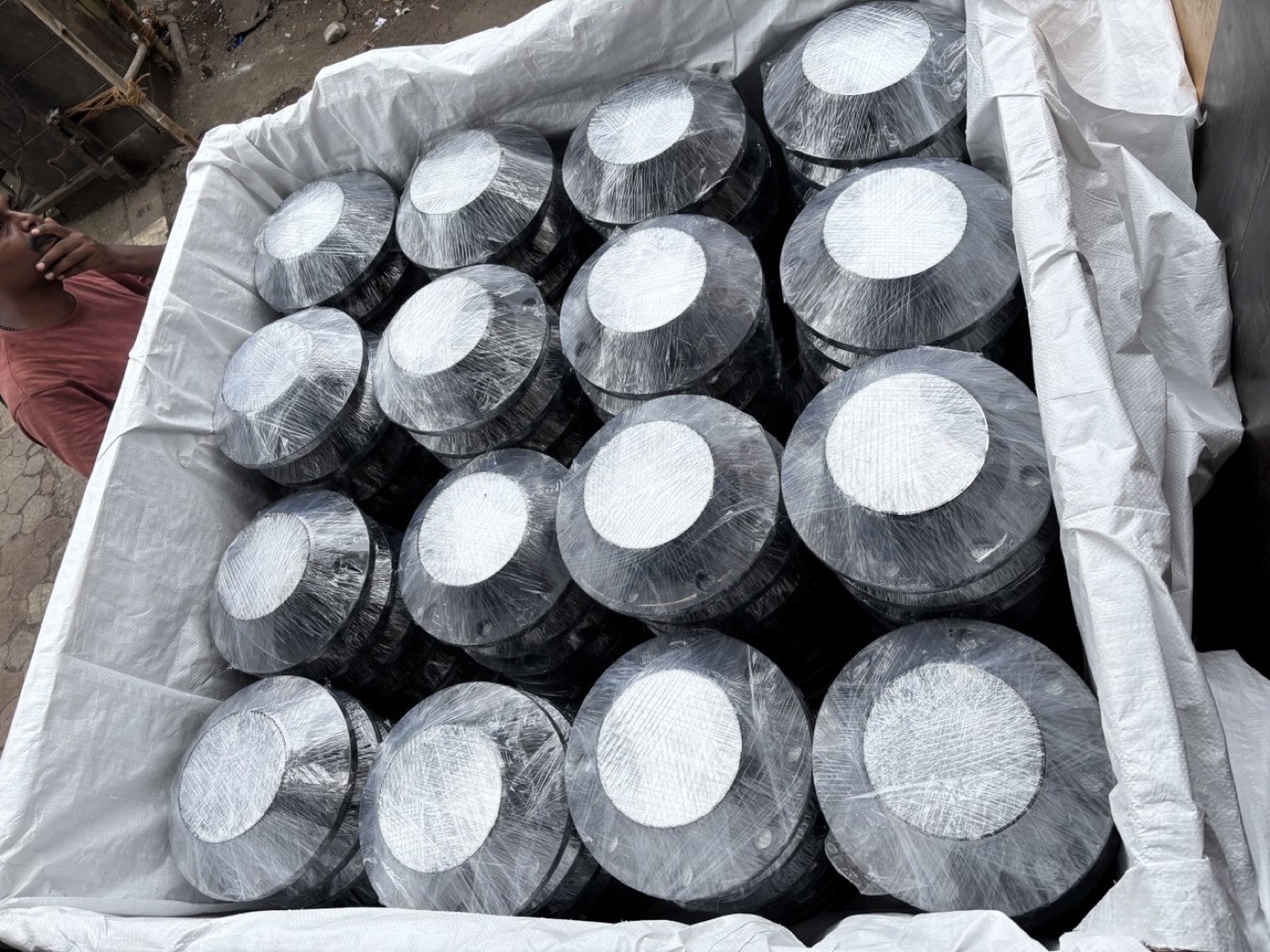
A105 weld neck flanges are our single highest-volume product. Certified forged blanks are heat treated (normalized on request), CNC-turned with the bore matched to your pipe schedule and the weld end bevelled to 37.5°, then marked with grade, size, rating and heat number. Finished flanges go black-coated or bare into warehouse stock, and travel face-protected in lined crates — both photographs below are our actual stock and packing:
A105 Weld Neck Flanges — Warehouse Ready Stock, Small to Large BoreBlack-Coated A105 Flanges — Lined Export Packing
Where ASTM A105 Weld Neck Flanges Are Used
Oil and gas leads: production facilities, gathering systems, refineries, gas plants and pipelines run A105 weld necks by the thousand. Power stations flange steam, feedwater and condensate circuits with it up to the alloy-steel handover; petrochemical plants use it on every non-corrosive utility and hydrocarbon line; and water, firewater, compressed air and district heating systems take it plain or galvanized. If the medium doesn't attack carbon steel — or a coating can protect it — A105 is the economical answer, with LF2 below −29 °C and F11/F22/F91 above ~425 °C completing the temperature ladder.
ASTM A105 Weld Neck Flange Dimensions
A105 weld neck flanges follow the standard dimensional tables — OD, thickness, hub, bore, bolt circle and bolting per class. Full ASME B16.5 charts:
A105 pricing follows the steel market and moves with size, class and quantity, so we quote live rather than publish a static list — and as our highest-volume product, it ships fastest and prices keenest of everything we make. To get a firm quotation, usually within 24 hours:
1
List your requirement — size (NB), class or PN, standard (ASME B16.5 / B16.47 / EN / DIN / BS), condition (A105 or A105N), pipe schedule or bore, and quantity.
2
Add any extras — NACE MR0175, IBR documentation, 3.2 certification, galvanizing, epoxy or FBE coating.
3
Send it across — via the inquiry form, WhatsApp, or email to sales@tescosteel.com — and we reply with price, delivery and stock position.
It is a weld neck flange forged from ASTM A105 — the standard carbon steel forging specification for piping flanges, fittings and valves in ambient and higher-temperature service. The long tapered hub is butt-welded to the pipe with the bore matched to the pipe schedule, giving a radiographable, fatigue-resistant joint in the most widely used flange material in the world. If a piping class does not name another material, it almost certainly means A105.
What does A105N mean?
The N stands for normalized — a heat treatment that refines the forging's grain structure for better toughness and more uniform properties. Many project specifications, and most offshore and low-temperature-adjacent work, call for A105N rather than as-forged A105. We supply either; state the requirement in your enquiry and the certificate documents the heat treatment condition.
What temperature range can A105 flanges handle?
Roughly -29 °C to 425 °C. The lower bound is the code impact-test exemption limit — below -29 °C, switch to impact-tested LTCS A350 LF2, which shares A105's strength class. The upper bound is where prolonged service starts to risk graphitization of carbon steel; above about 425 °C, alloy steels F11, F22 and F91 take over. Between those limits, A105 is the economical default.
What is the difference between A105 and A350 LF2 flanges?
They are strength twins with different temperature paperwork. A350 LF2 is the low-temperature carbon steel forging grade, Charpy impact tested at -46 °C, for cryogenic-adjacent and cold-climate service where A105's -29 °C exemption runs out. Chemistry and mechanical properties are close enough that LF2 is often dual-compatible with A105 piping classes. If your line sees below -29 °C, specify LF2 — we forge both.
When is carbon steel A105 the right choice over stainless steel?
Whenever the medium is non-corrosive or the line is protected — hydrocarbons, steam, air, lube oil, inhibited cooling water, buried or coated service. A105 delivers higher yield strength than austenitic stainless at a fraction of the price, and coatings (galvanizing, epoxy, FBE) handle external protection. Move to stainless or higher alloys when the fluid itself attacks carbon steel or when product purity forbids rust.
What is the chemical composition of ASTM A105?
Carbon 0.35% max, manganese 0.60 to 1.05%, phosphorus 0.035% max, sulphur 0.040% max, silicon 0.10 to 0.35%, with residuals capped at copper 0.40%, nickel 0.40%, chromium 0.30%, molybdenum 0.12% and vanadium 0.08%. Two spec rules apply: copper, nickel, chromium, molybdenum and vanadium together must not exceed 1.00%, and chromium plus molybdenum must not exceed 0.32%. For each 0.01% carbon below 0.35%, manganese may rise 0.06% above 1.05%, up to 1.35%.
What are the mechanical properties of A105 flanges?
Minimum tensile strength 485 MPa (70 ksi), minimum yield strength 250 MPa (36 ksi), minimum elongation 22%, minimum reduction of area 30%, and hardness capped at 187 HB. That yield figure is why A105 remains the benchmark: it out-muscles austenitic stainless grades at a fraction of their cost, which keeps bolted joints compact in high-pressure carbon steel classes.
Which pipe grades do A105 weld neck flanges mate with?
ASTM A106 Grade B seamless pipe is the classic partner — matched strength, matched weldability — along with API 5L Grade B and X-grades in pipeline work, and A53 in utility service. The weld neck bore is machined to the pipe's schedule so the joint is flush inside. State pipe grade and schedule in your order and the bevel arrives ready to weld.
What sizes and standards do you manufacture A105 weld neck flanges in?
From 1/2 inch NB to 56 inch NB: ASME B16.5 Class 150 to 2500 up to 24 inch, ASME B16.47 Series A and B for 26 inch and above, and European PN 2.5 to PN 400 patterns to EN 1092-1 Type 11, DIN 2631 to 2635 and BS 4504. Raised face is standard, flat face and ring joint on request, and every bore is machined to the mating pipe schedule from Sch 20 through XXS.
How are A105 flanges welded to pipe?
With standard carbon steel consumables — E7018 electrodes or ER70S wire — using ordinary carbon steel procedures. Preheat is generally unnecessary at common wall thicknesses; heavy sections and cold-weather work follow code preheat rules. The 37.5 degree bevel comes machined ready for a full-penetration butt weld that can be radiographed, which is the point of choosing a weld neck in the first place.
Can A105 flanges be galvanized or coated?
Yes — this is carbon steel's home ground. We supply hot-dip galvanized (GI) flanges for water, utility and outdoor service, epoxy and FBE coated flanges for buried and pipeline duty, and sand-blasted, shot-peened, phosphated or anti-rust-oiled finishes to order. Machined faces and weld bevels are masked or protected so coating never interferes with sealing or welding.
Are A105 flanges available for sour service (NACE)?
Yes. A105 with its 187 HB hardness ceiling sits comfortably under the NACE MR0175 / ISO 15156 hardness limit of 22 HRC for carbon steel in H2S service. We certify NACE compliance on request, add HIC-resistant material where the specification demands it, and document everything on the EN 10204 3.1 or 3.2 certificate.
Where are ASTM A105 weld neck flanges used?
Everywhere hydrocarbon and utility piping runs: oil and gas production, refineries and gas plants, petrochemical units, power station steam and feedwater circuits, district heating, compressed air, firewater and plain water systems, and general industry. A105 weld neck flanges are the single highest-volume flange item in world piping — and in our production.
What testing and certification do you supply with A105 flanges?
Every lot ships with EN 10204 3.1 mill test certificates covering chemical analysis and mechanical properties, with 3.2 certification witnessed by Lloyd's, DNV, BV or TÜV on request. We also offer PMI, ultrasonic and magnetic particle examination, hardness surveys for NACE work, normalizing certificates for A105N, and IBR Form III-C documentation for Indian boiler work.
Do you keep A105 weld neck flanges in stock? What is the lead time?
A105 is our highest-volume product: the warehouse photograph on this page is real stock. Common sizes from 1/2 to 24 inch in Class 150, 300 and 600 generally ship within days; B16.47 large diameters, Class 900 to 2500 and coated or NACE material are produced to order, typically in 2 to 4 weeks. Send your list for a firm delivery commitment.
What information should I include in an A105 flange enquiry?
Six things: size (NB), pressure class or PN rating, dimensional standard (ASME B16.5, B16.47 or EN/DIN/BS), condition (A105 or normalized A105N), pipe schedule or bore, and quantity. Add any extras — NACE compliance, IBR, 3.2 certification, galvanizing or coating. With these details we return a firm quotation, usually within 24 hours.
Do you export ASTM A105 flanges outside India?
Yes — in volume. Tesco Steel & Engineering is an ISO 9001:2015 certified manufacturer based in Mumbai, and A105 weld neck flanges ship continuously to EPC contractors, stockists and end users across the Middle East, Europe, Africa, Southeast Asia and the Americas. Flanges travel face-protected in lined crates, as the export packing photo on this page shows, with full heat-number traceability.