WNFF Flanges — Weld Neck Flat Face Flange Manufacturer
Tesco Steel & Engineering manufactures WNFF flanges (weld neck flat face flanges) from 1/2″ NB to 56″ NB — the weld neck strength you rely on, with a flat gasket face for full-face gaskets and brittle mating equipment such as cast iron, bronze and FRP. We forge and machine to ASME B16.5 Class 150–2500, ASME B16.47, EN 1092-1 Type 11, DIN, BS and JIS, in every material family we stock: carbon steel A105, LTCS, stainless steel, 254 SMO, 904L, duplex & super duplex, alloy steel F1–F91, Monel, Inconel, Hastelloy, titanium, copper nickel and bimetal clad — including copper nickel WNFF flanges for naval and marine seawater service. EN 10204 3.1/3.2 certified. ISO 9001:2015, made in Mumbai, India — exported worldwide.
1/2″ – 56″ NB
Class 150 – 2500 · PN 2.5 – 400
ASME B16.5 · B16.47 · EN 1092-1 · DIN
Full-Face Gasket Sealing
13 Material Families
EN 10204 3.1 / 3.2
ISO 9001:2015 · Exported Worldwide
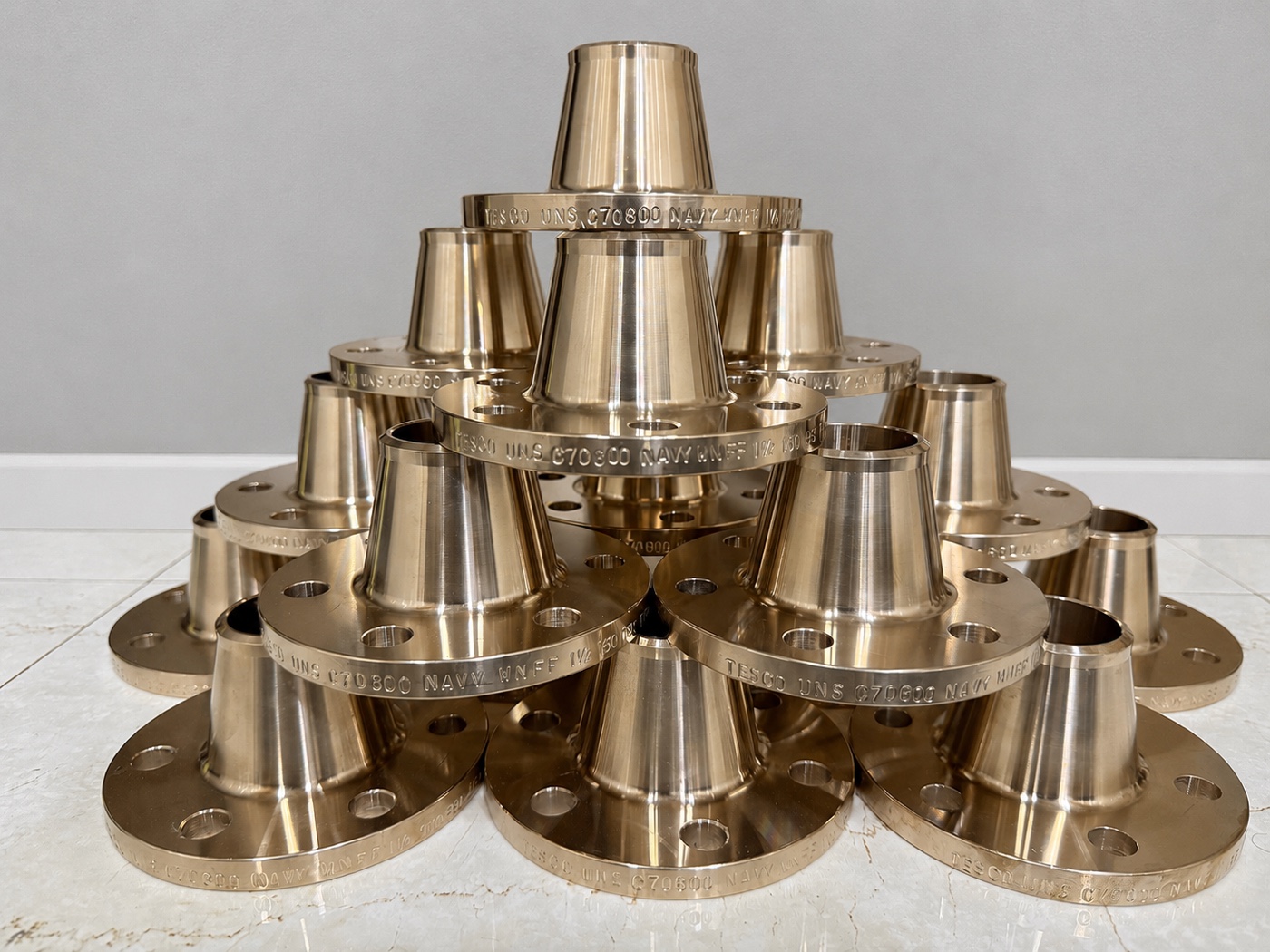
Copper Nickel UNS C70600 Navy WNFF Flanges — 1-1/2″ Class 150, Stamped for Traceability
What is a WNFF Flange?
WNFF is the full form of Weld Neck Flat Face — a weld neck flange whose gasket surface lies in the same plane as the bolting face, with no raised pad. The long tapered hub is butt-welded to the pipe, giving a full-penetration joint that can be radiographed, while the flat face seats a full-face gasket that spreads bolt load evenly across the whole flange — the safe way to bolt up against cast iron, bronze and FRP equipment.
The weld neck side of the design does what it always does. The tapered hub feeds pressure and bending stress gradually from the flange ring into the pipe wall, so the joint survives vibration, fatigue and thermal cycling; the bore is machined to match the mating pipe schedule, so flow passes through with no step, no turbulence and no erosion pocket, and there is no high stress concentration at the base of the hub.
The flat face is what changes the sealing mechanics. Instead of concentrating bolt load on a narrow raised pad, a WNFF joint compresses a soft gasket over the entire face — lower unit seating stress, but perfectly even loading with no bending moment on the mating flange. That is exactly what a cast iron pump casing, a bronze valve or a GRP nozzle needs to survive bolt-up. The same weld neck body can alternatively be supplied with a raised face (WNRF) or a ring joint groove; see our weld neck flanges overview for the full family.
Also searched as: WNFF flange full form, WNFF flange meaning, FFWN flange, flat face weld neck flange, weld neck FF flange — all refer to the same product described on this page.
WNFF Flange Specifications
| WNFF Flanges are available in the following specifications: |
|---|
| Size | 1/2"NB to 56"NB |
| Class | 150#, 300#, 400#, 600#, 900#, 1500#, 2500# |
| Sch (Schedule) | XS, XXS, STD & Schedule 20, 40, 80, 160 |
| Pressure Ratings | PN 2.5 - PN 400 |
| Stainless Steel WNFF Flanges | ASTM A 182 F - 304 / 304H / 304L / 316 / 316H / 316L / 316Ti, 309, 310, 317L, 321, 347, 904L |
| Duplex Steel WNFF Flanges | ASTM A 182 - F 51, F 53, F 55 |
| Alloy Steel WNFF Flanges | ASTM A 182 - F5, F9, F11, F21, F22 & F91 |
| Carbon Steel WNFF Flanges | ASTM A 105 |
| Low Temp. Carbon Steel Flanges (LTCS WNFF Flanges) | A 350 LF2 |
| Copper Nickel (Cu-Ni) WNFF Flanges | C70600, 90/10, C71500, 70/30, C71640 |
| Nickel WNFF Flanges | UNS N02200, UNS N02201 |
| Monel WNFF Flanges | UNS N04400, UNS N05500, Alloy 20 |
| Inconel WNFF Flanges | UNS N06600, UNS N06601, UNS N06625, UNS N08800, UNS N08810, UNS N08825 |
| Hastelloy WNFF Flanges | UNS N10276, UNS N06022, UNS N10665, UNS N06455 |
| Titanium WNFF Flanges | Gr. 1, Gr. 2, Gr. 3, DTH 3.7035, DTH 3.7055 |
| Other Services | Hot Dip Galvanized (GI) WNFF Flanges
Sand Blasting on WNFF Flanges
Shot Peening on WNFF Flanges
Epoxy Coating on WNFF Flanges
FBE Coating on WNFF Flanges |
The Flat Face — When and Why It Is Specified
A flat face is not a cost-saving simplification — it is a mechanical requirement. Brittle and low-strength flange materials (cast iron, bronze, gunmetal, FRP/GRP) cannot tolerate the bending moment a raised face creates during bolt-up. A WNFF flange mates flat against flat with a full-face gasket — elastomer (EPDM, neoprene, nitrile) or compressed non-asbestos fibre sheet, punched for the bolt holes — so the clamping load spreads evenly over the entire face and the weaker flange sees pure compression, never bending. The facing is machined to the same serrated 125–250 µin AARH stock finish as a raised face (smooth finish for rubber gaskets on request), and flange OD, drilling and bolting stay identical to the raised face version of the same class.
Bolt-up rule: never bolt a raised face steel flange directly against a flat faced cast iron flange — the raised pad acts as a fulcrum and tightening the bolts can crack the cast iron rim. Use a WNFF flange with a full-face gasket, or have the raised face machined off (checking that the remaining thickness still meets ASME B16.5, since the 1.6 mm raised face on Class 150/300 is included in the published thickness).
WNFF Flange Materials — All Grades We Manufacture
WNFF flanges are forged in every material family from our range. The grade follows the service — A105 for general utilities, copper nickel 90/10 and 70/30 for naval and shipboard seawater (as pictured above), 316L and duplex for chlorides, LF2 for sub-zero, and nickel alloys where the chemistry gets aggressive:
| Material Family | Grades for WNFF Flanges |
|---|
| Carbon Steel | ASTM A105 |
| LTCS (Low-Temperature Carbon Steel) | ASTM A350 LF2, LF3 |
| Stainless Steel | ASTM A182 F304/304L, F316/316L, F321, F310, F347, F410 |
| 254 SMO | ASTM A182 F44 (UNS S31254) |
| 904L | UNS N08904 |
| Duplex & Super Duplex | F51/F60 (2205), F53/F55 (2507) |
| Alloy Steel | ASTM A182 F1, F5, F9, F11, F22, F91 |
| Monel | Monel 400, K500 |
| Inconel | Inconel 600, 625, 825 |
| Hastelloy | Hastelloy C276, C22 |
| Titanium | Gr. 1, Gr. 2, Gr. 3, Gr. 5 |
| Copper Nickel | 90/10 (C70600), 70/30 (C71500) — naval / marine seawater service |
| Bimetal / Clad | Carbon steel body + SS / nickel-alloy overlay |
How We Manufacture WNFF Flanges
Every WNFF flange starts as a certified forged blank — forging aligns the grain flow around the hub, exactly where the stress lives. Blanks are heat treated to suit the grade, then CNC-turned: the tapered hub profiled, the bore matched to your pipe schedule, the weld end bevelled to 37.5°, bolt holes drilled on the correct circle, and the face machined dead flat and serrated. Each flange is stamped or laser-marked with alloy, size, class, standard and heat number — exactly as visible on the copper nickel Navy flanges pictured above — then inspected and face-protected before packing.
Why Specify a WNFF Flange
Kind to Brittle Equipment
The flat face and full-face gasket load the mating flange in pure compression — no fulcrum, no bending moment — so cast iron pumps, bronze valves and FRP nozzles bolt up without cracking.
A Weld You Can Prove
The butt weld between hub and pipe is a full-penetration joint that can be examined by radiography or ultrasonics — weld neck integrity even in low-pressure, brittle-equipment service.
Strength Under Fatigue
The long tapered hub feeds pressure, bending and thermal stress gradually into the pipe wall, giving roughly twice the fatigue life of a slip-on joint under vibration and cyclic loading.
Smooth, Matched Bore
The bore is machined to the mating pipe schedule, so there is no step at the joint — no turbulence, no erosion pocket, and no crevice for corrosion to start, which matters doubly in seawater lines.
Any Material, Any Standard
One geometry, thirteen material families — the same WNFF flange is delivered in A105, 316L, copper nickel 90/10 or Inconel 625, to ASME, EN, DIN, BS or JIS, from one certified source.
Where WNFF Flanges Are Used
Marine and naval piping is the signature application — copper nickel 90/10 and 70/30 WNFF flanges on shipboard seawater, cooling, fire-main and ballast systems, where flat faces and full-face gaskets are the specified joint. Water treatment and municipal works use WNFF flanges against cast iron pumps, valves and strainers; HVAC, compressed air and utility systems mate them to cast equipment casings; and chemical plants specify them against FRP/GRP piping and lined equipment where a raised face would overload the flange. Wherever weld neck strength has to meet a flat faced or fragile counter-flange, WNFF is the correct answer.
WNFF Flange Dimensions
A WNFF flange shares its outside diameter, thickness, hub, bore, bolt circle and bolting with the raised face weld neck flange of the same class — only the facing differs. Full dimension charts are published for every ASME class:
European and other standards are covered on their own pages — EN 1092-1 Type 11 (PN 2.5–400), DIN 2631–2635, BS 4504, BS 3293 and JIS B2220 30K/40K/63K — all available with flat facing on request.
Price List & How to Order
WNFF flange pricing depends on size, class, material grade and quantity — and moves with raw material markets, so we quote live rather than publish a static list. Because the body is shared with our weld neck stock, flat facing can often be machined quickly at highly competitive export prices. To get a firm quotation, usually within 24 hours:
1
List your requirement — size (NB), class or PN, standard (e.g. ASME B16.5 / EN 1092-1 Type 11), material grade, pipe schedule or bore, and quantity — and state flat face (FF) clearly.
2
Add any extras — NACE MR0175, impact testing, 3.2 certification, coatings or a special face finish for rubber gaskets.
WNFF Flanges — Frequently Asked Questions
What is the full form of WNFF flange?
WNFF stands for Weld Neck Flat Face. It is a weld neck flange supplied with a flat face — the gasket seating surface and the bolting face lie in the same plane, with no raised pad. The long tapered hub is butt-welded to the pipe, while the flat face mates over its full width with a full-face gasket, spreading the bolt load evenly across the joint.
What is the difference between WNFF and WNRF flanges?
The body is identical — both are weld neck flanges; only the facing differs. A WNRF flange carries a raised gasket pad that concentrates bolt load on a smaller area for higher seating stress, while a WNFF flange is machined flush so the gasket covers the entire face. WNRF is the default for steel-to-steel process piping; WNFF is chosen when the mating flange is flat faced or made of a brittle material such as cast iron.
Why must a flat face flange never be bolted against a raised face?
When a raised face flange is bolted to a flat faced cast iron or bronze flange, the raised pad acts as a fulcrum: tightening the bolts bends the outer rim of the weaker flange and can crack it. Piping codes therefore require flat face against flat face with a full-face gasket when mating to cast iron equipment. If only a raised face steel flange is available, the raised face is machined off or a WNFF flange is ordered instead.
What gaskets are used with WNFF flanges?
Full-face gaskets that cover the complete flange face, with bolt holes punched through — typically elastomers such as EPDM, neoprene and nitrile, or compressed non-asbestos fibre sheet. Soft full-face gaskets seal at the lower seating stress a flat joint generates and keep the load distribution even, which is exactly what brittle or low-strength mating equipment needs.
What sizes and pressure ratings do you manufacture WNFF flanges in?
We manufacture WNFF flanges from 1/2 inch NB to 56 inch NB. Most flat face work is Class 150 and 300 to ASME B16.5 — the ratings where cast iron, bronze and FRP equipment lives — but we also supply Class 400 to 2500, ASME B16.47 Series A and B above 24 inch, and the European PN 2.5 to PN 400 range to EN 1092-1 Type 11 with flat facing, DIN 2631 to 2635 and BS 4504. Bores are machined to any pipe schedule from Sch 10 to XXS.
Which material grades can I order WNFF flanges in?
Every family in our materials range: carbon steel ASTM A105, low-temperature carbon steel A350 LF2 and LF3, stainless steel A182 F304/304L, F316/316L, F321, F310, F347 and F410, 254 SMO (F44), 904L, duplex F51/F60 and super duplex F53/F55, alloy steel F1, F5, F9, F11, F22 and F91, Monel 400 and K500, Inconel 600, 625 and 825, Hastelloy C276 and C22, titanium, copper nickel 90/10 and 70/30 — a naval favourite, as pictured on this page — and bimetal (clad) combinations. Each lot ships with EN 10204 3.1 mill test certificates.
Where are WNFF flanges typically used?
Wherever the mating equipment is flat faced or fragile: cast iron pumps, valves, strainers and compressor casings, bronze and gunmetal marine fittings, FRP/GRP piping, and low-pressure water, air and utility systems. Copper nickel WNFF flanges are the standard in naval and shipboard seawater lines. The weld neck hub is kept for its strength and radiographable butt weld even though the facing is flat.
Which dimensional standards do you cover for WNFF flanges?
ASME B16.5 (1/2 to 24 inch) and ASME B16.47 Series A and B (26 to 60 inch) with flat face finish, EN 1092-1 Type 11 with flat facing, the DIN 2631 to 2635 series, BS 4504 and BS 3293, JIS B2220, and navy / marine specifications for copper nickel piping. Flange OD, drilling and bolting are identical to the raised face version of the same class — only the facing differs — so the ASME dimension charts linked on this page apply directly.
How do I specify the bore of a WNFF flange?
State the pipe schedule or the actual pipe inside diameter. The weld end of a WNFF flange is machined so its bore matches the mating pipe — for example, a 6 inch Sch 80 WNFF flange is bored to 146.3 mm. A matched bore leaves no step at the joint, avoiding turbulence, erosion and stress concentration. If you do not state a schedule, we quote standard bore (Sch 40/STD) by default.
What surface finish is applied to a flat face?
A flat face is normally machined to the same serrated 125 to 250 microinch AARH stock finish as a raised face, so soft full-face gaskets grip well. Smooth finishes (Ra 0.8 to 1.6 micrometres) are supplied for rubber gaskets on request. Because the whole face is the sealing surface, we check flatness and finish before dispatch and protect the face with covers for shipment.
Can a raised face flange be converted to a flat face?
Yes — a raised face can be machined off, but with care. Under ASME B16.5 the 1.6 mm raised face on Class 150 and 300 flanges is included in the published thickness, so machining it away removes usable metal and can take the flange below minimum thickness. Ordering a purpose-made WNFF flange keeps full thickness and avoids a non-standard part; we supply either, but recommend the factory-made flat face for new work.
What testing and certification do you supply with WNFF flanges?
Standard supply includes EN 10204 3.1 mill test certificates covering chemical analysis and mechanical properties, with 3.2 certification by Lloyd's, DNV, BV or TÜV witnessed on request. We also offer PMI (positive material identification), ultrasonic examination, dye penetrant testing, impact testing for low-temperature grades, and compliance with NACE MR0175 / ISO 15156 for sour service. Full heat-number traceability is maintained from raw material to finished flange.
Can WNFF flanges be supplied with protective coatings?
Yes. Carbon and alloy steel WNFF flanges can be hot-dip galvanized, epoxy coated, FBE coated, zinc or yellow passivated, phosphated or supplied with anti-rust oil and bevel protectors. We also offer sand blasting and shot peening. Stainless, copper nickel and nickel alloy flanges are normally supplied pickled and passivated. Machined faces and weld bevels are protected with covers for shipment.
Do you keep WNFF flanges in stock? What is the lead time?
We hold ready stock of weld neck flanges in carbon steel A105 and stainless steel F304L/F316L, and because a WNFF flange shares its body with the raised face version, flat facing can often be machined from stock within days. Copper nickel, Monel and other special grades are forged to order, typically in 2 to 4 weeks depending on size and quantity. Send your list for a firm delivery commitment.
What information should I include in a WNFF flange enquiry?
Six things: size (NB), pressure class or PN rating, dimensional standard (for example ASME B16.5 or EN 1092-1 Type 11), material grade, pipe schedule or bore, and quantity — and state clearly that you need a flat face (FF) so the flange is not supplied with the default raised face. Add any extras such as NACE compliance, impact testing, 3.2 certification or coatings. We usually return a firm quotation within 24 hours.
Do you export WNFF flanges outside India?
Yes. Tesco Steel & Engineering is an ISO 9001:2015 certified manufacturer based in Mumbai, and a large share of our WNFF flange production is exported — to the Middle East, Europe, Africa, Southeast Asia and the Americas, including copper nickel flanges for naval and shipyard projects. Export packing is seaworthy: faces protected, flanges strapped or crated, and each piece marked with size, class, grade, heat number and origin.

