

'SHAPING INDUSTRIES WITH THE FINEST STEEL'
'SHAPING INDUSTRIES WITH THE FINEST STEEL'
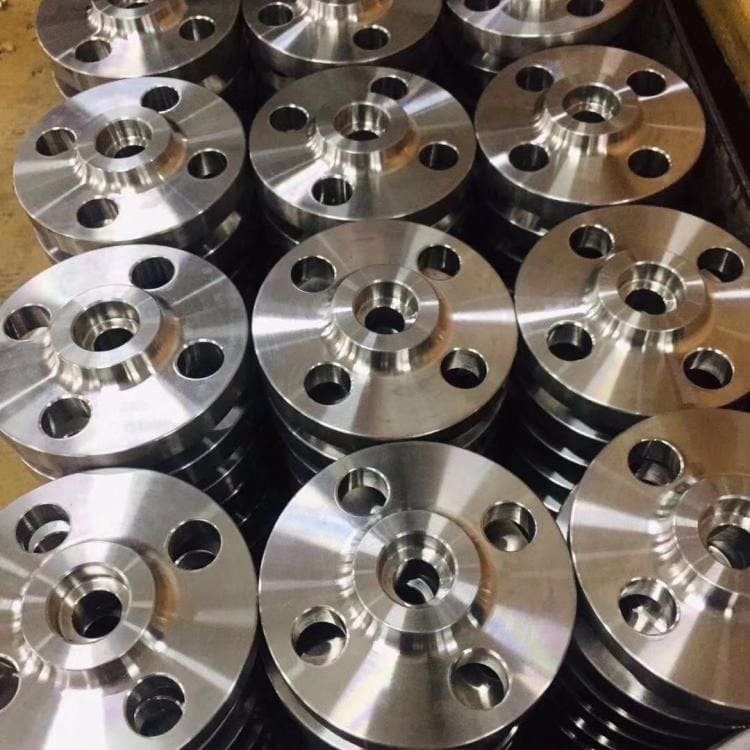
Tesco Steel & Engineering manufactures ASME B16.5 Class 1500 socket weld flanges — the small-bore flange with a counterbored socket and a single external fillet weld, leaving a smooth bore with nothing intruding into the line. Sizes NPS ½–2½ (DN 15–65), raised face 7 mm standard with FF or RTJ on request, socket bored to the pipe OD and through-bored to your schedule. This page is the complete reference: the full dimension chart in mm with socket bore and depth, bolt circles, bolting and weights, the pressure–temperature table in bar, the fit-up rules that make socket welds work, and every material grade we produce — from A105 and A350 LF2 to SS 316, alloy steel and duplex. ISO 9001:2015 certified, made in Mumbai, India — exported worldwide.
The socket weld flange is small-bore piping’s honest workhorse. Instead of a bevelled butt weld, the pipe drops into a machined socket and takes a single external fillet weld — no weld root inside the line, no protrusion to catch flow, no bevel preparation on site. That makes it the preferred welded flange for instrument and sample lines, hydraulic and lube-oil systems, steam tracing and condensate, chemical injection, boiler-feed small bore and the auxiliary piping around pumps and compressors. ASME B16.5 standardises the socket only in small sizes — NPS 1/2 to 2-1/2 at Class 1500 — because above that, the butt-welded weld neck takes over.
Two details decide whether a socket weld joint lives long. First, the 1.6 mm expansion gap: insert the pipe to the socket bottom, withdraw a sixteenth of an inch, then weld — ASME B31.1 and B31.3 both require it, because a bottomed-out pipe cracks the cooling fillet. Second, the bore: the socket ID fits the pipe OD at any schedule, but the through-bore ID 2 must match the pipe ID so the shoulder lines up — state the schedule on the order. The chart below carries every dimension against the lettered figure, with weights; bores are finished to the schedule you specify.

“Class 1500” (also written 1500 lb or #1500, roughly PN 260) is a pressure–temperature rating class, not a working pressure. ASME B16.5 Table 2 gives the maximum allowable working pressure at each temperature for each material group — here in bar for the groups we ship most:
| Temperature °C | Group 1.1 — A105 / A350 LF2 | Group 2.1 — A182 F304 | Group 2.2 — A182 F316 |
|---|---|---|---|
| −29 to 38 | 255.3 | 248.2 | 248.2 |
| 100 | 233.0 | 211.0 | 215.7 |
| 150 | 225.4 | 192.5 | 197.5 |
| 200 | 219.0 | 178.3 | 183.8 |
| 250 | 209.7 | 166.8 | 172.3 |
| 300 | 199.1 | 158.1 | 163.2 |
| 350 | 187.8 | 151.6 | 156.4 |
| 400 | 173.6 | 147.2 | 152.0 |
| 450 | 143.8 | 143.8 | 147.0 |
Working pressure in bar (gauge) per ASME B16.5-2020 Table 2. The rating applies to the flange — confirm the fillet weld, pipe, bolting and gasket for the same duty, and always check the rating at your design temperature.
All dimensions in mm per ASME B16.5-2020 Tables 18 and 19. Letters follow the figure: OD = flange outside diameter, T1 = flange thickness (excluding the 7 mm raised face), H = hub diameter, T = length through hub, ID = socket bore diameter, D = socket depth, ID 2 = through-bore (STD shown), R = raised face diameter, BC = bolt circle (PCD), B = bolt hole diameter. Prefer it on paper? Download the full Class 1500 socket weld dimensions datasheet (PDF) — the same chart with the drawing, ratings, welding practice and ordering notes, ready for the workshop.
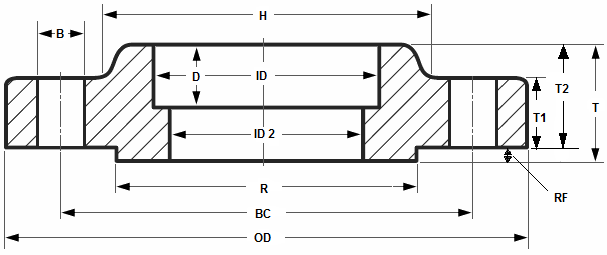
Socket Weld Flange Dimension Reference — ANSI / ASME B16.5
| Size in Inch | Size in mm | Flange OD | Thickness | Hub Ø | Length Through Hub | Socket Ø | Socket Depth | Bore (STD) | RF Diameter | PCD | No. of Studs | Hole Ø | Stud Size | Approx Weight (kg) |
|---|---|---|---|---|---|---|---|---|---|---|---|---|---|---|
| OD | T1 | H | T | ID | D | ID 2 | R | BC | — | B | — | |||
| 1/2 | 15 | 120 | 22.4 | 38 | 32 | 22.2 | 9.6 | 15.8 | 35 | 82.6 | 4 | 22.2 | 3/4 | 1.8 |
| 3/4 | 20 | 130 | 25.4 | 44 | 35 | 27.7 | 11.2 | 20.9 | 43 | 88.9 | 4 | 22.2 | 3/4 | 2.3 |
| 1 | 25 | 150 | 28.6 | 52 | 41 | 34.5 | 12.7 | 26.6 | 51 | 101.6 | 4 | 25.4 | 7/8 | 3.7 |
| 1 1/4 | 32 | 160 | 28.6 | 64 | 41 | 43.2 | 14.3 | 35.1 | 64 | 111.1 | 4 | 25.4 | 7/8 | 4.1 |
| 1 1/2 | 40 | 180 | 31.8 | 70 | 44 | 49.5 | 15.7 | 40.9 | 73 | 123.8 | 4 | 28.6 | 1 | 5.5 |
| 2 | 50 | 215 | 38.1 | 105 | 57 | 61.9 | 17.5 | 52.5 | 92 | 165.1 | 8 | 25.4 | 7/8 | 9.8 |
| 2 1/2 | 65 | 245 | 41.3 | 124 | 64 | 74.6 | 19.1 | 62.7 | 105 | 190.5 | 8 | 28.6 | 1 | 16.4 |
| Type | Joint | Character |
|---|---|---|
| Socket Weld (SW, this page) | Pipe in socket, one external fillet weld | Smooth bore, strong small-bore joint; NPS ½–3 |
| Slip-On (SO) | Pipe through bore, two fillet welds | Cheaper, lower strength; all sizes |
| Threaded (TH) | NPT thread, no welding | For galvanised & no-hot-work lines; low pressure |
| Weld Neck (WN) | Full-penetration butt weld | Highest strength, radiographable; preferred above NPS 2–3 |
Class 1500 socket weld flanges are produced in the material families below — each supplied with EN 10204 3.1 mill certificates, heat-number traceability and PMI on request:
| Material Family | Typical Flange Grades | Best suited to |
|---|---|---|
| Carbon Steel | ASTM A105 / A105N | General process & utility small bore |
| LTCS | ASTM A350 LF2 Cl.1 / Cl.2, LF3 | Low-temperature service, impact tested |
| Stainless Steel | A182 F304/L, F316/L, F321, F347 | Corrosive process & instrument lines |
| Alloy Steel | A182 F5, F9, F11, F12, F22, F91 | High-temperature steam & refinery service |
| Duplex / Super Duplex | A182 F51 (2205), F53 (2507), F55 | High strength + chloride resistance, offshore |
| Monel / Inconel / Hastelloy | 400, 600/625, C276 — on request | Severe corrosion & high temperature |
| Copper Nickel | 90/10 (C70600) — on request | Seawater & marine small bore |
| EN / DIN Equivalents | P250GH (1.0460), 1.4301, 1.4401, 1.4404, 1.4571 | European specifications — on request |
Use the Ask for Quote button or the inquiry form for today’s price and delivery position.
| Pressure Class | Dimension Chart | Approx. A105 Rating @ 38 °C |
|---|---|---|
| Class 150 | Class #150 Socket Weld Flange | ≈285 psig |
| Class 300 | Class #300 Socket Weld Flange | ≈740 psig |
| Class 600 | Class #600 Socket Weld Flange | ≈1480 psig |
| Class 1500 | Class #1500 Socket Weld Flange (this page) | ≈3705 psig |
Related references: Socket Weld Flanges overview · Socket Weld RF Flanges · Socket Weld FF Flanges · Class 1500 Socket Weld Flange (product page) · All Flange Dimension Charts · Flange Weight Chart.
The pipe seats in the socket and the weld stays outside — nothing protrudes into the line, which is why instrument, hydraulic and dosing systems specify it.
No bevel preparation, no alignment clamps: the socket locates the pipe and a single fillet weld completes the joint, faster and cheaper than a butt weld in small bore.
Socket bore and depth are fixed per pipe size across all classes, so pipe prepared for one class fits them all — only the flange body and bolting grow with pressure.
Instrument and sample lines, hydraulic and lube-oil systems, steam tracing and condensate, chemical injection and dosing, boiler feed and blow-down small bore, pump and compressor auxiliaries — offshore, refinery and petrochemical.
What is a Class 1500 socket weld flange?
A forged flange with a counterbored socket: the pipe slips into the socket and is fillet-welded on the outside of the hub, leaving a smooth bore with no weld protrusion inside the line. ASME B16.5 standardises socket weld flanges in small bore only — NPS 1/2 to 2-1/2 at Class 1500 — and they are the preferred welded small-bore flange where a butt weld is impractical: instrument and sample lines, hydraulics, steam tracing, chemical injection and auxiliary piping.
What are the dimensions of a Class 1500 socket weld flange?
They are tabulated in ASME B16.5-2020 Tables 18 and 19 and reproduced in full in the chart above: for each of the seven sizes, the flange OD, thickness, hub diameter and length, socket bore and depth, through-bore, raised face diameter, bolt circle and bolting — all in millimetres — plus the approximate weight. A 2 in Class 1500 socket weld flange, for example, is 215 mm OD and 38.1 mm thick (plus the 7 mm face) on a 165.1 mm bolt circle with eight 7/8 in studs, at about 9.8 kg.
What pressure can a Class 1500 socket weld flange handle?
The rating depends on material and temperature. For Group 1.1 materials such as A105 carbon steel, ASME B16.5 allows 255.3 bar (roughly 3705 psig) at 38 °C, derating with temperature — the full bar table for carbon and stainless groups is on this page. Remember that the fillet weld and the pipe, not just the flange, must suit the duty; always confirm the rating at your design temperature.
Why are socket weld flanges limited to NPS 3?
Because ASME B16.5 provides socket dimensions only for NPS 1/2 to 3 — and only to 2-1/2 at Class 1500. Above small bore, a fillet-welded socket joint is less economical and less robust than a butt-welded weld neck flange, so the standard simply stops tabulating sockets and the weld neck takes over.
Why must the pipe be withdrawn 1.6 mm before welding?
Insert the pipe to the bottom of the socket, then pull it back about 1.6 mm (1/16 in) before tacking. The gap lets the pipe expand as the weld cools; without it the shrinking fillet weld can crack at the root. ASME B31.1 (par. 127.3) and B31.3 (par. 328.5.2) both require the gap, and it is the single most important detail of socket weld fit-up.
Which pipe schedule should I specify?
The socket bore ID fits the pipe OD, which is the same for every schedule — but the through-bore ID 2 must match the pipe ID so the socket shoulder lines up with the pipe wall and the bore stays smooth. Our chart shows the STD bore; state the schedule (XS, Sch 80, Sch 160, XXS) or the exact ID on the order.
Is the socket the same at every pressure class?
Yes — the socket bore ID and socket depth D are fixed per pipe size in ASME B16.5, because they fit the same pipe OD whatever the class. What grows with the class is everything around the socket: flange OD, thickness, hub and bolting. Compare our Class 150 and Class 1500 charts and the ID and D columns match line for line.
Does the thickness in the chart include the raised face?
No — at Class 400 and above the raised face is 7 mm, and the tabulated thickness T1 excludes it, while the length through hub T includes it. That is the reverse of the Class 150 and 300 convention, where the 2 mm face is included in the thickness — worth checking whenever you compare charts from different sources.
What is the difference between a socket weld and a slip-on flange?
Both take the pipe into the flange and seal with fillet welds, but the socket weld has a machined shoulder that locates the pipe and needs only one external fillet, leaving a smooth internal bore; the slip-on has a plain through-bore, takes two fillet welds (inside and out) and is rated lower. In small bore, the socket weld is the stronger, cleaner joint; the slip-on earns its keep at larger sizes where sockets are not standardised.
When should a socket weld flange not be used?
Three cases: where the crevice between pipe and socket invites crevice corrosion or traps product (corrosive and hygienic service), where severe erosion attacks the internal shoulder, and where the piping class demands radiography of the weld — a fillet weld cannot be meaningfully radiographed. In all three, a weld neck flange with a full-penetration butt weld is the right answer.
How big must the fillet weld be?
Per ASME B31.3: throat at least 0.7 times the pipe wall, leg at least 1.09 times the wall or 3.2 mm, whichever is greater, welded all round. Two passes are good practice above Class 300. The weld is external only — nothing intrudes into the bore, which is the point of the socket design.
How much does a Class 1500 socket weld flange weigh?
From the weight column in our chart: a 1/2 in weighs about 1.8 kg, a 2 in about 9.8 kg and a 2-1/2 in about 16.4 kg. These are approximate carbon-steel weights with a STD bore; the exact weight varies with the bore schedule and material.
What materials are available for socket weld flanges?
Carbon steel ASTM A105/A105N is the usual choice, with A350 LF2/LF3 for low temperature. Stainless A182 F304/L, F316/L, F321 and F347, alloy steel F5/F9/F11/F12/F22/F91 for high-temperature service, duplex F51 and super duplex F53/F55 — plus Monel 400, Inconel 600/625, Hastelloy C276 and copper-nickel 90/10 on request. EN equivalents such as P250GH, 1.4301 and 1.4404 are available — all with EN 10204 3.1 mill certificates.
What facing do these flanges come with?
A 7 mm raised face as standard, serrated to 125-250 microinch Ra (3.2-6.3 micrometre); flat face and RTJ are available on request. State the facing with the enquiry.
Any good-practice rules for socket weld joints?
Keep the socket and pipe end clean and dry before fit-up; standard ASTM A106 and A312 pipe OD tolerances fit B16.5 sockets. Avoid socket weld joints in cyclic-vibration service without proper support — small-bore vibration fatigue is the classic failure — and for sour service limit the hardness of weld and HAZ per NACE MR0175.
How are your socket weld flanges tested and certified?
Forged from certified bars and billets, normalised, quenched-and-tempered or solution annealed per the material specification, with the socket bore and depth gauged on every piece. Dimensional inspection follows ASME B16.5 tolerances, face finish per MSS SP-6 and marking per MSS SP-25. Every batch ships with EN 10204 3.1 mill test certificates traceable by heat number; MPI/DPT, PMI, NACE MR0175, IBR and PED compliance and 3.2 endorsement are available on request.
What other names does this flange go by?
ANSI B16.5 1500 lb SW flange, 1500# socket welding flange, SWRF Class 1500 and socket weld raised face flange all describe the same product, at roughly PN 260 in metric terms. ANSI B16.5 and ASME B16.5 are also the same standard — custodianship moved from ANSI to ASME decades ago but the old name persists on drawings.
Why is there no 3 in Class 1500 socket weld flange?
ASME B16.5 ends the Class 1500 socket weld table at NPS 2-1/2 — seven sizes instead of the eight the lower classes carry. At 255 bar a 3 in fillet-welded socket joint no longer makes engineering sense, so above 2-1/2 in the standard expects a butt-welded weld neck flange; our Class 1500 weld neck chart carries those sizes.