Socket Weld Flat Face Flanges — SWFF Flange Manufacturer
Tesco Steel & Engineering manufactures socket weld flat face (SWFF) flanges — the small-bore workhorse that seats the pipe in a counterbored socket for a simple external fillet weld, finished with a flat gasket face for full-face gaskets and brittle mating equipment such as cast iron, bronze and FRP. We machine to ASME B16.5 Class 150, 300, 600 and 1500, from 1/2″ to 4″ NB, in every material family we stock — carbon steel A105, LTCS, stainless steel, duplex, alloy steel F5–F91, Monel, Inconel, Hastelloy, titanium, copper nickel and bimetal clad — including the ASTM B151 C70600 copper nickel flanges pictured below for naval seawater service. EN 10204 3.1/3.2 certified. ISO 9001:2015, made in Mumbai, India — exported worldwide.
1/2″ – 4″ NB Small-Bore
ASME B16.5 · Class 150 / 300 / 600 / 1500
Socket Hub · Fillet Weld · Smooth Bore
Full-Face Gasket Sealing
13 Material Families
EN 10204 3.1 / 3.2
ISO 9001:2015 · Exported Worldwide
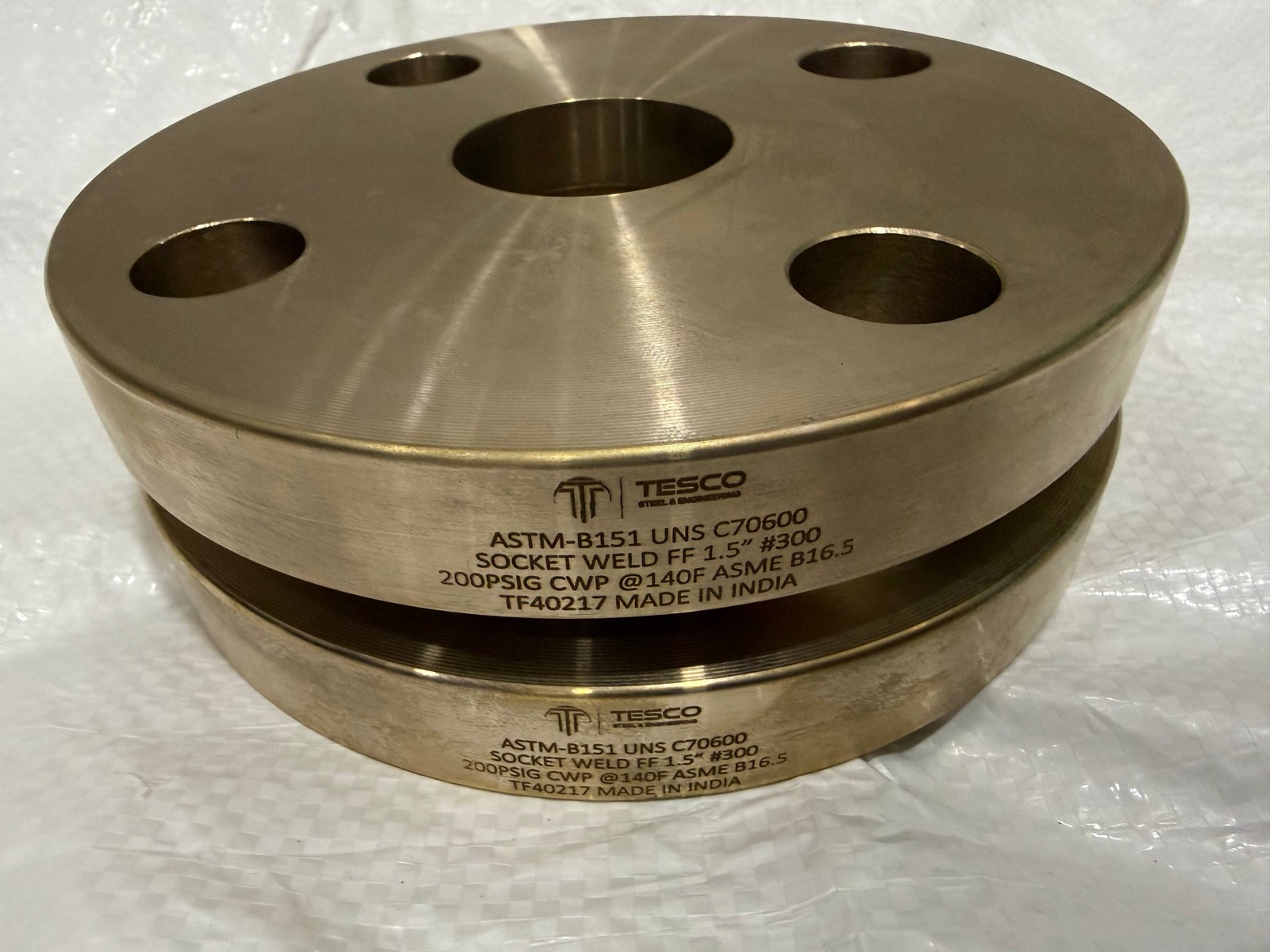
Copper Nickel ASTM B151 C70600 Socket Weld FF Flanges — 1-1/2″ Class 300, 200 PSIG CWP, Laser-Marked
What is a Socket Weld Flat Face Flange?
A socket weld flat face (SWFF) flange is a small-bore flange whose hub is counterbored to accept the pipe end, which is then secured with an external fillet weld — no bevelling, no butt-weld fit-up. Its flat face puts the gasket surface in the same plane as the bolting face, so a full-face gasket spreads bolt load evenly across the joint — the safe way to connect small-bore piping to cast iron, bronze or FRP equipment.
The socket does the alignment work for you: the pipe drops into the counterbore, seats square, and stays put while the fillet weld is run around the hub. Because the pipe bore and the flange bore match, flow passes smoothly with none of the internal step a slip-on flange leaves — and the joint is roughly 50% stronger than a slip-on under fatigue. An optional internal seal weld can be added in high-stress or leak-critical applications.
The flat face is the second half of the specification. Where the mating flange is flat faced or cast in a brittle material, a raised face would act as a fulcrum and crack it during bolt-up; the SWFF flange mates flat-on-flat with a soft full-face gasket instead. The same socket weld body is also supplied with a raised face — see socket weld raised face flanges — and the full type family is covered on our socketweld flanges overview.
Installation rule: seat the pipe fully in the socket, then withdraw it about 1.6 mm (1/16″) before welding. The gap gives the pipe room to expand as the weld heats it — without it, the cooling weld can crack. This clearance is required by ASME B31.1.
Also searched as: SWFF flange, socket weld FF flange, SW flat face flange, socket welding flange flat face — all refer to the product on this page.
Socket Weld Flat Face Flange Specifications
| Socket Weld Flat Face Flanges are available in the following specifications: |
|---|
| Size | 1/2"NB to 4"NB (most common 1/2" to 2") |
| Class | 150#, 300#, 600#, 1500# |
| Pressure Ratings | Per ASME B16.5 material group; PN drawings on request |
| Stainless Steel Socket Weld Flat Face Flanges | ASTM A 182 F - 304 / 304H / 304L / 316 / 316H / 316L / 316Ti, 309, 310, 317L, 321, 347, 904L |
| Duplex Steel Socket Weld Flat Face Flanges | ASTM A 182 - F 51, F 53, F 55 |
| Alloy Steel Socket Weld Flat Face Flanges | ASTM A 182 - F5, F9, F11, F21, F22 & F91 |
| Carbon Steel Socket Weld Flat Face Flanges | ASTM A 105 |
| Low Temp. Carbon Steel Flanges (LTCS Socket Weld Flat Face Flanges) | A 350 LF2 |
| Copper Nickel (Cu-Ni) Socket Weld Flat Face Flanges | C70600, 90/10, C71500, 70/30, C71640 |
| Nickel Socket Weld Flat Face Flanges | UNS N02200, UNS N02201 |
| Monel Socket Weld Flat Face Flanges | UNS N04400, UNS N05500, Alloy 20 |
| Inconel Socket Weld Flat Face Flanges | UNS N06600, UNS N06601, UNS N06625, UNS N08800, UNS N08810, UNS N08825 |
| Hastelloy Socket Weld Flat Face Flanges | UNS N10276, UNS N06022, UNS N10665, UNS N06455 |
| Titanium Socket Weld Flat Face Flanges | Gr. 1, Gr. 2, Gr. 3, DTH 3.7035, DTH 3.7055 |
| Other Services | Hot Dip Galvanized (GI) Socket Weld Flat Face Flanges
Sand Blasting on Socket Weld Flat Face Flanges
Shot Peening on Socket Weld Flat Face Flanges
Epoxy Coating on Socket Weld Flat Face Flanges
FBE Coating on Socket Weld Flat Face Flanges |
How a Socket Weld Joint Goes Together
1
Insert: the pipe end drops into the counterbored socket and seats square against the shoulder — no bevelling, no line-up clamps.
2
Withdraw 1/16″: the pipe is pulled back about 1.6 mm to leave the code-required expansion gap.
3
Fillet weld: a single external fillet weld around the hub completes the joint; an internal seal weld is optional for leak-critical service.
4
Gasket & bolt up: a full-face gasket is placed over the flat face and the joint is bolted flat-on-flat — even compression, no bending moment on the mating flange.
Why Specify an SWFF Flange
Small-Bore Welding Made Simple
The socket aligns the pipe automatically and the fillet weld needs no bevel, no gap setting and no internal access — faster, cheaper installation than a butt weld on lines 2″ and under.
Smooth, Matched Bore
Pipe and flange bores match, so there is no internal step, no turbulence and no pocket for erosion or debris — a real advantage over slip-on construction in high-pressure small-bore lines.
Stronger Than Slip-On
With the pipe bottomed in the socket and welded at the hub, the joint runs roughly 50% stronger under fatigue than a slip-on flange — the standard choice for high-pressure utilities.
Kind to Brittle Equipment
The flat face and full-face gasket load the mating flange in pure compression — no fulcrum, no bending — so cast iron pumps, bronze valves and FRP nozzles bolt up safely.
Any Material, One Source
The same SWFF flange ships in A105, 316L, duplex, F91, Monel, Inconel or copper nickel 90/10 — certified, laser-marked and export-packed from one ISO 9001:2015 manufacturer.
Where SWFF Flanges Are Used
Small-bore, high-pressure lines are the socket weld's territory: steam and condensate, hydraulic and lube oil systems, chemical injection, instrument and sampling connections, compressed air and utility headers. The flat face variant earns its place wherever those lines land on flat faced or cast equipment — cast iron pumps, strainers and compressor casings, bronze marine fittings and FRP packages. Naval and shipboard systems are the showcase: copper nickel SWFF flanges like the ASTM B151 C70600 pair pictured above are standard hardware on small-bore seawater, cooling and fire lines. For corrosion-critical media where the pipe-to-socket crevice is a concern, we recommend the butt-welded WNFF weld neck alternative — and supply both.
Socket Weld Flat Face Flange Dimensions
SWFF flanges share OD, drilling, bolting and thickness with other ASME B16.5 flanges of the same class — the socket bore and depth are machined to your pipe size and schedule. Full charts by class:
Related JIS B2220 charts are published on the JIS 5K, JIS 10K and JIS 16K pages, with JIS weld neck charts on the 30K, 40K and 63K pages.
Price List & How to Order
SWFF flange pricing depends on size, class, material grade and quantity — and moves with raw material markets, so we quote live rather than publish a static list. Small-bore bodies in standard grades ship fast from stock at competitive export prices. To get a firm quotation, usually within 24 hours:
1
List your requirement — size (NB), class, material grade, pipe schedule (the socket is bored to suit), and quantity — and state flat face (FF) clearly.
2
Add any extras — NACE MR0175, impact testing, 3.2 certification, seal-weld preparation or special marking.
Socket Weld Flat Face Flanges — Frequently Asked Questions
What is a socket weld flat face flange?
It is a small-bore flange that combines two features: a socket weld hub — a counterbored recess that accepts the pipe end for an external fillet weld — and a flat face, where the gasket surface lies in the same plane as the bolting face. The socket gives a smooth, matched bore without the fit-up work of a butt weld, while the flat face seats a full-face gasket that loads the joint evenly — the safe way to bolt small-bore lines to cast iron, bronze or FRP equipment.
How is a socket weld flange installed, and why the 1/16 inch gap?
The pipe is inserted until it bottoms in the socket, withdrawn approximately 1.6 mm (1/16 inch), and then fillet welded around the hub. The gap matters: it leaves room for the pipe to expand as the weld heats it, so the weld does not crack from thermal stress as it cools. Codes such as ASME B31.1 require this clearance. An optional internal seal weld can be added for high-stress or leak-critical applications.
What is the difference between SWFF and SWRF flanges?
The hub and socket are identical — only the facing differs. An SWRF (socket weld raised face) flange carries a raised gasket pad that concentrates bolt load for higher seating stress, and is the default in steel-to-steel process piping. An SWFF (socket weld flat face) flange is machined flush so a full-face gasket covers the entire face, which is specified when the mating flange is flat faced or made of a brittle material such as cast iron or bronze.
Why must a flat face flange never be bolted against a raised face?
When a raised face flange is bolted to a flat faced cast iron or bronze flange, the raised pad acts as a fulcrum: tightening the bolts bends the outer rim of the weaker flange and can crack it. Piping codes therefore require flat face against flat face with a full-face gasket when mating to cast iron equipment. That rule is exactly why the SWFF variant exists for small-bore connections to pumps, compressors and valves with cast bodies.
What gaskets are used with socket weld flat face flanges?
Full-face gaskets that cover the complete flange face with bolt holes punched through — typically elastomers such as EPDM, neoprene and nitrile, or compressed non-asbestos fibre sheet. Soft full-face gaskets seal at the lower seating stress a flat joint generates and keep the load distribution even, which is what brittle or low-strength mating equipment needs.
What sizes and pressure classes do SWFF flanges come in?
Socket weld flanges are a small-bore product: ASME B16.5 covers Class 150, 300, 600 and 1500, and the practical range is 1/2 to 4 inch NB, with 1/2 to 2 inch by far the most common. Above that, butt-welded joints take over and a weld neck flange is the normal choice. The pressure rating marked on the flange follows the class and material group — the copper nickel pair pictured on this page is marked 200 PSIG CWP at 140 °F for 1-1/2 inch Class 300.
When should I use a socket weld flange instead of a weld neck flange?
On small-bore lines — typically 2 inch and under — where a butt weld is awkward and expensive. The socket locates and aligns the pipe automatically, the fillet weld needs no bevelling or line-up clamps, and there is no weld-metal intrusion into the bore. A weld neck flange wins when the line is larger, when full radiography of the joint is required, or when severe cyclic loading demands the fatigue strength of a butt-welded tapered hub.
What is the advantage of a socket weld flange over a slip-on flange?
Strength and flow. The socket weld joint is roughly 50% stronger than a slip-on under fatigue because the pipe bottoms near the flange centreline and the bore stays smooth and matched — a slip-on leaves an internal step and usually needs two fillet welds. Cost and fit-up effort are similar at small sizes, which is why socket weld is the default small-bore welded flange in high-pressure service.
Which material grades can I order SWFF flanges in?
Every family in our range: carbon steel ASTM A105, low-temperature carbon steel A350 LF2, stainless steel A182 F304/304L, F316/316L, F321, F310, F347 and 904L, 254 SMO, duplex F51 and super duplex F53/F55, alloy steel F5, F9, F11, F21, F22 and F91, Monel 400 and K500, Inconel 600, 601, 625 and 800/825, Hastelloy C276 and C22, titanium, copper nickel 90/10 and 70/30, nickel 200/201 and bimetal combinations. Each lot ships with EN 10204 3.1 mill test certificates.
What are the copper nickel flanges shown in the photo?
A production pair of 1-1/2 inch Class 300 socket weld flat face flanges in copper nickel 90/10 to ASTM B151 UNS C70600, laser-marked with the full specification including the 200 PSIG cold working pressure rating at 140 °F and heat traceability. Copper nickel SWFF flanges are a staple of naval and shipboard small-bore seawater systems, where flat faces and full-face gaskets are standard practice.
Which standards do you manufacture socket weld flanges to?
ASME B16.5 for Class 150, 300, 600 and 1500 — dimension charts for each class are linked on this page — plus copper alloy specifications such as ASTM B151 for the material, and customer or navy drawings for special socket dimensions, facings or markings. Flange OD, drilling and bolting are identical to other B16.5 flanges of the same class; only the hub and facing differ.
Are socket weld flanges suitable for corrosive service?
With one caveat: the small annular gap between pipe and socket is a potential crevice, so for severely corrosive media — hot chlorides, acids, sour service — a butt-welded weld neck joint is often preferred. In clean utilities, steam, hydraulics, instrument air and marine seawater practice with compatible alloys such as copper nickel, socket weld joints give decades of service. An internal seal weld can eliminate the crevice where the specification requires it.
Can I get an internal seal weld on SWFF flanges?
The internal seal weld is applied at installation by the piping contractor rather than by the flange manufacturer, but we machine the socket dimensions and land to suit it on request. Specify seal-welded service in your enquiry and the socket depth and bore finish are prepared accordingly, with the flange material certified for the welding procedure you plan to qualify.
What testing and certification do you supply with SWFF flanges?
Standard supply includes EN 10204 3.1 mill test certificates covering chemical analysis and mechanical properties, with 3.2 certification witnessed by Lloyd's, DNV, BV or TÜV on request. We also offer PMI (positive material identification), dye penetrant examination, impact testing for low-temperature grades, and compliance with NACE MR0175 / ISO 15156 for sour service. Full heat-number traceability is laser-marked on each flange, as visible in the photograph on this page.
Do you keep socket weld flat face flanges in stock? What is the lead time?
Small-bore socket weld bodies in carbon steel A105 and stainless F304L/F316L are regularly stocked, and because the flat face is a machining operation, SWFF flanges can often be finished from stock within days. Copper nickel, Monel and other special grades are forged to order, typically in 2 to 4 weeks depending on size and quantity. Send your list for a firm delivery commitment.
What information should I include in an SWFF flange enquiry?
Six things: size (NB), pressure class, standard (ASME B16.5 unless your drawing differs), material grade, pipe schedule — the socket bore is machined to suit the pipe OD and schedule — and quantity, plus a clear note that you need the flat face (FF) rather than the default raised face. Add certification, seal-weld or marking requirements, and we return a firm quotation, usually within 24 hours.
Do you export socket weld flat face flanges outside India?
Yes. Tesco Steel & Engineering is an ISO 9001:2015 certified manufacturer based in Mumbai, and our socket weld flanges ship to EPC contractors, shipyards and process plants across the Middle East, Europe, Africa, Southeast Asia and the Americas — including copper nickel SWFF flanges for naval projects. Export packing is seaworthy, faces are protected, and every flange carries marked traceability from heat number to finished part.

