SWRF Flanges — Socket Weld Raised Face (RFSW) Flange Manufacturer
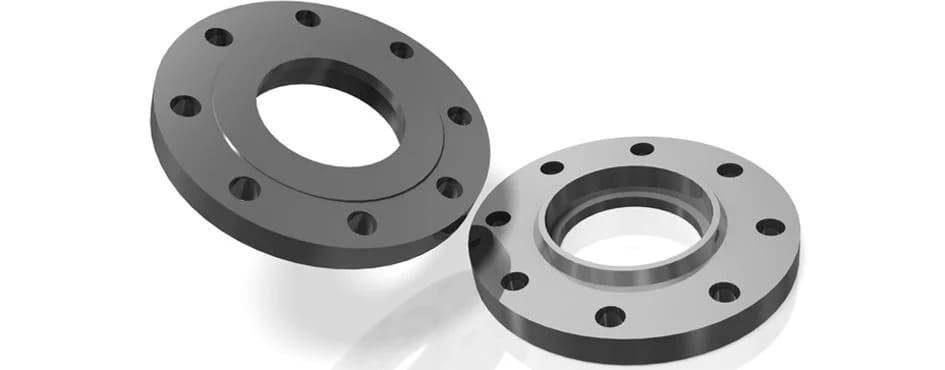
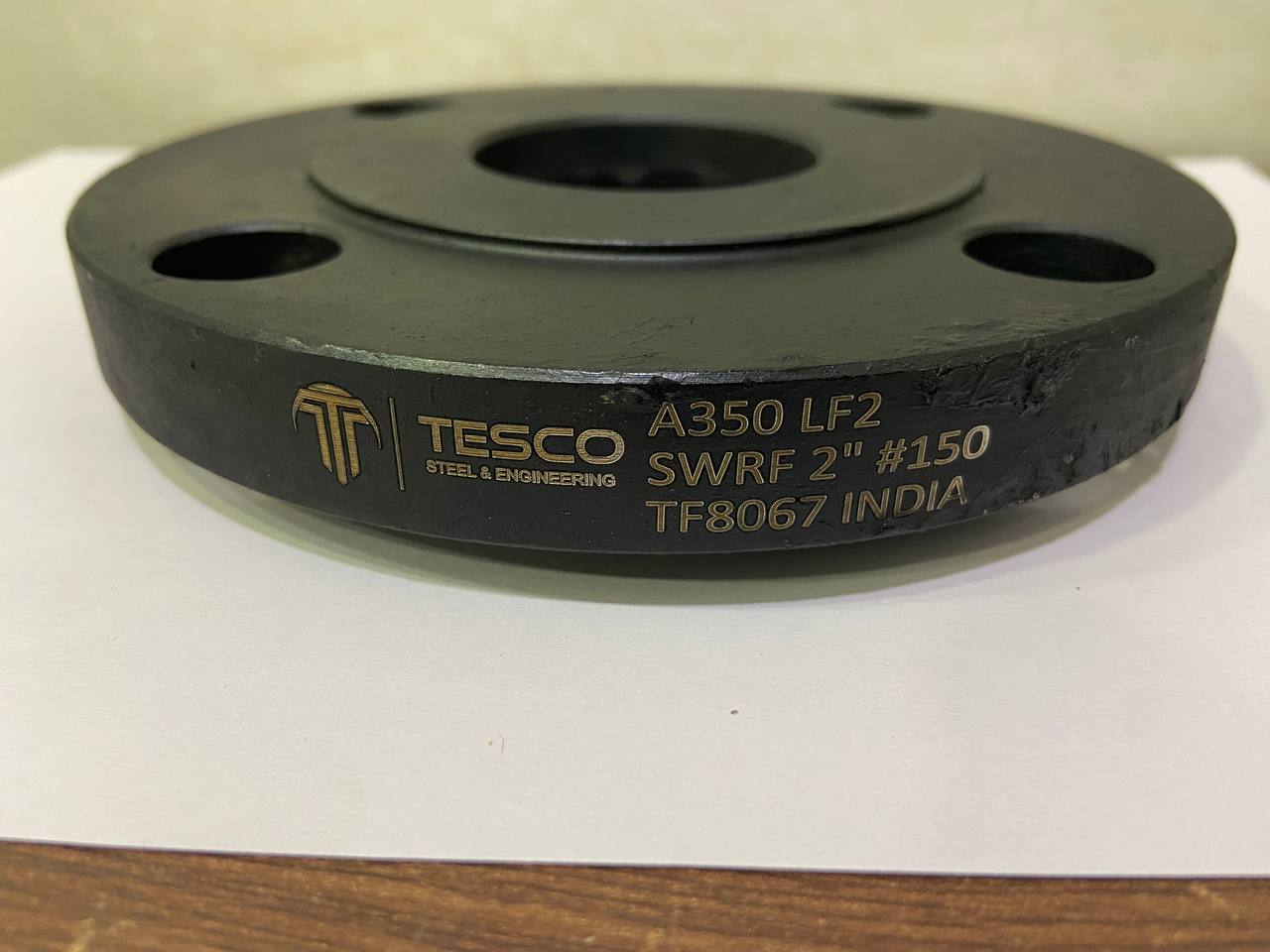
Tesco Steel & Engineering manufactures SWRF flanges — Socket Weld Raised Face, written RFSW in facing-first piping classes — to ASME B16.5 from ½″ to 3″ NB in Classes 150–1500 (2500 and 4″ to order) and EN 1092-1 Type 03. This is the small-bore specialist: the pipe seats in a machined socket, self-aligned square to the face, and takes one external fillet weld — no internal weld anyone would have to make inside a ¾″ bore. Stronger and tighter than threaded, simpler than a small-bore weld neck, with the 1/16″ expansion gap honestly explained below. Full material range — A105, A350 LF2 (the laser-marked 2″ #150 pictured is ours), stainless, duplex, nickel alloys, titanium, CuNi. Flat-face mate? SWFF. Metal-ring seal? SWRTJ. Every lot with EN 10204 3.1/3.2 MTC. ISO 9001:2015, made in Mumbai, India — exported to 50+ countries.
Socket Weld × Raised FaceASME B16.5 ½″–3″ · Class 150–1500EN 1092-1 Type 03One External Fillet WeldSelf-Aligning SocketThe Small-Bore SpecialistA105 · LF2 · SS · Duplex · Ni-AlloysEN 10204 3.1 / 3.2 · ISO 9001:2015
The small-bore specialist. SWRF — also abbreviated RFSW — = Socket Weld Raised Face: the pipe end seats inside a machined socket in the back of the flange — self-aligned square to the face — and is secured with a single external fillet weld, while the raised face concentrates bolt load onto a standard ring gasket. Sized by ASME B16.5 at ½″–3″ NB, Classes 150–1500 — instrument connections, injection points, drains, vents and high-pressure small-bore lines. Stronger than threads, simpler than a butt weld — with a 1/16″ expansion gap the welder must leave, and a built-in crevice the corrosion engineer must respect (both below). EN 10204 3.1 on every lot.
Also searched as: socket weld RF flange, SW RF flange, RFSW flange, socket welding raised face flange — all the same product. Related pages: SWFF (flat face) / SWRTJ (ring joint) siblings, the socketweld hub, the SORF slip-on equivalent, WNRF weld necks and threaded flanges either side of it, and flange-o-lets for branch connections.
SWRF Flange Specifications
SWRF (Socket Weld Raised Face) Flanges are available in the following specifications:
Type / Facing
Socket weld flange with raised face — 1/16″ (1.6 mm) on Class 150/300, 1/4″ (6.4 mm) on Class 400+; serrated stock finish Ra 3.2–6.3 µm
Connection
Pipe seats in machined socket; single external fillet weld per B16.5/B31.3; 1/16″ gap before welding — see the FAQ
Size
1/2"NB to 3"NB per ASME B16.5; 4″ and larger to order; DN15–DN80 per EN 1092-1 Type 03
Class
150#, 300#, 600#, 900#, 1500# (900# shares 1500# dimensions in most small-bore sizes); 2500# on request; PN16–PN100
Bore
Socket bore to pipe OD; through-bore matched to pipe schedule (Sch 40/80/160) — state the schedule at enquiry
Spiral wound (B16.20), CNAF / PTFE / graphite sheet (B16.21) — ring gaskets on the raised face
Modifications
Reduced socket bores, special face finishes, galvanizing / epoxy coating on carbon steel
Testing
Chemistry & mechanicals per heat; socket depth and bore gauged piece by piece; PMI on alloy grades
Certification
EN 10204 3.1 (standard) / 3.2 witnessed; NACE MR0175 where specified
Why SWRF Owns the Small-Bore World
Nobody Welds Inside a ¾″ Pipe
The slip-on's second, internal fillet is impossible on small bores. The socket replaces it with one external weld — fully accessible, visually and MT/PT inspectable.
The Socket Is the Jig
The pipe seats square and concentric by geometry — no alignment clamps, no fitter's eye — which is why socket welds fit up faster and truer than any other small-bore joint.
Threads Leak; Fillets Don't
Where a threaded joint thins the wall and opens a helical leak path, the socket weld is fused metal — immune to vibration loosening, standard in Classes 600–1500 instrument and injection service.
Cheaper Than a Butt Weld, Rightly
No bevel prep, no internal clamps, half the welding time of a small-bore weld neck — and inside clean welded process duty, the code asks no more. Where it does — radiography, severe cycling — WNRF takes over, and we say so.
Specification Notes — Getting Socket Welds Right
Three honest notes.The 1/16″ gap is not optional: pipe bottomed hard against the socket shoulder cracks the weld root under thermal expansion — B31.3's set-back exists for a reason, and our FAQ below explains the practice. The socket is a crevice: the annular gap between pipe and socket is where chloride pitting and crevice attack start — corrosion-critical alloy systems and stagnant services often specify butt welds instead, and hygienic lines exclude sockets outright. And fillet welds cannot be radiographed: where the line class mandates volumetric examination or severe cyclic service, the small-bore weld neck is the correct escalation — our quotation will say which side of the line your duty falls.
How Our SWRF Flanges Are Manufactured
1
Forging — cut billet of the certified heat is hot-forged into the flange blank with full traceability, in every grade from A105 to the nickel alloys.
2
Heat treatment — normalised, quenched-and-tempered or solution annealed per the material specification; furnace records retained.
3
Machining — faces, OD and drilling to ASME B16.5; the socket counterbore and depth gauged piece by piece, through-bore matched to the ordered pipe schedule.
4
Facing — raised face turned with the serrated stock finish per B16.5; smooth finish on request.
5
Testing & marking — chemistry and mechanicals per heat, PMI on alloy grades; laser-marked with grade, size, class, schedule and heat number.
6
Certification & packing — EN 10204 3.1 MTC (3.2 witnessed on request); faces protected, packed sea-worthy.
Where SWRF Flanges Are Used
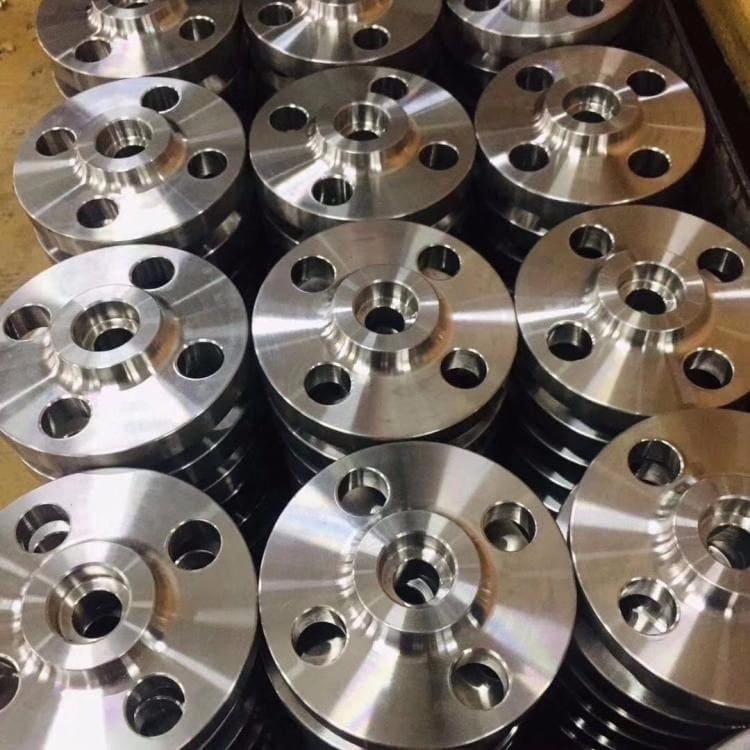
Small bore, high integrity: instrument and gauge connections, chemical injection and sampling points, drains, vents and bleeds, steam trap stations, hydraulic and lube-oil skids, boiler auxiliaries, compressor and pump seal-support piping — across refineries, petrochemical plants, power stations and offshore modules. Production below:
Example: “SWRF Flange, 2″ NB, ASME B16.5 Class 150, Sch 80 bore, ASTM A350 LF2, EN 10204 3.1 — 20 pcs, chemical injection points.” Quotations normally within 24 hours with price, unit weight and delivery.
SWRF Flanges — Frequently Asked Questions
What is a SWRF flange?
SWRF stands for Socket Weld Raised Face — a socket weld flange whose gasket face carries the standard raised ring. The pipe end seats inside a machined socket (counterbore) in the back of the flange and is secured with a single external fillet weld, while the raised face concentrates the bolt load onto the gasket for a reliable seal. Dimensioned to ASME B16.5 for ½" to 3" NB in Classes 150 to 1500, it is the small-bore specialist of the flange world — the standard answer for instrument connections, chemical injection points, drains, vents and high-pressure small-bore process lines where threading is too weak and a butt weld is unnecessary.
What does the raised face on a SWRF flange actually do?
It concentrates force. The raised ring — 1/16" high on Class 150 and 300 flanges, 1/4" on Class 400 and above — reduces the contact area between flange and gasket, so the same bolt load produces a much higher seating stress on the gasket than a full flat face would. That is what makes spiral wound and sheet gaskets seal reliably. The face carries a serrated 'stock' finish per ASME B16.5 (Ra 3.2-6.3 µm) whose grooves grip the gasket and give leak paths nowhere to run. On small-bore high-class joints the effect is amplified: with a small gasket area, even modest bolt loads develop the high seating stresses that make Class 600-1500 instrument and injection connections dependably tight.
How is a SWRF flange welded — and why must the pipe be pulled back 1/16"?
The pipe is inserted until it bottoms against the socket shoulder, then withdrawn approximately 1/16" (1.6 mm) before the single external fillet weld is made — the famous socket weld gap of ASME B31.3. The gap exists because the weld shrinks and the pipe expands when heated in service: bottomed-out pipe transmits that expansion straight into the root of the fillet weld, and cracked socket welds in steam and thermal-cycling service almost always trace back to a missing gap. Fabricators mark the pipe or use gap rings to prove the set-back. The weld itself must meet B16.5/B31.3 fillet sizing — throat not less than the pipe wall and no less than 3 mm — and being external, it is visually and MT/PT inspectable, though not radiographable.
Is SWRF the same as RFSW or SW RF?
Yes — SWRF, RFSW, SW RF and 'socket weld raised face' all describe exactly the same flange; the industry simply abbreviates in both orders, type-first (SWRF) or facing-first (RFSW). Purchase orders, piping classes and marking practices vary between companies and countries — European and Middle-East specifications lean toward RFSW, American ones toward SWRF — but the product quoted and supplied is identical. Tesco marks flanges with the designation your specification uses: write RFSW on the order and RFSW is what the marking and the certificate will say.
What is the difference between SWRF and SORF flanges?
The pipe connection and the size territory. A SORF (slip on raised face) flange slides over the pipe OD and takes two fillet welds — one outside at the hub, one inside the bore — and rules general service from 2" upward. A SWRF seats the pipe inside a socket and takes a single external weld, with no internal weld to make or grind — decisive on small bores where nobody can weld inside a ¾" pipe. Socket welds also self-align the pipe square to the flange face, where slip-ons rely on the fitter. Below 2", SWRF is the stronger, cleaner, faster joint; above 3", sockets disappear from B16.5 and the slip-on or weld neck takes over. The raised face itself is identical on both.
When should I choose SWRF over a threaded flange?
Whenever the line is welded anyway — and in most high-integrity small-bore systems, wherever leakage matters. A threaded flange grips the pipe by tapered threads: quick, no hot work, but the threads thin the pipe wall, concentrate stress, leak under vibration and thermal cycling, and corrode in the crevices. A socket weld replaces all of that with a fused metal joint — stronger than the threads, immune to loosening, with no helical leak path. Piping codes progressively exclude threaded joints as pressure, temperature and hazard rise; socket welds inherit that territory. Threaded flanges keep their place where welding is impossible or forbidden — galvanized utility lines, hazardous-area retrofits — and our threaded flange page covers them.
SWRF or a small-bore weld neck — how do I decide?
By consequence and code, not preference. The weld neck's butt weld is a full-penetration joint that can be radiographed and fatigue-rated — mandatory territory for severe cyclic service, lethal service and wherever the line class demands volumetric examination. The socket weld's fillet cannot be radiographed and its geometry concentrates stress at the root, so codes cap it out of those duties. Everywhere else on small bore — the overwhelming majority of instrument, drain, vent and injection connections in Classes 150-1500 — the SWRF does the same job with less welding time, no bevel preparation, no internal alignment clamps and self-jigging fit-up. The honest rule: read the line class first; where it is silent, small bore defaults to socket weld.
What sizes and pressure classes do SWRF flanges come in?
ASME B16.5 standardises socket weld flanges from ½" to 3" NB — the socket geometry exists precisely for small bore — in Classes 150, 300, 600, 900 and 1500. Two practical notes from the standard: Class 900 small-bore flanges share Class 1500 dimensions in most sizes, a take-off detail that surprises estimators, and Class 2500 sockets plus 4" sockets are manufactured to order outside the core tables. European equivalents follow EN 1092-1 Type 03 in PN 16-100. Above these sizes the socket concept gives way to slip-on and weld neck construction — see our SORF and WNRF pages.
When should I not use a socket weld flange?
Four situations. Corrosion-sensitive and stagnant services: the gap between pipe end and socket shoulder is a built-in crevice, and chloride pitting or crevice-driven attack starts exactly there — corrosive duty on alloy systems often specifies butt welds for this reason alone. Hygienic and high-purity lines: the same crevice traps product and defeats cleaning — food, pharma and clean-utility systems exclude socket welds outright. Severe cyclic or vibrating service: the fillet root concentrates stress and codes push such lines to weld necks. And wherever radiography is mandated: a fillet weld cannot be volumetrically examined. Inside its envelope — clean, welded small-bore process and utility duty — the socket weld remains the default for good reasons.
What materials are SWRF flanges available in?
The complete industrial range: carbon steel ASTM A105 (the volume standard), LTCS A350 LF2 for low temperature — the laser-marked 2" Class 150 LF2 unit pictured on this page is from our production — stainless ASTM A182 F304/L, F316/L, F321, F347, F310, F904L, duplex and super duplex F51/F53/F55, chrome-moly F5-F91, Monel 400/K-500, Inconel 600/601/625, Incoloy 800/825, Hastelloy C-276/C-22, titanium Grade 2 and copper-nickel C70600/C71500. Small-bore alloy systems are exactly where socket flanges earn their keep — instrument and injection connections on alloy lines want the same certificate as the pipe. All grades ship with EN 10204 3.1 or 3.2 certificates.
Which gasket is used with a SWRF flange?
Any standard raised-face gasket, sized to the small-bore tables: spiral wound with centering ring (the process default, ASME B16.20), compressed non-asbestos (CNAF), PTFE or graphite sheet per B16.21 — each sitting inside the bolt circle on the raised ring. Small-bore spiral wounds deserve one caution: with little radial width, over-compression is easy, so the outer ring matters and bolt torque should follow the gasket maker's card rather than habit. If the mating flange is flat-faced — cast iron equipment, GRP — switch to the SWFF flat face pattern with a full-face gasket; that page covers the reasoning.
What is the raised face height and finish on a SWRF flange?
Per ASME B16.5: 1/16" (1.6 mm) raised face for Class 150 and 300, and 1/4" (6.4 mm) for Class 400, 600, 900 and 1500. The published thickness dimensions include the 1/16" face but exclude the 1/4" one — the classic take-off trap, worth double care on small-bore high-class flanges where 6.4 mm is a visible fraction of the whole. The standard face finish is a serrated concentric or spiral 'stock' finish of Ra 3.2-6.3 µm (125-250 µin), designed to grip soft and semi-metallic gaskets; smooth finishes are supplied on request for special gasket systems.
How much does a SWRF flange weigh?
Small numbers — this is small-bore hardware: as working approximations for carbon steel ASME B16.5 socket weld flanges, a ½" Class 150 weighs about 0.4 kg, a 1" Class 150 about 0.8 kg, a 2" Class 150 about 2 kg, a 2" Class 600 about 3.5 kg, and a 3" Class 1500 roughly 9 kg. Stainless and nickel alloys weigh essentially the same. The complete size-by-size table is on our Flange Weight Chart page, and every quotation states the exact unit weight.
What details are needed to get an accurate SWRF flange quotation?
Five elements plus commercial terms: (1) size and dimensional standard — e.g. 2" NB ASME B16.5 or DN50 EN 1092-1 Type 03; (2) pressure class or PN rating; (3) the pipe schedule — unique to socket flanges: the socket bore is sized to the pipe OD, but the through-bore should match the pipe's inside diameter, so Sch 40, 80 or 160 belongs on the enquiry; (4) material grade — e.g. ASTM A105, A350 LF2, A182 F316L — with coating stated for carbon steel; (5) certification — EN 10204 3.1 or 3.2, PMI, NACE MR0175 where applicable. Add the quantity and destination and we return price, weight and delivery — normally within 24 hours.
Who manufactures SWRF flanges in India?
Tesco Steel & Engineering is an ISO 9001:2015 certified flange manufacturer based in Mumbai, India, producing SWRF flanges from ½" to 3" NB (larger to order) in Classes 150-1500 across the full material range — carbon steel A105, LTCS A350 LF2, stainless and duplex A182 grades, chrome-moly, and nickel alloys, Hastelloy, titanium and copper-nickel to ASTM B564/B381 — each machined with gauged socket depth and bore, laser-marked with grade, size, class and heat number, and shipped with EN 10204 3.1/3.2 certification. Common sizes are held in ready stock and exported to more than 50 countries.