ASTM A182 F51 Weld Neck Flanges — Duplex 2205 (UNS S31803)
Tesco Steel & Engineering forges ASTM A182 F51 weld neck flanges in duplex stainless steel 2205 — UNS S31803, Werkstoff Nr. 1.4462, the balanced 22Cr-5Ni-3Mo-N austenitic-ferritic alloy — from 1/2″ NB to 56″ NB, in ASME B16.5 Class 150–2500 and European PN patterns. Duplex delivers roughly twice the yield strength of 316L together with resistance to chloride pitting, crevice corrosion and stress corrosion cracking (PREN ~34–36) — the flange of offshore platforms, seawater systems, desalination plants and hot-chloride chemical service, mating A790 duplex pipe. Solution annealed, dual-certifiable F51/F60, with PMI, ferrite testing, ASTM A923 and EN 10204 3.1/3.2 on request. ISO 9001:2015, made in Mumbai, India — exported worldwide.
A182 F51 · Duplex 2205 · UNS S31803
1.4462 · 22Cr-5Ni-3Mo-N
1/2″ – 56″ NB
Class 150 – 2500 · PN 2.5 – 400
2× Yield of 316L · PREN ~34–36
Chloride SCC Resistant
ISO 9001:2015 · Exported Worldwide
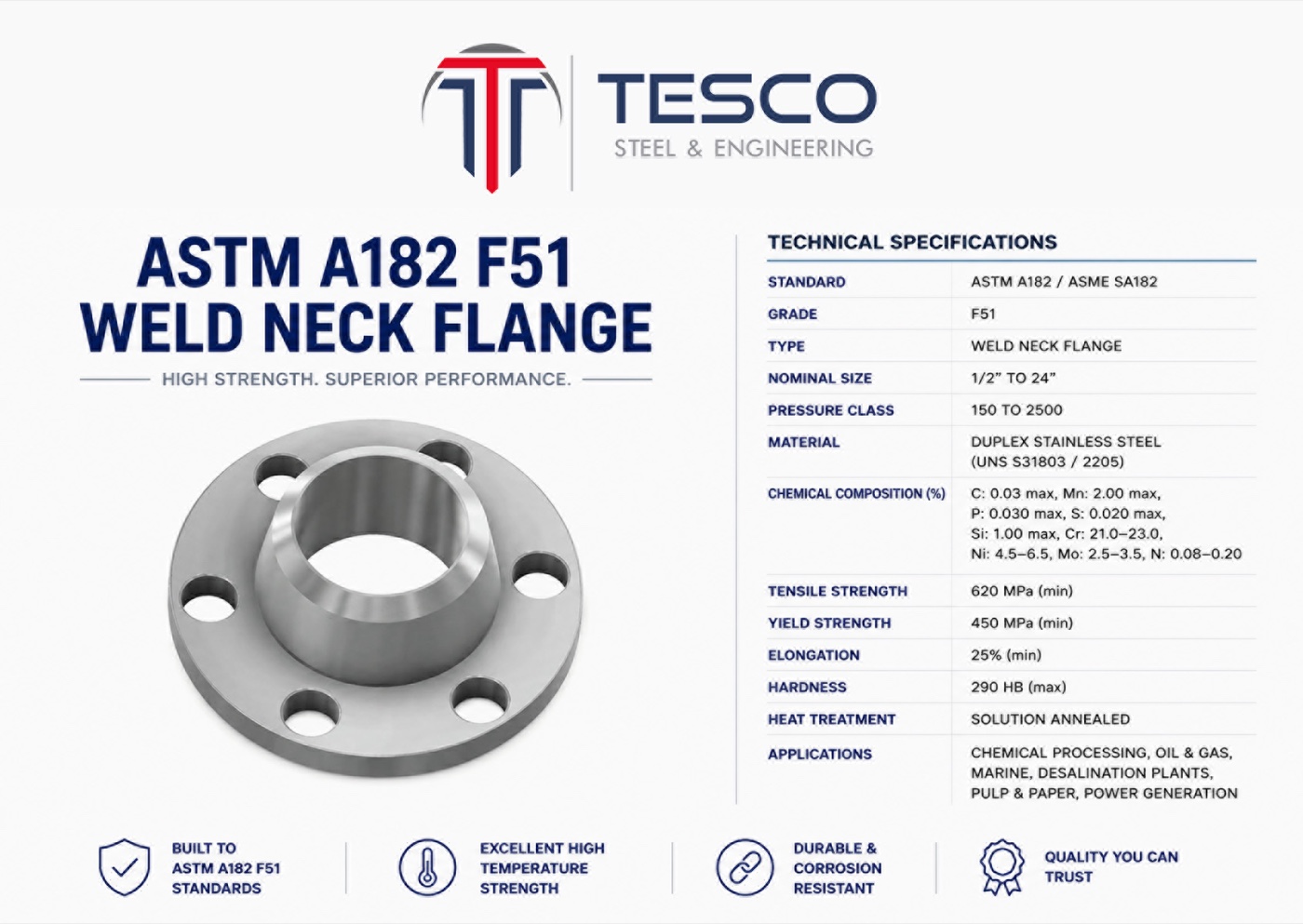
ASTM A182 F51 Weld Neck Flange — Duplex 2205 (UNS S31803), Technical Specifications
What is an ASTM A182 F51 Weld Neck Flange?
ASTM A182 F51 is the forged-flange grade of duplex stainless steel 2205 (UNS S31803 / 1.4462) — a balanced half-austenite, half-ferrite alloy of 22% chromium, 5% nickel, 3% molybdenum and deliberate nitrogen. An F51 weld neck flange pairs that structure with the strongest flange design: a long tapered hub butt-welded to the pipe, bore matched to the pipe schedule, joint fully radiographable — delivering twice the yield strength of 316L and practical immunity to chloride stress corrosion cracking.
The two phases split the work: ferrite brings the 450 MPa yield floor and blocks the chloride cracking mechanism that defeats austenitics above ~60 °C, while austenite keeps the alloy tough and weldable. Nitrogen ties the package together — strengthening, speeding austenite reformation in weld zones, and lifting the pitting resistance number to PREN ~34–36, well clear of 316L's 24–26. The extra strength is money in the joint: duplex systems run thinner walls and lighter flanges at the same rating.
Our melt practice follows the tightened modern window, so flanges are dual-certifiable F51/F60 (S31803/S32205); when the service outruns 2205 — hot, aggressive seawater, PREN > 40 territory — the super duplex F53/F55 family continues the ladder, all forged in-house.
Also searched as: duplex 2205 weld neck flange, UNS S31803 flange, 1.4462 flange, S32205 flange, duplex steel WNRF flange, SA182 F51 flange — all refer to the product on this page.
Chemical Composition of ASTM A182 F51
| C | Mn | Si | P | S | Cr | Mo | Ni | N | Fe |
|---|
| 0.030 max | 2.00 max | 1.00 max | 0.030 max | 0.020 max | 22.00-23.00 | 3.00-3.50 | 4.50-6.50 | 0.14-0.20 | Bal |
Values in weight %. These are the tightened 2205 ranges — within UNS S31803 and simultaneously satisfying S32205 — so certificates can carry both designations. Nitrogen (0.14–0.20%) is the quiet hero: austenite strength, weld-zone phase balance and pitting resistance all lean on it.
Mechanical Properties of ASTM A182 F51
| Tensile Strength, MPa | Yield Strength, Min, MPa | Elongation % min. |
|---|
| 620 | 450 | 25 |
Minimums per ASTM A182 — 620 MPa (90 ksi) tensile and 450 MPa (65 ksi) yield, roughly twice the yield of austenitic 316L. Hardness typically runs to ~290 HB max, and the mandatory solution-annealed condition (which dissolves harmful intermetallic phases) is documented on every certificate.
Equivalent Grades of ASTM A182 F51
| Standard | Werkstoff Nr. | UNS |
|---|
| Alloy F51 (Duplex 2205) | 1.4462 | UNS S31803 |
Also covered by UNS S32205 (the tightened modern variant — our stock dual-certifies) and EN X2CrNiMoN22-5-3. System partners: A790 seamless duplex pipe, A928 welded pipe and A815 butt-weld fittings. For super duplex F53 (S32750) and F55 (S32760), see our duplex steel flanges page.
ASTM A182 F51 Weld Neck Flange Specifications
| ASTM A182 F51 Weld Neck Flanges are available in the following specifications: |
|---|
| Size | 1/2"NB to 56"NB |
| Class | 150#, 300#, 400#, 600#, 900#, 1500#, 2500# |
| Sch (Schedule) | XS, XXS, STD & Schedule 20, 40, 80, 160 |
| Pressure Ratings | PN 2.5 - PN 400 |
| Standards | ASME B16.5, ASME B16.47, EN 1092-1 Type 11, DIN 2631–2635, BS 4504 |
| Condition | Solution Annealed; dual-certifiable F51/F60 (S31803/S32205) |
| Other Services | Pickling & passivation on ASTM A182 F51 Weld Neck Flanges
Sand Blasting on ASTM A182 F51 Weld Neck Flanges
Shot Peening on ASTM A182 F51 Weld Neck Flanges
Ferrite count, ASTM A923 & PMI testing
Project-specific marking, wrapping & export packing |
Why Duplex 2205 for Corrosive, High-Strength Joints
Immunity Where 316L Cracks
The ferrite phase blocks chloride stress corrosion cracking — the silent killer of austenitic stainless in warm chloride media above ~60 °C.
Twice the Yield of 316L
450 MPa minimum yield lets duplex systems run thinner walls and lighter flanges at the same rating — strength that pays for itself in material and bolting.
PREN ~34–36 Pitting Margin
22% chromium, 3%+ molybdenum and deliberate nitrogen hold off the pitting and crevice attack that starts corrosion failures in brines and seawater-adjacent service.
Dual-Certified F51/F60
Melted to the tightened S32205 window and certifiable to both designations — one flange satisfies specifications written around either.
Offshore Paperwork Ready
Ferrite counts, ASTM A923, G48 pitting tests, −46 °C impacts, 3.2 witness — the testing scope offshore specifications demand, delivered with the flange.
Welding Duplex F51 — Phase Balance is Everything
Duplex welds well — on its own terms. Use over-alloyed 2209 filler (ER2209 / E2209), hold heat input in the moderate window that lets austenite reform without cooking the ferrite, control interpass temperature, and skip PWHT — solution annealing is a mill operation, not a field one. The quality metric is the austenite-ferrite balance: offshore specifications typically require ferrite measurement on production welds, with ASTM A923 screening for intermetallic phases where the stakes justify it.
Temperature window: keep long-term service between roughly −46 °C and 300 °C. Extended exposure around 475 °C embrittles the ferrite, and higher temperatures form sigma phase — duplex's strengths live inside its window.
Where ASTM A182 F51 Weld Neck Flanges Are Used
Offshore oil and gas leads: produced water, seawater injection, firewater ring mains and process piping on platforms and FPSOs, where NORSOK-style specifications made 2205 a standard material. Desalination plants flange their brine circuits in it; chemical and petrochemical plants use it against hot chlorides and organic acids; pulp and paper bleach plants, flue gas desulphurisation and marine systems complete the range. The photographs below are our own F51 production — a hard-stamped Class 1500 weld neck and duplex-family stock wrapped for dispatch:
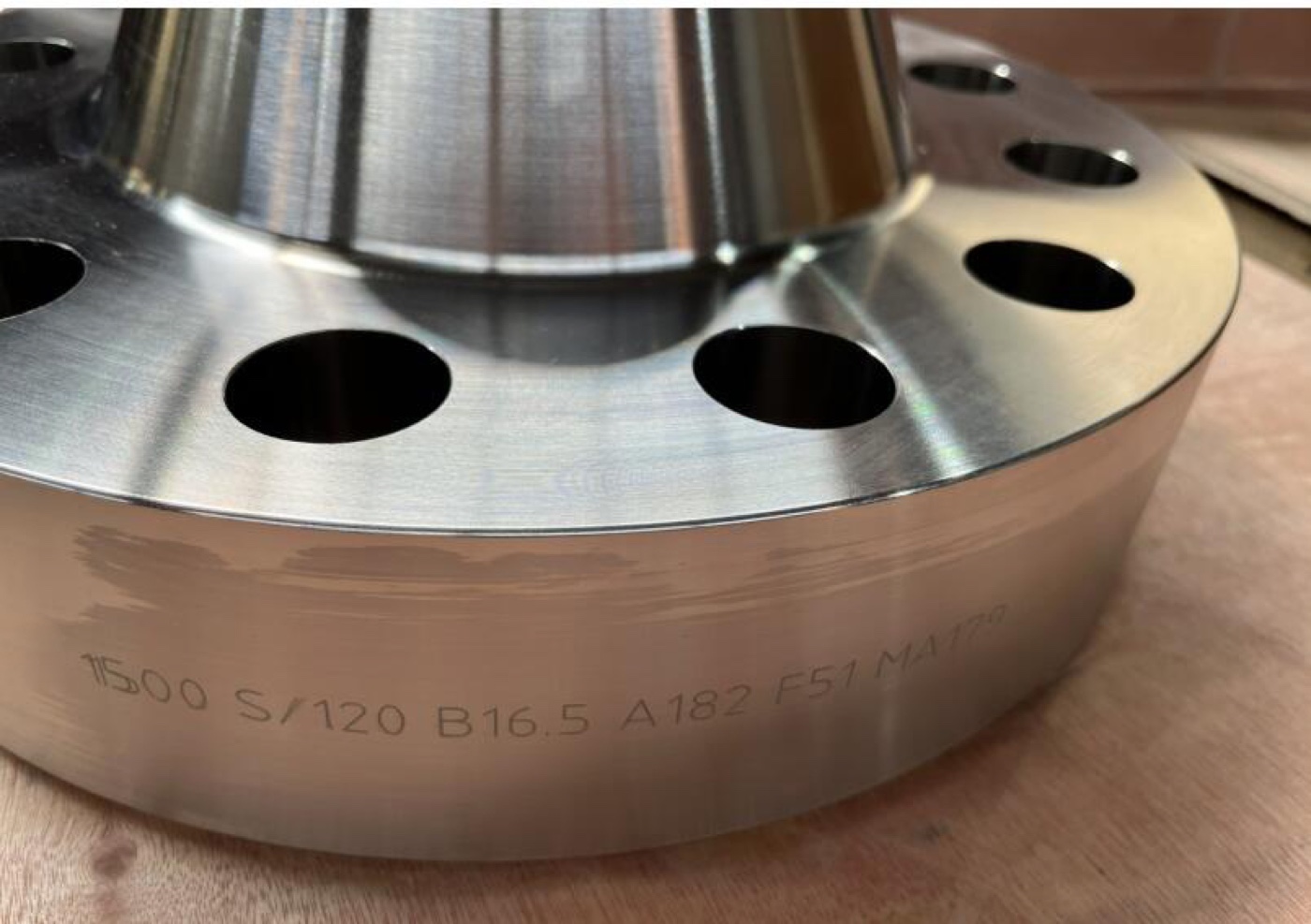
A182 F51 Weld Neck Flange — 6″ Class 1500, Sch 120 Bore, RTJ (Hard-Stamped Rim)
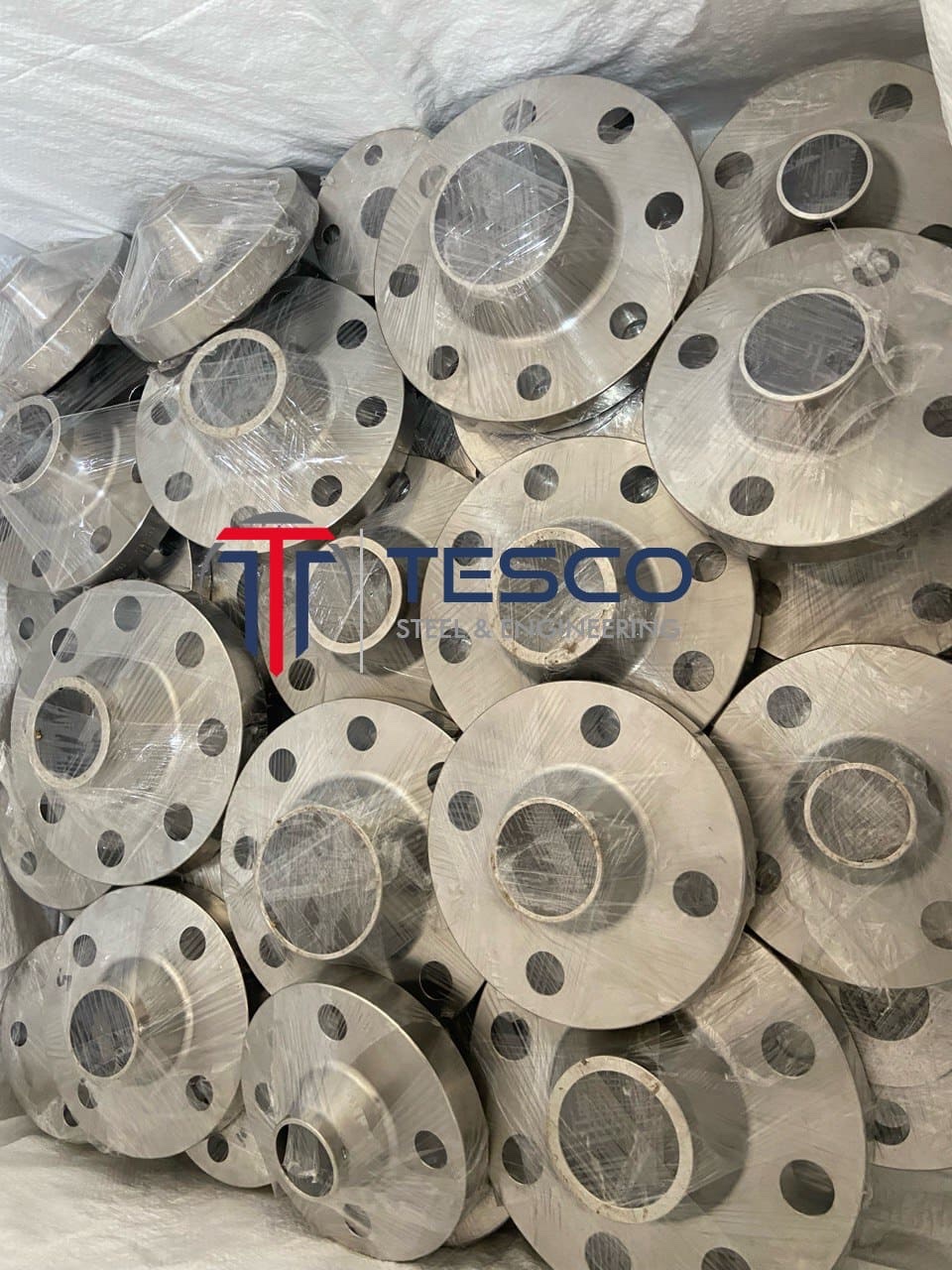
Duplex Weld Neck Flanges — Wrapped & Ready for Dispatch
ASTM A182 F51 Weld Neck Flange Dimensions
F51 weld neck flanges share their dimensions with every other material in the same class — OD, thickness, hub, bore, bolt circle and bolting per the standard tables. Full ASME B16.5 charts:
European PN dimensions are published on the EN 1092-1 Type 11, DIN 2631–2635 and BS 4504 pages.
Price List & How to Order
Duplex pricing tracks nickel and molybdenum plus the testing scope, so we quote live with a stated validity rather than publish a static list. To get a firm quotation, usually within 24 hours:
1
List your requirement — size (NB), class or PN, standard (ASME B16.5 / B16.47 / EN / DIN / BS), grade (F51 or dual-certified F51/F60), pipe schedule or bore, and quantity.
2
Add the testing scope — ferrite count, ASTM A923, G48, impact at −46 °C, 3.2 witness, NORSOK or project specifications.
ASTM A182 F51 Weld Neck Flanges — Frequently Asked Questions
What is an ASTM A182 F51 weld neck flange?
It is a weld neck flange forged from ASTM A182 grade F51 — duplex stainless steel 2205 (UNS S31803), the balanced austenitic-ferritic alloy of roughly 22% chromium, 5% nickel, 3% molybdenum and deliberate nitrogen. The long tapered hub is butt-welded to the pipe with the bore matched to the pipe schedule, giving a radiographable, fatigue-resistant joint in the grade offshore and chemical industries choose when 316L is neither strong enough nor chloride-proof enough.
What makes duplex stainless steel different from 316L?
Structure and the properties it buys. Duplex solidifies as roughly half austenite, half ferrite: the ferrite contributes yield strength around twice that of 316L (450 versus 170 MPa) and immunity to chloride stress corrosion cracking, while the austenite keeps the alloy tough and weldable. Add a PREN of about 34 to 36 — well above 316L's 24 to 26 — and you get a material that survives hot chlorides, brines and seawater-adjacent service where austenitics pit and crack.
What is the difference between F51 (S31803) and F60 (S32205)?
S32205 is the tightened, modern version of the same 2205 alloy: the broad S31803 ranges are narrowed to guarantee higher nitrogen and molybdenum, which raises the floor on corrosion resistance and strength. Most current mill production — including ours — melts to the tighter window and is dual-certified F51/F60, so one flange satisfies specifications written around either designation. The chemistry table on this page reflects that tighter practice.
When should I step up to super duplex F53 or F55?
When the PREN arithmetic demands it. Super duplex 2507 (F53, UNS S32750) and Zeron-type F55 (S32760) run 25% chromium with more molybdenum and nitrogen, pushing PREN above 40 for hot, aggressive seawater and the harshest offshore duty — with yield strength around 550 MPa. Standard 2205 covers the broad middle of chloride service at a better price. We forge both families; state the service conditions and we will confirm the economic choice.
What temperature range can F51 duplex flanges be used in?
Roughly -46 °C to 300 °C. The upper limit is metallurgical, not mechanical: hold duplex around 475 °C and the ferrite embrittles; above about 300 °C long-term service risks the same effect, and sigma phase forms at higher temperatures still. The lower limit reflects the ferrite's ductile-brittle transition, with impact testing at -46 °C standard for offshore specifications. Within that window, duplex is hard to beat.
What are the equivalent designations for A182 F51?
Duplex 2205 in general usage; UNS S31803 (with S32205 as the tightened modern variant); Werkstoff Nr. 1.4462; and EN X2CrNiMoN22-5-3. Its system partners share the chemistry: A790 seamless duplex pipe, A815 fittings and A928 welded pipe. An enquiry in any of these designations is quoted as the same material.
What is the chemical composition of ASTM A182 F51?
Per our supply practice: carbon 0.030% max, manganese 2.00% max, silicon 1.00% max, phosphorus 0.030% max, sulphur 0.020% max, chromium 22.00 to 23.00%, molybdenum 3.00 to 3.50%, nickel 4.50 to 6.50% and nitrogen 0.14 to 0.20%, balance iron — the tightened 2205 window that also satisfies S32205. Nitrogen is the quiet hero: it strengthens the austenite, speeds its reformation in weld zones and lifts pitting resistance.
What are the mechanical properties of A182 F51 flanges?
Minimum tensile strength 620 MPa (90 ksi), minimum yield strength 450 MPa (65 ksi) and minimum elongation 25% — roughly twice the yield of austenitic 316L, which is why duplex systems can run thinner walls and lighter flanges at the same rating. Hardness typically runs to about 290 HB maximum, and the solution-annealed condition is documented on every certificate.
Which pipe grades do F51 weld neck flanges mate with?
ASTM A790 seamless duplex pipe in UNS S31803/S32205 is the standard partner, with A928 welded pipe on larger diameters and A815 butt-weld fittings completing the system. The weld neck bore is machined to the pipe schedule you state, so the bore runs flush through the joint and the bevel arrives ready for a matched-chemistry butt weld.
How are duplex F51 flanges welded to pipe?
With over-alloyed 2209 filler (ER2209 / E2209), controlled heat input — enough to let austenite reform in the weld zone, not so much as to cook the ferrite — controlled interpass temperature, and no post-weld heat treatment in normal practice. The phase balance is the quality metric: offshore specifications typically require ferrite measurement and sometimes ASTM A923 testing on production welds. Nitrogen-bearing shielding gas helps hold the balance on TIG roots.
Why is duplex the answer to chloride stress corrosion cracking?
Chloride SCC is the silent killer of austenitic stainless above roughly 60 °C in chloride media — cracks grow through 304 and 316 with little warning. The ferrite phase in duplex blocks that cracking mechanism, so 2205 delivers practical immunity in the same environments while also resisting the pitting that starts SCC in the first place. For warm brines, seawater-adjacent systems and chloride-bearing process streams, that is the deciding property.
What testing and certification do you supply with F51 flanges?
Every lot ships with EN 10204 3.1 mill test certificates covering chemical analysis including nitrogen, mechanical properties and the solution-anneal record, with 3.2 certification witnessed by Lloyd's, DNV, BV or TÜV on request. We also offer PMI, ferrite count verification, ASTM A923 intermetallic-phase testing, G48 pitting tests and impact testing at -46 °C for offshore specifications — with full heat-number traceability throughout.
Are F51 flanges suitable for sour service (NACE)?
Yes, within the limits ISO 15156 / NACE MR0175 sets for duplex stainless steels — the standard defines acceptable H2S partial pressures and requires the correct solution-annealed, intermetallic-free condition. Offshore production systems use 2205 extensively inside those limits. State the sour-service requirement in your enquiry and the material, testing and certification are aligned to it.
Where are ASTM A182 F51 weld neck flanges used?
Offshore oil and gas above all — produced water, seawater injection, firewater and process piping on platforms and FPSOs — plus desalination plants, chemical and petrochemical circuits with hot chlorides or organic acids, pulp and paper bleach plants, flue gas desulphurisation and marine systems. Wherever 316L pits or cracks and nickel alloys cost too much, duplex 2205 is the engineered middle ground.
What sizes and standards do you manufacture F51 weld neck flanges in?
From 1/2 inch NB to 56 inch NB: ASME B16.5 Class 150 to 2500 up to 24 inch, ASME B16.47 above, and European PN 2.5 to PN 400 patterns to EN 1092-1 Type 11, DIN and BS 4504. Raised face is standard, ring joint for high-class offshore service on request, and every bore is machined to the mating pipe schedule from Sch 10 through XXS.
Do you keep A182 F51 weld neck flanges in stock? What is the lead time?
Common offshore and process sizes in Class 150, 300 and 600 rotate through regular production, with popular items often available from stock — the wrapped duplex-family flanges photographed on this page are real dispatch stock. Larger diameters, higher classes and witness-tested lots are forged to order, typically in 3 to 5 weeks. Duplex prices track nickel and molybdenum, so quotations carry a validity period.
What information should I include in an F51 flange enquiry?
Six things: size (NB), pressure class or PN rating, dimensional standard (ASME B16.5, B16.47 or EN/DIN/BS), grade (F51, or dual-certified F51/F60), pipe schedule or bore, and quantity. Add the testing scope — A923, ferrite count, G48, impact at -46 °C, 3.2, NORSOK or project specs — since duplex paperwork is usually specification-driven. With these details we return a firm quotation, usually within 24 hours.
Do you export ASTM A182 F51 flanges outside India?
Yes. Tesco Steel & Engineering is an ISO 9001:2015 certified manufacturer based in Mumbai, and F51 duplex flanges ship to offshore contractors, desalination projects and chemical plants across the Middle East, Europe, Africa, Southeast Asia and the Americas. Flanges travel pickled, face-protected and seaworthy-packed, with full heat-number and test traceability.

