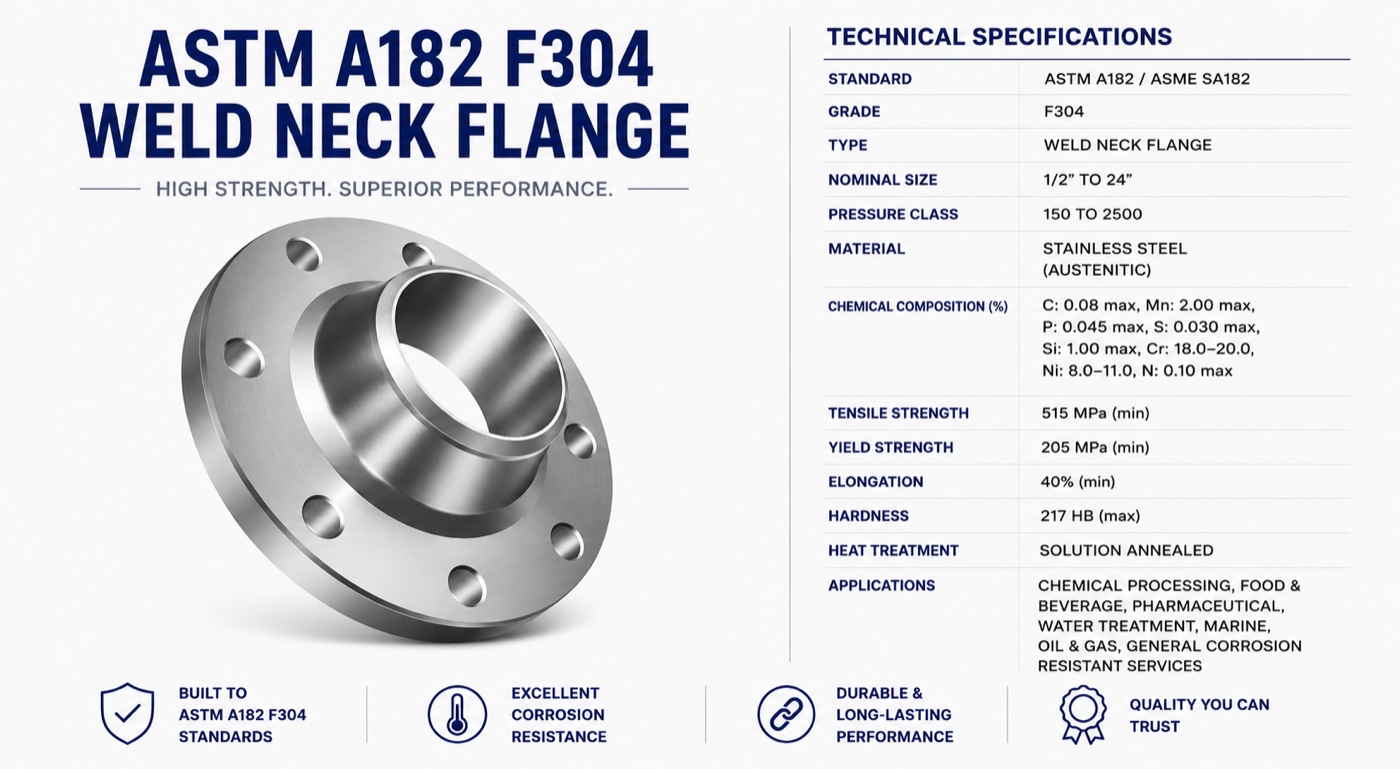
Tesco Steel & Engineering forges ASTM A182 F304 weld neck flanges in stainless steel 304 — the classic 18% chromium, 8% nickel austenitic grade, UNS S30400, Werkstoff Nr. 1.4301 — from 1/2″ NB to 56″ NB. The world's most widely used stainless steel earns its keep on volume: dependable corrosion resistance in water, food, dairy, pharmaceutical and general chemical service, cryogenic toughness with no brittle transition, and the best price of any stainless flange grade. Machined to ASME B16.5 Class 150–2500, ASME B16.47, EN 1092-1 Type 11, DIN and BS 4504, bores matched to your pipe schedule, dual-certified 304/304L stock, pickled & passivated, EN 10204 3.1/3.2 certified. ISO 9001:2015, made in Mumbai, India — exported worldwide.
A182 F304 · UNS S304001.4301 · SUS 304 · 18/81/2″ – 56″ NBClass 150 – 2500 · PN 2.5 – 400Dual-Certified 304/304LCryogenic to ~500 °CISO 9001:2015 · Exported Worldwide
ASTM A182 F304 is the forged-flange grade of stainless steel 304 — the original 18/8 austenitic (18% chromium, 8% nickel), UNS S30400 / 1.4301, and the most-produced stainless steel on earth. An F304 weld neck flange pairs that dependable chemistry with the strongest flange design: a long tapered hub butt-welded to the pipe, bore matched to the pipe schedule, joint fully radiographable. It is the value benchmark of corrosion-resistant flanged piping.
The weld neck geometry works for 304 exactly as it does for richer alloys: the tapered hub feeds pressure, bending and vibration stresses gradually into the pipe wall, and the matched bore leaves no step, no turbulence and — important for any stainless system — no crevice where localised attack could start. The butt weld is radiographed at installation and pickled afterwards to restore the passive layer.
Within the family, 304 (0.08% C max) is the standard, 304L (0.030% C) the welding-safe variant, and 304H (0.04–0.10% C) the creep-range specification. Most of our stock is dual-certified 304/304L — L-grade carbon at standard-304 strength — so one flange satisfies either callout. When chlorides or acids enter the service, the molybdenum-bearing F316L weld neck flange is the natural step up.
Also searched as: SS 304 weld neck flange, 304 WNRF flange, UNS S30400 flange, 1.4301 flange, SUS 304 flange, X5CrNi18-10 flange, 18/8 stainless flange — all refer to the product on this page.
Chemical Composition of ASTM A182 304
C
Mn
Si
P
S
Cr
Mo
Ni
N
0.080 max
2.00 max
0.75 max
0.045 max
0.030 max
18.00-20.00
-
8.00-11.00
-
Values in weight %. The 18–20% chromium builds the self-healing passive oxide layer; 8–11% nickel stabilises the tough austenitic structure. Note there is no molybdenum — chloride-pitting resistance is what separates 304 from the 316 family.
Mechanical Properties of ASTM A182 304
Tensile Strength, MPa
Yield Strength, Min, MPa
Elongation % min.
Hardness Rockwell HRB
Hardness Brinell HB
515
205
30
92 max
201 max
Minimums per ASTM A182 for grade F304. Like all austenitics, 304 is not hardenable by heat treatment; its generous ductility absorbs bolt-up, vibration and thermal movement, and its impact toughness holds to cryogenic temperatures with no ductile-brittle transition.
Equivalent Grades of ASTM A182 304
Standard
Werkstoff Nr.
UNS
JIS
BS
GOST
AFNOR
EN
SS 304
1.4301
S30400
SUS 304
304S31
08Х18Н10
Z7CN18‐09
X5CrNi18-10
An enquiry in any of these designations is quoted as the same material. For the low-carbon and controlled-carbon variants (304L / 304H, UNS S30403 / S30409), state the grade and the forgings are certified accordingly — or take dual-certified 304/304L stock and cover both.
ASTM A182 F304 Weld Neck Flange Specifications
ASTM A182 304 Weld Neck Flanges are available in the following specifications:
Size
1/2"NB to 56"NB
Class
150#, 300#, 400#, 600#, 900#, 1500#, 2500#
Sch (Schedule)
XS, XXS, STD & Schedule 20, 40, 80, 160
Pressure Ratings
PN 2.5 - PN 400
Standards
ASME B16.5, ASME B16.47, EN 1092-1 Type 11, DIN 2631–2635, BS 4504
No stainless flange grade delivers usable corrosion resistance at a lower price — which is why 304 remains the volume stainless of food, water, pharma and general chemical piping worldwide.
Clean & Hygienic
The passive chromium oxide surface is inert, cleanable and product-safe — the reason 18/8 stainless owns food, beverage, dairy and pharmaceutical service.
Cryogenic Without Drama
Fully austenitic, no ductile-brittle transition: the same F304 flange serves LNG cold boxes and ambient utility headers, with impact toughness certified where specs demand it.
Welds Predictably
ER308 filler, no preheat, no PWHT — and with dual-certified 304/304L stock, the heat-affected zone stays free of carbide precipitation on every pass.
A Clear Upgrade Path
Same dimensions, richer chemistry when service tightens: 316L for chlorides, duplex for strength, 310S for heat — all forged in-house, so a spec change never means a new supplier.
Production & Ready Stock
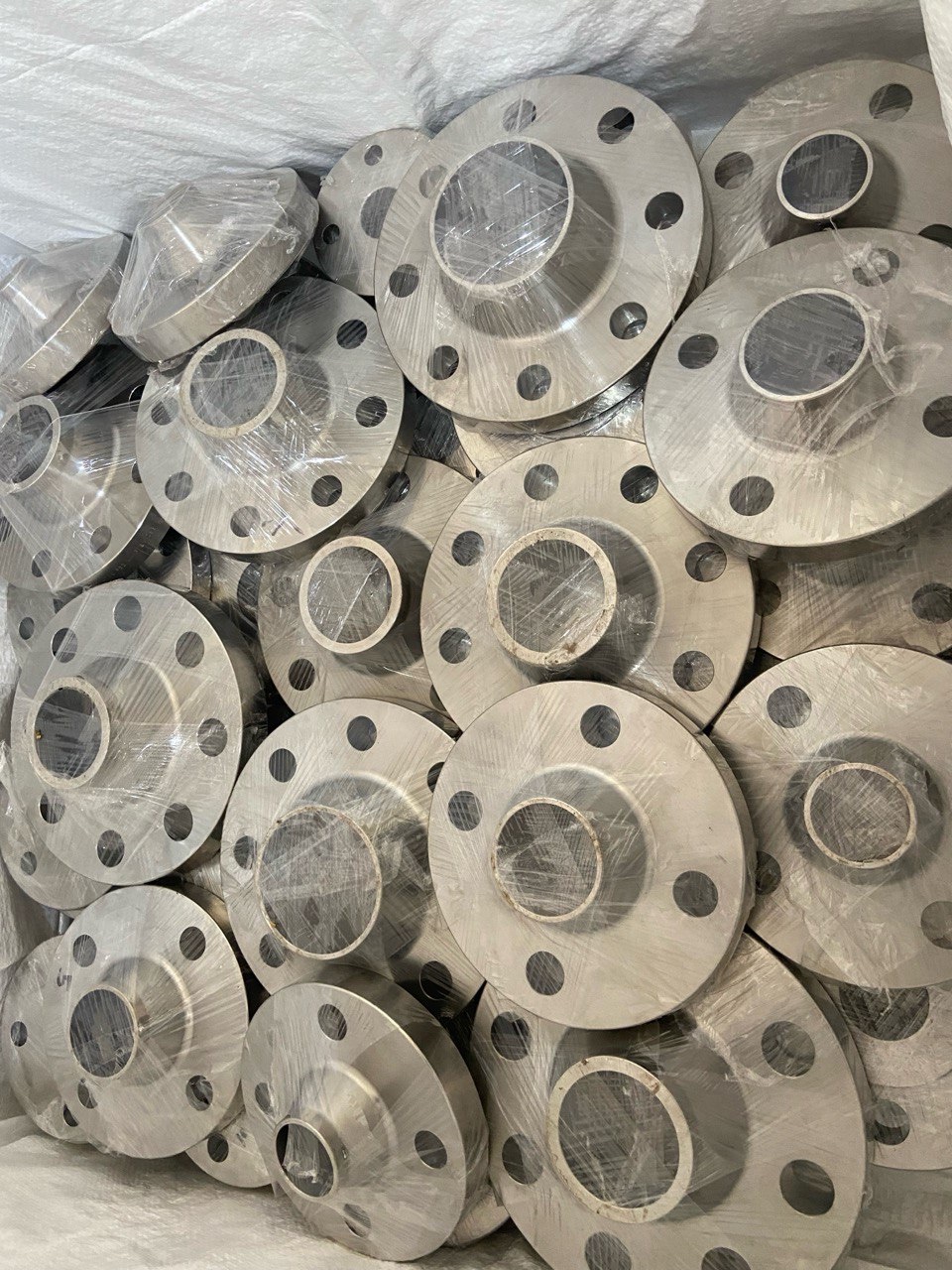
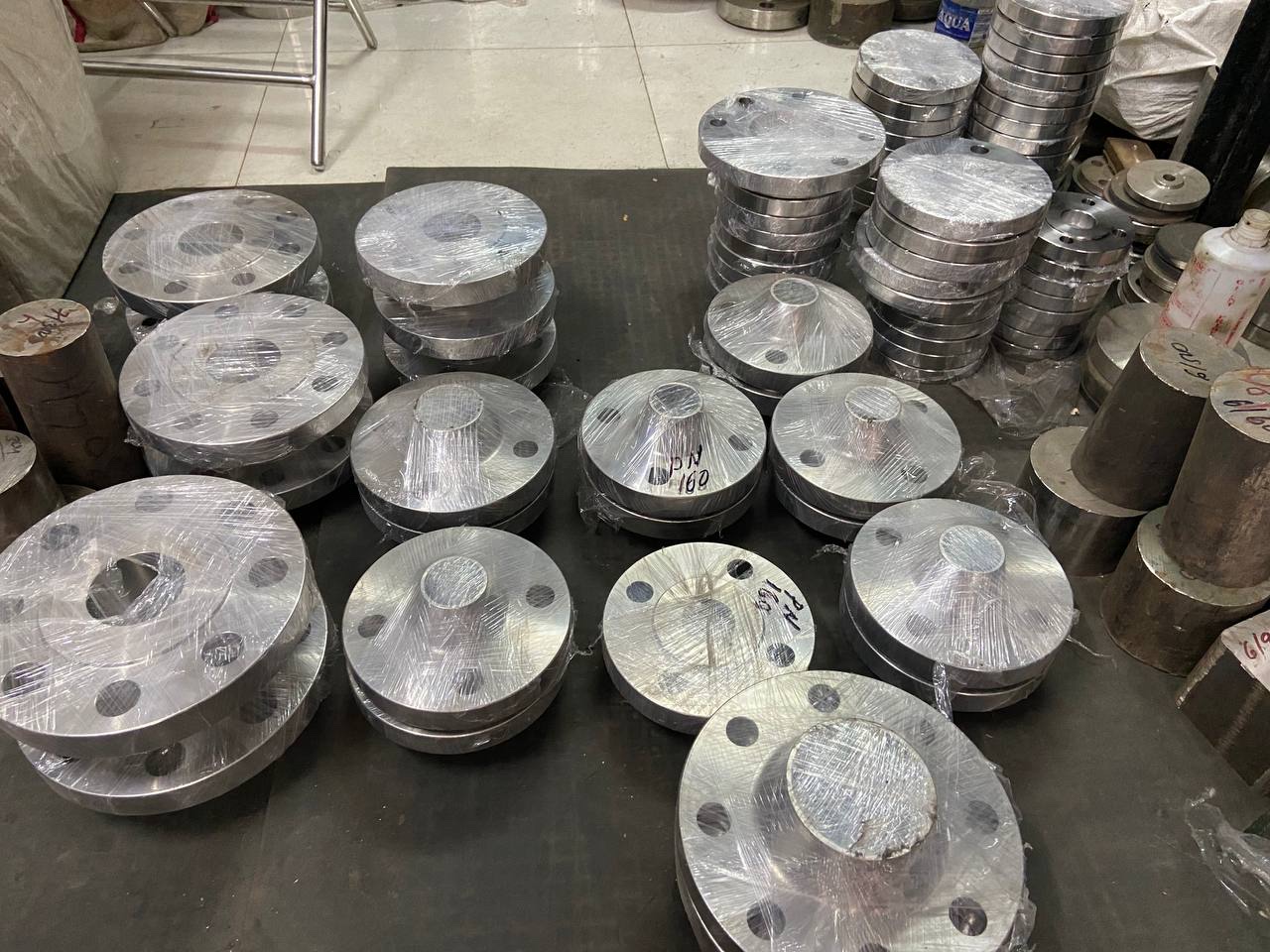
Every F304 flange starts as a certified forged blank, solution annealed, then CNC-turned: hub profiled, bore matched to your pipe schedule, weld end bevelled to 37.5°, drilling on the correct circle, face serrated to 125–250 µin AARH. Flanges are pickled, passivated, marked with grade, size, rating and heat number, then stretch-wrapped into lined bags or crates — the photographs below are our actual 304 production and stock:
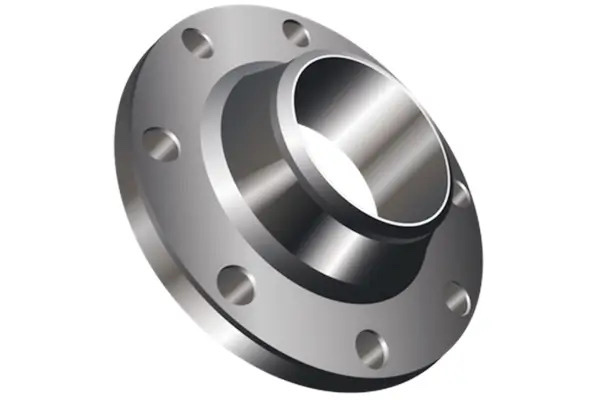
F304 Weld Neck Flanges — Wrapped Ready StockSS 304 Flanges in Production — ASME & PN Patterns with Bar StockASTM A182 F304 Weld Neck Flange — Raised Face (WNRF / RFWN)
Where ASTM A182 F304 Weld Neck Flanges Are Used
Food, beverage and dairy plants run 304 as their default flange grade — breweries, distilleries, edible oil and sugar refineries included. Water and wastewater treatment uses it on dosing, filtration and process lines; pharmaceutical plants on utilities and non-product-critical circuits; chemical plants wherever the medium is mild enough to spare the 316L premium; and LNG and cryogenic installations exploit its low-temperature toughness. Add pulp & paper, textiles and building services, and 304 covers more flanged joints than any other stainless grade — until chlorides, acids or furnace temperatures argue for 316L, duplex or 310S.
ASTM A182 304 Weld Neck Flange Dimensions
F304 weld neck flanges follow the standard dimensional tables — OD, thickness, hub, bore, bolt circle and bolting are identical to any other material in the same class. Full ASME B16.5 charts for every class:
European PN dimensions — like the PN-marked flanges visible in the production photo above — are published on the EN 1092-1 Type 11, DIN 2631–2635 and BS 4504 pages.
Price List & How to Order
Pricing depends on size, class and quantity and moves with the nickel market, so we quote live rather than publish a static list. As one of our two highest-volume stainless grades, 304/304L ships fast from wrapped ready stock at highly competitive export prices. To get a firm quotation, usually within 24 hours:
1
List your requirement — size (NB or DN), class or PN, standard (e.g. ASME B16.5 / EN 1092-1 Type 11), grade (304, dual-certified 304/304L, or 304H), pipe schedule or bore, and quantity.
2
Add any extras — IGC testing, 3.2 certification, PMI, flat facing or a special finish.
3
Send it across — via the inquiry form, WhatsApp, or email to sales@tescosteel.com — and we reply with price, delivery and stock position.
It is a weld neck flange forged from stainless steel 304 — the classic 18% chromium, 8% nickel austenitic grade — under the ASTM A182 forging specification, grade F304. The long tapered hub is butt-welded to the pipe with the bore matched to the pipe schedule, giving a radiographable, fatigue-resistant joint in the world's most widely used stainless steel: the sensible default wherever carbon steel corrodes but molybdenum-grade alloys would be overkill.
What is the difference between 304, 304L and 304H flanges?
Carbon content, and what it buys. Standard 304 allows up to 0.08% carbon. 304L caps it at 0.030% so welding cannot sensitise the heat-affected zone — the usual pick for welded piping. 304H holds carbon between 0.04 and 0.10% deliberately, for creep strength in high-temperature ASME work. Much of our forging stock is dual-certified 304/304L, meeting the L carbon limit at standard 304 strength, so one flange satisfies either specification.
When should I choose 316L instead of 304 flanges?
When chlorides enter the picture. 304 carries no molybdenum, so coastal atmospheres, brackish water, brines and de-icing salt environments will eventually pit it; 316L's 2-3% molybdenum roughly doubles the pitting resistance for a modest premium. For fresh water, food and beverage, dairy, pharmaceutical utilities and general indoor chemical service, 304 does the job at the better price — which is why it remains the volume stainless grade worldwide.
What are the equivalent designations for SS 304?
UNS S30400; Werkstoff Nr. 1.4301; JIS SUS 304; BS 304S31; GOST 08Ch18N10; AFNOR Z7CN18-09; and EN X5CrNi18-10. It is also the original '18/8' stainless of kitchenware fame. An enquiry in any of these designations is quoted as the same material — the full cross-reference table is published on this page.
What is the chemical composition of ASTM A182 F304?
Carbon 0.08% max, manganese 2.00% max, silicon 0.75% max, phosphorus 0.045% max, sulphur 0.030% max, chromium 18.00 to 20.00% and nickel 8.00 to 11.00%. The chromium builds the passive oxide layer that gives stainless steel its name; the nickel stabilises the tough austenitic structure. No molybdenum — that is the 316 family's addition.
What are the mechanical properties of A182 F304 flanges?
Per ASTM A182: minimum tensile strength 515 MPa (75 ksi), minimum yield strength 205 MPa (30 ksi) and 30% minimum elongation, with hardness typically capped around 92 HRB / 201 HB. Like all austenitics, 304 is not hardenable by heat treatment and keeps its impact toughness from cryogenic temperatures upward — there is no ductile-to-brittle transition.
What corrosion service can 304 flanges handle?
Fresh and potable water, steam and condensate, food, beverage and dairy fluids, pharmaceutical utilities, many organic chemicals, nitric acid service and general atmospheric exposure. Its limits are chlorides — pitting and crevice attack in seawater, brines and coastal splash zones — and strong reducing acids. For those, step up to 316L, duplex or higher alloys, all of which we forge as well.
What temperature range can 304 flanges be used in?
From liquid-gas cryogenic temperatures — the austenitic structure stays tough with no transition — up to around 500 °C for pressure duty per the ASME rating tables. For continuous creep-range service above about 525 °C, specify 304H with its controlled carbon; for oxidation beyond 800 °C move to 310S. Between those extremes, standard 304 covers the vast majority of process temperatures.
What sizes and standards do you manufacture F304 weld neck flanges in?
From 1/2 inch NB to 56 inch NB in ASME B16.5 Class 150 to 2500, ASME B16.47 Series A and B above 24 inch, and European PN 2.5 to PN 400 ratings to EN 1092-1 Type 11, DIN 2631 to 2635 and BS 4504 — the production photo on this page includes PN-marked European pattern flanges alongside ASME items. Raised face is standard, flat face on request, and every bore is machined to the mating pipe schedule from Sch 10 through XXS.
How are 304 flanges welded to pipe?
By TIG or MMA using ER308 / E308 filler — the standard over-alloyed consumable for 304 base metal — with low heat input, no preheat and no post-weld heat treatment. For heavily welded systems, 304L or dual-certified material keeps the heat-affected zone free of chromium carbide precipitation. The weld neck bevel comes machined at 37.5 degrees ready for a radiographable butt weld, and joints are pickled after welding to restore the passive layer.
Where are ASTM A182 F304 weld neck flanges used?
Everywhere general-purpose stainless piping runs: food, beverage and dairy plants, breweries and distilleries, pharmaceutical utilities, water and wastewater treatment, pulp and paper, general chemical processing, LNG and cryogenic installations, and building services. 304 is the volume grade of the stainless world — the default answer until chlorides, acids or extreme temperatures argue for something richer.
Can you supply dual-certified 304/304L flanges?
Yes — most of our 304 forging stock is dual-certified. The material meets the 0.030% carbon ceiling of 304L while achieving the strength minimums of straight 304, and the mill test certificate states both grades. One flange then satisfies specifications written around either designation, which simplifies stocking for contractors running mixed project specs.
What testing and certification do you supply with F304 flanges?
Every lot ships with EN 10204 3.1 mill test certificates covering chemical analysis and mechanical properties, with 3.2 certification witnessed by Lloyd's, DNV, BV or TÜV on request. We also offer PMI (positive material identification), intergranular corrosion testing to ASTM A262, dye penetrant examination and dimensional reports, with full heat-number traceability from billet to finished flange.
How are your F304 flanges finished and packed?
Flanges are pickled and passivated to restore the chromium oxide passive layer, individually stretch-wrapped, and packed in lined bags or crates — exactly as the ready-stock photograph on this page shows. Faces and weld bevels carry protectors, each flange is marked with grade, size, rating, standard and heat number, and export packing is seaworthy.
Do you keep 304 weld neck flanges in stock? What is the lead time?
304/304L is one of our two highest-volume stainless grades: common sizes from 1/2 to 24 inch in Class 150 and 300, plus popular DIN/EN PN sizes, generally ship within days from the wrapped ready stock pictured on this page. Larger diameters, higher classes and 304H material are forged and machined to order, usually in 2 to 4 weeks. Send your list for a firm delivery commitment.
What information should I include in an F304 flange enquiry?
Six things: size (NB or DN), pressure class or PN rating, dimensional standard (for example ASME B16.5 or EN 1092-1 Type 11), grade (304, dual-certified 304/304L, or 304H), pipe schedule or bore, and quantity. Add any extras — IGC testing, 3.2 certification, flat facing or special finish. With these details we return a firm quotation, usually within 24 hours.
Do you export ASTM A182 F304 flanges outside India?
Yes. Tesco Steel & Engineering is an ISO 9001:2015 certified manufacturer based in Mumbai, and 304/304L flanges ship constantly to food processors, EPC contractors, water projects and chemical plants across the Middle East, Europe, Africa, Southeast Asia and the Americas. Export packing is seaworthy, faces are protected, and every flange carries marked traceability from heat number to finished part.