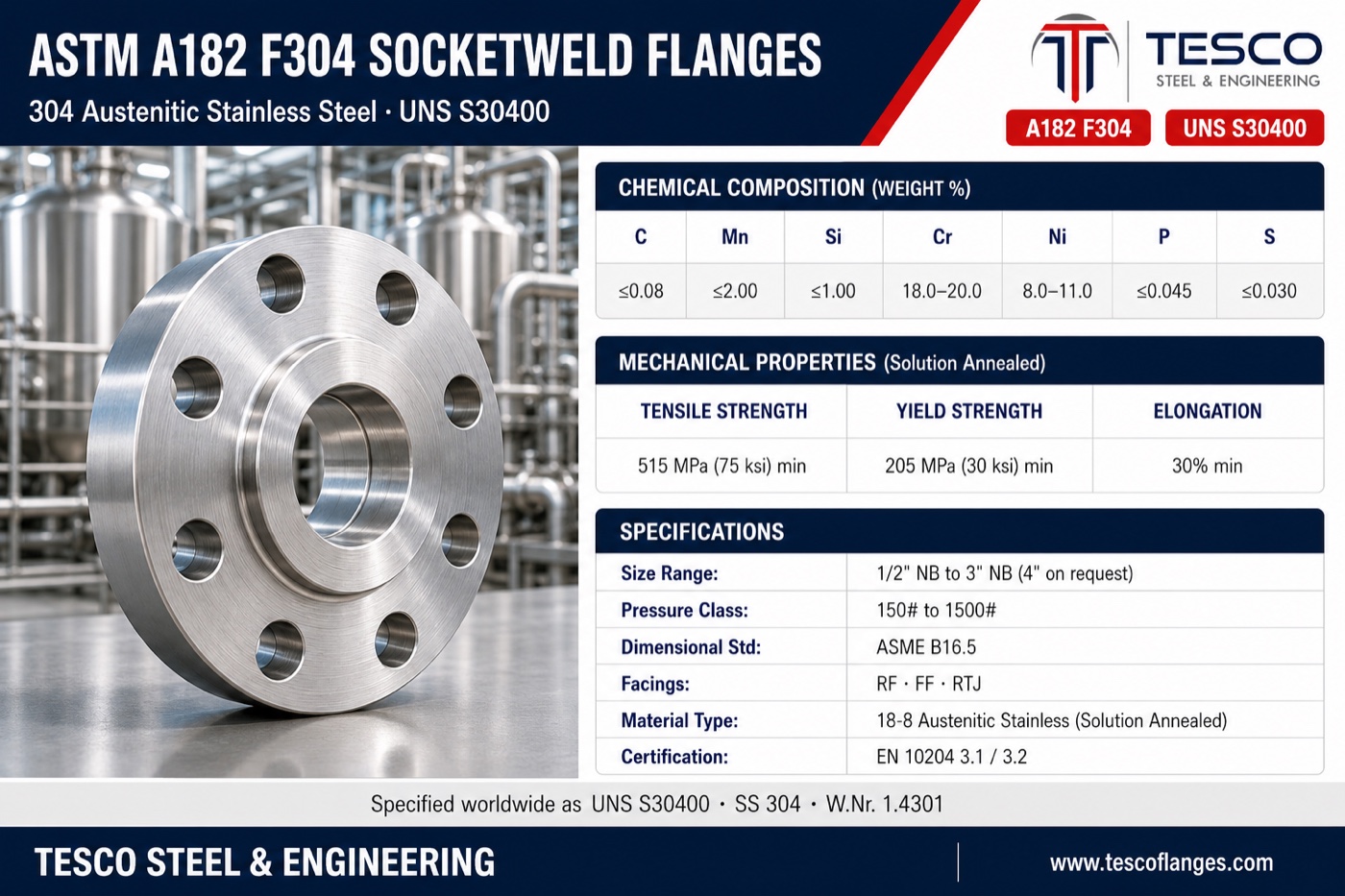
Tesco Steel & Engineering manufactures ASTM A182 F304 socketweld flanges — the world's default stainless: 18-8 austenitic, UNS S30400, W.Nr. 1.4301 — to ASME B16.5 from ½″ to 3″ NB in Classes 150–1500. 304 is what industry means when it says stainless: 18% Cr for the film, 8–11% Ni for toughness at every temperature — including cryogenic, where the carbon-steel ladder ends and austenitics simply continue — welded with no preheat and no PWHT. The general-service stainless small bore of food, beverage, pharma utilities, water and chemical plants — with the famous paradox stated honestly below: hygienic product lines exclude sockets, and 304 sockets rule the utility side instead. Dual 304/304L certification routine; F304L and F304H covered in the FAQs; chlorides? 316 and the duplex family continue the ladder. Facings: SWRF, SWFF, SWRTJ. Every lot with EN 10204 3.1/3.2 MTC. ISO 9001:2015, made in Mumbai, India — exported to 50+ countries.
A182 F304 · UNS S30400 · W.Nr. 1.4301The World's Default Stainless — 18-8Cryogenic-Capable — No TransitionNo Preheat — No PWHTDual 304/304L Certification515 / 205 MPa · 30% ElongationASME B16.5 ½″–3″ · Class 150–1500EN 10204 3.1 / 3.2 · ISO 9001:2015
ASTM A182 F304 Socketweld Flanges — Specifications at a Glance
What is an ASTM A182 F304 Socketweld Flange?
The default stainless in the small-bore pattern. A forged 18-8 austenitic flange (ASTM A182 F304 / UNS S30400) with a machined socket: pipe seated square by geometry, one external fillet weld — no preheat, no PWHT — through-bore matched to the pipe schedule. 18% Cr for the self-healing film, 8–11% Ni for toughness from cryogenic temperatures upward (no ductile-brittle transition). Tensile ≥515 MPa, yield ≥205 MPa, elongation ≥30%, solution annealed; dual 304/304L certification routine. Sized by ASME B16.5 at ½″–3″ NB, Classes 150–1500; EN 10204 3.1 on every lot.
Also searched as: SS 304 socket weld flange, 304 SW flange, S30400 SWRF flange, 1.4301 socket weld flange, 18-8 stainless flange — all the same product family. Related pages: the facings — SWRF / SWFF / SWRTJ — the socketweld hub, the other F304 types — blind, weld neck, slip-on, threaded — the siblings F304L / F316 / F316L socketweld, and the stainless steel hub.
The stainless ladder this site climbs starts here — and for fresh water, food chemistry, atmosphere and clean process, the bottom rung is the right one.
What 18-8 Buys
The Self-Healing Film
18% chromium forms the passive oxide that re-grows the instant it is scratched — corrosion resistance as a property of the metal, not a coating.
Toughness Without a Transition
8–11% nickel holds the austenitic structure at every temperature: where A105 stops at −29 °C and LF3 at −101 °C, 304 simply continues to cryogenic service — LNG, LOX, LN2.
The Easiest Welding in the Catalogue
No preheat, no PWHT — the discipline is cleanliness and moderate heat input, and dual-certified 304/304L removes the sensitization worry entirely.
The Price That Made It Default
The cheapest stainless there is — which is why most of the world's stainless piping is exactly this grade, and why we stock its sockets by the shelf.
ASTM A182 F304 Chemical Composition (UNS S30400)
Element
C
Mn
Si
Cr
Ni
P
S
Weight %
≤0.08
≤2.00
≤1.00
18.0–20.0
8.0–11.0
≤0.045
≤0.030
Note what is absent: no molybdenum (316's addition), no nitrogen floor, no deliberate alloying beyond the classic pair. The 0.08% carbon ceiling is the plain grade's — the L-grade halves it, the H-grade floors it; both FAQs below. PMI on every piece; dual 304/304L certification stated where the heat qualifies.
Mechanical Properties (Solution Annealed)
Property
ASTM A182 F304 Requirement
Tensile Strength
≥ 515 MPa (75 ksi)
Yield Strength (0.2%)
≥ 205 MPa (30 ksi) — the gentlest yield in this series; the class tables, not the yield, govern flange duty
Elongation
≥ 30% — the series' most ductile certificate
Condition
Solution annealed — single condition, no ageing metallurgy
Temperature Span
Cryogenic (no transition) to ~525 °C general duty; sustained creep service names F304H — see the FAQ
Strength Escalation
Chloride + strength duty → the duplex family at 450–550 MPa yield
ASTM A182 F304 Socketweld Flanges are available in the following specifications:
Material Grade
ASTM A182 F304 (UNS S30400), W.Nr. 1.4301 — dual 304/304L certification routine; F304H forged to order with the carbon floor certified
Heat Treatment
Solution annealed — furnace records certified
Size
1/2"NB to 3"NB per ASME B16.5; 4″ and larger to order; EN 1092-1 patterns to order
Class
150#, 300#, 600#, 900#, 1500# (900# shares 1500# dimensions in most sizes); 2500# on request — volume lives in 150/300
Facings
Raised Face (SWRF), Flat Face (SWFF), Ring Type Joint (SWRTJ) with groove per B16.20
Bore
Socket bore to pipe OD; through-bore matched to pipe schedule (Sch 10S/40S dominate stainless systems)
Welding
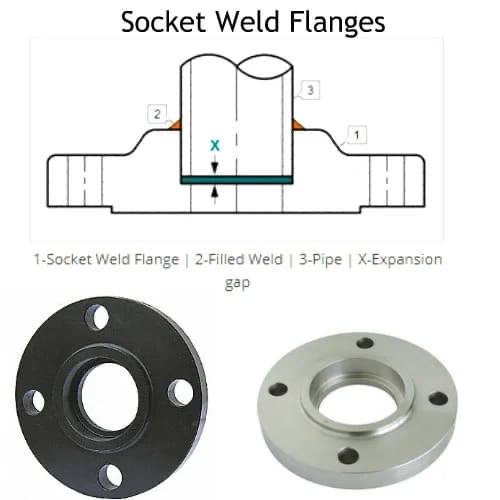
Single external fillet with 1/16″ expansion gap; 308-type filler; no preheat, no PWHT; stainless-clean practice
Service Span
Cryogenic to ~525 °C general duty; fresh water, food chemistry, utilities, clean process; chloride limits honest — see the notes
Surface Finish
Pickled or natural machined — stainless-dedicated handling, no carbon-steel contact
Testing
Tension & chemistry per heat; PMI on every piece; socket depth and bore gauged
Certification
EN 10204 3.1 with solution-anneal records (standard) / 3.2 witnessed
Specification Notes — Getting 304 Sockets Right
Four honest notes.The hygienic paradox: 304 is the hygienic industries' metal, but their product lines exclude socket welds — the socket gap traps product and defeats CIP — so 304 sockets belong on the utility side of those plants: steam, air, cooling, CIP supply, water treatment. Chloride limits are real: no molybdenum means warm chloride water pits it, and austenitic SCC starts around 60 °C — 316 and the duplex family continue the ladder, and the socket's own crevice sharpens the question. Weld-zone sensitization is solved by dual-cert: 304/304L supply removes the classic HAZ corrosion worry — our default recommendation for welded corrosion duty. And H-grade lines need H-grade metal: plain or dual-certified stock does not satisfy an F304H specification — the carbon floor must be certified; we forge it to order.
How Our A182 F304 Socketweld Flanges Are Manufactured
1
Forging — cut billet of the spectro-verified S30400 heat is hot-forged into the flange blank with full heat traceability and segregated stainless handling.
2
Solution annealing — the anneal-and-quench that dissolves carbides and sets the clean austenitic structure; furnace charts retained against the heat number.
3
Machining — faces, OD and drilling to ASME B16.5 on stainless-dedicated stations — work-hardening respected with sharp tooling and positive feeds; socket counterbore and depth gauged piece by piece, through-bore matched to the ordered schedule.
4
Facing — RF serrations, flat face or RTJ groove per B16.20.
5
Testing & marking — tension and chemistry per heat; PMI on every piece; laser-marked with grade, size, class, schedule and heat number.
6
Certification & packing — EN 10204 3.1 MTC with solution-anneal records, dual 304/304L stated where the heat qualifies (3.2 witnessed on request); packed sea-worthy with no carbon-steel contact.
Where ASTM A182 F304 Socketweld Flanges Are Used
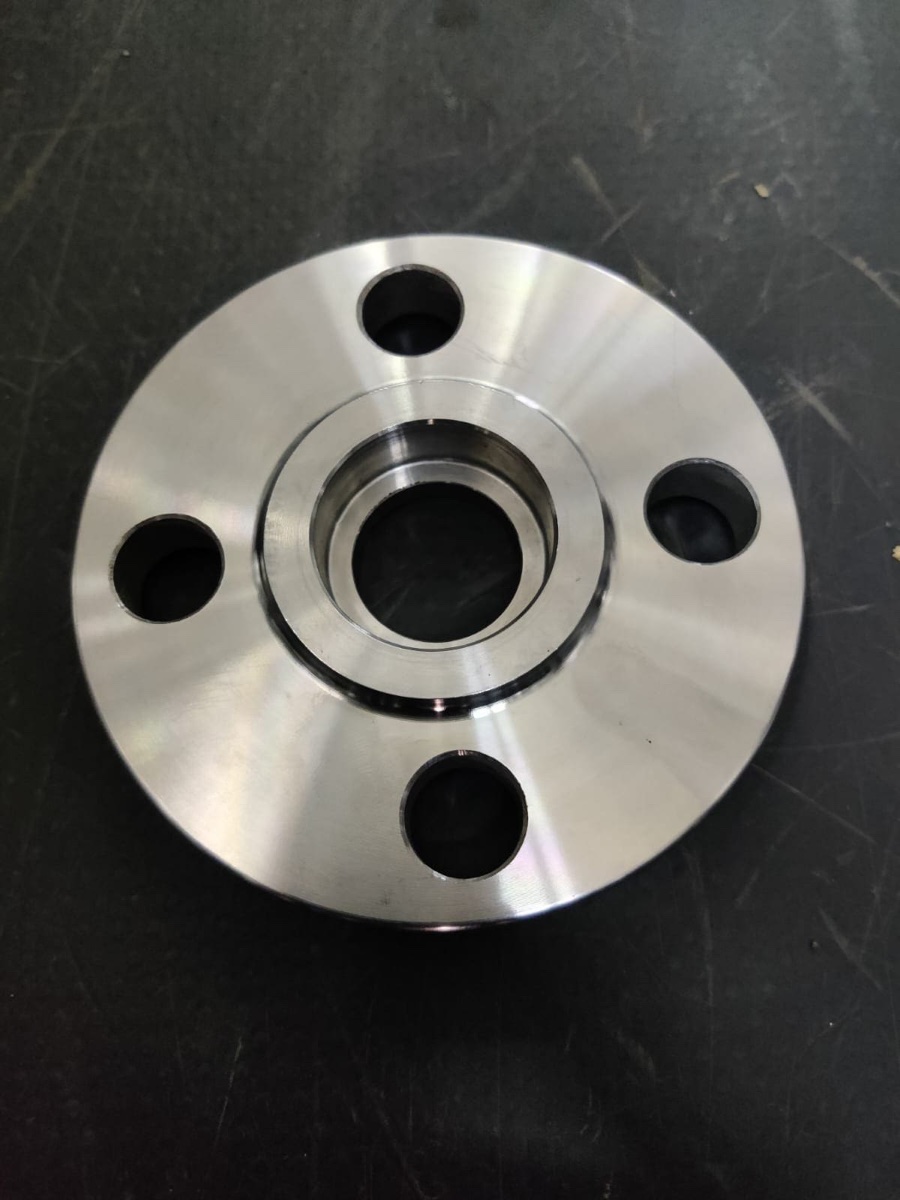
The utility side of the stainless world: steam and condensate systems in food, beverage and pharma plants, CIP supply headers, plant air and nitrogen, cooling circuits, water and effluent treatment, chemical-plant clean services, cryogenic vents and instrument connections — wherever the plant's standard is stainless and the duty is ordinary process piping. Production below:
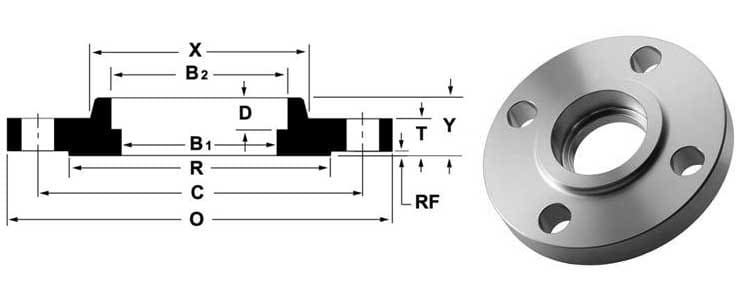
Socket weld flange dimensions are class-governed per ASME B16.5 — identical across material grades (pressure-temperature ratings follow the austenitic group; see the nomenclature diagram above). Full charts:
How to Specify & Order an A182 F304 Socketweld Flange
Six elements — the schedule and the grade variant both belong on the enquiry:
1
Size & standard — e.g. 1″ NB ASME B16.5, or DN25 EN 1092-1 Type 03.
2
Pressure class & facing — 150#–1500#; SWRF (the default), SWFF or SWRTJ with ring number.
3
Pipe schedule — Sch 10S, 40S or 80S: the through-bore is matched to the pipe ID.
4
Grade detail — F304, dual 304/304L (our sensible default for welded corrosion duty), or F304H by name where the specification requires the carbon floor.
5
Certification — EN 10204 3.1 with solution-anneal records (our standard) / 3.2 witnessed, PMI as applicable.
An ASTM A182 F304 socketweld flange is a forged austenitic stainless steel flange — the classic 18-8 chemistry, UNS S30400, W.Nr. 1.4301 — whose back carries a machined socket: the pipe end seats inside, self-aligned square to the face, and is secured with a single external fillet weld. 304 is the world's default stainless: 18% chromium for the passive film, 8% nickel to hold the tough austenitic structure at all temperatures, welded with no preheat and no PWHT. Dimensioned to ASME B16.5 for ½" to 3" NB in Classes 150 to 1500, in raised face, flat face and ring joint facings — the general-service stainless small-bore flange of food, beverage, pharmaceutical utility, water and chemical plants.
Why is 304 the world's default stainless?
Because the 18-8 recipe hit the economic sweet spot a century ago and never left it. Eighteen percent chromium forms the self-healing passive film that makes stainless stainless; eight-to-eleven percent nickel stabilises the austenitic structure, buying toughness from cryogenic temperatures to red heat, easy forming, and forgiving weldability with no preheat or PWHT. The result handles fresh water, food acids, most organic chemistry, atmospheric exposure and cleaning regimes — the overwhelming majority of what industry actually pumps — at the lowest cost of any stainless. Everything else in the stainless world is 304 plus something: molybdenum makes 316, low carbon makes the L-grades, and the duplex family re-balances the phases. The default earns its name.
What is the chemical composition of ASTM A182 F304 (UNS S30400)?
Carbon ≤0.08%, manganese ≤2.00%, silicon ≤1.00%, chromium 18.0-20.0%, nickel 8.0-11.0%, phosphorus ≤0.045%, sulphur ≤0.030%. Note what is absent: no molybdenum — that is 316's addition for chloride pitting — and no nitrogen floor or deliberate alloying beyond the classic pair. The 0.08% carbon ceiling is the plain grade's; the L-grade halves it to 0.030% for as-welded corrosion duty, and the H-grade sets a floor for creep strength — both covered in their own FAQs below. Chemistry is verified per heat and travels on the EN 10204 3.1 MTC, with dual 304/304L certification stated where the heat qualifies.
What are the mechanical properties of A182 F304 socketweld flanges?
In the solution-annealed condition A182 requires tensile strength 515 MPa (75 ksi) minimum, yield strength 205 MPa (30 ksi) minimum and elongation 30% minimum — the austenitic signature: modest yield, enormous ductility, and toughness that never disappears at low temperature. Two honest notes for designers: this is the gentlest yield in our socket weld range (the duplex grades double it), and B16.5 pressure-temperature ratings for the austenitic group derate faster with temperature than carbon steel's — the class tables, not the yield number, govern a flange's duty. Work-hardening is the flip side: 304 machines tougher than its numbers suggest, which is a manufacturing problem we own so you don't.
F304 or F304L — and what does dual certification mean?
The L is insurance against weld sensitization. When plain 304 lingers between roughly 450 and 850°C — as a weld heat-affected zone briefly does — chromium carbides precipitate at grain boundaries and locally strip the film, setting up intergranular corrosion in aggressive service. 304L's 0.030% carbon ceiling starves that mechanism, making the L-grade the standard for as-welded corrosion duty. The practical modern answer is dual certification: most mill product is melted with low carbon but still meets the plain grade's strength, certifying as 304/304L simultaneously — our routine supply, satisfying specifications written either way. For a socket weld flange, whose fillet weld creates exactly the HAZ in question, dual-certified supply is the sensible default; our F304L socketweld page carries the L-grade's own story.
What about F304H for high temperature?
The H-grade runs the carbon logic the other way. Where 304L trims carbon for corrosion, 304H (UNS S30409) specifies it with a floor — 0.04-0.10% — because at creep temperatures carbon is strength: the carbides that sensitize a weld zone are the same phase that pins grain boundaries against slow deformation above roughly 525°C. Refinery hot circuits, steam service and furnace-adjacent duty in the austenitic world therefore name 304H, often with a grain-size requirement attached. If your specification says F304H, order it by name — plain F304 or dual-certified 304/304L stock does not satisfy an H-grade line, because the L-side carbon may sit below the H-grade's floor. We forge F304H to order with the carbon floor certified.
F304 or F316 — when is molybdenum worth it?
When chlorides or reducing acids enter the picture. 316 is 304 plus 2-3% molybdenum, and that addition buys measurably better pitting resistance in chloride-bearing waters and better standing in dilute reducing acids — the reason coastal plants, marine-adjacent utilities and many chemical services specify it. Where the fluid is fresh water, food product, atmospheric or clean chemistry, the molybdenum buys little and 304 is the economical right answer. The escalation past 316 is the story this site tells at length: 317L, 904L, the duplex family and beyond, each with its own socket weld page. Our quotation names the economical grade when an enquiry describes the service.
What are 304's chloride limits — honestly?
Real, and worth stating plainly. Without molybdenum, 304 pits in warm chloride-bearing water — brackish cooling, seawater spray, chlorinated washdown that dwells — and like all austenitics it is vulnerable to chloride stress corrosion cracking from around 60°C where chlorides, tensile stress and temperature combine. Insulated hot stainless lines with chloride-bearing wet insulation are the classic hidden failure. The ladder answers: 316 for modest chloride exposure, duplex 2205 for chloride process duty with SCC essentially removed, super duplex for seawater. A socket weld adds its own crevice to this picture — see the hygienic-and-crevice FAQ — so chloride-side 304 sockets deserve a hard look at enquiry, and our quotation will say so.
Is F304 suitable for cryogenic service?
Yes — this is one of austenitic stainless's quiet superpowers. The face-centred-cubic structure has no ductile-brittle transition, so 304 keeps its toughness to liquid-nitrogen temperatures and beyond without the impact-testing gymnastics the carbon steel ladder needs: where A105 stops at -29°C, LF2 at -46°C and LF3 at -101°C, austenitic stainless simply continues — LNG, liquid oxygen, liquid nitrogen and CO2 services run on it. For small bore this matters doubly, because cryogenic plants are full of instrument and vent connections. Codes may still require weld-procedure impact qualification for the joint; the base material's capability is inherent. State the design temperature on the enquiry and the certificate documents the solution-annealed condition that delivers it.
How is an F304 socketweld flange welded?
With the easiest rules in this catalogue — and one quiet care point. Joint geometry is standard: pipe bottomed, withdrawn 1/16" (1.6 mm), single external fillet, typically with 308-type filler. Austenitic stainless takes no preheat and no PWHT; the discipline is cleanliness (dedicated stainless brushes and tools, no carbon-steel contamination) and moderate heat input with sensible interpass, both to limit distortion — austenitics expand half again as much as carbon steel — and to keep the sensitized band narrow if plain-carbon 304 is being welded for corrosion duty. Dual-certified 304/304L material removes that last worry, which is why it is the sensible small-bore default. Our flanges arrive solution annealed with records.
Why do hygienic plants exclude socket welds — the 304 paradox?
It is the neatest irony in the flange world: 304 is the hygienic industries' metal, and the socket weld is the joint their product lines refuse. The socket's internal gap traps product, resists cleaning-in-place, and harbours exactly the biofilm hygienic design exists to prevent — so food, dairy, pharmaceutical and clean-utility product lines are orbitally butt-welded or clamp-connected, never socket-welded. Where 304 sockets legitimately live is the other 80% of those same plants: steam and condensate utilities, plant air, cooling circuits, CIP supply headers, water treatment — services where the metal must match the plant's stainless standard but the duty is ordinary process piping. That division is written into hygienic engineering guidelines, and our quotation respects it.
What facings are A182 F304 socketweld flanges made with?
All three, each with its own page on this site: raised face (SWRF) — the default, with PTFE or graphite spiral wound gaskets by service — flat face (SWFF) for GRP, lined and cast equipment mates, and ring type joint (SWRTJ) for the rarer high-pressure stainless duty, with soft iron or stainless rings per the class. One stainless-specific note: bolting deserves anti-galling attention — stainless-on-stainless threads seize under torque, so coated or dissimilar-grade fasteners and thread lubricant are standard practice on stainless joints. NPT-tapped test and injection variants are machined and certified at the works.
What sizes and pressure classes do F304 socketweld flanges come in?
ASME B16.5 standardises socket weld flanges from ½" to 3" NB in Classes 150, 300, 600, 900 and 1500 — Class 900 sharing Class 1500 dimensions in most small-bore sizes — with 4" and Class 2500 made to order. 304 stock concentrates where its duty lives: Classes 150 and 300 cover the vast majority of general-service stainless small bore. As with every socket flange, put the pipe schedule on the enquiry — Sch 10S and 40S dominate stainless systems, and the through-bore is matched to the pipe ID. B16.5 pressure-temperature ratings for the austenitic group govern the limits; our quotations state them per class.
What details are needed to get an accurate F304 socketweld flange quotation?
Six elements plus commercial terms: (1) size — ½" to 3" NB; (2) pressure class — 150 to 1500; (3) facing — SWRF, SWFF or SWRTJ with ring number; (4) the pipe schedule — Sch 10S, 40S or 80S, so the through-bore matches the pipe ID; (5) grade detail — F304, dual 304/304L (our sensible default for welded corrosion duty), or F304H by name where a high-temperature specification requires the carbon floor; (6) certification — EN 10204 3.1 with solution-anneal records (our standard) or 3.2 witnessed, PMI as applicable. Add quantity and destination and we return price, weight and delivery — normally within 24 hours, with common sizes quoted from ready stock.
Who manufactures ASTM A182 F304 socketweld flanges in India?
Tesco Steel & Engineering is an ISO 9001:2015 certified flange manufacturer based in Mumbai, India, producing ASTM A182 F304 socket weld flanges from ½" to 3" NB (larger to order) in Classes 150-1500 — each forged from certified heats, solution annealed with furnace records, machined on stainless-dedicated stations with gauged socket depth and schedule-matched bore, PMI-checked and laser-marked with grade, size, class, schedule and heat number. Supplied with EN 10204 3.1/3.2 certification — dual 304/304L stated where the heat qualifies — alongside the F304L, F316/F316L and full stainless socket weld range, the duplex family, and every other grade this series covers. Common sizes in ready stock; exported to more than 50 countries.