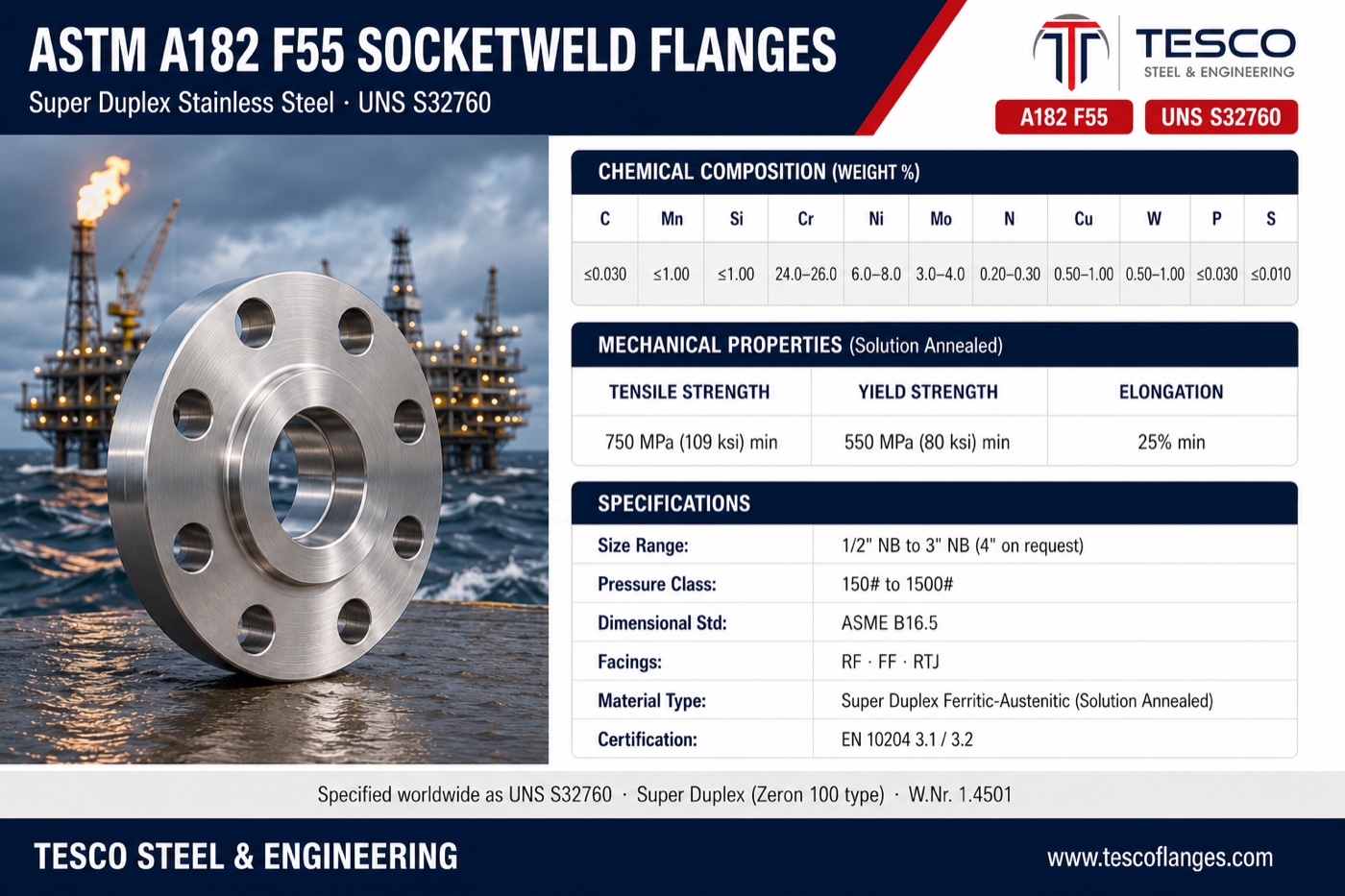
Tesco Steel & Engineering manufactures ASTM A182 F55 socketweld flanges — super duplex UNS S32760, the Zeron 100 type, W.Nr. 1.4501 — to ASME B16.5 from ½″ to 3″ NB in Classes 150–1500. F55 reaches the 40-PREN seawater threshold by its own route: copper and tungsten deliberately alloyed at 0.50–1.00% each — tungsten counting in the extended pitting formula, copper buying margin in acidified seawater — and uniquely, PREN ≥40 is guaranteed on the S32760 certificate itself. 550 MPa yield with a 25% elongation floor, solution annealed. This is the North Sea's super duplex: UK-heritage offshore specifications name it outright, and its twin F53 (2507) covers the other half of the world — we forge both, certified exactly as named. Same duplex rules: no preheat, no PWHT ever. Facings: SWRF, SWFF, SWRTJ. Every lot with EN 10204 3.1/3.2 MTC including computed PREN. ISO 9001:2015, made in Mumbai, India — exported to 50+ countries.
A182 F55 · UNS S32760 · W.Nr. 1.4501The Zeron 100 TypeCu 0.5–1% + W 0.5–1% — DeliberatePREN ≥40 — Guaranteed on Certificate550 MPa Yield · 25% ElongationThe North Sea's Super DuplexASME B16.5 ½″–3″ · Class 150–1500EN 10204 3.1 / 3.2 · ISO 9001:2015
ASTM A182 F55 Socketweld Flanges — Specifications at a Glance
What is an ASTM A182 F55 Socketweld Flange?
The Zeron-type seawater grade in the small-bore pattern. A forged super duplex flange (ASTM A182 F55 / UNS S32760) with a machined socket: pipe seated square by geometry, one external fillet weld under super duplex discipline, through-bore matched to the pipe schedule. The 40-PREN bar cleared with deliberate Cu and W additions (0.50–1.00% each) — and PREN ≥40 guaranteed on the certificate, a uniquely S32760 feature. Tensile ≥750 MPa, yield ≥550 MPa, elongation ≥25%, solution annealed. Sized by ASME B16.5 at ½″–3″ NB, Classes 150–1500; EN 10204 3.1 with computed PREN on every lot.
Performance envelopes overlap almost completely — the correct answer is whichever UNS number your specification prints, and we forge both.
What Cu + W Buy
Tungsten Counts in the Formula
The extended pitting equation credits W at half Mo's weight — PREN = %Cr + 3.3×(%Mo + 0.5×%W) + 16×%N — and S32760's specification requires the result to clear 40 on every certified heat.
Copper for the Acid Edge
Acidified seawater, sulphuric contamination, mineral-acid splash — the duties where plain super duplex sits near its limit are where Cu 0.5–1% earns its keep.
The More Ductile Certificate
25% elongation floor against the twin's 15% — at identical 550 MPa yield. A balance field engineers quietly prefer in a flange that gets welded and bolted offshore.
Same Family Rulebook
Solution annealed, no preheat, PWHT prohibited, heat input controlled, ~−50 to 250–300 °C band — the duplex rules apply unchanged; details below.
ASTM A182 F55 Chemical Composition (UNS S32760)
Element
C
Mn
Si
Cr
Ni
Mo
N
Cu
W
P
S
Weight %
≤0.030
≤1.00
≤1.00
24.0–26.0
6.0–8.0
3.0–4.0
0.20–0.30
0.50–1.00
0.50–1.00
≤0.030
≤0.010
Beside F53 the design story reads: Mo trimmed to 3–4% and N to 0.20–0.30 because tungsten picks up part of the pitting duty, Cu and W as deliberate ranged additions, and sulphur at the family's tightest ceiling — all while preserving the half-ferrite, half-austenite balance that defines the duplex family. PMI reads the Cu-W signature, so F55 and F53 can never mix on the shelf.
Mechanical Properties (Solution Annealed)
Property
ASTM A182 F55 Requirement
Tensile Strength
≥ 750 MPa (109 ksi)
Yield Strength (0.2%)
≥ 550 MPa (80 ksi) — identical to the F53 twin
Elongation
≥ 25% — the family's most ductile super duplex certificate
PREN
≥40 guaranteed — computed per heat and stated on our MTC
Condition
Solution annealed — the phase balance is set at the mill and never re-heat-treated on site
Service Band
~−50 °C to ~250–300 °C — the super duplex walls; Cu and W widen the corrosion envelope inside them, not the walls themselves
ASTM A182 F55 Socketweld Flanges are available in the following specifications:
Material Grade
ASTM A182 F55 (UNS S32760), W.Nr. 1.4501 — the Zeron 100 type; twin F53 (S32750) forged where the specification names 2507 — supplied exactly as named
Heat Treatment
Solution annealed — furnace records certified; no site heat treatment is ever permitted on super duplex
Size
1/2"NB to 3"NB per ASME B16.5; 4″ and larger to order; EN 1092-1 patterns to order
Class
150#, 300#, 600#, 900#, 1500# (900# shares 1500# dimensions in most sizes); 2500# on request — duty concentrates in 600–1500
Facings
Raised Face (SWRF), Flat Face (SWFF), Ring Type Joint (SWRTJ) with groove per B16.20
Bore
Socket bore to pipe OD; through-bore matched to pipe schedule (Sch 80/160 dominate offshore small bore)
Welding
Single external fillet with 1/16″ expansion gap; super duplex discipline — controlled heat input, interpass ~100–150 °C, S32760-matching filler, no preheat, no PWHT
Service Span
Seawater systems, hydraulic and injection small bore, acidified-seawater and mildly sour duty per ISO 15156-3 limits; ~−50 to 250–300 °C
Testing
Tension & chemistry per heat; PREN computed and stated; PMI (Cu-W signature) on every piece; socket depth and bore gauged
Certification
EN 10204 3.1 with solution-anneal records and PREN (standard) / 3.2 witnessed; NACE MR0175 declaration where specified
Specification Notes — Getting F55 Right
Four honest notes.Name the twin precisely: S32760 (this page) and S32750 (F53) overlap in performance but an auditor reads UNS numbers literally — a specification naming either gets exactly that grade and number on our certificate, and PMI's Cu-W read keeps the twins apart in the works. The sigma clock still runs fast at 25% Cr: heat input and interpass discipline are tight, and PWHT is prohibited — only a mill solution anneal resets the structure. Hot seawater under gaskets still deserves respect: tungsten's crevice insurance is margin, not immunity — critical hot-seawater lines butt-weld by class rule, and the F55 weld neck is the matching flange. And the 1/16″ gap stands — expansion against a bottomed socket cracks weld roots in any alloy.
How Our A182 F55 Socketweld Flanges Are Manufactured
1
Forging — cut billet of the spectro-verified F55 heat — Cr, Ni, Mo, N windows and the deliberate Cu-W additions confirmed — is hot-forged in the grade's narrow working window with full heat traceability.
2
Solution annealing — the anneal-and-quench that sets the 50/50 phase balance and dissolves any intermetallics; furnace charts retained against the heat number.
3
Machining — faces, OD and drilling to ASME B16.5 (or EN 1092-1 to order); socket counterbore and depth gauged piece by piece, through-bore matched to the ordered schedule; RF serrations, flat face or RTJ groove per B16.20.
4
Testing — tension and full chemistry per heat; PREN computed against the ≥40 guarantee; PMI reads the Cu-W signature on every piece.
5
Finishing & marking — pickled or natural machined finish; laser-marked with grade, size, class, schedule and heat number.
6
Certification & packing — EN 10204 3.1 MTC with solution-anneal records and stated PREN (3.2 witnessed on request); NACE declaration where specified; packed sea-worthy with no carbon-steel contact.
Where ASTM A182 F55 Socketweld Flanges Are Used
The North Sea pattern, worldwide: offshore hydraulic systems on platforms, FPSOs and subsea control skids; chemical injection into seawater-wetted and produced-fluid systems; seawater lift, cooling and firewater auxiliaries; acidified-seawater and mineral-acid-adjacent duties where the copper earns its margin; and wellhead-adjacent instrument connections in mildly sour service. Production below:
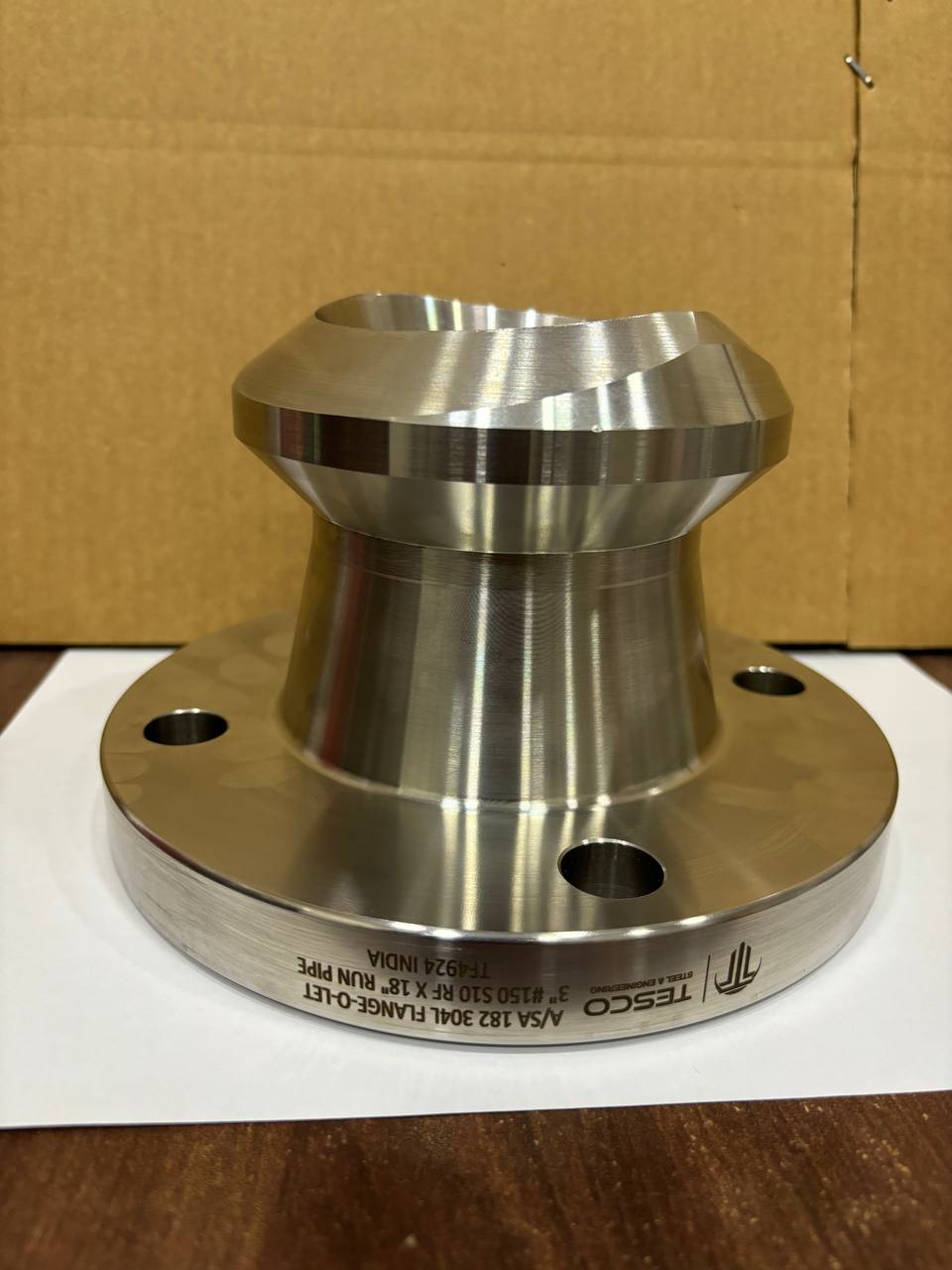
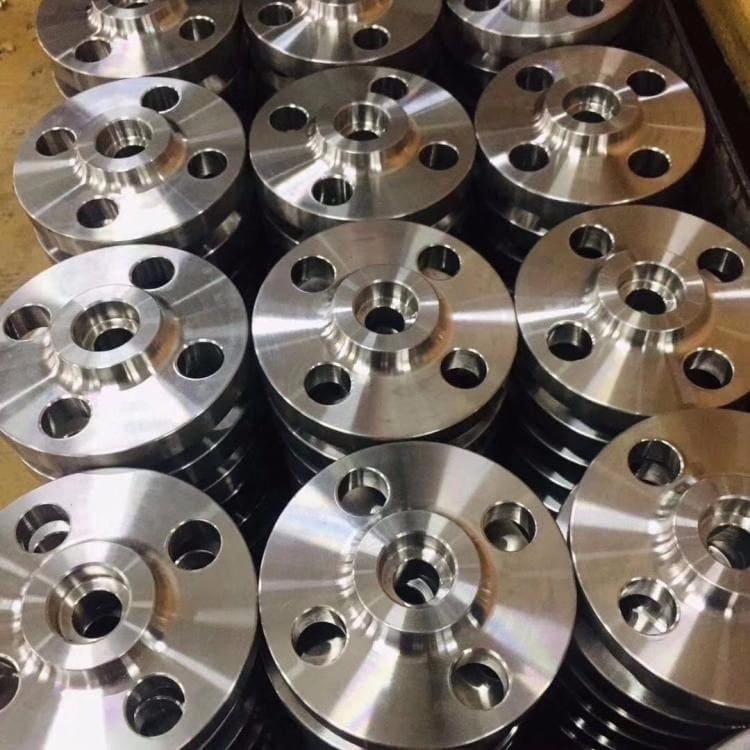
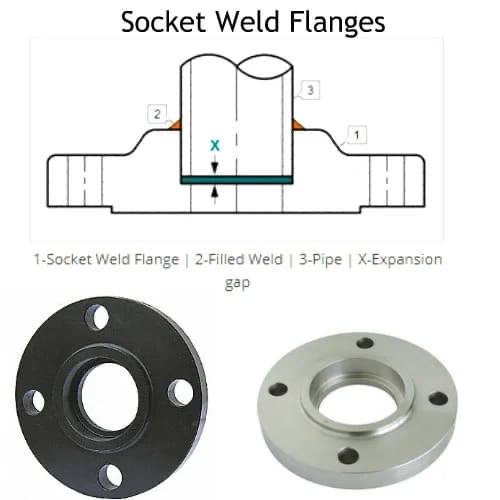
Duplex Family Socketweld Production — Flange-O-LetSocket Weld Flanges — Machined BatchThe Socket Weld Joint — Note the Expansion Gap (X)
A182 F55 Socketweld Flange Dimensions
Socket weld flange dimensions are class-governed per ASME B16.5 — identical across material grades (pressure-temperature ratings follow the super duplex material group). Full charts:
How to Specify & Order an A182 F55 Socketweld Flange
Six elements — the schedule and the exact UNS number both belong on the enquiry:
1
Size & standard — e.g. 1″ NB ASME B16.5, or DN25 EN 1092-1 Type 03.
2
Pressure class & facing — 150#–1500#; SWRF (the default), SWFF or SWRTJ with ring number.
3
Pipe schedule — Sch 40, 80 or 160: the through-bore is matched to the pipe ID.
4
Grade detail — F55/S32760 (this page) or F53/S32750 where the specification names 2507; PREN statement requirement if any; NACE MR0175 declaration if sour.
5
Certification — EN 10204 3.1 with solution-anneal records and computed PREN (our standard) / 3.2 witnessed, PMI as applicable.
An ASTM A182 F55 socketweld flange is a forged super duplex stainless steel flange — UNS S32760, the Zeron 100 type, W.Nr. 1.4501 — whose back carries a machined socket: the pipe end seats inside, self-aligned square to the face, and is secured with a single external fillet weld made under super duplex welding discipline. S32760 reaches the 40-PREN seawater threshold by a distinctive route: alongside 25% chromium, molybdenum and nitrogen, it deliberately alloys both copper and tungsten at 0.50-1.00% each — and uniquely, its specification guarantees PREN ≥40 as a certified number. 550 MPa yield with a 25% elongation floor. Dimensioned to ASME B16.5 for ½" to 3" NB in Classes 150 to 1500, in raised face, flat face and ring joint facings.
What makes F55 the 'Zeron 100 type' — what do the copper and tungsten do?
S32760 descends from Zeron 100, the super duplex developed in the UK with two deliberate additions its 2507 twin lacks. Tungsten behaves as molybdenum's heavier cousin in the passive film — it counts in the extended pitting formula and strengthens crevice resistance without accelerating the sigma-phase clock the way extra molybdenum would. Copper buys measurable margin in acidic environments — sulphuric-contaminated seawater, acidified wells, mineral-acid splash — where plain super duplex sits closer to its limit. The result is a grade with its own loyal following: North Sea and UK-heritage offshore specifications frequently name S32760 outright, and its certificate carries a feature no sibling offers — see the PREN question.
Why is PREN guaranteed on an S32760 certificate?
Because the specification writes it in — uniquely among the common duplex grades. For most alloys PREN is something an engineer computes from the chemistry; for S32760 the requirement PREN = %Cr + 3.3×(%Mo + 0.5×%W) + 16×%N ≥ 40 is part of the material standard, so every certified heat must demonstrate the number, not merely imply it. Note the formula itself is the extended version crediting tungsten at half molybdenum's weight — the arithmetic recognition of what the tungsten addition does. For specifiers this is a genuinely useful property: a piping class written around 'PREN ≥40 guaranteed' is naming S32760 whether it says so or not, and our EN 10204 certificates state the computed PREN per heat explicitly.
What is the chemical composition of ASTM A182 F55 (UNS S32760)?
Carbon ≤0.030%, manganese ≤1.00%, silicon ≤1.00%, chromium 24.0-26.0%, nickel 6.0-8.0%, molybdenum 3.0-4.0%, nitrogen 0.20-0.30%, copper 0.50-1.00%, tungsten 0.50-1.00%, phosphorus ≤0.030%, sulphur ≤0.010%. Beside F53 the differences tell the design story: molybdenum trimmed to 3-4% and nitrogen to 0.20-0.30 — because tungsten picks up part of the pitting duty — while copper and tungsten appear as deliberate ranged additions rather than residual caps, and sulphur is held at the family's tightest ceiling. Chemistry is verified per heat, the PREN computed and stated, and PMI reads the Cu-W signature that distinguishes F55 from F53 on the shelf.
What are the mechanical properties of A182 F55 socketweld flanges?
In the solution-annealed condition A182 requires tensile strength 750 MPa (109 ksi) minimum, yield strength 550 MPa (80 ksi) minimum and elongation 25% minimum. Two comparisons worth making: the yield matches F53's 550 MPa exactly — the two super duplexes are interchangeable on strength — while the certificate trades a slightly lower tensile floor (750 versus 800) for a notably higher ductility floor (25% versus 15%), a balance many piping engineers quietly prefer in a small-bore flange that will be welded and bolted in the field. As across the duplex family, the strength arrives solution-annealed, with no ageing windows or hardness ceilings to manage in supply.
F55 or F53 — how do I choose between the super duplex twins?
Nearly always by the specification, occasionally by the chemistry of the service. Their performance envelopes overlap almost completely: same 550 MPa yield, same 40-PREN seawater standing, same welding discipline and temperature band. F55's copper earns its margin where the seawater is acidified or the duty sees mineral-acid excursions; its tungsten adds crevice insurance; and its certificate carries the guaranteed PREN. F53 (2507) counters with the higher tensile floor and broader global stocking. In practice, North Sea and UK-heritage documents name S32760, Scandinavian and American ones lean 2507, and the correct answer is whichever UNS number your specification prints — we forge both, and the certificate matches the order exactly.
F55 or F51 — where is the dividing line?
The same line as for all super duplex: the sea. F51 (2205, PREN ≥34) carries brackish water, produced water, firewater and process chloride duty economically; its crevice threshold falls short of hot open seawater. F55 clears the 40-PREN bar — guaranteed on its certificate — and takes seawater systems proper: lift and injection lines, cooling and utility circuits, splash-zone hydraulics. The strength gap (550 versus 450 MPa yield) adds its own argument on high-pressure small bore. Where a project's piping classes split '2205 for process, super duplex for seawater', F55 is the seawater half in UK-heritage documents; our F51 socketweld page carries the other half of the story.
How is an F55 socketweld flange welded — the super duplex rules?
Under the same discipline as all super duplex, with matching-composition consumables. The joint geometry is standard — pipe bottomed, withdrawn 1/16" (1.6 mm), single external fillet — and the craft is phase balance: controlled heat input, interpass temperature capped around 100-150°C, and filler of the over-alloyed S32760-matching type so the weld inherits the copper-tungsten chemistry. The two absolute duplex rules apply unchanged: no preheat beyond dryness, and no PWHT ever — stress relief grows embrittling phases, and only a full mill solution anneal resets the structure. Our flanges arrive solution annealed with records and stated PREN; the joint's phase balance is the fabricator's craft.
Does the socket crevice matter in S32760 seawater service?
The honest answer mirrors the F53 page, with tungsten's insurance noted. Super duplex crevice thresholds sit far above 2205's — ambient seawater utility and hydraulic sockets are routine offshore practice, and F55's tungsten addition was aimed at exactly this mechanism. The care point remains the hot end: heated seawater, stagnant deposits and gasket crevices push any stainless toward its crevice threshold, and critical hot-seawater lines are commonly butt-welded as a class rule regardless of alloy. The practical division: sockets for hydraulic, injection, instrument and ambient utility duty; butt welds where the class demands them — our F55 weld neck page carries the matching flange, and our quotation will not argue with the class.
What are the temperature limits of super duplex S32760?
The super duplex band: roughly -50°C to +250-300°C, with real walls on both sides. Cold: the ferrite half's ductile-brittle transition draws the line around -46 to -50°C — below it, austenitics or nickel steels take over. Hot: at 25% chromium the intermetallic chemistry is eager — 475°C embrittlement and sigma phase both arrive faster than in 2205 — so design codes cap sustained service around 250-300°C and prohibit stress-relieving heat treatment absolutely. The copper and tungsten additions do not move these walls meaningfully; they widen the corrosion envelope inside them. A specification pushing either wall gets an honest alloy change on our quotation.
Is A182 F55 suitable for NACE MR0175 sour service?
Yes — S32760 is listed in ISO 15156-3 among the super duplex stainless steels, with the family's environmental ceilings on H2S partial pressure, chloride content and temperature; within them it serves mildly sour subsea and wellhead-adjacent duty, and its acid-resisting copper earns quiet credit in acidified sour wells. Compliance is supply discipline: solution-annealed condition, hardness within the listed limits, the declaration on the certificate. State NACE MR0175 on the enquiry and our quotation and EN 10204 certificate carry it explicitly; where the sour envelope exceeds the super duplex limits, the escalation is the nickel-alloy world — 825, 625 and the C-family — each with its own pages on this site.
What facings are A182 F55 socketweld flanges made with?
All three, each with its own page on this site: raised face (SWRF) — the default — flat face (SWFF) for GRP and lined mates in offshore utility systems, and ring type joint (SWRTJ) for high-pressure wellhead-adjacent duty. Gasket practice in seawater service is corrosion design: inner-ring spiral wounds or kammprofile types that add no avoidable crevice, seating stress per the maker's card, and attention to the galvanic system where the mating flange is a lesser alloy. NPT-tapped test and injection variants are machined and certified at the works.
What sizes and pressure classes do F55 socketweld flanges come in?
ASME B16.5 standardises socket weld flanges from ½" to 3" NB in Classes 150, 300, 600, 900 and 1500 — Class 900 sharing Class 1500 dimensions in most small-bore sizes — with 4" and Class 2500 made to order. Like its twin, F55 small bore concentrates at the working end: Class 600-1500 hydraulic, chemical injection and wellhead-adjacent connections. As with every socket flange, put the pipe schedule on the enquiry — Sch 80 and 160 dominate offshore small bore — so the through-bore matches the pipe ID. B16.5 pressure-temperature ratings for the super duplex material group govern the limits; our quotations state them per class.
What details are needed to get an accurate F55 socketweld flange quotation?
Six elements plus commercial terms: (1) size — ½" to 3" NB; (2) pressure class — 150 to 1500; (3) facing — SWRF, SWFF or SWRTJ with ring number; (4) the pipe schedule — Sch 40, 80 or 160, so the through-bore matches the pipe ID; (5) grade detail — F55/S32760 (this page) or F53/S32750 if your specification names 2507, with NACE MR0175 declaration if sour and any PREN statement requirement; (6) certification — EN 10204 3.1 with solution-anneal records and computed PREN (our standard) or 3.2 witnessed, PMI as applicable. Add quantity and destination and we return price, weight and delivery — normally within 24 hours.
Who manufactures ASTM A182 F55 socketweld flanges in India?
Tesco Steel & Engineering is an ISO 9001:2015 certified flange manufacturer based in Mumbai, India, producing ASTM A182 F55 super duplex socket weld flanges from ½" to 3" NB (larger to order) in Classes 150-1500 — each forged from certified heats, solution annealed with furnace records, machined with gauged socket depth and schedule-matched bore, PMI-checked with the Cu-W signature read so F55 and F53 can never mix, and laser-marked with grade, size, class, schedule and heat number. Supplied with EN 10204 3.1/3.2 certification including the computed PREN, and NACE MR0175 declaration where specified — alongside the F51 and F53 duplex families and the complete socket weld range. Exported to more than 50 countries.