Tesco Steel & Engineering manufactures ASTM A182 F316 socketweld flanges — the world's second stainless: 304 plus 2–3% molybdenum, UNS S31600, W.Nr. 1.4401 — to ASME B16.5 from ½″ to 3″ NB in Classes 150–1500. The molybdenum is a measured dose against chlorides: it hardens the passive film where pitting starts, lifting PREN from 304's ~19 to roughly 24–26, and improves standing in dilute reducing acids — while keeping everything the austenitic family does well: cryogenic toughness with no transition, no preheat, no PWHT. The honest limits are stated below: 316 is the coast, not the sea — continuous warm seawater belongs to super duplex — and molybdenum does not stop chloride SCC; that structural fix is the duplex family's. Down the ladder sits 304; alongside, the siblings F316L and F317L. Dual 316/316L certification routine. Facings: SWRF, SWFF, SWRTJ. Every lot with EN 10204 3.1/3.2 MTC. ISO 9001:2015, made in Mumbai, India — exported to 50+ countries.
A182 F316 · UNS S31600 · W.Nr. 1.4401The World's Second Stainless — +MoPREN ~24–26 — Chloride PittingNo Preheat — No PWHTDual 316/316L Certification515 / 205 MPa · 30% ElongationASME B16.5 ½″–3″ · Class 150–1500EN 10204 3.1 / 3.2 · ISO 9001:2015
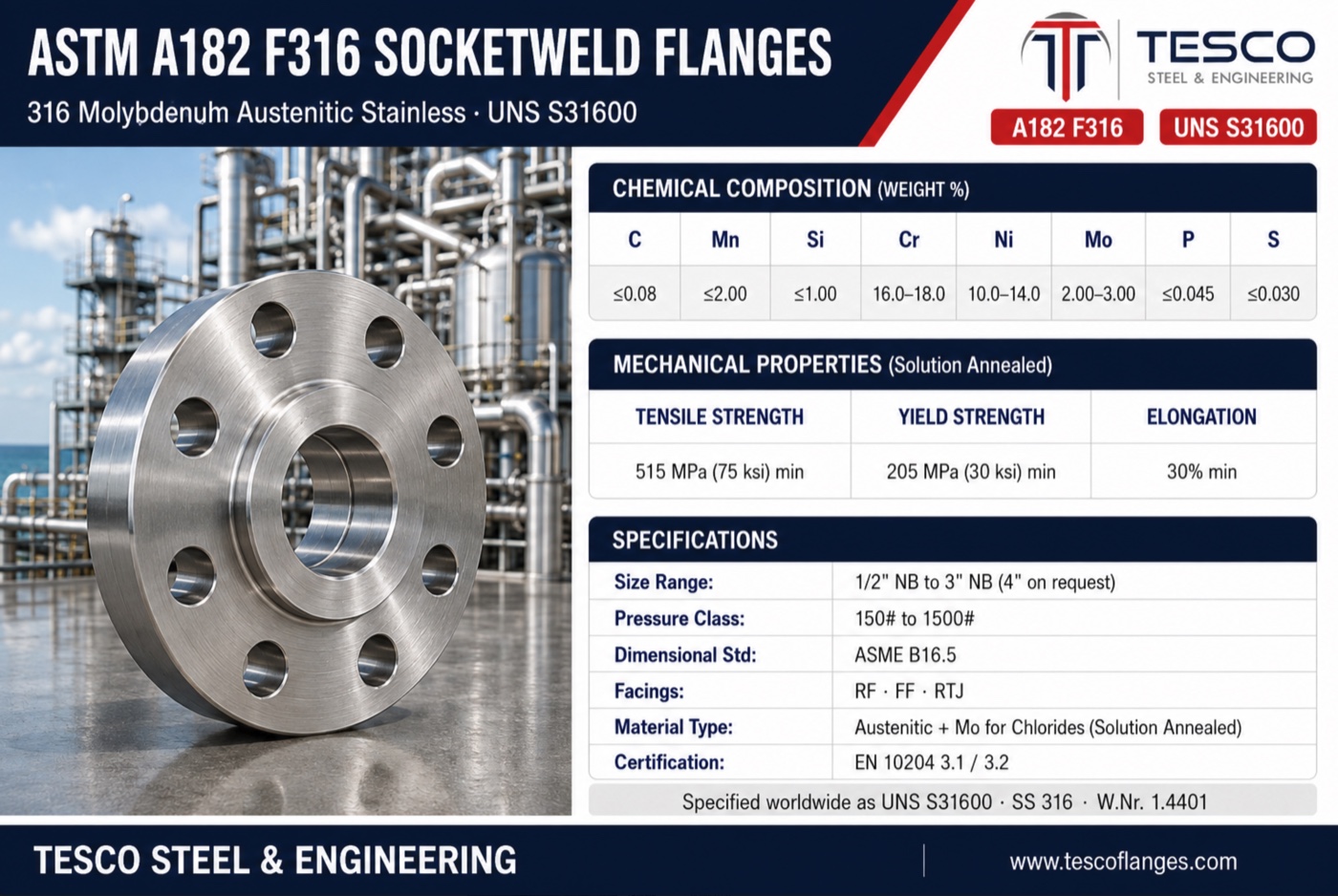
ASTM A182 F316 Socketweld Flanges — Specifications at a Glance
What is an ASTM A182 F316 Socketweld Flange?
The chloride escalation in the small-bore pattern. A forged molybdenum austenitic flange (ASTM A182 F316 / UNS S31600) with a machined socket: pipe seated square by geometry, one external fillet weld with 316L filler — no preheat, no PWHT — through-bore matched to the pipe schedule. Mo 2.00–3.00% hardens the passive film against chloride pitting — PREN ~24–26 against 304's ~19 — and improves dilute reducing-acid standing. Tensile ≥515 MPa, yield ≥205 MPa, elongation ≥30%, solution annealed, cryogenic-capable; dual 316/316L certification routine. Sized by ASME B16.5 at ½″–3″ NB, Classes 150–1500; EN 10204 3.1 on every lot.
Also searched as: SS 316 socket weld flange, 316 SW flange, S31600 SWRF flange, 1.4401 socket weld flange, marine grade stainless flange — all the same product family. Related pages: the facings — SWRF / SWFF / SWRTJ — the socketweld hub, the other F316 types — blind, weld neck, slip-on, threaded — the siblings F316L / F316H / F317L socketweld, and the stainless steel hub.
PREN ≈ Cr + 3.3×Mo + 16×N — the standard yardstick for chloride pitting resistance. 316 is the first rung with molybdenum on it: one confident step above the default, well short of exotic — and priced accordingly.
What the Molybdenum Buys
The Film, Hardened Where It Fails
Chlorides attack stainless at flaws in the passive film. 2–3% molybdenum helps a forming pit repassivate before it becomes self-sustaining — the difference between a stain and a perforation in warm chloride water.
Standing in Reducing Acids
Dilute sulphuric, acetic and phosphoric duty that etches 304 sits comfortably on 316 — the reason chemical works write 316 into their piping classes by reflex.
Everything 304 Does, Kept
Cryogenic toughness with no transition, no preheat, no PWHT, solution-annealed simplicity — the molybdenum is added to the recipe, not traded against it.
Honesty About the Limit
316 is the coast, not the sea. Continuous warm seawater crevice duty defeats a PREN of ~25 — we say so, and the super duplex pages carry the answer.
ASTM A182 F316 Chemical Composition (UNS S31600)
Element
C
Mn
Si
Cr
Ni
Mo
P
S
Weight %
≤0.08
≤2.00
≤1.00
16.0–18.0
10.0–14.0
2.00–3.00
≤0.045
≤0.030
Read the shifts against 304, not just the addition: chromium down (16–18 against 18–20), nickel up (10–14 against 8–11), molybdenum in. Molybdenum promotes ferrite, so nickel rises to hold the austenite — a certificate reading Cr 16.5% is correct 316, not sub-standard 304. PMI on every piece confirms the molybdenum; dual 316/316L certification stated where the heat qualifies.
Mechanical Properties (Solution Annealed)
Property
ASTM A182 F316 Requirement
Tensile Strength
≥ 515 MPa (75 ksi)
Yield Strength (0.2%)
≥ 205 MPa (30 ksi) — identical to 304: molybdenum buys corrosion resistance, not strength
Elongation
≥ 30% — the austenitic signature: modest yield, enormous ductility
Condition
Solution annealed — single condition, no ageing metallurgy
Temperature Span
Cryogenic (no transition) to ~525 °C general duty; sustained creep service names F316H — its own page
Strength Escalation
Chloride + strength duty → the duplex family at 450–550 MPa yield
ASTM A182 F316 Socketweld Flanges are available in the following specifications:
Material Grade
ASTM A182 F316 (UNS S31600), W.Nr. 1.4401 — dual 316/316L certification routine; F316L and F316H by name to order
Heat Treatment
Solution annealed — furnace records certified
Size
1/2"NB to 3"NB per ASME B16.5; 4″ and larger to order; EN 1092-1 patterns to order
Class
150#, 300#, 600#, 900#, 1500# (900# shares 1500# dimensions in most sizes); 2500# on request — volume lives in 150/300
Facings
Raised Face (SWRF), Flat Face (SWFF), Ring Type Joint (SWRTJ) with groove per B16.20
Bore
Socket bore to pipe OD; through-bore matched to pipe schedule (Sch 10S/40S dominate stainless systems)
Welding
Single external fillet with 1/16″ expansion gap; 316L filler; no preheat, no PWHT; stainless-clean practice
Service Span
Chloride-side small bore: chemical process, coastal & marine-adjacent utilities, brackish cooling; cryogenic-capable; not continuous warm seawater
Surface Finish
Pickled or natural machined — stainless-dedicated handling, no carbon-steel contact
Testing
Tension & chemistry per heat; PMI on every piece — molybdenum confirmed; socket depth and bore gauged
Certification
EN 10204 3.1 with solution-anneal records (standard) / 3.2 witnessed
Specification Notes — Getting 316 Sockets Right
Four honest notes.The coast, not the sea: 316 handles spray, brackish cooling and coastal atmosphere — but continuous warm seawater crevice duty defeats a PREN of ~25, and the socket's own gap hands the sea exactly the crevice it wants: genuine seawater lines belong to F53/F55 super duplex. Molybdenum does not stop SCC: chloride stress corrosion cracking above ~60 °C runs on the austenitic structure itself — the structural fix is the duplex family. Sensitization is solved by dual-cert: 316/316L supply removes the weld-zone worry — our default recommendation for welded corrosion duty. And strength is unchanged: 515/205 MPa, same as 304 — the molybdenum buys corrosion resistance, not numbers; strength-plus-chloride enquiries get pointed at duplex honestly.
How Our A182 F316 Socketweld Flanges Are Manufactured
1
Forging — cut billet of the spectro-verified S31600 heat is hot-forged into the flange blank with full heat traceability and segregated stainless handling.
2
Solution annealing — the anneal-and-quench that dissolves carbides and sets the clean austenitic structure; furnace charts retained against the heat number.
3
Machining — faces, OD and drilling to ASME B16.5 on stainless-dedicated stations — work-hardening respected with sharp tooling and positive feeds; socket counterbore and depth gauged piece by piece, through-bore matched to the ordered schedule.
4
Facing — RF serrations, flat face or RTJ groove per B16.20.
5
Testing & marking — tension and chemistry per heat; PMI on every piece with the molybdenum confirmed; laser-marked with grade, size, class, schedule and heat number.
6
Certification & packing — EN 10204 3.1 MTC with solution-anneal records, dual 316/316L stated where the heat qualifies (3.2 witnessed on request); packed sea-worthy with no carbon-steel contact.
Where ASTM A182 F316 Socketweld Flanges Are Used
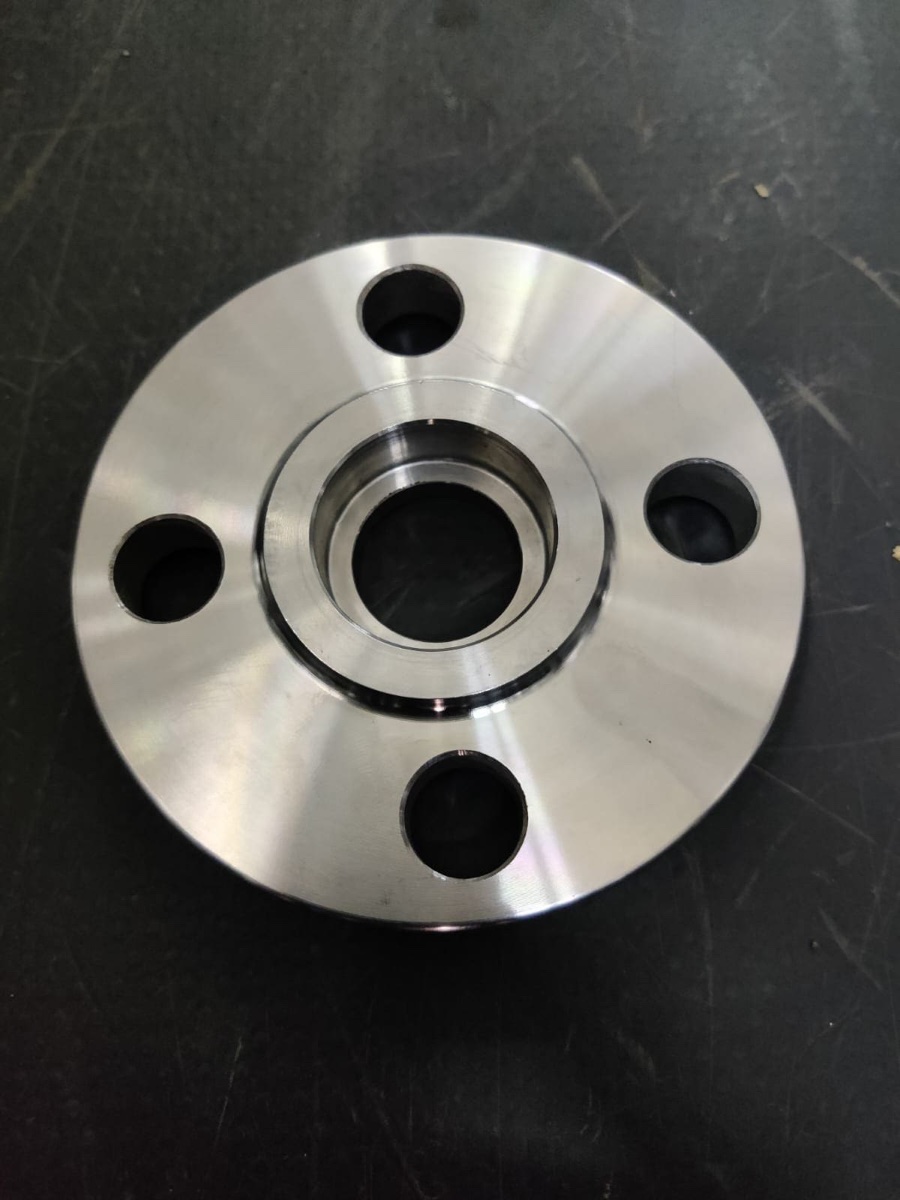
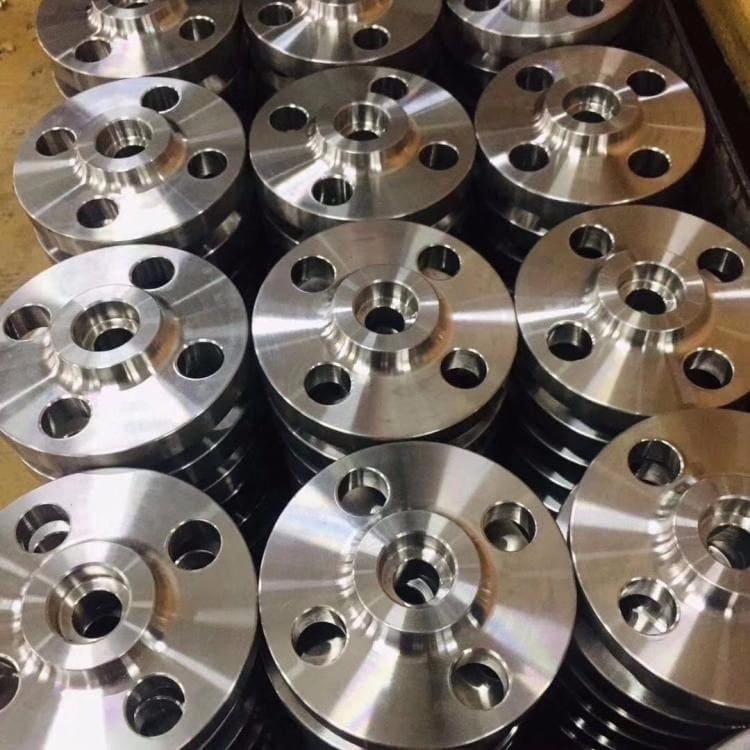
The chloride side of the utility world: chemical process small bore and dosing lines, coastal and marine-adjacent plant utilities, brackish and treated cooling circuits, offshore topside utility systems (splash and spray — not immersion), pharmaceutical and food-plant services where the site standard is 316, and LNG-terminal small bore where salt air surrounds cryogenic duty. Production below:
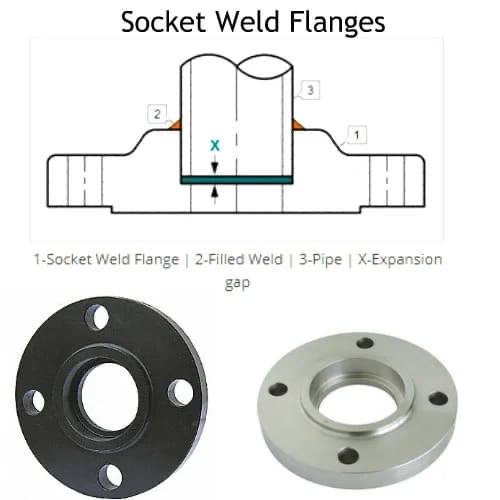
Stainless Socket Weld Flange — Socket Bore Visible, Our WorksSocket Weld Flanges — Machined Batch, Ready for DispatchThe Socket Weld Joint — Note the Expansion Gap (X)
A182 F316 Socketweld Flange Dimensions
Socket weld flange dimensions are class-governed per ASME B16.5 — identical across material grades (pressure-temperature ratings follow the austenitic group). Full charts:
How to Specify & Order an A182 F316 Socketweld Flange
Six elements — the schedule and the grade variant both belong on the enquiry:
1
Size & standard — e.g. 1″ NB ASME B16.5, or DN25 EN 1092-1 Type 03.
2
Pressure class & facing — 150#–1500#; SWRF (the default), SWFF or SWRTJ with ring number.
3
Pipe schedule — Sch 10S, 40S or 80S: the through-bore is matched to the pipe ID.
4
Grade detail — F316, dual 316/316L (our sensible default for welded corrosion duty), or the siblings by name: F316L for as-welded corrosion lines, F316H where the specification requires the carbon floor.
5
Certification — EN 10204 3.1 with solution-anneal records (our standard) / 3.2 witnessed, PMI as applicable.
An ASTM A182 F316 socketweld flange is a forged molybdenum-bearing austenitic stainless steel flange — UNS S31600, W.Nr. 1.4401 — whose back carries a machined socket: the pipe end seats inside, self-aligned square to the face, and is secured with a single external fillet weld. 316 is 304 plus 2-3% molybdenum, and that addition upgrades the passive film against the one enemy the default stainless handles worst: chlorides. Welded with no preheat and no PWHT, cryogenic-capable, dimensioned to ASME B16.5 for ½" to 3" NB in Classes 150 to 1500 in raised face, flat face and ring joint facings — the world's second stainless, and the first escalation every piping engineer reaches for.
Why is 316 the world's second stainless?
Because the first one has a known weakness and 316 is the measured dose of cure. 304 handles fresh water, food chemistry and atmosphere at the lowest cost in the stainless world — but the moment chlorides enter warm water, its film starts pitting. 316 keeps the entire 304 recipe — austenitic toughness at every temperature, the easiest welding in the catalogue, solution-annealed simplicity — and adds just enough molybdenum to push pitting resistance meaningfully up the scale, at a price still far below the duplex and super austenitic grades. That positioning — one confident step above the default, well short of exotic — is why coastal plants, chemical works and marine-adjacent utilities write 316 into their piping classes by reflex.
What does molybdenum actually do in 316?
It hardens the passive film at its weakest points. Chloride ions attack stainless locally — they find a flaw in the chromium-oxide film, dig a pit, and the pit's own chemistry keeps it dissolving. Molybdenum enriches the film and the freshly exposed metal beneath a forming pit, helping it repassivate before the attack becomes self-sustaining. The standard yardstick is the pitting resistance equivalent number, PREN: roughly Cr + 3.3×Mo + 16×N. Plain 304 scores about 19; 316's 2-3% molybdenum lifts it to roughly 24-26 — a genuine, measurable step. The same addition improves standing in dilute reducing acids such as sulphuric and acetic, where 304 struggles. What molybdenum does not do is fix chloride stress corrosion cracking — that honest limit has its own FAQ below.
What is the chemical composition of ASTM A182 F316 (UNS S31600)?
Carbon ≤0.08%, manganese ≤2.00%, silicon ≤1.00%, chromium 16.0-18.0%, nickel 10.0-14.0%, molybdenum 2.00-3.00%, phosphorus ≤0.045%, sulphur ≤0.030%. Two shifts against 304 reward attention. Chromium is lower — 16-18 against 18-20 — and nickel is higher — 10-14 against 8-11. That is not carelessness but balance: molybdenum promotes ferrite, so the austenite-stabilising nickel must rise to hold the structure, and the chromium band gives way to make the alloy economics work. The certificate that reads Cr 16.5% is correct 316, not sub-standard 304. Chemistry is verified per heat and travels on the EN 10204 3.1 MTC, with dual 316/316L certification stated where the heat qualifies.
What are the mechanical properties of A182 F316 socketweld flanges?
In the solution-annealed condition A182 requires tensile strength 515 MPa (75 ksi) minimum, yield strength 205 MPa (30 ksi) minimum and elongation 30% minimum — numerically identical to plain 304. That identity is the honest headline: molybdenum buys corrosion resistance, not strength. A 316 flange obeys the same austenitic B16.5 pressure-temperature tables, work-hardens in machining the same way, and doubles nothing — an engineer who needs chloride resistance and strength at once is shopping for duplex, where 450-550 MPa yields come standard. Within its own lane, 316's mechanicals are exactly what austenitic small bore wants: modest yield, enormous ductility, toughness that never disappears at low temperature.
F316 or F304 — how do I decide?
Ask what the fluid and the environment carry. Chlorides in warm water — brackish cooling, coastal atmosphere, chlorinated washdown, marine-adjacent service — argue for 316; so do dilute reducing acids and many chemical process streams. Fresh water, food chemistry, clean process, dry atmosphere and ordinary utilities argue for 304, because there the molybdenum buys little and costs real money. Two honest notes on the boundary: 316 is an upgrade, not an immunity — hot seawater and severe crevice duty defeat it too — and plant standardisation often overrides fluid logic: many sites simply run one grade to simplify stores, and that grade is increasingly 316. Describe the service on the enquiry and our quotation names the economical grade.
F316 or F316L — and what does dual certification mean?
The same L-logic as the 304 family, one rung up. Plain 316's 0.08% carbon can sensitize in a weld's heat-affected zone, setting up intergranular attack in aggressive service; 316L's 0.030% ceiling starves the mechanism, making the L-grade the standard for as-welded corrosion duty. Modern mill practice melts low and certifies both: dual 316/316L material meets the plain grade's strength with the L-grade's carbon, satisfying specifications written either way — our routine supply. For a socket weld flange, whose fillet weld creates exactly the HAZ in question, dual-certified supply is the sensible default; the F316L socketweld page carries the L-grade's own story, including where it must be L by name.
Is 316 seawater-proof — honestly?
No — and this is the most expensive misunderstanding in the stainless world. 316 resists chloride-bearing water: spray, brackish cooling, coastal atmosphere, intermittent exposure. Continuous immersion in warm seawater is a different regime — at a PREN of roughly 24-26, crevice attack under deposits, gaskets and, yes, socket gaps begins in the 15-25°C range, and a socket weld joint hands the sea exactly the crevice it wants. Genuine seawater service belongs to super duplex at PREN ≥40 — F53 and F55, both with socketweld pages on this site — or to the non-ferrous seawater metals: copper-nickel by antifouling, titanium by immunity. Specify 316 for the splash zone and the coast; specify past it for the sea itself.
Does molybdenum stop chloride stress corrosion cracking?
No. Chloride SCC is the austenitic family's shared vulnerability — cracking that starts where chlorides, tensile stress and temperatures above roughly 60°C combine — and it runs on the structure, not the film: 316 cracks much as 304 does, molybdenum notwithstanding. The classic hidden case remains hot insulated lines under chloride-bearing wet insulation. Where SCC drives the specification, the answer is a structural change, not more molybdenum: the duplex family's half-ferrite structure takes SCC essentially off the map, which is precisely why 2205 exists. Our F51 and F60 socketweld pages carry that story; state the temperature and chloride picture on the enquiry and the quotation will point honestly.
Is F316 suitable for cryogenic service?
Yes — the austenitic superpower carries over unchanged. The face-centred-cubic structure has no ductile-brittle transition, so 316 keeps its toughness to liquid-nitrogen temperatures and beyond, without the impact-testing ladder carbon steel needs. In practice 304/304L takes most cryogenic duty on economics, but 316 appears wherever a cryogenic plant sits in a marine or chemical atmosphere — LNG terminals on the coast being the textbook case: the cold side doesn't need the molybdenum, but the salt air on the outside does. Codes may still require weld-procedure impact qualification; the base metal's capability is inherent and the solution-annealed condition is documented on every certificate.
How is an F316 socketweld flange welded?
With the same easy rules as the whole austenitic family. Pipe bottomed in the socket, withdrawn 1/16" (1.6 mm) to leave the expansion gap, single external fillet — typically with 316L filler, whose low carbon protects the weld zone regardless of base-metal variant. No preheat, no PWHT; the discipline is stainless cleanliness — dedicated brushes and tools, no carbon-steel contamination — and moderate heat input to limit distortion, since austenitics expand half again as much as carbon steel. Dual-certified 316/316L base metal removes the sensitization worry entirely. Our flanges arrive solution annealed with furnace records on the certificate.
What facings are A182 F316 socketweld flanges made with?
All three, each with its own page on this site: raised face (SWRF) — the default, with PTFE or graphite spiral wound gaskets by service — flat face (SWFF) for GRP, lined and cast equipment mates, and ring type joint (SWRTJ) for the rarer high-pressure stainless duty, with soft iron or stainless rings per the class. Stainless bolting deserves anti-galling attention — stainless-on-stainless threads seize under torque, so coated or dissimilar-grade fasteners and thread lubricant are standard practice on stainless joints. NPT-tapped test and injection variants are machined and certified at the works.
What sizes and pressure classes do F316 socketweld flanges come in?
ASME B16.5 standardises socket weld flanges from ½" to 3" NB in Classes 150, 300, 600, 900 and 1500 — Class 900 sharing Class 1500 dimensions in most small-bore sizes — with 4" and Class 2500 made to order. Like 304, 316 stock concentrates in Classes 150 and 300, where chemical and coastal utility small bore lives. Put the pipe schedule on the enquiry — Sch 10S and 40S dominate stainless systems, and the through-bore is matched to the pipe ID so the joint presents no step to flow. B16.5 pressure-temperature ratings for the austenitic group govern the limits; our quotations state them per class.
What details are needed to get an accurate F316 socketweld flange quotation?
Six elements plus commercial terms: (1) size — ½" to 3" NB; (2) pressure class — 150 to 1500; (3) facing — SWRF, SWFF or SWRTJ with ring number; (4) the pipe schedule — Sch 10S, 40S or 80S, so the through-bore matches the pipe ID; (5) grade detail — F316, dual 316/316L (our sensible default for welded corrosion duty), or the siblings by name where the specification says so: F316L for as-welded corrosion lines, F316H where a high-temperature spec requires the carbon floor; (6) certification — EN 10204 3.1 with solution-anneal records (our standard) or 3.2 witnessed, PMI as applicable. Add quantity and destination and we return price, weight and delivery — normally within 24 hours, with common sizes quoted from ready stock.
Who manufactures ASTM A182 F316 socketweld flanges in India?
Tesco Steel & Engineering is an ISO 9001:2015 certified flange manufacturer based in Mumbai, India, producing ASTM A182 F316 socket weld flanges from ½" to 3" NB (larger to order) in Classes 150-1500 — each forged from certified heats, solution annealed with furnace records, machined on stainless-dedicated stations with gauged socket depth and schedule-matched bore, PMI-checked — molybdenum confirmed on every piece — and laser-marked with grade, size, class, schedule and heat number. Supplied with EN 10204 3.1/3.2 certification — dual 316/316L stated where the heat qualifies — alongside the F304 family, F316L, F317L and the duplex and super duplex socketweld range this series covers. Common sizes in ready stock; exported to more than 50 countries.