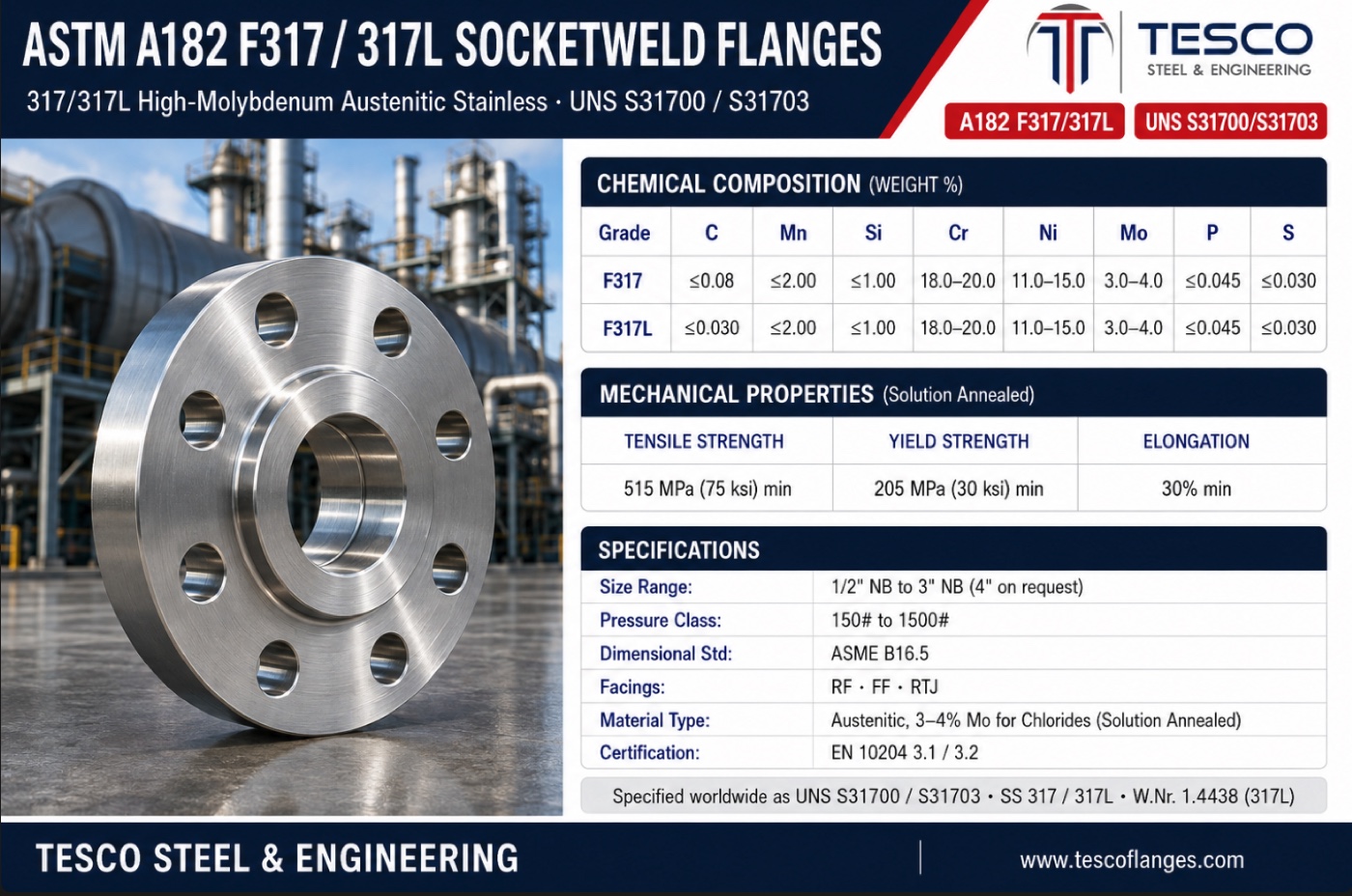
Tesco Steel & Engineering manufactures ASTM A182 F317 and F317L socketweld flanges — the next molybdenum rung: Mo 3–4% with chromium back up at 18–20%, UNS S31700/S31703, W.Nr. 1.4438 — to ASME B16.5 from ½″ to 3″ NB in Classes 150–1500. One page for both grades, because the market runs on one: at this alloy level the L pays no strength penalty — F317L certifies the same 515/205 MPa as plain F317 — so 317L and dual 317/317L supply dominate. This is the bleach-plant stainless: pulp-and-paper chlorine dioxide washers, FGD scrubbers, phosphoric and organic acid duty — PREN ~30, one confident step past 316L. The honest rival is named below: duplex 2205 matches the pitting number with twice the strength, and where it fits it usually wins — we price the pair. Seawater still escalates to super duplex. Facings: SWRF, SWFF, SWRTJ. Every lot with EN 10204 3.1/3.2 MTC. ISO 9001:2015, made in Mumbai, India — exported to 50+ countries.
A182 F317/317L · S31700/S31703 · W.Nr. 1.4438Mo 3–4% — Cr Back Up at 18–20%PREN ~30 — The Bleach-Plant GradeThe L Pays No Strength PenaltyNo Preheat — No PWHT515 / 205 MPa · 30% ElongationASME B16.5 ½″–3″ · Class 150–1500EN 10204 3.1 / 3.2 · ISO 9001:2015
ASTM A182 F317/317L Socketweld Flanges — Specifications at a Glance
What is an ASTM A182 F317/317L Socketweld Flange?
The next molybdenum rung, in the small-bore pattern. A forged high-molybdenum austenitic flange (ASTM A182 F317/F317L, UNS S31700/S31703) with a machined socket: pipe seated square by geometry, one external fillet weld with 317L filler — no preheat, no PWHT — through-bore matched to the pipe schedule. Mo 3.0–4.0% with Cr back up at 18–20%: both film elements raised, PREN ~30 against 316's ~25. The L's 0.030% carbon makes the weld zone immune to sensitization — and at this alloy level costs no strength: both grades certify 515/205 MPa, 30% elongation. Sized by ASME B16.5 at ½″–3″ NB, Classes 150–1500; EN 10204 3.1 on every lot.
Note the double raise: 317 adds a full point of molybdenum and pushes chromium back up — it refuses the trade 316 made. A certificate reading Cr 19% / Mo 3.4% is textbook 317L.
What 317L Buys
Both Film Elements Raised
Mo up a full point, Cr back to 18–20% — PREN ~30, a genuine step in pitting and crevice threshold, felt exactly where 316L starts staining.
The L Costs Nothing Here
In the 304/316 families the L surrenders 30/35 MPa; at 317's alloy level both grades certify 515/205 — weld immunity free of mechanical charge, which is why the market runs on 317L.
Licensor-Proven Homes
Pulp bleach plants, FGD scrubbers, phosphoric and organic acids — decades of corrosion history and licensor specifications, not brochure claims, put 317L where it is.
Honesty About the Rival
Duplex 2205 matches the pitting number with twice the strength — where it fits, it usually wins on price. We say so, and quote the pair when the duty allows either.
ASTM A182 F317 / F317L Chemical Composition
Grade
C
Mn
Si
Cr
Ni
Mo
P
S
F317 (S31700)
≤0.08
≤2.00
≤1.00
18.0–20.0
11.0–15.0
3.0–4.0
≤0.045
≤0.030
F317L (S31703)
≤0.030
≤2.00
≤1.00
18.0–20.0
11.0–15.0
3.0–4.0
≤0.045
≤0.030
One difference only: the carbon ceiling — the L's 0.030% makes the weld zone immune to sensitization. Nickel rises to 11–15% to hold the austenite against all that ferrite-forming molybdenum. PMI on every piece confirms the molybdenum; dual 317/317L certification stated where the heat qualifies.
Mechanical Properties (Solution Annealed) — Both Grades
Property
ASTM A182 F317 & F317L Requirement
Tensile Strength
≥ 515 MPa (75 ksi) — both grades
Yield Strength (0.2%)
≥ 205 MPa (30 ksi) — the L pays no penalty at this alloy level: molybdenum and nickel carry the certificate
Elongation
≥ 30% — the austenitic signature
Condition
Solution annealed — single condition, no ageing metallurgy
Temperature Span
Cryogenic (no transition) to ~425 °C practical for the L; wet corrosive duty is the grade's actual home
Strength Escalation
Chloride + strength → duplex 2205 at 450–485 MPa yield — the honest rival, compared in the FAQ
ASTM A182 F317/317L Socketweld Flanges are available in the following specifications:
Material Grade
ASTM A182 F317L (UNS S31703) — the modern default; plain F317 (S31700) by name; dual 317/317L certification routine; W.Nr. 1.4438
Heat Treatment
Solution annealed — furnace records certified
Size
1/2"NB to 3"NB per ASME B16.5; 4″ and larger to order; EN 1092-1 patterns to order
Class
150#, 300#, 600#, 900#, 1500# (900# shares 1500# dimensions in most sizes) — bleach & scrubber volume lives in 150/300
Facings
Raised Face (SWRF), Flat Face (SWFF), Ring Type Joint (SWRTJ) with groove per B16.20
Bore
Socket bore to pipe OD; through-bore matched to pipe schedule (Sch 10S/40S dominate stainless systems)
Welding
Single external fillet with 1/16″ expansion gap; 317L filler (over-alloyed filler where the spec calls it); no preheat, no PWHT
Service Span
Hard chloride process duty: bleach stages, FGD slurry, phosphoric & organic acids; cryogenic-capable; not open seawater — see the notes
Surface Finish
Pickled or natural machined — stainless-dedicated handling, no carbon-steel contact
Testing
Tension & chemistry per heat; PMI on every piece — molybdenum confirmed; socket depth and bore gauged
Certification
EN 10204 3.1 with solution-anneal records (standard) / 3.2 witnessed
Specification Notes — Getting 317L Sockets Right
Four honest notes.Price duplex 2205 alongside: it matches 317L's pitting number with twice the yield and usually less cost — 317L wins on fabrication ease, cryogenic reach and licensor specs, not on the corrosion chart; we quote the pair when the duty allows either. Closer to the sea, still short: PREN ~30 raises the crevice threshold but warm seawater immersion still defeats it — the sea belongs to F53/F55 super duplex. SCC is unmoved by molybdenum: above ~60 °C in chlorides the austenitic structure cracks regardless of the film — the structural fix is the duplex family. And write the L: plain F317 is a specification rarity — F317L or dual 317/317L on new work, with the plain grade forged by name only where an old class demands it.
How Our A182 F317/317L Socketweld Flanges Are Manufactured
1
Forging — cut billet of the spectro-verified S31703 (or S31700) heat is hot-forged into the flange blank with full heat traceability and segregated stainless handling.
2
Solution annealing — dissolves carbides and any molybdenum-rich phases, setting the clean austenitic structure; furnace charts retained against the heat number.
3
Machining — faces, OD and drilling to ASME B16.5 on stainless-dedicated stations — work-hardening respected with sharp tooling and positive feeds; socket counterbore and depth gauged piece by piece, through-bore matched to the ordered schedule.
4
Facing — RF serrations, flat face or RTJ groove per B16.20.
5
Testing & marking — tension and chemistry per heat; PMI on every piece with the 3–4% molybdenum confirmed; laser-marked with grade, size, class, schedule and heat number.
6
Certification & packing — EN 10204 3.1 MTC with solution-anneal records, dual 317/317L stated where the heat qualifies (3.2 witnessed on request); packed sea-worthy with no carbon-steel contact.
Where ASTM A182 F317/317L Socketweld Flanges Are Used
Where 316L's corrosion history ran out: pulp-and-paper bleach plants (chlorine dioxide washer showers, filtrate and dosing small bore), flue-gas desulphurisation scrubber trim and quench connections, phosphoric acid circuits, organic acid and dye-works process, hot brackish and high-chloride process streams, and licensor-specified chemical duty. Production below:
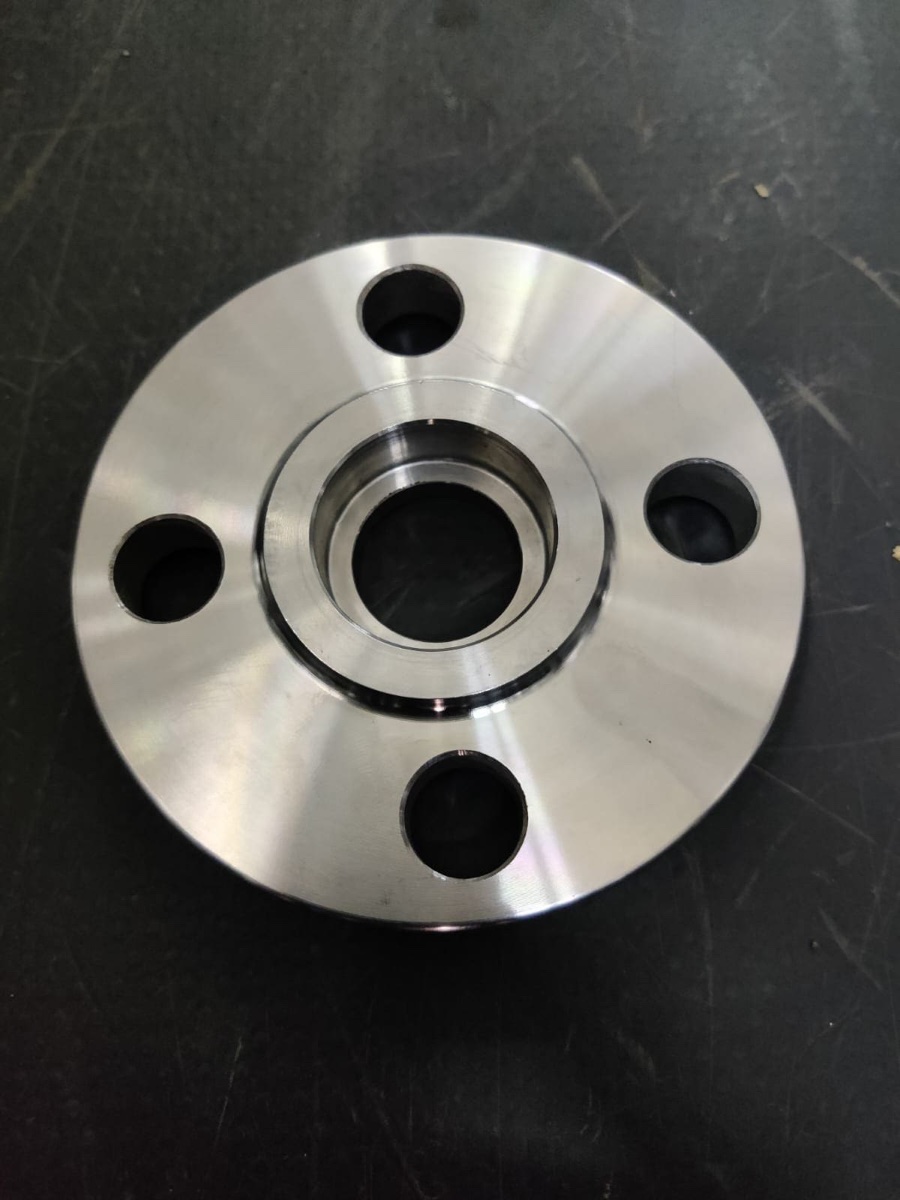
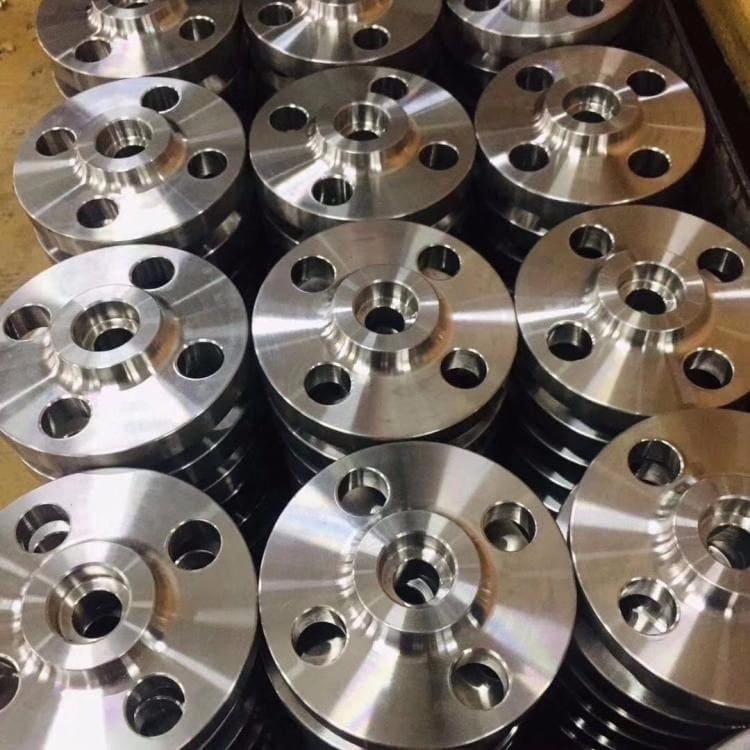
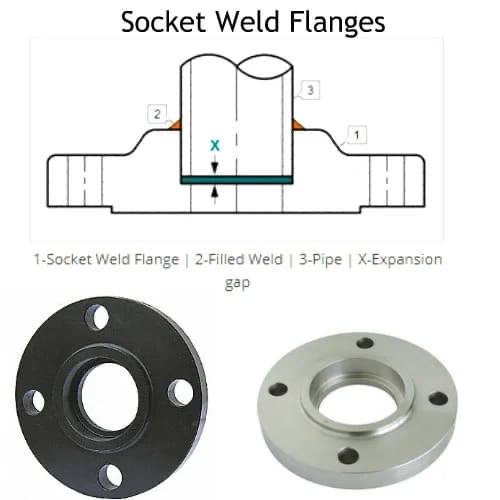
Stainless Socket Weld Flange — Socket Bore Visible, Our WorksSocket Weld Flanges — Machined Batch, Ready for DispatchThe Socket Weld Joint — Note the Expansion Gap (X)
A182 F317/317L Socketweld Flange Dimensions
Socket weld flange dimensions are class-governed per ASME B16.5 — identical across material grades (pressure-temperature ratings follow the austenitic group). Full charts:
How to Specify & Order an A182 F317/317L Socketweld Flange
Six elements — the schedule and the exact grade line both belong on the enquiry:
1
Size & standard — e.g. 1″ NB ASME B16.5, or DN25 EN 1092-1 Type 03.
2
Pressure class & facing — 150#–1500#; SWRF (the default), SWFF (common against GRP/lined mates) or SWRTJ with ring number.
3
Pipe schedule — Sch 10S, 40S or 80S: the through-bore is matched to the pipe ID.
4
Grade line as written — F317L (the modern default) or dual 317/317L; plain F317 by name only where an older class demands it. Service description invited — bleach stage, FGD slurry, acid duty — for the honest 317L-vs-2205 comparison.
5
Certification — EN 10204 3.1 with solution-anneal records (our standard) / 3.2 witnessed, PMI as applicable.
An ASTM A182 F317/317L socketweld flange is a forged high-molybdenum austenitic stainless steel flange — 3-4% molybdenum with chromium back up at 18-20%, UNS S31700 for the plain grade and S31703 for the low-carbon L, W.Nr. 1.4438 — whose back carries a machined socket: the pipe end seats inside, self-aligned square to the face, and is secured with a single external fillet weld. This page covers both grades together because the market does: 317L dominates supply, dual 317/317L certification is routine, and the L pays no strength penalty at this alloy level. Dimensioned to ASME B16.5 for ½" to 3" NB in Classes 150 to 1500, in raised face, flat face and ring joint facings — the bleach-plant and scrubber stainless, one confident rung above 316L.
Where does 317 sit on the molybdenum ladder?
One full rung above 316 — and with both film elements raised at once. 316 bought its 2-3% molybdenum by letting chromium slip to 16-18%; 317 adds a full extra point of molybdenum, 3.0-4.0%, and pushes chromium back up to 18-20% besides. On the PREN yardstick — roughly Cr + 3.3×Mo + 16×N — that lands around 28-31 against 316's 24-26 and plain 304's 19: a genuine step in pitting and crevice threshold, felt exactly where 316L starts staining — hotter chlorides, wet acidic process, oxidising bleach chemistries. Above it the ladder continues to duplex 2205 at PREN ≥34, super duplex at ≥40 and the 6Mo super austenitics — each with its own page in this series.
What is the chemical composition of ASTM A182 F317 and F317L?
Both grades: manganese ≤2.00%, silicon ≤1.00%, chromium 18.0-20.0%, nickel 11.0-15.0%, molybdenum 3.0-4.0%, phosphorus ≤0.045%, sulphur ≤0.030%. The single difference is carbon: F317 carries the plain ceiling of 0.08%, F317L the low-carbon 0.030% that makes the fillet weld's heat-affected zone immune to sensitization. Note the two deliberate raises against 316: molybdenum up a full point, and chromium back up to the 304-style band — the alloy refuses 316's chromium trade. Nickel rises to 11-15% to hold the austenite against all that ferrite-forming molybdenum. Chemistry is verified per heat and travels on the EN 10204 3.1 MTC, with dual 317/317L certification stated where the heat qualifies.
What are the mechanical properties of A182 F317/317L socketweld flanges?
Both grades certify identically in the solution-annealed condition: tensile strength 515 MPa (75 ksi) minimum, yield strength 205 MPa (30 ksi) minimum, elongation 30% minimum. That identity carries a point worth savouring: in the 304 and 316 families the L-grade surrenders strength — 485/170 against 515/205 — but at 317's alloy level the substitutional strengthening from all that molybdenum and nickel carries the certificate on its own, and the L costs nothing. It is one reason the market runs almost entirely on 317L: weld immunity free of mechanical charge. The austenitic signature is otherwise unchanged — modest yield, enormous ductility, no ductile-brittle transition — and B16.5's austenitic class tables govern the flange's duty.
F317 or F317L — and why is the market effectively all-L?
Because every reason to choose the plain grade evaporated. The classic trade — plain grade for strength, L for weld immunity — collapses at this alloy level, where F317L certifies the same 515/205 as F317; and 317's duties are precisely the wet, corrosive, as-welded services where sensitization matters most. So mills melt low-carbon, certify dual 317/317L, and plain-only F317 has become a specification rarity — we forge it by name when an old piping class demands it, and supply dual-certified material for everything else. The practical guidance: write F317L or dual 317/317L on new work, and if your governing spec says F317 only, the certificate will match it — the plain grade has its own page on this site for completeness.
317L or 316L — when does the extra molybdenum earn its keep?
When 316L is known to stain, pit or thin in the actual service — not hypothetically. The classic evidence-backed homes: pulp-and-paper bleach plants, where chlorine dioxide chemistry eats 316L washers and 317L became the industry's baseline; flue-gas desulphurisation, where chlorides concentrate in hot acidic slurry; phosphoric acid and aggressive organic acid process; textile and dye works. In ordinary coastal and chemical utility duty 316L remains the economical answer — the extra point of molybdenum is real money and buys nothing you can measure there. The honest test: if the plant's corrosion history or the licensor's spec names 317L, follow it; if you are escalating speculatively from 316L, price duplex 2205 at the same time — the next FAQ explains why.
317L or duplex 2205 — the honest competition?
This is the comparison that shrank 317L's world. Duplex 2205 matches or beats it on pitting — PREN ≥34 against roughly 30 — doubles its yield strength, takes chloride stress corrosion cracking essentially off the map, and carries less nickel, which usually means less cost. Where 2205 fits, it is generally the better buy, and modern specifications increasingly say so. Where 317L still wins on merit: fabrication ease — austenitic welding is more forgiving, with no phase-balance discipline or temperature ceilings; cryogenic and deep-cold capability the duplex family's -50°C floor cannot offer; established licensor specifications in pulp bleaching and FGD written around it; and matching existing 317L plant. Both socketweld pages live on this site; describe the duty and our quotation prices the honest pair.
Why is 317L the pulp-and-paper grade?
Because bleach plants found 316's limit the hard way. Chlorine dioxide bleaching — the D-stage that replaced elemental chlorine — produces hot, acidic, chloride-and-oxidant liquor that pits 316L washers, filters and piping on a maintenance-budget timescale. The industry's answer, standardised through decades of licensor specifications, was the 3-4% molybdenum grade: 317L became the bleach plant's baseline stainless, with the 6Mo super austenitics and titanium reserved for the worst washers. The same chemistry logic carried it into flue-gas desulphurisation scrubbers and chevrons, phosphoric acid circuits and dye works. For small bore that means 317L socket weld flanges on washer shower headers, dosing lines, instrument taps and scrubber trim — the exact duty this page's product serves.
Is 317L seawater-proof — honestly?
No — closer than 316L, still short. At PREN around 30, 317L raises the crevice-attack threshold usefully, but continuous immersion in warm seawater sits beyond it: deposits, gaskets and the socket's own gap still concentrate chlorides past what a 3-4% molybdenum film withstands, and warm-sea crevice failures of 317-class alloys are well documented. The honest seawater metals remain super duplex at PREN ≥40, the 6Mo super austenitics, copper-nickel and titanium — each with its own page and mechanism. Specify 317L for hard chloride process duty — bleach liquor, scrubber slurry, hot brackish streams — and specify past it for the open sea. State the water on the enquiry and the quotation points honestly.
Does the extra molybdenum stop chloride stress corrosion cracking?
No — the family verdict stands at every molybdenum level. Chloride SCC runs on the austenitic structure itself: where chlorides, tensile stress and temperatures above roughly 60°C combine, 317L cracks by the same mechanism as 304 and 316, its superior pitting film notwithstanding — the hot insulated line under chloride-bearing wet insulation remains the classic case. Molybdenum moves the pitting threshold, not the cracking one. Where SCC drives the specification, the fix is structural: the duplex family's half-ferrite microstructure removes the susceptibility, which is precisely the 2205 comparison two FAQs up. State the temperature and chloride picture on the enquiry; it decides between the austenitic and duplex answers more often than the pitting numbers do.
How is an F317/317L socketweld flange welded?
With the austenitic family's easy rules. Geometry is standard: pipe bottomed in the socket, withdrawn 1/16" (1.6 mm) to leave the expansion gap, single external fillet — with 317L filler as the routine consumable, keeping the deposit's molybdenum and low carbon matched to the base metal. No preheat, no PWHT; stainless housekeeping — dedicated brushes and tooling, no carbon-steel contamination — and moderate heat input against distortion. One high-alloy note: molybdenum segregates in austenitic weld metal, so for the most aggressive services specifications sometimes call an over-alloyed filler; where your spec does, follow it, and where it is silent, matching 317L filler is correct practice. Dual-certified base metal removes any sensitization question. Flanges arrive solution annealed with records.
What facings are A182 F317/317L socketweld flanges made with?
All three, each with its own page on this site: raised face (SWRF) — the default, with PTFE or graphite spiral wound gaskets by service — flat face (SWFF) for GRP, lined and cast equipment mates (common in FGD and bleach-plant service, where GRP and lined piping abound), and ring type joint (SWRTJ) for the rare high-pressure case. Stainless bolting deserves anti-galling attention — coated or dissimilar-grade fasteners and thread lubricant are standard practice. NPT-tapped test and injection variants are machined and certified at the works.
What sizes and pressure classes do F317/317L socketweld flanges come in?
ASME B16.5 standardises socket weld flanges from ½" to 3" NB in Classes 150, 300, 600, 900 and 1500 — Class 900 sharing Class 1500 dimensions in most small-bore sizes — with 4" and Class 2500 made to order. Bleach-plant and scrubber small bore lives almost entirely in Classes 150 and 300. Put the pipe schedule on the enquiry — Sch 10S and 40S dominate stainless systems, and the through-bore is matched to the pipe ID so the joint presents no step to flow. B16.5 pressure-temperature ratings for the austenitic group govern the limits; our quotations state them per class.
What details are needed to get an accurate F317/317L socketweld flange quotation?
Six elements plus commercial terms: (1) size — ½" to 3" NB; (2) pressure class — 150 to 1500; (3) facing — SWRF, SWFF or SWRTJ with ring number; (4) the pipe schedule — Sch 10S, 40S or 80S, so the through-bore matches the pipe ID; (5) the grade line as written — F317L (the modern default), dual 317/317L, or plain F317 where an older specification demands it; (6) certification — EN 10204 3.1 with solution-anneal records (our standard) or 3.2 witnessed, PMI as applicable. Add the service description — bleach stage, scrubber slurry, acid duty — if you want the 317L-versus-2205 comparison priced alongside, plus quantity and destination. Quotations normally within 24 hours.
Who manufactures ASTM A182 F317/317L socketweld flanges in India?
Tesco Steel & Engineering is an ISO 9001:2015 certified flange manufacturer based in Mumbai, India, producing ASTM A182 F317 and F317L socket weld flanges from ½" to 3" NB (larger to order) in Classes 150-1500 — each forged from certified heats, solution annealed with furnace records, machined on stainless-dedicated stations with gauged socket depth and schedule-matched bore, PMI-checked — the 3-4% molybdenum confirmed on every piece — and laser-marked with grade, size, class, schedule and heat number. Supplied with EN 10204 3.1/3.2 certification — dual 317/317L stated where the heat qualifies — alongside the F316/F316L rungs below, the duplex and super duplex rungs above, and the full stainless socketweld range this series covers. Exported to more than 50 countries.