ASTM A182 F317L Weld Neck Flanges — High-Molybdenum SS 317L (UNS S31703)
Tesco Steel & Engineering forges ASTM A182 F317L weld neck flanges in stainless steel 317L — UNS S31703, Werkstoff Nr. 1.4438, the austenitic that carries 3–4% molybdenum against 316L's 2–3% — from 1/2″ NB to 56″ NB, in ASME B16.5 Class 150–2500 and European PN patterns. The extra molybdenum steps pitting and crevice resistance decisively past 316L for pulp & paper bleach plants, flue gas scrubbers, phosphoric and organic acid services — while the 0.030% carbon cap keeps every welded joint sensitization-safe, at full 515 MPa strength. Mating A312 TP317L pipe, supplied pickled & passivated with IGC ASTM A262, PMI and EN 10204 3.1/3.2 on request. ISO 9001:2015, made in Mumbai, India — exported worldwide.
A182 F317L · UNS S31703 · 1.4438
3–4% Mo · PREN ~29–33
C 0.030% Max · Weld-Safe
1/2″ – 56″ NB
Class 150 – 2500 · PN 2.5 – 400
Bleach Plant & Scrubber Duty
ISO 9001:2015 · Exported Worldwide
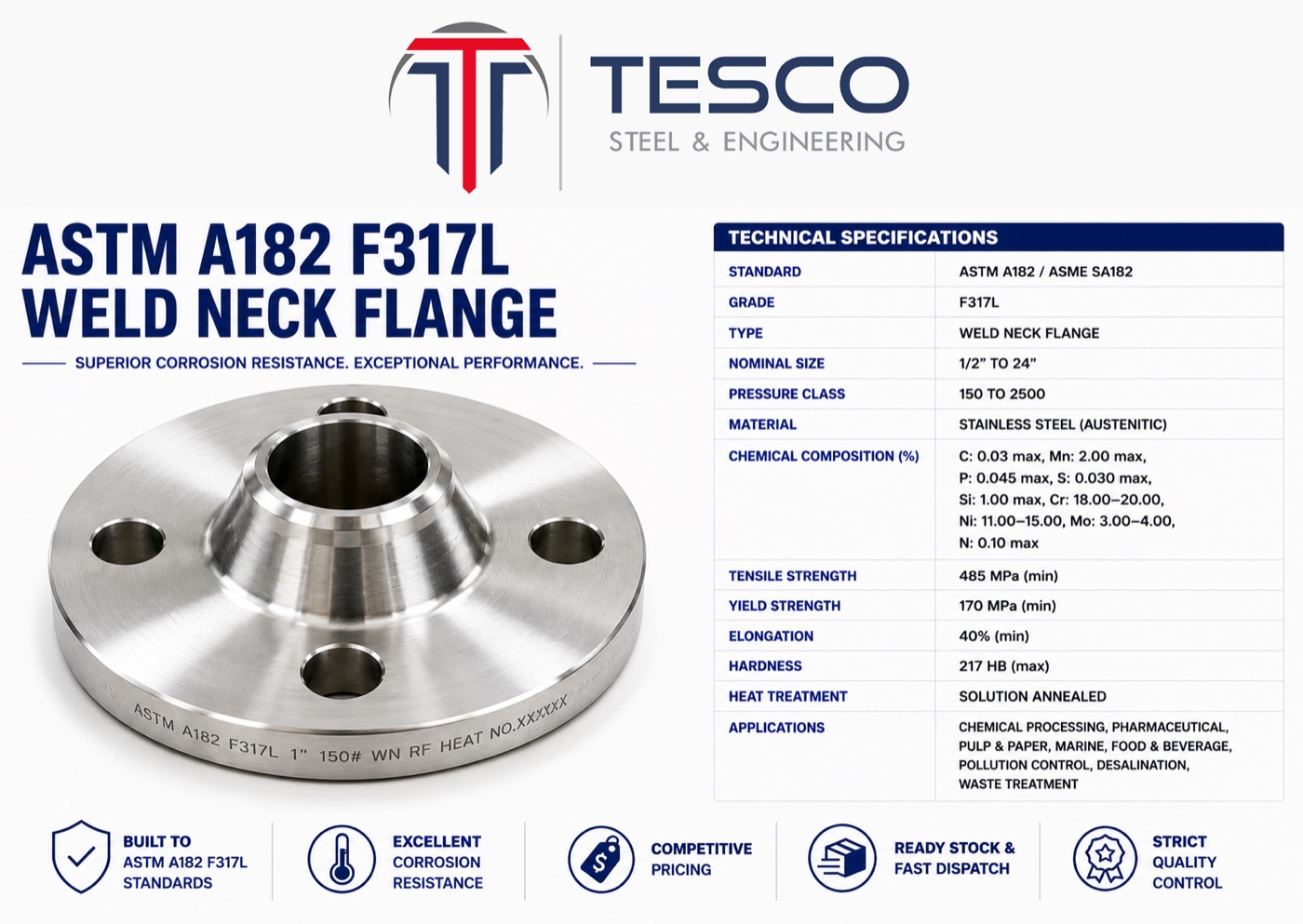
ASTM A182 F317L Weld Neck Flange — Stainless Steel 317L (UNS S31703), Technical Specifications
What is an ASTM A182 F317L Weld Neck Flange?
ASTM A182 F317L is the forged-flange grade of stainless steel 317L (UNS S31703 / 1.4438) — the austenitic one deliberate step above 316L, carrying 3–4% molybdenum with more chromium and nickel to balance it. The result is a pitting resistance number around 29–33 and real margin in chloride-bearing, acidic media — with the 0.030% carbon cap keeping welds sensitization-safe. An F317L weld neck flange pairs that chemistry with a long tapered hub butt-welded to the pipe, bore matched to schedule, joint fully radiographable.
The grade's logic is simple: when 316L pits, 317L is the economical next move — the same weld-safe austenitic family, one percentage point more molybdenum. Unusually for an L grade it keeps full standard strength (515/205 MPa): the heavier alloying pays back what the low carbon gives up.
Its home industry is pulp and paper — chlorine dioxide bleach stages and washers made it the default specification — with FGD scrubbers presenting the same chloride-plus-acid attack. When 317L runs out, the ladder continues to duplex 2205, 904L and 254 SMO — all forged in-house.
Also searched as: SS 317L weld neck flange, UNS S31703 flange, 1.4438 flange, 317L WNRF flange, SA182 F317L flange, high molybdenum stainless steel flange — all refer to the product on this page.
Chemical Composition of ASTM A182 F317L
| C | Mn | Si | P | S | Cr | Mo | Ni |
|---|
| 0.030 max | 2.00 max | 1.00 max | 0.045 max | 0.030 max | 18.00-20.00 | 3.00-4.00 | 11.00-15.00 |
Values in weight %. The 3.00–4.00% molybdenum is the grade's working element — a full point above 316L — and the 0.030% carbon cap keeps welds sensitization-safe. Higher nickel (to 15%) holds the richly alloyed melt fully austenitic.
Mechanical Properties of ASTM A182 F317L
| Tensile Strength, MPa | Yield Strength, Min, MPa | Elongation % min. | Hardness Rockwell HRB | Hardness Brinell HB |
|---|
| 515 | 205 | 30 | 95 max | 217 max |
Minimums per ASTM A182. Unusually for an L grade, 317L keeps full standard-grade strength — no 485/170 penalty — because the heavier alloying compensates for the low carbon. The solution-annealed condition is documented on every certificate.
Equivalent Grades of ASTM A182 F317L
| Standard | Werkstoff Nr. | UNS | JIS | EN |
|---|
| SS 317L | 1.4438 | S31703 | SUS 317L | X2CrNiMo18-15-4 |
System partners: A312 TP317L seamless pipe, A403 WP317L butt-weld fittings and A240 317L plate. The corrosion ladder continues with duplex 2205, 904L and 254 SMO.
ASTM A182 F317L Weld Neck Flange Specifications
| ASTM A182 317L Weld Neck Flanges are available in the following specifications: |
|---|
| Size | 1/2"NB to 56"NB |
| Class | 150#, 300#, 400#, 600#, 900#, 1500#, 2500# |
| Sch (Schedule) | XS, XXS, STD & Schedule 20, 40, 80, 160 |
| Pressure Ratings | PN 2.5 - PN 400 |
| Standards | ASME B16.5, ASME B16.47, EN 1092-1 Type 11, DIN 2631–2635, BS 4504 |
| Condition | Solution Annealed; dual-certifiable 317/317L |
| Other Services | Pickling & passivation on ASTM A182 317L Weld Neck Flanges
Sand Blasting on ASTM A182 317L Weld Neck Flanges
Shot Peening on ASTM A182 317L Weld Neck Flanges
IGC (ASTM A262) & PMI testing
Project-specific marking, wrapping & export packing |
Why 317L When 316L Runs Out of Margin
A Full Point More Molybdenum
3–4% Mo lifts the pitting resistance number to ~29–33 — real margin in the chloride-and-acid chemistry that pits 316L.
Weld-Safe at Full Strength
The 0.030% carbon cap protects every weld from sensitization — and unlike 316L, the heavier alloying keeps the full 515 MPa tensile floor.
Bleach Plant Pedigree
Decades of chlorine dioxide washer and filtrate service made 317L pulp & paper's default stainless — the same chemistry FGD scrubbers throw at it.
The Economical Step
When 316L pits, 317L usually solves it without the jump to duplex or 6-Mo pricing — and when it doesn't, we forge every rung above it.
Dual-Certified 317/317L
One heat, two grades on the certificate — a dual flange satisfies purchase orders written around either specification.
Welding 317L — Simplicity With Margin
317L welds with standard austenitic ease: E317L / ER317L filler, moderate heat input, no preheat, no PWHT. The low-carbon chemistry keeps the heat-affected zone sensitization-safe, so joints enter corrosive service as-welded. In the harshest scrubber duties, over-alloyed fillers — 309MoL or nickel-base consumables — add weld-metal pitting margin where the specification calls for it.
Ladder note: 317L buys pitting margin, not chloride-SCC immunity — hot concentrated chlorides above ~60 °C can still crack any austenitic. For that service, step across to
duplex 2205; for severe sulphuric acid,
904L is the engineered answer.
Where ASTM A182 F317L Weld Neck Flanges Are Used
Pulp and paper leads: chlorine dioxide bleach stages, washers and filtrate systems — the grade's home industry. Flue gas desulphurisation scrubbers and ducting follow, then phosphoric and organic acid services, textile and dye chemistry, desalination pretreatment, and condensers running chloride-bearing cooling water. Our stainless weld neck production, faces protected, below:
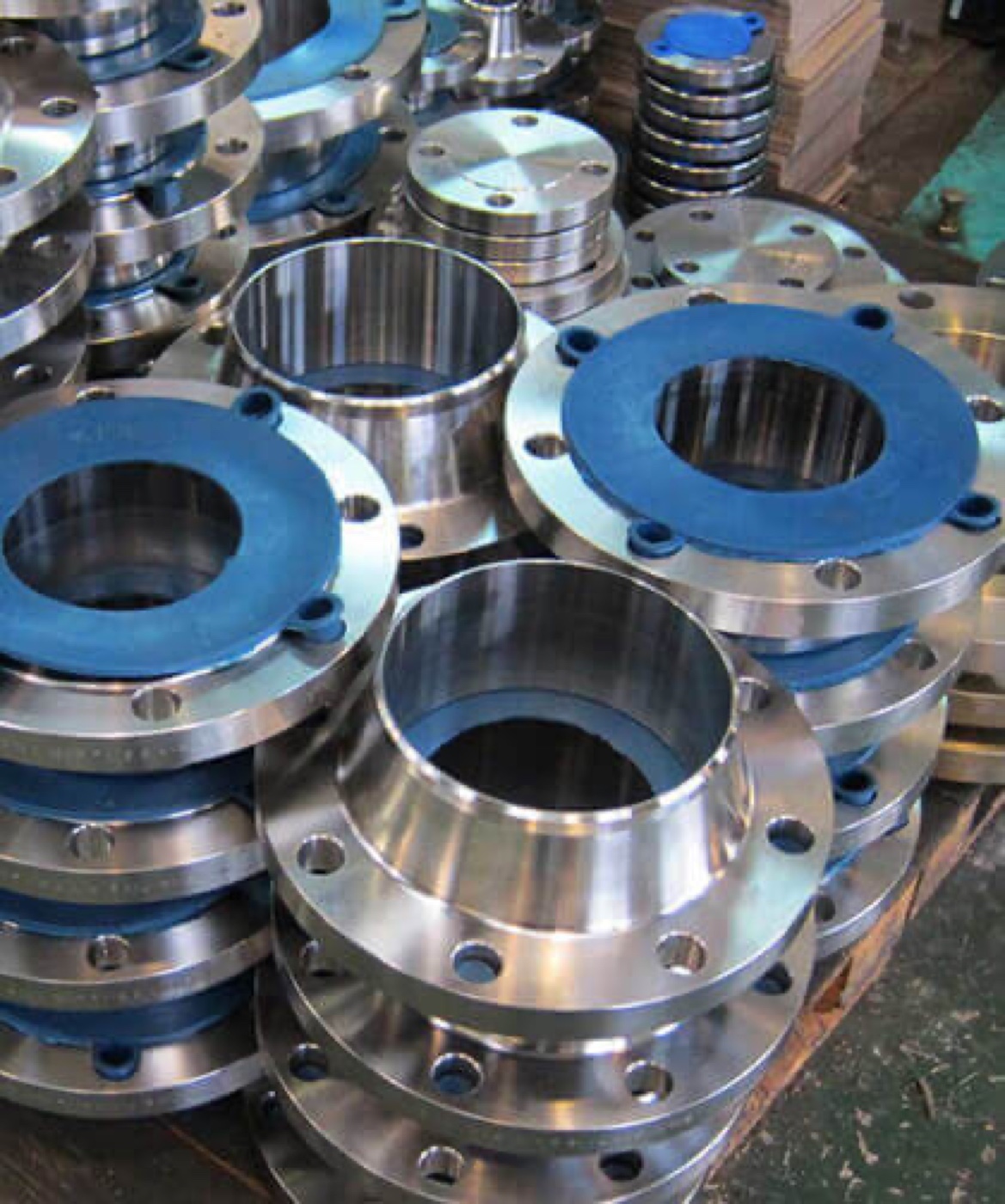
Stainless Steel Weld Neck & Blind Flanges — Faces Protected, In Stock
ASTM A182 F317L Weld Neck Flange Dimensions
F317L weld neck flanges share their dimensions with every other material in the same class — OD, thickness, hub, bore, bolt circle and bolting per the standard tables. Full ASME B16.5 charts:
European PN dimensions are published on the EN 1092-1 Type 11, DIN 2631–2635 and BS 4504 pages.
Price List & How to Order
Stainless pricing tracks nickel and molybdenum plus the certification scope, so we quote live with a stated validity rather than publish a static list. To get a firm quotation, usually within 24 hours:
1
List your requirement — size (NB), class or PN, standard (ASME B16.5 / B16.47 / EN / DIN / BS), grade (F317L, or dual-certified 317/317L), pipe schedule or bore, and quantity.
2
Add the testing scope — IGC ASTM A262, 3.2 witness, PMI, or project specifications.
ASTM A182 F317L Weld Neck Flanges — Frequently Asked Questions
What is an ASTM A182 F317L weld neck flange?
It is a weld neck flange forged from ASTM A182 grade F317L — the high-molybdenum, low-carbon austenitic stainless steel, UNS S31703 / 1.4438, carrying 3 to 4% molybdenum against 316L's 2 to 3%. The long tapered hub is butt-welded to the pipe with the bore matched to the pipe schedule, giving a radiographable, fatigue-resistant joint in the grade process industries specify when 316L's pitting resistance runs out but duplex or 6-Mo alloys are more than the service needs.
What is the difference between 317L and 316L?
An extra percentage point of molybdenum — 3 to 4% versus 2 to 3% — plus a little more chromium and nickel to balance it. That lifts the pitting resistance number from the mid-20s to roughly 29 to 33, buying real margin in chloride-bearing and acidic media: bleach plant washers, scrubber environments and organic acid streams that pit 316L. Both grades cap carbon at 0.030%, so welds stay sensitization-safe; 317L also carries slightly higher strength minimums (515 versus 485 MPa tensile).
Where does 317L sit on the corrosion ladder?
One deliberate step above 316L and below the specialist tiers. When 316L pits, 317L is the economical next move; when 317L runs out — hot concentrated chlorides, raw seawater, severe crevices — the ladder continues to duplex 2205 (which adds strength and SCC immunity), 904L (for sulphuric acid), and the 6-Mo super austenitic 254 SMO. We forge every rung, so the enquiry can name the service and we can confirm the economic grade.
Why is 317L the pulp and paper industry's stainless?
Bleach plants are chloride chemistry at warm temperatures — chlorine dioxide stages, washers, filtrate tanks — exactly the pitting environment where 316L's margin runs thin. 317L's extra molybdenum was the industry's classic answer, and decades of bleach-washer service made it the default specification for that duty, alongside flue gas desulphurisation scrubbers, which present a similar chloride-plus-acid attack.
What temperature range can F317L flanges be used in?
From cryogenic — austenitics have no ductile-brittle transition — up to around 450 to 500 °C for pressure duty. As a low-carbon grade it is not intended for sustained creep-range service; its territory is wet, corrosive process chemistry at low and moderate temperatures, where the molybdenum does its work.
What are the equivalent designations for A182 F317L?
SS 317L in general usage; UNS S31703; Werkstoff Nr. 1.4438 (EN X2CrNiMo18-15-4); and JIS SUS 317L. Its system partners share the chemistry: A312 TP317L seamless and welded pipe, A403 WP317L butt-weld fittings and A240 317L plate. An enquiry in any of these designations is quoted as the same material.
What is the chemical composition of ASTM A182 F317L?
Per ASTM A182: carbon 0.030% max — the weld-safe cap — manganese 2.00% max, silicon 1.00% max, phosphorus 0.045% max, sulphur 0.030% max, chromium 18.00 to 20.00%, molybdenum 3.00 to 4.00% and nickel 11.00 to 15.00%. The extra molybdenum is the grade's working element, and the higher nickel keeps the richly alloyed melt fully austenitic.
What are the mechanical properties of A182 F317L flanges?
Minimum tensile strength 515 MPa (75 ksi), minimum yield strength 205 MPa (30 ksi) and minimum elongation 30%, with hardness typically limited to 95 HRB / 217 HB. Unusually for an L grade, 317L keeps full standard-grade strength — the heavier alloying compensates for the low carbon — so there is no strength penalty for the weld-safe chemistry.
Which pipe grades do F317L weld neck flanges mate with?
ASTM A312 TP317L seamless and welded pipe is the standard partner, with A403 WP317L butt-weld fittings completing the system. The weld neck bore is machined to the pipe schedule you state, so the bore runs flush through the joint and the bevel arrives ready for a matched-chemistry butt weld.
How are 317L flanges welded to pipe?
With E317L / ER317L filler and standard austenitic practice: moderate heat input, no preheat, no post-weld heat treatment. The 0.030% carbon cap keeps the heat-affected zone sensitization-safe, so the joint enters corrosive service as-welded. Where the specification allows, over-alloyed fillers such as 309MoL or nickel-base consumables add weld-metal pitting margin in the harshest scrubber duties.
What does dual-certified 317/317L mean?
A heat melted with carbon at or below 0.030% while meeting standard 317's strength minimums certifies to both specifications on one mill certificate — the same modern-practice convenience as 304/304L and 316/316L. One flange then satisfies purchase orders written around either grade, and inventories consolidate instead of splitting.
What testing and certification do you supply with F317L flanges?
Every lot ships with EN 10204 3.1 mill test certificates covering chemical analysis — demonstrating the 3% molybdenum minimum and the 0.030% carbon cap — mechanical properties and the solution-anneal record, with 3.2 certification witnessed by Lloyd's, DNV, BV or TÜV on request. We also offer intergranular corrosion testing to ASTM A262, PMI verification and hydrostatic or hardness testing to project specifications, with full heat-number traceability.
Can 317L flanges be used at cryogenic temperatures?
Yes — austenitic stainless keeps its toughness to liquid nitrogen temperatures and below, with no ductile-brittle transition. Where a cryogenic system's process chemistry also demands more pitting margin than 316L offers, 317L serves with impact testing at design temperature available on request.
Where are ASTM A182 F317L weld neck flanges used?
Pulp and paper bleach plants above all — the grade's home industry — plus flue gas desulphurisation scrubbers, phosphoric and organic acid services, textile and dye chemistry, desalination pretreatment, condensers and heat exchangers running chloride-bearing cooling water, and chemical plants wherever 316L's pitting margin has proven thin. If a 316L flange keeps pitting, this is the next call.
What sizes and standards do you manufacture F317L weld neck flanges in?
From 1/2 inch NB to 56 inch NB: ASME B16.5 Class 150 to 2500 up to 24 inch, ASME B16.47 above, and European PN 2.5 to PN 400 patterns to EN 1092-1 Type 11, DIN and BS 4504. Raised face is standard, flat face and ring joint on request, and every bore is machined to the mating pipe schedule from Sch 10 through XXS.
Do you keep A182 F317L weld neck flanges in stock? What is the lead time?
317L moves in project quantities, so common process sizes in Class 150 and 300 rotate through production with popular items often available, while larger diameters, higher classes and witness-tested lots are forged to order — typically 3 to 5 weeks. Prices track nickel and molybdenum, so quotations carry a validity period — send the size list and we confirm the stock position the same day.
What information should I include in an F317L flange enquiry?
Six things: size (NB), pressure class or PN rating, dimensional standard (ASME B16.5, B16.47 or EN/DIN/BS), grade (F317L, or dual-certified 317/317L), pipe schedule or bore, and quantity. Add any testing scope — IGC ASTM A262, 3.2 witness, PMI — and the facing if other than raised face. With these details we return a firm quotation, usually within 24 hours.
Do you export ASTM A182 F317L flanges outside India?
Yes. Tesco Steel & Engineering is an ISO 9001:2015 certified manufacturer based in Mumbai, and F317L flanges ship to pulp and paper, chemical and environmental projects across the Middle East, Europe, Africa, Southeast Asia and the Americas. Flanges travel pickled, face-protected and seaworthy-packed, with full heat-number and test traceability.

