ASTM A182 F304L Weld Neck Flanges — Low-Carbon SS 304L (UNS S30403)
Tesco Steel & Engineering forges ASTM A182 F304L weld neck flanges in stainless steel 304L — UNS S30403, Werkstoff Nr. 1.4306/1.4307, the 18Cr-8Ni austenitic with carbon capped at 0.030% — from 1/2″ NB to 56″ NB, in ASME B16.5 Class 150–2500 and European PN patterns. The low carbon is the whole point: welded joints cannot sensitize, so the heat-affected zone stays corrosion-safe with no post-weld treatment — the working stainless of food, dairy, pharmaceutical, chemical and water systems, tough down to cryogenic temperatures, mating A312 TP304L pipe. Dual-certifiable 304/304L, supplied pickled & passivated with IGC ASTM A262, PMI and EN 10204 3.1/3.2 on request. ISO 9001:2015, made in Mumbai, India — exported worldwide.
A182 F304L · UNS S30403 · 1.4307
C 0.030% Max · Weld-Safe
1/2″ – 56″ NB
Class 150 – 2500 · PN 2.5 – 400
Cryogenic to −196 °C
Dual-Certified 304/304L
ISO 9001:2015 · Exported Worldwide
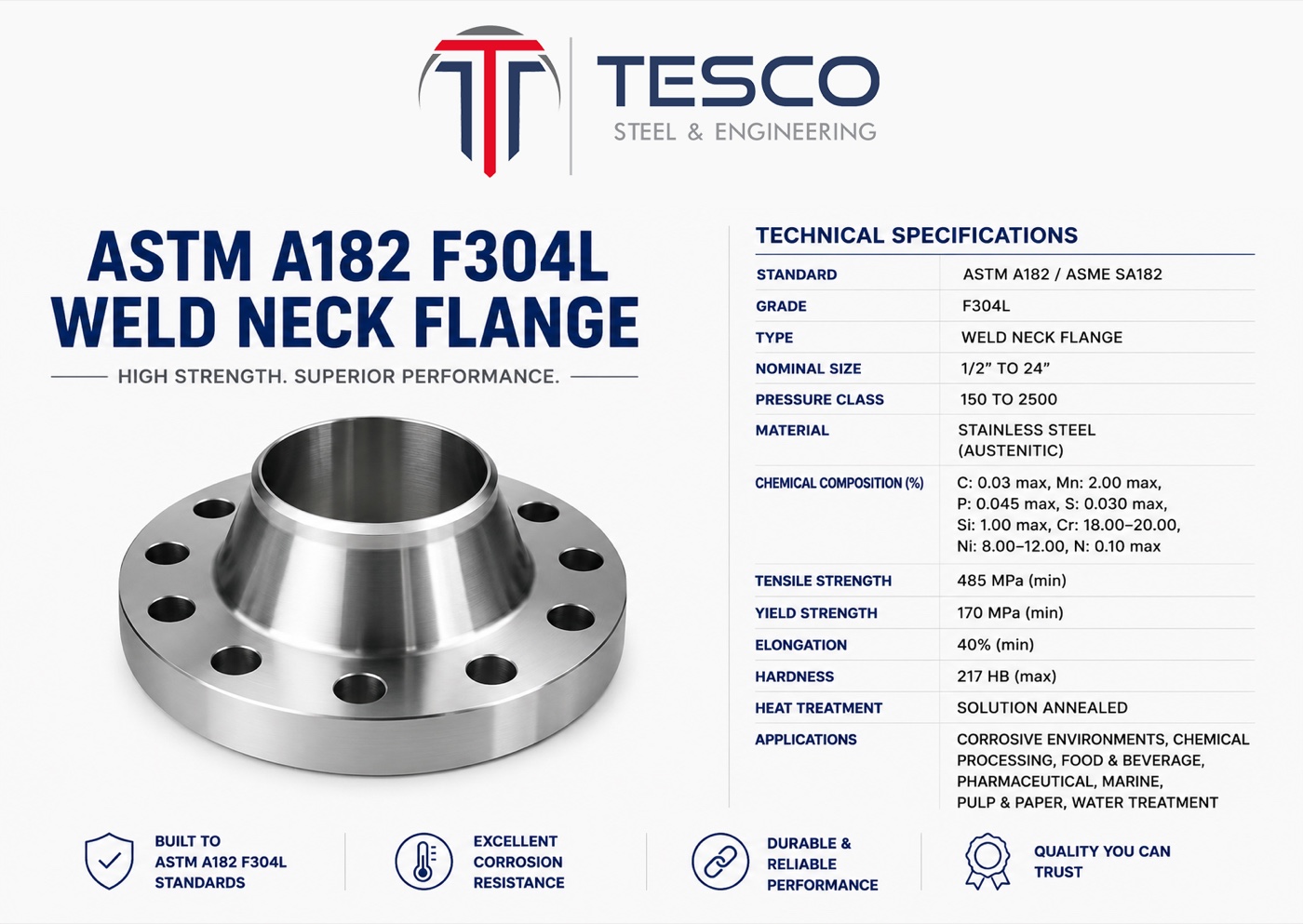
ASTM A182 F304L Weld Neck Flange — Stainless Steel 304L (UNS S30403), Technical Specifications
What is an ASTM A182 F304L Weld Neck Flange?
ASTM A182 F304L is the forged-flange grade of stainless steel 304L (UNS S30403 / 1.4307) — classic 18Cr-8Ni austenitic chemistry with carbon capped at 0.030%. That cap makes the grade immune to weld sensitization: the heat-affected zone keeps its chromium, so the joint resists corrosion as-welded, with no post-weld anneal. An F304L weld neck flange pairs that metallurgy with a long tapered hub butt-welded to the pipe, bore matched to schedule, joint fully radiographable — the default flange of hygienic and general corrosion-resistant piping.
The 304 family splits by carbon: 304L (0.030% max) owns welded corrosive service, standard 304 covers the middle ground, and 304H (0.04% min) takes the creep range above 525 °C. Modern melt practice usually lands in the overlap, so our stock is typically dual-certified 304/304L — one flange, both callouts.
Being austenitic, 304L has no ductile-brittle transition: the same grade that serves a dairy line stays tough at −196 °C in LNG and liquid-nitrogen service. When chlorides enter the picture — coastal, brackish or process — the molybdenum-bearing 316L is the step up.
Also searched as: SS 304L weld neck flange, UNS S30403 flange, 1.4307 flange, 304L WNRF flange, SA182 F304L flange, low carbon stainless steel flange — all refer to the product on this page.
Chemical Composition of ASTM A182 F304L
| C | Mn | Si | P | S | Cr | Mo | Ni | N |
|---|
| 0.030 max | 2.00 max | 1.00 max | 0.045 max | 0.030 max | 18.00-20.00 | - | 8.00-13.00 | - |
Values in weight %. The 0.030% carbon cap is the L grade's defining requirement — too little carbon to form a damaging grain-boundary carbide network during welding. The wider nickel window (to 13%) helps the low-carbon melt stay fully austenitic.
Mechanical Properties of ASTM A182 F304L
| Tensile Strength, MPa | Yield Strength, Min, MPa | Elongation % min. | Hardness Rockwell HRB | Hardness Brinell HB |
|---|
| 485 | 170 | 30 | 92 max | 201 max |
Minimums per ASTM A182. The low carbon gives up a little room-temperature strength against standard 304 (485 vs 515 MPa tensile) — the deliberate price of weld-safe metallurgy, already reflected in the flange pressure-temperature ratings. The solution-annealed condition is documented on every certificate.
Equivalent Grades of ASTM A182 F304L
| Standard | Werkstoff Nr. | UNS | JIS | BS | GOST | AFNOR | EN |
|---|
| SS 304L | 1.4306 / 1.4307 | S30403 | SUS 304L | 304S11 | 03Х18Н11 | Z3CN18‐10 | X2CrNi18-9 / X2CrNi19-11 |
System partners: A312 TP304L seamless pipe, A403 WP304L butt-weld fittings and A240 304L plate. The stainless family continues with 316L for chlorides and 304H for creep-range heat.
ASTM A182 F304L Weld Neck Flange Specifications
| ASTM A182 304L Weld Neck Flanges are available in the following specifications: |
|---|
| Size | 1/2"NB to 56"NB |
| Class | 150#, 300#, 400#, 600#, 900#, 1500#, 2500# |
| Sch (Schedule) | XS, XXS, STD & Schedule 20, 40, 80, 160 |
| Pressure Ratings | PN 2.5 - PN 400 |
| Standards | ASME B16.5, ASME B16.47, EN 1092-1 Type 11, DIN 2631–2635, BS 4504 |
| Condition | Solution Annealed; dual-certifiable 304/304L |
| Other Services | Pickling & passivation on ASTM A182 304L Weld Neck Flanges
Sand Blasting on ASTM A182 304L Weld Neck Flanges
Shot Peening on ASTM A182 304L Weld Neck Flanges
IGC (ASTM A262) & PMI testing
Project-specific marking, wrapping & export packing |
Why 304L is the Working Stainless of Industry
Weld-Safe by Chemistry
With carbon capped at 0.030%, the heat-affected zone cannot sensitize — joints go into corrosive service as-welded, no post-weld anneal, no weld-decay risk.
Hygienic Industries' Default
Inert to food chemistry, cleanable and traceable — the standard flange of dairies, breweries, pharma and water treatment, supplied pickled and passivated.
Cryogenic Without Drama
No ductile-brittle transition: full toughness at −196 °C for LNG, liquid oxygen and nitrogen systems — impact-tested at design temperature on request.
Dual-Certified 304/304L
One heat, two grades on the certificate — a dual flange satisfies purchase orders written around either specification and consolidates inventory.
The Economical Baseline
The highest-volume stainless flange grade we forge — competitive pricing, deep stock in common sizes, and an easy step up to 316L when chlorides demand it.
Welding 304L — Simplicity is the Feature
304L welds with standard austenitic ease: E308L / ER308L filler, moderate heat input, no preheat, no PWHT. The L-grade chemistry is what makes that simplicity safe — there is not enough carbon to sensitize the heat-affected zone, so the joint resists corrosion exactly as it left the welder. Back-purge TIG roots on hygienic and high-purity lines where internal oxide is unacceptable, and pickle or brush weld discoloration where the service warrants.
Chloride note: 304L's limit is chlorides — pitting in coastal, brackish or chlorinated service and stress corrosion cracking in hot chloride media. Above roughly 200 ppm chloride or in marine duty, specify
316L; where hot chlorides threaten cracking,
duplex 2205 is the engineered answer.
Where ASTM A182 F304L Weld Neck Flanges Are Used
Hygienic industries lead: food, dairy, brewery and beverage plants, pharmaceutical and biotech utilities. Water and wastewater treatment flange their process trains in it; chemical and petrochemical plants use it wherever chlorides stay low; cryogenic systems from LNG to liquid nitrogen rely on its low-temperature toughness. The large-diameter weld neck below, crated for export, is our own production:
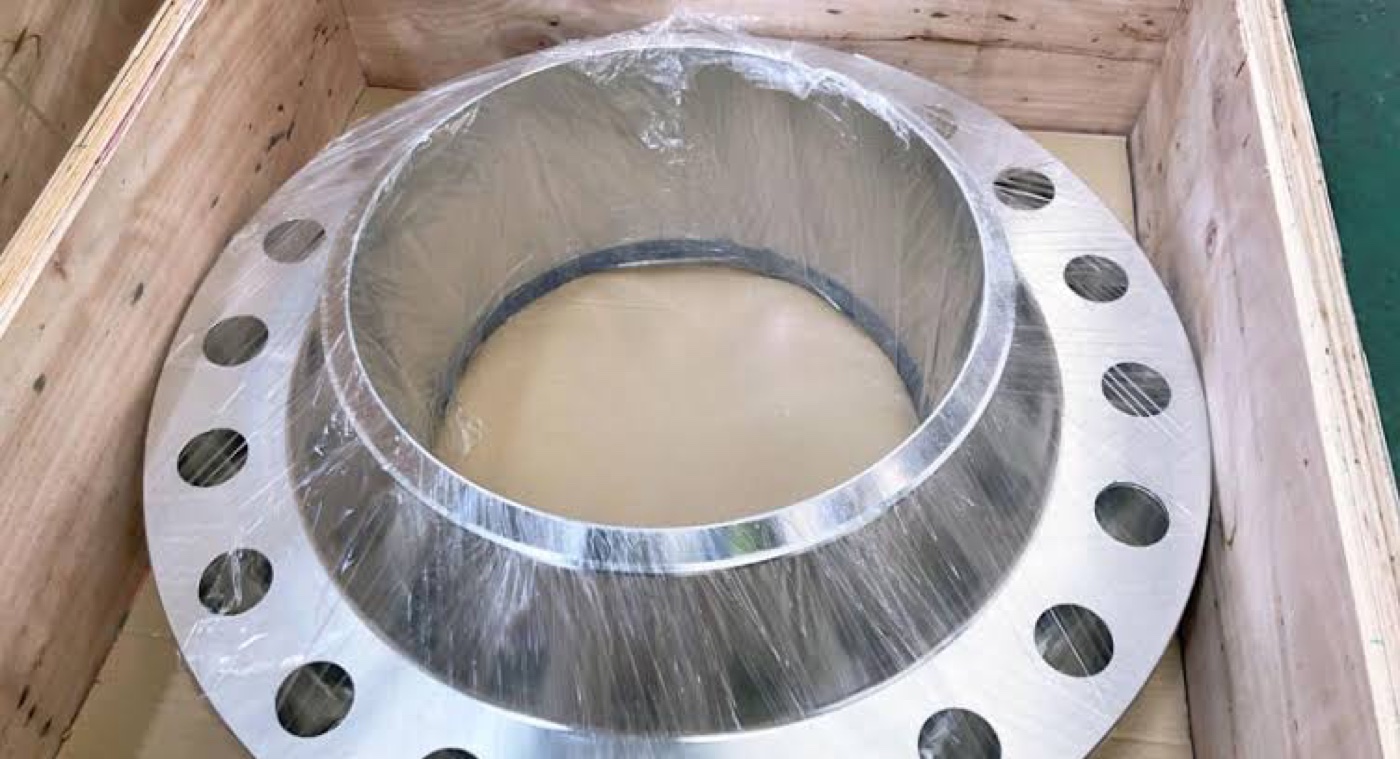
Large-Diameter F304L Weld Neck Flange — Wrapped & Crated for Export
ASTM A182 F304L Weld Neck Flange Dimensions
F304L weld neck flanges share their dimensions with every other material in the same class — OD, thickness, hub, bore, bolt circle and bolting per the standard tables. Full ASME B16.5 charts:
European PN dimensions are published on the EN 1092-1 Type 11, DIN 2631–2635 and BS 4504 pages.
Price List & How to Order
Stainless pricing tracks nickel plus the certification scope, so we quote live with a stated validity rather than publish a static list. To get a firm quotation, usually within 24 hours:
1
List your requirement — size (NB), class or PN, standard (ASME B16.5 / B16.47 / EN / DIN / BS), grade (F304L, or dual-certified 304/304L), pipe schedule or bore, and quantity.
2
Add the testing scope — IGC ASTM A262, 3.2 witness, PMI, impact testing for cryogenic duty, or project specifications.
ASTM A182 F304L Weld Neck Flanges — Frequently Asked Questions
What is an ASTM A182 F304L weld neck flange?
It is a weld neck flange forged from ASTM A182 grade F304L — the low-carbon variant of 18Cr-8Ni stainless steel 304, UNS S30403, with carbon capped at 0.030%. The long tapered hub is butt-welded to the pipe with the bore matched to the pipe schedule, giving a radiographable, fatigue-resistant joint whose heat-affected zone stays corrosion-safe without any post-weld treatment — which is exactly why the L grade exists.
What is the difference between 304, 304L and 304H?
Carbon — and the jobs it enables. 304L caps carbon at 0.030% so welding cannot sensitize the joint; standard 304 allows up to 0.08%; 304H requires a 0.04% minimum for creep strength above 525 °C. In welded corrosive service the L grade is the safe default; in creep-range heat the H grade is mandatory; standard 304 covers everything in between. Most modern melt practice lands in the overlap, which is why dual-certified 304/304L stock satisfies both callouts.
What is sensitization and how does 304L prevent it?
When austenitic stainless spends time at 450 to 850 °C — as every weld heat-affected zone briefly does — carbon combines with chromium into grain-boundary carbides, stripping the adjacent metal of the chromium it needs to resist corrosion. The result is weld decay: intergranular attack tracking the joint. With only 0.030% carbon there is too little to form a damaging carbide network, so 304L welds stay corrosion-resistant as-welded, with no post-weld anneal required.
What does dual-certified 304/304L mean?
A heat melted with carbon at or below 0.030% while still meeting standard 304's strength minimums certifies to both specifications on one mill certificate. That is normal modern practice — our stainless stock is typically dual-certified — so a dual flange satisfies a purchase order written around either grade, and inventories consolidate instead of splitting.
When should I choose 316L instead of 304L?
When chlorides enter the picture. 316L adds 2 to 3% molybdenum, lifting pitting resistance from a PREN of about 19 to the mid-20s — the difference between surviving coastal atmospheres, brackish cooling water and chloride-bearing process streams or not. For fresh water, food, dairy, pharma and general chemical duty, 304L delivers the same weld-safe metallurgy at a lower price. If chlorides exceed roughly 200 ppm or the service is marine, step up to 316L.
Can 304L flanges be used at cryogenic temperatures?
Yes — austenitic stainless has no ductile-brittle transition, so 304L keeps its toughness to liquid nitrogen temperatures and below (-196 °C and colder). LNG, liquid oxygen and nitrogen systems, cold boxes and cryogenic storage all flange in the L grades, with impact testing at the design temperature available on request. The same flange that serves a dairy line can serve a cold box — few materials cover that span.
What are the equivalent designations for A182 F304L?
SS 304L in general usage; UNS S30403; Werkstoff Nr. 1.4306 / 1.4307 (EN X2CrNi19-11 / X2CrNi18-9); JIS SUS 304L; BS 304S11; GOST 03Х18Н11; and AFNOR Z3CN18-10. Its system partners share the chemistry: A312 TP304L seamless pipe, A403 WP304L butt-weld fittings and A240 304L plate. An enquiry in any of these designations is quoted as the same material.
What is the chemical composition of ASTM A182 F304L?
Per ASTM A182: carbon 0.030% max — the defining cap — manganese 2.00% max, silicon 1.00% max, phosphorus 0.045% max, sulphur 0.030% max, chromium 18.00 to 20.00% and nickel 8.00 to 13.00%. No molybdenum or nitrogen requirement applies. The slightly wider nickel window than standard 304 helps the low-carbon melt stay fully austenitic.
What are the mechanical properties of A182 F304L flanges?
Minimum tensile strength 485 MPa (70 ksi), minimum yield strength 170 MPa (25 ksi) and minimum elongation 30%, with hardness typically limited to 92 HRB / 201 HB. The low carbon gives up a little room-temperature strength against standard 304 (485 versus 515 MPa tensile) — the deliberate price of weld-safe metallurgy, already accounted for in the flange pressure ratings.
Which pipe grades do F304L weld neck flanges mate with?
ASTM A312 TP304L seamless and welded pipe is the standard partner, with A403 WP304L butt-weld fittings completing the system. The weld neck bore is machined to the pipe schedule you state, so the bore runs flush through the joint and the bevel arrives ready for a matched-chemistry butt weld.
How are 304L flanges welded to pipe?
With E308L / ER308L filler and standard austenitic practice: moderate heat input, no preheat, no post-weld heat treatment. The L-grade chemistry is what makes that simplicity safe — the heat-affected zone cannot sensitize, so the joint goes into corrosive service as-welded. Back-purge TIG roots for hygienic and high-purity lines where internal oxide is unacceptable.
What testing and certification do you supply with F304L flanges?
Every lot ships with EN 10204 3.1 mill test certificates covering chemical analysis — demonstrating the 0.030% carbon cap — mechanical properties and the solution-anneal record, with 3.2 certification witnessed by Lloyd's, DNV, BV or TÜV on request. We also offer intergranular corrosion testing to ASTM A262 Practice E, PMI verification and hydrostatic or hardness testing to project specifications, with full heat-number traceability.
Are F304L flanges suitable for food, dairy and pharmaceutical service?
Yes — 304L is the default stainless of hygienic industries: inert to food chemistry, cleanable, and weldable without corrosion-prone zones. Flanges are supplied pickled and passivated; finer face finishes and full material traceability for validation documentation are available on request. Where process chemistry adds chlorides or aggressive cleaning regimes, 316L is the step up.
Where are ASTM A182 F304L weld neck flanges used?
Food, dairy, brewery and beverage plants; pharmaceutical and biotech utilities; water and wastewater treatment; chemical and petrochemical services without heavy chlorides; pulp and paper; cryogenic systems from LNG to liquid nitrogen; and general architecture of corrosion-resistant piping everywhere. It is the highest-volume stainless flange grade we forge — the working stainless of industry.
What sizes and standards do you manufacture F304L weld neck flanges in?
From 1/2 inch NB to 56 inch NB: ASME B16.5 Class 150 to 2500 up to 24 inch, ASME B16.47 above, and European PN 2.5 to PN 400 patterns to EN 1092-1 Type 11, DIN and BS 4504. Raised face is standard, flat face and ring joint on request — the large-diameter weld neck crated on this page is our own export production — and every bore is machined to the mating pipe schedule from Sch 10 through XXS.
Do you keep A182 F304L weld neck flanges in stock? What is the lead time?
Yes — 304/304L dual-certified stock covers the common sizes in Class 150, 300 and 600, usually available immediately. Larger diameters, higher classes and witness-tested lots are forged to order, typically in 2 to 4 weeks. Prices track nickel, so quotations carry a validity period — send the size list and we confirm the stock position the same day.
What information should I include in an F304L flange enquiry?
Six things: size (NB), pressure class or PN rating, dimensional standard (ASME B16.5, B16.47 or EN/DIN/BS), grade (F304L, or dual-certified 304/304L), pipe schedule or bore, and quantity. Add any testing scope — IGC ASTM A262, 3.2 witness, PMI, impact testing for cryogenic duty — and the facing if other than raised face. With these details we return a firm quotation, usually within 24 hours.
Do you export ASTM A182 F304L flanges outside India?
Yes. Tesco Steel & Engineering is an ISO 9001:2015 certified manufacturer based in Mumbai, and F304L flanges ship to food, pharmaceutical, chemical and water projects across the Middle East, Europe, Africa, Southeast Asia and the Americas. Flanges travel pickled, face-protected and seaworthy-packed — like the crated weld neck photographed on this page — with full heat-number and test traceability.

