ASTM A182 F316L Weld Neck Flanges — Stainless Steel 316L (UNS S31603)
Tesco Steel & Engineering forges ASTM A182 F316L weld neck flanges in stainless steel 316L — the low-carbon, molybdenum-bearing 16Cr-10Ni-2Mo austenitic grade, UNS S31603, Werkstoff Nr. 1.4404 / 1.4435 — from 1/2″ NB to 56″ NB. The 2–3% molybdenum resists the chloride pitting that defeats 304, and the 0.030% carbon ceiling keeps weld zones free of sensitisation — which is why 316L is the workhorse flange grade of chemical, pharmaceutical, food, marine and offshore piping. Machined to ASME B16.5 Class 150–2500, ASME B16.47, EN 1092-1 Type 11, DIN and BS 4504, bores matched to your pipe schedule, supplied pickled & passivated with EN 10204 3.1/3.2 certificates. ISO 9001:2015, made in Mumbai, India — exported worldwide.
A182 F316L · UNS S31603
1.4404 / 1.4435 · SUS 316L
1/2″ – 56″ NB
Class 150 – 2500 · PN 2.5 – 400
2–3% Mo · Chloride-Pitting Resistant
Dual-Certified 316/316L
ISO 9001:2015 · Exported Worldwide
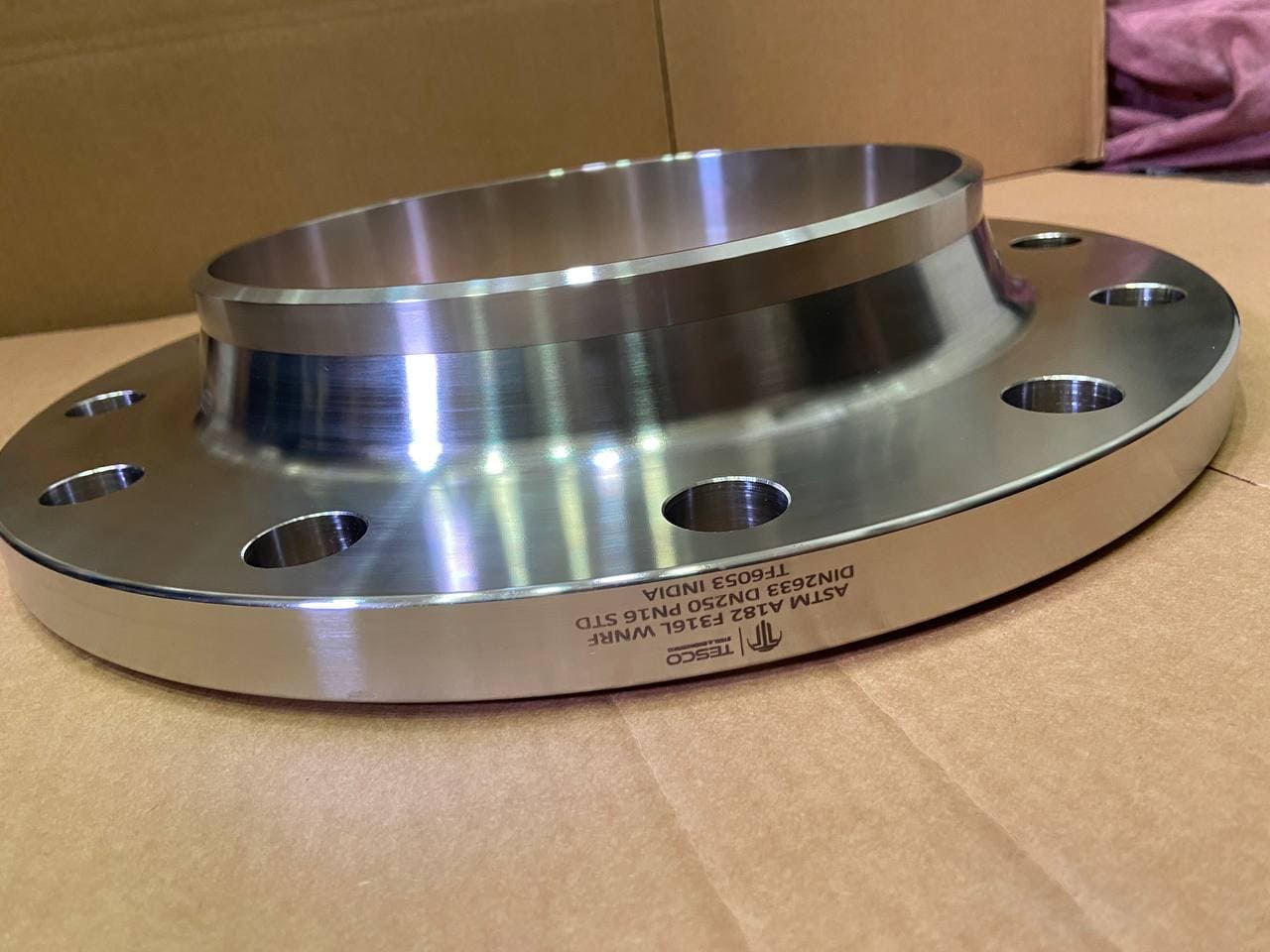
ASTM A182 F316L Weld Neck Flange — DN250 PN16 (DIN 2633), Laser-Marked, From Production
What is an ASTM A182 F316L Weld Neck Flange?
ASTM A182 F316L is the forged-flange grade of stainless steel 316L — a 16–18% chromium, 10–14% nickel austenitic alloy whose 2–3% molybdenum addition resists chloride pitting and crevice corrosion, with carbon held to 0.030% max so welding never sensitises the joint. A 316L weld neck flange pairs that chemistry with the strongest flange design: a long tapered hub butt-welded to the pipe, bore matched to the pipe schedule, joint fully radiographable. It is the most widely ordered corrosion-resistant flange in process piping.
The weld neck geometry carries its usual advantages into corrosive service — and adds one more. The tapered hub spreads pressure, bending and vibration stresses into the pipe wall; the matched bore leaves no step in the flow path; and critically for stainless systems, no step means no crevice — the geometry where chloride attack loves to start. The butt weld is radiographed at installation, and after welding the joint area is pickled to restore the passive layer.
Within the 316 family, 316L is the welding-safe specification: its 0.030% carbon ceiling prevents chromium carbide precipitation in the heat-affected zone. Most of our forging stock is dual-certified 316/316L — L-grade carbon with standard-316 strength — so one flange satisfies specifications written around either designation. The flange pictured above, laser-marked ASTM A182 F316L WNRF · DIN 2633 DN250 PN16, is a production example.
Also searched as: SS 316L weld neck flange, 316L WNRF flange, UNS S31603 flange, 1.4404 / 1.4435 flange, SUS 316L flange, X2CrNiMo17-12-2 flange — all refer to the product on this page.
Chemical Composition of ASTM A182 F316L
| C | Mn | Si | P | S | Cr | Mo | Ni | N |
|---|
| 0.030 max | 2.00 max | 1.00 max | 0.045 max | 0.030 max | 16.00-18.00 | 2.00-3.00 | 10.00-14.00 | 0.10 max |
Values in weight %. Molybdenum is the working ingredient — it lifts pitting resistance (PREN ≈ 24–26) well beyond 304-family grades — while the tight carbon ceiling protects weld heat-affected zones from sensitisation. Every heat is analysed and reported on the mill test certificate.
Mechanical Properties of ASTM A182 F316L
| Tensile Strength, MPa | Yield Strength, Min, MPa | Elongation % min. |
|---|
| 485 | 170 | 30 |
Minimums per ASTM A182 for grade F316L. The low carbon trades a little strength against standard 316 (515 / 205 MPa) — where your design needs the full 316 values, we supply dual-certified 316/316L forgings meeting both. Like all austenitics, 316L is not hardenable by heat treatment and keeps its toughness to cryogenic temperatures.
Equivalent Grades of ASTM A182 F316L
| Standard | Werkstoff Nr. | UNS | JIS | BS | GOST | AFNOR | EN |
|---|
| SS 316L | 1.4404 / 1.4435 | S31603 | SUS 316L | 316S11 / 316S13 | 03Ch17N14M3 / 03Ch17N14M2 | Z3CND17‐11‐02 / Z3CND18‐14‐03 | X2CrNiMo17-12-2 / X2CrNiMo18-14-3 |
An enquiry in any of these designations is quoted as the same material. 1.4435 is the higher-nickel, higher-molybdenum end of the 316L band, often requested for pharmaceutical and fine-chemical work — specify it if your project demands it.
ASTM A182 F316L Weld Neck Flange Specifications
| ASTM A182 316L Weld Neck Flanges are available in the following specifications: |
|---|
| Size | 1/2"NB to 56"NB |
| Class | 150#, 300#, 400#, 600#, 900#, 1500#, 2500# |
| Sch (Schedule) | XS, XXS, STD & Schedule 20, 40, 80, 160 |
| Pressure Ratings | PN 2.5 - PN 400 |
| Standards | ASME B16.5, ASME B16.47, EN 1092-1 Type 11, DIN 2631–2635, BS 4504 |
| Facings | Raised Face (WNRF), Flat Face (WNFF) |
| Other Services | Pickling & passivation on ASTM A182 316L Weld Neck Flanges
Sand Blasting on ASTM A182 316L Weld Neck Flanges
Shot Peening on ASTM A182 316L Weld Neck Flanges
IGC (ASTM A262) & PMI testing
Project-specific marking, wrapping & boxed export packing |
Why 316L for Corrosion-Resistant Flanged Joints
Molybdenum Against Chlorides
2–3% Mo lifts pitting and crevice corrosion resistance decisively above 304-family grades — the difference between surviving and failing in coastal air, brackish water and brine service.
Welds Without Sensitisation
The 0.030% carbon ceiling stops chromium carbide precipitation in the heat-affected zone, so the corrosion resistance you paid for survives the butt weld — no post-weld heat treatment needed.
No Crevice at the Joint
The weld neck's matched bore leaves no step and no crevice in the flow path — removing the exact geometry where chloride attack initiates in stainless piping systems.
Cryogenic to 450 °C
Fully austenitic, no ductile-brittle transition: the same flange grade serves LNG cold boxes and hot process lines, with design stresses per the ASME rating tables.
Dual-Certified Flexibility
Most of our stock meets 316 strength at 316L carbon and is certified to both — one flange for either specification, simpler stocking for mixed project specs.
Where ASTM A182 F316L Weld Neck Flanges Are Used
Chemical and petrochemical plants are the volume users — process lines, acid circuits, solvent and additive systems. Pharmaceutical, food and dairy plants specify 316L (often the 1.4435 variant) for cleanability and corrosion-free product contact. Marine, offshore and desalination installations run it on topside piping, seawater-adjacent utilities and RO trains; water treatment, pulp & paper and textile plants on dosing and bleach-adjacent lines; and LNG and cryogenic facilities exploit its low-temperature toughness. When carbon steel corrodes and duplex or nickel alloys are more than the service demands, 316L is the answer — which is why it is the most-ordered stainless flange grade in the industry.
ASTM A182 F316L Weld Neck Flange Dimensions
F316L weld neck flanges follow the standard dimensional tables — OD, thickness, hub, bore, bolt circle and bolting are identical to any other material in the same class. Full ASME B16.5 charts for every class:
European PN dimensions — like the DIN 2633 DN250 PN16 flange pictured above — are published on the EN 1092-1 Type 11, DIN 2631–2635 and BS 4504 pages.
Price List & How to Order
Pricing depends on size, class and quantity and moves with the nickel and molybdenum markets, so we quote live rather than publish a static list. As our most-stocked stainless grade, 316L ships fast at highly competitive export prices. To get a firm quotation, usually within 24 hours:
1
List your requirement — size (NB or DN), class or PN, standard (e.g. ASME B16.5 / EN 1092-1 Type 11 / DIN 2633), grade (316L or dual-certified 316/316L), pipe schedule or bore, and quantity.
2
Add any extras — IGC testing, 3.2 certification, PMI, flat facing or a special finish.
ASTM A182 F316L Weld Neck Flanges — Frequently Asked Questions
What is an ASTM A182 F316L weld neck flange?
It is a weld neck flange forged from stainless steel 316L — the low-carbon, molybdenum-bearing austenitic grade (16-18% chromium, 10-14% nickel, 2-3% molybdenum) — under the ASTM A182 forging specification, grade F316L. The long tapered hub is butt-welded to the pipe with the bore matched to the pipe schedule, giving a radiographable, fatigue-resistant joint in the most widely specified corrosion-resistant flange material in process piping.
What is the difference between 316 and 316L flanges?
Carbon. 316 allows up to 0.08% carbon while 316L is capped at 0.030%. During welding, higher carbon lets chromium carbides form at grain boundaries in the heat-affected zone (sensitisation), which invites intergranular corrosion; the L grade avoids this, so welded piping is normally specified 316L. Much forged stock is dual-certified 316/316L — meeting the L carbon limit while achieving standard 316 strength — giving you both compliance paths on one certificate.
When should I choose 316L over 304L flanges?
Whenever chlorides or reducing acids are in play. The 2-3% molybdenum in 316L roughly doubles its pitting resistance compared with 304L, which is why 316L is the default for coastal and marine atmospheres, brackish cooling water, brines, sulphuric and acetic acid service and most chemical plant duty. If the medium is mild — fresh water, food-grade, dry indoor atmospheres — 304L does the job for less money.
What are the equivalent designations for 316L?
UNS S31603; Werkstoff Nr. 1.4404 and the higher-nickel/molybdenum 1.4435; JIS SUS 316L; BS 316S11 / 316S13; GOST 03Ch17N14M3 / 03Ch17N14M2; AFNOR Z3CND17-11-02 / Z3CND18-14-03; and EN X2CrNiMo17-12-2 / X2CrNiMo18-14-3. An enquiry in any of these designations is quoted as the same material — the full cross-reference table is published on this page.
What is the chemical composition of ASTM A182 F316L?
Carbon 0.030% max, manganese 2.00% max, silicon 1.00% max, phosphorus 0.045% max, sulphur 0.030% max, chromium 16.00 to 18.00%, molybdenum 2.00 to 3.00%, nickel 10.00 to 14.00% and nitrogen 0.10% max. The molybdenum is the working ingredient against chloride pitting; the low carbon protects weld zones from sensitisation.
What are the mechanical properties of A182 F316L flanges?
Per ASTM A182, grade F316L requires a minimum tensile strength of 485 MPa (70 ksi), minimum yield strength of 170 MPa (25 ksi) and 30% minimum elongation. Note these are slightly below standard 316 (515 / 205 MPa) — the price of the low carbon. Where design stresses demand full 316 values, we supply dual-certified 316/316L forgings that meet both.
What corrosion service can 316L flanges handle?
Chloride-bearing atmospheres and waters, brines, food and pharma process fluids, organic acids, sulphuric acid at low concentration and temperature, phosphoric acid, and general chemical plant duty. Its pitting resistance equivalent number (PREN) of roughly 24 to 26 covers most process environments; for hotter, more concentrated chlorides step up to duplex 2205, super duplex 2507, 904L or 254 SMO — all of which we forge as well.
What temperature range can 316L flanges be used in?
From cryogenic service — the austenitic structure keeps its toughness at liquid-gas temperatures with no ductile-brittle transition — up to around 450 to 500 °C for pressure duty, where design stresses follow the ASME rating tables. Above that range, carbide effects and falling strength make 316H or a heat-resistant grade like 310S the better choice. For most corrosive process service, 316L's limits are set by the medium, not the metal.
What sizes and standards do you manufacture F316L weld neck flanges in?
From 1/2 inch NB to 56 inch NB in ASME B16.5 Class 150 to 2500, ASME B16.47 Series A and B above 24 inch, and European PN 2.5 to PN 400 ratings to EN 1092-1 Type 11, DIN 2631 to 2635 and BS 4504 — the flange pictured on this page is a DIN 2633 DN250 PN16 example from production. Raised face is standard, flat face on request, and every bore is machined to the mating pipe schedule from Sch 10 through XXS.
How are 316L flanges welded to pipe?
By TIG or MMA using matching ER316L / E316L filler, with low heat input and interpass temperature control, no preheat and no post-weld heat treatment. The low-carbon chemistry keeps the heat-affected zone free of chromium carbide precipitation, so corrosion resistance survives the weld. The weld neck bevel comes machined at 37.5 degrees, ready for a radiographable butt weld, and weld areas are pickled after welding to restore the passive layer.
Where are ASTM A182 F316L weld neck flanges used?
Chemical and petrochemical plants above all, then pharmaceutical and food processing lines where cleanability and corrosion-free surfaces are mandatory, marine and offshore topside piping, desalination and water treatment, pulp and paper, and LNG and cryogenic installations. 316L is the most-ordered stainless flange grade in the industry — the default answer when carbon steel corrodes and exotic alloys are overkill.
Can you supply dual-certified 316/316L flanges?
Yes — most of our 316L forging stock is dual-certified. The material meets the 0.030% carbon ceiling of 316L while achieving the higher strength minimums of straight 316, and the mill test certificate states both grades. That lets one flange satisfy specifications written around either designation, and simplifies stocking for contractors running mixed project specs.
What testing and certification do you supply with F316L flanges?
Every lot ships with EN 10204 3.1 mill test certificates covering chemical analysis and mechanical properties, with 3.2 certification witnessed by Lloyd's, DNV, BV or TÜV on request. We also offer PMI (positive material identification), intergranular corrosion testing to ASTM A262 Practice E, dye penetrant examination and dimensional reports, with full heat-number traceability from billet to finished flange.
How are your F316L flanges finished and marked?
Flanges are pickled and passivated to restore the chromium oxide passive layer, faces are protected for shipment, and each flange is laser- or stamp-marked on the rim with grade, size, rating, standard and heat number — exactly as visible on the DN250 PN16 flange photographed on this page. Special project marking, tagging and colour coding are applied on request.
Do you keep 316L weld neck flanges in stock? What is the lead time?
316L is our most-stocked stainless grade: common sizes from 1/2 to 24 inch in Class 150 and 300, and popular DIN/EN PN 10/16/40 sizes, generally ship within days. Larger diameters, higher classes and special facings are forged and machined to order, usually in 2 to 4 weeks depending on size and quantity. Send your list for a firm delivery commitment.
What information should I include in an F316L flange enquiry?
Six things: size (NB or DN), pressure class or PN rating, dimensional standard (for example ASME B16.5 or EN 1092-1 Type 11 / DIN 2633), grade (316L or dual-certified 316/316L), pipe schedule or bore, and quantity. Add any extras — IGC testing, 3.2 certification, flat facing or special finish. With these details we return a firm quotation, usually within 24 hours.
Do you export ASTM A182 F316L flanges outside India?
Yes. Tesco Steel & Engineering is an ISO 9001:2015 certified manufacturer based in Mumbai, and 316L is the grade we export most — to chemical plants, EPC contractors, shipyards and water projects across the Middle East, Europe, Africa, Southeast Asia and the Americas. Export packing is seaworthy, faces are protected, and every flange carries stamped traceability from heat number to finished part.

