ASTM A182 F304H Weld Neck Flanges — High-Carbon SS 304H (UNS S30409)
Tesco Steel & Engineering forges ASTM A182 F304H weld neck flanges in stainless steel 304H — UNS S30409, Werkstoff Nr. 1.4948, the 18Cr-8Ni austenitic with carbon deliberately held at 0.04–0.10% — from 1/2″ NB to 56″ NB, in ASME B16.5 Class 150–2500 and European PN patterns. That carbon floor is the whole point: it buys the creep and stress-rupture strength ASME codes credit above ~525 °C, making 304H the flange of boiler circuits, refinery heaters, steam piping and hot process systems, mating A312 TP304H pipe. Solution annealed for creep service, welded with E308H, with IBR, PMI and EN 10204 3.1/3.2 on request. ISO 9001:2015, made in Mumbai, India — exported worldwide.
A182 F304H · UNS S30409 · 1.4948
C 0.04–0.10% · Creep Rated
1/2″ – 56″ NB
Class 150 – 2500 · PN 2.5 – 400
Service Above 525 °C
IBR Form III-C on Request
ISO 9001:2015 · Exported Worldwide
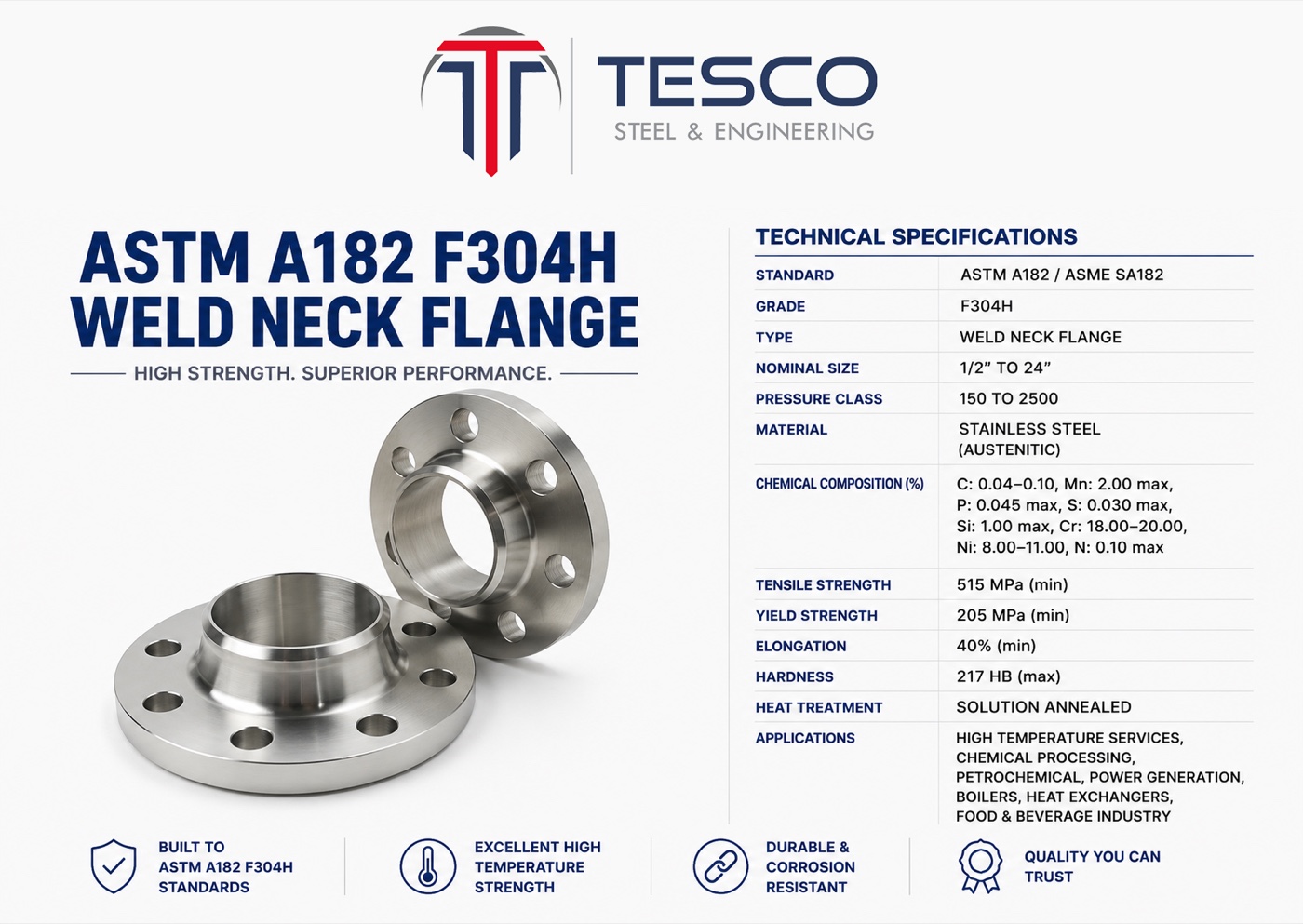
ASTM A182 F304H Weld Neck Flange — Stainless Steel 304H (UNS S30409), Technical Specifications
What is an ASTM A182 F304H Weld Neck Flange?
ASTM A182 F304H is the forged-flange grade of stainless steel 304H (UNS S30409 / 1.4948) — classic 18Cr-8Ni austenitic chemistry with one decisive change: carbon is required at 0.04–0.10%, a minimum as well as a maximum. That carbon pins grain boundaries against creep, so ASME code tables carry 304H into service above ~525 °C with certified time-dependent allowable stresses. An F304H weld neck flange pairs that pedigree with a long tapered hub butt-welded to the pipe, bore matched to schedule, joint fully radiographable.
The 304 family splits by carbon: 304L (0.030% max) buys corrosion insurance for aqueous service, standard 304 sits in the middle, and 304H claims the high-temperature end — the only one the code follows into the creep range. H-grade practice adds a high-temperature solution anneal and coarser grain, both of which extend stress-rupture life in boilers, fired heaters and hot steam systems.
The trade-off is honest: carbides precipitate during creep-range service, which is fine in hot gas and steam but matters at shutdowns in some refinery chemistry — where the stabilized 321H and 347 family takes over. For everything below the creep range, see our standard F304 weld neck flanges.
Also searched as: SS 304H weld neck flange, UNS S30409 flange, 1.4948 flange, 304H WNRF flange, SA182 F304H flange, high temperature stainless steel flange — all refer to the product on this page.
Chemical Composition of ASTM A182 F304H
| C | Mn | Si | P | S | Cr | Mo | Ni | N |
|---|
| 0.04-0.10 | 2.00 max | 0.75 max | 0.045 max | 0.030 max | 18.00-20.00 | - | 8.00-10.50 | - |
Values in weight %. The 0.04% carbon minimum is the H grade's defining requirement — it underwrites the creep strength — and every certificate demonstrates it. Where the heat's carbon falls in the 0.04–0.08% window, flanges can be dual-certified 304/304H.
Mechanical Properties of ASTM A182 F304H
| Tensile Strength, MPa | Yield Strength, Min, MPa | Elongation % min. |
|---|
| 515 | 205 | 30 |
Minimums per ASTM A182 — identical to standard 304 at room temperature. The H grade's advantage lives in the ASME time-dependent allowable stresses above ~525 °C, where 304H's certified creep and stress-rupture values carry the design and plain 304 has none listed. The mandatory solution-annealed condition is documented on every certificate.
Equivalent Grades of ASTM A182 F304H
| Standard | Werkstoff Nr. | UNS |
|---|
| SS 304H | 1.4948 | S30409 |
Also written EN X6CrNi18-10. System partners: A312 TP304H seamless pipe, A403 WP304H butt-weld fittings and A240 304H plate. The creep-range stainless family continues with 316H, 321H and 310/310S.
ASTM A182 F304H Weld Neck Flange Specifications
| ASTM A182 304H Weld Neck Flanges are available in the following specifications: |
|---|
| Size | 1/2"NB to 56"NB |
| Class | 150#, 300#, 400#, 600#, 900#, 1500#, 2500# |
| Sch (Schedule) | XS, XXS, STD & Schedule 20, 40, 80, 160 |
| Pressure Ratings | PN 2.5 - PN 400 |
| Standards | ASME B16.5, ASME B16.47, EN 1092-1 Type 11, DIN 2631–2635, BS 4504 |
| Condition | Solution Annealed (high-temperature practice for creep service); dual-certifiable 304/304H |
| Other Services | Pickling & passivation on ASTM A182 304H Weld Neck Flanges
Sand Blasting on ASTM A182 304H Weld Neck Flanges
Shot Peening on ASTM A182 304H Weld Neck Flanges
PMI, grain size reporting & IBR Form III-C certification
Project-specific marking, wrapping & export packing |
Why 304H When the Pipe Runs Hot
Code-Listed Creep Strength
Above ~525 °C, ASME allowable stresses become time-dependent — and only the H grade carries certified values there. The 0.04% carbon floor is what the code is crediting.
One Chemistry, Pipe to Flange
A312 TP304H pipe, A403 WP304H fittings, A182 F304H flanges — a matched creep-rated system with E308H weld metal holding the same pedigree through the joints.
Economical Above the Chrome-Molys
Where 600 °C+ oxidation retires even P91, austenitic 304H holds strength and scaling resistance at the lowest price in the stainless creep family.
Boiler Paperwork Ready
IBR Form III-C for Indian boiler scope, 3.2 witness inspection, PMI and grain size reporting — the documentation high-temperature projects specify, delivered with the flange.
Dual-Certified 304/304H
Heats melted into the 0.04–0.08% carbon window certify to both grades — one flange covers specifications written around either.
Welding 304H — Keep the Carbon in the Joint
304H welds with standard austenitic ease — no preheat, no PWHT in normal practice, moderate heat input. The discipline is in the consumable: use E308H / ER308H, whose controlled carbon (0.04–0.08%) and ferrite keep the weld metal as creep-resistant as the base material. Substituting ordinary 308L filler quietly deletes the creep strength the H grade was specified for — a paperwork-invisible downgrade that surfaces years later, at temperature.
Sensitization note: carbide precipitation during creep-range service is accepted H-grade metallurgy — but where shutdown chemistry (classically polythionic acid in refinery units) threatens intergranular attack, specify the stabilized grades
321H or
347 instead.
Where ASTM A182 F304H Weld Neck Flanges Are Used
Power and steam lead: boiler circuits, main steam and hot reheat auxiliaries, waste heat recovery. Refining and petrochemicals follow: fired heaters and transfer lines, FCC and reformer units, ethylene and ammonia plant hot sections. Incinerators, hot-air systems and high-temperature exchangers complete the range — any flanged joint that spends its life above 525 °C in steam, hot air or combustion gas. The heavy Class 1500 weld necks below are our own production:
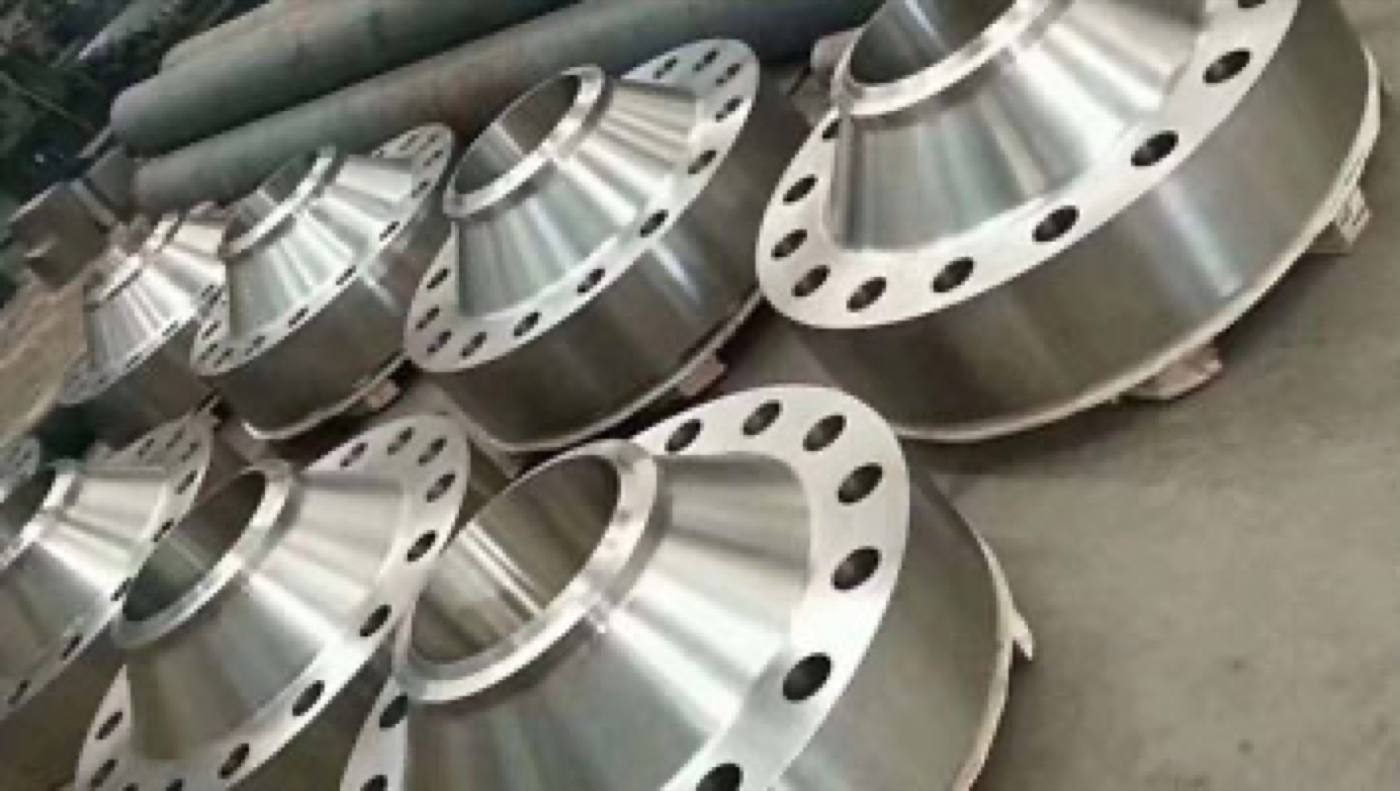
Series A Weld Neck Flanges — Class 1500 RTJ, Heavy Hubs in Production
ASTM A182 F304H Weld Neck Flange Dimensions
F304H weld neck flanges share their dimensions with every other material in the same class — OD, thickness, hub, bore, bolt circle and bolting per the standard tables. Full ASME B16.5 charts:
European PN dimensions are published on the EN 1092-1 Type 11, DIN 2631–2635 and BS 4504 pages.
Price List & How to Order
Stainless pricing tracks nickel plus the certification scope, so we quote live with a stated validity rather than publish a static list. To get a firm quotation, usually within 24 hours:
1
List your requirement — size (NB), class or PN, standard (ASME B16.5 / B16.47 / EN / DIN / BS), grade (F304H, or dual-certified 304/304H), pipe schedule or bore, and quantity.
2
Add the certification scope — IBR Form III-C, 3.2 witness, PMI, grain size reporting or project specifications.
ASTM A182 F304H Weld Neck Flanges — Frequently Asked Questions
What is an ASTM A182 F304H weld neck flange?
It is a weld neck flange forged from ASTM A182 grade F304H — the high-carbon variant of 18Cr-8Ni stainless steel 304, UNS S30409, with carbon deliberately held at 0.04 to 0.10%. The long tapered hub is butt-welded to the pipe with the bore matched to the pipe schedule, giving a radiographable, fatigue-resistant joint in the austenitic grade that ASME codes credit with creep strength above about 525 °C — boiler, heater and hot steam territory.
What is the difference between 304, 304L and 304H?
Carbon — and the jobs it enables. 304L caps carbon at 0.030% to prevent sensitization in corrosive aqueous service; standard 304 allows up to 0.08%; 304H requires a minimum of 0.04% because at high temperature that carbon is a strength element, pinning grain boundaries against creep. The H grade trades low-temperature corrosion insurance for certified stress-rupture performance: it is the only one of the three the ASME code tables carry into the creep range with full allowable stresses.
Why does 304H require a minimum carbon content?
Because above roughly 525 °C the design question changes from short-term strength to creep — slow, continuous deformation under sustained load. Carbon in solution and as fine carbides resists that mechanism, so the H specification writes a floor of 0.04% into the chemistry, and pairs it with a high-temperature solution anneal and coarser grain practice that further improve stress-rupture life. A lean 0.02% carbon 304 simply cannot certify the same allowable stresses at 600 °C.
What temperature range are F304H flanges used in?
The grade earns its keep from about 525 °C — where ASME allowable stresses become time-dependent and standard or L-grade 304 drops out — up to roughly 815 °C for pressure duty, with oxidation resistance in continuous service to about 870 °C. Below the creep range, ordinary 304/304L is the economical choice; above it, 304H holds code-listed allowable stresses where carbon steel and low-alloy grades are long gone.
What are the equivalent designations for A182 F304H?
SS 304H in general usage; UNS S30409; and Werkstoff Nr. 1.4948 (X6CrNi18-10) in the European system. Its system partners share the chemistry: A312 TP304H seamless pipe, A403 WP304H butt-weld fittings and A240 304H plate. An enquiry in any of these designations is quoted as the same material.
What is the chemical composition of ASTM A182 F304H?
Per our supply practice: carbon 0.04 to 0.10% — the defining requirement, with a minimum as well as a maximum — manganese 2.00% max, silicon 0.75% max, phosphorus 0.045% max, sulphur 0.030% max, chromium 18.00 to 20.00% and nickel 8.00 to 10.50%. No molybdenum or nitrogen requirement applies. The carbon floor is what separates H-grade from every other 304 and underwrites its creep strength.
What are the mechanical properties of A182 F304H flanges?
Minimum tensile strength 515 MPa (75 ksi), minimum yield strength 205 MPa (30 ksi) and minimum elongation 30% — the same room-temperature minimums as standard 304. The difference appears where it matters: in the ASME time-dependent allowable stresses above 525 °C, where 304H's certified creep and stress-rupture values carry the design and plain 304 has none to offer.
Which pipe grades do F304H weld neck flanges mate with?
ASTM A312 TP304H seamless and welded pipe is the standard partner, with A403 WP304H butt-weld fittings completing the system. The weld neck bore is machined to the pipe schedule you state, so the bore runs flush through the joint and the bevel arrives ready for a matched-chemistry butt weld — one creep-rated chemistry from pipe to flange.
How are 304H flanges welded to pipe?
With E308H / ER308H filler — the H-grade consumable whose controlled carbon (0.04-0.08%) and ferrite keep the weld metal as creep-resistant as the base material. Standard austenitic practice applies: moderate heat input, no preheat, no PWHT in normal service. Using ordinary 308L filler on a 304H joint quietly deletes the creep strength the H grade was specified for, so consumable control matters on these systems.
Does 304H suffer from sensitization? Should I worry about corrosion?
In the creep range, chromium carbides do precipitate at grain boundaries — that is accepted metallurgy for H-grade service, where the environment is hot gas or steam rather than aggressive aqueous chemistry. The caveat applies at shutdowns and on the water side: sensitized material can suffer intergranular attack or polythionic acid stress corrosion in refinery service. Where that risk drives the design, the stabilized grades 321H and 347H are the engineered answer — we forge those too.
When should I choose 321H or 347H instead of 304H?
When the service combines creep-range temperature with a sensitization-driven corrosion risk — classically refinery units where polythionic acid attack strikes during shutdowns. Titanium-stabilized 321H and niobium-stabilized 347H tie up carbon so grain boundaries stay chromium-rich, at a price premium over 304H. For clean steam, hot air and combustion gas duty, 304H remains the economical creep-rated choice.
Are F304H flanges suitable for IBR (boiler) applications?
Yes — high-temperature boiler and steam-line duty is exactly where 304H lives, and we supply flanges with IBR Form III-C certification for Indian boiler regulation scope on request. State the IBR requirement in the enquiry so the heat, testing and documentation are aligned from the start.
What testing and certification do you supply with F304H flanges?
Every lot ships with EN 10204 3.1 mill test certificates covering chemical analysis — demonstrating the 0.04% carbon minimum — mechanical properties and the solution-anneal record, with 3.2 certification witnessed by Lloyd's, DNV, BV or TÜV on request. We also offer PMI verification, grain size reporting, IBR Form III-C and hydrostatic or hardness testing to project specifications, with full heat-number traceability.
Where are ASTM A182 F304H weld neck flanges used?
Power plant boiler circuits, main steam and hot reheat auxiliary lines, refinery fired heaters and transfer lines, FCC and reformer units, ethylene and ammonia plant hot sections, waste heat recovery, incinerators and high-temperature heat exchangers — any flanged joint that spends its life above 525 °C in steam, hot air or combustion gas, where the code asks for certified creep strength.
What sizes and standards do you manufacture F304H weld neck flanges in?
From 1/2 inch NB to 56 inch NB: ASME B16.5 Class 150 to 2500 up to 24 inch, ASME B16.47 above, and European PN 2.5 to PN 400 patterns to EN 1092-1 Type 11, DIN and BS 4504. Raised face is standard, ring joint for high-class service on request — the heavy Class 1500 weld necks photographed on this page are our own production — and every bore is machined to the mating pipe schedule from Sch 10 through XXS.
Do you keep A182 F304H weld neck flanges in stock? What is the lead time?
Common boiler and refinery sizes in Class 150, 300 and 600 rotate through regular production, with popular items often available from stock. Larger diameters, higher classes and IBR or witness-tested lots are forged to order, typically in 3 to 5 weeks. Prices track nickel and the testing scope, so quotations carry a validity period — send the size list and we confirm the stock position the same day.
What information should I include in an F304H flange enquiry?
Six things: size (NB), pressure class or PN rating, dimensional standard (ASME B16.5, B16.47 or EN/DIN/BS), grade (F304H — or dual-certified 304/304H where the carbon window allows), pipe schedule or bore, and quantity. Add the certification scope — IBR Form III-C, 3.2 witness, PMI, grain size — since high-temperature paperwork is usually specification-driven. With these details we return a firm quotation, usually within 24 hours.
Do you export ASTM A182 F304H flanges outside India?
Yes. Tesco Steel & Engineering is an ISO 9001:2015 certified manufacturer based in Mumbai, and F304H flanges ship to power, refinery and petrochemical projects across the Middle East, Europe, Africa, Southeast Asia and the Americas. Flanges travel pickled, face-protected and seaworthy-packed, with full heat-number and test traceability.

