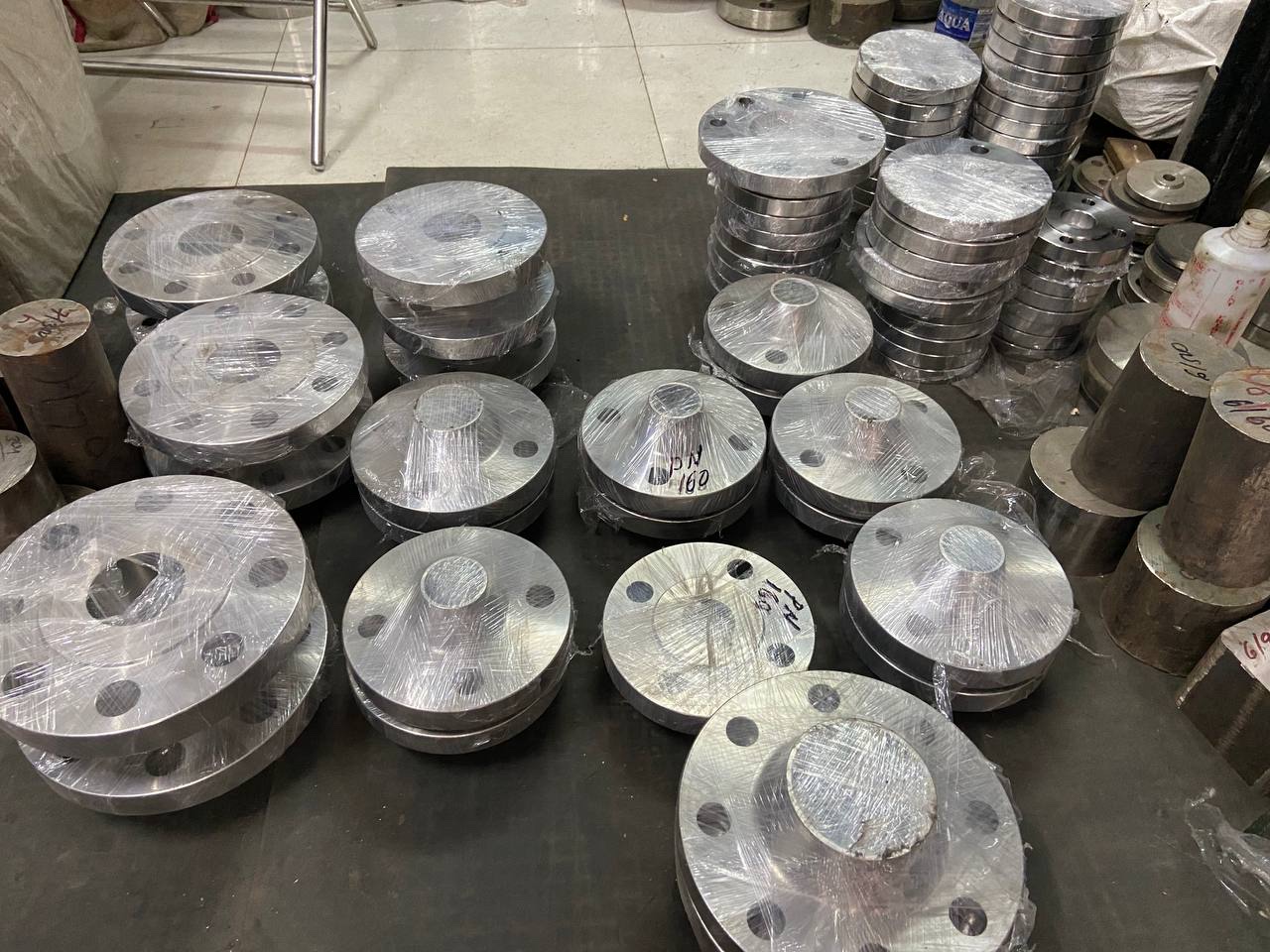
Tesco Steel & Engineering manufactures ASTM A182 F304H lap joint flanges — the carbon-floor grade (UNS S30409, W.Nr. 1.4948) bought for numbers that never appear on a tensile report: the time-dependent allowable stresses above roughly 525 °C, where heats without the 0.04–0.10% carbon band are excluded. On the lap joint bench this page is the mirror of the L-grade's irony: the never-welded ring runs at line metal temperature, so this letter is not wasted on it — creep does not care what was welded, only how hot the metal runs and for how long. The room-temperature certificate reads exactly like plain 304's — 515/205 MPa at 30% — while the H particulars live in the furnace records: a solution anneal run hot enough to dissolve the carbon, and a deliberately coarser grain (ASTM 7 or coarser where specified, verified metallographically). The single butt weld belongs to the A403 WP304H stub end per B16.9 — the same carbon floor on both halves. Per ASME B16.5, ½″–24″ NB, Classes 150–2500, pickled & passivated. Every lot with EN 10204 3.1/3.2 MTC. ISO 9001:2015, made in Mumbai, India — exported to 50+ countries.
ASTM A182 F304H · UNS S30409 · W.Nr. 1.4948Carbon 0.04–0.10% — A Floor as Well as a CeilingBought for Numbers No Tensile Report ShowsThe Mirror of the L-Irony — the H Is Not WastedHot Anneal · Deliberately Coarser GrainStub Ends: A403 WP304H per B16.9½″–24″ NB · Classes 150–2500EN 10204 3.1 / 3.2 · ISO 9001:2015
ASTM A182 F304H Lap Joint Flanges — Specifications at a Glance
What is an ASTM A182 F304H Lap Joint Flange?
The carbon-floor backing flange. An ASTM A182 F304H lap joint flange is the loose backing ring of the two-piece system in high-carbon 18/8 austenitic (UNS S30409) — carbon specified 0.04–0.10%, a floor as well as a ceiling, because at creep temperatures carbon is strength. The grade buys the code's time-dependent allowables above ~525 °C, and the lap joint reverses the L-grade's verdict: the ring runs at line metal temperature, so the H is metallurgy on both halves. Per ASME B16.5, ½″–24″ NB, Classes 150–2500, 515/205/30%, hot solution anneal with deliberately coarser grain; stub ends A403 WP304H per B16.9. EN 10204 3.1 with the carbon value on every certificate.
Also searched as: F304H backing flange, 304H stainless lap joint flange, S30409 lap joint flange, high-carbon loose flange, SS 304H LJ flange — all this page's product. Related pages: the lap joint hub (the pattern's full story), the trio's other two — F304 and F304L — the hot bench elsewhere — F11 and the chrome-moly staircase — the F304H bench — weld neck / blind / long weld neck — and the stainless steel overview.
One Element, Three Grades — Read from the Hot End
Grade
Carbon
What the Dial Buys
F304H (this page)
0.04–0.10% — a floor
Standing in the creep tables above ~525 °C — the same carbides, deliberately kept
Weld zones that cannot sensitize — the as-welded corrosion standard
The certificate trap runs both ways: a heat certifying 0.02% carbon is 304L territory and fails the H-grade outright, however perfect the rest of the analysis — and dual 304/304L stock can never cover an H order. One element, dialled three ways, making three grades.
The Mirror of the L-Irony — Why This Letter Is Not Wasted on the Ring
No — the ring has no weld zone; its L is bought for paperwork uniformity
The H (this page)
Creep — time at temperature under sustained stress
Yes — the ring runs at line metal temperature under sustained bolt load, and the creep tables govern it too
Creep does not care what was welded — it cares how hot the metal runs and for how long. The bench's verdict reverses cleanly between the variants: the L is uniformity on the ring and metallurgy on the stub end; the H is metallurgy on both halves.
What the Pattern Gives This Grade
The Invisible Purchase, Austenitic Edition
Room-temperature numbers identical to plain 304's — the H is bought for the time-dependent allowables above ~525 °C, where heats without the floor are excluded: the same invisible-until-hot logic as the chrome-moly bench's F11.
The Same Carbide, Two Fates
The particle that villains the L-grade's story pins grain boundaries in this one — sensitizer at a weld, strengthener at temperature; the H keeps it deliberately, and the specification accepts the trade knowingly.
The Coarser Grain, On Purpose
Creep travels along grain boundaries — fewer boundaries, slower creep — so the hot anneal leaves the grain coarser by design: ASTM 7 or coarser where specified, verified metallographically, on the certificate beside the carbon value.
The Turnaround Franchise, Hot
The H-grade lap joint earns its place at the hot system's edges — strainers, exchanger connections and regeneration lines that dismantle on schedule, where alignment-by-rotation pays at every rebuild.
Specification Notes — Getting F304H Lap Joints Right
Three honest notes.Most 304H hardware is weld-neck hardware: sustained creep duty is heavy, welded, high-moment territory per the pattern's own boundaries — the lap joint earns its place only on the hot connections that genuinely dismantle; the hub page states the boundaries fully. The H is its own paperwork: dual 304/304L stock cannot cover it, a 0.02% heat fails it outright, and grain-size requirements ride on the certificate where specified. And cooler duty descends: below the creep range the floor buys nothing — plain 304 or the L-grade serves for less, because descending honestly is engineering too.
How Our F304H Lap Joint Flanges Are Manufactured
1
Material — certified A182 F304H forgings, solution annealed hot — carbon fully into solution, grain deliberately coarser — furnace records retained and supplied; heat-number transfer at the first operation.
2
Machining — B16.5 lap joint dimensions: OD, thickness, bolt circle to class; bore and shoulder turned to suit the stub end's lap — the austenitics' work-hardening priced in and owned by us.
3
Shoulder dressing — the radius dressed to bear evenly on the back of the lap — spreading a bolt load that, at temperature, is a sustained stress the creep tables price.
4
Testing — chemistry certified per heat with the 0.04–0.10% carbon band proven — floor and ceiling both; PMI per piece; grain size verified metallographically where specified.
5
Pickling & passivation — stainless's own finish; and no welding, ever — the ring's hot-annealed structure does exactly the creep duty it was built for, undisturbed.
6
Pairing & certification — matched to A403 WP304H stub ends where ordered; one EN 10204 3.1 document per pair, carbon values and furnace records on both halves (3.2 witnessed on request); packed sea-worthy.
Where F304H Lap Joint Flanges Are Used
Where the hot austenitic duty and the pattern meet: refinery and petrochemical hot circuits at the connections that dismantle — strainer and filter housings, exchanger and air-cooler nozzles opened at every turnaround, catalyst regeneration and decoke lines that run hot in campaigns but unbolt between them — steam and hot-air service in the austenitic world, and furnace-adjacent utility connections where alignment-by-rotation pays at every rebuild. Production and supply below:
Stainless Lap Joints with Stub Ends — The Two-Piece PairThe Two-Piece System — Flange, Stub End, Butt Weld, Pipe304-Family Production — Machining at Our Works
F304H Lap Joint Flange Dimensions
Flange dimensions are class-governed per ASME B16.5 — identical in every grade; stub ends per B16.9. Full class-by-class charts:
Example: “Lap Joint Flange, 6″ NB, ASME B16.5 Class 300, ASTM A182 F304H, grain size ASTM 7 or coarser, with A403 WP304H stub ends Sch 40S (B16.9 Type A, supplied together), carbon values on MTC, pairs on one document, EN 10204 3.1 — 10 sets.” Quotations normally within 24 hours with price, unit weights (both parts) and delivery.
F304H Lap Joint Flanges — Frequently Asked Questions
What is an ASTM A182 F304H lap joint flange?
An ASTM A182 F304H lap joint flange is the loose backing flange of the two-piece lap joint system, forged in the high-carbon 18/8 austenitic (UNS S30409, W.Nr. 1.4948) — plain 304's chemistry with carbon specified as a band with a floor, 0.04-0.10%, because at creep temperatures carbon is strength. The grade is bought for numbers that never appear on a tensile report: the time-dependent allowable stresses in the ASME code tables above roughly 525°C, where heats without the floor are excluded. Like every lap joint flange it slides over the pipe, sits free behind the stub end's flared lap, and carries the entire bolt load without touching the line fluid — but unlike the L-grade's famous irony, the H is not wasted on the ring: bolted against the lap of a hot line, the ring runs at line metal temperature, and the creep tables govern it too. Manufactured per ASME B16.5 in ½" to 24" NB, Classes 150 to 2500, solution annealed hot with the grain deliberately coarser, pickled and passivated, with EN 10204 3.1/3.2 on every lot.
How does the two-piece lap joint system work?
By splitting sealing from bolting. The stub end butt-welds to the pipe: its flared lap provides the gasket face and does all the fluid contact. The backing flange never welds and never wets: it slides on before the stub end is welded — the classic site lesson — spins freely until the bolts enter, and transmits bolt load through its radiused shoulder onto the back of the lap. Two virtues follow: bolt holes always align, because the loose ring rotates, and the flange's material follows its own duty rather than the line's chemistry. On this grade the second virtue reads carefully: the ring's duty is temperature as much as bolting — heat reaches it through the metal it clamps — so on genuine H-grade service the ring shares the line's creep problem even while dodging its welds. The full pattern story — stub end types, the alloy economy, the honest boundaries — is on the lap joint hub page.
When does an H-grade lap joint actually earn its place — the honest question?
Less often than the other grades on this bench, and the pattern's own boundaries say why: sustained creep-range duty is heavy, welded, high-moment territory where weld necks rule, and most 304H hardware on any site is weld-neck hardware. The lap joint earns its place at the hot system's edges — the connections that dismantle: strainer and filter housings on hot circuits, exchanger and air-cooler connections opened at every turnaround, regeneration and decoke lines that run hot in campaigns but unbolt between them, and furnace-adjacent utility connections where alignment-by-rotation pays at every rebuild. Where a specification writes 304H through such a line, the two-piece logic applies unchanged — ring and stub end both carrying the carbon floor — and where it does not, the honest advice is that plain 304 or the L-grade serves the cooler duty for less. State the metal temperature and the answer falls out.
What is the chemical composition of ASTM A182 F304H (UNS S30409)?
Carbon 0.04-0.10% — the defining band, a floor as well as a ceiling — manganese ≤2.00%, silicon ≤1.00%, chromium 18.0-20.0%, nickel 8.0-11.0%, phosphorus ≤0.045%, sulphur ≤0.030%. Beside the carbon line the analysis is plain 304's: no molybdenum, no stabiliser, the classic 18-8 pair. That makes carbon the certificate's most important number — a heat certifying 0.02% is 304L territory and fails the H-grade outright, however perfect the rest of the analysis reads. Chemistry is verified per heat, PMI-checked per piece, and the carbon value travels on the EN 10204 3.1 MTC. Note also the nickel band: 8.0-11.0%, the plain grade's window — not the L-grade forging's wider 8.0-13.0%.
What are the mechanical properties of F304H lap joint flanges?
On the room-temperature certificate, identical to plain 304: tensile strength 515 MPa (75 ksi) minimum, yield strength 205 MPa (30 ksi) minimum, elongation 30% minimum, solution annealed. That is worth pausing on: you buy 304H for numbers that never appear on a tensile report — the time-dependent allowable stresses in the ASME code tables above roughly 525°C, where heats without the carbon floor are excluded. Two H-grade particulars do show in the metal: the solution anneal is run hot enough to take the carbon fully into solution, and it typically leaves a somewhat coarser grain — both deliberate, both creep-motivated, both documented in the furnace records that accompany the certificate. For the backing-flange duty the room-temperature numbers carry the bolting; the code tables carry the ring through the years at temperature.
The L was wasted on the ring — why isn't the H?
Because the two letters guard against different enemies, and only one of them respects the ring's never-welded status. The L-grade exists for weld heat-affected zones: the backing ring has none, so on the 304L page this bench admits the ring's L is bought for paperwork, not metallurgy. The H-grade exists for time at temperature: creep does not care whether a part was ever welded — it cares how hot the metal runs and for how long, and a backing ring bolted hard against the lap of a 550°C line runs at essentially that temperature for the same years the pipe does. Its bolt load is a sustained stress; the code's time-dependent tables are exactly the mathematics of sustained stress at temperature; and a ring without the carbon floor has no standing in those tables. So the bench's verdict reverses cleanly between the variants: the L is uniformity on the ring and metallurgy on the stub end — the H is metallurgy on both halves.
Why does F304H's carbon have a floor — the same carbide, two fates?
Because the chromium carbide that villains one page is the hero of this one. In the L-grade's story, carbides precipitating at grain boundaries during welding strip chromium from the surrounding metal and invite intergranular corrosion — so 304L starves them with a 0.030% ceiling. At creep temperatures the same particles change jobs: dispersed carbides pin grain boundaries and dislocations against the slow deformation that pulls hot metal apart over years — no carbon, no carbides, no creep strength. So 304H writes carbon as a floor, 0.04% minimum, and the code tables above roughly 525°C admit only heats that carry it. The trade is accepted knowingly: H-grade weld zones can sensitize, and specifications for aggressive aqueous exposure after hot service manage that risk deliberately — but on sustained hot duty, creep outranks corrosion, and the floor wins. One element, two fates, three grades — the 304 family's whole story in a single column of the certificate.
Why is the grain size coarser on an H-grade certificate?
Deliberately, and for the same creep-motivated reason as the carbon floor. Creep deformation travels preferentially along grain boundaries, so at temperature, fewer boundaries mean slower creep: a coarser grain is a stronger hot metal, the opposite of the fine-grain instinct that serves toughness at ambient. The H-grade's solution anneal is therefore run hot — hot enough to take the carbon fully into solution so it is available to form its strengthening carbides in service, and hot enough that the grain grows somewhat in the process. Where a specification attaches a grain-size requirement — ASTM 7 or coarser is the common form — the size is set by the anneal, verified metallographically, and belongs on the certificate alongside the carbon value. Our furnace records travel with every lot; on a lap joint order both halves carry them, because the stub end lives at the same temperature the ring does.
What stub ends pair with F304H lap joint flanges?
The matching stub end is wrought high-carbon austenitic per ASME B16.9 in ASTM A403 WP304H — the fitting grade carrying the same 0.04-0.10% carbon band, because the stub end runs at the same temperature as the ring and answers to the same code tables. It is welded to the pipe with the line's qualified stainless procedure; on H-grade circuits the filler and procedure follow the project's high-temperature practice, and the weld's own creep standing is the specifier's deliberate business. The matching rules are the pattern's usual dimensional ones — lap OD to the flange's shoulder, schedule to the line bore, B16.9 Type A or B lap details to order — plus the H-grade documentary one: the carbon value and heat-treatment records stated on both certificates, grain size reported where specified, pairs certified together on one EN 10204 document.
Does an F304H backing flange need PWHT or a weld procedure?
No — the austenitic bench's answer, with the H-grade's asterisk on the joint's other half. The backing ring is never welded to anything: no procedure, no purge, nothing to qualify or reopen, and since austenitic stainless takes no PWHT anyway, the ring's dodge here is procedural rather than thermal — as the F304 page says honestly, the smallest dodge on the bench. The H-grade adds one sharpening note: its weld zones sensitize more readily than the L-grade's by design, so the stub end's single butt weld is where the project's welding attention belongs — qualified procedure, controlled heat input, and the post-service corrosion question answered by the specification rather than by luck. The ring, meanwhile, sidesteps the whole topic: never welded, never sensitized, its hot-annealed structure doing exactly the creep duty it was built for. The dodge covers the flange, not the joint — here as everywhere.
What sizes and pressure classes do F304H lap joint flanges come in?
½" to 24" NB per ASME B16.5 in Classes 150, 300, 400, 600, 900, 1500 and 2500, with larger diameters machined to B16.47 or drawing — the full class-by-class lap joint dimension charts are on this site. The order book mirrors the grade's habitat: refinery and petrochemical hot circuits concentrate in Classes 150 to 600 at small and mid bore — the dismantling strainer, exchanger and regeneration connections where the H-grade lap joint earns its keep. Dimensionally an F304H lap joint flange is identical to any other grade's — B16.5 governs by class, not by material — but the rating table behind the class matters more here than anywhere on the austenitic bench: at H-grade temperatures the time-dependent allowables govern, and the joint's duty is set by the code tables, not the room-temperature certificate. State size, class, metal temperature and the stub-end question together, and our quotation returns price, unit weight and delivery per class.
How much does an F304H lap joint flange weigh?
Exactly what the same-size lap joint flange weighs in any other steel — B16.5 fixes the dimensions by class, and alloy density differences are negligible. Representative Class 150 figures for the flange alone: 1" roughly 0.8 kg, 2" roughly 2 kg, 4" roughly 5.5 kg, 8" roughly 14 kg, climbing steeply with class; the A403 WP304H stub end adds its schedule-dependent mass. The commercial difference sits in the certificate's particulars: the H-grade carries its controlled carbon band, hot solution anneal and per-heat documentation in its price — a modest premium over plain 304, well below the step to the molybdenum and duplex benches — and unlike the dual-certified L, the H is always its own explicit paperwork. Our quotations state unit and consignment weights per line item, flange and stub end separately, and the site's flange weight chart carries the full reference tables.
How are your F304H lap joint flanges manufactured?
As the pattern's standard sequence with the H-grade's discipline at the heat-treatment step. Certified A182 F304H forgings are solution annealed hot — the anneal that takes the carbon fully into solution and deliberately leaves the coarser grain the creep tables reward — with furnace records retained and supplied. Machining follows to B16.5's lap joint dimensions: OD, thickness and bolt circle to class, bore and shoulder turned to suit the stub end's lap, and the shoulder radius dressed to bear evenly on the back of the lap; the austenitics' work-hardening is priced in and owned by us. Chemistry is certified per heat with the 0.04-0.10% carbon band proven — floor and ceiling both — and grain size verified metallographically where the specification asks. The finish is stainless's own: pickled and passivated. Heat-number marking transfers at the first operation. No welding is performed on the flange at any stage. Where the order includes A403 WP304H stub ends, the pair is dimensionally matched and certified together on one EN 10204 3.1 document (3.2 witnessed on request). Packed sea-worthy with laps and shoulders protected.
What details are needed to get an accurate F304H lap joint flange quotation?
Seven elements plus commercial terms: (1) size and dimensional standard — e.g. 4" NB ASME B16.5; (2) pressure class — 150 to 2500; (3) the grade stated exactly — 304H, its own explicit certificate: dual 304/304L stock cannot cover it, and a 0.02% carbon heat fails it outright; (4) the stub end — A403 WP304H matched pair with schedule and B16.9 type, or 'flange only'; (5) the metal temperature — it confirms the H-grade against plain 304 for cooler duty, and flags any grain-size requirement your specification attaches; (6) certification — EN 10204 3.1 (our standard) or 3.2 witnessed, carbon value and furnace records included, pairs certified together on one document; (7) quantity as pairs or pieces, and destination. Quotations normally return within 24 hours with price, unit weights for both parts, and delivery.
Who manufactures ASTM A182 F304H lap joint flanges in India?
Tesco Steel & Engineering is an ISO 9001:2015 certified flange manufacturer based in Mumbai, India, producing ASTM A182 F304H lap joint (lapped joint) flanges per ASME B16.5 from ½" to 24" NB (larger to B16.47 or drawing) in Classes 150-2500 — each machined from certified S30409 forgings with the 0.04-0.10% carbon band proven per heat, solution annealed hot with furnace records supplied, grain size verified metallographically where specified, pickled and passivated, with the shoulder dressed to bear evenly on the lap, heat-number marked, and certified to EN 10204 3.1/3.2. Matched A403 WP304H stub ends per B16.9 are supplied against the same order, pairs certified together on one document. Alongside the complete A182 F304H range — weld neck, slip-on, socket weld, threaded, blind, spectacle blind and long weld neck — the plain 304 and 304L variants completing the trio, and the complete lap joint grade bench. Exported to more than 50 countries.