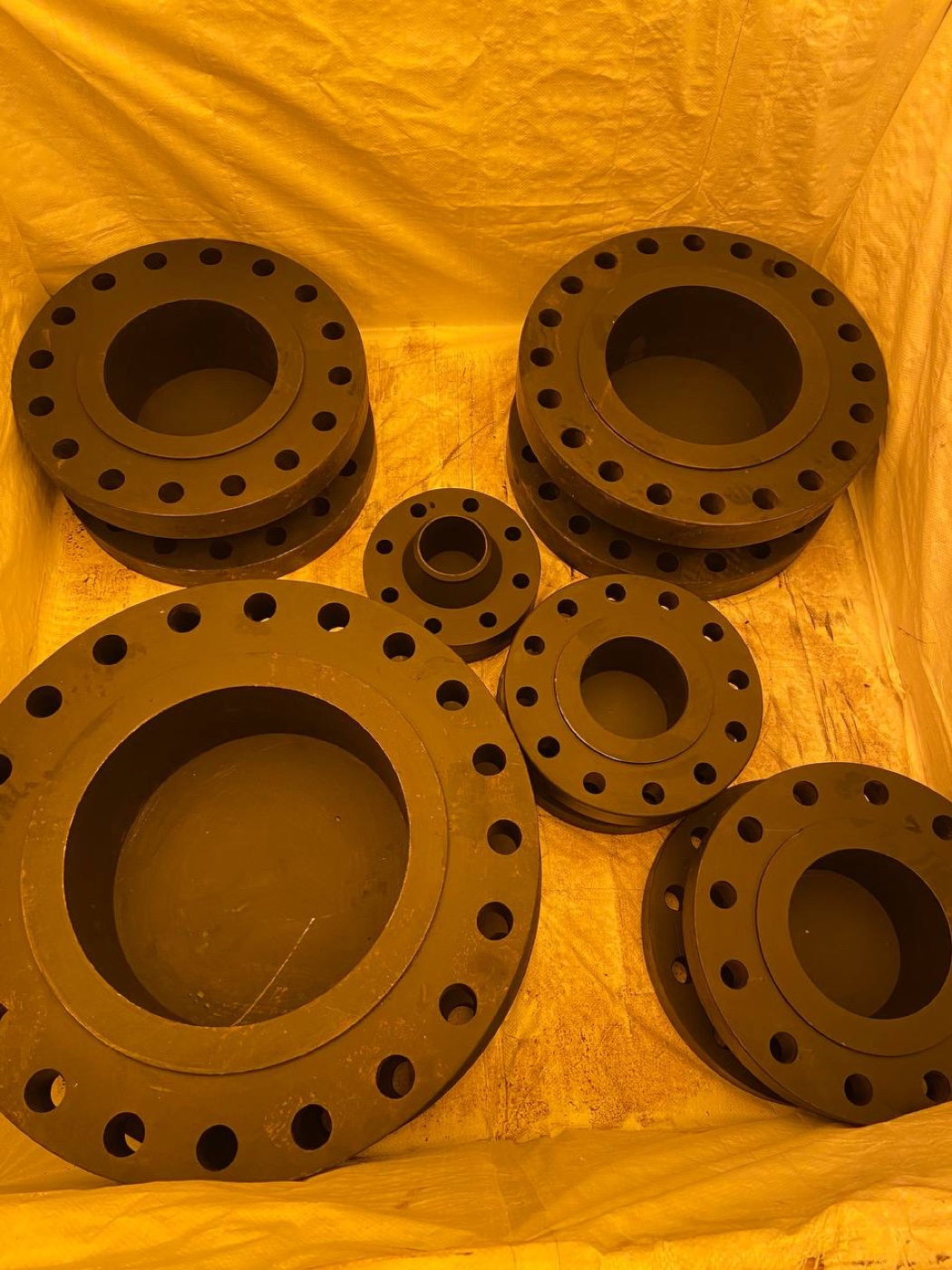
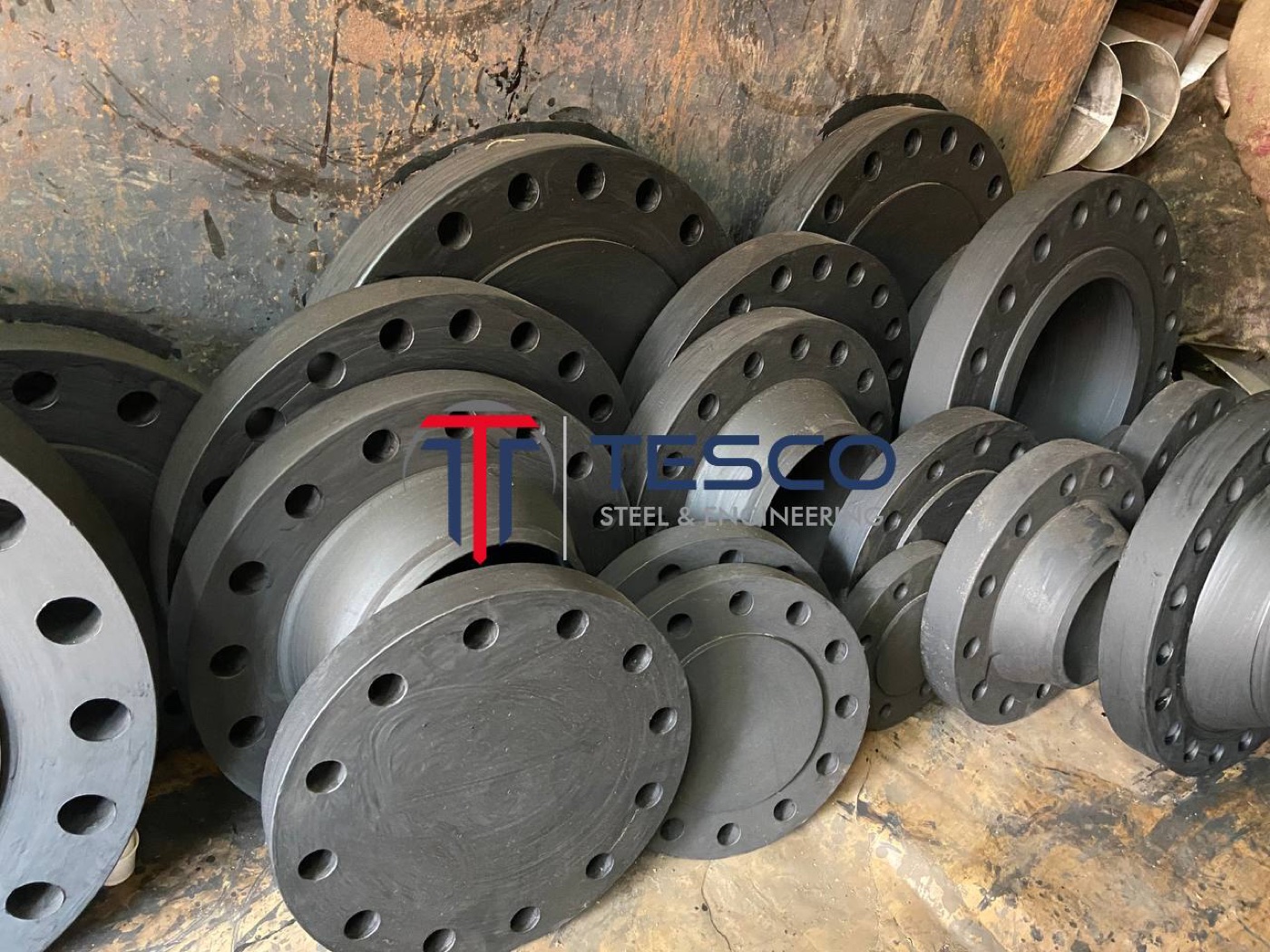
Tesco Steel & Engineering manufactures ASTM A182 F11 lap joint flanges — the chrome-moly staircase's first step (UNS K11572, W.Nr. 1.7335) at the lap joint bench: 1¼% chromium stabilising the carbides, ½% molybdenum holding creep strength at the 450–550 °C steam temperatures where carbon steel's allowable-stress tables fall away. The grade's neatest line is in its chemistry: carbon specified as a range with a floor, because creep is carbide strength. The pattern's virtues apply in full — the backing ring never welds and never wets, dodging the chrome-moly weld discipline; the joint's single butt weld belongs to the matched A234 WP11 stub end per B16.9. And the lap joint bench's metal-temperature argument holds at its steam rung: the ring runs at line metal temperature, so it cannot be A105. Per ASME B16.5, ½″–24″ NB, Classes 150–2500, normalised and tempered, Class 2 quoted and certified explicitly, hardness held in the 143–207 HB band. Every lot with EN 10204 3.1/3.2 MTC. ISO 9001:2015, made in Mumbai, India — exported to 50+ countries.
ASTM A182 F11 Class 2 · UNS K11572 · W.Nr. 1.73351¼Cr-½Mo — The Staircase's First StepSteam + Hot Hydrogen DutyCarbon With a Floor — Creep Is Carbide StrengthStub Ends: A234 WP11 per B16.9½″–24″ NB · Classes 150–2500Pairs Certified TogetherEN 10204 3.1 / 3.2 · ISO 9001:2015
ASTM A182 F11 Lap Joint Flanges — Specifications at a Glance
What is an ASTM A182 F11 Lap Joint Flange?
The steam bench's backing flange. An ASTM A182 F11 lap joint flange is the loose backing ring of the two-piece system in 1¼Cr-½Mo alloy steel (UNS K11572) — bought not for ambient strength but for creep resistance at 450–550 °C, where carbon steel's allowable-stress tables fall away. Its chemistry carries the grade's whole logic in one cell: carbon 0.10–0.20%, a range with a floor, because creep is carbide strength. The ring never welds — no preheat, no PWHT on the flange; the single butt weld belongs to the stub end. Per ASME B16.5, ½″–24″ NB, Classes 150–2500, N&T, Class 2 certified explicitly, 143–207 HB; stub ends A234 WP11 per B16.9. EN 10204 3.1 on every lot.
Also searched as: F11 backing flange, F11 Class 2 lap joint flange, 1¼ chrome lap joint flange, A182 F11 LJ flange, chrome moly loose flange — all this page's product. Related pages: the lap joint hub (the pattern's full story), the carbon twins — A105 warm and LF2 cold — the staircase neighbours F22 and F5, the F11 bench — weld neck / blind / long weld neck — and the alloy steel overview.
The argument at this rung is about the tables, not the scale: the heat reaches the never-wetted ring through the metal it clamps, and at steam temperatures the problem is not corrosion but creep — A105's allowable-stress column simply runs out while F11's keeps going. The ring can skip the welding; it cannot skip the temperature class.
F11 on the Chrome-Moly Staircase
Rung
Chromium
What the Money Buys
F11 Lap Joint (this page)
1¼%
The first step — carbide-stabilised creep strength for steam and moderate hydrogen
A different mission — vanadium-modified precision creep strength for power-plant steam
The honest advice at the bottom of the staircase is about not over-climbing: steam duty that fits F11's ratings gains nothing from paying for F22 — while duty that pushes hotter or sourer steps up one rung at a time, for stated reasons. Descending honestly is engineering too.
What the Pattern Gives This Grade
The Carbon Floor
Carbon 0.10–0.20% — a range with a minimum — because creep resistance is carbide strength: the mill must prove there is enough carbon to form the strengthening phase, not just little enough to weld. A datasheet printing '≤0.20' has lost the floor and the point.
The Invisible Purchase
Room-temperature numbers that match carbon steel's — deliberately — the certificate's value only appears when the allowable-stress tables reach 450 °C and A105's column runs out while F11's keeps going.
The Weld-Procedure Dodge
The backing ring never welds — no preheat, no PWHT, no procedure to qualify or reopen on the flange. F11's discipline is the mildest of the family, so the dodge is modest here — and grows with every rung of the staircase.
The Turnaround Franchise
Loose flanges align by rotation — on steam headers and utility circuits that dismantle for inspection, bolt holes line up without pipe-twisting, and re-assembly never reopens a weld procedure.
Specification Notes — Getting F11 Lap Joints Right
Three honest notes.State the class: an unqualified 'F11' order is quoted and certified as Class 2 — the flange default; Class 1 (softer, maximum weldability) and Class 3 (stronger) exist for specifications that genuinely ask for them, and the certificates are not interchangeable. The P/S ceilings are 0.040: looser than F5/F9's 0.030 — a detail estimators trip over in the other direction when comparing certificates across the staircase. And the pattern's boundaries apply in any grade: heavy external loads, severe vibration and high-moment positions read the weld neck bench — most steam-header joints are weld necks, and lap joints earn their place where lines dismantle; the hub page states the boundaries fully.
How Our F11 Lap Joint Flanges Are Manufactured
1
Material — certified A182 F11 Class 2 forgings, normalised and tempered with the condition and class stated and furnace records retained; heat-number transfer at the first operation.
2
Machining — B16.5 lap joint dimensions: OD, thickness, bolt circle to class; bore and shoulder turned to suit the stub end's lap.
3
Shoulder dressing — the radius dressed to bear evenly on the back of the lap — spreading bolt load instead of concentrating it.
4
Testing — hardness verified against the 143–207 HB band as the evidence of proper tempering; chemistry certified per heat with the carbon floor proven — 0.10% minimum, because creep is carbide strength.
5
No welding, ever — the ring's whole career is mechanical: no weld, no preheat, no PWHT — the pattern's gift, modest on this rung and growing up the staircase.
6
Pairing & certification — matched to A234 WP11 stub ends where ordered; one EN 10204 3.1 document per pair (3.2 witnessed on request); packed sea-worthy with laps and shoulders protected.
Where F11 Lap Joint Flanges Are Used
Where the steam, the years and the pattern meet: power and cogeneration steam headers, boiler and economiser circuits, refinery and petrochemical hot utility lines, and moderate hot-hydrogen duty inside F11's Nelson-curve territory — specifically the positions that earn a lap joint: headers and exchanger connections that dismantle for statutory inspection, spools swapped on schedule, and bolt circles that must align across seasons of thermal cycling, where a loose ring that rotates beats a welded flange that argues. Production and supply below:
F11 Alloy Steel Production — Machining at Our WorksThe Two-Piece System — Flange, Stub End, Butt Weld, PipeF11 Chrome-Moly Stock — Ready for Dispatch
F11 Lap Joint Flange Dimensions
Flange dimensions are class-governed per ASME B16.5 — identical in every grade; stub ends per B16.9. Full class-by-class charts:
Example: “Lap Joint Flange, 6″ NB, ASME B16.5 Class 300, ASTM A182 F11 Class 2, with A234 WP11 stub ends Sch 80 (B16.9 Type A, supplied together), pairs on one MTC, EN 10204 3.1 — 10 sets.” Quotations normally within 24 hours with price, unit weights (both parts) and delivery.
F11 Lap Joint Flanges — Frequently Asked Questions
What is an ASTM A182 F11 lap joint flange?
An ASTM A182 F11 lap joint flange is the loose backing flange of the two-piece lap joint system, forged in 1¼Cr-½Mo alloy steel (UNS K11572) — the chrome-moly staircase's first step, bought not for room-temperature strength but for creep resistance at the 450-550°C steam temperatures where carbon steel's allowable-stress tables fall away. Like every lap joint flange it slides over the pipe, sits free behind the stub end's flared lap, and carries the entire bolt load without touching the line fluid — and because it never welds, it stays out of the chrome-moly weld discipline entirely; the joint's single butt weld belongs to the stub end. Manufactured per ASME B16.5 in ½" to 24" NB, Classes 150 to 2500, normalised and tempered, Class 2 quoted and certified explicitly, with EN 10204 3.1/3.2 certification on every lot.
How does the two-piece lap joint system work?
By splitting sealing from bolting. The stub end butt-welds to the pipe: its flared lap provides the gasket face and does all the fluid contact. The backing flange never welds and never wets: it slides on before the stub end is welded — the classic site lesson — spins freely until the bolts enter, and transmits bolt load through its radiused shoulder onto the back of the lap. Two consequences follow on this grade. First, the flange's material follows its own duty — here temperature, which is why the ring is F11 rather than plain carbon steel on steam and hot hydrogen circuits. Second, the chrome-moly consequence: the flange never welds, so it never enters the weld procedure — no preheat, no PWHT on the ring itself; the joint's single butt weld belongs to the stub end. The full pattern story — stub end types, the alloy economy, the honest boundaries — is on the lap joint hub page.
Why must the never-wetted backing flange still be F11 — the metal-temperature argument?
Because the backing flange gets hot even though it never gets wet — the argument that runs the whole lap joint bench, here at its steam rung. The heat reaches the ring through the metal it clamps: bolted hard against the lap of a 480°C steam or hot-hydrogen line, the flange sits at essentially line metal temperature, and that is the territory where plain A105 stops being trusted — above roughly 425°C carbon steel's ratings carry the graphitisation caveat, and its creep ratings were never there to begin with. F11's chromium-stabilised carbides hold the ring's strength over years at exactly those temperatures. The subtlety worth noticing: at room temperature F11's certificate reads just like carbon steel's — the purchase is invisible until the allowable-stress tables reach 450°C and A105's column runs out while F11's keeps going. The ring can skip the welding; it cannot skip the temperature class.
What is the chemical composition of ASTM A182 F11 Class 2?
Carbon 0.10-0.20% (a deliberate range with a minimum — see the carbon FAQ), manganese 0.30-0.80%, silicon 0.50-1.00%, chromium 1.00-1.50%, molybdenum 0.44-0.65%, phosphorus ≤0.040%, sulphur ≤0.040%. The 1¼% chromium is enough to stabilise carbides and confer modest oxidation resistance at steam temperatures without the air-hardening drama of the high-chrome rungs; the silicon range assists scale resistance. Note the P and S ceilings sit at 0.040 — looser than F5/F9's 0.030, a detail estimators occasionally trip over in the other direction. Chemistry is verified per heat and travels on the EN 10204 3.1 MTC.
What are the mechanical properties of F11 lap joint flanges?
In the Class 2 normalised-and-tempered condition A182 requires tensile strength 485 MPa (70 ksi) minimum, yield strength 275 MPa (40 ksi) minimum and elongation 20% minimum, with hardness controlled in the 143-207 HB band. The room-temperature numbers match carbon steel's — deliberately: F11 is not bought for ambient strength but for its creep-rupture ratings at 450-550°C, where the ASME allowable-stress tables leave A105 behind. For the backing-flange duty that is exactly the right shape of certificate: the ring works in bolting and bending at line metal temperature, and the B16.5 rating tables for the grade's material group carry it deep into steam territory. The hardness band is the mill's evidence of proper tempering — floor proving the strength arrived, ceiling proving the structure stayed tough and machinable. Supplied with the condition and class stated and records retained.
Why does F11's carbon have a minimum?
Because creep strength is carbide strength. F11's job is to resist slow deformation over years at steam temperatures, and the mechanism is a dispersion of chromium-molybdenum carbides pinning the microstructure — no carbon, no carbides, no creep resistance. So Class 2 specifies carbon as a range with a floor, 0.10-0.20%: the mill must prove there is enough carbon to form the strengthening phase, not just little enough to weld. It is the mirror image of the corrosion-driven grades' logic (LF2 and the stainless L-grades trim carbon toward zero), and a neat one-line summary of what F11 is for. A datasheet printing F11 carbon as '≤0.20' has lost the point — and the floor. On a lap joint order the floor travels on both certificates: the flange's and the matched stub end's together.
What do F11 Class 1, Class 2 and Class 3 mean?
Three strength levels of the same 1¼Cr-½Mo chemistry, set by carbon and heat treatment. Class 2 — the flange default, and what an unqualified 'F11' order means — carries C 0.10-0.20% and delivers 485 MPa tensile / 275 MPa yield. Class 1 trims carbon (0.05-0.15%) for maximum weldability at 415/205 MPa — it appears mainly in welded fittings practice. Class 3 holds Class 2 chemistry but is heat treated to 515/310 MPa where a designer wants more margin. Almost all stock and almost all piping specifications run Class 2; our certificates state the class explicitly, and if your enquiry just says F11, we quote and certify Class 2. The lap joint wrinkle: the backing ring never welds, so Class 1's weldability advantage buys nothing here — one more reason Class 2 is the bench's answer.
What stub ends pair with F11 lap joint flanges?
The matching stub end is wrought 1¼Cr-½Mo per ASME B16.9 in ASTM A234 WP11 — the fitting grade that pairs with F11 forgings exactly as WP5 pairs with F5 and WP9 with F9, sharing the chemistry philosophy and welded to the pipe with the line's qualified chrome-moly procedure. That butt weld is the joint's only weld, and it belongs entirely to the stub end: the backing flange never enters the procedure. The matching rules are the pattern's usual dimensional ones — lap OD to the flange's shoulder, schedule to the line bore — plus the documentary one: flange and stub end bought as a matched pair and certified together on one EN 10204 document, class and carbon floor stated on both sides, so the '1¼ chrome both halves' answer is provable at handover. Where an order needs B16.9 Type A or Type B lap details, state it and the pair is machined to suit.
Does an F11 backing flange need preheat and PWHT?
No — the backing flange in any grade never welds, so it never needs either. What F11 changes is how much that gift is worth. The 1¼-chrome rung is the mildest air-hardener of the family: its welds take a gentler preheat than the high-chrome rungs and, within code thickness limits, sometimes negotiate their PWHT — so F11's dodge is real but modest, where F9's is dramatic. The discipline that remains concentrates on the joint's single butt weld: stub end to pipe, A234 WP11 to the line, welded under the line's qualified chrome-moly procedure and returned toward the certificate's hardness band. On steam headers that dismantle for inspection the practical gain is the same as everywhere on this bench: fewer alloy welds in the first place, and re-assembly that never reopens a weld procedure. The dodge covers the flange, not the joint — the stub end's weld takes whatever discipline the code asks of it, always.
Where does F11 sit on the chrome-moly staircase?
On the first step, and it is a strength purchase. The staircase climbs by chromium: F11's 1¼% is there to stabilise carbides — creep strength for steam and moderate hydrogen duty, with only modest corrosion gain; F22 at 2¼% is more of the same, hotter and deeper into the Nelson curves; F5 at 4-6% is the first corrosion purchase, bought for sulphidation on refinery hot circuits; F9 at 8-9.5% doubles that for the sourest heater service; and F91, the vanadium-modified 9-chrome, is the precision creep grade for modern power-plant steam. Every rung has a lap joint page on this site, and the honest advice at this end of the staircase is about not over-climbing: steam and hot-hydrogen duty that fits F11's ratings gains nothing from paying for F22 — while duty that pushes hotter or sourer steps up one rung at a time, for stated reasons. State the service and the rung picks itself.
What sizes and pressure classes do F11 lap joint flanges come in?
½" to 24" NB per ASME B16.5 in Classes 150, 300, 400, 600, 900, 1500 and 2500, with larger diameters machined to B16.47 or drawing — the full class-by-class lap joint dimension charts are on this site. The order book mirrors the grade's habitat: steam and utility headers concentrate in Classes 150 to 600 at mid bore, with Classes 900 and 1500 appearing on boiler and hot-hydrogen circuits where pressure climbs alongside temperature. Dimensionally an F11 lap joint flange is identical to any other grade's — B16.5 governs by class, not by material — so the charts serve every grade on the bench; what changes is the rating table behind the class, where the grade's material group keeps usable pressures at temperatures that retire carbon steel. State size, class and the stub-end question together, and our quotation returns price, unit weight and delivery per class.
How much does an F11 lap joint flange weigh?
Exactly what the same-size lap joint flange weighs in any other steel — B16.5 fixes the dimensions by class, and alloy density differences are negligible. Representative Class 150 figures for the flange alone: 1" roughly 0.8 kg, 2" roughly 2 kg, 4" roughly 5.5 kg, 8" roughly 14 kg, climbing steeply with class; the A234 WP11 stub end adds its schedule-dependent mass. The commercial difference sits in the metallurgy and the paperwork: F11 carries a modest alloy surcharge — the gentlest of the chrome-moly family — plus controlled heat treatment and per-lot testing, and the matched stub end carries its weld-end preparation in its own price. Our quotations state unit and consignment weights per line item, flange and stub end separately, and the site's flange weight chart carries the full reference tables.
How are your F11 lap joint flanges manufactured?
As the pattern's standard sequence with the class discipline at the heat-treatment step. Certified A182 F11 Class 2 forgings are normalised and tempered — the condition and class stated on the certificate, with furnace records retained — then machined to B16.5's lap joint dimensions: OD, thickness and bolt circle to class, bore and shoulder turned to suit the stub end's lap, and the shoulder radius dressed to bear evenly on the back of the lap. Hardness is verified against the 143-207 HB band as the evidence of proper tempering; chemistry is certified per heat with the carbon floor proven — 0.10% minimum, because creep is carbide strength. Heat-number marking transfers at the first operation. No welding is performed on the flange at any stage — the ring's whole career is mechanical. Where the order includes A234 WP11 stub ends, the pair is dimensionally matched and certified together on one EN 10204 3.1 document (3.2 witnessed on request). Packed sea-worthy with laps and shoulders protected.
What details are needed to get an accurate F11 lap joint flange quotation?
Seven elements plus commercial terms: (1) size and dimensional standard — e.g. 4" NB ASME B16.5; (2) pressure class — 150 to 2500; (3) the grade and class — an unqualified 'F11' is quoted and certified as Class 2; state Class 1 or Class 3 only where the specification genuinely asks for them; (4) the stub end — A234 WP11 matched pair with schedule and B16.9 type, or 'flange only'; (5) the service temperature where it helps — it confirms the rung, and hotter or sourer duty steers the conversation up the staircase to F22 or F5; (6) certification — EN 10204 3.1 (our standard) or 3.2 witnessed, pairs certified together on one document; (7) quantity as pairs or pieces, and destination. Quotations normally return within 24 hours with price, unit weights for both parts, and delivery.
Who manufactures ASTM A182 F11 lap joint flanges in India?
Tesco Steel & Engineering is an ISO 9001:2015 certified flange manufacturer based in Mumbai, India, producing ASTM A182 F11 Class 2 lap joint (lapped joint) flanges per ASME B16.5 from ½" to 24" NB (larger to B16.47 or drawing) in Classes 150-2500 — each machined from certified 1¼Cr-½Mo forgings in the normalised-and-tempered condition, hardness-verified in the 143-207 HB band, carbon floor proven on every heat, with the shoulder dressed to bear evenly on the lap, heat-number marked, and certified to EN 10204 3.1/3.2 with the class stated explicitly. Matched A234 WP11 stub ends per B16.9 are supplied against the same order, pairs certified together on one document. Alongside the complete A182 F11 range — weld neck, slip-on, socket weld, threaded, blind, spectacle blind and long weld neck — the full chrome-moly staircase in every flange type, and the complete lap joint grade bench. Exported to more than 50 countries.