Tesco Steel & Engineering manufactures ASTM A182 F9 lap joint flanges — the chrome-moly staircase's chromium doubled (UNS K90941, W.Nr. 1.7386): 8–9.5% chromium with a deliberate silicon addition for the hottest, sourest circuits the ferritic family faces, and molybdenum doubled against F5 for hot strength and hydrogen resistance. The lap joint pattern's gift is worth the most on this rung: 9Cr steel air-hardens fiercest of the plain grades, and the backing ring never welds — no preheat, no PWHT, no procedure on the flange; the joint's single butt weld belongs to the matched A234 WP9 stub end per B16.9. And the metal-temperature argument of the lap joint bench holds one rung higher: the ring never gets wet, but it runs at line metal temperature. Per ASME B16.5, ½″–24″ NB, Classes 150–2500, annealed or N&T, hardness held in the 179–217 HB band — the strongest certificate of the plain rungs. Every lot with EN 10204 3.1/3.2 MTC. ISO 9001:2015, made in Mumbai, India — exported to 50+ countries.
ASTM A182 F9 · UNS K90941 · W.Nr. 1.73869Cr-1Mo — The Chromium DoubledHot Sulphur + Hydrogen DutyFiercest Air-Hardening — Biggest DodgeStub Ends: A234 WP9 per B16.9½″–24″ NB · Classes 150–2500Pairs Certified TogetherEN 10204 3.1 / 3.2 · ISO 9001:2015
ASTM A182 F9 Lap Joint Flanges — Specifications at a Glance
What is an ASTM A182 F9 Lap Joint Flange?
The 9-chrome backing flange. An ASTM A182 F9 lap joint flange is the loose backing ring of the two-piece system in 9Cr-1Mo alloy steel (UNS K90941) — chromium at 8–9.5% with a deliberate 0.50–1.00% silicon addition for the hottest sulphur circuits, molybdenum at 0.90–1.10% for creep strength and hydrogen resistance. The point on this pattern: 9Cr air-hardens fiercest of the plain chrome-moly rungs — and the ring never welds, so it escapes the strictest preheat/PWHT discipline of the family. Per ASME B16.5, ½″–24″ NB, Classes 150–2500, annealed or N&T, 179–217 HB; stub ends A234 WP9 per B16.9. EN 10204 3.1 on every lot.
F9 — the ring runs at 500–650 °C surface temperatures through the lap it clamps
The argument, inherited and sharpened: the heat reaches the never-wetted ring through the metal it clamps — and at heater and transfer-line temperatures, even F5's chromium scale is not enough against aggressive sulphur. F9's doubled chromium and silicon-reinforced scale are bought for exactly that surface condition; the ring can skip the welding, but it cannot skip the temperature class.
A different mission — vanadium-modified precision creep strength for power-plant steam
The honest advice runs both ways: circuits whose sulphur is milder than feared step down to F5 and save, while services chasing creep strength rather than corrosion skip sideways to F91. Descending honestly is engineering too.
What the Pattern Gives This Grade
The Biggest Weld-Procedure Dodge
9Cr air-hardens fiercest of the plain rungs — a freely-cooled weld zone is hard martensite — and the backing ring never welds: no preheat, no PWHT, no procedure to qualify or reopen. The discipline concentrates on the stub end's single butt weld.
The Chromium Doubled
8–9.5% chromium completes the ferritic corrosion ladder — the scale that holds against the hottest, sourest circuits, where F5's band has reached its honest limit.
The Silicon Signature
Silicon specified 0.50–1.00% — a floor as well as a ceiling — a deliberate alloying addition reinforcing the chromium oxide scale at heater-surface temperatures, not a deoxidation leftover.
The Turnaround Franchise
Loose flanges align by rotation — on heater and transfer-line circuits that dismantle at every turnaround, bolt holes line up without pipe-twisting, spools rotate to distribute wear, and re-assembly never reopens a 9-chrome weld procedure.
Specification Notes — Getting F9 Lap Joints Right
Three honest notes.F9 is not F91: the vanadium-modified grade is a precision creep alloy for power-plant steam with its own fabrication rules — an enquiry that says '9 chrome' without the suffix gets a question back, because the certificates are not interchangeable. The silicon floor is part of the grade: a datasheet showing F9 silicon as '≤0.50' has copied the F5 line — an F9 heat must prove silicon above 0.50% as well as below 1.00%. And the pattern's boundaries apply in any grade: heavy external loads, severe vibration and high-moment positions read the weld neck bench — most 9-chrome joints are weld necks, and lap joints earn their place where hot lines dismantle; the hub page states the boundaries fully.
How Our F9 Lap Joint Flanges Are Manufactured
1
Material — certified A182 F9 forgings, annealed or normalised and tempered with the condition stated and furnace records retained; heat-number transfer at the first operation.
2
Machining — B16.5 lap joint dimensions: OD, thickness, bolt circle to class; bore and shoulder turned to suit the stub end's lap.
3
Shoulder dressing — the radius dressed to bear evenly on the back of the lap — spreading bolt load instead of concentrating it.
4
Testing — hardness verified against the 179–217 HB band — floor and ceiling both — the proof the tempering went right; PMI reads the Cr-Mo-Si signature together, silicon floor included; chemistry and mechanicals certified per heat.
5
No welding, ever — the ring's whole career is mechanical: no weld, no preheat, no PWHT — the pattern's gift on the fiercest air-hardening rung of the plain family.
6
Pairing & certification — matched to A234 WP9 stub ends where ordered; one EN 10204 3.1 document per pair (3.2 witnessed on request); packed sea-worthy with laps and shoulders protected.
Where F9 Lap Joint Flanges Are Used
Where the fiercest heat, the sulphur and the pattern meet: fired-heater outlet and transfer-line circuits, crude and vacuum unit hot sections at their sourest, hydroprocessing loops where hydrogen and sulphur climb together, and sulphur-plant hot lines — specifically the positions that earn a lap joint: heater circuits that dismantle at every decoke and turnaround, hot spools rotated to distribute erosion, and exchanger connections opened on schedule, where a never-welded flange means re-assembly without reopening the strictest weld procedure of the plain chrome-moly family. Production and supply below:
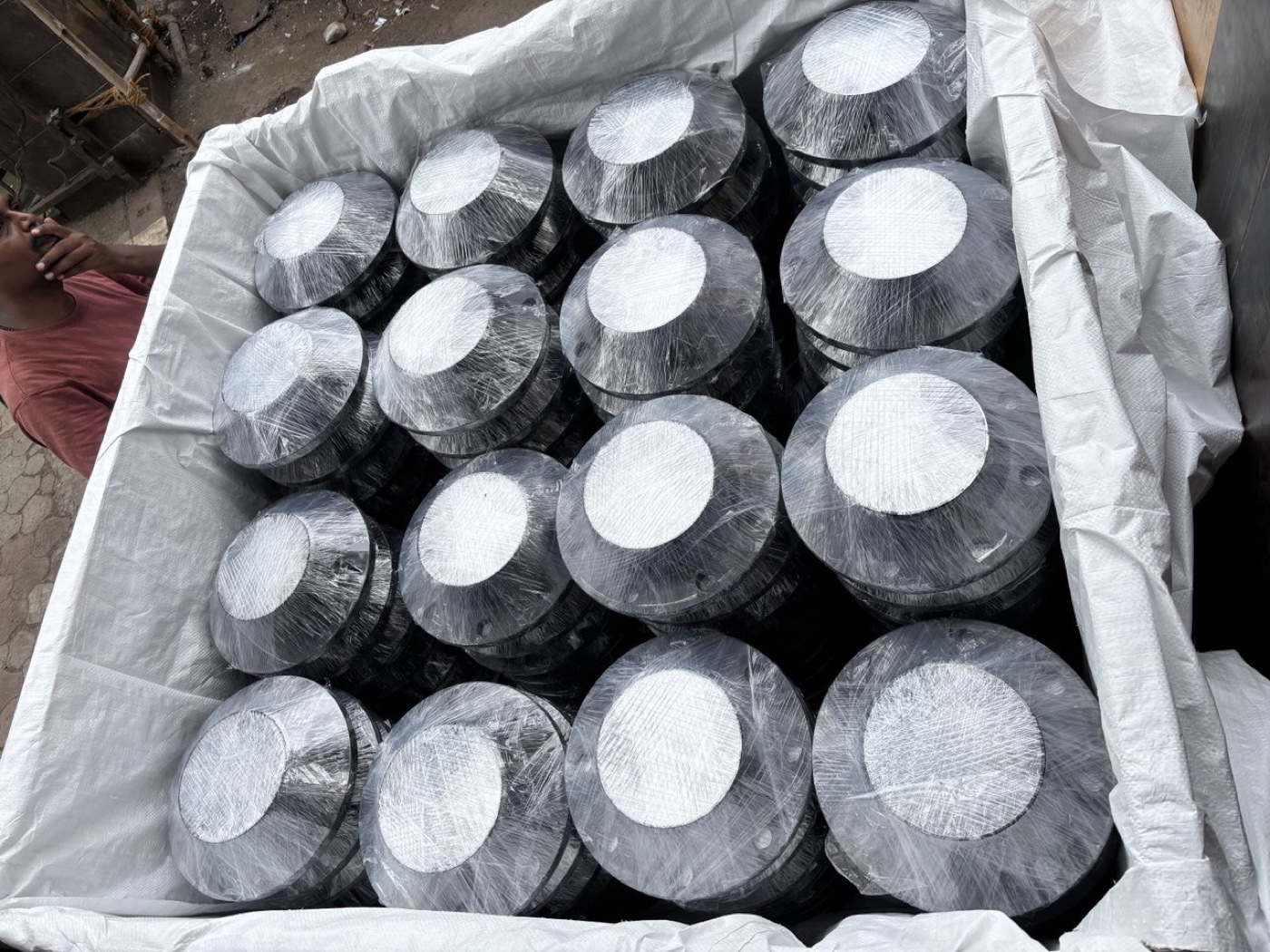
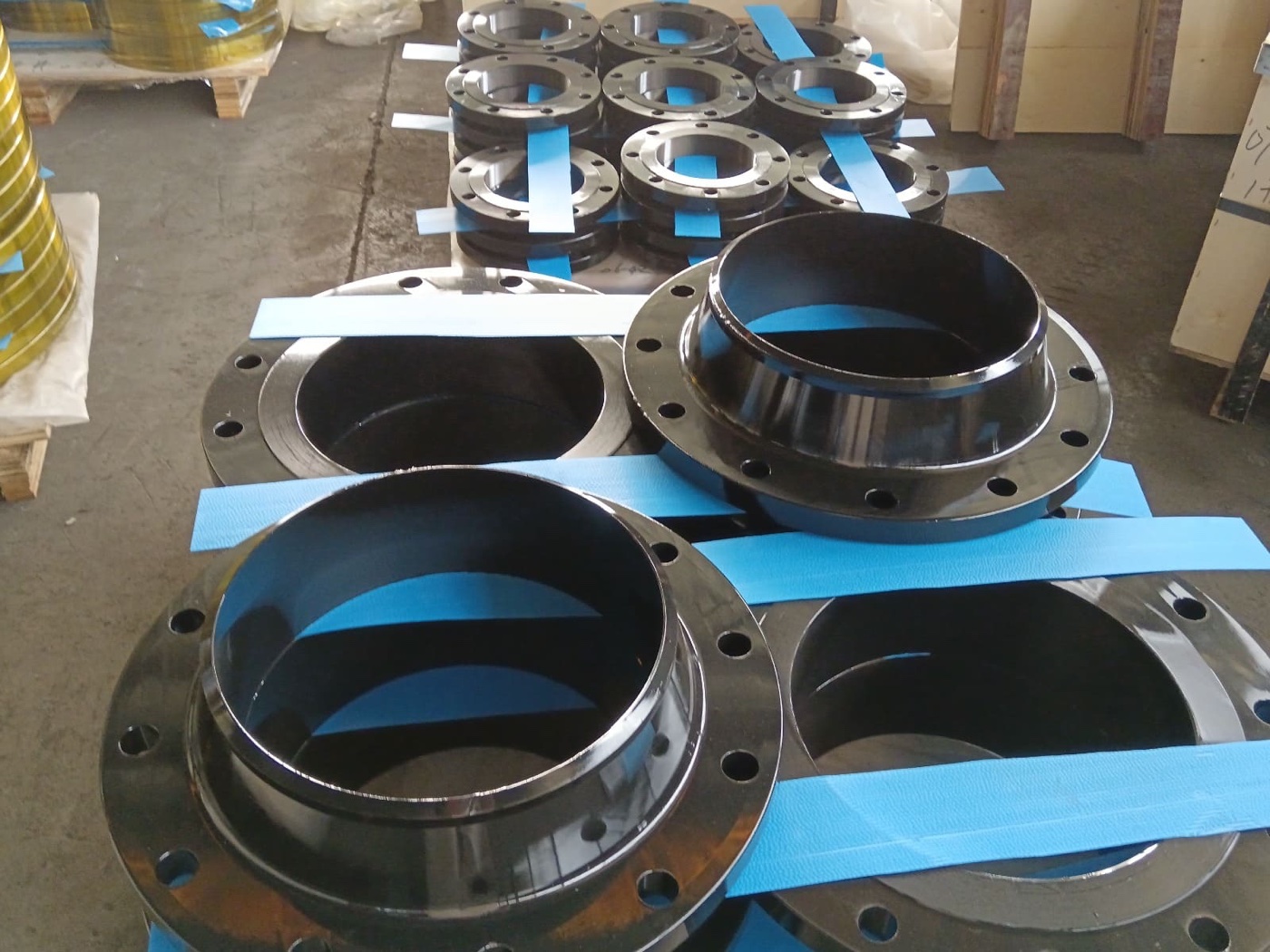
F9 Alloy Steel Supply — Export Packing at Our WorksThe Two-Piece System — Flange, Stub End, Butt Weld, PipeF9 Chrome-Moly Stock — Warehouse Ready for Dispatch
F9 Lap Joint Flange Dimensions
Flange dimensions are class-governed per ASME B16.5 — identical in every grade; stub ends per B16.9. Full class-by-class charts:
Example: “Lap Joint Flange, 4″ NB, ASME B16.5 Class 300, ASTM A182 F9, with A234 WP9 stub ends Sch 80 (B16.9 Type A, supplied together), pairs on one MTC, EN 10204 3.1 — 12 sets.” Quotations normally within 24 hours with price, unit weights (both parts) and delivery.
F9 Lap Joint Flanges — Frequently Asked Questions
What is an ASTM A182 F9 lap joint flange?
An ASTM A182 F9 lap joint flange is the loose backing flange of the two-piece lap joint system, forged in 9Cr-1Mo alloy steel (UNS K90941) — the chrome-moly rung where the chromium doubles against F5 for the harshest hot sulphur circuits, and the molybdenum doubles with it for hot strength and hydrogen resistance. Like every lap joint flange it slides over the pipe, sits free behind the stub end's flared lap, and carries the entire bolt load without touching the line fluid. The pattern's gift matters most on this grade: 9Cr steel air-hardens fiercest of the plain chrome-moly rungs, so every welded F9 flange type drags a strict preheat-and-PWHT discipline behind it — and the backing ring, never welded, dodges all of it. Manufactured per ASME B16.5 in ½" to 24" NB, Classes 150 to 2500, annealed or normalised and tempered, with EN 10204 3.1/3.2 certification on every lot.
How does the two-piece lap joint system work?
By splitting sealing from bolting. The stub end butt-welds to the pipe: its flared lap provides the gasket face and does all the fluid contact. The backing flange never welds and never wets: it slides on before the stub end is welded — the classic site lesson — spins freely until the bolts enter, and transmits bolt load through its radiused shoulder onto the back of the lap. Two consequences follow on this grade. First, the flange's material follows its own duty — here temperature, which is why the ring is F9 rather than plain carbon steel. Second, and sharpest on 9-chrome: the flange never welds, so it never enters the weld procedure — no preheat, no PWHT on the ring itself; the joint's single butt weld belongs to the stub end, welded once under the strictest discipline of the plain chrome-moly rungs. The full pattern story — stub end types, the alloy economy, the honest boundaries — is on the lap joint hub page.
Why must the never-wetted backing flange still be F9 — the metal-temperature argument?
Because the backing flange gets hot even though it never gets wet — the same argument the F5 lap joint page makes, one rung higher. The heat reaches the ring through the metal it clamps: bolted hard against the lap of a heater or transfer-line circuit running 500-650°C at the surface, the flange sits at essentially line metal temperature, far beyond plain carbon steel's trusted range and beyond where F5's 4-6% chromium scale holds cleanly against aggressive sulphur. F9's doubled chromium and silicon-reinforced scale are bought exactly for that surface condition, and its doubled molybdenum keeps creep strength at temperatures that would slowly hollow out a leaner certificate. So the lap joint economy stays honest: the ring can skip the welding, but it cannot skip the temperature class. F9 backing F9 is the normal answer, and the certificate proves both halves.
What is the chemical composition of ASTM A182 F9?
Carbon ≤0.15%, manganese 0.30-0.60%, silicon 0.50-1.00% (a deliberate range — see the silicon FAQ), chromium 8.0-9.5%, molybdenum 0.90-1.10%, phosphorus ≤0.030%, sulphur ≤0.030%. Two identity marks: the 8-9.5% chromium band that completes the ferritic corrosion ladder, and molybdenum doubled against F5 (0.90-1.10 versus 0.44-0.65) for hot strength and hydrogen resistance. Note there is no vanadium, niobium or nitrogen — those belong to F91, a different grade with a different mission. Chemistry is verified per heat and travels on the EN 10204 3.1 MTC.
What are the mechanical properties of F9 lap joint flanges?
In the annealed or normalised-and-tempered condition A182 requires tensile strength 585 MPa (85 ksi) minimum, yield strength 380 MPa (55 ksi) minimum and elongation 20% minimum, with hardness controlled in the 179-217 HB band — the strongest certificate of the plain chrome-moly rungs, comfortably above F5's 485/275. The band is tighter than F5's too, and it works both ways: the floor proves the heat treatment delivered the strength, the ceiling proves the tempering softened the air-hardened structure into something machinable and tough. As with all the family, the room-temperature numbers understate the purchase — F9 is bought for what it keeps at 500-650°C, where its dense Cr-Mo carbides resist both creep and the hydrogen attack that dissolves lesser carbides. For the backing-flange duty the strength arrives as margin: the ring works in bolting and bending at line metal temperature, and the B16.5 rating tables for the grade's material group carry it. Supplied with the condition stated and records retained.
What is the difference between F9 and F91?
The same 9% chromium, two different missions. F9 is the corrosion grade: plain 9Cr-1Mo, bought for sulphidation resistance and hydrogen duty on refinery hot circuits, heat treated by simple anneal or normalise-and-temper, welded with strict but conventional chrome-moly discipline. F91 adds vanadium, niobium and nitrogen to the same base and becomes a precision creep-strength grade for power-plant steam — dramatically stronger at temperature, but dependent on a tightly controlled normalise-and-temper that welding can locally destroy, which is why F91 fabrication rules fill code cases. On a lap joint the distinction is refreshingly simple: the backing ring never welds in either grade, so the choice follows the line. Refinery sulphur circuits specify F9 and match A234 WP9 stub ends; power and energy-recovery steam specifies F91 with its own matched fittings — that page is on this site. An enquiry that says '9 chrome' without the suffix gets a question back, because the two certificates are not interchangeable.
Why does F9's silicon have a floor as well as a ceiling?
Because in F9 silicon is an alloying decision, not a leftover. Most flange steels cap silicon as a deoxidation residue — F5 allows up to 0.50% and no more. F9 instead specifies 0.50-1.00%: a deliberate addition that reinforces the chromium oxide scale, measurably improving oxidation and sulphidation resistance at the 500-650°C surface temperatures of heater and transfer-line service. It is a small signature with a practical certificate consequence: an F9 heat must prove silicon above the floor as well as below the ceiling, and our PMI reads the Cr-Mo-Si signature together. If a datasheet shows F9 silicon as '≤0.50', someone has copied the F5 line — a mistake worth catching at enquiry, and doubly worth catching on a lap joint order where flange and stub end certificates travel together.
What stub ends pair with F9 lap joint flanges?
The matching stub end is wrought 9Cr-1Mo per ASME B16.9 in ASTM A234 WP9 — the fitting grade that pairs with F9 forgings exactly as WP5 pairs with F5, sharing the chemistry philosophy and welded to the pipe with the line's qualified 9-chrome procedure, preheat and PWHT included. That butt weld is the joint's only weld, and it belongs entirely to the stub end: the backing flange never enters the procedure — which on this grade means never entering the strictest procedure of the plain chrome-moly family. The matching rules are the pattern's usual dimensional ones — lap OD to the flange's shoulder, schedule to the line bore — plus the documentary one: flange and stub end bought as a matched pair and certified together on one EN 10204 document, so the '9 chrome both halves' answer is provable at handover, silicon floor included. Where an order needs B16.9 Type A or Type B lap details, state it and the pair is machined to suit.
Does an F9 backing flange need preheat and PWHT?
No — and on this rung the dodge is worth the most. 9Cr steel air-hardens even more decisively than 5Cr: a freely-cooled F9 weld zone is hard martensite, and cracking follows, so code work makes preheat (typically around 200-260°C for this class) and post-weld heat treatment effectively mandatory on every F9 weld — the strictest discipline of the plain chrome-moly rungs. The lap joint backing flange inherits none of it, because it is never welded to anything: it slides over the pipe, floats behind the lap, and does its whole job mechanically. The discipline concentrates instead on the joint's single butt weld — stub end to pipe, A234 WP9 to the line, welded once under full control and returned by PWHT toward the 179-217 HB band. On a turnaround this matters twice: fewer 9-chrome welds to make and test in the first place, and a flange that can be swapped, rotated or re-used without any weld procedure being reopened. The dodge covers the flange, not the joint — the stub end's weld takes the full discipline, always.
Where does F9 sit on the chrome-moly staircase?
At the top of the plain rungs, and it is the corrosion summit. The staircase climbs by chromium: F11 at 1¼% and F22 at 2¼% are bought mostly for creep strength in steam and hot hydrogen; F5 jumps to 4-6% chromium — the first corrosion purchase, for sulphidation and the Nelson curves; F9 doubles it to 8-9.5% with a silicon reinforcement, for the hottest, sourest circuits the ferritic family faces; and F91, the vanadium-modified 9-chrome, turns off the corrosion road entirely toward precision creep strength for power-plant steam. Every rung has a lap joint page on this site, and the honest advice runs both ways: circuits whose sulphur is milder than they feared step down to F5 and save, while services chasing creep strength rather than corrosion skip sideways to F91. Descending honestly is engineering too — state the service and the rung picks itself.
What sizes and pressure classes do F9 lap joint flanges come in?
½" to 24" NB per ASME B16.5 in Classes 150, 300, 400, 600, 900, 1500 and 2500, with larger diameters machined to B16.47 or drawing — the full class-by-class lap joint dimension charts are on this site. The order book mirrors the grade's habitat: heater, transfer-line and sulphur-circuit work concentrates in Classes 150 to 600 at mid bore, with Classes 900 and 1500 appearing on hydroprocessing circuits where pressure climbs alongside temperature. Dimensionally an F9 lap joint flange is identical to any other grade's — B16.5 governs by class, not by material — so the charts serve every grade on the bench; what changes is the rating table behind the class, where the grade's material group carries usable pressures at temperatures that retire carbon steel and stretch F5. State size, class and the stub-end question together, and our quotation returns price, unit weight and delivery per class.
How much does an F9 lap joint flange weigh?
Exactly what the same-size lap joint flange weighs in any other steel — B16.5 fixes the dimensions by class, and alloy density differences are negligible. Representative Class 150 figures for the flange alone: 1" roughly 0.8 kg, 2" roughly 2 kg, 4" roughly 5.5 kg, 8" roughly 14 kg, climbing steeply with class; the A234 WP9 stub end adds its schedule-dependent mass. The commercial difference sits in the metallurgy and the paperwork: F9 carries the 9-chrome alloy surcharge, controlled heat treatment and per-lot testing in its price, and the matched stub end carries the strictest chrome-moly weld-end preparation in its own. Our quotations state unit and consignment weights per line item, flange and stub end separately, and the site's flange weight chart carries the full reference tables.
How are your F9 lap joint flanges manufactured?
As the pattern's standard sequence with 9-chrome discipline at the heat-treatment step. Certified A182 F9 forgings are supplied annealed or normalised and tempered — the condition stated on the certificate, with furnace records retained — then machined to B16.5's lap joint dimensions: OD, thickness and bolt circle to class, bore and shoulder turned to suit the stub end's lap, and the shoulder radius dressed to bear evenly on the back of the lap. Hardness is verified against the 179-217 HB band — floor and ceiling both — as the proof the tempering went right; chemistry is certified per heat with PMI reading the Cr-Mo-Si signature together, silicon floor included. Heat-number marking transfers at the first operation. No welding is performed on the flange at any stage — the ring's whole career is mechanical, which on the fiercest air-hardening rung of the plain family is precisely the point. Where the order includes A234 WP9 stub ends, the pair is dimensionally matched and certified together on one EN 10204 3.1 document (3.2 witnessed on request). Packed sea-worthy with laps and shoulders protected.
What details are needed to get an accurate F9 lap joint flange quotation?
Seven elements plus commercial terms: (1) size and dimensional standard — e.g. 4" NB ASME B16.5; (2) pressure class — 150 to 2500; (3) the grade stated exactly — F9, not '9 chrome' or 'F9/F91', because the vanadium-modified grade is a different certificate with a different mission; (4) the stub end — A234 WP9 matched pair with schedule and B16.9 type, or 'flange only'; (5) the service where it helps — sulphur-driven refinery duty confirms F9, while creep-driven steam duty steers the conversation to F91; (6) certification — EN 10204 3.1 (our standard) or 3.2 witnessed, pairs certified together on one document; (7) quantity as pairs or pieces, and destination. Quotations normally return within 24 hours with price, unit weights for both parts, and delivery.
Who manufactures ASTM A182 F9 lap joint flanges in India?
Tesco Steel & Engineering is an ISO 9001:2015 certified flange manufacturer based in Mumbai, India, producing ASTM A182 F9 lap joint (lapped joint) flanges per ASME B16.5 from ½" to 24" NB (larger to B16.47 or drawing) in Classes 150-2500 — each machined from certified 9Cr-1Mo forgings in the annealed or normalised-and-tempered condition, hardness-verified in the 179-217 HB band, PMI-checked on the Cr-Mo-Si signature, with the shoulder dressed to bear evenly on the lap, heat-number marked, and certified to EN 10204 3.1/3.2. Matched A234 WP9 stub ends per B16.9 are supplied against the same order, pairs certified together on one document. Alongside the complete A182 F9 range — weld neck, slip-on, socket weld, threaded, blind, spectacle blind and long weld neck — the full chrome-moly staircase in every flange type, and the complete lap joint grade bench. Exported to more than 50 countries.