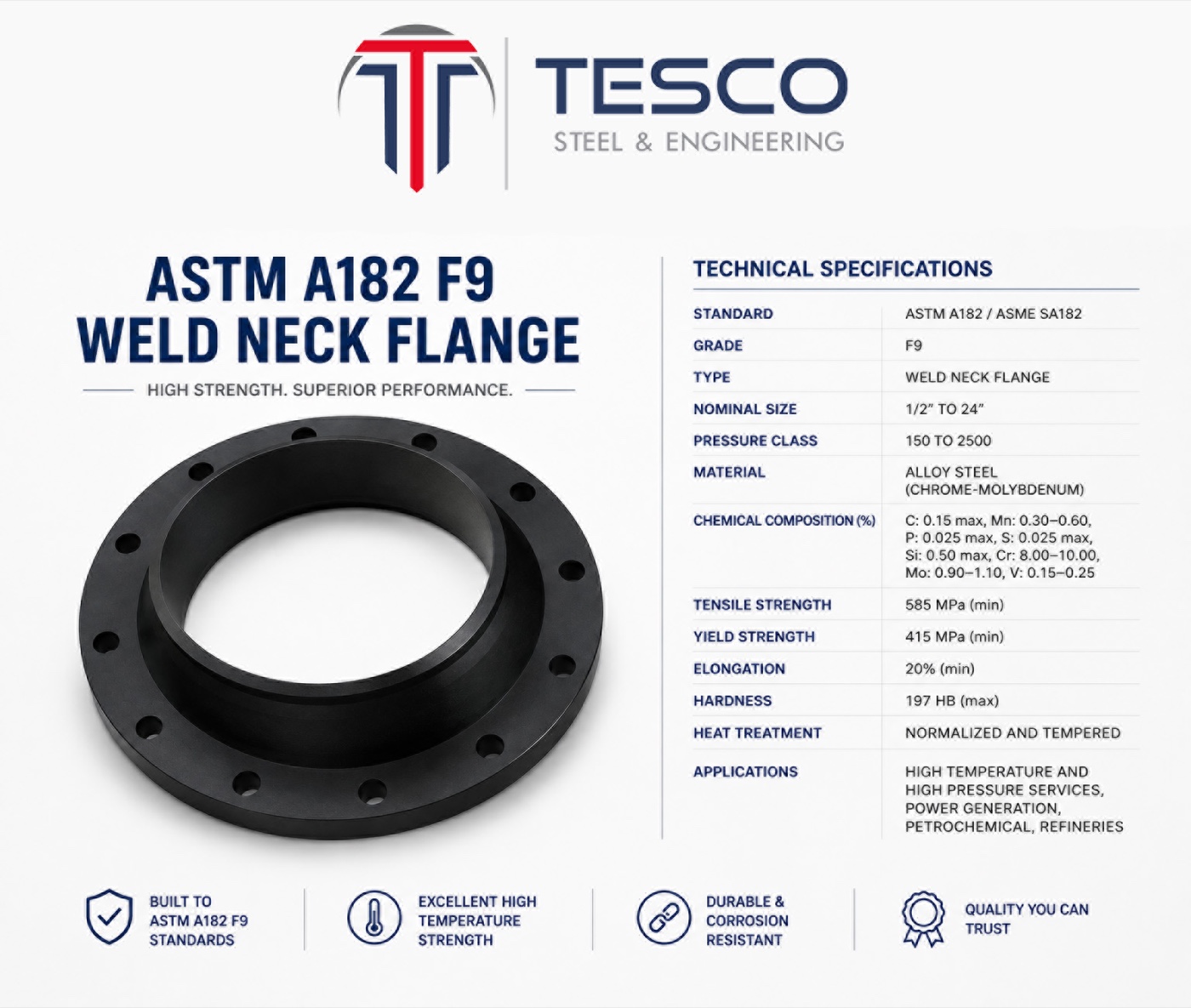
Tesco Steel & Engineering forges ASTM A182 F9 weld neck flanges in 9% chromium, 1% molybdenum alloy steel — UNS K90941, Werkstoff Nr. 1.7386 — from 1/2″ NB to 56″ NB, in ASME B16.5 Class 150–2500 and European PN patterns. The highest-chromium grade of the classic chrome-moly family, F9 delivers maximum sulphidation resistance for the hottest, most sulphur-rich refinery streams — heater outlets, hydrodesulphurisation and hydrocracker circuits — with 585 MPa strength and creep capability to ~600 °C, mating A335 P9 pipe. Normalized & tempered, hardness-controlled 179–217 HB, with PMI, NACE MR0175 and EN 10204 3.1/3.2 on request. ISO 9001:2015, made in Mumbai, India — exported worldwide.
ASTM A182 F9 is the 9Cr-1Mo alloy steel forging grade (UNS K90941) — the highest-chromium member of the classic chrome-moly family, built for the hottest, most sulphur-rich refinery streams. An F9 weld neck flange pairs that chemistry with the strongest flange design: a long tapered hub butt-welded to the pipe, bore matched to the pipe schedule, joint fully radiographable — carrying 585 MPa strength and creep capability to ~600 °C.
Chromium is the working ingredient: sulphidation resistance scales with it, so F9's nominal 9% roughly doubles F5's margin against the hot H2S attack that thins heater outlets and hydroprocessing loops. The full 1% molybdenum and a deliberate silicon addition lift creep strength and scaling resistance further, and the specification demands 585 MPa tensile — a full class above F5. Its system partners are A335 P9 pipe and A234 WP9 fittings.
Above F9 the family forks: for even more creep strength in clean steam, the modified grade F91 (9Cr-1Mo-V) takes over; for oxidation beyond the chrome-moly range entirely, 310S stainless continues the ladder. We forge every rung in-house.
Also searched as: A182 F9 WNRF flange, SA182 F9 weld neck flange, 9Cr-1Mo flange, UNS K90941 flange, 1.7386 flange, alloy steel F9 flange — all refer to the product on this page.
Chemical Composition of ASTM A182 F9
C
Mn
P
S
Si
Cr
Mo
0.15 max
0.30-0.60
0.030 max
0.030 max
0.50 - 1.00
8.00-10.00
0.90-1.10
Values in weight %. The 8–10% chromium band centres on the nominal 9% that gives F9 its sulphidation resistance, and the silicon range — unusual among chrome-moly grades — assists scaling resistance at temperature. The low carbon ceiling keeps the strongly air-hardening steel weldable, with preheat and PWHT still mandatory.
Mechanical Properties of ASTM A182 F9
Tensile Strength, MPa [ksi]
Yield Strength, Min, MPa [ksi]
Elongation % min.
Reduction of Area % min.
Hardness HB
585 [85]
380 [55]
20
40
179-217
A full strength class above F5 (585 vs 485 MPa tensile), with the hardness band — floor and ceiling — certifying the normalize-and-temper heat treatment, keeping welds sound, and holding the flange under NACE sour-service limits. Actual hardness is reported on every certificate.
Equivalent Grades of ASTM A182 F9
Standard
Werkstoff Nr.
UNS
DIN
Alloy F9
1.7386
K90941
X12CrMo91
The same 9Cr-1Mo chemistry runs through the whole piping system: A335 P9 seamless pipe, A234 WP9 butt-weld fittings and A217 C12 castings. An enquiry in any of these designations is quoted as the same material.
ASTM A182 F9 Weld Neck Flange Specifications
ASTM A182 F9 Weld Neck Flanges are available in the following specifications:
Size
1/2"NB to 56"NB
Class
150#, 300#, 400#, 600#, 900#, 1500#, 2500#
Sch (Schedule)
XS, XXS, STD & Schedule 20, 40, 80, 160
Pressure Ratings
PN 2.5 - PN 400
Standards
ASME B16.5, ASME B16.47, EN 1092-1 Type 11, DIN 2631–2635, BS 4504
Heat Treatment
Normalized & Tempered or Annealed, hardness 179–217 HB
Other Services
Hot Dip Galvanized (GI) ASTM A182 F9 Weld Neck Flanges Sand Blasting on ASTM A182 F9 Weld Neck Flanges Shot Peening on ASTM A182 F9 Weld Neck Flanges Epoxy Coating on ASTM A182 F9 Weld Neck Flanges FBE Coating on ASTM A182 F9 Weld Neck Flanges
Why F9 for the Hottest Sulphur Service
Top of the Sulphidation Ladder
9% chromium roughly doubles F5's margin against hot H2S attack — the last stop in the classic chrome-moly family before stainless steel.
A Full Strength Class Above F5
585 MPa tensile and 380 MPa yield minimums carry higher ratings at temperature, with the full 1% molybdenum backing creep resistance to ~600 °C.
Hardness Under Control
The specified 179–217 HB band certifies heat treatment, keeps welds sound and holds the flange inside NACE MR0175 sour-service limits.
One Chemistry, Whole System
F9 flanges, A335 P9 pipe, WP9 fittings — matched chemistry and matched welding procedures across the entire hot circuit.
A Weld You Can Prove
The full-penetration butt weld radiographs cleanly — and with the preheat and PWHT this grade demands, verifiable quality matters twice as much.
Welding F9 — What the Grade Demands
At 9% chromium, F9 is strongly air-hardening: the heat-affected zone quenches itself to brittle martensite in still air. Sound joints follow three rules — preheat around 200–250 °C, matching 9Cr-1Mo consumables (E8018-B8 / ER80S-B8), and mandatory PWHT at roughly 700–760 °C to temper the HAZ and relieve stress. Build the PWHT into the construction schedule from day one.
Do not skip PWHT. An as-welded F9 joint carries a hard, crack-prone heat-affected zone; ASME B31.3 mandates post-weld heat treatment for this material class in essentially all thicknesses.
Where ASTM A182 F9 Weld Neck Flanges Are Used
The hot end of the refinery: fired heater outlet headers and transfer lines, hydrodesulphurisation and hydrocracker loops, coker and FCC circuits — wherever temperature and sulphur peak together. Petrochemical furnace systems follow the same logic. For clean steam creep duty the economics favour F22 or F91; below the sulphidation threshold, F5 or plain A105 saves money. Where sulphur rules the corrosion allowance, F9 is the answer.
Production & Packing
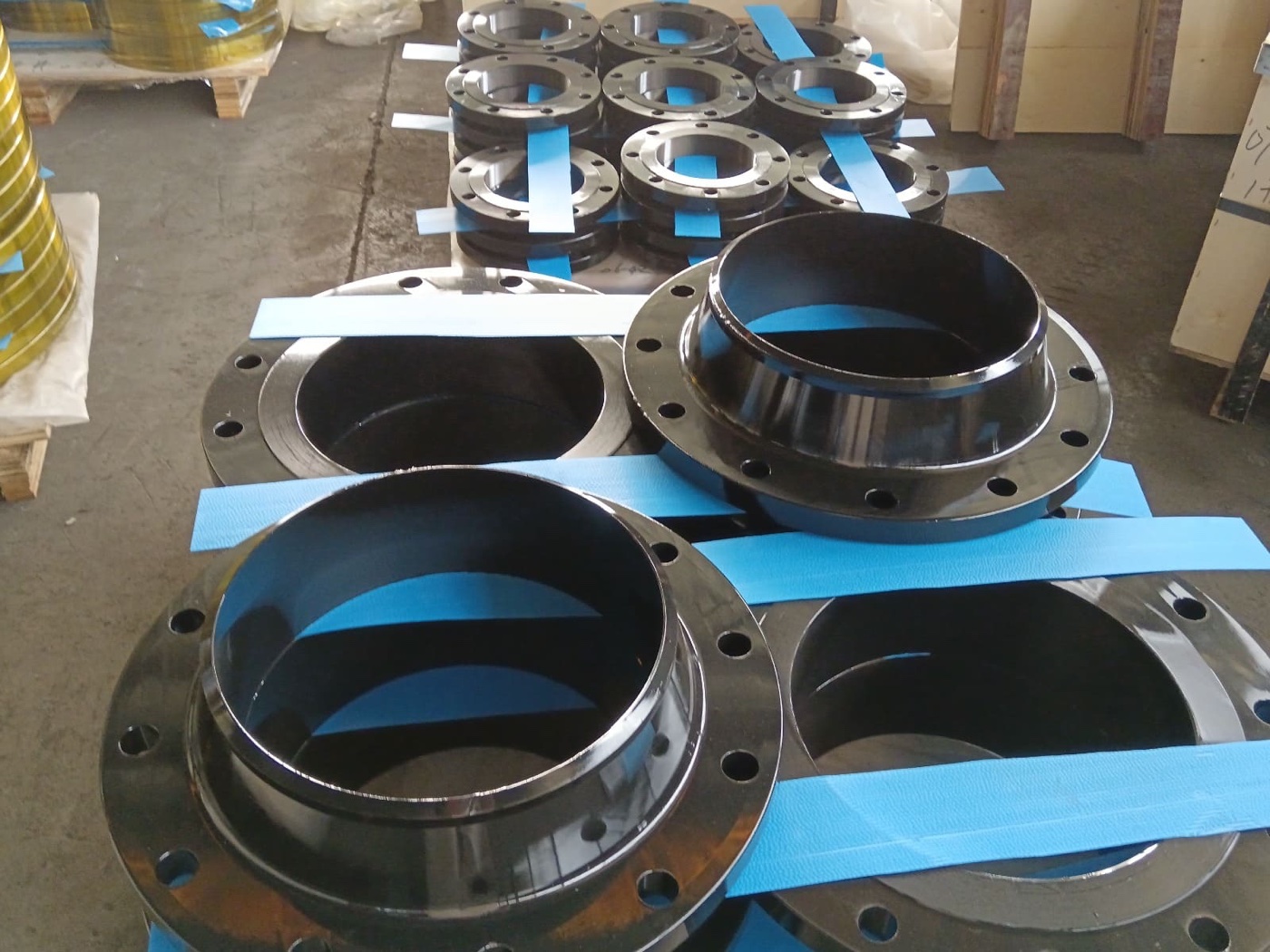
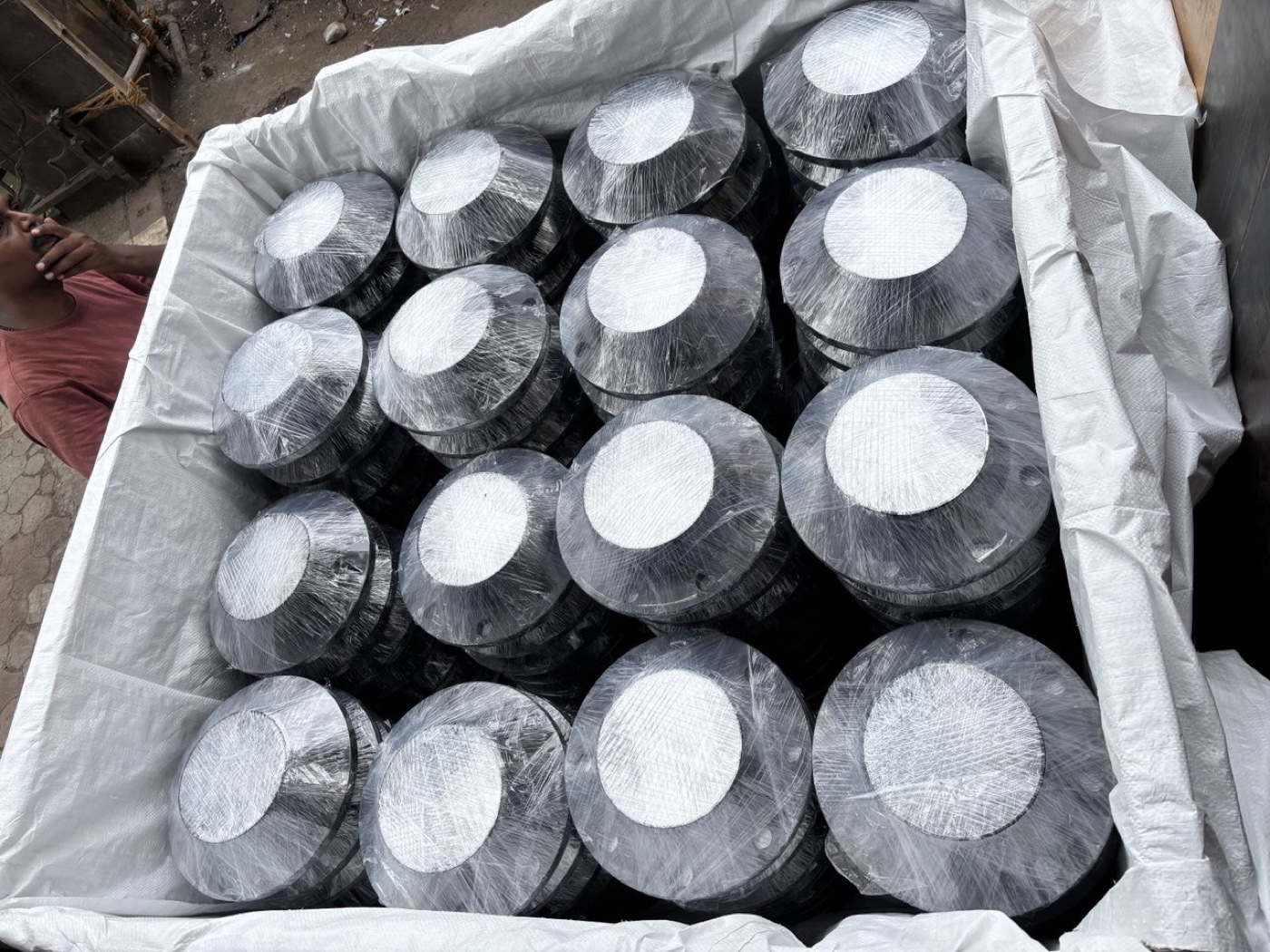
Certified 9Cr-1Mo blanks are forged, normalized and tempered, hardness-surveyed and PMI-verified, then CNC-turned: hub profiled, bore matched to your pipe schedule, weld end bevelled to 37.5°, faces serrated, and each flange marked with grade, size, rating and heat number. Alloy steel production and packing are shown below:
A182 F9 Weld Neck Flanges — Warehouse Stock, Small to Large BoreBlack-Coated F9 Alloy Steel Flanges — Lined Export Packing
ASTM A182 F9 Weld Neck Flange Dimensions
F9 weld neck flanges share their dimensions with every other material in the same class — OD, thickness, hub, bore, bolt circle and bolting per the standard tables. Full ASME B16.5 charts:
F9 pricing follows the alloy steel market plus heat-treatment and testing scope, so we quote live rather than publish a static list. To get a firm quotation, usually within 24 hours:
1
List your requirement — size (NB), class or PN, standard (ASME B16.5 / B16.47 / EN / DIN / BS), facing (RF or RTJ), pipe schedule or bore, and quantity.
2
Add any extras — NACE MR0175, PMI, 3.2 certification, or a specific heat treatment condition.
3
Send it across — via the inquiry form, WhatsApp, or email to sales@tescosteel.com — and we reply with price, delivery and stock position.
It is a weld neck flange forged from ASTM A182 grade F9 — the 9% chromium, 1% molybdenum alloy steel (UNS K90941). The long tapered hub is butt-welded to the pipe with the bore matched to the pipe schedule, giving a radiographable, fatigue-resistant joint in the highest-chromium grade of the classic chrome-moly family — the one refineries specify when hot, sulphur-rich streams are too aggressive even for F5.
Why 9% chromium — what does F9 do that F5 cannot?
Sulphidation resistance scales with chromium, so F9's nominal 9% roughly doubles F5's margin against hot H2S attack — the corrosion mode that thins carbon and low-alloy steel in heater outlets and hydroprocessing loops. The full 1% molybdenum also lifts creep strength, and the specification demands 585 MPa tensile against F5's 485. When a sulphur-rich circuit runs at the hot end of the unit, F9 is the step refineries take before jumping to stainless.
What temperature can F9 flanges handle?
Roughly 600 °C in continuous service, with design stresses per the ASME rating tables. In practice F9 is chosen less for the last few degrees than for chemistry: at any given heater-outlet temperature it survives sulphur attack far longer than lower-chromium grades. For maximum creep strength in clean steam — supercritical boilers, main steam lines — the modified grade F91 with its vanadium and niobium additions is the right tool instead.
How does F9 compare with F5, F11, F22 and F91?
Chromium is the sulphidation dial, molybdenum and micro-alloying the creep dial. F11 (1.25Cr) and F22 (2.25Cr) serve power-plant steam; F5 (5Cr) and F9 (9Cr) serve sulphur-bearing refinery duty, with F9 the more resistant and the stronger of the pair. F91 shares F9's 9% chromium but adds vanadium, niobium and nitrogen for roughly double the creep strength — a different metallurgy with stricter welding rules. We forge weld neck flanges in every grade of the ladder.
What are the equivalent designations for A182 F9?
UNS K90941; Werkstoff Nr. 1.7386; and the DIN designation X12CrMo9-1. Its system partners share the chemistry: A335 P9 seamless pipe, A234 WP9 butt-weld fittings and A217 C12 castings. An enquiry in any of these designations is quoted as the same material.
What is the chemical composition of ASTM A182 F9?
Carbon 0.15% max, manganese 0.30 to 0.60%, phosphorus 0.030% max, sulphur 0.030% max, silicon 0.50 to 1.00%, chromium 8.00 to 10.00% and molybdenum 0.90 to 1.10%. Note the silicon range — unusual among the chrome-moly grades — which assists the alloy's scaling resistance at temperature.
What are the mechanical properties of A182 F9 flanges?
Minimum tensile strength 585 MPa (85 ksi), minimum yield strength 380 MPa (55 ksi), minimum elongation 20%, minimum reduction of area 40%, and hardness controlled within 179 to 217 HB. The hardness band has a floor and a ceiling: it confirms the normalize-and-temper heat treatment, keeps the flange weldable, and holds it under sour-service limits.
Which pipe grade do F9 weld neck flanges mate with?
ASTM A335 P9 — the 9Cr-1Mo seamless alloy pipe sharing F9's chemistry and heat treatment philosophy — with A234 WP9 fittings completing the system. The weld neck bore is machined to the pipe schedule you state, so the bore runs flush through the joint and the bevel arrives ready for a matched-chemistry butt weld.
How are F9 flanges welded to pipe?
With matching 9Cr-1Mo consumables — E8018-B8 electrodes or ER80S-B8 wire — plus strict thermal discipline: preheat around 200 to 250 °C, controlled interpass temperature, and mandatory post-weld heat treatment at roughly 700 to 760 °C. At 9% chromium the steel is strongly air-hardening; an untreated weld zone is hard, brittle and crack-prone. The 37.5 degree bevel comes machined ready for a radiographable butt weld.
Why is PWHT mandatory for F9 flange welds?
Because 9% chromium makes the heat-affected zone quench itself to hard martensite in still air — even more decisively than F5. Post-weld heat treatment tempers that zone back to a tough, stable structure and relieves residual stress; without it the joint risks cracking in service or even before it. ASME B31.3 mandates PWHT for this material class, so build the furnace or field-PWHT time into the schedule from the start.
Where are ASTM A182 F9 weld neck flanges used?
The hot, sulphur-rich end of refineries: fired heater outlet headers and transfer lines, hydrodesulphurisation and hydrocracker circuits, coker and FCC piping, and sulphur-bearing steam auxiliaries. Petrochemical furnace systems use it for the same chemistry. Where the stream is clean steam rather than sour hydrocarbons, F22 or F91 usually wins on economics; where sulphur rules, F9 is the top of the classic ladder.
What sizes and standards do you manufacture F9 weld neck flanges in?
From 1/2 inch NB to 56 inch NB: ASME B16.5 Class 150 to 2500 up to 24 inch, ASME B16.47 above, and European PN 2.5 to PN 400 patterns to EN 1092-1 Type 11, DIN and BS 4504. Raised face is standard, ring joint for high-class refinery service on request, and every bore is machined to the mating pipe schedule from Sch 20 through XXS.
Are F9 flanges available for sour service (NACE)?
Yes. The specified 217 HB ceiling keeps properly heat-treated F9 within NACE MR0175 / ISO 15156 hardness limits, and hot sour hydrocarbon streams are the grade's whole reason for existing. We certify NACE compliance on request, run hardness surveys across the flange, and document everything on the EN 10204 3.1 or 3.2 certificate.
What testing and certification do you supply with F9 flanges?
Every lot ships with EN 10204 3.1 mill test certificates covering chemical analysis, mechanical properties, heat treatment condition and hardness, with 3.2 certification witnessed by Lloyd's, DNV, BV or TÜV on request. PMI is strongly recommended on alloy grades — it verifies the 9% chromium on the actual flange — and ultrasonic and magnetic particle examination are available, with full heat-number traceability from billet to finished part.
Do you keep A182 F9 weld neck flanges in stock? What is the lead time?
F9 is a lower-volume grade than F5 or F11, so common refinery sizes rotate through short production runs rather than deep shelf stock. Typical manufacture and dispatch runs 3 to 5 weeks depending on size, class and quantity, with urgent requirements prioritised from in-process forgings where possible. Send your list for a firm delivery commitment.
What information should I include in an F9 flange enquiry?
Six things: size (NB), pressure class or PN rating, dimensional standard (ASME B16.5, B16.47 or EN/DIN/BS), facing (RF or RTJ), pipe schedule or bore, and quantity. Add any extras — NACE compliance, PMI, 3.2 certification, specific heat treatment condition. With these details we return a firm quotation, usually within 24 hours.
Do you export ASTM A182 F9 flanges outside India?
Yes. Tesco Steel & Engineering is an ISO 9001:2015 certified manufacturer based in Mumbai, and F9 weld neck flanges ship to refineries, EPC contractors and stockists across the Middle East, Europe, Africa, Southeast Asia and the Americas. Flanges travel face-protected in lined crates — as the packing photographs on this page show — with full heat-number and heat-treatment traceability.