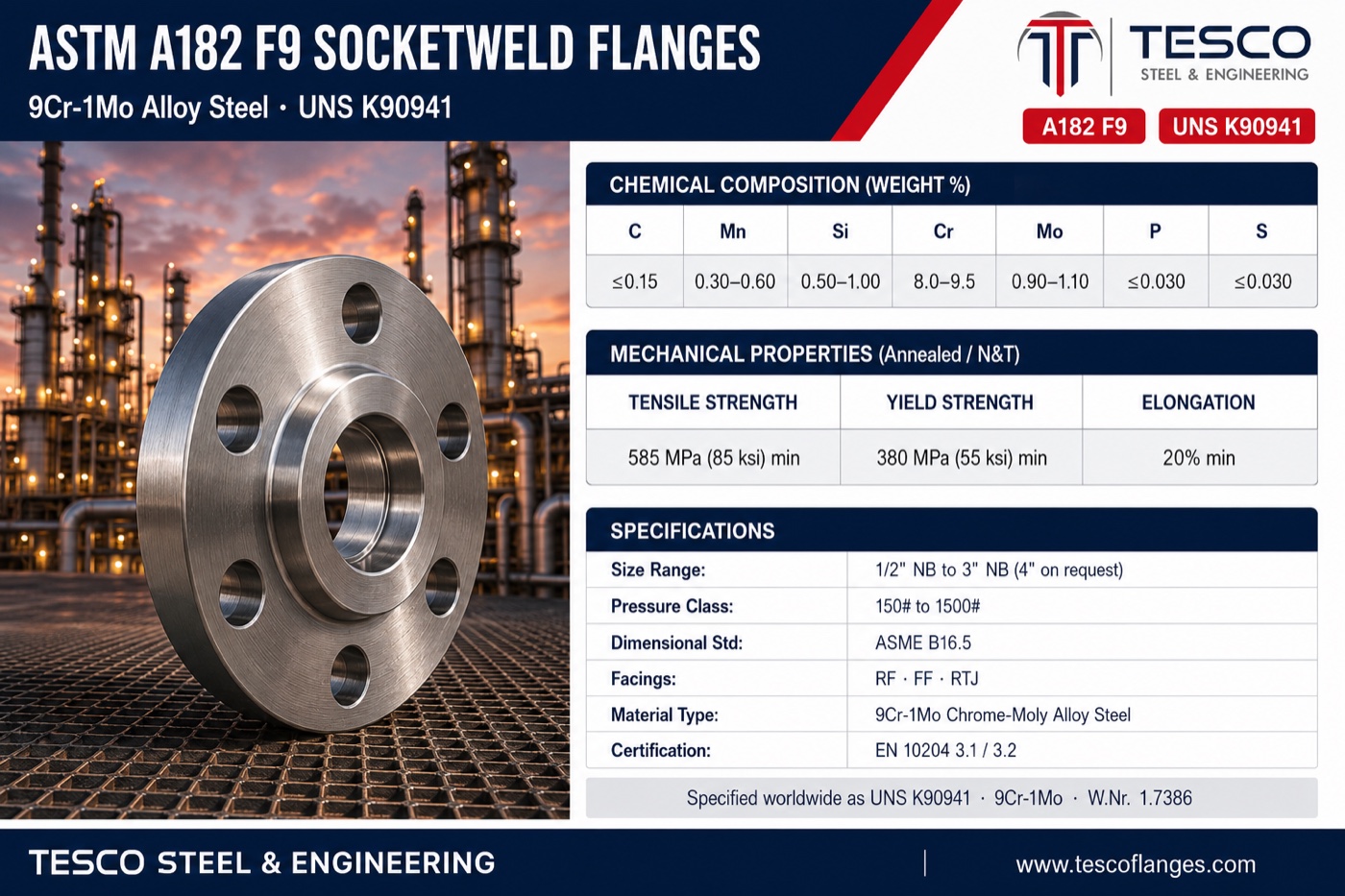
Tesco Steel & Engineering manufactures ASTM A182 F9 socketweld flanges — 9Cr-1Mo alloy steel, UNS K90941, W.Nr. 1.7386 — to ASME B16.5 from ½″ to 3″ NB in Classes 150–1500 (2500 and 4″ to order). This is the top corrosion rung of the ferritic chrome-moly ladder: twice F5's chromium for the hottest, sourest circuits a refinery runs — coker heaters, vacuum bottoms, high-sulphur transfer lines, hydroprocessing hot sections per the Nelson curves — with the strongest plain chrome-moly certificate: 585/380 MPa, and a deliberate silicon addition (0.50–1.00%) that thickens the protective scale. F9 is not F91 — the V-grade is a steam-plant mission, and the difference gets its own FAQ. Socket seated, one external fillet weld, strict 9Cr preheat/PWHT discipline stated honestly below. Facings: SWRF, SWFF, SWRTJ. Every lot with EN 10204 3.1/3.2 MTC. ISO 9001:2015, made in Mumbai, India — exported to 50+ countries.
A182 F9 · UNS K90941 · W.Nr. 1.73869Cr-1Mo — Top of the Ferritic LadderMaximum Sulphidation Resistance585 / 380 MPa · 179–217 HBSi 0.50–1.00% Scaling ArmourASME B16.5 ½″–3″ · Class 150–1500Not F91 — Difference ExplainedEN 10204 3.1 / 3.2 · ISO 9001:2015
ASTM A182 F9 Socketweld Flanges — Specifications at a Glance
What is an ASTM A182 F9 Socketweld Flange?
The ferritic ladder's corrosion ceiling. A forged 9Cr-1Mo alloy steel flange (ASTM A182 F9 / UNS K90941) with a machined socket: pipe seated square by geometry, one external fillet weld, through-bore matched to the pipe schedule. Twice F5's chromium for maximum sulphidation and hydrogen resistance, Mo doubled to 0.90–1.10%, and a deliberate Si addition (0.50–1.00%) for scaling resistance — the small-bore flange of the hottest, sourest refinery circuits. Tensile ≥585 MPa, yield ≥380 MPa, 179–217 HB, annealed or N&T. Sized by ASME B16.5 at ½″–3″ NB, Classes 150–1500; welded with strict 9Cr preheat/PWHT discipline; EN 10204 3.1 on every lot. Not F91 — see the FAQ.
Also searched as: A182 F9 socket weld flange, F9 SWRF flange, 9Cr-1Mo socket weld flange, 9 chrome SW flange, K90941 flange — all the same product family. Related pages: the facings — SWRF / SWFF / SWRTJ — the socketweld hub, the other F9 types — blind, weld neck, slip-on, F9 grade hub — the ladder neighbours F5 / F22 / F91, and the alloy steel hub.
Beyond F9, more resistance means a change of crystal structure, not more ferritic chromium — which is why F9 is where the refinery's PWHT-based, thermally-matched piping philosophy reaches its ceiling.
What Doubling the Chromium Buys
Sulphidation, Solved for the Worst Streams
The McConomy relationships keep paying with chromium: 9% Cr survives vacuum bottoms, coker heater outlets and high-sulphur transfer lines at rates F5 cannot economically match.
The Widest Ferritic Hydrogen Window
On the Nelson curves, 9Cr-1Mo stands at higher temperatures and hydrogen partial pressures than any lower rung — hydroprocessing hot sections specify it for exactly that.
Silicon as Armour, Not Residue
Si 0.50–1.00% — a range with a minimum: a deliberate addition that thickens the protective scale at 500–650 °C surface temperatures. A datasheet showing F9 silicon as “≤0.50” has copied the F5 line.
The Strongest Plain Chrome-Moly Certificate
585/380 MPa against F5's 485/275 — the strength arrives with the corrosion resistance, not instead of it.
ASTM A182 F9 Chemical Composition (UNS K90941)
Element
C
Mn
Si
Cr
Mo
P
S
Weight %
≤0.15
0.30–0.60
0.50–1.00
8.0–9.5
0.90–1.10
≤0.030
≤0.030
Identity marks: Cr 8–9.5% completing the ferritic corrosion ladder, Mo doubled against F5, and the deliberate silicon range. No vanadium, niobium or nitrogen — those belong to F91, a different grade with a different mission. PMI reads the Cr-Mo-Si signature together on every piece.
Mechanical Properties (Annealed / N&T)
Property
ASTM A182 F9 Requirement
Tensile Strength
≥ 585 MPa (85 ksi) — the plain ladder's strongest
Yield Strength (0.2%)
≥ 380 MPa (55 ksi)
Elongation
≥ 20%
Hardness
179–217 HB — the mill's proof of tempering, and your PWHT baseline
Condition
Annealed or normalized-and-tempered — furnace records certified
Why It's Bought
What it keeps at 500–650 °C — dense Cr-Mo carbides against creep and hydrogen attack alike
ASTM A182 F9 Socketweld Flanges are available in the following specifications:
Material Grade
ASTM A182 F9 (UNS K90941), W.Nr. 1.7386 — 9Cr-1Mo; not interchangeable with F91 — a specification naming either must be supplied with that grade exactly
Heat Treatment
Annealed or normalized-and-tempered; hardness verified 179–217 HB; furnace records certified
Size
1/2"NB to 3"NB per ASME B16.5; 4″ and larger to order
Class
150#, 300#, 600#, 900#, 1500# (900# shares 1500# dimensions in most sizes); 2500# on request — duty clusters in 300–900
Facings
Raised Face (SWRF), Flat Face (SWFF), Ring Type Joint (SWRTJ) with groove per B16.20
Bore
Socket bore to pipe OD; through-bore matched to pipe schedule (Sch 40/80/160 — 80/160 dominate hot small bore)
Welding
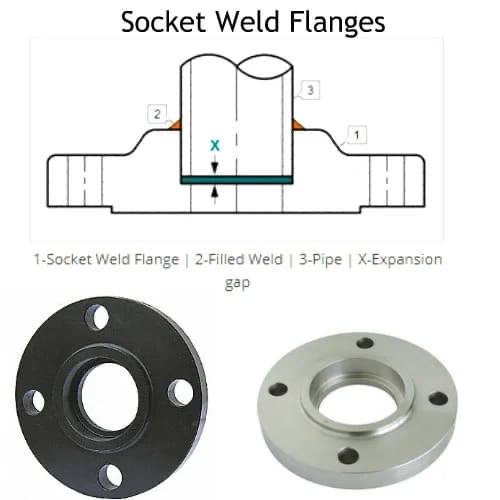
Single external fillet per B16.5/B31.3 with 1/16″ expansion gap; preheat and PWHT effectively mandatory for 9Cr — see the FAQ
Service Span
The hottest, sourest hydrocarbon and hydrogen circuits per McConomy/Nelson practice; beyond F9 → austenitic stainless
Testing
Tension, chemistry and hardness per heat; PMI (Cr-Mo-Si signature) on every piece; socket depth and bore gauged
Certification
EN 10204 3.1 with heat-treatment records (standard) / 3.2 witnessed
Specification Notes — Getting F9 Sockets Right
Four honest notes.9Cr air-hardens decisively: preheat (~200–260 °C) and PWHT are effectively mandatory in code work — a freely-cooled F9 fillet is hard martensite, and small-bore sockets are exactly where the discipline gets skipped. F9 is not F91: the V-microalloyed grade is a steam-plant mission with stricter rules still — a specification naming one must never be supplied with the other, and our certificates say which you got. The 1/16″ gap stands — expansion against a bottomed socket cracks weld roots. And the hottest small bore cycles brutally: decoking and steam-out circuits concentrate alternating stress at the fillet root — many owners butt-weld all cyclic 9Cr small bore, and where your line class says so, the F9 weld neck is the right escalation.
How Our A182 F9 Socketweld Flanges Are Manufactured
1
Forging — cut billet of the spectro-verified F9 heat — the Cr, Mo and Si windows confirmed — is hot-forged into the flange blank with full heat traceability.
2
Heat treatment — annealed or normalized-and-tempered per the specification; furnace charts retained against the heat number.
3
Hardness & testing — hardness verified in the 179–217 HB band; tension and chemistry per heat; PMI reads the Cr-Mo-Si signature on every piece.
4
Machining — faces, OD and drilling to ASME B16.5; socket counterbore and depth gauged piece by piece, through-bore matched to the ordered schedule; RF serrations, flat face or RTJ groove per B16.20.
5
Marking — laser-marked with grade, size, class, schedule and heat number.
6
Certification & packing — EN 10204 3.1 MTC with heat-treatment records (3.2 witnessed on request); packed sea-worthy.
Where ASTM A182 F9 Socketweld Flanges Are Used
The hottest, sourest small bore: coker and visbreaker heater auxiliaries, vacuum column bottoms circuits, high-sulphur crude and transfer lines, hydroprocessing hot sections, FCC slurry systems, sulphur plant duty and furnace connections — the drains, vents, instrument taps and injection points of services running 500–650 °C with sulphur or hydrogen in the stream. Production below:
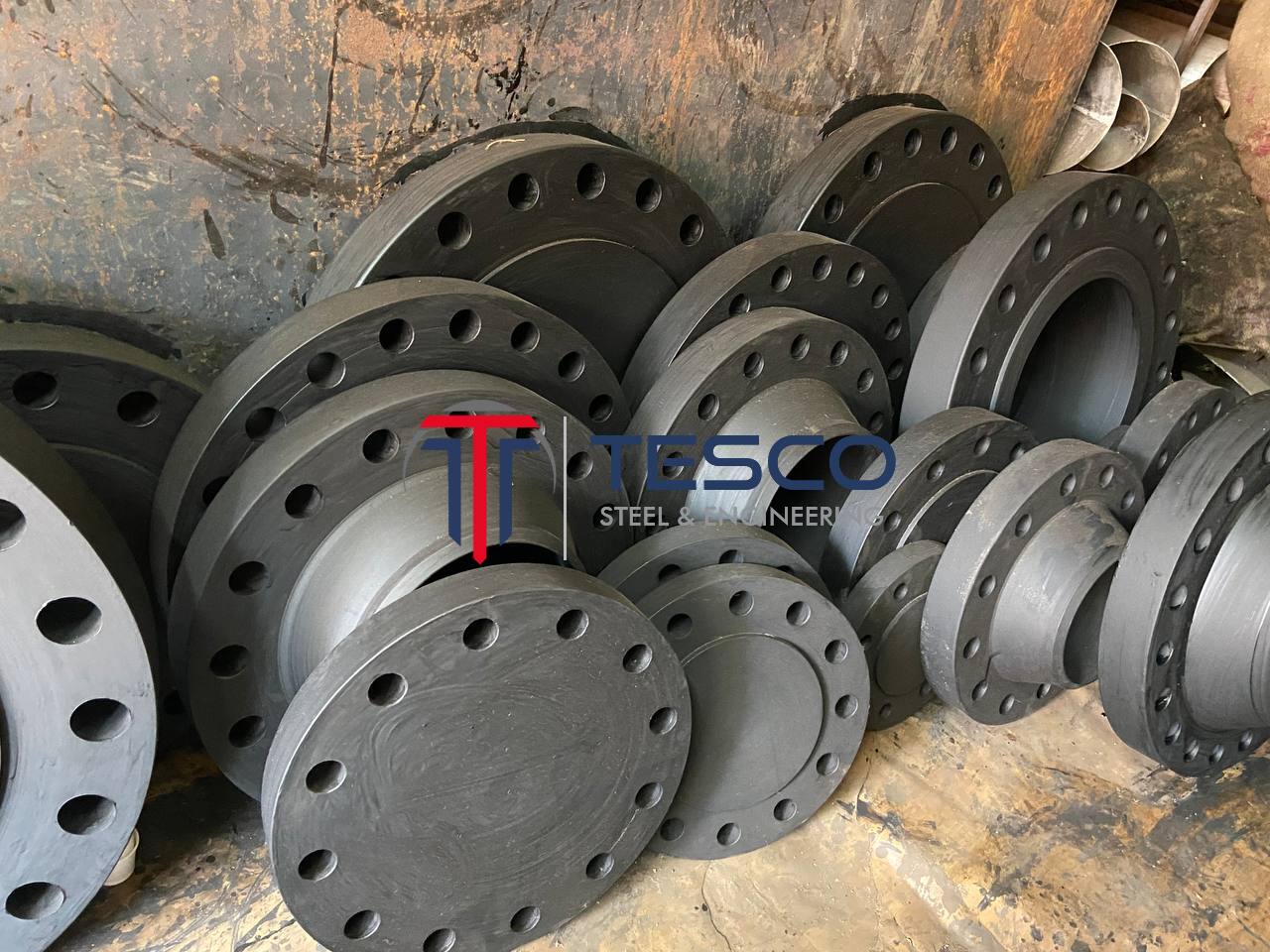
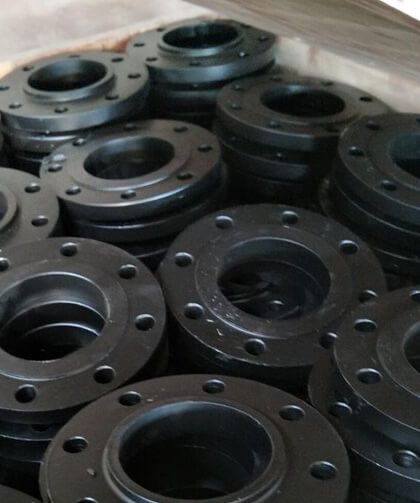
A182 Alloy Steel Flanges — Warehouse StockThe Socket Weld Joint — Note the Expansion Gap (X)Steel Flanges — Black-Coated, Crated at Our Works
A182 F9 Socketweld Flange Dimensions
Socket weld flange dimensions are class-governed per ASME B16.5 — identical across material grades (pressure-temperature ratings follow the 9Cr material group). Full charts:
An ASTM A182 F9 socketweld flange is a forged 9Cr-1Mo alloy steel flange — 9% chromium, 1% molybdenum, UNS K90941 — whose back carries a machined socket: the pipe end seats inside, self-aligned square to the face, and is secured with a single external fillet weld. F9 is the top corrosion rung of the ferritic chrome-moly ladder: twice F5's chromium for the hottest, sourest hydrocarbon circuits a refinery runs, with the strongest plain chrome-moly certificate — 585 MPa tensile, 380 MPa yield — and a deliberate silicon addition for high-temperature scaling resistance. Dimensioned to ASME B16.5 for ½" to 3" NB in Classes 150 to 1500, in raised face, flat face and ring joint facings.
Where does F9 sit on the chrome-moly ladder?
At the top of the plain rungs. The ladder climbs F1 (½Mo) → F11 (1¼Cr) → F22 (2¼Cr) → F5 (5Cr) → F9 (9Cr-1Mo), with F91 (9Cr-1Mo-V) as a separate, creep-mission branch. From F5 upward the chromium is a corrosion purchase, and F9 is that logic completed: the most sulphidation- and hydrogen-resistant ferritic steel in the family, holding duties that would consume F5 severalfold faster. Beyond F9 the next step is a change of world — the austenitic stainless grades — so F9 is where a refinery's ferritic, PWHT-based, thermally-matched piping philosophy reaches its corrosion ceiling. Every rung has its own pages on this site; this page is the F9 socket weld.
What does 9% chromium buy over F5?
Roughly another whole step on both of F5's curves. Sulphidation: the McConomy relationships keep paying with chromium, and 9Cr steel survives hot sour streams — vacuum column bottoms, coker heater outlets, high-sulphur transfer lines — at rates F5 cannot economically match. Hydrogen: on the Nelson curves, 9Cr-1Mo stands at higher temperatures and hydrogen partial pressures than any lower rung, which is why hydroprocessing hot sections specify it. And as a bonus the certificate is stronger — 585/380 MPa against F5's 485/275 — plus the silicon addition (0.50-1.00%, a deliberate range with a minimum) that thickens the protective oxide scale in hot air and flue gas. You pay in welding discipline; see that FAQ.
Why does F9's silicon have a minimum?
Because in F9 silicon is an alloying decision, not a leftover. Most flange steels cap silicon as a deoxidation residue — F5 allows up to 0.50% and no more. F9 instead specifies 0.50-1.00%: a deliberate addition that reinforces the chromium oxide scale, measurably improving oxidation and sulphidation resistance at the 500-650°C surface temperatures of heater and transfer-line service. It is a small signature with a practical certificate consequence: an F9 heat must prove silicon above the floor as well as below the ceiling, and our PMI reads the Cr-Mo-Si signature together. If a datasheet shows F9 silicon as '≤0.50', someone has copied the F5 line — a mistake worth catching at enquiry.
What is the chemical composition of ASTM A182 F9?
Carbon ≤0.15%, manganese 0.30-0.60%, silicon 0.50-1.00% (a deliberate range — see the silicon FAQ), chromium 8.0-9.5%, molybdenum 0.90-1.10%, phosphorus ≤0.030%, sulphur ≤0.030%. Two identity marks: the 8-9.5% chromium band that completes the ferritic corrosion ladder, and molybdenum doubled against F5 (0.90-1.10 versus 0.44-0.65) for hot strength and hydrogen resistance. Note there is no vanadium, niobium or nitrogen — those belong to F91, a different grade with a different mission. Chemistry is verified per heat and travels on the EN 10204 3.1 MTC.
What are the mechanical properties of A182 F9 socketweld flanges?
In the annealed or normalized-and-tempered condition A182 requires tensile strength 585 MPa (85 ksi) minimum, yield strength 380 MPa (55 ksi) minimum, elongation 20% minimum, with hardness controlled at 179-217 HB — the strongest certificate of the plain chrome-moly rungs, comfortably above F5's 485/275. As with all the family, the room-temperature numbers understate the purchase: F9 is bought for what it keeps at 500-650°C, where its dense Cr-Mo carbides resist both creep and the hydrogen attack that dissolves lesser carbides. The hardness band is the mill's proof of proper tempering and the baseline your site PWHT should return the weld zone to.
F9 or F91 — what is the difference?
Same 9Cr-1Mo base, different centuries of metallurgy — and they are not interchangeable. F9 is the classic grade: plain 9Cr-1Mo, bought for corrosion in refinery service, heat treated by ordinary anneal or N&T, welded with standard chrome-moly discipline. F91 (UNS K91560) adds vanadium, niobium and nitrogen to create a creep-strength-enhanced ferritic for modern high-energy steam piping — nearly double the creep strength — but at the price of a strict normalize-and-temper window, unforgiving weld and PWHT rules, and well-documented failures where fabricators treated it casually. Rule of thumb: sulphur-driven refinery duty says F9; advanced steam conditions say F91; and a specification that names one must never be supplied with the other. Both have full page families on this site.
How is an F9 socketweld flange welded — preheat and PWHT?
With the strictest discipline of the plain chrome-moly rungs. The joint geometry is standard socket weld practice — pipe bottomed, withdrawn 1/16" (1.6 mm) per ASME B31.3, single external fillet — but 9Cr steel air-hardens even more decisively than 5Cr: a freely-cooled F9 weld zone is hard martensite, and cracking follows. Preheat (typically around 200-260°C for this class) and post-weld heat treatment are effectively mandatory for F9 joints in code work, returning the zone toward the 179-217 HB band. Small-bore sockets are where the discipline gets skipped — and F9 forgives that even less than F5. Our flanges arrive properly heat treated with records; the joint's pedigree is the fabricator's half of the contract.
What facings are A182 F9 socketweld flanges made with?
All three, each with its own page on this site: raised face (SWRF) — the refinery default, with graphite-filled spiral wound gaskets for the hot services F9 lives in — flat face (SWFF) for the rare lined or brittle mate, and ring type joint (SWRTJ) for high-pressure hot circuits in Classes 900-1500. The socket, the welding discipline and the schedule-matched bore are identical across the three; only the gasket face changes, and the piping class decides which you order.
What sizes and pressure classes do F9 socketweld flanges come in?
ASME B16.5 standardises socket weld flanges from ½" to 3" NB in Classes 150, 300, 600, 900 and 1500 — Class 900 sharing Class 1500 dimensions in most small-bore sizes — with 4" and Class 2500 made to order. F9's duty profile concentrates orders in Classes 300-900, heater and hot-transfer auxiliaries especially. As with every socket flange, put the pipe schedule on the enquiry — Sch 80 and 160 dominate hot high-pressure small bore — so the through-bore matches the pipe ID. B16.5 pressure-temperature ratings for the 9Cr material group govern the limits; our quotations state them per class.
When should I not use a socket weld flange?
The standard socket weld limits apply, sharpened by F9's service profile. As always: the socket gap is a crevice (stagnant corrosive duty prefers butt welds), fillet welds cannot be radiographed (mandatory-RT and lethal-service classes escalate to weld necks), and hygienic duty excludes sockets. The F9-specific caution mirrors F5's but harder: the hottest refinery small bore cycles brutally — decoking, steam-air decoking, steam-out — and alternating stress at a fillet root in an air-hardening 9Cr steel is precisely where cracks start; many owners butt-weld all cyclic 9Cr small bore as policy. Where your line class says so, our F9 weld neck page has the matching flange.
What comes after F9 — when does the duty leave the ladder?
When 9% chromium is no longer enough, the answer is not more ferritic chromium — it is a change of crystal structure. The austenitic stainless grades take over: 304H, 321H and 347H for hot hydrocarbon and steam where creep plus corrosion both bite, 316/317 families where aqueous corrosion enters, each with its own page family on this site. The trade is real on both sides: stainless buys corrosion immunity and creep capability but brings a different thermal expansion, different welding, and chloride sensitivities the ferritic ladder never had — which is why refineries hold the F5/F9 world as long as the sulphur curves allow. Our quotations walk that boundary honestly when an enquiry sits near it.
What details are needed to get an accurate F9 socketweld flange quotation?
Six elements plus commercial terms: (1) size — ½" to 3" NB; (2) pressure class — 150 to 1500; (3) facing — SWRF, SWFF or SWRTJ with ring number; (4) the pipe schedule — Sch 40, 80 or 160, so the through-bore matches the pipe ID; (5) grade confirmation — F9 (this page) or F91 if your specification is a steam-plant document naming the V-grade, with any hardness or PWHT-simulation requirements; (6) certification — EN 10204 3.1 with heat-treatment records (our standard) or 3.2 witnessed, PMI as applicable. Add quantity and destination and we return price, weight and delivery — normally within 24 hours.
Who manufactures ASTM A182 F9 socketweld flanges in India?
Tesco Steel & Engineering is an ISO 9001:2015 certified flange manufacturer based in Mumbai, India, producing ASTM A182 F9 socket weld flanges from ½" to 3" NB (larger to order) in Classes 150-1500 — each forged from certified heats, annealed or normalized-and-tempered with furnace records, hardness-verified in the 179-217 HB band, machined with gauged socket depth and schedule-matched bore, PMI-checked with the Cr-Mo-Si signature read on every piece, and laser-marked with grade, size, class and heat number. Supplied with EN 10204 3.1/3.2 certification, alongside the full chrome-moly ladder — F1, F11, F22, F5 and F91 — and the complete socket weld range in carbon, stainless and nickel alloys. Exported to more than 50 countries.