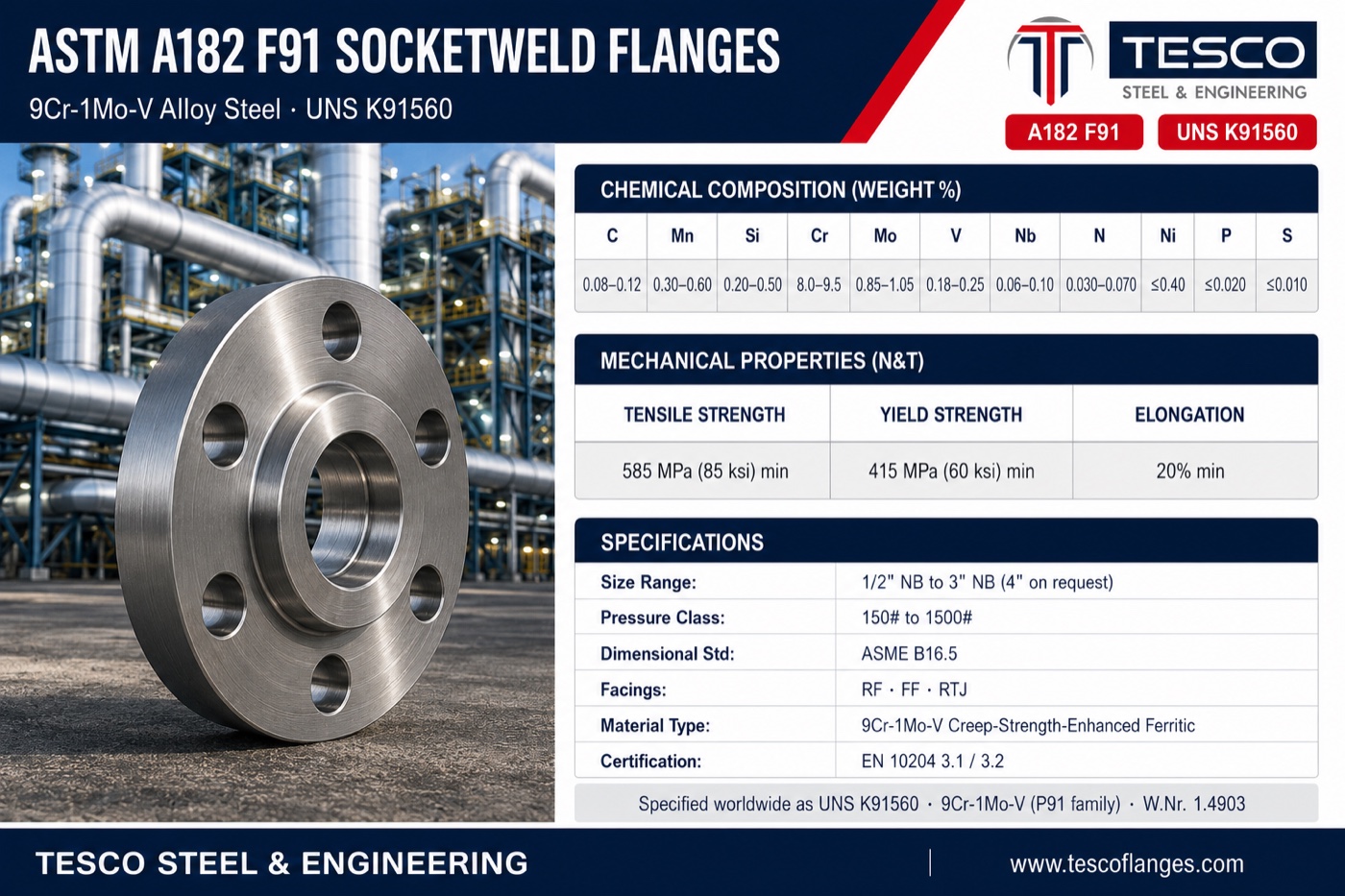
Tesco Steel & Engineering manufactures ASTM A182 F91 socketweld flanges — 9Cr-1Mo-V creep-strength-enhanced ferritic, UNS K91560, W.Nr. 1.4903 — to ASME B16.5 from ½″ to 3″ NB in Classes 150–1500. F91 is a different generation from the classic ladder: vanadium, niobium and a deliberate nitrogen addition build fine carbonitrides in a tempered-martensite matrix, worth nearly double F22's creep strength — the grade of supercritical and ultra-supercritical steam, matching P91 pipe. It also carries the strictest heat-treatment and welding rules on the ladder — the narrow N&T window, the ~745–775 °C PWHT band, the Type IV soft-zone story — and this page states them honestly, including when not to socket-weld P91. Not plain F9 — never interchangeable. Facings: SWRF, SWFF, SWRTJ. Every lot with EN 10204 3.1/3.2 MTC including furnace charts and hardness. ISO 9001:2015, made in Mumbai, India — exported to 50+ countries.
A182 F91 · UNS K91560 · W.Nr. 1.49039Cr-1Mo-V — The CSEF Generation~2× F22's Creep Strength585 / 415 MPa · ≤248 HBWSupercritical & USC Steam · P91 MatchStrictest Rules on the Ladder — StatedASME B16.5 ½″–3″ · Class 150–1500EN 10204 3.1 / 3.2 + Furnace Charts
ASTM A182 F91 Socketweld Flanges — Specifications at a Glance
What is an ASTM A182 F91 Socketweld Flange?
The CSEF generation's small-bore flange. A forged 9Cr-1Mo-V flange (ASTM A182 F91 / UNS K91560) with a machined socket: pipe seated square by geometry, one external fillet weld under full P91 discipline, through-bore matched to the pipe schedule. V + Nb + N carbonitrides in tempered martensite deliver ~2× F22's creep-rupture strength — the metallurgy of supercritical steam — at the price of the ladder's strictest heat-treatment and welding rules. Tensile ≥585 MPa, yield ≥415 MPa, ≤248 HBW, mandatory N&T with furnace charts on the MTC. Sized by ASME B16.5 at ½″–3″ NB, Classes 150–1500. Not plain F9 — see the FAQ.
Also searched as: P91 socket weld flange, A182 F91 SW flange, 9Cr-1Mo-V flange, CSEF socket weld flange, K91560 flange — all the same product family. Related pages: the facings — SWRF / SWFF / SWRTJ — the socketweld hub, the other F91 types — blind, weld neck, slip-on, F91 grade hub — the ladder neighbours F22 / F9, and the alloy steel hub.
F91 shares F9's chromium and nothing else that matters: a different strengthening mechanism, a different rulebook, a different mission — and the two are never interchangeable on a certificate.
What the V-Nb-N Trio Buys — and Costs
Nearly Double F22's Creep Strength
Fine vanadium-niobium carbonitrides, stabilised by deliberate nitrogen, pin a tempered-martensite matrix for decades — the metallurgy that let modern plants raise steam conditions and thin their pressure parts.
The Strongest Certificate on the Ladder
585/415 MPa with hardness capped at 248 HBW — and in the F91 world, hardness is more than a number: it is the field's quickest proxy for correct microstructure.
The Cost: Everything Is Strict
The property set lives in one precise microstructure — so the N&T window is mandatory and narrow, the PWHT band is ~745–775 °C, and vague heat-treatment paperwork is grounds for rejection. Our MTCs attach the furnace charts.
The Known Weakness: Type IV
Every weld's heat-affected zone carries a soft band where creep cracks concentrate in service — the reason P91 owners minimise weld count and treat every joint as an engineered object.
ASTM A182 F91 Chemical Composition (UNS K91560)
Element
C
Mn
Si
Cr
Mo
V
Nb
N
Ni
P
S
Weight %
0.08–0.12
0.30–0.60
0.20–0.50
8.0–9.5
0.85–1.05
0.18–0.25
0.06–0.10
0.030–0.070
≤0.40
≤0.020
≤0.010
Everything is deliberate: the V-Nb-N trio builds the strengthening carbonitrides, the narrow carbon band balances hardenability against weldability, the nickel cap protects the tempering response, and P/S sit at the ladder's tightest ceilings for long-term creep ductility. Al, Ti and Zr are additionally restricted — they steal the nitrogen the vanadium needs. PMI reads the V-Nb signature, so F91 and F9 can never mix.
Mechanical Properties (N&T — Mandatory)
Property
ASTM A182 F91 Requirement
Tensile Strength
≥ 585 MPa (85 ksi)
Yield Strength (0.2%)
≥ 415 MPa (60 ksi) — the ladder's strongest
Elongation
≥ 20%
Hardness
≤ 248 HBW — low warns of over-tempering (lost creep life), high of untempered martensite (cracking)
Condition
Normalized & tempered inside the grade's mandatory narrow window — furnace charts attached to our MTC
Types
Type 1 (default) / Type 2 (tighter trace elements) — see the FAQ
ASTM A182 F91 Socketweld Flanges are available in the following specifications:
Material Grade
ASTM A182 F91 (UNS K91560), W.Nr. 1.4903 — Type 1 default, Type 2 to order; never interchangeable with plain F9
Heat Treatment
Mandatory N&T inside the grade's narrow window; hardness verified ≤248 HBW; furnace charts attached to the MTC
Size
1/2"NB to 3"NB per ASME B16.5; 4″ and larger to order
Class
150#, 300#, 600#, 900#, 1500# (900# shares 1500# dimensions in most sizes); 2500# on request — duty concentrates in 900–1500
Facings
Raised Face (SWRF), Flat Face (SWFF), Ring Type Joint (SWRTJ) with groove per B16.20
Bore
Socket bore to pipe OD; through-bore matched to pipe schedule (Sch 80/160 dominate)
Welding
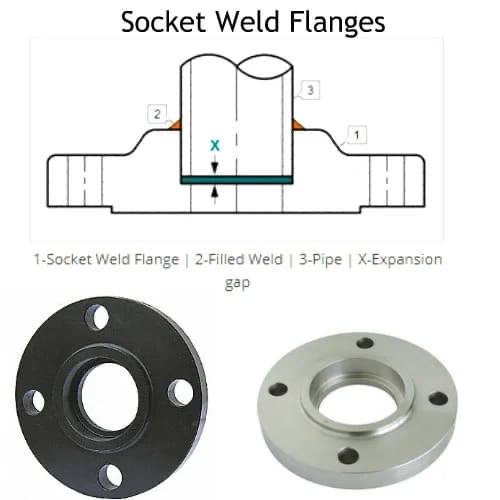
Single external fillet with 1/16″ expansion gap — under full P91 discipline: preheat ~200–260 °C, matching 9Cr-1Mo-V consumables, PWHT ~745–775 °C
Service Span
Supercritical / USC steam small bore in P91 systems, where the owner's piping class permits sockets — see the honest notes
Testing
Tension, chemistry and hardness per heat; PMI reads the V-Nb signature on every piece; socket depth and bore gauged
Certification
EN 10204 3.1 with N&T furnace charts and hardness results (standard) / 3.2 witnessed
Specification Notes — Getting F91 Right
Four honest notes — F91 earns them all.F91 is not F9: same chromium, different century — PMI reads the V-Nb signature, and a specification naming either must be supplied with that grade exactly. The paperwork is the product: the creep life lives in the N&T microstructure — our MTCs attach the actual furnace charts, and vague heat-treatment records on any F91 component deserve rejection. Welding is an engineered operation: preheat, matching consumables, the ~745–775 °C PWHT band, and the Type IV soft zone are why field crews who treat F91 like ordinary chrome-moly caused the industry's documented failures. And many P91 owners avoid sockets altogether: weld-count minimisation and volumetric examination push consequential joints to butt welds — where your class says so, the F91 weld neck is the right product, and our quotation will not argue with the class.
How Our A182 F91 Socketweld Flanges Are Manufactured
1
Forging — cut billet of the spectro-verified F91 heat — V, Nb and N windows confirmed alongside Cr-Mo — is hot-forged into the flange blank with full heat traceability.
2
Normalize & temper — inside the grade's mandatory narrow window; furnace charts retained and attached to the MTC, not merely summarised.
3
Hardness & testing — hardness verified against the 248 HBW ceiling per heat; tension and full chemistry; PMI reads the V-Nb signature on every piece.
4
Machining — faces, OD and drilling to ASME B16.5; socket counterbore and depth gauged piece by piece, through-bore matched to the ordered schedule; RF serrations, flat face or RTJ groove per B16.20.
5
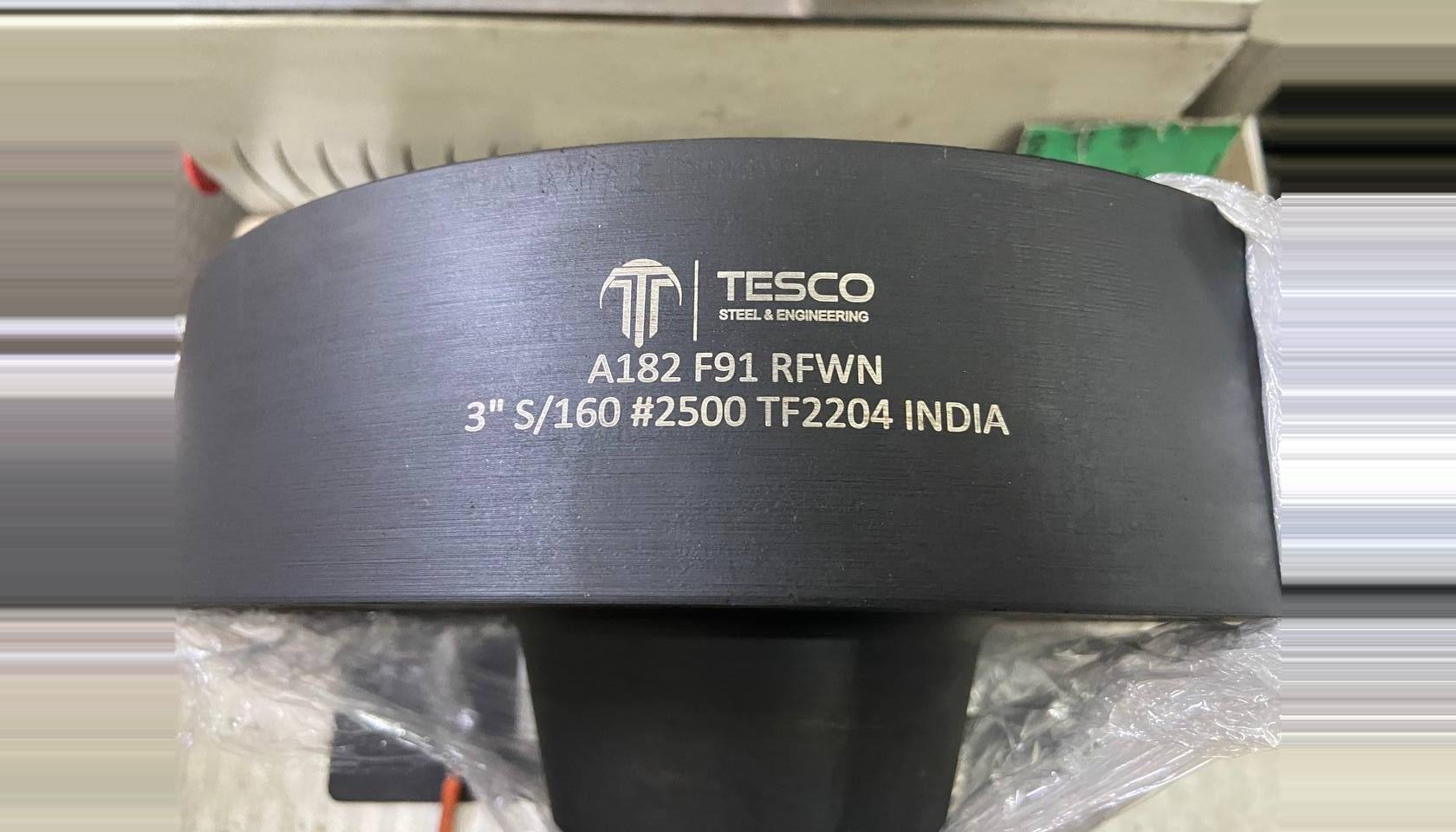
Marking — laser-marked with grade (and Type where ordered), size, class, schedule and heat number.
6
Certification & packing — EN 10204 3.1 MTC with N&T charts and hardness results (3.2 witnessed on request); packed sea-worthy.
Where ASTM A182 F91 Socketweld Flanges Are Used
Around the highest-energy steam in power engineering: main steam and hot reheat auxiliaries of supercritical and ultra-supercritical plants, HRSG high-pressure sections in combined-cycle stations, superheater and header instrument and vent connections — wherever the line is P91 and the owner's class permits socket-welded small bore. Production below:
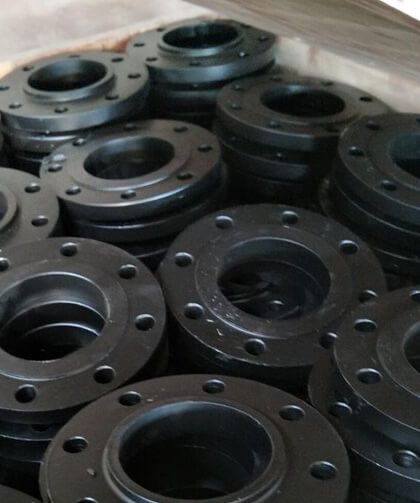
A182 F91 Flange — 2500# Class, From Our ProductionThe Socket Weld Joint — Note the Expansion Gap (X)Steel Flanges — Black-Coated, Crated at Our Works
A182 F91 Socketweld Flange Dimensions
Socket weld flange dimensions are class-governed per ASME B16.5 — identical across material grades (pressure-temperature ratings follow the 9Cr-1Mo-V material group). Full charts:
Example: “SWRF Flange, 1″ NB, ASME B16.5 Class 1500, Sch 160 bore, ASTM A182 F91 Type 1, EN 10204 3.1 with N&T charts — 12 pcs, main steam vent connections.” Quotations normally within 24 hours with price, unit weight and delivery.
An ASTM A182 F91 socketweld flange is a forged 9Cr-1Mo-V creep-strength-enhanced ferritic (CSEF) steel flange — UNS K91560, the flange member of the P91 family — whose back carries a machined socket: the pipe end seats inside, self-aligned square to the face, and is secured with a single external fillet weld made under full P91 welding discipline. F91 is a different generation from the classic chrome-moly rungs: vanadium, niobium and nitrogen build fine carbonitrides in a tempered-martensite matrix, worth nearly double F22's creep-rupture strength — the grade of supercritical and ultra-supercritical steam. Dimensioned to ASME B16.5 for ½" to 3" NB in Classes 150 to 1500, in raised face, flat face and ring joint facings.
What makes F91 a different generation from the classic chrome-moly grades?
The strengthening mechanism. The classic rungs — F11, F12, F22 — are ferrite-pearlite or bainitic steels strengthened by ordinary chromium-molybdenum carbides. F91 is a martensitic steel: normalized to form martensite through the full section, then tempered, with vanadium and niobium carbonitrides — stabilised by a deliberate nitrogen addition — precipitated as a fine, thermally stable dispersion that pins the structure against creep for decades. The result is roughly double F22's creep-rupture strength, which let modern power plants raise steam conditions and thin their pressure parts. The price is sensitivity: the entire property set depends on that precise microstructure, which is why F91's heat-treatment and welding rules are the strictest on the ladder — see those FAQs.
F91 or F9 — what is the difference?
Same 9% chromium, different centuries — and never interchangeable. F9 (UNS K90941) is the classic plain 9Cr-1Mo: a corrosion purchase for hot sour refinery streams, heat treated by ordinary anneal or N&T, welded with standard chrome-moly care. F91 (UNS K91560) is the vanadium-microalloyed CSEF: a creep purchase for advanced steam, with a mandatory narrow normalize-and-temper window and unforgiving weld rules. Their chemistries diverge in every detail that matters: F91 adds V, Nb and N, narrows carbon to 0.08-0.12%, trims Mo to 0.85-1.05, and tightens P/S to 0.020/0.010. A specification naming either must be supplied with that grade exactly — our certificates and PMI (which reads the V-Nb signature) make the distinction auditable.
What is the chemical composition of ASTM A182 F91?
Carbon 0.08-0.12%, manganese 0.30-0.60%, silicon 0.20-0.50%, chromium 8.0-9.5%, molybdenum 0.85-1.05%, vanadium 0.18-0.25%, niobium 0.06-0.10%, nitrogen 0.030-0.070%, nickel ≤0.40%, phosphorus ≤0.020%, sulphur ≤0.010%. Everything about it is deliberate: the V-Nb-N trio builds the strengthening carbonitrides, the narrow carbon band balances hardenability against weldability, the nickel cap protects the tempering response, and the tight P/S ceilings protect long-term creep ductility. Aluminium, titanium and zirconium are additionally restricted because they steal the nitrogen the vanadium needs. Chemistry is verified per heat and travels on the EN 10204 3.1 MTC.
What are the mechanical properties of A182 F91 socketweld flanges?
In the mandatory normalized-and-tempered condition A182 requires tensile strength 585 MPa (85 ksi) minimum, yield strength 415 MPa (60 ksi) minimum, elongation 20% minimum, and hardness not exceeding 248 HBW — the strongest certificate on the chrome-moly ladder. Hardness deserves special respect in the F91 world: it is the field's quickest proxy for correct microstructure, with low readings warning of over-tempering (lost creep strength) and high readings of untempered martensite (cracking risk). Our certificates report hardness per heat alongside the normalize-and-temper furnace records, because in this grade the heat-treatment paperwork is the product.
Why is F91's heat-treatment window so strict?
Because every property F91 is bought for lives in one precise microstructure. Normalizing must fully austenitise and form martensite through the section; tempering must then precipitate the vanadium-niobium carbonitrides at the right size — high enough in temperature to restore toughness, low enough not to coarsen the dispersion that carries the creep strength. Miss low and hard, brittle zones remain; miss high and the strength quietly evaporates — the flange still looks perfect and passes a tensile test, while its creep life has been halved. This is why F91 components with vague heat-treatment records are rejected by good inspectors, and why our MTCs attach the actual furnace charts, not just a compliance statement.
How is an F91 socketweld flange welded — the famous rules?
Under the strictest discipline in ferritic piping. The joint geometry is ordinary — pipe bottomed, withdrawn 1/16" (1.6 mm), single external fillet — but everything around it is not: preheat typically 200-260°C held through welding, controlled interpass, hydrogen-controlled consumables of matching 9Cr-1Mo-V composition, and PWHT in a narrow band around 745-775°C that must temper the weld without exceeding the base metal's lower transformation temperature. The heat-affected zone also carries F91's known weakness — the soft 'Type IV' zone where creep cracks concentrate in service — which is a reason many owners minimise welds in P91 systems altogether. Field crews treating F91 like ordinary chrome-moly caused the industry's well-documented failures; the rules exist because of them.
What are F91 Type 1 and Type 2?
Recent editions of A182 split F91 into two chemistry types. Type 1 is the classic composition described on this page. Type 2 tightens the recipe further — tramp and trace elements are restricted harder, with controls added on elements like arsenic, tin and antimony, and tighter nitrogen-to-aluminium balance — reflecting a decade of industry research into creep ductility and long-term cracking in 9Cr steels. Advanced projects and some owner specifications now call Type 2 for critical service. Practical guidance: if your specification says simply F91, Type 1 supply satisfies it; if it names Type 2, say so on the enquiry and the quotation and certificate will state Type 2 explicitly.
What facings are A182 F91 socketweld flanges made with?
All three, each with its own page on this site: raised face (SWRF) — the default, with graphite-filled spiral wound gaskets for high-energy steam — flat face (SWFF) for the rare lined or brittle mate, and ring type joint (SWRTJ) for the Class 900-1500 circuits where F91 small bore concentrates. The socket, the welding discipline and the schedule-matched bore are identical across the three; only the gasket face changes, and the piping class decides which you order.
What sizes and pressure classes do F91 socketweld flanges come in?
ASME B16.5 standardises socket weld flanges from ½" to 3" NB in Classes 150, 300, 600, 900 and 1500 — Class 900 sharing Class 1500 dimensions in most small-bore sizes — with 4" and Class 2500 made to order. F91's service profile concentrates orders firmly at the high end: Class 900-1500 connections around main steam and hot reheat systems. As with every socket flange, put the pipe schedule on the enquiry — Sch 80 and 160 dominate — so the through-bore matches the pipe ID. B16.5 pressure-temperature ratings for the 9Cr-1Mo-V material group govern the limits; our quotations state them per class.
When should I not use a socket weld flange in P91 systems?
More often than in any other grade — and honestly, many P91 owners avoid sockets altogether. The general limits stand: the socket gap is a crevice, fillet welds cannot be radiographed, and cyclic services hammer the fillet root. F91 adds its own: every weld in a P91 system is a Type IV soft zone waiting for service stress, so operators minimise weld count and prefer butt-welded, volumetrically examined joints on anything consequential; thermal-fatigue drains and attemperator services doubly so. Where F91 sockets are legitimate — low-consequence vents, gauge connections, services the owner's piping class explicitly allows — this page supplies them; where the class says butt weld, our F91 weld neck page has the matching flange, and our quotation will not argue with the class.
Where are F91 socketweld flanges used?
Around the highest-energy steam in power engineering: main steam and hot reheat system auxiliaries in supercritical and ultra-supercritical plants, HRSG high-pressure sections of combined-cycle stations, superheater and header instrument and vent connections, and the P91 piping systems of modernised units — wherever the line itself is P91 and the owner's class permits socket-welded small bore. The matching rule matters more here than anywhere: an F91 line deserves F91 closures with full heat-treatment pedigree, because a mismatched or poorly documented component in a CSEF system is exactly what remaining-life assessments stumble over decades later.
What details are needed to get an accurate F91 socketweld flange quotation?
Six elements plus commercial terms: (1) size — ½" to 3" NB; (2) pressure class — 150 to 1500; (3) facing — SWRF, SWFF or SWRTJ with ring number; (4) the pipe schedule — Sch 40, 80 or 160, so the through-bore matches the pipe ID; (5) grade detail — F91 (Type 1 default) or Type 2 where the specification names it, and confirm F91 versus plain F9 against the system; (6) certification — EN 10204 3.1 with normalize-and-temper records and hardness results (our standard) or 3.2 witnessed, PMI as applicable. Add quantity and destination and we return price, weight and delivery — normally within 24 hours.
Who manufactures ASTM A182 F91 socketweld flanges in India?
Tesco Steel & Engineering is an ISO 9001:2015 certified flange manufacturer based in Mumbai, India, producing ASTM A182 F91 socket weld flanges from ½" to 3" NB (larger to order) in Classes 150-1500 — each forged from certified heats, normalized and tempered inside the grade's mandatory window with furnace charts attached to the MTC, hardness-verified against the 248 HBW ceiling, machined with gauged socket depth and schedule-matched bore, PMI-checked with the V-Nb signature read on every piece, and laser-marked with grade, size, class, schedule and heat number. Supplied with EN 10204 3.1/3.2 certification, alongside the full chrome-moly ladder — F11, F12, F22, F5 and F9 — and the complete socket weld range. Exported to more than 50 countries.