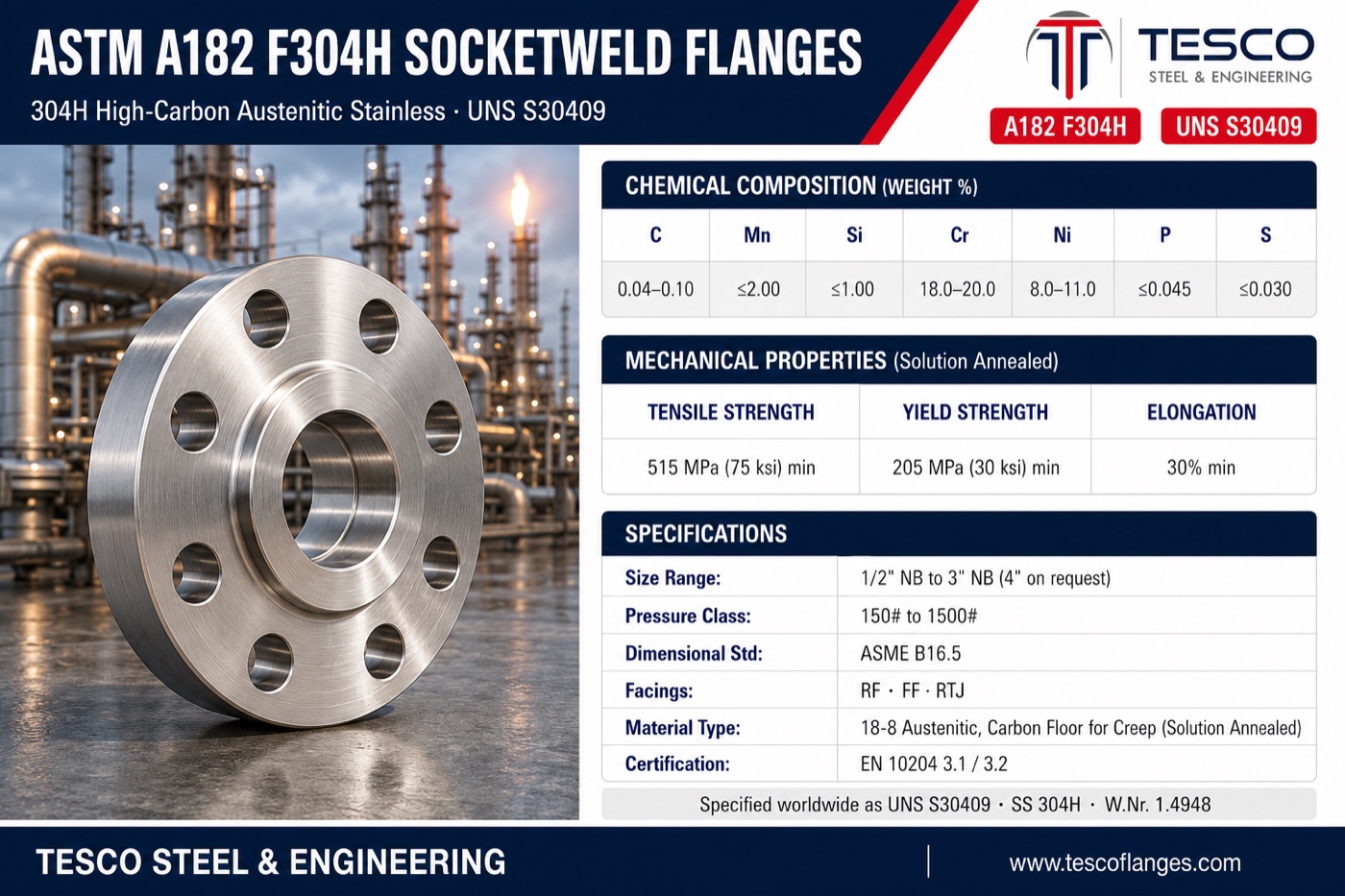
Tesco Steel & Engineering manufactures ASTM A182 F304H socketweld flanges — the creep grade of the austenitic world: 304H, UNS S30409, W.Nr. 1.4948 — to ASME B16.5 from ½″ to 3″ NB in Classes 150–1500. The H is one element, dialled the opposite way to the L: carbon specified with a floor, 0.04–0.10%, because above roughly 525 °C carbon is creep strength — carbides pin the grain boundaries, and the ASME time-dependent allowables demand the floor. Same 18-8 chemistry as plain F304 otherwise, welded with no preheat and no PWHT — 308H carbon-floored filler. The small-bore flange of refinery hot circuits, superheated steam and furnace-adjacent piping — where the ferritic chrome-moly ladder is the parallel road, chosen line by line. Ordered by name — plain or dual-certified 304/304L stock can never satisfy it. Facings: SWRF, SWFF, SWRTJ. Every lot with EN 10204 3.1/3.2 MTC carrying the carbon band. ISO 9001:2015, made in Mumbai, India — exported to 50+ countries.
A182 F304H · UNS S30409 · W.Nr. 1.4948Carbon Floor 0.04–0.10% — Creep StrengthTime-Dependent Design Beyond ~525 °CNo Preheat — No PWHT — 308H FillerNever Substituted by 304 / Dual-Cert515 / 205 MPa · 30% ElongationASME B16.5 ½″–3″ · Class 150–1500EN 10204 3.1 / 3.2 · ISO 9001:2015
ASTM A182 F304H Socketweld Flanges — Specifications at a Glance
What is an ASTM A182 F304H Socketweld Flange?
The austenitic creep grade in the small-bore pattern. A forged high-carbon 18-8 flange (ASTM A182 F304H / UNS S30409) with a machined socket: pipe seated square by geometry, one external fillet weld — no preheat, no PWHT, 308H filler — through-bore matched to the pipe schedule. The H means carbon 0.04–0.10%, floor included: above ~525 °C, carbides pin grain boundaries against creep, and the ASME time-dependent allowables require the floor the certificate proves. Tensile ≥515 MPa, yield ≥205 MPa, elongation ≥30%, solution annealed hot for grain. Sized by ASME B16.5 at ½″–3″ NB, Classes 150–1500; EN 10204 3.1 with the carbon band on every lot.
Also searched as: SS 304H socket weld flange, 304H SW flange, S30409 SWRF flange, 1.4948 socket weld flange, high-carbon stainless socket weld flange — all the same product family. Related pages: the facings — SWRF / SWFF / SWRTJ — the socketweld hub, the other F304H types — blind, weld neck, slip-on, threaded — the carbon-dial siblings F304 / F304L, the stabilised cousins F321 / F347, and the stainless steel hub.
Same 18-8 chassis, one element dialled three ways. The stabilised route — 321 with titanium, 347 with niobium — buys creep strength and sensitization resistance together, at a price; the FAQ weighs them.
What the Carbon Floor Buys
Grain Boundaries, Pinned
Above ~525 °C metal creeps — deforms slowly under stress it would hold forever when cold. Chromium carbides pin the sliding boundaries, and carbides need carbon: the floor is the strength.
The Allowables Only H Can Claim
ASME creep-range allowable stresses for 304 apply only when carbon is ≥0.04%. Plain 304 may have it by luck; 304H has it by certificate — which is the entire purchase.
Austenitic Welding, Kept
No preheat, no PWHT even in creep service — the privilege the chrome-moly road never gets. One rule: 308H filler, carbon-floored like the base metal.
Hot Grain, On Purpose
The H-grade anneal runs hot and leaves coarser grain — fewer boundaries to slide. Specifications often ask for ASTM No. 7 or coarser; we certify it metallographically when they do.
ASTM A182 F304H Chemical Composition (UNS S30409)
Element
C
Mn
Si
Cr
Ni
P
S
Weight %
0.04–0.10
≤2.00
≤1.00
18.0–20.0
8.0–11.0
≤0.045
≤0.030
The carbon band is the grade: a floor as well as a ceiling, and the certificate's most important number — a heat at 0.02% is L-territory and fails the H-grade outright. Beside it the analysis is plain 304's: no molybdenum, no stabiliser, the classic 18-8 pair preserving the austenitic structure that holds toughness at every temperature. PMI on every piece; the certified carbon value travels on the MTC.
Mechanical Properties (Solution Annealed)
Property
ASTM A182 F304H Requirement
Tensile Strength
≥ 515 MPa (75 ksi)
Yield Strength (0.2%)
≥ 205 MPa (30 ksi) — identical to plain 304 at room temperature; the H-grade's difference lives in the creep-range allowables
Elongation
≥ 30% — the full austenitic ductility
Condition
Solution annealed — run hot for full carbon solution and creep-friendly grain; furnace records certified
Temperature Span
Bought for above ~525 °C — the time-dependent regime where plain-carbon heats are excluded from the code tables
Grain Size
Coarse by design; ASTM No. 7 or coarser certified where the specification requires it
Temperature picks the gasket: PTFE has no business at 304H temperatures — graphite rules the hot classes — and bolting must both resist galling and hold its clamp in the creep range.
ASTM A182 F304H Socketweld Flange Specifications
ASTM A182 F304H Socketweld Flanges are available in the following specifications:
Material Grade
ASTM A182 F304H (UNS S30409), W.Nr. 1.4948 — ordered by name; plain or dual-certified stock never substitutes
Heat Treatment
Solution annealed, run hot for carbon solution and grain — furnace records certified; grain size reported where specified
Size
1/2"NB to 3"NB per ASME B16.5; 4″ and larger to order; EN 1092-1 patterns to order
Class
150#, 300#, 600#, 900#, 1500# (900# shares 1500# dimensions in most sizes); 2500# on request
Facings
Raised Face (SWRF), Flat Face (SWFF), Ring Type Joint (SWRTJ) with groove per B16.20
Bore
Socket bore to pipe OD; through-bore matched to pipe schedule (Sch 40S/80S dominate hot circuits)
Welding
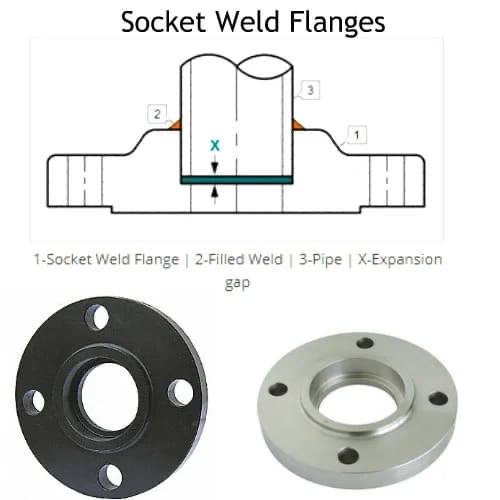
Single external fillet with 1/16″ expansion gap; 308H carbon-floored filler; no preheat, no PWHT; nickel-base filler at chrome-moly interfaces
Service Span
Bought for the creep range above ~525 °C — refinery hot circuits, superheated steam, furnace-adjacent piping; dry hot service its home
Surface Finish
Pickled or natural machined — stainless-dedicated handling, no carbon-steel contact
Testing
Tension & chemistry per heat — carbon band verified; PMI on every piece; socket depth and bore gauged
Certification
EN 10204 3.1 with carbon band and solution-anneal records (standard) / 3.2 witnessed
Specification Notes — Getting 304H Sockets Right
Four honest notes.The ordering trap: modern mill stock is melted low-carbon to dual-certify 304/304L — typically ~0.02% C, below the H-grade floor — so an F304H line can never be satisfied by plain or dual-certified stock; the grade is melted, not paperwork-corrected. Sensitization is the price, paid knowingly: years above 525 °C decorate the boundaries with the very carbides doing the strengthening — free in dry hot service, but shutdown condensate and polythionic acid can crack a sensitized structure: refinery practice answers with soda-ash washes, or with 347-type stabilised grades where wet cycling dominates. The filler follows the floor: 308H, never 308L — a low-carbon fillet is a creep-weak ring at the joint's stress concentration. And hot cyclic lines may refuse sockets: some creep-service piping classes require butt welds where thermal cycling is severe — where yours does, the F304H weld neck is the same certified metal in the joint the class wants.
How Our A182 F304H Socketweld Flanges Are Manufactured
1
Forging — cut billet of the spectro-verified S30409 heat — carbon band confirmed at 0.04–0.10% — is hot-forged into the flange blank with full heat traceability and segregated stainless handling.
2
Solution annealing — run hot for full carbon solution and the coarser, creep-friendly grain; furnace charts retained against the heat number, grain size verified metallographically where specified.
3
Machining — faces, OD and drilling to ASME B16.5 on stainless-dedicated stations; socket counterbore and depth gauged piece by piece, through-bore matched to the ordered schedule.
4
Facing — RF serrations, flat face or RTJ groove per B16.20.
5
Testing & marking — tension and chemistry per heat with the carbon value reported; PMI on every piece; laser-marked with grade, size, class, schedule and heat number.
6
Certification & packing — EN 10204 3.1 MTC carrying the carbon band and solution-anneal records (3.2 witnessed on request); packed sea-worthy with no carbon-steel contact.
Where ASTM A182 F304H Socketweld Flanges Are Used
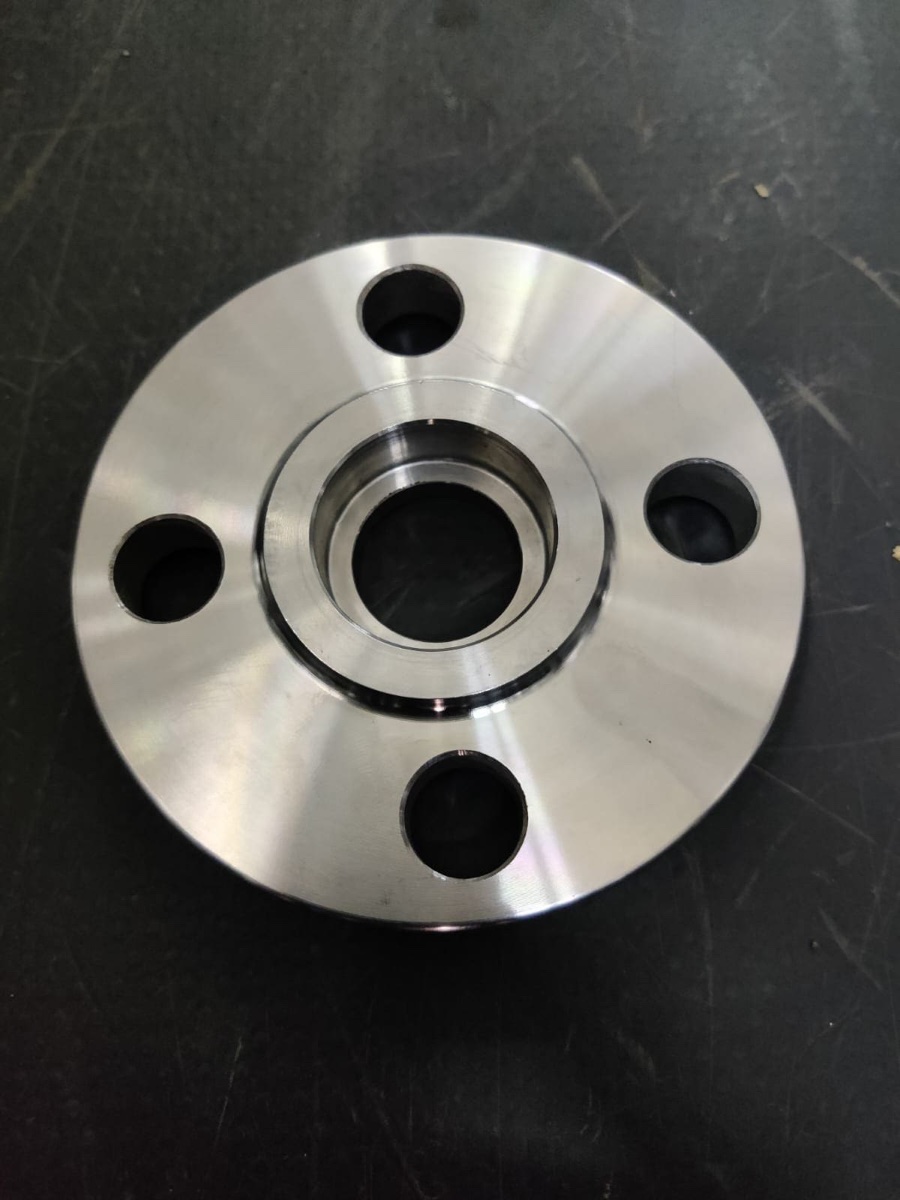
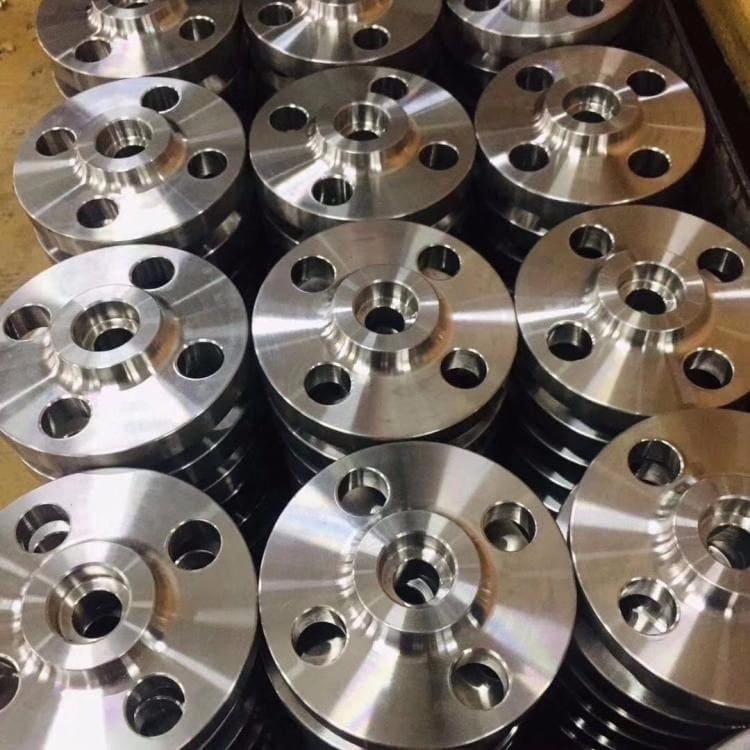
The hot side of the austenitic world: refinery hot circuits — FCC and flue-gas-adjacent piping, hydrogen-unit hot lines, hot-oil and regeneration circuits — superheated steam services, furnace-adjacent connections, and the drains, vents, instrument taps and sample points those hot lines still need in small bore. Production below:
Stainless Socket Weld Flange — Socket Bore Visible, Our WorksSocket Weld Flanges — Machined Batch at Our WorksThe Socket Weld Joint — Note the Expansion Gap (X)
A182 F304H Socketweld Flange Dimensions
Socket weld flange dimensions are class-governed per ASME B16.5 — identical across material grades; what changes with 304H is the pressure-temperature table the class is read from. Full charts:
How to Specify & Order an A182 F304H Socketweld Flange
Six elements — the grade by name and the design temperature both belong on the enquiry:
1
Size & standard — e.g. 1″ NB ASME B16.5, or DN25 EN 1092-1 Type 03.
2
Pressure class & facing — 150#–1500#; SWRF (the default), SWFF or SWRTJ with ring number — state the design temperature and let the class follow the tables.
3
Pipe schedule — Sch 40S or 80S typical of hot circuits: the through-bore is matched to the pipe ID.
4
Grade by name — ASTM A182 F304H, UNS S30409, with any grain-size requirement stated; plain or dual-certified 304 stock never substitutes.
5
Certification — EN 10204 3.1 with the carbon band and solution-anneal records (our standard) / 3.2 witnessed, PMI as applicable.
An ASTM A182 F304H socketweld flange is a forged high-carbon austenitic stainless steel flange — 304H, UNS S30409, W.Nr. 1.4948 — whose back carries a machined socket: the pipe end seats inside, self-aligned square to the face, and is secured with a single external fillet weld. The H means carbon specified with a floor, 0.04-0.10%, because above roughly 525°C carbon is creep strength: the same 18-8 chemistry as plain 304, deliberately kept carbon-rich so grain boundaries stay pinned against slow deformation. Dimensioned to ASME B16.5 for ½" to 3" NB in Classes 150 to 1500, in raised face, flat face and ring joint facings — the austenitic small-bore flange of refinery hot circuits, superheated steam and furnace-adjacent piping.
What does the H in 304H actually buy?
Time. At creep temperatures metal deforms slowly and continuously under stress it would carry indefinitely when cold, and the defence is microstructural: chromium carbides — which need carbon to form — pin the grain boundaries where creep does its sliding. The code makes this concrete: ASME allowable stresses for 304 in the time-dependent range above roughly 525°C apply only when carbon is at least 0.04%, and 304H guarantees that with its 0.04-0.10% band, so the designer may use the creep-range allowables with the certificate to prove it. It is the mirror image of the L-grade's logic: 304L trims carbon to protect corrosion resistance at the weld; 304H banks carbon to protect strength in the creep range. One element, dialled two opposite ways — and this site carries a page for each setting.
What is the chemical composition of ASTM A182 F304H (UNS S30409)?
Carbon 0.04-0.10% — the defining band, a floor as well as a ceiling — manganese ≤2.00%, silicon ≤1.00%, chromium 18.0-20.0%, nickel 8.0-11.0%, phosphorus ≤0.045%, sulphur ≤0.030%. Beside the carbon line the analysis is plain 304's: no molybdenum, no stabiliser, the classic 18-8 pair. That makes carbon the certificate's most important number — a heat certifying 0.02% is 304L territory and fails the H-grade outright, however perfect the rest of the analysis reads. Chemistry is verified per heat, PMI-checked per piece, and the carbon value travels on the EN 10204 3.1 MTC.
What are the mechanical properties of A182 F304H socketweld flanges?
On the room-temperature certificate, identical to plain 304: tensile strength 515 MPa (75 ksi) minimum, yield strength 205 MPa (30 ksi) minimum, elongation 30% minimum, solution annealed. That is worth pausing on: you buy 304H for numbers that never appear on a tensile report — the time-dependent allowable stresses in the ASME code tables above roughly 525°C, where heats without the carbon floor are excluded. Two H-grade particulars do show in the metal: the solution anneal is run hot enough to take the carbon fully into solution, and it typically leaves a somewhat coarser grain — both deliberate, both creep-motivated, both documented in the furnace records that accompany the certificate.
When does a specification require F304H?
Whenever design enters the time-dependent regime — as a working rule, metal temperatures above about 525°C held for real service life. Refinery hot circuits are the classic customers: FCC and flue-gas-adjacent piping, hydrogen-unit hot lines, hot-oil and regeneration circuits — joined by superheated steam services and furnace-adjacent connections. The code mechanics drive the choice: ASME B31.3 and Section VIII creep-range allowables for 304 apply only when carbon is at least 0.04%, which plain 304 may or may not have and 304H guarantees. Small bore matters here because hot lines still need drains, vents, instrument taps and sample connections — exactly the socket weld population — and every one of them must match the line class.
Can plain F304 or dual-certified 304/304L stock satisfy an F304H line?
No — and this is the ordering trap the grade exists to prevent. Modern mill stock is overwhelmingly melted low-carbon so it can dual-certify as 304/304L, which puts its carbon typically near 0.02% — below the H-grade's 0.04% floor. Such a heat can never be paperwork-corrected into 304H; the carbon is fixed at the melt. The reverse substitution fails too: an H heat exceeds the L-grade's ceiling by definition. F304H must be melted, certified and ordered by name — UNS S30409 — with the carbon band shown on the certificate. We forge it to order from verified H-grade heats, and our quotation flags any enquiry that names 304H in the line class but plain 304 in the description.
Do F304H flanges carry a grain-size requirement?
Often — because creep resistance likes coarse grain: fewer grain boundaries means less boundary sliding, which is why H-grade practice anneals hot and accepts the coarser structure the L- and plain grades avoid. Many refinery and power specifications therefore attach a grain-size requirement to 304H — ASTM No. 7 or coarser is the common wording, borrowed from the boiler-tube standards. If your specification carries one, put it on the enquiry: grain size is set by the anneal, verified metallographically, and belongs on the certificate alongside the carbon band. Where no grain requirement is stated, we certify the solution-annealed condition with furnace records as standard.
F304H or the stabilised grades 321H and 347H?
The stabilised grades solve the same hot-service problem a different way. 321 adds titanium and 347 adds niobium — elements that lock carbon into their own harmless carbides so chromium is never stripped from the grain boundaries: creep strength and sensitization resistance together, at a price. Choose 304H where the duty is steady dry hot service and post-weld aqueous exposure is not on the menu — it is the economical austenitic creep grade. Choose 321 or 347, especially their H variants, where thermal cycling, dew-point condensation or shutdown chemistry threatens a sensitized structure — 347H is the refinery favourite for exactly that combination. Both siblings have their own socketweld pages here; our quotation names the economical grade when the enquiry describes the service.
F304H or chrome-moly F11/F22/F91 for hot service?
Two creep worlds, chosen by different logic. The ferritic chrome-moly ladder — F11, F22, F91 — is the power and refinery workhorse: cheaper per kilo, lower thermal expansion, immune to chloride stress corrosion, but demanding preheat, controlled welding and PWHT, and offering no passive film worth the name. Austenitic 304H costs more and expands half again as much, but welds with no preheat and no PWHT, keeps a stainless surface in oxidising hot service, and continues where chrome-moly's oxidation limits end. Refineries run both, chosen line by line on temperature, corrodent and economics. One hard rule at the interface: a dissimilar joint between 304H and chrome-moly is welded with nickel-base filler to bridge the expansion mismatch — the welding FAQ carries it.
Does 304H sensitize — and does it matter?
It sensitizes by design, and honesty about that is the grade's best specification note. With 0.04-0.10% carbon and years above 525°C, chromium carbides will decorate the grain boundaries — that is precisely the microstructure doing the creep-strengthening work. In dry hot service — hot hydrocarbon vapour, steam, flue gas — this costs nothing. The caution belongs to shutdowns and dew-point zones: a sensitized structure wetted by chloride- or polythionic-acid-bearing condensate can crack along the grain boundaries, which is why refinery practice manages shutdowns with soda-ash neutralising washes and specifies 347H where the polythionic risk dominates. If your service cycles through wet conditions, say so on the enquiry — the honest answer may be a stabilised grade rather than 304H.
How is an F304H socketweld flange welded?
With austenitic ease and one filler-metal rule. Geometry is standard socket practice: pipe bottomed in the socket, withdrawn 1/16" (1.6 mm) before tacking, single external fillet weld. No preheat and no PWHT — the austenitic privilege survives in the H-grade — with stainless-clean discipline and moderate heat input. The rule: the filler must match the carbon logic, which means 308H — itself specified with a carbon floor — never standard 308L, whose low carbon would put a creep-weak ring exactly where the joint concentrates stress. Dissimilar joints to chrome-moly piping take nickel-base filler to absorb the thermal-expansion mismatch. Procedures for creep service qualify to the applicable code, and our flanges arrive solution annealed with records so the procedure starts from a known condition.
What facings are A182 F304H socketweld flanges made with?
All three, each with its own page on this site: raised face (SWRF) — the default — flat face (SWFF) for the rare soft-mate duty, and ring type joint (SWRTJ) where the class and service demand it. Gasket choice follows the temperature: flexible-graphite spiral wound is the hot-service standard — PTFE-based gaskets have no business at 304H temperatures — and RTJ rings run stainless per the class. Bolting deserves double attention on a hot stainless joint: anti-galling practice (coated or dissimilar-grade fasteners with thread lubricant) plus a bolt grade rated for the design temperature, because ordinary bolting relaxes in the creep range. NPT-tapped test and injection variants are machined and certified at the works.
What sizes and pressure classes do F304H socketweld flanges come in?
ASME B16.5 standardises socket weld flanges from ½" to 3" NB in Classes 150, 300, 600, 900 and 1500 — Class 900 sharing Class 1500 dimensions in most small-bore sizes — with 4" and Class 2500 to order. Two H-specific notes: the pressure-temperature tables are where 304H earns its keep, so state the design temperature and let the class follow from the tables; and put the pipe schedule on the enquiry — Sch 40S and 80S dominate hot circuits — because the through-bore is matched to the pipe ID. One caveat repeated from the specification notes: some hot-service piping classes restrict socket welds in cyclic duty in favour of butt welds — where yours does, our F304H weld neck page is the answer, in the same certified metal.
What details are needed to get an accurate F304H socketweld flange quotation?
Six elements plus commercial terms: (1) size — ½" to 3" NB; (2) pressure class — 150 to 1500; (3) facing — SWRF, SWFF or SWRTJ with ring number; (4) the pipe schedule — Sch 40S or 80S typical of hot circuits — so the through-bore matches the pipe ID; (5) the grade by name — ASTM A182 F304H, UNS S30409 — with any grain-size requirement stated; (6) certification — EN 10204 3.1 with the carbon band and solution-anneal records (our standard) or 3.2 witnessed, PMI as applicable. Add design temperature, quantity and destination and we return price, weight and delivery — normally within 24 hours. F304H is a forge-to-order grade: the melt matters, so lead time is quoted honestly alongside the price.
Who manufactures ASTM A182 F304H socketweld flanges in India?
Tesco Steel & Engineering is an ISO 9001:2015 certified flange manufacturer based in Mumbai, India, producing ASTM A182 F304H socket weld flanges from ½" to 3" NB (larger to order) in Classes 150-1500 — each forged from verified S30409 heats with the 0.04-0.10% carbon band certified, solution annealed with furnace records, machined on stainless-dedicated stations with gauged socket depth and schedule-matched bore, PMI-checked and laser-marked with grade, size, class, schedule and heat number. Supplied with EN 10204 3.1/3.2 certification — grain size reported where specified — alongside the full austenitic socket weld range (F304, F304L, F316/F316L, F321, F347), the duplex family and the chrome-moly series this site covers. Exported to more than 50 countries.