Tesco Steel & Engineering manufactures ASTM A182 F347 socketweld flanges — the niobium-stabilised 304: UNS S34700, W.Nr. 1.4550 — to ASME B16.5 from ½″ to 3″ NB in Classes 150–1500. 347 is the precision member of the stabilised family: niobium chaperones the carbon like 321's titanium — full 515/205 MPa strength with permanent weld-zone immunity — but niobium survives the welding arc, so even the weld deposit stays stabilised, matching 347 filler exists (321 borrows it), and the fusion line resists knife-line attack best in the family. That precision earned it the power plant's pedigree: high-pressure steam circuits and nuclear-heritage piping classes have named 347 for sixty years, and refinery hot units run it alongside 321 through the 400–800 °C band. The stabilised family: F321 the volume sibling, F316Ti the molybdenum cousin; 347H forged to order for code creep duty; chlorides belong to 316L and the duplex family. Facings: SWRF, SWFF, SWRTJ. Every lot with EN 10204 3.1/3.2 MTC. ISO 9001:2015, made in Mumbai, India — exported to 50+ countries.
A182 F347 · UNS S34700 · W.Nr. 1.4550Niobium-Stabilised — Nb ≥10×CThe Weld Deposit Stays StabilisedSteam & Nuclear PedigreeNo Preheat — No PWHT · 347 Filler515 / 205 MPa · 30% ElongationASME B16.5 ½″–3″ · Class 150–1500EN 10204 3.1 / 3.2 · ISO 9001:2015
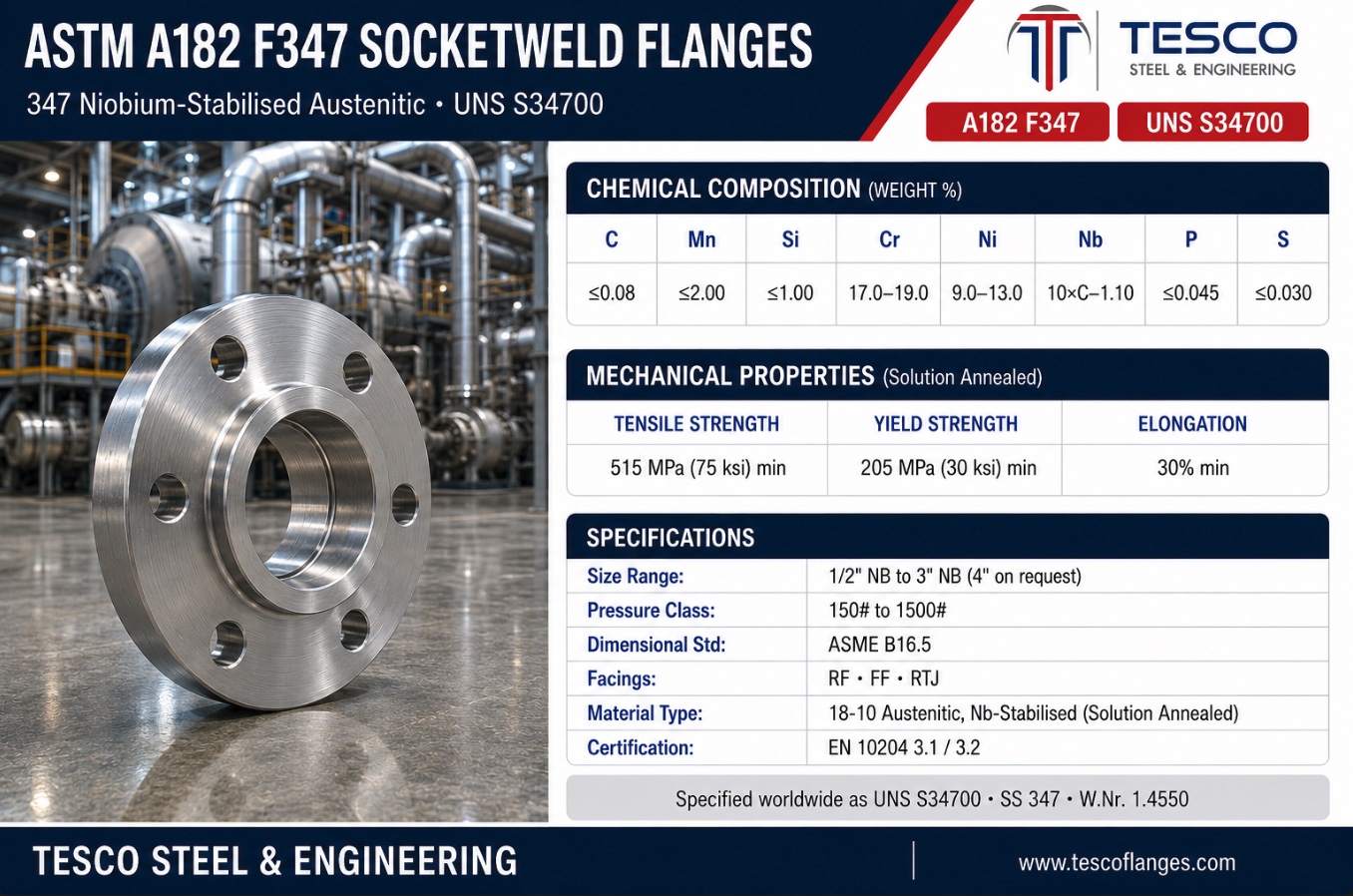
ASTM A182 F347 Socketweld Flanges — Specifications at a Glance
What is an ASTM A182 F347 Socketweld Flange?
The precision stabilised grade in the small-bore pattern. A forged niobium-stabilised austenitic flange (ASTM A182 F347 / UNS S34700 / W.Nr. 1.4550) with a machined socket: pipe seated square by geometry, one external fillet weld with matching 347 filler — no preheat, no PWHT — through-bore matched to the pipe schedule. Nb ≥10×C locks carbon up before chromium can, so the weld zone cannot sensitize — and because niobium survives the arc, the deposit stays stabilised too. Full plain-grade strength: tensile ≥515 MPa, yield ≥205 MPa, elongation ≥30%, held through the 400–800 °C band. Sized by ASME B16.5 at ½″–3″ NB, Classes 150–1500; EN 10204 3.1 on every lot.
One strategy — chaperone the carbon — and 347 executes it most completely: base metal, fusion line and weld deposit all stay stabilised.
What the Niobium Buys
The Weld That Stays Stabilised
Titanium burns off in the arc; niobium rides through it — so 347's deposits keep their protection, matching filler exists, and the whole stabilised family borrows 347's consumables.
The Best Fusion Line in the Family
Niobium carbide needs more heat to dissolve and re-forms faster than titanium's — the strongest resistance to knife-line attack of any stabilised grade.
Steam-Circuit Creep Credentials
Fine NbC precipitates give 347 creep numbers slightly ahead of 321's — the property that put it in superheater circuits and keeps it in power piping classes.
Full Strength, Permanently Protected
515/205 MPa kept — the carbon stays, chaperoned — with grain boundaries safe not just during welding but through decades at temperature.
ASTM A182 F347 Chemical Composition (UNS S34700)
Element
C
Mn
Si
Cr
Ni
Nb
P
S
Weight %
≤0.08
≤2.00
≤1.00
17.0–19.0
9.0–13.0
10×C–1.10
≤0.045
≤0.030
The familiar stabilised rebalance — Cr eased to 17–19, Ni raised to 9–13 — with the chaperone dosed to the carbon: Nb ≥10×C, capped at 1.10%. Note the simpler formula than titanium's: nitrogen does not consume niobium, so the ratio counts carbon alone — one more reason the stabilisation is delivered reliably. No molybdenum: chloride credentials are 304's. Nb-to-C ratio verified per heat; PMI on every piece.
Mechanical Properties (Solution Annealed)
Property
ASTM A182 F347 Requirement
Tensile Strength
≥ 515 MPa (75 ksi) — the full plain-grade number, kept
Yield Strength (0.2%)
≥ 205 MPa (30 ksi) — where the L-grades drop to 170, the stabilised grade holds
Elongation
≥ 30% — the austenitic signature
Condition
Solution annealed — stabilising anneal available for aggressive service
Temperature Span
Cryogenic (no transition) through the 400–800 °C franchise band — NbC creep numbers slightly ahead of 321's; ~850 °C scaling limit — beyond, F310
Creep Escalation
Code-certified creep with carbon floor & grain size → 347H by name, forged to order
ASTM A182 F347 Socketweld Flanges are available in the following specifications:
Material Grade
ASTM A182 F347 (UNS S34700), W.Nr. 1.4550 — 347H by name where the code requires the carbon floor
Heat Treatment
Solution annealed — furnace records certified; stabilising anneal for aggressive service on request
Size
1/2"NB to 3"NB per ASME B16.5; 4″ and larger to order; EN 1092-1 patterns to order
Class
150#, 300#, 600#, 900#, 1500# (900# shares 1500# dimensions in most sizes) — steam & hot hydrocarbon duty spreads into 600+
Facings
Raised Face (SWRF), Flat Face (SWFF), Ring Type Joint (SWRTJ) with groove per B16.20
Bore
Socket bore to pipe OD; through-bore matched to pipe schedule (Sch 40S/80S common in hot service)
Welding
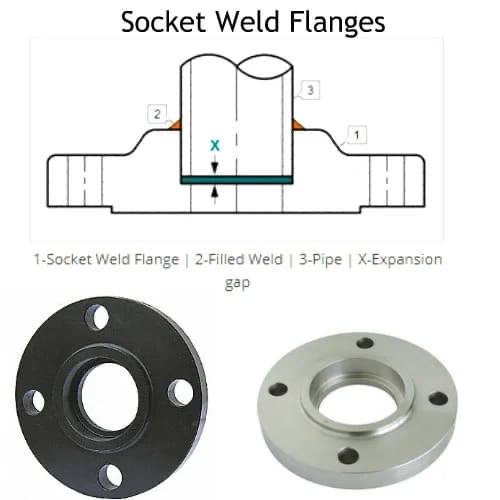
Single external fillet with 1/16″ expansion gap; matching 347 filler, ferrite-controlled, slim beads; no preheat, no PWHT
Service Span
Steam-circuit and hot hydrocarbon small bore, 400–800 °C franchise; cryogenic-capable; chloride credentials are 304's — honest notes below
Surface Finish
Pickled or natural machined — stainless-dedicated handling, no carbon-steel contact
Testing
Tension & chemistry per heat; Nb-to-C ratio verified; PMI on every piece; socket depth and bore gauged
Certification
EN 10204 3.1 with solution-anneal records (standard) / 3.2 witnessed
Specification Notes — Getting 347 Sockets Right
Four honest notes.The weld metal wants discipline: niobium-bearing deposits are hot-cracking-sensitive — ferrite-controlled 347 filler, slim beads and modest dilution are routine practice, stated in our WPS guidance. Reheat cracking is a heavy-section story: 347's famous weakness lives in thick, restrained butt welds — a socket weld's small single fillet sits at the benign end of every variable, but the engineer who knows the reputation deserves the sentence. The chloride credentials are 304's: no molybdenum, austenitic SCC unchanged — chloride duty belongs to 316L and the duplex family. And H-lines need H-metal: a 347H specification requires the certified carbon floor and grain size — plain F347 stock does not satisfy it; order it by name and we forge it.
How Our A182 F347 Socketweld Flanges Are Manufactured
1
Forging — cut billet of the spectro-verified S34700 heat — niobium-to-carbon ratio confirmed — is hot-forged into the flange blank with full heat traceability and segregated stainless handling.
2
Solution annealing — sets the clean austenitic structure with niobium carbides distributed; furnace charts retained against the heat number; stabilising anneal added where ordered.
3
Machining — faces, OD and drilling to ASME B16.5 on stainless-dedicated stations — niobium carbides are mildly abrasive: sharp inserts and disciplined feeds; socket counterbore and depth gauged piece by piece, through-bore matched to the ordered schedule.
4
Facing — RF serrations, flat face or RTJ groove per B16.20.
5
Testing & marking — tension and chemistry per heat; PMI on every piece; laser-marked with grade, size, class, schedule and heat number.
6
Certification & packing — EN 10204 3.1 MTC with solution-anneal records (3.2 witnessed on request); packed sea-worthy with no carbon-steel contact.
Where ASTM A182 F347 Socketweld Flanges Are Used
Where steam circuits and hot units meet small bore: superheater- and reheater-adjacent drains and vents, main-steam instrument taps and sample connections, power-plant bypass and warm-up small bore, nuclear-heritage piping classes, refinery hot units alongside 321, and hot clean-process connections that dwell for decades in the sensitizing band. Production below:
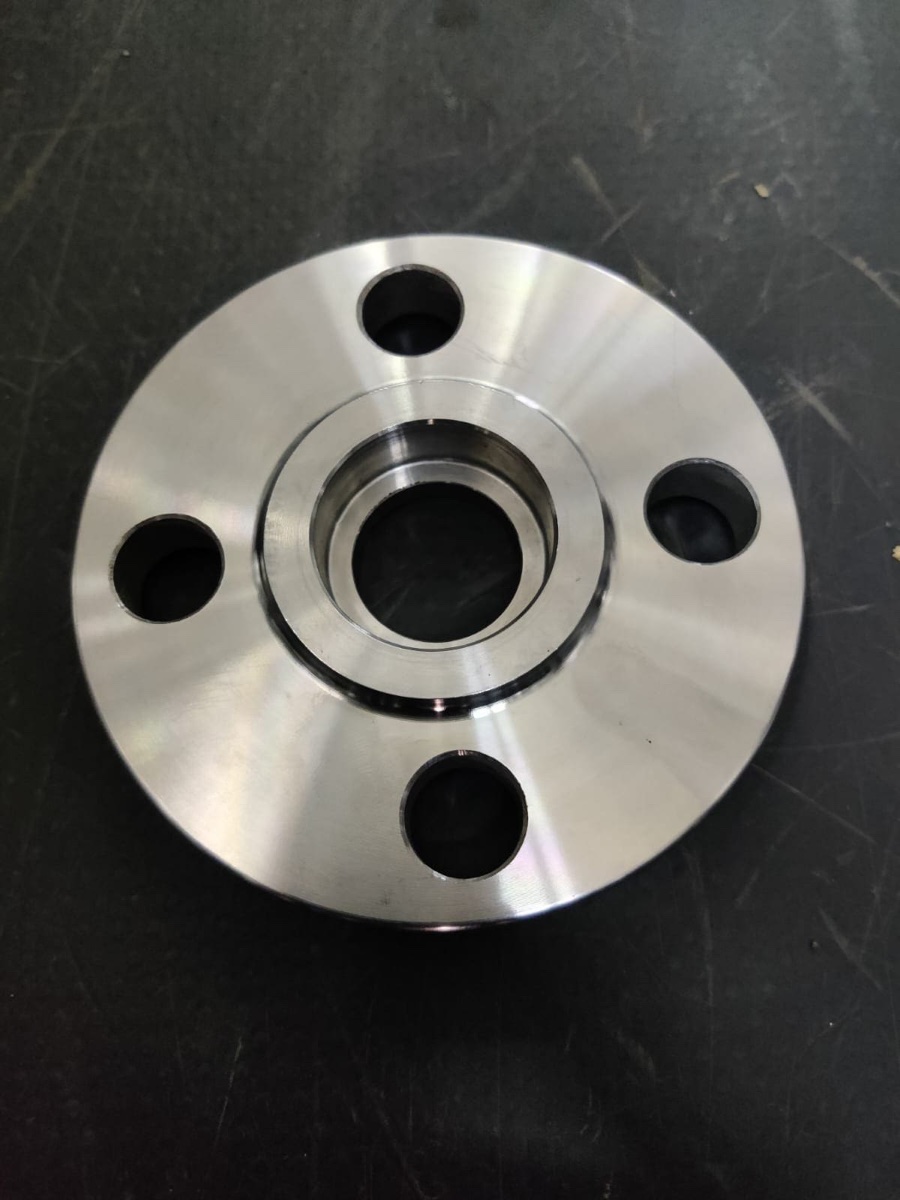
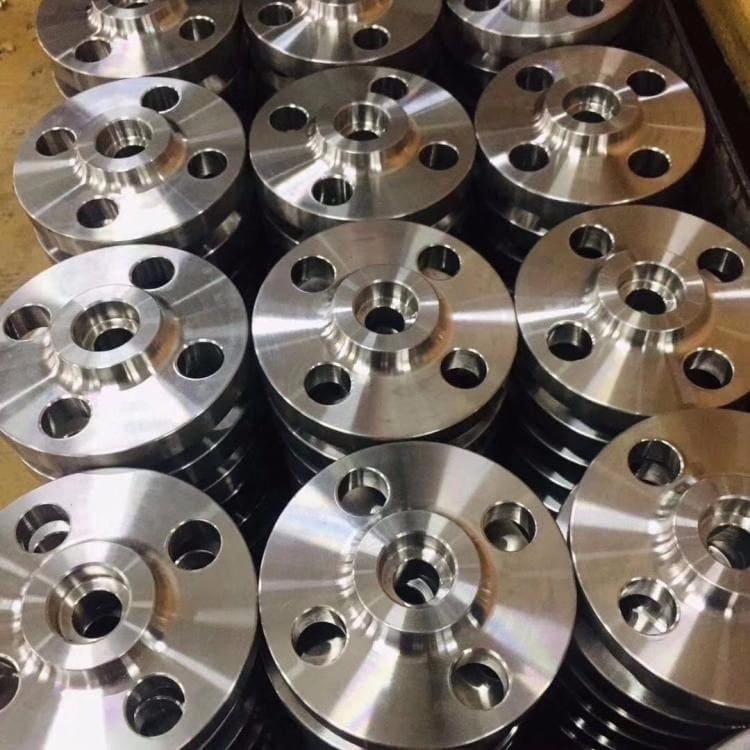
Stainless Socket Weld Flange — Socket Bore Visible, Our WorksSocket Weld Flanges — Machined Batch, Ready for DispatchThe Socket Weld Joint — Note the Expansion Gap (X)
A182 F347 Socketweld Flange Dimensions
Socket weld flange dimensions are class-governed per ASME B16.5 — identical across material grades (pressure-temperature ratings follow the austenitic group and derate with temperature). Full charts:
How to Specify & Order an A182 F347 Socketweld Flange
Six elements — the design temperature belongs on every hot-service enquiry:
1
Size & standard — e.g. 1″ NB ASME B16.5, or DN25 EN 1092-1 to order.
2
Pressure class & facing — 150#–1500#; SWRF (the default), SWFF or SWRTJ with ring number — with the design temperature, which governs the rating and the gasket guidance.
3
Pipe schedule — Sch 40S or 80S common in hot service: the through-bore is matched to the pipe ID.
4
Grade line as written — F347, or 347H by name where the code requires the certified carbon floor and grain size.
5
Certification — EN 10204 3.1 with solution-anneal records (our standard) / 3.2 witnessed, PMI as applicable.
An ASTM A182 F347 socketweld flange is a forged niobium-stabilised austenitic stainless steel flange — 304-family chemistry with a deliberate niobium addition, UNS S34700, W.Nr. 1.4550 — whose back carries a machined socket: the pipe end seats inside, self-aligned square to the face, and is secured with a single external fillet weld. The niobium ties carbon up as stable niobium carbide before chromium can, so the weld zone keeps its corrosion resistance while the grade keeps full plain-grade strength through the hot intermediate band. What sets 347 apart even from its stabilised siblings: niobium survives the welding arc, so the weld deposit itself stays stabilised — the grade welds complete. Dimensioned to ASME B16.5 for ½" to 3" NB in Classes 150 to 1500 — the power plant's stabilised stainless, in the small-bore pattern.
What does the niobium in 347 actually do?
The same chaperone work as titanium in 321, done with more precision. Weld sensitization happens when carbon finds chromium in the 450-850°C band and precipitates as chromium carbide at the grain boundaries; niobium forms its own carbide more eagerly, locking the carbon up — at least ten times the carbon content, capped at 1.10% — before the danger band is reached, so the chromium stays in solution and the film stays intact. Niobium's advantages over titanium are practical: it does not burn off in a welding arc, it does not get consumed by nitrogen the way titanium does, and its carbides resist re-dissolution at the fusion line slightly better — the three details that give 347 its complete-weldability, its knife-line-attack resistance, and its role as the whole family's filler metal.
Why is 347 the power plant's stabilised grade?
Pedigree, earned in the industries that forgive least. High-pressure steam practice adopted 347 for superheater and reheater circuits, main-steam drains and instrument connections — duties that dwell for decades exactly where sensitization and creep overlap — and nuclear construction wrote it into reactor-adjacent piping from the industry's first generation, a qualification history that keeps it specified there still. The properties behind the pedigree: permanent grain-boundary protection at full-carbon strength, weld deposits that stay stabilised because niobium survives the arc, and the best fusion-line behaviour in the stabilised family. Refinery hot service uses 347 freely alongside 321 for the same reasons. Where a power or nuclear-heritage piping class names 347, it is naming sixty years of steam-circuit evidence.
What is the chemical composition of ASTM A182 F347 (UNS S34700)?
Carbon ≤0.08%, manganese ≤2.00%, silicon ≤1.00%, chromium 17.0-19.0%, nickel 9.0-13.0%, niobium at least ten times the carbon content up to 1.10% maximum, phosphorus ≤0.045%, sulphur ≤0.030%. The pattern echoes 321: chromium eased a point from 304's band, nickel raised — here to 9-13% — to hold the austenite, and the stabiliser dosed in proportion to the carbon it must capture. Note the simpler formula than titanium's: niobium is not consumed by nitrogen, so the ratio counts carbon alone. No molybdenum — 347 is a stabilised 304, and its chloride credentials are the family baseline. Chemistry is verified per heat, the niobium-to-carbon ratio checked, and everything travels on the EN 10204 3.1 MTC.
What are the mechanical properties of A182 F347 socketweld flanges?
In the solution-annealed condition A182 requires tensile strength 515 MPa (75 ksi) minimum, yield strength 205 MPa (30 ksi) minimum and elongation 30% minimum — the full plain-grade certificate, kept, because the carbon stays in the metal chaperoned rather than removed. Niobium adds a little extra: fine niobium carbides give 347 a modest precipitation-strengthening contribution at temperature, one reason its creep numbers read slightly ahead of 321's in the design tables. The advantage compounds through the 400-800°C band where the L-grades' allowables fall away. Where a design code demands certified creep performance with a carbon floor and grain-size control, 347H is the named answer — forged to order; state the code line and the certificate matches it.
F347 or F321 — niobium or titanium?
Same strategy, different chaperone — and the practical differences all favour precision versus price. 347's case: niobium survives the arc, so weld deposits stay stabilised and matching 347 filler exists (321 must borrow it); niobium carbides hold on better at the fusion line, giving the best knife-line-attack resistance in the family; nitrogen does not consume niobium, so the stabilisation is more reliably delivered; and the steam-and-nuclear pedigree keeps 347 written into power codes. 321's case: titanium is cheaper than niobium, the grade dominates stabilised volume, and for ordinary refinery hot service the difference rarely shows. Most piping classes simply name one; where you genuinely choose, severe or code-governed duty argues 347, general hot hydrocarbon duty argues 321. We forge both, and both pages live in this series.
How is an F347 socketweld flange welded?
With the family's easy rules and its most self-sufficient consumable story. Geometry is standard: pipe bottomed in the socket, withdrawn 1/16" (1.6 mm) to leave the expansion gap, single external fillet weld — with matching 347 filler, whose niobium survives the transfer and keeps the deposit stabilised; this is the same consumable the whole stabilised family borrows. No preheat, no PWHT; stainless housekeeping and moderate heat input as always. The one discipline specific to niobium-bearing weld metal: it is more hot-cracking-sensitive than plain austenitic deposits, so filler is specified with a small controlled ferrite content and beads are kept slim with modest dilution — routine practice for any shop that welds 347, and stated in the WPS guidance we supply. Our flanges arrive solution annealed with records.
What is knife-line attack — and why does 347 resist it best?
Knife-line attack is the stabilised family's own narrow failure mode: in a thin band right against the weld fusion line, the heat is fierce enough to dissolve the protective stabiliser carbides; if a later pass or repair then reheats that band into the sensitizing range, the freed carbon can form chromium carbide in a razor-thin line before the stabiliser recaptures it — a knife-cut of corrosion susceptibility in aggressive service. 347 is the most resistant of the stabilised grades because niobium carbide needs more heat to dissolve than titanium carbide and re-forms more readily on cooling, leaving less free carbon for less time. The management is the same for all: sensible weld sequencing, and a stabilising anneal for genuinely aggressive service. For a socket weld's single small fillet the exposure is minimal — a footnote here, though a famous one.
What is reheat cracking — and does it affect socket weld flanges?
Reheat (strain-age) cracking is 347's honest weakness in heavy fabrication: in thick, highly restrained weldments that relax at service or stress-relief temperatures, the same fine niobium carbides that give the grade its creep strength can stiffen grain interiors while boundaries slide, opening intergranular cracks — a phenomenon power-plant fabricators of thick 347 headers learned to respect. The socket weld flange sits at the benign end of every variable involved: a small single-pass fillet, thin sections, low restraint, no PWHT. In ½"-3" small bore the phenomenon is effectively academic — but an engineer who knows 347's reputation deserves the honest sentence: the concern belongs to heavy-wall butt welds, not to this product. Sequencing and heat-input discipline in the WPS keep even that margin comfortable.
What is the temperature range of F347 socketweld flanges?
The stabilised franchise band: roughly 400-800°C, where full-carbon allowable stresses, permanent grain-boundary protection and adequate oxidation resistance (to about 850°C in air) hold together — with 347's fine niobium carbides reading slightly ahead of 321 in the creep tables, which is why steam circuits favoured it. Downward, the austenitic structure keeps its toughness to cryogenic temperatures. The boundaries: above roughly 850°C scaling accelerates and the conversation moves to 310's 25-20 chemistry; and where a design code requires certified creep strength with a carbon floor and grain-size control — superheater-class duty — specify 347H by name, forged to order with the floor certified. State the design temperature and the governing code; the rating and the certificate follow.
What are 347's chloride limits — honestly?
They are 304's limits, unchanged — the same honest verdict as for 321. Niobium stabilisation protects grain boundaries; it adds nothing to the passive film — no molybdenum, PREN in the high teens — so 347 pits in warm chloride water like any 304-family grade, and as an austenitic it keeps the vulnerability to chloride stress corrosion cracking above roughly 60°C. Its steam-and-heat pedigree does not transfer to brine. The chloride ladder is its own thread — 316L, 317L, the duplex family, super duplex, each with a socketweld page on this site — and 347 does not stand on it. State the environment alongside the temperature on the enquiry and the quotation points honestly.
What facings are A182 F347 socketweld flanges made with?
All three, each with its own page on this site: raised face (SWRF) — the default — flat face (SWFF) for cast and lined equipment mates, and ring type joint (SWRTJ) where high-pressure steam and hydrocarbon classes demand it. The hot-service note is the gasket: flexible graphite serves to roughly 450-500°C, and hotter joints move to mica-graphite or vermiculite systems with bolting alloy chosen to match — state the joint temperature on the enquiry and sealing guidance comes with the quotation. Stainless bolting deserves anti-galling attention: coated or dissimilar-grade fasteners and thread lubricant are standard practice. NPT-tapped variants are machined and certified at the works.
What sizes and pressure classes do F347 socketweld flanges come in?
ASME B16.5 standardises socket weld flanges from ½" to 3" NB in Classes 150, 300, 600, 900 and 1500 — Class 900 sharing Class 1500 dimensions in most small-bore sizes — with 4" and Class 2500 made to order. 347's steam-circuit and hot-hydrocarbon duties spread across the classes — 600 and above are commoner here than anywhere else in the stainless socketweld range, with the B16.5 austenitic tables derating as temperature climbs. Put the pipe schedule on the enquiry — Sch 40S and 80S dominate hot service — and state the design temperature, which sets the governing rating. Our quotations state the applicable rating per class.
What details are needed to get an accurate F347 socketweld flange quotation?
Six elements plus commercial terms: (1) size — ½" to 3" NB; (2) pressure class — 150 to 1500, with the design temperature, which governs the rating and the gasket guidance; (3) facing — SWRF, SWFF or SWRTJ with ring number; (4) the pipe schedule — Sch 40S and 80S are common in hot service, and the through-bore is matched to the pipe ID; (5) the grade line as written — F347, or 347H by name where the code requires the carbon floor and grain-size control; (6) certification — EN 10204 3.1 with solution-anneal records (our standard) or 3.2 witnessed, PMI as applicable. Add quantity and destination and we return price, weight and delivery — normally within 24 hours.
Who manufactures ASTM A182 F347 socketweld flanges in India?
Tesco Steel & Engineering is an ISO 9001:2015 certified flange manufacturer based in Mumbai, India, producing ASTM A182 F347 socket weld flanges from ½" to 3" NB (larger to order) in Classes 150-1500 — each forged from certified S34700 heats with the niobium-to-carbon ratio verified, solution annealed with furnace records, machined on stainless-dedicated stations with gauged socket depth and schedule-matched bore, PMI-checked and laser-marked with grade, size, class, schedule and heat number. Supplied with EN 10204 3.1/3.2 certification — 347H by name where the specification requires it — alongside the F321 sibling, the F316Ti cousin, the F304H creep thread and the full stainless socketweld range this series covers. Exported to more than 50 countries.