

Tesco Steel & Engineering manufactures SS 347 & 347H flanges — niobium-stabilised austenitic stainless (ASTM A182 F347 / F347H, UNS S34700 / S34709, EN 1.4550 / 1.4961). A niobium addition (min 10× carbon) locks up carbon as stable niobium carbide, making the grade immune to weld sensitisation through the critical 425–870 °C range, with the added edge of superior polythionic acid stress-corrosion-cracking resistance — the reason 347 is the refinery and nuclear stabilised grade of choice. Oxidation-resistant to 900 °C; 347H adds creep strength above 550 °C. Available in weld neck, slip-on, blind, socket-weld, threaded, lap-joint, orifice and long weld neck types to ASME B16.5 / B16.47. Class 150 to 2500, NPS 1/2″ to 56″. ISO 9001:2015 certified. Made in India.

SS 347 / 347H (ASTM A182 F347) Flanges

SS 347H Weld Neck & Blind Flanges
Tesco Steel & Engineering manufactures SS 347 / 347H flanges per ASTM A182 F347 / F347H and ASME B16.5, in all flange types from weld neck to blind, Class 150 to 2500 — supplied with EN 10204 3.1 / 3.2 certification, PMI and third-party inspection on request. Explore the wider stainless steel flange range, SS 321 flanges, SS 310S flanges, and the flange dimension charts.
| 347 / 347H SS Flange Specifications at a Glance | |
|---|---|
| Material Standard | ASTM A182 Grade F347 / F347H |
| UNS Numbers | S34700 (347) · S34709 (347H) |
| Stabilising Element | Niobium + Tantalum (Nb+Ta): min 10 × C, max 1.10% |
| Size Range | 1/2″ NB to 56″ NB (DN 15 to DN 1400) |
| ANSI Pressure Classes | 150#, 300#, 600#, 900#, 1500#, 2500# |
| DIN Pressure Ratings | PN 6, 10, 16, 25, 40, 64, 100, 160, 250, 320, 400 |
| Bore Schedule | STD, XS, XXS, SCH 10, 20, 40, 60, 80, 120, 160 |
| Flange Types | Weld Neck (WNRF), Slip-On (SORF), Blind (BFF), Socket Weld (SWRF), Lap Joint (LJRF), Threaded (TRFF), Long Weld Neck (LWN), Orifice |
| Flange Faces | Raised Face (RF), Flat Face (FF), Ring Type Joint (RTJ) |
| Max Continuous Service Temp | 900 °C (oxidising atmosphere) |
| Sensitisation-Free Range | 425 °C – 870 °C (same advantage as 321) |
| Key Advantage Over 321 | Superior polythionic acid SCC resistance; preferred for nuclear service |
All 347 and 347H flanges are machined to published dimensional tolerances — bore, bolt circle, number of holes, flange thickness and raised-face height conform to ASME B16.5 (1/2″–24″ NB) and ASME B16.47 Series A & B (26″ NB and above).
| Reference | Dimension Chart |
|---|---|
| 347 Stainless Steel Flange Dimensions (ASME B16.5 / B16.47) | View Flange Dimensions → |
| Flange Weight Chart | View Flange Weights → |
| RTJ Gasket Size Chart | View RTJ Size Chart → |
The defining addition in Grade 347 is niobium (Nb), specified at a minimum of 10× the carbon content (max 1.10%). Niobium forms stable NbC precipitates within and above the sensitisation range, permanently tying up carbon that would otherwise migrate to grain boundaries as Cr₂₃C₆. Unlike titanium (used in 321), niobium transfers effectively across the welding arc, making ER347 a more reliable weld-metal stabiliser. 347H specifies a tighter 0.04–0.10% carbon range to guarantee sufficient NbC for long-term creep resistance above 550 °C.
| Element | 347 (S34700) | 347H (S34709) |
|---|---|---|
| Carbon (C) | 0.08% max | 0.04 – 0.10% |
| Chromium (Cr) | 17.00 – 20.00% | 17.00 – 20.00% |
| Nickel (Ni) | 9.00 – 13.00% | 9.00 – 13.00% |
| Niobium + Tantalum (Nb+Ta) — stabiliser | 10 × C min, 1.10% max | 10 × C min, 1.10% max |
| Manganese (Mn) | 2.00% max | 2.00% max |
| Silicon (Si) | 1.00% max | 1.00% max |
| Phosphorus (P) | 0.045% max | 0.045% max |
| Sulfur (S) | 0.030% max | 0.030% max |
| Mechanical Property | 347 (F347) | 347H (F347H) |
|---|---|---|
| Tensile Strength (min) | 515 MPa (75 ksi) | 515 MPa (75 ksi) |
| Yield Strength 0.2% offset (min) | 205 MPa (30 ksi) | 205 MPa (30 ksi) |
| Elongation in 2″ (min) | 35% | 35% |
| Hardness Rockwell (max) | 92 HRB | 92 HRB |
| Hardness Brinell (max) | 201 HBW | 201 HBW |
| Density | 7.96 g/cm³ | 7.96 g/cm³ |
| International Equivalent Grades | |
|---|---|
| UNS (USA) | S34700 (347) / S34709 (347H) |
| EN / DIN (Europe) | 1.4550 / X6CrNiNb18-10 (347) · 1.4961 / X8CrNiNb16-13 (347H) |
| JIS (Japan) | SUS 347 / SUS 347H |
| GOST (Russia) | 08Ch18N12B (347) |
| BS (UK) | 347S31 |
| Old ASTM name | Columbium (Cb) — now standardised as Niobium (Nb) |
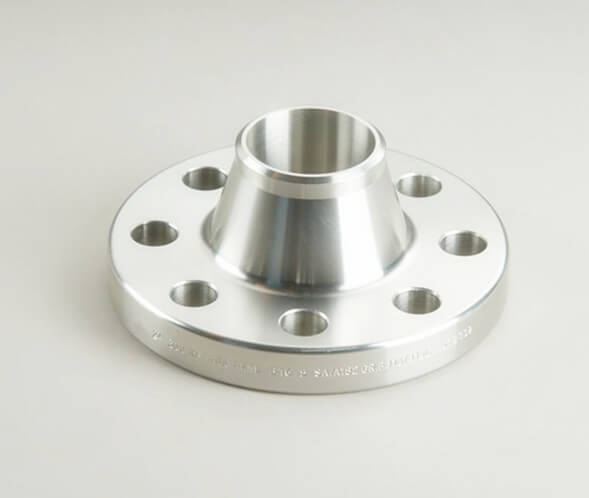
347 Weld Neck Flange (WNRF)

347 Slip-On Flange (SORF)
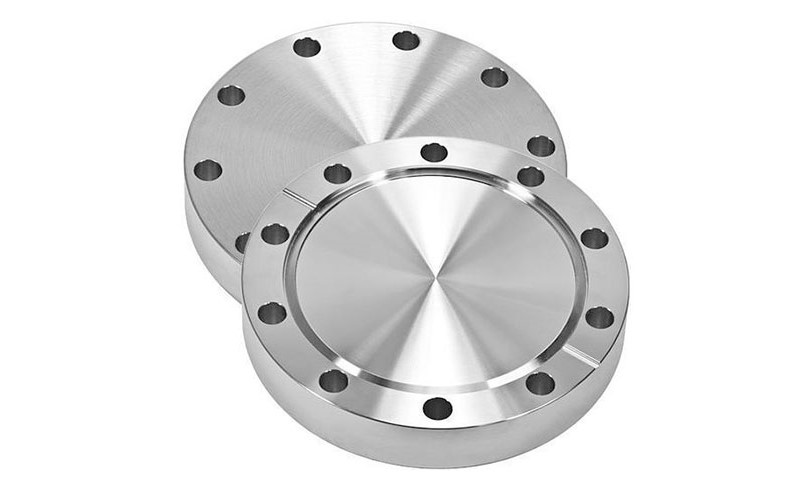
347H Blind Flange (BFF)
| Flange Type | Description & 347-Specific Use |
|---|---|
| Weld Neck (WNRF) | Standard for high-temperature 347 piping welded into continuous sensitisation-range and sulphur-bearing refinery service; tapered hub transfers stress while the niobium-stabilised HAZ resists intergranular attack and polythionic SCC. Class 150–2500, F347 & F347H. |
| Slip-On (SORF) | Moderate-pressure elevated-temperature systems — heat-exchanger nozzles, secondary boiler and reformer piping. Two fillet welds, no sensitisation. |
| Blind (BFF) | Seals high-temperature vessel and pipeline terminations operating between 425–870 °C — exchanger bonnets, reactor nozzles, furnace atmosphere piping. |
| Socket Weld (SWRF) | Small-bore (1/2″–2″) instrument and sample connections in hot sulphur-bearing process streams; niobium stabilisation keeps the single fillet weld corrosion-resistant. |
| Lap Joint (LJRF) | Used with a 347 stub end where high-temperature systems need frequent dismantling — exchanger manifolds and reactor inlet piping for tube/catalyst access. |
| Threaded (TRFF) | Instrument taps, gauge connections and utility branches in moderate-temperature 347 piping (to ~260 °C); above that use weld neck / socket weld. |
| Long Weld Neck (LWN) | Extended nozzle flanges in 347H for high-temperature vessels, columns and reactors in the creep range (>550 °C). |
| Orifice | Paired flanges for flow metering in hot refinery process lines; stabilisation keeps tap bores and seat free of intergranular corrosion. |
| Property | 347 (S34700) | 347H (S34709) | 321 (S32100) | 304 (S30400) | 316L (S31603) |
|---|---|---|---|---|---|
| Stabiliser | Nb+Ta | Nb+Ta | Ti | None | None |
| Sensitisation Immunity | Yes | Yes | Yes | No | Partial (low C) |
| Polythionic Acid SCC Resistance | Best | Best | Good | Poor if sensitised | Moderate |
| Nuclear Suitability | Preferred | Preferred | Limited (Ti activation) | General | General |
| Max Continuous Temp | 900 °C | 900 °C | 900 °C | 870 °C | 870 °C |
| Creep Resistance >550 °C | Good | Superior | Moderate | Moderate | Moderate |
| Weld Filler Reliability | Excellent (ER347) | Excellent (ER347) | Good (Ti oxidises) | n/a | n/a |
| ASTM Flange Grade | A182 F347 | A182 F347H | A182 F321 | A182 F304 | A182 F316L |
| Best For | Refinery sulphur, nuclear, high-temp | High-temp creep, boilers | General high-temp, exchangers | General service | Marine, chemical |
347 and 321 share sensitisation immunity; 347 is preferred where polythionic acid SCC resistance (refinery shutdowns) or nuclear neutron behaviour matters, and where reliable weld-metal stabilisation with ER347 is required.
| Industry | Specific Application |
|---|---|
| Oil Refining & Petrochemical | Sulphur-bearing crude/FCC piping, hydrotreater & reformer flanges (polythionic SCC resistance) |
| Nuclear Power | Reactor coolant & intermediate heat-exchanger nozzle flanges (preferred over 321 for neutron behaviour) |
| Power Generation | Superheater & reheater piping flanges, header nozzles, turbine inlet connections (347H) |
| Heat Exchangers & Boilers | Shell-side nozzle flanges, tube-sheet connections, expansion-joint end flanges |
| Chemical Processing | High-temperature reactor nozzles, nitric/sulphuric acid converter connections |
| Aerospace & Defence | Jet-engine exhaust collector flanges, high-temperature test-rig piping |
| Pharmaceutical | Autoclave and steriliser nozzle flanges, high-temperature CIP connections |
| Fertiliser & Process | Ammonia & urea reformer piping, high-temperature process headers |
| Standard | Scope |
|---|---|
| ASTM A182 / ASME SA182 | Forged stainless flanges — Grade F347 and F347H |
| ASME B16.5 | Pipe flanges & flanged fittings — 1/2″ to 24″ NB, Class 150 to 2500 |
| ASME B16.47 | Large-diameter flanges — 26″ to 60″ NB (Series A: MSS SP-44, Series B: API 605) |
| ASME B16.36 | Orifice flanges — Class 300 to 2500 |
| EN 1092-1 | European flanges — PN 6 to PN 400, material 1.4550 (347) / 1.4961 (347H) |
| DIN 2631 – 2638 | German DIN flanges — PN 6 to PN 160 |
| JIS B2220 | Japanese flanges — 5K to 63K, material SUS 347 / SUS 347H |
| NACE RP0170 / API RP 582 | Polythionic acid SCC protection in refinery austenitic stainless |
| GOST 12820 / 12821 | Russian standard flanges |
| ASME Section III / VIII / B31.3 | Nuclear (F347) & elevated-temperature (F347H) pressure vessels and process piping |
Immune to intergranular corrosion through 425–870 °C — welded assemblies need no post-weld solution anneal.
Superior polythionic acid SCC resistance and favourable neutron behaviour — the stabilised grade of choice for sulphur service and nuclear plants.
Controlled 0.04% C minimum gives superior creep rupture strength above 550 °C for boilers and reformers.
EN 10204 3.1 / 3.2 MTC (with Nb/Ta ratio), PMI, NACE / API RP 582 and ASME Section II-D allowables on request.
347 flange prices depend on size, pressure class, schedule, flange type, grade (347 or 347H), quantity and current nickel/niobium rates. Grade 347 carries a modest premium over 304 for the niobium addition; 347H commands a further premium for the tighter carbon spec and creep qualification testing. Tesco Steel & Engineering offers competitive ex-works pricing from Mumbai with full export documentation and material traceability from melt to finished product, including nuclear-qualified supply on request. Click Ask for Quote or message us on WhatsApp at +91 92233 66922 with grade, flange type, size (NB), pressure class, quantity and documentation requirements.
Q1. What is a 347 stainless steel flange?
A 347 stainless steel flange is a pipe flange made from Grade 347 (UNS S34700), a niobium-stabilised austenitic stainless steel. The niobium (Nb) addition at a minimum of 10× the carbon content prevents sensitisation — intergranular chromium carbide precipitation — during welding and high-temperature service between 425–870 °C. Flanges are forged to ASTM A182 F347 and machined to ASME B16.5 or B16.47, used in refinery piping, nuclear service, power generation and high-temperature welded assemblies requiring intergranular corrosion and polythionic acid SCC resistance.
Q2. What is the difference between 347 and 321 stainless steel flanges?
Both prevent sensitisation through stabilisation but use different elements: 347 uses niobium (Nb), 321 uses titanium (Ti). Key differences: (1) 347 provides superior resistance to polythionic acid SCC — a critical refinery shutdown failure mode; (2) 347 is preferred in nuclear applications because niobium has lower neutron activation than titanium; (3) ER347 filler is a more reliable weld-metal stabiliser because niobium transfers across the arc consistently, whereas titanium in ER321 tends to oxidise. For non-refinery, non-nuclear applications, both grades are broadly interchangeable.
Q3. What is polythionic acid SCC and why does 347 resist it?
Polythionic acids (H₂SₓO₆) form when sulphur deposits on refinery equipment react with atmospheric moisture and oxygen during maintenance shutdowns, causing intergranular SCC in sensitised austenitic stainless by attacking chromium-depleted grain boundaries created during 425–870 °C service. Grade 347's niobium stabilisation prevents grain-boundary chromium depletion entirely, removing the susceptible microstructure. This is the primary reason 347 is specified over 321 in sulphur-bearing refinery service, and it is addressed in NACE RP0170 and API RP 582.
Q4. What is the difference between 347 and 347H stainless steel flanges?
Both have the same base composition and niobium stabilisation; the only difference is carbon. Grade 347 allows up to 0.08% with no minimum, while 347H specifies 0.04–0.10%. The controlled minimum in 347H ensures adequate NbC precipitation for superior creep rupture strength above 550 °C. Below 550 °C standard 347 is sufficient; for power-plant superheaters, reformer systems and long-term elevated-temperature vessels, 347H is specified and is listed in ASME Section II Part D with higher elevated-temperature allowable stresses.
Q5. Why is niobium called columbium (Cb) in some older standards?
Columbium (Cb) is the historical American name for the element now officially designated niobium (Nb) by IUPAC. ASTM standards historically used Cb — which is why older A182 editions show "10×C Cb min". Modern ASTM A182 and all current international standards (EN, JIS, ISO) use niobium (Nb). The element is identical; only the name differs by convention.
Q6. What is the maximum temperature for 347 stainless steel flanges?
Grade 347 flanges can be used in continuous service up to 900 °C in oxidising atmospheres; 347H extends creep life above 550 °C. For continuous service above 900 °C, specify Grade 310S. For allowable pressure at elevated temperature, consult ASME B16.5 Table 2-1.1 for the F347 pressure-temperature ratings in each class.
Q7. What filler metal is used to weld 347 stainless steel flanges?
ER347 (AWS A5.9) wire for GTAW and GMAW, and E347-15/16/17 (AWS A5.4) for SMAW. ER347 is also the recommended filler for welding 321 base metal where ER321 is considered unreliable due to titanium oxidation. Never use unstabilised 308 or 304 fillers on 347 above 425 °C — the weld metal would be susceptible to sensitisation and polythionic acid SCC.
Q8. Can 347 flanges be used in nuclear power plants?
Yes. Grade 347 is one of the preferred austenitic stainless grades for nuclear service, specifically because niobium has lower and more manageable neutron activation than titanium in 321. For ASME Section III nuclear construction, 347 flanges must be supplied to SA-182 F347 with qualified certifications, heat traceability and nuclear N-stamp or equivalent documentation. The activation profile of niobium in the reactor neutron flux must be evaluated by the nuclear safety authority for each project.
Q9. What is the equivalent grade of SS 347 in EN/DIN and JIS standards?
SS 347 (UNS S34700) equals EN/DIN 1.4550 (X6CrNiNb18-10) and JIS SUS347; SS 347H (UNS S34709) equals EN/DIN 1.4961 (X8CrNiNb16-13) and JIS SUS347H. The Russian equivalent is GOST 08Ch18N12B and the British equivalent is BS 347S31.
Q10. What certifications are available with 347 flanges from Tesco Steel?
Standard supply includes EN 10204 Type 3.1 mill test certificates confirming chemistry (with Nb/Ta stabilisation ratio), mechanical properties, heat number and heat treatment. On request: Type 3.2 (third-party witnessed), PMI reports, hydrostatic test certificates, UT/RT reports, NACE MR0175 / API RP 582 compliance declarations, and ASME Section II Part D allowable confirmation for F347H. TPI by Lloyd's, Bureau Veritas, TÜV or SGS can be arranged.
Q11. Who manufactures 347 stainless steel flanges in India?
Tesco Steel & Engineering, based in Mumbai, India, is an ISO-certified manufacturer and exporter of 347 and 347H stainless steel flanges to ASTM A182, ASME B16.5, B16.47, EN 1092-1, DIN, JIS B2220 and GOST standards, supplying EPC contractors, refineries, nuclear plant operators, power-plant builders and process-plant operators across 96 countries.