

Tesco Steel & Engineering manufactures 316L stainless steel flanges — the low-carbon (C max 0.03%), molybdenum-bearing version of marine-grade 316, made to ASTM A182 F316L (UNS S31603). Its 2–3% molybdenum resists pitting and crevice corrosion in chlorides, seawater and acids, while the ultra-low carbon prevents weld sensitisation — so welded joints keep full corrosion resistance without post-weld heat treatment. This dual benefit makes 316L the default grade for welded marine, chemical and pharmaceutical piping. Available in weld neck, slip-on, blind, socket-weld, threaded, lap-joint and plate types to ASME B16.5 / B16.47. EN 1.4404, SUS316L. Class 150 to 2500, PN6 to PN400. ISO 9001:2015 certified. Made in India.
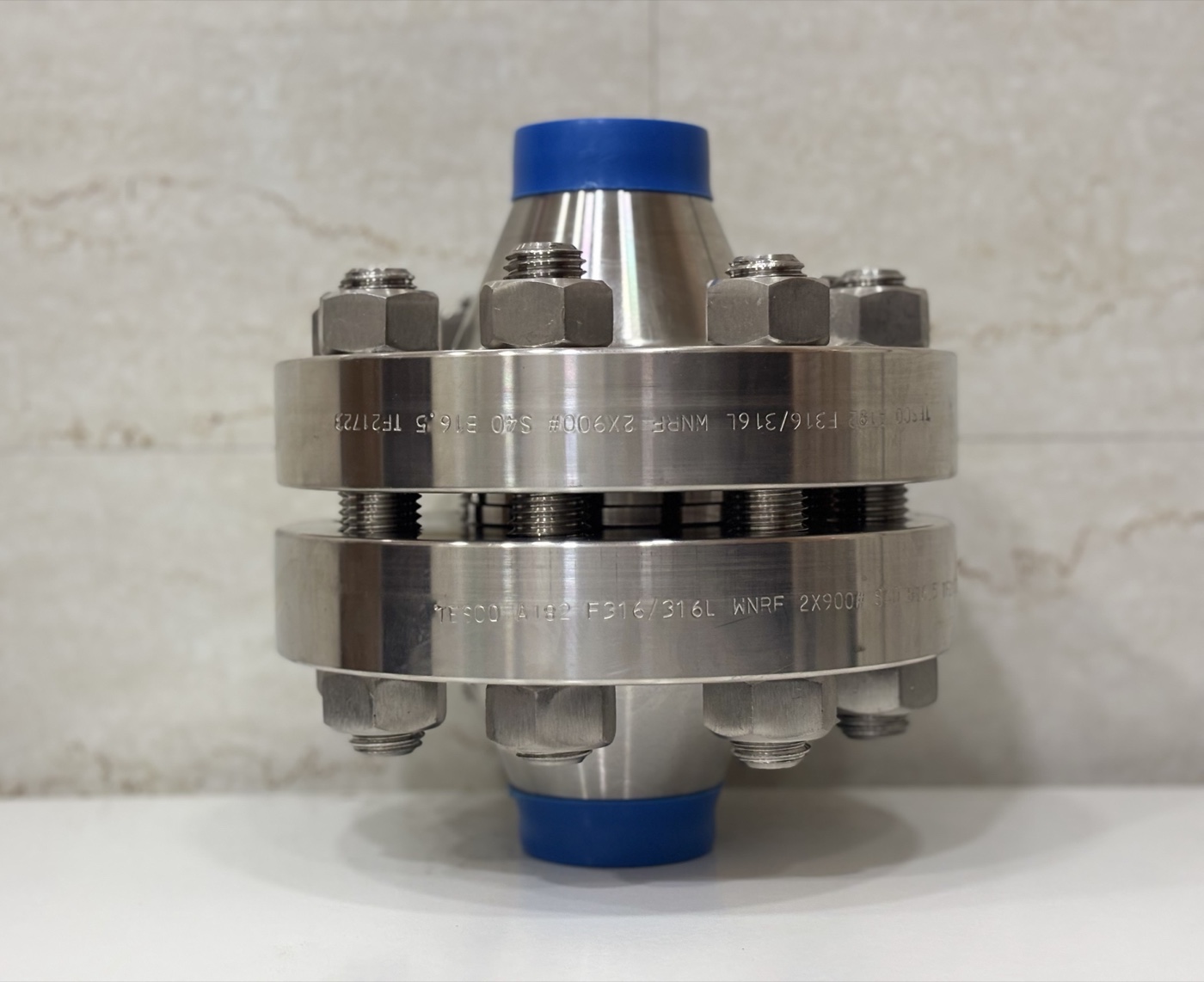
A182 F316/316L WNRF Pair, 2″ #900 Sch 40 — Bolted Up, Heat TF21723
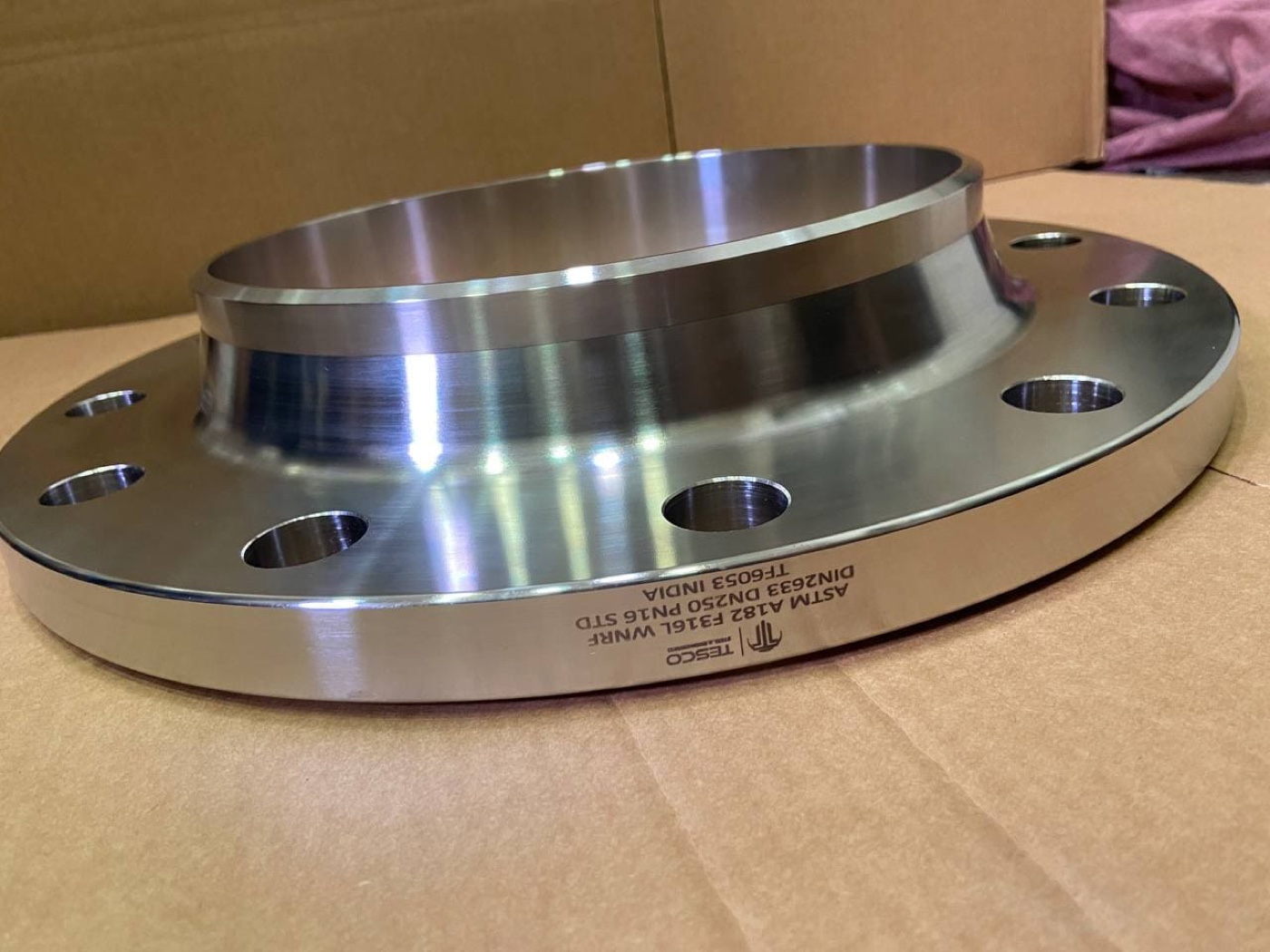
F316L WNRF to DIN 2633, DN250 PN16 — Heat TF6053
Every Tesco 316L flange is forged to ASTM A182 F316L, solution-annealed and CNC-machined to ASME B16.5 / B16.47 tolerances, supplied with EN 10204 3.1 mill test reports. Explore the wider stainless steel flange range, SS 316 flanges, SS 304L flanges, and the flange dimension charts.
| Standard / System | Designation |
|---|---|
| UNS (USA) | S31603 |
| ASTM / ASME (Flanges) | A182 F316L |
| EN / W. Nr. (Europe) | 1.4404 / X2CrNiMo17-12-2 |
| JIS (Japan) | SUS316L |
| BS (UK) | 316S11 |
| GOST (Russia) | 03Kh17N14M3 |
| Typical Composition | Cr 16.0–18.0%, Ni 10.0–14.0%, Mo 2.0–3.0%, C ≤ 0.03%, Mn ≤ 2.0%, Si ≤ 0.75%, balance Fe |
| SS 316L flanges are available in the following specifications: | |
|---|---|
| Material Grade | SS 316L / ASTM A182 F316L / UNS S31603 / EN 1.4404 / SUS316L / X2CrNiMo17-12-2 |
| Size | NPS 1/2″ to 56″ (DN 15 to DN 1400) |
| Class / Rating | 150#, 300#, 600#, 900#, 1500#, 2500# · 3000#, 6000#, 9000# (socket-weld / threaded) |
| Pressure Ratings | PN 6 – PN 400 (PN6, 10, 16, 25, 40, 64, 100, 160, 250, 320, 400) |
| Schedule / Wall Thickness | SCH 10, 20, 40, STD, 60, 80, XS, 120, 160 |
| Standards | ASME B16.5, ASME B16.47 (Series A & B), MSS SP-44, DIN EN 1092-1, BS 4504, JIS B 2220 |
| Flange Types | Weld Neck (WNRF), Slip-On (SORF), Blind, Socket Weld (SWRF), Lap Joint, Threaded / Screwed, Plate, Long Weld Neck, Reducing, Orifice |
| Face Finish | Raised Face (RF), Flat Face (FF), Ring Type Joint (RTJ), Tongue & Groove (T&G), Male & Female (M&F) |
| Testing | Hydrostatic, PMI, IGC test (ASTM A262 Practice E), NACE MR0175, UT, MT, PT per spec |
| Property | SS 316L (F316L) | SS 316 (F316) |
|---|---|---|
| Carbon (C) | 0.03% max — prevents sensitisation | 0.08% max |
| Molybdenum (Mo) | 2.00–3.00% | 2.00–3.00% |
| PREN (Pitting Resistance) | ~24–26 | ~24–26 |
| Tensile Strength (min) | 485 MPa (70 ksi) | 515 MPa (75 ksi) |
| 0.2% Yield Strength (min) | 170 MPa (25 ksi) | 205 MPa (30 ksi) |
| Elongation (min) | 30% | 30% |
| Hardness (max) | 217 HBW / 95 HRB | 217 HBW / 95 HRB |
| Sensitisation Risk (welding) | Very low — low C | Possible |
| Best For | Welded corrosive & hygienic assemblies | Machined / threaded & non-welded service |
316L flange dimensions follow the same ASME B16.5 / B16.47 standards as other stainless grades. Use the links below for the complete charts — outside diameter, bolt-circle diameter, number and size of bolt holes, hub and bore dimensions for every NPS and class:
| Reference | Dimension Chart |
|---|---|
| 316L Stainless Steel Flange Dimensions (ASME B16.5 / B16.47) | View Flange Dimensions → |
| Flange Weight Chart | View Flange Weights → |
| RTJ Gasket Size Chart | View RTJ Size Chart → |
316L flanges come in several types, each with its own features. The most common are Weld Neck, Slip-On, Blind, Socket Weld, Lap Joint and Threaded — with 316L preferred wherever the flange is welded into corrosive service.
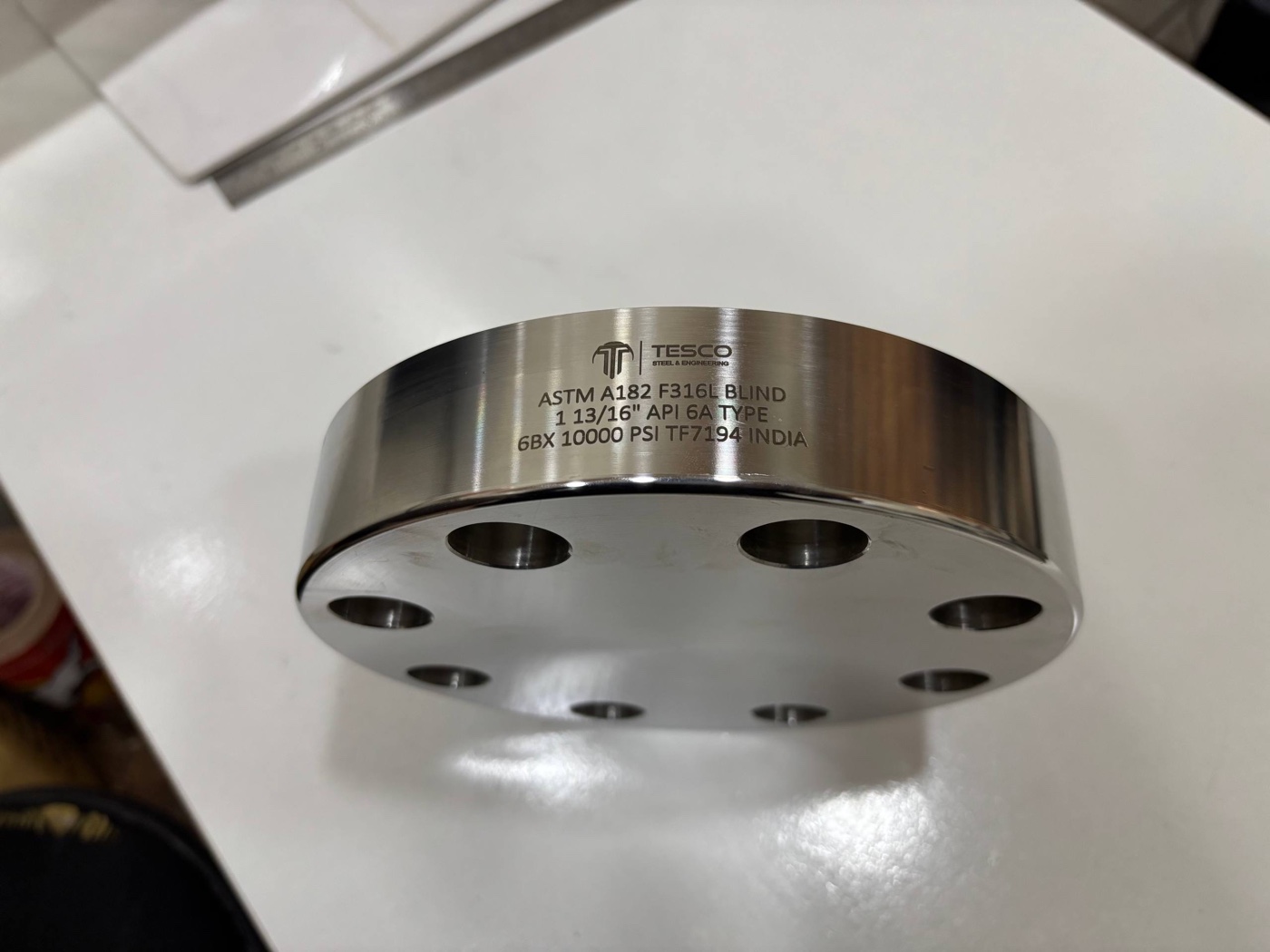
F316L Blind, 1 13/16″ API 6A Type 6BX 10,000 PSI — Heat TF7194
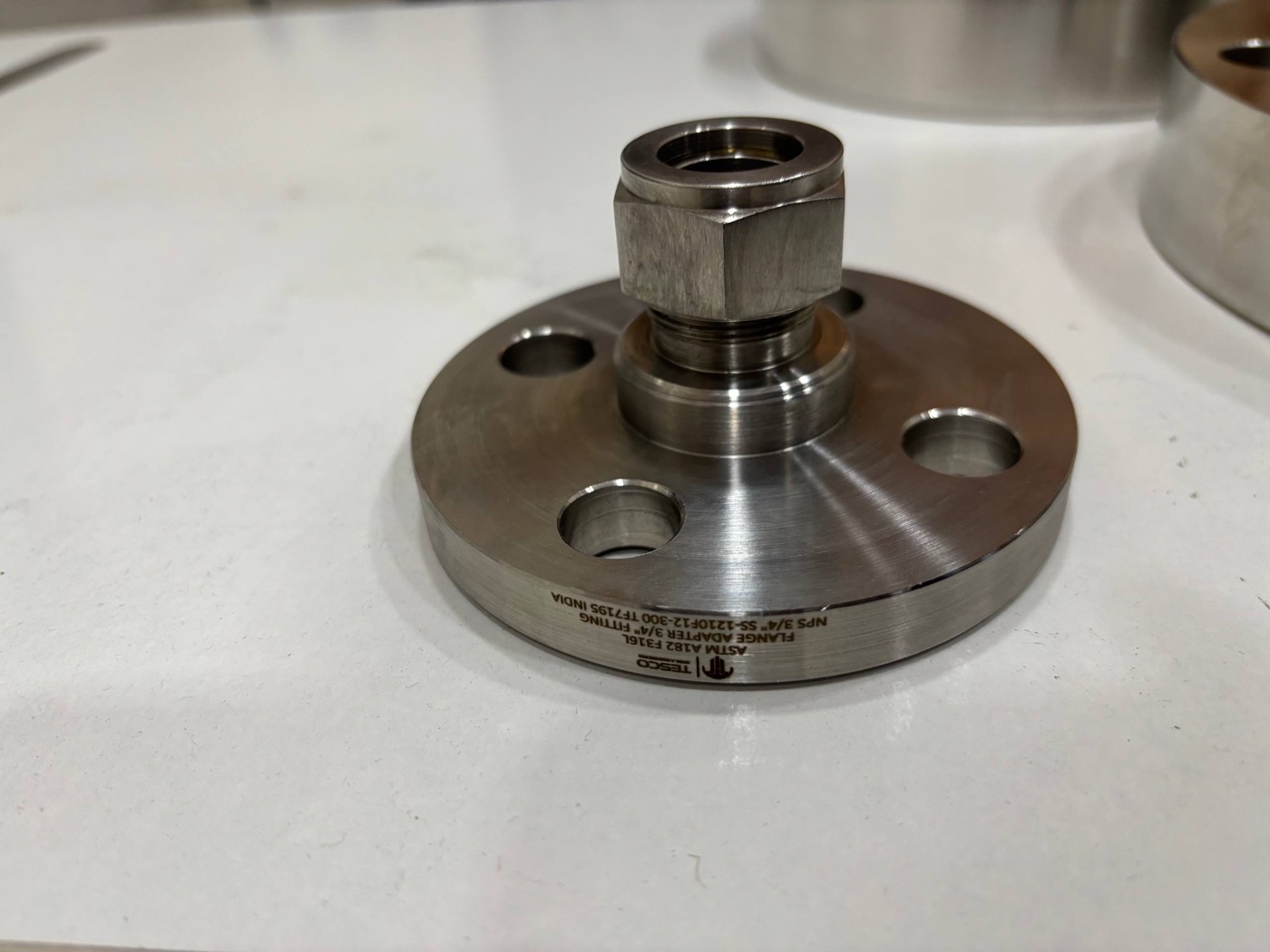
F316L Flange Adapter, ¾″ #300 with Tube Fitting — Heat TF7195
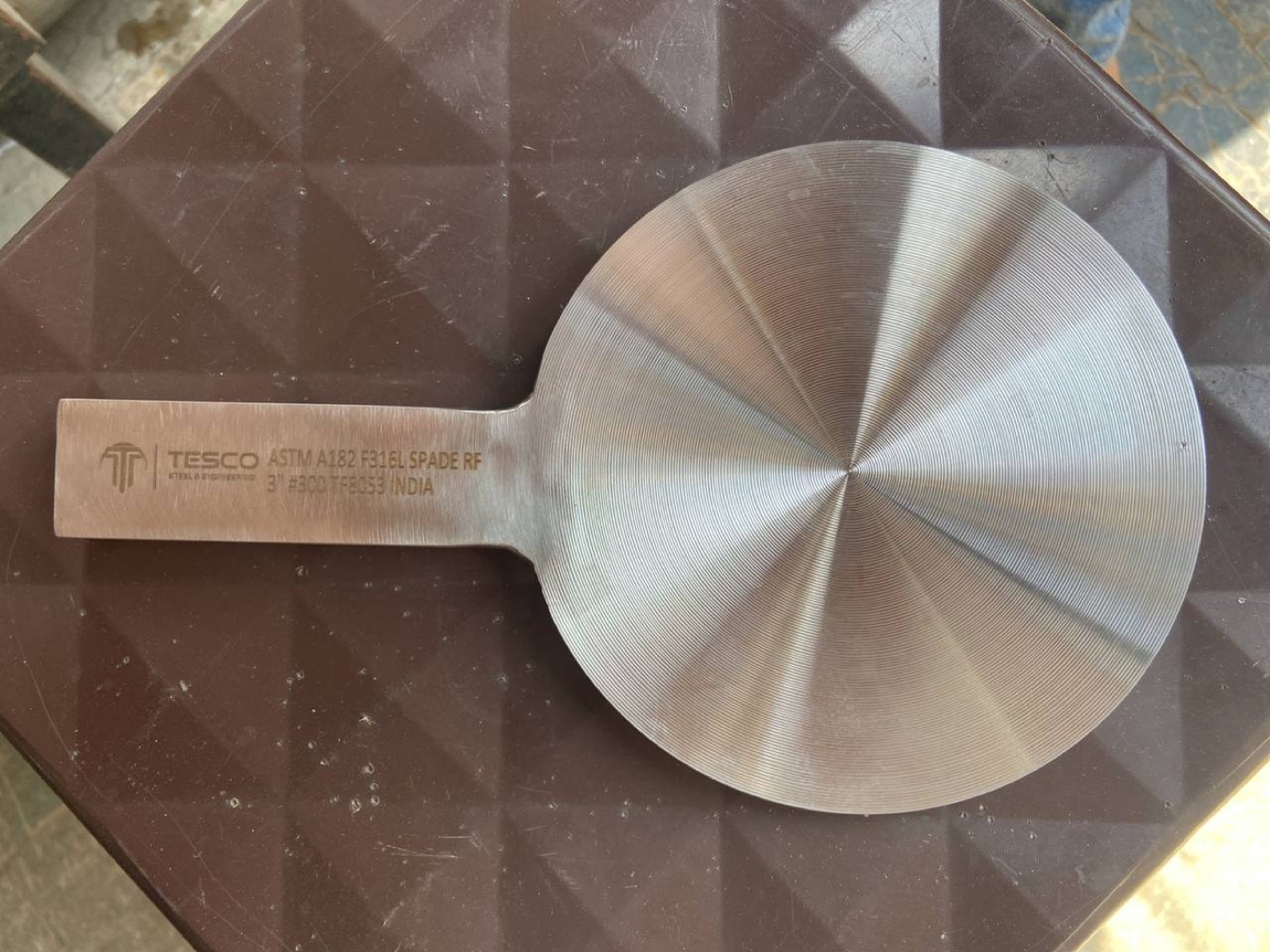
F316L Spade RF, 3″ #300 — Heat TF8053
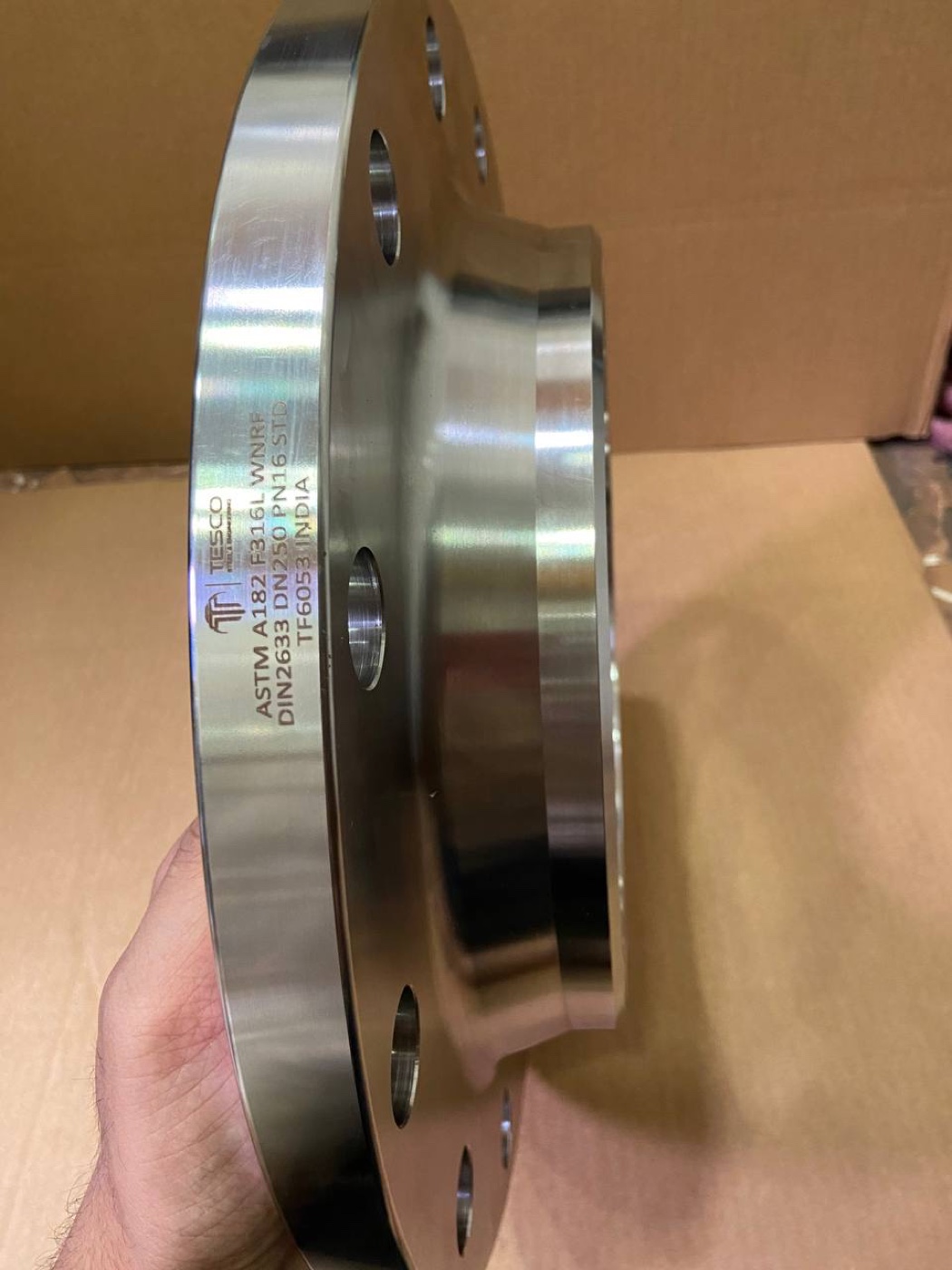
The DN250 in Hand — Hub Taper and Bore of the DIN 2633 Weld Neck
| Flange Type | Description & Typical Use |
|---|---|
| Weld Neck | Tapered hub butt-welded to the pipe for a high-integrity, leak-free joint — the most common 316L type for corrosive high-pressure service; the low carbon avoids HAZ sensitisation. |
| Slip-On | Slipped over the pipe and fillet-welded inside and out — easy to align; common in offshore topsides and chemical secondary lines. |
| Blind | Solid disc that seals a pipe end or vessel nozzle in corrosive service — the default for capped nozzles offshore. |
| Socket Weld | Pipe inserted into a socket bore and fillet-welded — small-bore (1/2″–2″) instrument and chemical-injection lines. |
| Lap Joint | Used with a 316L stub end for systems needing frequent dismantling — common in pharma/dairy CIP installations. |
| Threaded | Internal NPT/BSP threads for low-pressure, non-welded connections such as instrument and sample points. |
| Property | SS 316L | SS 316 | SS 304L |
|---|---|---|---|
| Carbon Content | ≤ 0.03% | ≤ 0.08% | ≤ 0.03% |
| Molybdenum (Mo) | 2.00–3.00% | 2.00–3.00% | None |
| PREN (Pitting Resistance) | ~24–26 | ~24–26 | ~18–20 |
| Chloride / Seawater Resistance | Good | Good | Limited |
| Sensitisation Risk (welding) | Very low | Possible | Very low |
| Yield Strength (min) | 170 MPa | 205 MPa | 170 MPa |
| Relative Cost | Higher (Mo) | Higher (Mo) | Lower |
| Best Suited For | Welded corrosive / marine / hygienic | Non-welded corrosive service | Welded general (non-chloride) |
2–3% Mo gives PREN ~24–26 — superior pitting and crevice resistance in chlorides, seawater and acids.
0.03% C max eliminates weld sensitisation — welded joints keep full HAZ corrosion resistance without PWHT.
Orbital TIG welds, back-purged, with bore/face polished to Ra ≤ 0.8 µm to 3-A / EHEDG standards.
WNRF, SORF, blind, socket-weld, threaded, lap-joint, LWN and plate — in RF, FF, RTJ, T&G and M&F faces.
EN 10204 3.1 / 3.2 MTC, PMI, ASTM A262 IGC, NACE MR0175 declarations and TPI on request.
Made to ASME B16.5/B16.47, EN 1092-1, DIN and JIS — exported worldwide with full documentation.
| Industry | Typical Use |
|---|---|
| Offshore & Marine | Seawater cooling, ballast water, topside process headers, firewater ring mains |
| Chemical Processing | Chloride-bearing & acid process lines, absorber columns, reactor nozzles |
| Pharmaceutical & Biotech | WFI distribution, CIP/SIP circuits, fermentation vessel nozzles (electropolished) |
| Food & Beverage | Dairy CIP lines, pasteurisation loops, brewery and food-grade piping |
| Oil & Gas | Sour service piping (NACE MR0175), chemical & methanol injection headers |
| Desalination | RO pressure vessels, seawater feed piping, brine discharge lines |
| Pulp & Paper | Bleach plant piping (ClO₂, hypochlorite), digester nozzles |
| Water Treatment | Chlorinated potable water mains, wastewater plant piping |
316L flange prices depend on grade, NPS, pressure class, flange type, quantity and current nickel/molybdenum market rates. Because 316L contains 2–3% molybdenum and 10–14% nickel, it typically carries a 15–25% premium over equivalent 304/304L items. Tesco Steel & Engineering offers competitive factory-direct pricing backed by ISO-certified quality and keeps ready stock of standard 316/316L items for fast delivery. Click Ask for Quote or message us on WhatsApp at +91 92233 66922 for an updated price list with stock availability against your requirement.
Q1. What is a 316L stainless steel flange?
A 316L stainless steel flange is a pipe flange made from grade SS 316L (UNS S31603) — the low-carbon (C max 0.03%) version of molybdenum-bearing 316. The 2–3% molybdenum gives superior pitting and crevice corrosion resistance in chlorides, while the low carbon prevents weld sensitisation, making 316L the default for welded flanges in marine and corrosive service.
Q2. What is the difference between 316 and 316L?
The only difference is carbon: 316 has max 0.08% C, 316L max 0.03% C. Both contain 2–3% molybdenum for chloride resistance. The low carbon of 316L prevents chromium carbide precipitation (sensitisation) during welding, so its weld HAZ keeps full corrosion resistance without post-weld heat treatment — the reason 316L is preferred for welded assemblies.
Q3. Why is 316L preferred for welded corrosive piping?
316L combines two advantages: 2–3% molybdenum for pitting/crevice resistance in chlorides, and ultra-low carbon that prevents sensitisation in the weld heat-affected zone. Together they keep the welded joint as corrosion-resistant as the base metal, which is why 316L is the standard for welded marine, chemical and pharmaceutical piping.
Q4. What is the difference between 304L and 316L?
Both are low-carbon austenitic grades, but 316L adds 2–3% molybdenum that 304L lacks. This raises 316L's pitting resistance (PREN ~24–26 vs ~18–20) and makes it suitable for chlorides, seawater and acids where 304L would pit. 316L costs roughly 20–30% more due to the molybdenum and higher nickel content.
Q5. What are the equivalent grades of SS 316L?
SS 316L equivalents include UNS S31603, ASTM A182 F316L, EN 1.4404 (X2CrNiMo17-12-2), JIS SUS316L, BS 316S11 and GOST 03Kh17N14M3.
Q6. Can 316L flanges be used in seawater?
316L gives good resistance in flowing seawater but is susceptible to pitting and crevice corrosion in stagnant seawater or under crevices over long service. It is used in seawater systems with adequate flow velocity and cathodic protection when submerged; for continuous warm seawater, super duplex (2507) or 6Mo stainless is more appropriate.
Q7. What filler metal is used to weld 316L flanges?
ER316L (AWS A5.9) wire for GTAW/GMAW and E316L-15/16/17 (AWS A5.4) electrodes for SMAW. The low-carbon filler keeps the weld metal low in carbon, preserving corrosion resistance across the joint. For joining 316L to carbon or low-alloy steel, ER309L is used as a transitional buffer layer.
Q8. Are 316L flanges supplied with material test certificates?
Yes. Every 316L flange is supplied with EN 10204 3.1 (or 3.2) mill test certificates with heat/lot traceability, dimensional inspection, PMI, ASTM A262 IGC testing, NACE MR0175 declarations and 3-A/EHEDG hygienic certification on request.