

Tesco Steel & Engineering manufactures 304L stainless steel flanges — the low-carbon (C max 0.030%) version of 18/8 austenitic grade 304, made to ASTM A182 F304L (UNS S30403). The very low carbon prevents chromium-carbide precipitation (sensitisation) in the weld heat-affected zone, making 304L the preferred grade for welded piping that will not be solution-annealed after welding. It keeps the same excellent corrosion resistance, cryogenic toughness to −196 °C, non-magnetic structure and weldability as 304. Available in weld neck, slip-on, blind, socket-weld, threaded, lap-joint and plate types to ASME B16.5 / B16.47. EN 1.4307, SUS304L. Class 150 to 2500, PN10 to PN400. ISO 9001:2015 certified. Made in India.

SS 304L (ASTM A182 F304L) Flanges

SS 304L Blind & Weld Neck Flanges
Every Tesco 304L flange is forged from ASTM A182 F304L, solution-annealed and CNC-machined to ASME B16.5 / B16.47 tolerances, supplied with EN 10204 3.1 mill test reports. Explore the wider stainless steel flange range, SS 304 flanges, SS 316L flanges, and the flange dimension charts.
| Standard / System | Designation |
|---|---|
| UNS (USA) | S30403 |
| ASTM / ASME (Flanges) | A182 F304L |
| EN / W. Nr. (Europe) | 1.4307 / X2CrNi18-9 (also 1.4306 / X2CrNi19-11) |
| JIS (Japan) | SUS304L |
| BS (UK) | 304S11 |
| GOST (Russia) | 03X18H11 |
| AFNOR (France) | Z3CN18-10 |
| Typical Composition | Cr 18.0–20.0%, Ni 8.0–12.0%, C ≤ 0.030%, Mn ≤ 2.0%, Si ≤ 0.75%, balance Fe |
| SS 304L flanges are available in the following specifications: | |
|---|---|
| Material Grade | SS 304L / ASTM A182 F304L / UNS S30403 / EN 1.4307 / 1.4306 / SUS304L / X2CrNi18-9 |
| Size | NPS 1/2″ to 60″ (DN 15 to DN 1500) |
| Class / Rating | 150#, 300#, 600#, 900#, 1500#, 2500# · 3000#, 6000#, 9000# (socket-weld / threaded) |
| Pressure Ratings | PN 10 – PN 400 (PN10, 16, 25, 40, 64, 100, 160, 250, 320, 400) |
| Schedule / Wall Thickness | SCH 10, 20, 40, STD, 80, XS, 160, XXS |
| Standards | ASME B16.5, ASME B16.47 (Series A & B), MSS SP-44, DIN EN 1092-1, BS 4504, JIS B 2220 |
| Flange Types | Weld Neck (WNRF), Slip-On (SORF), Blind, Socket Weld (SWRF), Lap Joint, Threaded / Screwed, Plate, Long Weld Neck, Reducing, Orifice |
| Face Finish | Raised Face (RF), Flat Face (FF), Ring Type Joint (RTJ), Tongue & Groove (T&G), Male & Female (M&F) |
| Testing | Hydrostatic, PMI, IGC test (ASTM A262 Practice E), UT, MT, PT per spec |
| Property | SS 304L (F304L) | SS 304 (F304) |
|---|---|---|
| Carbon (C) | 0.030% max — prevents sensitisation | 0.080% max |
| Tensile Strength (min) | 485 MPa (70 ksi) | 515 MPa (75 ksi) |
| 0.2% Yield Strength (min) | 170 MPa (25 ksi) | 205 MPa (30 ksi) |
| Elongation (min) | 40% | 40% |
| Hardness (max) | 92 HRB / 201 HB | 92 HRB / 201 HB |
| Density | 8.00 g/cm³ | 8.00 g/cm³ |
| Sensitisation Risk (welding) | Very low — low C | Moderate (425–870 °C) |
| Best For | Welded vessels, exchangers, piping systems | Machined / threaded & general service |
304L flange dimensions follow the same ASME B16.5 / B16.47 standards as other stainless grades. Use the links below for the complete charts — outside diameter, bolt-circle diameter, number and size of bolt holes, hub and bore dimensions for every NPS and class:
| Reference | Dimension Chart |
|---|---|
| 304L Stainless Steel Flange Dimensions (ASME B16.5 / B16.47) | View Flange Dimensions → |
| Flange Weight Chart | View Flange Weights → |
| RTJ Gasket Size Chart | View RTJ Size Chart → |
304L flanges come in several types, each with its own features. Understanding them is the first step to choosing the right flange — the most common are Weld Neck, Slip-On, Blind, Socket Weld, Lap Joint and Threaded.
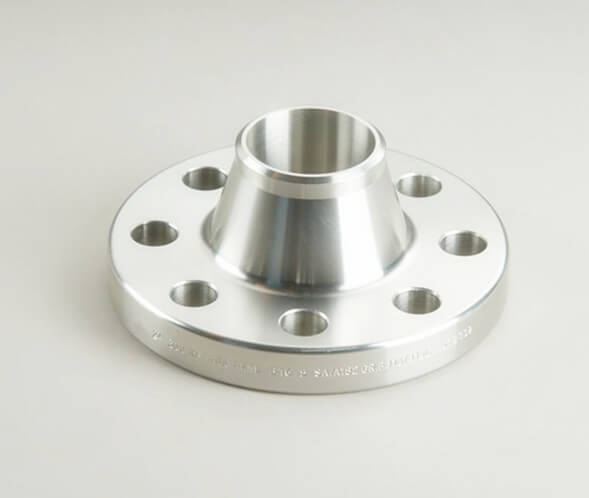
SS 304L Weld Neck Flange

SS 304L Slip-On Flange
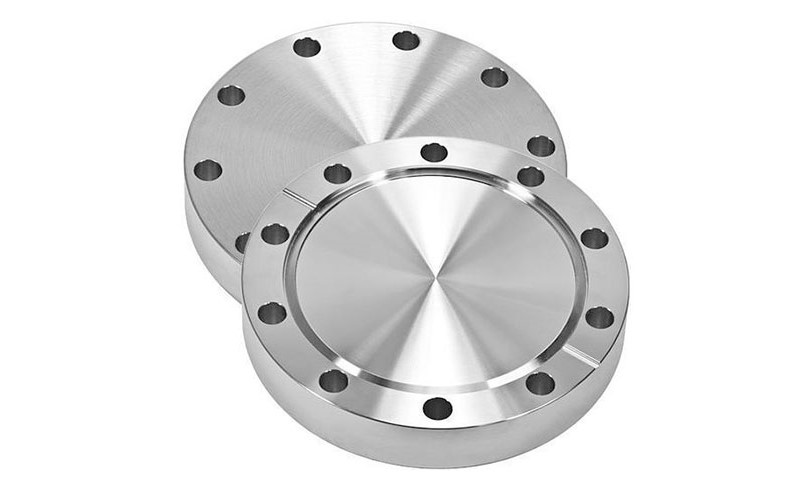
SS 304L Blind Flange
| Flange Type | Description & Typical Use |
|---|---|
| Weld Neck | Tapered hub butt-welded to the pipe for a long-lasting, leak-free joint — the most common 304L type, ideal because welded 304L resists sensitisation in the HAZ. |
| Slip-On | Slipped over the pipe and fillet-welded inside and out — easy to align; 304L preferred to avoid sensitisation at the double fillet welds. |
| Blind | Solid disc that closes the end of a pipe or vessel — used where periodic inspection or future expansion is needed. |
| Socket Weld | Pipe inserted into a socket bore and fillet-welded — for small-bore (1/2″–2″) high-pressure lines. |
| Lap Joint | Used with a stub end so the flange can rotate freely — ideal for systems needing frequent dismantling and cleaning access. |
| Threaded | Internal NPT/BSP threads screw onto the pipe — for low-pressure, non-welded connections. |
| Property | SS 304L | SS 304 | SS 316L |
|---|---|---|---|
| Carbon Content | ≤ 0.030% | ≤ 0.08% | ≤ 0.030% |
| Molybdenum (Mo) | None | None | 2.00–3.00% |
| Yield Strength (min) | 170 MPa | 205 MPa | 170 MPa |
| PREN (Pitting Resistance) | ~18–20 | ~18–20 | ~24–26 |
| Sensitisation Risk (welding) | Very low | Moderate | Very low |
| Chloride / Seawater Resistance | Limited | Limited | Good (Mo) |
| Cryogenic (to −196 °C) | Excellent | Excellent | Excellent |
| Relative Cost | Slightly above 304 | Base (lowest) | ~20–30% higher |
| Best Suited For | Welded piping, vessels & exchangers | Machined / general (non-Cl) | Marine, offshore, high-chloride |
Low carbon (≤0.030%) prevents chromium-carbide precipitation in welds — the right grade for welded piping without post-weld annealing.
No ductile-to-brittle transition — suited to liquid nitrogen, liquid oxygen and LNG service.
18/8 austenitic film resists atmospheric corrosion and many organic and inorganic chemicals.
WNRF, SORF, blind, socket-weld, threaded, lap-joint and plate — in RF, FF, RTJ, T&G and M&F faces.
EN 10204 3.1 mill test reports, PMI, ASTM A262 IGC testing and TPI on request.
Made to ASME B16.5/B16.47, EN 1092-1, DIN and JIS — exported worldwide with full documentation.
| Industry | Typical Use |
|---|---|
| Chemical Processing | Welded process piping, reactor & vessel nozzles (non-chloride media) |
| Food & Beverage | Dairy, brewing and juice lines; CIP/SIP welded headers |
| Pharmaceutical & Biotech | WFI distribution and API process piping (electropolished) |
| Cryogenic & LNG | LN₂, LOX and LNG transfer lines; cold-box flanged joints |
| Water Treatment | Potable water pipelines and desalination pre-treatment (fresh water) |
| Oil & Gas (Onshore) | Sweet gas, utility and instrument-air welded piping |
| Pulp & Paper | White liquor and low-chloride process piping |
| Power & Engineering | Balance-of-plant piping and general welded flanged joints |
304L flange prices depend on grade, NPS, pressure class, flange type, quantity and current nickel/stainless market rates. Tesco Steel & Engineering offers competitive factory-direct pricing backed by ISO-certified quality, and keeps ready stock of standard 304/304L items for fast delivery. Click Ask for Quote or message us on WhatsApp at +91 92233 66922 for an updated price list with stock availability against your requirement.
Q1. What is a 304L stainless steel flange?
A 304L stainless steel flange is a pipe flange made from grade SS 304L (UNS S30403) — the low-carbon (C max 0.030%) version of 18/8 austenitic 304. The very low carbon prevents chromium-carbide precipitation (sensitisation) in the weld heat-affected zone, making 304L the preferred grade for welded piping that will not be solution-annealed.
Q2. What is the difference between 304 and 304L?
The only compositional difference is carbon: 304 has max 0.08% C, 304L max 0.030% C. The low carbon of 304L prevents chromium carbides forming at grain boundaries during welding (sensitisation), avoiding intergranular corrosion. The trade-off is a slightly lower minimum yield strength (170 MPa for 304L vs 205 MPa for 304).
Q3. Why is 304L preferred for welded flanges?
When stainless is welded, the heat-affected zone passes through 425–870 °C, where standard 304 forms chromium carbides that deplete the matrix of chromium and create intergranular corrosion susceptibility. 304L's carbon is too low to form significant carbides, so welded 304L joints stay corrosion-resistant without a post-weld solution anneal.
Q4. What are the equivalent grades of SS 304L?
SS 304L equivalents include UNS S30403, ASTM A182 F304L, EN 1.4307 / 1.4306 (X2CrNi18-9), JIS SUS304L, BS 304S11, GOST 03X18H11 and AFNOR Z3CN18-10.
Q5. What pressure classes and sizes are available for 304L flanges?
304L flanges are available from NPS 1/2 to 60 inch in ASME classes 150, 300, 600, 900, 1500 and 2500 (and 3000#/6000#/9000# socket-weld/threaded), with DIN/EN ratings from PN10 to PN400.
Q6. Can 304L flanges be used in cryogenic service?
Yes. 304L flanges suit cryogenic service down to −196 °C. The austenitic structure has no ductile-to-brittle transition, so it retains toughness at all sub-zero temperatures — standard for liquid nitrogen, liquid oxygen and LNG transfer systems.
Q7. Can 304L flanges be used in seawater?
No. Like 304, grade 304L has limited chloride resistance (PREN ~18–20) and pits in seawater (15,000–35,000 ppm chlorides). Use 316L for moderate exposure, or Duplex 2205 / Super Duplex 2507 for offshore and warm-seawater service.
Q8. What is a 304/304L dual-certified flange?
A dual-certified 304/304L flange is made from material that meets both the 304L composition limit (C ≤ 0.030%) and the 304 mechanical properties (yield ≥ 205 MPa, tensile ≥ 515 MPa), so it can be marked as both F304 and F304L — giving 304L weld-corrosion protection while allowing full 304 strength credit in pressure design.
Q9. Are 304L flanges supplied with material test certificates?
Yes. Every 304L flange is supplied with EN 10204 3.1 (or 3.2) mill test certificates with heat/lot traceability, dimensional inspection to ASME B16.5, and PMI, ASTM A262 IGC testing and third-party inspection on request.
Countries We Export 304L Stainless Steel Flanges To: Kuwait, UAE, Germany, Saudi Arabia, West Africa, Iraq, Congo, Mexico, Bahrain, Canada, Philippines, Thailand, Kenya, Oman, Malaysia, Turkey, Qatar, Sudan, Netherlands, Nigeria, Russia, Vietnam, Angola, Indonesia, UK, Yemen, Italy, United States, Venezuela, Spain, Iran, Kazakhstan, Algeria, Jordan, Portugal, Colombia, Libya, Chile, Peru, South Africa, Afghanistan, Israel, Zambia, Morocco, Denmark, Taiwan, Norway, Belarus, Lebanon, Sri Lanka, Bulgaria, Ukraine, Belgium, Finland, Slovakia, Romania, France, Brazil, Trinidad & Tobago, Tunisia, Hungary, Zimbabwe, Ghana, Egypt, Czech Republic, Azerbaijan, Poland, Greece, New Zealand, Croatia, Tanzania.
Major Exporting Areas: 304L Stainless Steel Flanges Manufacturers / Suppliers / Stockist in Moscow, Seoul, Montreal, Dubai, Kuala Lumpur, Aberdeen, Tehran, Bogota, Melbourne, Abu Dhabi, Edmonton, Ho Chi Minh City, Bangkok, Toronto, Muscat, Milan, Busan, Mexico City, Perth, Santiago, Rio de Janeiro, London, Karachi, Los Angeles, Manama, Sydney, Riyadh, New York, Jeddah, Houston, Jakarta, Brisbane, Algiers, Kuwait City, Hanoi, Doha, Al Jubail, Cairo, Caracas, Lagos, Al Khobar, Madrid, Singapore, Calgary, Colombo, Ulsan, Istanbul, Dammam, Dallas, Ankara, Sharjah, Vung Tau.