

Tesco Steel & Engineering manufactures 316 & 316L stainless steel flanges — the molybdenum-bearing "marine grade" austenitic flange (ASTM A182 F316 / F316L, UNS S31600 / S31603). Its 2–3% molybdenum addition — absent in 304 — dramatically improves resistance to pitting and crevice corrosion in chlorides, seawater, process acids and pharmaceutical solutions. The low-carbon 316L (C max 0.03%) eliminates weld sensitisation, making it the default for welded corrosive-service assemblies. Available in weld neck, slip-on, blind, socket-weld, lap-joint, threaded, long weld neck and orifice types to ASME B16.5 / B16.47. EN 1.4401 / 1.4404, SUS316. Class 150 to 2500, PN6 to PN400. ISO 9001:2015 certified. Made in India.
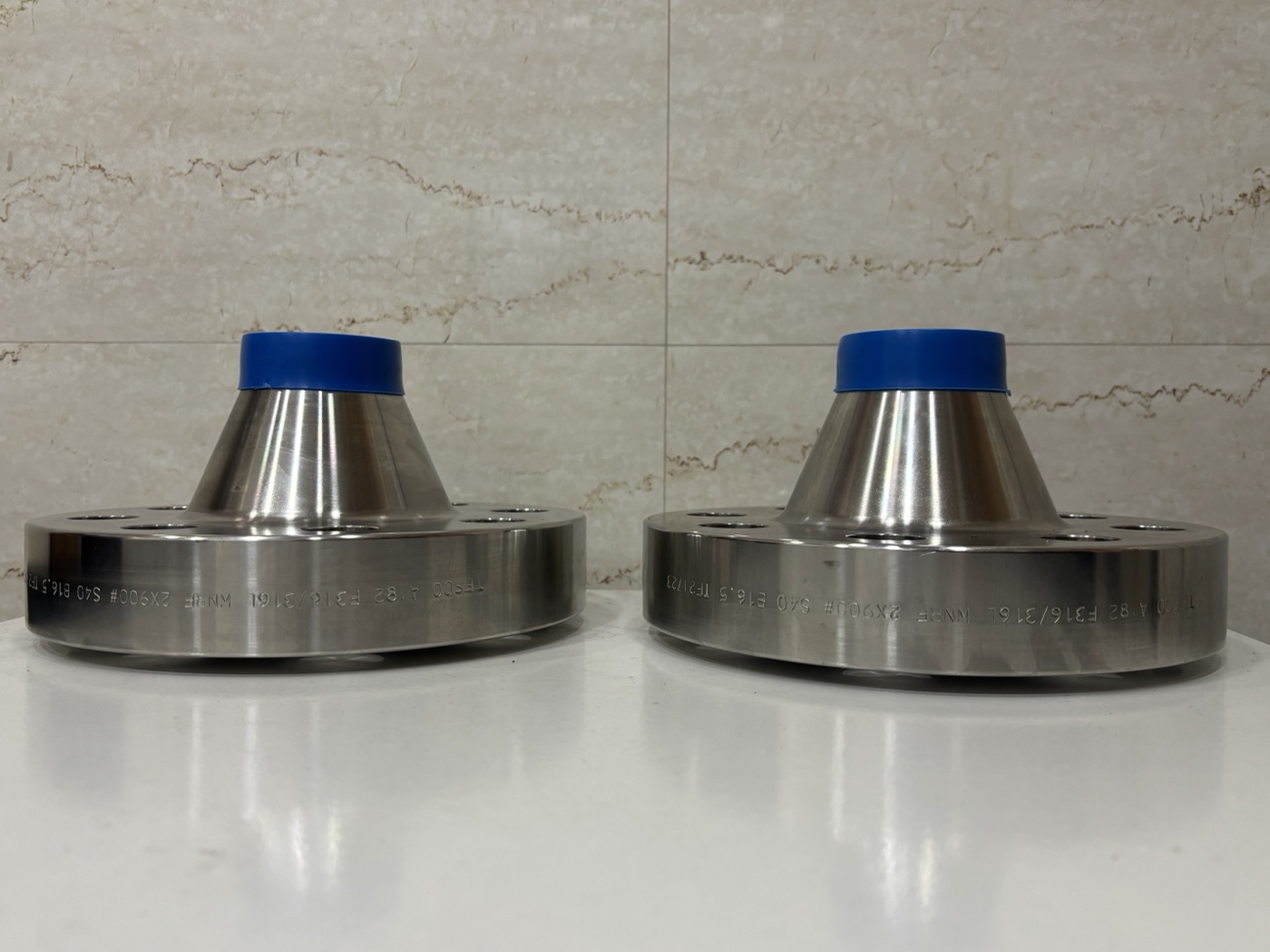
A182 F316/316L Dual-Certified WNRF, 2″ #900 Sch 40 — Heat TF21723
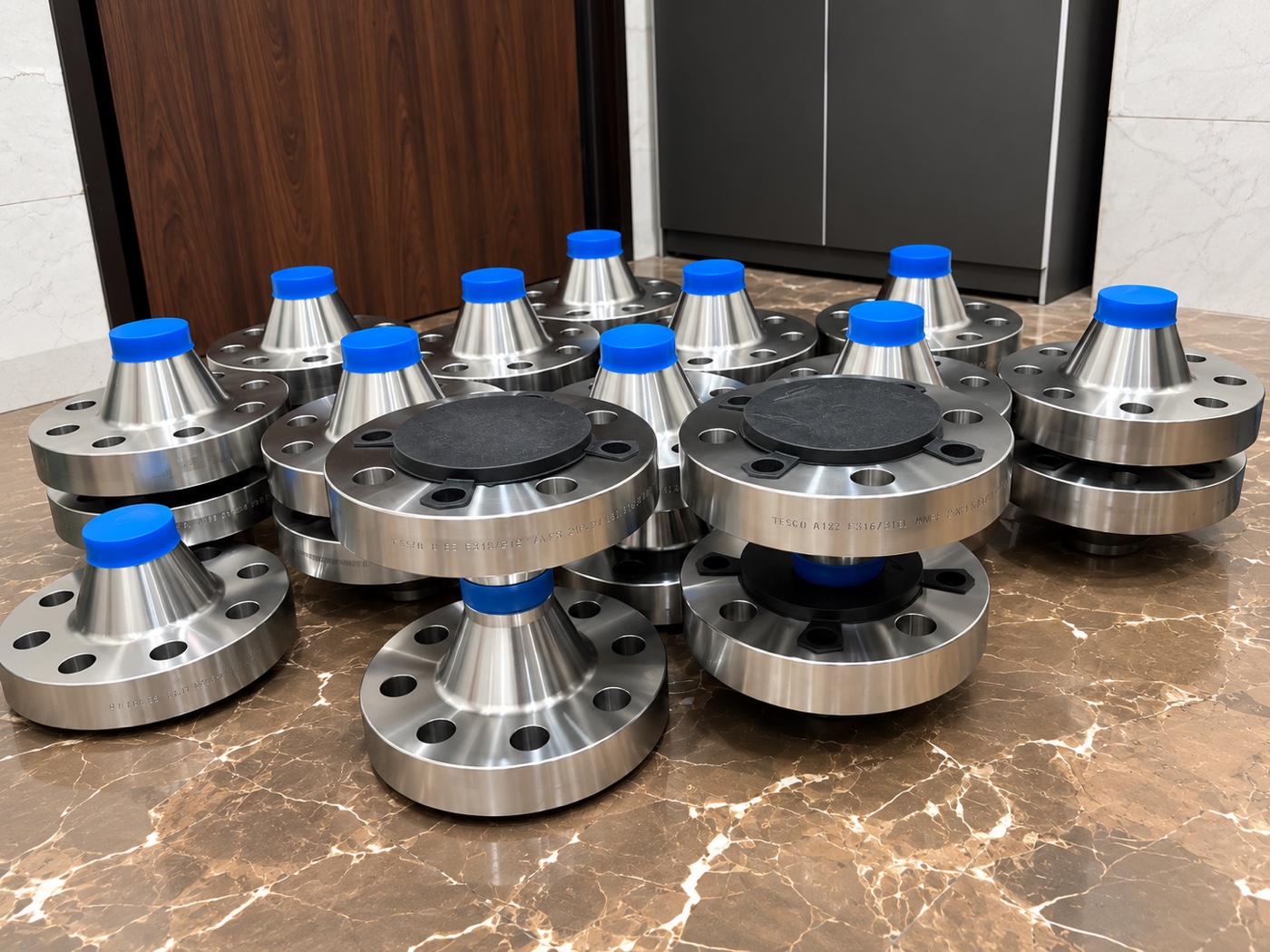
F316/316L Weld Necks — Capped and Paired for Dispatch
Every Tesco 316/316L flange is forged to ASTM A182 F316/F316L, solution-annealed and CNC-machined to ASME B16.5 / B16.47 tolerances, supplied with EN 10204 3.1 mill test reports. Explore the wider stainless steel flange range, SS 316L flanges, SS 304 flanges, and the flange dimension charts.
| 316 / 316L SS Flange Specifications at a Glance | |
|---|---|
| Material Standard | ASTM A182 Grade F316 / F316L / F316H |
| UNS Numbers | S31600 (316) · S31603 (316L) · S31609 (316H) |
| Size Range | 1/2″ NB to 56″ NB (DN 15 to DN 1400) |
| ANSI Pressure Classes | 150#, 300#, 600#, 900#, 1500#, 2500# |
| DIN Pressure Ratings | PN 6, 10, 16, 25, 40, 64, 100, 160, 250, 320, 400 |
| Bore Schedule | STD, XS, XXS, SCH 10, 20, 40, 60, 80, 120, 160 |
| Flange Types | Weld Neck (WNRF), Slip-On (SORF), Blind (BFF), Socket Weld (SWRF), Lap Joint (LJRF), Threaded (TRFF), Long Weld Neck (LWN), Orifice |
| Flange Faces | Raised Face (RF), Flat Face (FF), Ring Type Joint (RTJ) |
| Max Continuous Service Temp | 870 °C (oxidising) · 925 °C intermittent |
| Pitting Resistance Equiv. (PREN) | ~25 (316) vs ~18 (304) |
All 316 and 316L flanges are machined to published dimensional tolerances. Bore diameters, bolt circle, number of holes, flange thickness and raised-face height conform to ASME B16.5 (1/2″ to 24″ NB) and ASME B16.47 Series A & B (26″ NB and above).
| Reference | Dimension Chart |
|---|---|
| 316 Stainless Steel Flange Dimensions (ASME B16.5 / B16.47) | View Flange Dimensions → |
| Flange Weight Chart | View Flange Weights → |
| RTJ Gasket Size Chart | View RTJ Size Chart → |
The 2–3% molybdenum addition is what separates Grade 316 from 304 — it stabilises the passive film against chloride ions, preventing the localised breakdown that causes pitting and crevice corrosion. 316L reduces carbon to 0.03% max to prevent weld sensitisation, while 316H raises carbon to 0.04% min for improved creep strength in high-temperature vessels.
| Element | 316 (S31600) | 316L (S31603) | 316H (S31609) |
|---|---|---|---|
| Chromium (Cr) | 16.00 – 18.00% | 16.00 – 18.00% | 16.00 – 18.00% |
| Nickel (Ni) | 10.00 – 14.00% | 10.00 – 14.00% | 10.00 – 14.00% |
| Molybdenum (Mo) | 2.00 – 3.00% | 2.00 – 3.00% | 2.00 – 3.00% |
| Carbon (C) | 0.08% max | 0.03% max | 0.04 – 0.10% |
| Manganese (Mn) | 2.00% max | 2.00% max | 2.00% max |
| Silicon (Si) | 0.75% max | 0.75% max | 0.75% max |
| Phosphorus (P) | 0.045% max | 0.045% max | 0.045% max |
| Sulfur (S) | 0.030% max | 0.030% max | 0.030% max |
| Nitrogen (N) | 0.10% max | 0.10% max | — |
| Mechanical Property | 316 (F316) | 316L (F316L) |
|---|---|---|
| Tensile Strength (min) | 515 MPa (75 ksi) | 485 MPa (70 ksi) |
| Yield Strength 0.2% offset (min) | 205 MPa (30 ksi) | 170 MPa (25 ksi) |
| Elongation in 2″ (min) | 30% | 30% |
| Hardness (max) | 217 HBW / 95 HRB | 217 HBW / 95 HRB |
| Density | 7.99 g/cm³ | 7.99 g/cm³ |
| International Equivalent Grades | |
|---|---|
| UNS (USA) | S31600 (316) / S31603 (316L) / S31609 (316H) |
| EN / DIN (Europe) | 1.4401 (316) / 1.4404 (316L) / 1.4919 (316H) |
| JIS (Japan) | SUS 316 / SUS 316L |
| BS (UK) | 316S31 / 316S11 |
| GOST (Russia) | 03Kh17N14M3 (316L) |
| IS (India) | FG 316 / FG 316L (IS 6911) |
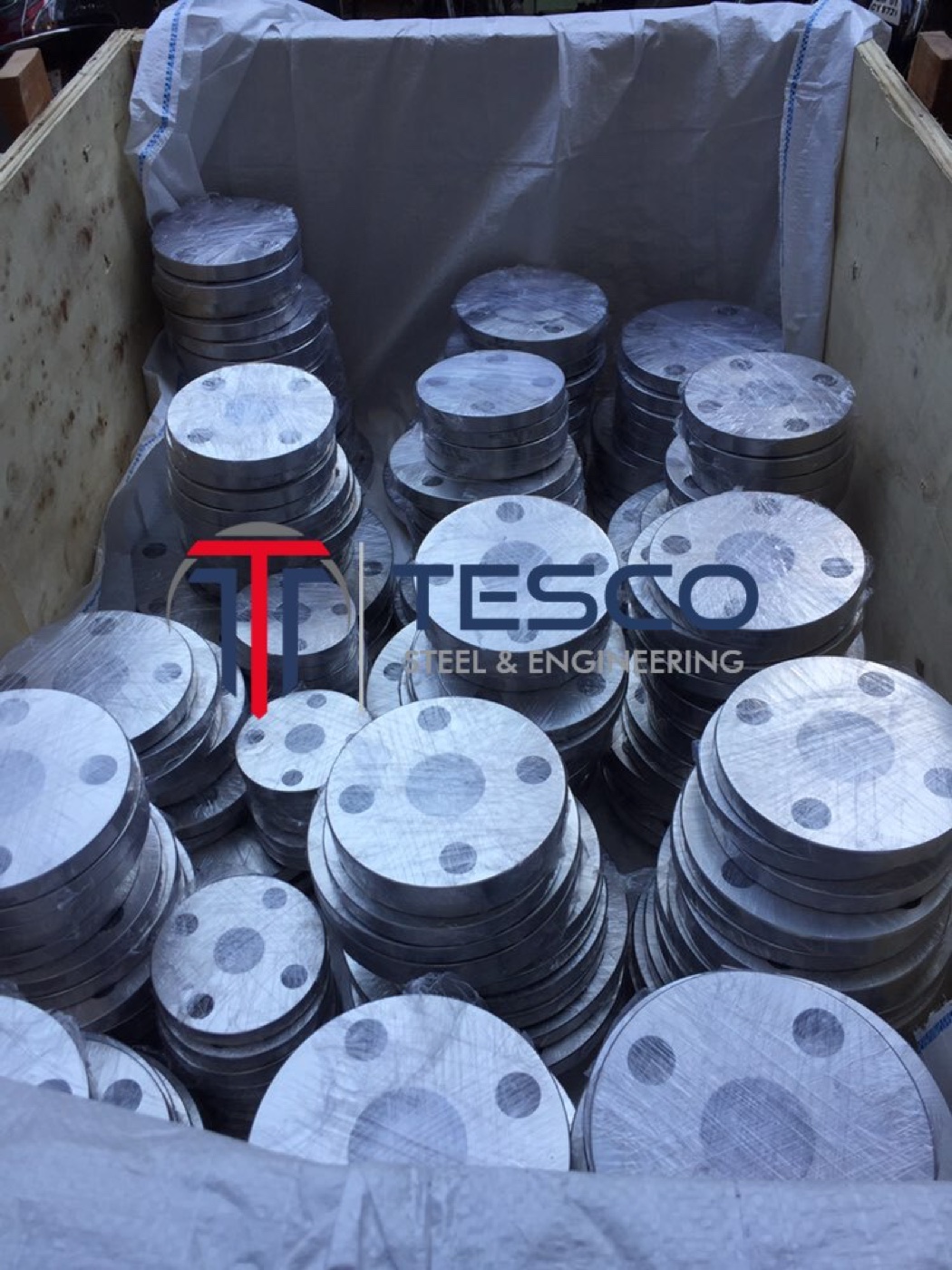
Wrapped 316 Flanges in the Export Crate
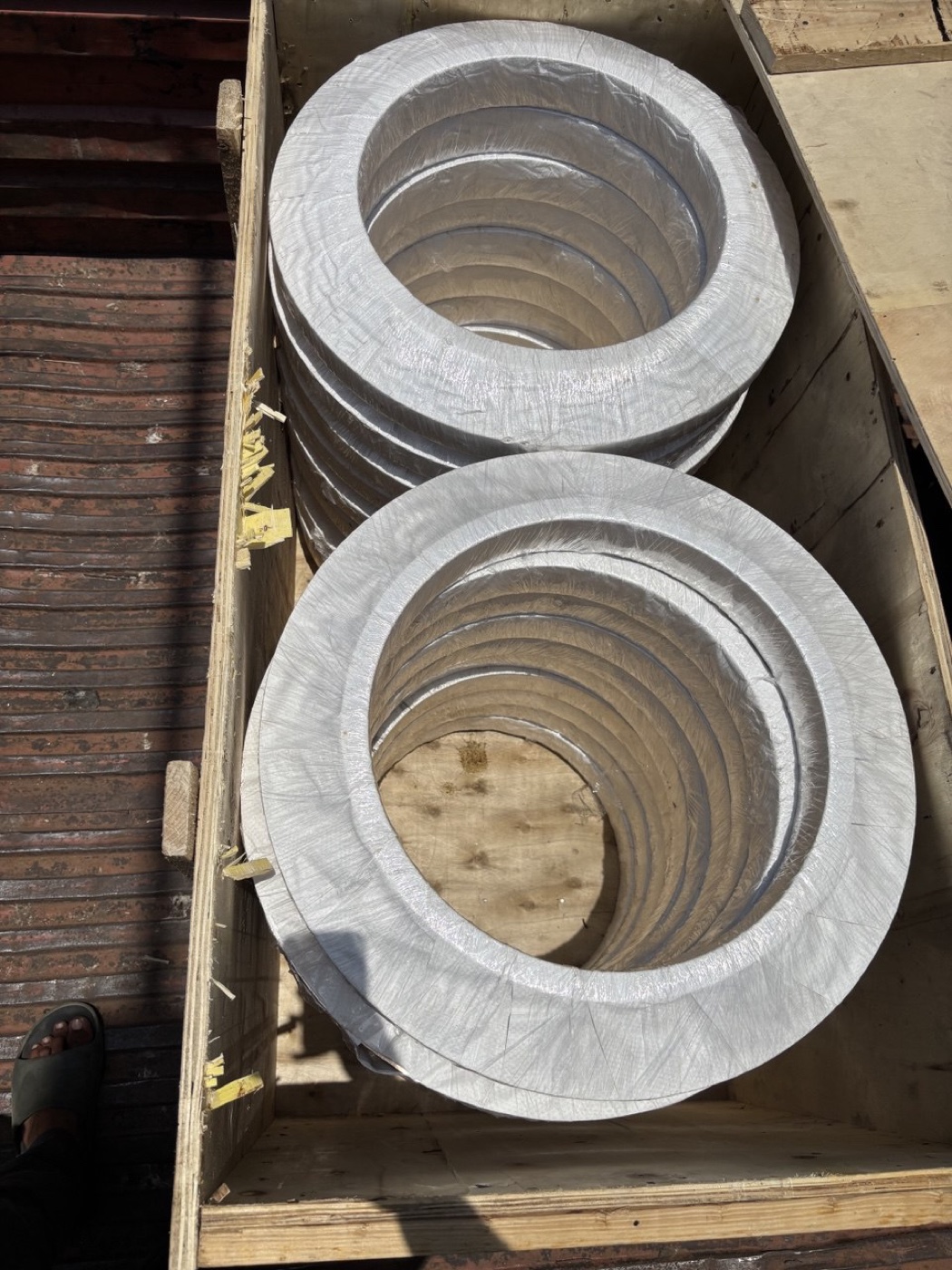
Large-Bore Flanges — Wrapped, Crated, Ready to Ship
| Flange Type | Description & 316-Specific Use |
|---|---|
| Weld Neck (WNRF) | Long tapered hub gives a smooth bore transition and distributes stress away from the face — standard for high-pressure, high-cycle and corrosive 316 piping. 316L for all welded assemblies to avoid sensitisation. |
| Slip-On (SORF) | Pipe slides through the bore, secured with two fillet welds; common in offshore topsides, chemical secondary lines and food & beverage where 304 is insufficient due to chlorides. |
| Blind (BFF) | Seals pipeline ends and vessel nozzles in corrosive service; the default for capped nozzles on process vessels, exchangers and seawater headers offshore. |
| Socket Weld (SWRF) | Small-bore (1/2″–2″) instrument and sample connections in chemical, pharma and food plants; single fillet weld, Class 150–3000. |
| Lap Joint (LJRF) | Used with a 316L stub end where piping is frequently disassembled for cleaning or lining replacement — common in pharma/dairy CIP installations. |
| Threaded (TRFF) | Screwed onto threaded pipe for low-to-moderate pressure instrument and utility connections; not recommended above 260 °C due to thread relaxation. |
| Long Weld Neck (LWN) | Extended nozzle on vessels, columns and reactor shells — acts as a pipe spool, eliminating a separate weld-on nozzle. |
| Orifice | Paired flanges with tapped pressure ports for flow measurement; 316L keeps the orifice bore and taps accurate without chloride pitting. |
| Property | 316 (S31600) | 316L (S31603) | 304 (S30400) | 304L (S30403) |
|---|---|---|---|---|
| Molybdenum | 2–3% | 2–3% | None | None |
| Carbon Max | 0.08% | 0.03% | 0.08% | 0.03% |
| Chloride Resistance | Excellent | Excellent | Moderate | Moderate |
| Pitting Resistance (PREN) | ~25 | ~25 | ~18 | ~18 |
| Sensitisation After Welding | Possible | Minimal | Possible | Minimal |
| Tensile Strength (min) | 515 MPa | 485 MPa | 515 MPa | 485 MPa |
| Max Continuous Service Temp | 870 °C | 870 °C | 870 °C | 870 °C |
| ASTM Flange Grade | A182 F316 | A182 F316L | A182 F304 | A182 F304L |
| Relative Material Cost | Higher (Mo) | Higher (Mo) | Lower | Lower |
| Best For | Corrosive, marine, chemical | Welded corrosive assemblies | General service, food | Welded general assemblies |
Tesco Steel supplies 316 / 316L flanges with mill test certificates (MTC) to EN 10204 Type 3.1 as standard, or Type 3.2 (third-party witnessed) on request.
| Standard | Scope |
|---|---|
| ASTM A182 / ASME SA182 | Material standard for forged stainless flanges — Grade F316, F316L, F316H |
| ASME B16.5 | Pipe flanges & flanged fittings — 1/2″ to 24″ NB, Class 150 to 2500 |
| ASME B16.47 | Large-diameter flanges — 26″ to 60″ NB (Series A: MSS SP-44, Series B: API 605) |
| ASME B16.36 | Orifice flanges — Class 300 to 2500 |
| EN 1092-1 | European flanges — PN 6 to PN 400, material 1.4401 (316) / 1.4404 (316L) |
| DIN 2631 – 2638 | German DIN flanges — PN 6 to PN 160 |
| JIS B2220 | Japanese flanges — 5K to 63K, material SUS 316 / 316L |
| BS 4504 / BS 10 | British Standard flanges |
| GOST 12820 / 12821 | Russian standard flanges |
| NACE MR0175 / ISO 15156 | Sour service (H₂S) — 316L commonly qualified |
| 3-A Sanitary Standards | Hygienic flanges for dairy & food processing — 316L required |
316 and 316L are readily weldable by all standard arc processes; the key considerations are preventing sensitisation and preserving corrosion resistance at the weld:
| Industry | Specific Application |
|---|---|
| Offshore & Marine | Seawater cooling piping, ballast water systems, subsea jumpers, topside headers, firewater ring mains |
| Chemical Processing | Chloride-bearing process lines, acetic acid piping, sulphate/phosphate plant, absorber columns |
| Pharmaceutical & Biotech | WFI piping, CIP/SIP circuits, fermentation vessel nozzles, sterile process connections |
| Food & Beverage | Dairy CIP lines, pasteurisation loops, brewery piping, food-grade heat exchanger connections |
| Oil & Gas | Sour service piping (NACE MR0175), platform process piping, chemical & methanol injection headers |
| Desalination | RO pressure vessels, high-pressure seawater feed piping, brine discharge lines |
| Pulp & Paper | Bleach plant piping (ClO₂, hypochlorite), black liquor lines, digester nozzles |
| Power Generation | Condensate polishing, coastal cooling water systems, feedwater heater nozzles |
| Water Treatment | Chlorinated potable water mains, wastewater plant piping, UV vessel nozzles |
| Architecture | Exposed coastal structural connections, curtain-wall anchor flanges in marine environments |
2–3% Mo gives PREN ~25 — superior pitting and crevice resistance in chlorides, seawater, acids and bleach.
0.03% C max eliminates sensitisation — welded assemblies keep full HAZ corrosion resistance without PWHT.
Open-die forge presses and CNC machining to ASME B16.5 / B16.47 tolerances with 100% dimensional inspection.
Orbital TIG welds, back-purged, with bore/face polished to Ra ≤ 0.8 µm to 3-A / EHEDG standards.
EN 10204 3.1 / 3.2 MTC, PMI, NACE MR0175 declarations, RT/UT and third-party inspection on request.
Made to ASTM A182, ASME B16.5/B16.47, EN 1092-1, DIN, JIS and GOST — exported across 96 countries.
Because 316 contains 2–3% molybdenum and 10–14% nickel, 316 flanges typically carry a 15–25% premium over equivalent 304 items; price also depends on size, class, schedule, quantity and flange type. Tesco Steel & Engineering keeps ready stock of common 316/316L sizes and classes for fast delivery, and produces custom sizes and dual-certified 316/316L flanges to order with full traceability. Click submit an enquiry or message us on WhatsApp at +91 92233 66922 with grade (316 or 316L), flange type, size (NB), pressure class/PN, quantity, delivery port and any inspection/certification requirements — our team responds within 24 hours.
Q1. What is a 316 stainless steel flange?
A 316 stainless steel flange is a pipe flange made from Grade 316 or 316L austenitic stainless steel (UNS S31600 / S31603). The 2–3% molybdenum addition distinguishes it from Grade 304 and gives superior resistance to pitting and crevice corrosion in chloride-bearing environments. Flanges are forged to ASTM A182 F316/F316L and machined to ASME B16.5 or B16.47, used to connect, terminate or control flow in corrosive and hygienic piping.
Q2. What is the difference between 316 and 316L flanges?
The only difference is carbon content. 316 allows up to 0.08% carbon; 316L limits it to 0.03% max. The lower carbon in 316L prevents sensitisation (chromium carbide precipitation) during welding, so its weld HAZ keeps full corrosion resistance without PWHT. For non-welded applications 316 and 316L are interchangeable; for welded assemblies 316L is preferred.
Q3. What is the difference between 304 and 316 flanges?
Grade 316 contains 2–3% molybdenum; 304 contains none. Molybdenum greatly improves resistance to pitting and crevice corrosion in chlorides — seawater, salt spray, acids and bleach. The PREN of 316 is ~25 versus ~18 for 304. In dry non-chloride environments 304 performs comparably at lower cost; where chlorides or marine exposure are present, 316 is the correct choice.
Q4. Can 316 flanges be used in seawater?
316 gives acceptable resistance in seawater for short-term or intermittent exposure but is susceptible to pitting and crevice corrosion in stagnant seawater or under crevices over long service. For continuous seawater piping, super duplex (2507) or 6Mo stainless is more appropriate. 316L is used in seawater systems with adequate flow velocity to prevent stagnation, and cathodic protection when submerged.
Q5. What is the maximum temperature for 316 flanges?
316 withstands continuous service to 870 °C in oxidising atmospheres and 925 °C intermittently, but it is selected for corrosion resistance rather than heat resistance. For continuous service above 870 °C, specify Grade 310S. ASME B16.5 pressure-temperature ratings for F316 drop significantly with temperature and must be verified for the specific class.
Q6. Is 316 stainless steel magnetic?
316 is austenitic and non-magnetic in the annealed condition. Cold working during forming and machining can induce slight ferrite transformation and weak magnetic permeability. This is not a structural or corrosion issue, but for sensitive electromagnetic environments verify permeability or specify a fully annealed condition.
Q7. What standard applies to 316 stainless steel flanges?
The material standard is ASTM A182 / ASME SA182 Grade F316 or F316L. ASME B16.5 covers 1/2″ to 24″ NB in all classes; ASME B16.47 covers 26″ NB and above. European projects use EN 1092-1 with material to EN 10222-5 Grade X2CrNiMo17-12-2 (1.4404 for 316L). Hygienic applications reference 3-A or EHEDG, which mandate 316L minimum.
Q8. What filler metal is used to weld 316L flanges?
ER316L (AWS A5.9) wire for GTAW (TIG) and GMAW (MIG), and E316L-15/16/17 (AWS A5.4) for SMAW (stick), on both 316 and 316L base metal — the L-grade filler keeps the weld metal low-carbon, preserving corrosion resistance across the joint. For joining 316L to carbon or low-alloy steel, ER309L is used as a transitional buffer layer.
Q9. What certifications come with 316 flanges from Tesco Steel?
Standard supply includes EN 10204 Type 3.1 mill test certificates with chemical analysis, mechanical results and heat traceability. On request: Type 3.2 (third-party witnessed), PMI reports, hydrostatic test certificates, RT/UT reports, NACE MR0175 declarations, and 3-A or EHEDG hygienic certification for food-grade flanges.
Q10. What is the price of 316 stainless steel flanges?
Price varies with size, pressure class, schedule, quantity, flange type and current nickel and molybdenum surcharges. Because 316 contains 2–3% molybdenum and 10–14% nickel, 316 flanges carry roughly a 15–25% premium over equivalent 304 items. Tesco Steel offers competitive ex-works prices from Mumbai with export documentation — request a current price list and stock availability.
Q11. Who manufactures 316 stainless steel flanges in India?
Tesco Steel & Engineering, based in Mumbai, India, is an ISO-certified manufacturer and exporter of 316 and 316L stainless steel flanges to ASTM A182, ASME B16.5, B16.47, EN 1092-1, DIN, JIS B2220 and GOST standards, supplying EPC contractors, oil & gas majors, pharmaceutical plant builders and process plant operators across 96 countries.