

Tesco Steel & Engineering manufactures 310S stainless steel flanges — the high-temperature austenitic grade (ASTM A182 F310S, UNS S31008) with 24–26% chromium and 19–22% nickel, engineered for service where 304 or 316 fall short. It delivers exceptional resistance to oxidation and scaling at up to 1100 °C continuous (1150 °C intermittent), making it the go-to choice for furnaces, kilns, heat exchangers and radiant-tube piping. The low-carbon "S" designation (C max 0.08%) minimises weld sensitisation. Available in weld neck, slip-on, blind, socket-weld, lap-joint, threaded and long weld neck types to ASME B16.5 / B16.47. EN 1.4845, SUS310S. Class 150 to 2500, PN6 to PN400. ISO 9001:2015 certified. Made in India.
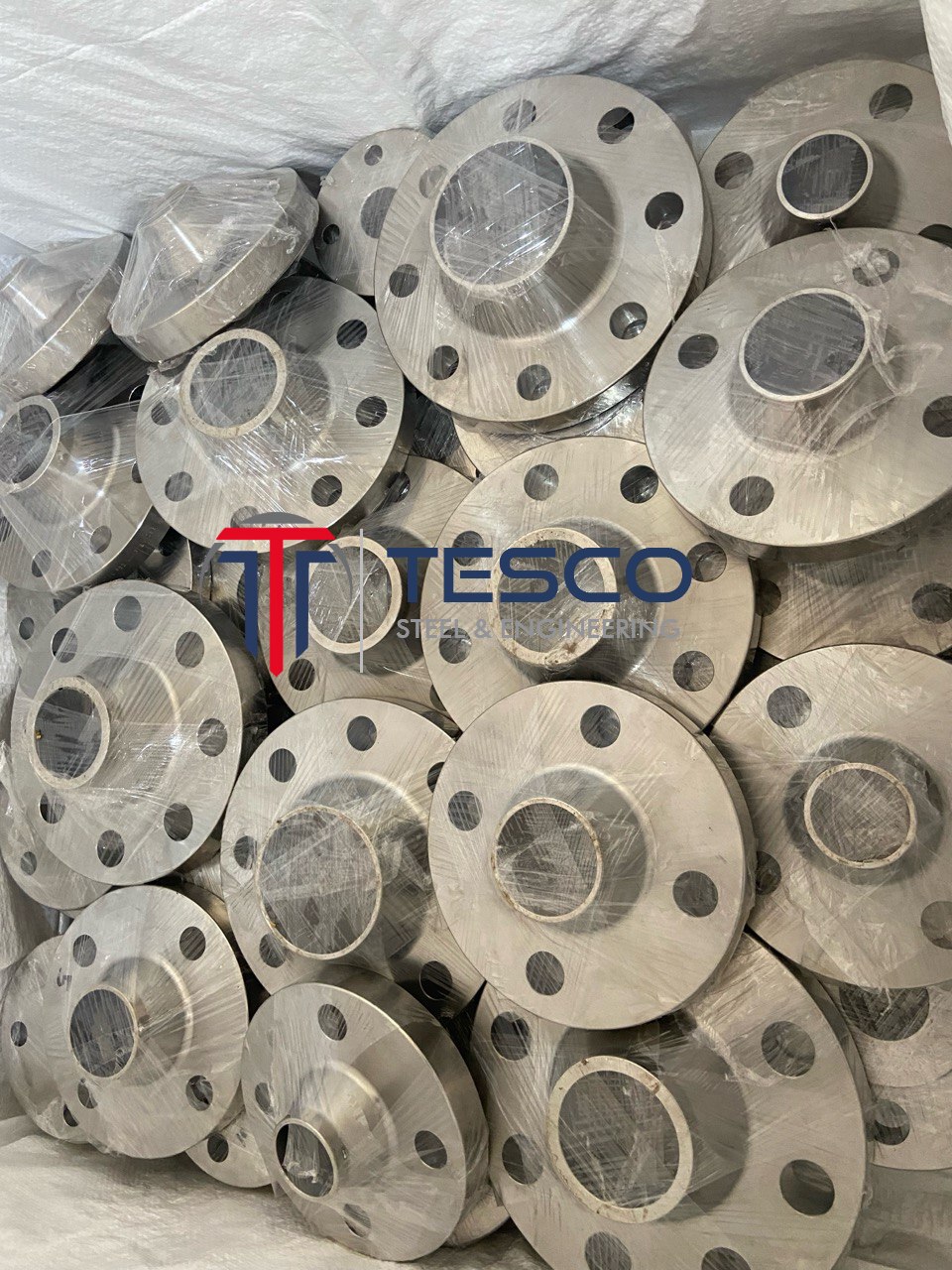
SS 310S Weld Neck Flanges (ASTM A182 F310S)
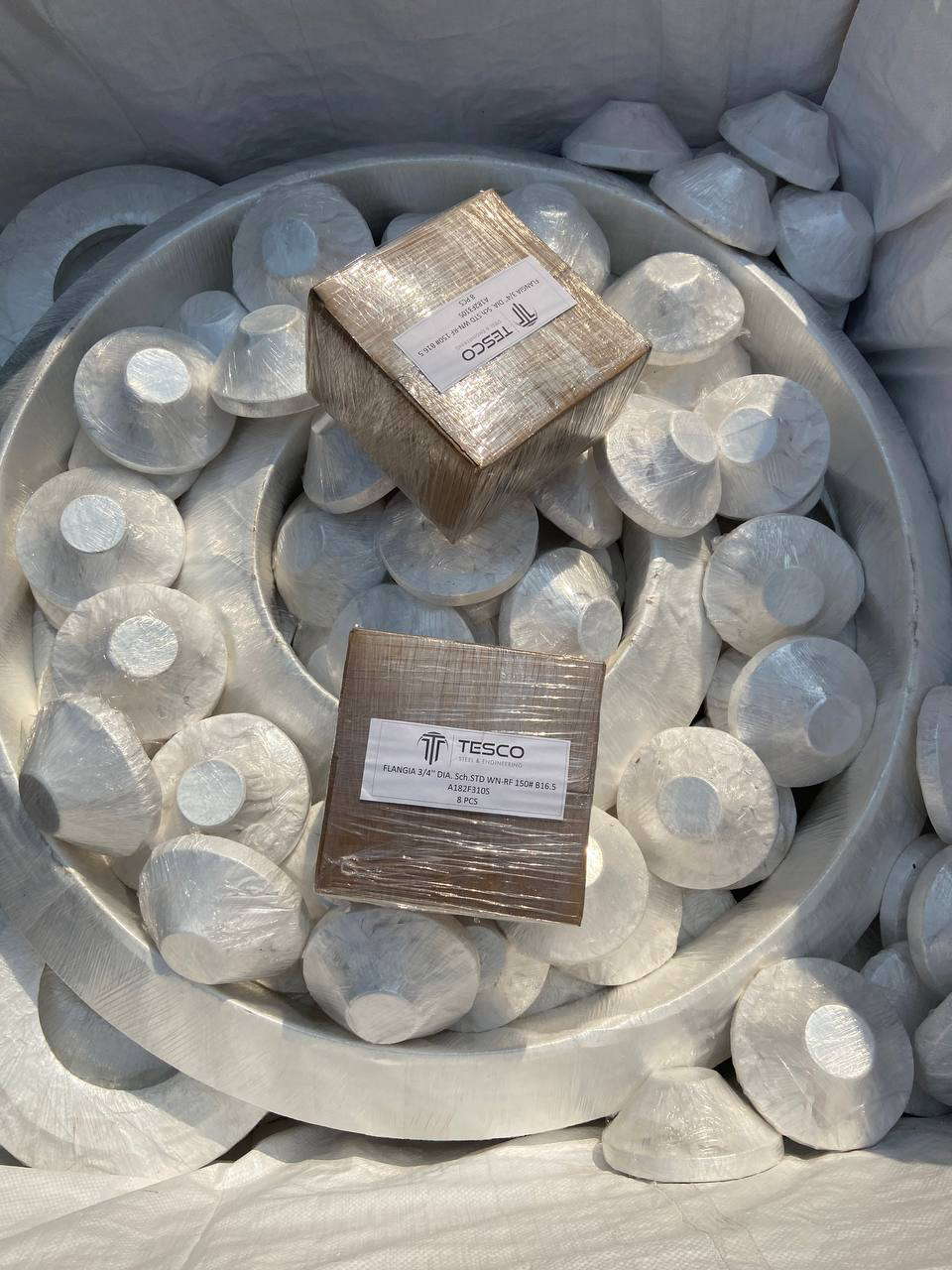
SS 310S WN-RF Flanges — Export Packing
Every Tesco 310S flange is produced to ASTM A182 F310S, solution-annealed and CNC-machined to ASME B16.5 / B16.47 tolerances, supplied with EN 10204 3.1 mill test reports. Explore the wider stainless steel flange range, the dedicated F310/310S weld neck flanges, blind flanges, and the flange dimension charts.
| 310S SS Flange Specifications at a Glance | |
|---|---|
| Material Standard | ASTM A182 Grade F310S |
| UNS Number | S31008 |
| Size Range | 1/2″ NB to 56″ NB (DN 15 to DN 1400) |
| ANSI Pressure Classes | 150#, 300#, 600#, 900#, 1500#, 2500# |
| DIN Pressure Ratings | PN 6, 10, 16, 25, 40, 64, 100, 160, 250, 320, 400 |
| Bore Schedule | STD, XS, XXS, SCH 10, 20, 40, 80, 120, 160 |
| Flange Types | Weld Neck (WNRF), Slip-On (SORF), Blind (BFF), Socket Weld (SWRF), Lap Joint (LJRF), Threaded (TRFF), Long Weld Neck (LWN), Orifice |
| Flange Faces | Raised Face (RF), Flat Face (FF), Ring Type Joint (RTJ) |
| Max Service Temperature | 1100 °C continuous / 1150 °C intermittent |
All 310S flanges conform to published dimensional standards. Bore diameters, bolt-circle diameters, number of bolt holes and flange thickness are machined to ASME B16.5 (up to 24″ NB) and ASME B16.47 Series A & B (26″ NB and above) tolerances.
| Reference | Dimension Chart |
|---|---|
| 310S Stainless Steel Flange Dimensions (ASME B16.5 / B16.47) | View Flange Dimensions → |
| Flange Weight Chart | View Flange Weights → |
| RTJ Gasket Size Chart | View RTJ Size Chart → |
Grade 310S (UNS S31008) is an austenitic stainless with the highest chromium and nickel content in the standard 3xx series. The "S" designation signifies a controlled 0.08% carbon maximum, which reduces the risk of sensitisation — intergranular carbide precipitation — during and after welding, critical for flanges welded into high-temperature loops.
| Chemical Composition — ASTM A182 F310S | |
|---|---|
| Chromium (Cr) | 24.00 – 26.00% |
| Nickel (Ni) | 19.00 – 22.00% |
| Carbon (C) | 0.08% max |
| Manganese (Mn) | 2.00% max |
| Silicon (Si) | 1.50% max |
| Phosphorus (P) | 0.045% max |
| Sulfur (S) | 0.030% max |
| Iron (Fe) | Balance |
| Mechanical Properties — ASTM A182 F310S | |
|---|---|
| Tensile Strength (min) | 515 MPa (75 ksi) |
| Yield Strength 0.2% offset (min) | 205 MPa (30 ksi) |
| Elongation in 2″ (min) | 30% |
| Hardness (max) | 217 HBW / 95 HRB |
| Density | 7.90 g/cm³ |
| International Equivalent Grades | |
|---|---|
| UNS (USA) | S31008 |
| EN / DIN (Europe) | 1.4845 / X8CrNi25-21 |
| JIS (Japan) | SUS 310S |
| BS (UK) | 310S24 |
| GOST (Russia) | 10Kh23N18 |
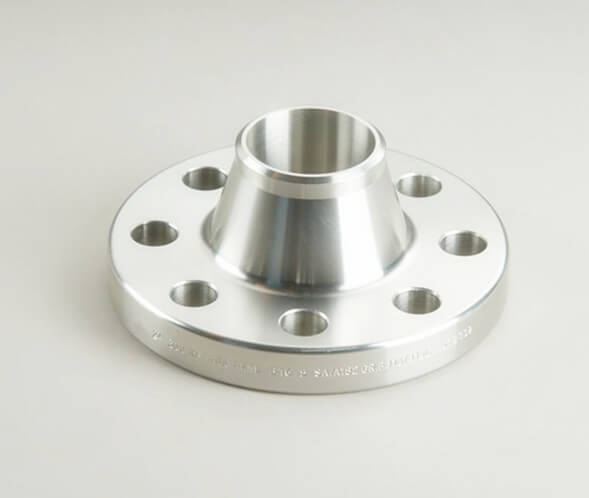
310S Weld Neck Flange (WNRF)

310S Slip-On Flange (SORF)
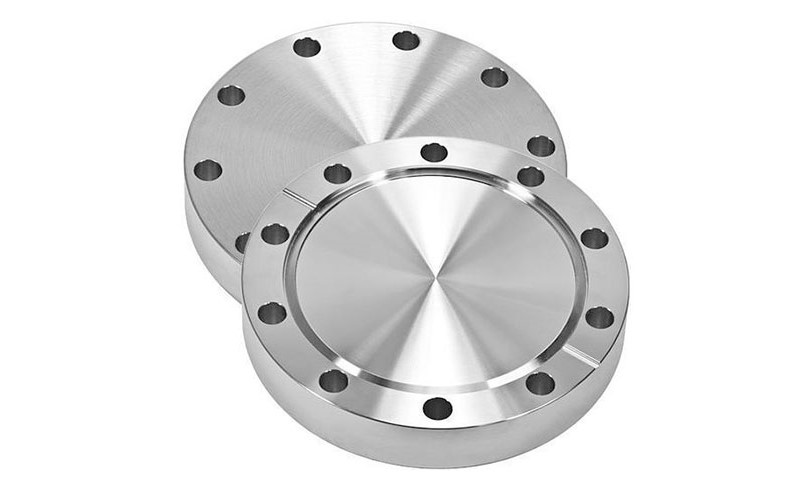
310S Blind Flange (BFF)
| Flange Type | Description & 310S-Specific Use |
|---|---|
| Weld Neck (WNRF) | Long tapered hub transfers stress from flange to pipe wall — preferred for high-temperature, high-pressure 310S piping that cycles between ambient and >800 °C. |
| Slip-On (SORF) | Two fillet welds secure the pipe; used in secondary high-temperature ducting, heat exchanger inlets and low-pressure furnace exhaust connections. |
| Blind (BFF) | Seals the end of high-temperature pipelines, vessels and furnace penetrations; provides full inspection/maintenance access without pipe removal. |
| Socket Weld (SWRF) | Small-bore (up to 2″ NB) high-temperature instrument connections, bypass and pilot piping within furnaces and kilns; sealed by a single fillet weld. |
| Lap Joint (LJRF) | Used with a 310S stub end; the rotating back ring aligns bolt holes for systems needing frequent disassembly, inspection or cleaning. |
| Threaded (TRFF) | For low-to-moderate pressure connections where welding isn't feasible (instrument taps, sample points); not recommended above 300 °C due to thread relaxation. |
| Long Weld Neck (LWN) | Extended weld neck used as a nozzle on vessels, reactors and autoclaves — specified for high-temperature reactor inlet/outlet nozzles. |
| Orifice | Paired flanges with tapped pressure ports for differential-pressure flow measurement in high-temperature gas and process lines. |
Grade choice is the most critical material decision in high-temperature piping design. The table compares 310S against the common alternatives engineers consider for elevated-temperature flange service.
| Property | 310S (S31008) | 316L (S31603) | 321 (S32100) | 347 (S34700) |
|---|---|---|---|---|
| Max Continuous Temp | 1100 °C | 870 °C | 900 °C | 900 °C |
| Chromium % | 24–26 | 16–18 | 17–19 | 17–19 |
| Nickel % | 19–22 | 10–14 | 9–12 | 9–13 |
| Oxidation Resistance | Excellent | Good | Good | Good |
| Sulphidation Resistance | Moderate | Low | Low | Low |
| Weldability (low carbon) | Good (0.08% C max) | Excellent (0.03% C max) | Good (Ti-stabilised) | Good (Nb-stabilised) |
| Typical Flange Standard | ASTM A182 F310S | ASTM A182 F316L | ASTM A182 F321 | ASTM A182 F347 |
| Best For | Furnaces, kilns, high-temp piping | Marine, food, pharma | Creep resistance, cryogenic | Nuclear, high-temp corrosion |
Tesco Steel manufactures 310S flanges to all major international standards. Every order is supported by mill test certificates (MTC) to EN 10204 3.1 or 3.2 confirming composition, mechanical properties and heat treatment.
| Standard | Scope |
|---|---|
| ASTM A182 / ASME SA182 | Material standard for forged stainless flanges — Grade F310S |
| ASME B16.5 | Pipe flanges & flanged fittings — 1/2″ to 24″ NB, Class 150 to 2500 |
| ASME B16.47 | Large-diameter flanges — 26″ to 60″ NB (Series A: MSS SP-44, Series B: API 605) |
| ASME B16.36 | Orifice flanges — Class 300 to 2500 |
| EN 1092-1 | European flanges — PN 6 to PN 400, Type 01 to 13 |
| DIN 2631 – 2638 | German DIN flanges — PN 6 to PN 160 |
| JIS B2220 | Japanese flanges — 5K to 63K |
| BS 4504 / BS 10 | British Standard flanges |
| GOST 12820 / 12821 | Russian standard flanges |
| NACE MR0175 / ISO 15156 | Sour-service (H₂S) compatibility requirements |
310S is weldable with standard austenitic stainless techniques, but several grade-specific precautions are essential to maintain elevated-temperature performance:
| Industry | Specific Application |
|---|---|
| Furnace & Heat Treatment | Combustion air piping, burner connections, radiant tube flanges, atmosphere retort nozzles |
| Petrochemical & Refining | Fired heater piping, regeneration gas lines, catalyst feed nozzles, cracking unit piping |
| Power Generation | Gas turbine exhaust ducts, waste heat recovery units (WHRU), superheater piping |
| Cement & Lime | Kiln shell piping, preheater cyclone connections, clinker cooler ducting |
| Chemical Processing | Sulphuric acid converter piping, nitric acid plant absorber connections |
| Food Processing | High-temperature sterilisation and pasteurisation loop piping (where 316 is insufficient) |
| Steel & Metallurgy | Annealing furnace piping, bell furnace atmosphere lines, sintering plant connections |
| Waste Incineration | Flue gas piping, secondary combustion chamber and heat recovery connections |
| Aerospace & Defence | Engine test cell exhaust piping, high-temperature test rig flanges |
24–26% Cr and 19–22% Ni give the best high-temperature oxidation and scaling resistance among standard austenitic grades.
0.08% C max reduces sensitisation during welding — better weld-joint integrity in fabricated high-temperature assemblies.
Forge presses and CNC machining to ASME B16.5 / B16.47 tolerances with 100% dimensional inspection.
WNRF, SORF, blind, socket-weld, lap-joint, threaded, LWN and orifice — in RF, FF and RTJ faces.
EN 10204 3.1 / 3.2 MTC, heat/lot traceability, PMI, RT/UT and third-party inspection on request.
Made to ASTM A182, ASME B16.5/B16.47, EN 1092-1, DIN, JIS and GOST — exported across 96 countries.
Because 310S contains far more nickel (19–22%) and chromium (24–26%) than 304 or 316, it carries a material premium; price also depends on size, pressure class, flange type, schedule and quantity. Tesco Steel & Engineering keeps ready stock of common sizes and classes for fast delivery, and produces non-stock and custom forgings to order with full traceability. Click submit an enquiry or message us on WhatsApp at +91 92233 66922 with flange type, size (NB), pressure class/PN, quantity, delivery port and any TPI/documentation requirements — our technical team responds within 24 hours.
Q1. What is a 310S stainless steel flange?
A 310S stainless steel flange is a pipe flange made from Grade 310S (UNS S31008) austenitic stainless steel, used to connect, terminate or control flow in high-temperature piping. The grade contains 24–26% chromium and 19–22% nickel, giving superior oxidation resistance up to 1100 °C. Flanges are made to ASTM A182 F310S and dimensioned to ASME B16.5 or B16.47.
Q2. What is the maximum temperature for 310S flanges?
310S flanges withstand continuous service to 1100 °C and intermittent peaks to 1150 °C in oxidising atmospheres — the highest operating temperature among standard austenitic stainless grades, making 310S the first choice for furnace, kiln and high-temperature process piping.
Q3. What is the difference between 310 and 310S stainless steel?
Grades 310 and 310S share the same chromium (24–26%) and nickel (19–22%) but differ in carbon: 310 allows up to 0.25% C while 310S limits carbon to 0.08% max. The lower carbon in 310S reduces sensitisation (carbide precipitation at grain boundaries), making it more suitable for welded high-temperature applications.
Q4. What standard applies to 310S stainless steel flanges?
The material standard is ASTM A182 / ASME SA182 Grade F310S. Dimensional standards depend on size: ASME B16.5 covers 1/2″ to 24″ NB in all classes, ASME B16.47 covers 26″ NB and above. European projects use EN 1092-1 with material to EN 10222-5 Grade X8CrNi25-21 (1.4845).
Q5. Is 310S suitable for sulphur-rich or carburising environments?
310S performs well in oxidising and mildly sulphidising atmospheres but is not recommended for strongly sulphidising (H₂S above 500 °C) or carburising (carbon-rich reducing gas) environments without protective coatings or alloying. In those conditions, nickel-based alloys such as Alloy 601, 625 or 310MoLN are preferred.
Q6. What filler metal is used to weld 310S flanges?
ER310 (AWS A5.9) wire for GTAW/GMAW and E310-15/16 (AWS A5.4) electrodes for SMAW. Keep interpass temperature below 175 °C to avoid sigma-phase embrittlement. PWHT is generally not applied; if sensitisation must be corrected, solution-anneal at 1040–1180 °C with rapid water quench.
Q7. What is the price of 310S stainless steel flanges?
310S flange price depends on size, pressure class, flange type, wall schedule, quantity and current nickel/chromium surcharges. Because 310S contains far more nickel (19–22%) and chromium (24–26%) than 304 or 316, it carries a material premium. Tesco Steel offers competitive ex-works and CIF pricing — request a current price list and ready stock details.
Q8. What certifications does Tesco Steel provide with 310S flanges?
310S flanges are supplied with EN 10204 Type 3.1 mill test certificates as standard, or Type 3.2 (third-party witnessed) on request, plus heat/lot traceability, PMI reports, hydrostatic test certificates, RT/UT reports and NACE MR0175 compliance declarations.
Q9. Can 310S flanges be used in cryogenic service?
310S is not optimised for cryogenic service. Its austenitic structure stays stable and will not become brittle, but 304L, 316L or 347 are more commonly specified for cryogenic applications due to better documented low-temperature impact properties and lower cost.
Q10. Who manufactures 310S stainless steel flanges in India?
Tesco Steel & Engineering, based in Mumbai, India, is an ISO-certified manufacturer and exporter of 310S stainless steel flanges to ASTM A182, ASME B16.5, B16.47, DIN, JIS and GOST standards, supplying EPC contractors, oil & gas majors and process plant operators across 96 countries.