ASTM A182 F310 / 310S Weld Neck Flanges — Heat-Resistant 25Cr-20Ni Stainless
Tesco Steel & Engineering forges ASTM A182 F310 and F310S weld neck flanges in the 25% chromium, 20% nickel heat-resistant austenitic stainless family — UNS S31000 / S31008, Werkstoff Nr. 1.4841 / 1.4845 — from 1/2″ NB to 56″ NB. Where 304 and 316 scale away, 310S holds its strength and oxidation resistance to around 1100 °C, making these the flanges for furnaces, heat-treatment plants, petrochemical heaters, boiler and flue gas systems — and, at the other extreme, fully tough cryogenic service. Machined to ASME B16.5 Class 150–2500 and European PN ratings, bores matched to your pipe schedule, EN 10204 3.1/3.2 certified. ISO 9001:2015, made in Mumbai, India — exported worldwide.
A182 F310 · F310S · S31000 / S31008
1.4841 / 1.4845 · SUS 310 / 310S
1/2″ – 56″ NB
Class 150 – 2500 · PN 2.5 – 400
Oxidation Resistance to ~1100 °C
EN 10204 3.1 / 3.2
ISO 9001:2015 · Exported Worldwide
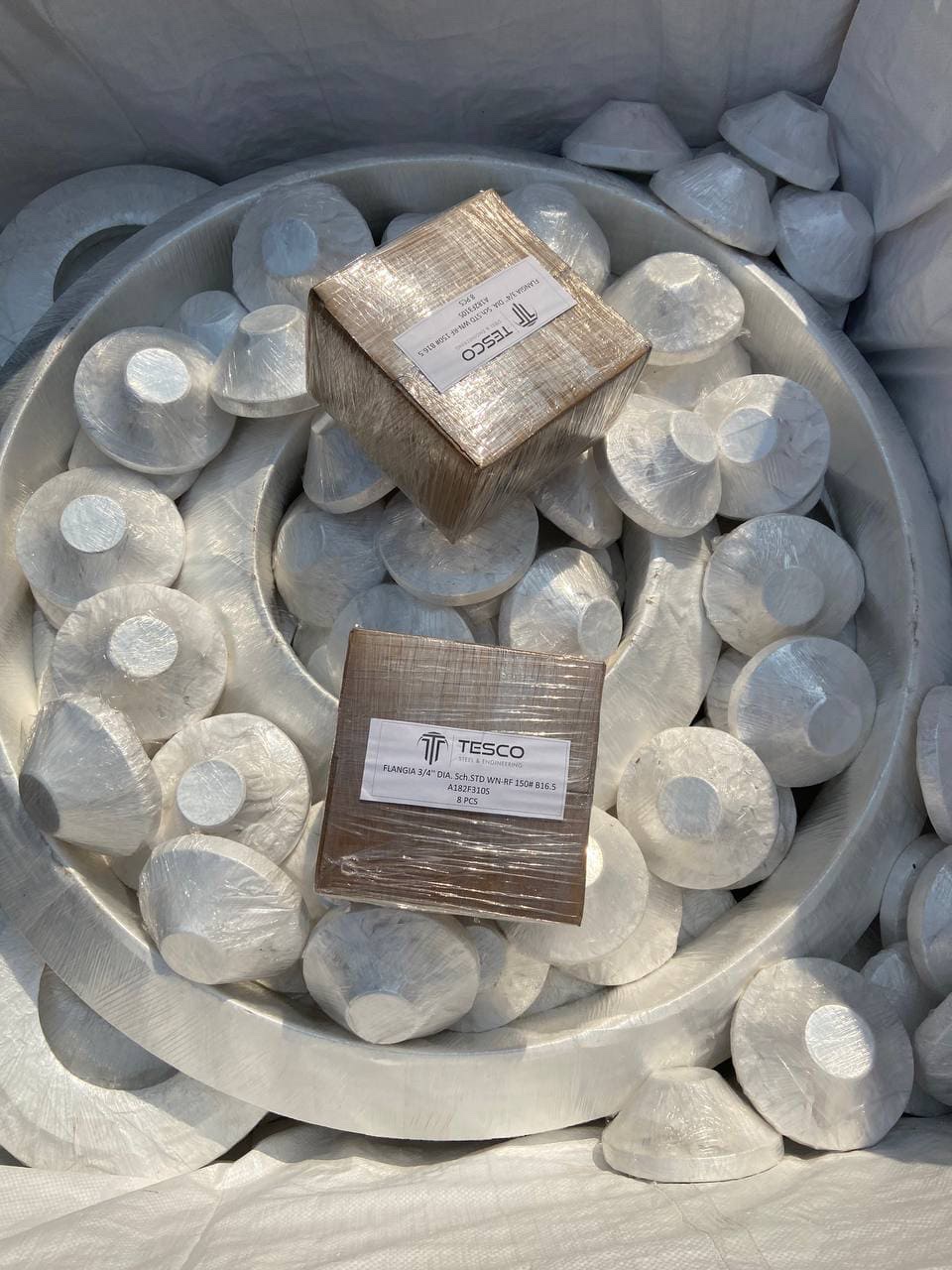
ASTM A182 F310S Weld Neck Flanges — 3/4″ Sch STD, Class 150 B16.5, Wrapped & Boxed for Export
What is an ASTM A182 F310 / 310S Weld Neck Flange?
ASTM A182 F310 / F310S are the forged-flange grades of stainless steel 310 / 310S — a 25% chromium, 20% nickel austenitic alloy built for heat. A 310S weld neck flange pairs that alloy with the strongest flange design: a long tapered hub butt-welded to the pipe, bore matched to the pipe schedule, joint fully radiographable. It keeps working at furnace temperatures — up to roughly 1100 °C oxidation resistance — where standard stainless grades scale and fail.
The weld neck geometry matters even more at high temperature than at ambient. Thermal cycling loads a flanged joint with expansion and contraction on every heat-up and cool-down; the tapered hub spreads those stresses into the pipe wall instead of concentrating them at the weld, and the matched bore leaves no step to disturb flow or trap scale. The butt weld can be radiographed at installation — insurance you want on a line that will spend its life at red heat, where in-service inspection is difficult.
Within the pair, 310S (0.08% C max) is the welding-friendly workhorse — less carbide precipitation in the heat-affected zone — while 310 (0.25% C max) trades a little weldability for slightly better creep strength at the top of the range. The controlled-carbon 310H is supplied on request for creep-range design. All three share the same dimensions and the same 25Cr-20Ni chemistry base.
Also searched as: SS 310 weld neck flange, 310S WNRF flange, UNS S31000 / S31008 flange, 1.4841 / 1.4845 flange, SUS 310S flange, X8CrNi25-21 flange — all refer to the product on this page.
Chemical Composition of ASTM A182 310 / 310S
| Grade | C | Mn | Si | P | S | Cr | Ni |
|---|
| SS 310 | 0.25 max | 2.00 max | 1.50 max | 0.045 max | 0.030 max | 24.00-26.00 | 19.00-21.00 |
| SS 310S | 0.080 max | 2.00 max | 1.50 max | 0.045 max | 0.030 max | 24.00-26.00 | 19.00-22.00 |
Values in weight %. The heavy chromium loading builds the protective oxide scale; nickel stabilises the austenite so the alloy stays ductile and tough through thermal cycling. The only real difference between the grades is carbon — and that is why 310S welds better.
Mechanical Properties of ASTM A182 310 / 310S
| Grade | Tensile Strength, MPa | Yield Strength, Min, Mpa | Elongation % min. | Hardness Rockwell HRB | Hardness Brinell HB |
|---|
| SS 310 | 515 | 205 | 40 | 92 max | 217 max |
| SS 310S | 515 | 205 | 40 | 95 max | 217 max |
Like all austenitics, 310 / 310S is not hardenable by heat treatment; the 40% minimum elongation is what lets a flange absorb bolt-up, vibration and thermal movement without cracking. Design stresses at elevated temperature follow the ASME rating tables for the material group.
Equivalent Grades of ASTM A182 310 / 310S
| Standard | Werkstoff Nr. | UNS | JIS | BS | GOST | EN |
|---|
| SS 310 | 1.4841 | S31000 | SUS 310 | 310S24 | 20Ch25N20S2 | X15CrNi25-20 |
| SS 310S | 1.4845 | S31008 | SUS 310S | 310S16 | 20Ch23N18 | X8CrNi25-21 |
An enquiry in any of these designations is quoted as the same material. For creep-range design, the controlled-carbon 310H (UNS S31009) or dual-certified 310S/310H is supplied on request.
ASTM A182 F310 / 310S Weld Neck Flange Specifications
| ASTM A182 310 Weld Neck Flanges are available in the following specifications: |
|---|
| Size | 1/2"NB to 56"NB |
| Class | 150#, 300#, 400#, 600#, 900#, 1500#, 2500# |
| Sch (Schedule) | XS, XXS, STD & Schedule 20, 40, 80, 160 |
| Pressure Ratings | PN 2.5 - PN 400 |
| Standards | ASME B16.5, ASME B16.47, EN 1092-1 Type 11, DIN, BS 4504 |
| Facings | Raised Face (WNRF), Flat Face (WNFF) |
| Other Services | Pickling & passivation on ASTM A182 310 Weld Neck Flanges
Sand Blasting on ASTM A182 310 Weld Neck Flanges
Shot Peening on ASTM A182 310 Weld Neck Flanges
IGC (ASTM A262) & PMI testing
Project-specific marking, wrapping & boxed export packing |
Why 310 / 310S for High-Temperature Flanged Joints
Oxidation Resistance to ~1100 °C
25% chromium builds a stable, adherent oxide scale that survives continuous furnace service — roughly 250 °C beyond where 304/316 begin to scale heavily. The economical step before nickel alloys.
Tough From Cryogenic to Red Heat
The fully austenitic 25Cr-20Ni structure has no ductile-to-brittle transition — the same grade family serves liquid-gas cryogenics and furnace piping alike.
Built for Thermal Cycling
The weld neck's tapered hub feeds expansion and contraction stresses gradually into the pipe wall, and 310S's low carbon resists sensitisation through repeated heat-up and cool-down.
A Weld You Can Prove
The full-penetration butt weld is radiographed at installation — exactly what you want on a joint that will spend its service life at temperatures where inspection access is hard.
One Source for Furnace Hardware
We forge the same 310 family into boiler ferrules and refractory anchors, so furnace and boiler projects can source flanges and high-temperature hardware from one certified manufacturer.
Where 310 / 310S Weld Neck Flanges Are Used
Thermal processing is home ground — furnace and heat-treatment plant piping, radiant and convection sections of petrochemical heaters, steam-methane reformer and FCC circuits, incinerators, kilns, annealing lines and thermal oxidisers. Boiler and flue gas systems use 310S around ferrules, sootblower lines and hot-gas ducting flanges; power and cement plants flange burner and hot-air lines with it. At the cold extreme, its austenitic toughness earns it a place in cryogenic installations. If the joint lives above 800 °C or below −100 °C, the 310 family is usually the answer before stepping up to Inconel.
ASTM A182 310 / 310S Weld Neck Flange Dimensions
F310 / 310S weld neck flanges follow the standard ASME B16.5 dimensional tables — OD, thickness, hub, bore, bolt circle and bolting are identical to any other material in the same class. Full charts for every class:
European PN dimensions are published on the EN 1092-1 Type 11, DIN 2631–2635 and BS 4504 pages.
Price List & How to Order
Pricing depends on size, class, grade (310 / 310S / 310H) and quantity, and moves with nickel and chromium markets — so we quote live rather than publish a static list. Common sizes ship from ready stock at competitive export prices, packed and labelled as pictured above. To get a firm quotation, usually within 24 hours:
1
List your requirement — size (NB), class or PN, standard (e.g. ASME B16.5 / EN 1092-1 Type 11), grade (310, 310S or 310H), pipe schedule or bore, and quantity.
2
Add any extras — IGC testing, 3.2 certification, PMI, flat facing or special finish.
ASTM A182 F310 / 310S Weld Neck Flanges — Frequently Asked Questions
What is an ASTM A182 F310 / 310S weld neck flange?
It is a weld neck flange forged from stainless steel 310 or 310S — the 25% chromium, 20% nickel austenitic grades made for high-temperature service — under the ASTM A182 forging specification (grades F310 and F310S). The long tapered hub is butt-welded to the pipe with the bore matched to the pipe schedule, giving a radiographable, fatigue-resistant joint in an alloy that keeps its strength and oxidation resistance where ordinary stainless grades scale away.
What is the difference between SS 310 and SS 310S?
Carbon content. SS 310 allows up to 0.25% carbon, while 310S is the low-carbon version capped at 0.08%. Lower carbon means less carbide precipitation during welding and thermal cycling, so 310S is the standard choice for welded constructions such as flanged piping. 310 offers slightly better creep strength at the very top of the temperature range. Both share the same 25Cr-20Ni base and the same mechanical property minimums.
What temperature can 310 / 310S flanges handle?
The 25% chromium and 20% nickel content forms a stable, adherent oxide scale that resists oxidation up to roughly 1100 °C in continuous service, with intermittent service limits somewhat lower because thermal cycling spalls the scale. For pressure-retaining duty, design stresses fall with temperature per the ASME rating tables, so the working limit of a flanged joint depends on class and gasket selection — we confirm ratings for your conditions at quotation.
What are the equivalent designations for 310 and 310S?
SS 310 is UNS S31000, Werkstoff Nr. 1.4841, JIS SUS 310, BS 310S24, GOST 20Ch25N20S2 and EN X15CrNi25-20. SS 310S is UNS S31008, Werkstoff Nr. 1.4845, JIS SUS 310S, BS 310S16, GOST 20Ch23N18 and EN X8CrNi25-21. An enquiry in any of these designations is quoted as the same material — the full cross-reference table is published on this page.
What is the chemical composition of 310 / 310S?
Both grades contain 24.00 to 26.00% chromium and 19.00 to 21.00% nickel (up to 22.00% for 310S), with 2.00% max manganese, 1.50% max silicon, 0.045% max phosphorus and 0.030% max sulphur. The difference is carbon: 0.25% max for 310 versus 0.08% max for 310S. That high chromium-nickel loading is what buys the oxidation resistance and hot strength.
What are the mechanical properties of A182 F310 / 310S flanges?
Minimum tensile strength 515 MPa, minimum yield strength 205 MPa and minimum elongation 40% for both grades, with hardness capped at 217 HB (92 HRB for 310, 95 HRB for 310S). Like all austenitic stainless steels they are not hardenable by heat treatment and stay tough from cryogenic temperatures right up to their oxidation limit.
When should I choose 310S over 304 or 316 flanges?
Above roughly 800 to 870 °C, where 304 and 316 begin to scale heavily and lose strength. 310S carries nearly twice the chromium and nickel of 304, pushing usable oxidation resistance to around 1100 °C. If your line runs through furnace zones, heater convection banks, flue gas paths or any thermal processing environment, 310S is the economical step before nickel alloys like Inconel 600. For ordinary corrosive service at moderate temperature, 304L or 316L remains the better-value choice.
Do you also supply 310H flanges?
Yes, on request. 310H (UNS S31009) is the controlled-carbon version — 0.04 to 0.10% carbon — specified where ASME creep-range design above about 525 °C demands guaranteed carbon for creep strength. If your specification calls for 310H, or dual-certified 310S/310H material, state it in the enquiry and the forgings are supplied and certified accordingly.
What sizes and standards do you manufacture F310 / 310S weld neck flanges in?
From 1/2 inch NB to 56 inch NB in ASME B16.5 Class 150 to 2500, ASME B16.47 Series A and B above 24 inch, and European PN 2.5 to PN 400 ratings to EN 1092-1 Type 11, DIN and BS 4504. Raised face (WNRF) is standard, flat face (WNFF) on request, and every bore is machined to the mating pipe schedule from Sch 10 through XXS.
How are 310 / 310S flanges welded to pipe?
By TIG or MMA using matching ER310 / E310 filler. The keys are low heat input, low interpass temperature and no preheat — austenitic 310 needs none — with no post-weld heat treatment required for the weld itself. The 310S low-carbon grade minimises carbide precipitation in the heat-affected zone during both welding and later thermal cycling. The weld neck bevel comes machined at 37.5 degrees, ready for a radiographable butt weld.
Where are 310 / 310S weld neck flanges used?
Furnace and heat-treatment plant piping, radiant and convection sections of petrochemical heaters, FCC and steam-methane reformer circuits, boiler ferrule and flue gas systems, incinerators, kilns, annealing lines and thermal oxidisers — plus cryogenic installations at the other extreme, where the austenitic structure stays tough. We also forge boiler ferrules and refractory anchors in the same 310 family, so high-temperature projects can source flanges and furnace hardware together.
Can 310 / 310S flanges be used at cryogenic temperatures?
Yes. The fully austenitic 25Cr-20Ni structure has no ductile-to-brittle transition, so 310 and 310S keep their impact toughness down to liquid-gas temperatures. The same grade family therefore appears at both extremes of the temperature scale — furnace piping at one end and cryogenic service at the other — which few materials can claim.
What testing and certification do you supply with F310 / 310S flanges?
Every lot ships with EN 10204 3.1 mill test certificates covering chemical analysis and mechanical properties, with 3.2 certification witnessed by Lloyd's, DNV, BV or TÜV on request. We also offer PMI (positive material identification), intergranular corrosion (IGC) testing to ASTM A262, dye penetrant examination and dimensional reports, with full heat-number traceability from billet to finished flange.
How are your F310 / 310S flanges finished and packed?
Flanges are pickled and passivated, faces protected, and small-bore sizes individually wrapped and boxed with size, grade and heat number on the label — exactly as shown in the photograph on this page of 3/4 inch Class 150 F310S weld neck flanges packed for export. Larger flanges ship strapped or crated in lined seaworthy packing. Sand blasting, shot peening and special marking are available on request.
Do you keep 310 / 310S weld neck flanges in stock? What is the lead time?
Common sizes in Class 150 and 300 — typically 1/2 to 12 inch — are regularly held as ready stock or finished quickly from forged blanks, as the boxed stock photo on this page shows. Larger diameters, higher classes and 310H dual-certified material are forged to order, usually in 2 to 4 weeks depending on size and quantity. Send your list for a firm delivery commitment.
What information should I include in an F310 / 310S flange enquiry?
Six things: size (NB), pressure class or PN rating, dimensional standard (for example ASME B16.5 or EN 1092-1 Type 11), grade (310, 310S or 310H if specified), pipe schedule or bore, and quantity. Add any extras — IGC testing, 3.2 certification, special facing or finish. With these details we return a firm quotation, usually within 24 hours.
Do you export ASTM A182 F310 / 310S flanges outside India?
Yes. Tesco Steel & Engineering is an ISO 9001:2015 certified manufacturer based in Mumbai, and our 310 / 310S flanges ship to furnace builders, refineries, petrochemical plants and thermal processing projects across the Middle East, Europe, Africa, Southeast Asia and the Americas. Export packing is seaworthy, and every flange carries stamped traceability from heat number to finished part.

