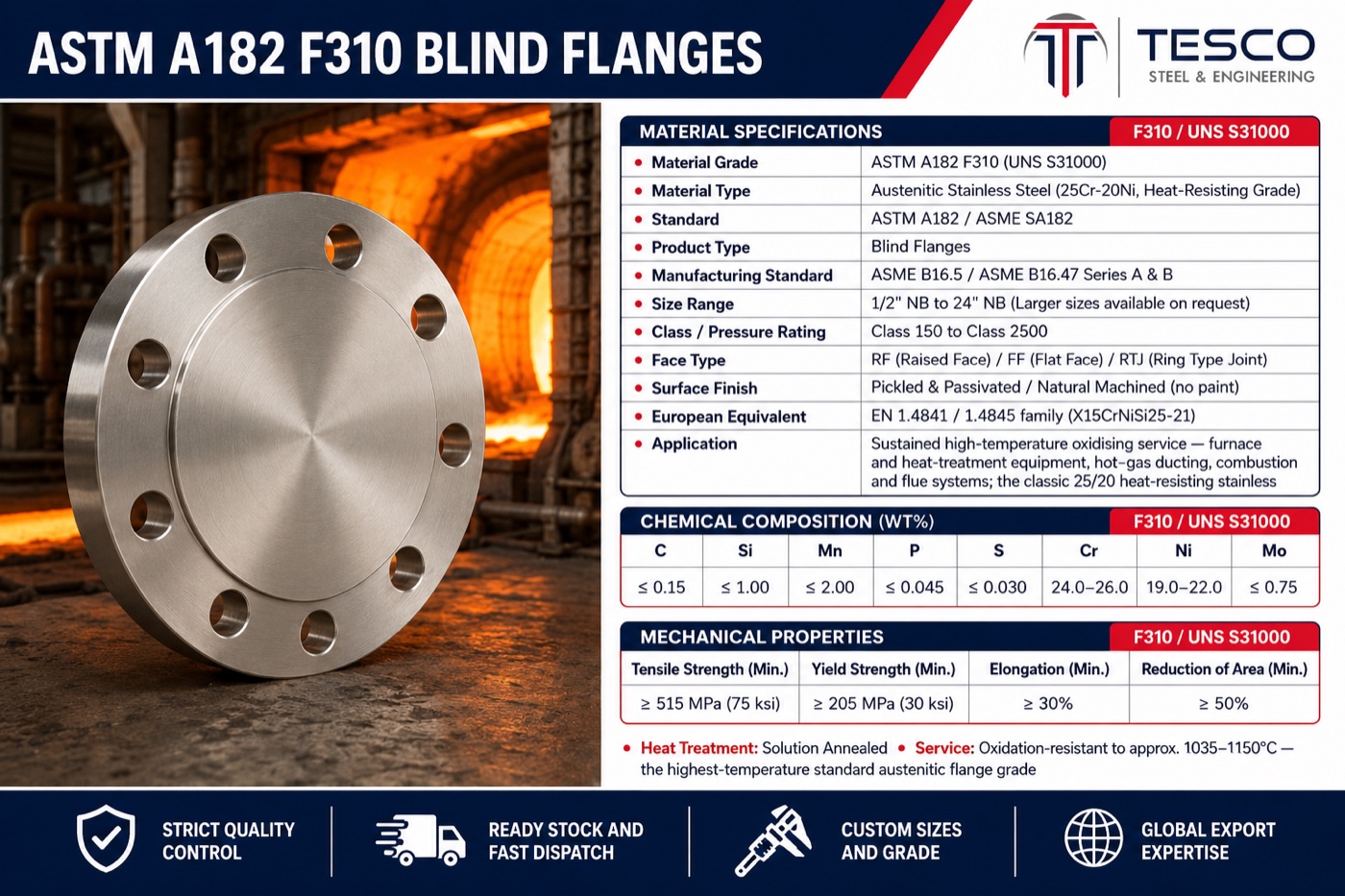
Tesco Steel & Engineering forges ASTM A182 F310 blind flanges — UNS S31000, the classic 25% chromium / 20% nickel heat-resisting stainless — to ASME B16.5 Class 150–2500 from ½″ to 24″ NB and to ASME B16.47 up to 60″. Every other page in this family fights corrosion or creep; F310 fights fire: chromium at 24–26% builds an oxide scale that keeps protecting toward 1150°C, and nickel at 19–22% keeps that scale adherent through thermal cycling — furnace, heat-treatment, hot-gas and combustion duty where 304 surrendered near 870°C. 310S and 310H variants to order; code creep duty at 525–815°C belongs to F316H/F304H, wet chlorides to 316L and duplex. Facings: BLRF, BLFF or BLRTJ. Every lot with EN 10204 3.1/3.2 MTC. ISO 9001:2015, made in Mumbai, India — exported to 50+ countries.
ASTM A182 F310 · UNS S31000 · EN 1.4841/1.484525Cr-20Ni Heat-Resisting GradeOxidising Service Toward 1150°CTop of the Stainless Heat Ladder310S & 310H Variants to OrderASME B16.5 ½″–24″ · Class 150–2500RF · FF · RTJ FacingsEN 10204 3.1 / 3.2 · ISO 9001:2015
ASTM A182 F310 Blind Flanges — Specifications at a Glance
What is an ASTM A182 F310 Blind Flange?
The closure for furnace country. A solid forged disc of heat-resisting 25Cr-20Ni stainless (UNS S31000) with no bore, closing ducts, headers and nozzles in sustained high-temperature oxidising service: furnace and heat-treatment plant, hot-gas ducting, combustion and flue systems. Chromium at 24–26% builds an oxide scale that protects toward 1150°C continuous; nickel at 19–22% keeps the structure austenitic and the scale attached through thermal cycling. Tensile ≥515 MPa, yield ≥205; 310S / 310H variants to order. Dimensions per ASME B16.5 / B16.47 in RF, FF and RTJ facings; EN 10204 3.1 certified.
Also searched as: SS 310 blind flange, 310S blind flange, F310S blind, S31000 / S31008 blind, 25/20 stainless blind, 1.4841 / 1.4845 blind flange, heat-resistant stainless blind — all covered on this page. See also the stainless steel hub, the hot-duty siblings F304H / F316H blind flanges, our stainless refractory anchors for the same hot plants, and the facing pages BLRF / BLFF / BLRTJ.
The Grade That Fights Fire
The rest of the blind family battles chlorides, hydrogen and creep. F310's enemy is simpler and hotter — air itself, at furnace temperature:
Chromium Builds the Shield
At 24–26% — half again what 316 carries — the grade grows a thick, continuous chromia scale that keeps re-forming and protecting at temperatures where 18%-chromium grades have long since scaled away to nothing.
Nickel Keeps It Attached
The 19–22% nickel holds the structure fully austenitic at that chromium level and — the underrated half of the recipe — keeps the protective scale adherent through heating and cooling cycles, resisting the spalling that strips lesser grades bare.
Carbon Left Generous
The ≤0.15% carbon cap — the family's most generous — is deliberate: carbon means hot strength in furnace hardware. The familiar variants exist here too: 310S trims it for weldability, 310H enforces the floor for code creep ratings.
Cycling reads lower. For a scale-protected alloy, intermittent service rates below continuous (~1035°C for 310): every cool-down stresses the oxide, and spalled scale must be regrown at the metal's expense. Steady heat lets the same scale sit and protect — the reverse of the intuition most datasheet readers bring.
310 · 310S · 310H — The Carbon Variants
Variant
UNS
Carbon
Specify For
F310 (this page)
S31000
≤0.15%
General furnace hardware — maximum hot-strength allowance
F310S
S31008
≤0.08%
Welded fabrications where sensitization-range excursions matter
F310H
S31009
0.04–0.10% (min enforced)
Code creep-rated design — the H-grade logic of F316H, at 25/20
The 25/20 chemistry — and the oxidation resistance it buys — is identical across all three. We forge all three variants; state the suffix on the enquiry.
F310 Chemical Composition (UNS S31000)
Element
C
Si
Mn
P
S
Cr
Ni
Mo
Weight %
≤0.15
≤1.00
≤2.00
≤0.045
≤0.030
24.0–26.0
19.0–22.0
≤0.75
Two bold columns carry the whole design — chromium and nickel bought in furnace quantities. Note what is absent: molybdenum is a ≤0.75% residual, not an alloying addition — its oxides are volatile at 310's working temperatures, so the chloride element would actively hurt here. This is not a wet-corrosion grade.
Mechanical Properties & The Service Span
Property
ASTM A182 F310 Requirement
Tensile Strength
≥ 515 MPa (75 ksi)
Yield Strength (0.2%)
≥ 205 MPa (30 ksi)
Elongation
≥ 30%
Reduction of Area
≥ 50%
Hardness
No A182 limit — typically soft as annealed
Condition
Solution annealed — mandatory
Service Span
Oxidising service to ~1035°C intermittent / ~1150°C continuous; code creep-rated pressure design per H-grade allowables (F316H/F304H at 525–815°C)
ASTM A182 F310 Blind Flanges are available in the following specifications:
Material Grade
ASTM A182 F310 (UNS S31000); F310S (S31008) and F310H (S31009) variants to order; EN 1.4841/1.4845 family equivalents
Heat Treatment
Solution annealed — mandatory; condition stated on certificate
Size
1/2"NB to 24"NB per ASME B16.5; 26"–60" per ASME B16.47; EN 1092-1 to order
Class
150#, 300#, 400#, 600#, 900#, 1500#, 2500#
Facings
Raised Face (BLRF), Flat Face (BLFF), Ring Type Joint (BLRTJ) with groove per B16.20
Service Span
High-temperature oxidising duty to ~1035°C intermittent / ~1150°C continuous; reducing or sulphur-bearing atmospheres rate lower — advise the environment at enquiry
Surface Finish
Pickled & passivated or natural machined — no paint; segregated stainless handling throughout
Modifications
NPT-tapped centre (test / vent / instrument), lifting provisions — machined & certified at the works
Testing
Tension & chemistry per heat — the 25/20 chromium-nickel verified; PMI routine; IGC (A262) where specified
Certification
EN 10204 3.1 (standard) / 3.2 witnessed
Why F310 Blind Flanges Are Specified
The Closure Sits in the Same Gas Stream
A blind on a hot-air header or thermal-oxidiser nozzle sees the same temperature as the duct it blanks — a lower-grade closure becomes the joint's sacrificial component: scale, thickness loss, seized studs, a leak path.
Top of the Standard Ladder
When 304 surrenders near 870°C and 309 near 1000°C, 310 is the last standard austenitic rung before the duty crosses into nickel-alloy territory — at stainless, not Inconel, cost.
Cycle-Tolerant Scale
The 20% nickel earns its price in plants that heat and cool: adherent scale instead of spalling, protection that survives the shutdown as well as the run.
One Family, One Works
The same plants that flange in 310 anchor their refractory linings in 310-family alloys — we forge the refractory anchors and studs alongside the flanges, one certificate trail for the whole hot side.
Know the Ladder
Code creep-rated pressure duty at 525–815°C: F316H / F304H. Wet chlorides: 316L or duplex. Hotter still, or aggressive reducing atmospheres: Inconel. Facings: BLRF / BLFF / BLRTJ.
Specification Notes — Getting 310 Right
Three details buyers miss.Oxidation resistance is not creep strength: scaling limits near 1150°C do not make the grade code-rated for pressure at such temperatures — allowable-stress design governs first, and H-grade rules apply; much 310 closure duty is low-pressure hot gas, exactly where it belongs. Mind the sigma window: at 25% chromium, long soaking at roughly 650–870°C slowly forms brittle sigma phase — happiest service is below or above that band; sustained duty inside it deserves a design-stage metallurgical review. Not a wet-chloride grade: no molybdenum means poor pitting resistance in salty water despite all that chromium — marine and brine duty belongs to duplex, and hot sulphur-bearing or reducing atmospheres also rate lower and favour different alloys; state the environment on the enquiry.
How Our F310 Blind Flanges Are Manufactured
1
Forging — cut billet of the spectro-verified S31000 heat — chromium and nickel confirmed in the 25/20 windows — is hot-forged into the solid disc blank with full heat traceability and segregated stainless handling.
2
Solution anneal — dissolving any sigma or carbide phases and restoring the uniform austenite; furnace charts retained against the heat number.
3
Machining & facing — faces, OD and drilling to ASME B16.5 / B16.47; RF serrations, flat face or RTJ groove gauged per B16.20; NPT taps machined where ordered.
4
Testing — tension test and chemistry against the heat; PMI on every piece reads the 25/20 signature; intergranular-corrosion (ASTM A262) and other tests where specified.
5
Pickling & passivation — the clean paint-free surface the grade's own scale will replace in service, with marking of standard, grade (S or H suffix where applicable), size, class and heat number.
6
Certification & packing — EN 10204 3.1 MTC (3.2 witnessed on request); faces protected, palletised or crated sea-worthy — no carbon-steel contact in transit.
Where F310 Blind Flanges Are Used
Around fire and furnace: heat-treatment and annealing plant, furnace and kiln connections, hot-air and hot-gas ducting, combustion and flue systems, thermal oxidisers and incinerators, calcining circuits, refinery hot-side utilities. Production below:
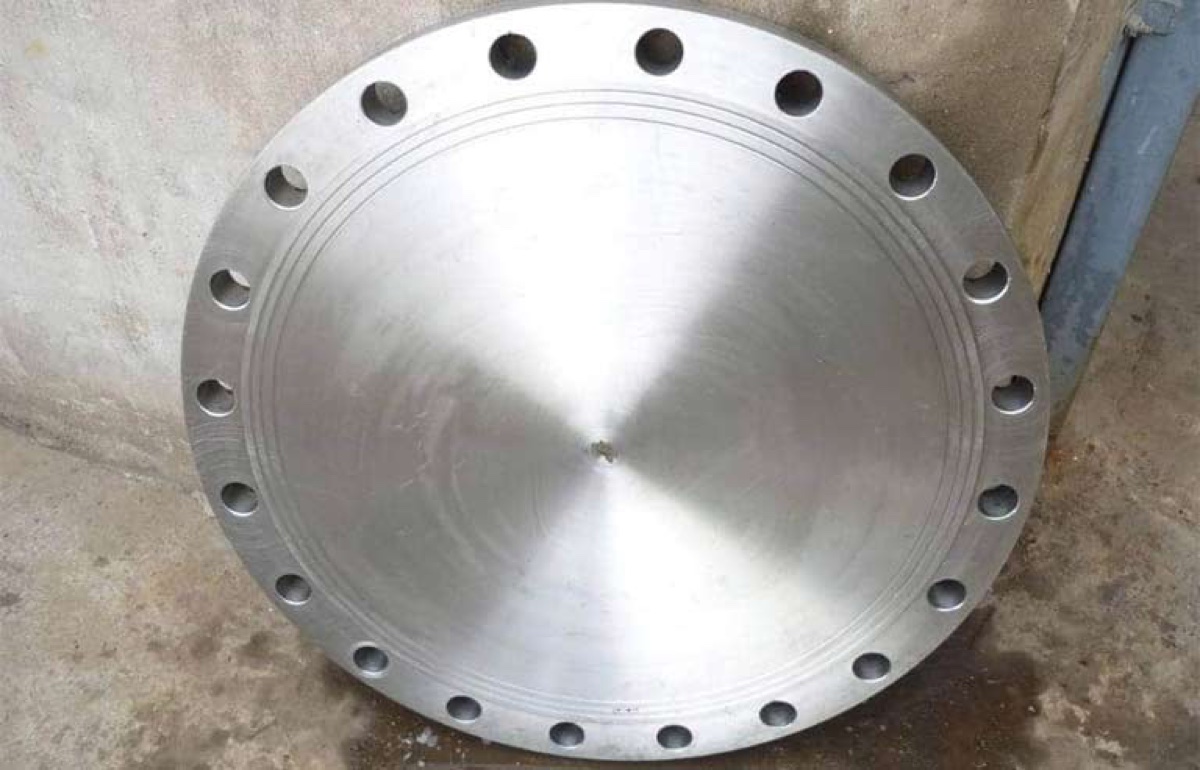
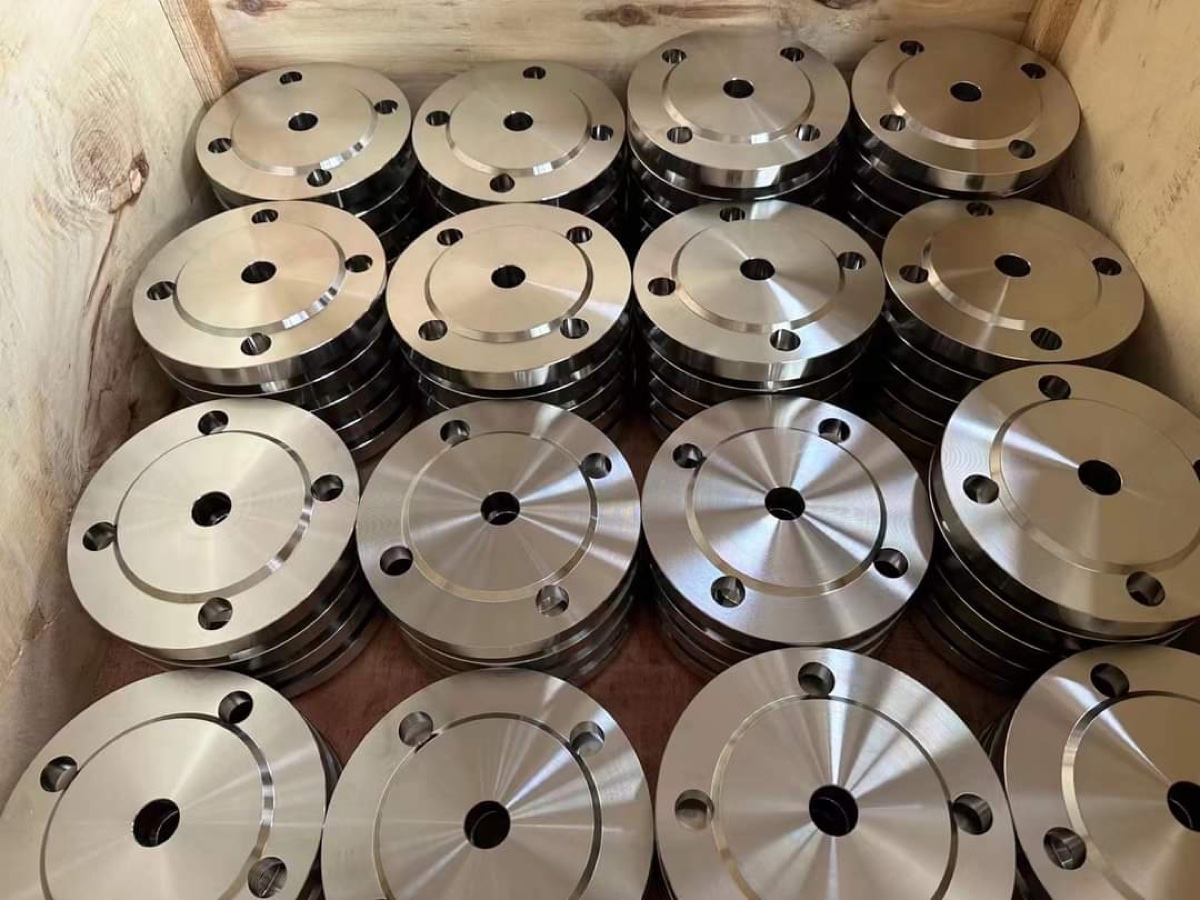
Machined Stainless Blind Flange — At Our WorksStainless Blind Flanges — Ready for Dispatch
F310 Blind Flange Dimensions
Blind dimensions are class-governed — identical across material grades. Full charts:
Five elements — the variant suffix and the service environment are the 310-specific ones:
1
Size & standard — e.g. 6″ NB ASME B16.5, or the B16.47 series for 26″ and above.
2
Pressure class & facing — Class 150–2500; RF, FF or RTJ (with ring number) to match the mating flange.
3
Grade & variant — ASTM A182 F310, F310S or F310H — the suffix follows the design code and welding plan.
4
Service environment & certification — state temperature, cycling and atmosphere (oxidising / reducing / sulphur-bearing); NPT tap size if a test blind; IGC (A262), PMI or 3.2 witnessing as specified; EN 10204 3.1 standard.
Example: “Blind Flange, RF, 6″ NB, ASME B16.5 Class 150, ASTM A182 F310, EN 10204 3.1 — 6 pcs, hot-air duct service ~950°C.” Quotations normally within 24 hours with price, unit weight and delivery.
An ASTM A182 F310 blind flange is a solid forged disc of heat-resisting austenitic stainless steel — UNS S31000, the classic 25% chromium, 20% nickel grade — drilled to the standard bolt pattern with no bore, used to close pipes, ducts and nozzles in sustained high-temperature oxidising service: furnace and heat-treatment plant, hot-gas ducting, combustion and flue systems. Where the rest of the stainless family fights corrosion, 310 fights fire. Dimensions follow ASME B16.5 from ½ inch to 24 inch and ASME B16.47 beyond, in raised face, flat face and ring joint facings.
What makes 310 the heat-resisting grade?
Chromium in a quantity no ordinary stainless carries. At 24-26%, the grade builds a thick, continuous chromium-oxide scale that keeps protecting at furnace temperatures where 18% grades have long since scaled away. The 19-22% nickel does the second half of the job: it holds the structure fully austenitic at that chromium level and keeps the protective scale adherent through heating and cooling cycles, resisting the spalling that strips lesser grades bare. The pair is the classic 25/20 recipe — essentially a furnace alloy that still certifies as a stainless flange grade.
What temperature can an F310 blind flange take?
In oxidising atmospheres, roughly 1150°C in continuous service and about 1035°C where the temperature cycles — the highest figures of any standard austenitic flange grade. Cycling gets the lower number for a scale-based alloy: each cool-down stresses the oxide layer, and spalled scale must be regrown at the metal's expense; steady heat lets the same scale sit and protect. Two caveats bound the numbers: pressure-retaining code design at such temperatures is governed by creep allowables long before scaling limits, and reducing or sulphur-bearing atmospheres pull the limits down substantially.
What is the difference between 310, 310S and 310H?
The familiar carbon story, played at 25/20. Straight 310 (this page, ≤0.15% carbon) carries the family's most generous carbon allowance — useful hot strength for furnace hardware. 310S (S31008, ≤0.08%) trims carbon for better weldability where sensitization-range excursions matter. 310H (S31009, 0.04-0.10% enforced minimum) guarantees the carbon floor for code creep ratings. The 25/20 chemistry — and the oxidation resistance it buys — is identical across all three; specify by what the design code and the welding plan require. We forge all three variants.
How does the stainless heat ladder run — 304, 309, 310?
By chromium and nickel, bought in steps. 304 (18Cr-8Ni) scales usefully to about 870°C continuous. 309 (22Cr-13Ni) stretches to roughly 1000°C. 310 (25Cr-20Ni) tops the standard ladder near 1100°C and beyond in steady oxidising heat. Each step buys scale that forms faster, holds tighter and survives hotter. When a hot-air duct, furnace connection or thermal-oxidiser nozzle outruns the grade below, the next rung answers — and 310 is where the standard austenitic ladder ends.
Why is there no molybdenum in F310?
Because molybdenum solves a problem 310 does not have — and creates one it would. Molybdenum is the chloride-pitting element, essential in wet corrosive duty and beside the point in furnace air. Worse, molybdenum oxides are volatile at 310's working temperatures, so the element actively degrades high-temperature oxidation performance. A182 accordingly caps it at 0.75% residual. The corollary matters at specification time: F310 is not a wet-chloride grade — that duty belongs to the 316 family and to duplex.
What are the mechanical properties of F310 blind flanges?
Tensile strength 515 MPa (75 ksi) minimum, yield strength 205 MPa (30 ksi) minimum, elongation 30% minimum and reduction of area 50% minimum, in the solution-annealed condition — the standard austenitic numbers, with no hardness limit in A182. Room-temperature strength is not the grade's selling point and needs no inflation: what distinguishes 310 is that it still retains meaningful strength, and its protective scale, at temperatures where those room-temperature numbers have become academic for every lower grade.
Is oxidation resistance the same as creep strength?
No — and the distinction decides real specifications. Oxidation resistance is a surface matter: whether the metal scales away. Creep strength is a structural one: whether the metal stretches under sustained pressure-load at temperature — the property ASME code allowables are built on. 310 handles the first superbly to furnace temperatures; for the second, code-governed pressure design uses the H-grade rules, and at more moderate 525-815°C creep duty F316H and F304H carry the established allowable-stress pedigree. Many 310 closures serve low-pressure hot-gas duty, where scaling is the whole question — exactly its home ground.
What is sigma phase and should F310 users care?
Sigma is a brittle chromium-rich phase that high-chromium stainless grades can slowly form between roughly 650 and 870°C — and at 25% chromium, 310 forms it more readily than leaner grades. Long service in that window embrittles the metal, showing up as cracking on cool-down or in bolt-load cycling rather than in hot operation itself. The practical readings: 310 is happiest either below that band or above it, sustained soaking in the middle deserves a metallurgical review at design stage, and a solution anneal dissolves accumulated sigma. Our flanges ship fully annealed — service history is the variable to watch.
Can F310 blind flanges handle chlorides or seawater?
No — wrong enemy. With no molybdenum, 310's pitting resistance in wet chloride service is poor despite all its chromium, and as an austenitic grade it remains susceptible to chloride stress-corrosion cracking. Its 25/20 chemistry is spent entirely on surviving heat. Wet chloride and marine duty belongs to F316L, duplex F51 or super duplex F53 depending on severity. The one environment-selection rule for 310: hot and oxidising, yes; wet and salty, no.
A blind flange isn't a furnace tube — why forge it in 310?
Because the closure sits in the same gas stream as the duct it blanks. A blind on a hot-air header, a spare nozzle on a thermal oxidiser, an inspection closure on flue ducting — all see the same temperature as the pressure parts around them, and a lower-grade blind becomes the joint's sacrificial component: scaling, thickness loss, seized studs and a leak path where the system was supposed to be sealed. Matching the closure to the line class also keeps certificates and future welded modifications simple — the same system logic as every grade page on this site, applied at furnace temperature.
What facings are F310 blind flanges made with?
All three: raised face (BLRF) — the default — flat face (BLFF) for mating flat-faced or lined equipment, and ring type joint (BLRTJ) where high-pressure practice calls for it, the ring chosen softer than the groove. Each facing has its own page on this site. Gasket selection deserves more attention than usual at 310's temperatures — graphite and mica-based materials have their own thermal limits, and the joint is only as heat-proof as its softest member. NPT-tapped blinds for test and instrument points are machined and certified at the works.
Where are F310 blind flanges used?
Around fire and furnace: heat-treatment and annealing plant, furnace and kiln connections, hot-air and hot-gas ducting, combustion and flue systems, thermal oxidisers and incinerators, carbon-regeneration and calcining circuits, and refinery hot-side utilities. They close those systems as isolations, spare-nozzle blanks and inspection closures — frequently alongside the 310-family refractory anchors and studs that hold the same plants' linings, which we also manufacture.
Which standards cover F310 blind flanges?
The material standard is ASTM A182 grade F310 (UNS S31000), with ASME SA-182 as its boiler-code twin and the EN 1.4841/1.4845 family as the European equivalents; 310S (S31008) and 310H (S31009) are the low-carbon and creep-rated variants. Dimensions follow ASME B16.5 for ½"-24" and ASME B16.47 for 26"-60". A complete specification reads: 'Blind Flange, RF, 6", ASME B16.5 Class 150, ASTM A182 F310' — with the S or H suffix stated where the design requires it — and our EN 10204 certificates state it exactly that way.
Who manufactures ASTM A182 F310 blind flanges in India?
Tesco Steel & Engineering is an ISO 9001:2015 certified flange manufacturer based in Mumbai, India, forging ASTM A182 F310 / UNS S31000 blind flanges — with 310S and 310H variants to order — from ½" to 24" NB per ASME B16.5 in Classes 150-2500 and to 60" per ASME B16.47, solution annealed, pickled and passivated, PMI-verified with the 25/20 chromium-nickel read on every piece, certified to EN 10204 3.1/3.2 on every lot, in raised face, flat face and ring joint facings — alongside the full austenitic blind family, duplex and nickel-alloy blinds, and the stainless refractory anchors that serve the same hot plants. Exported to more than 50 countries.