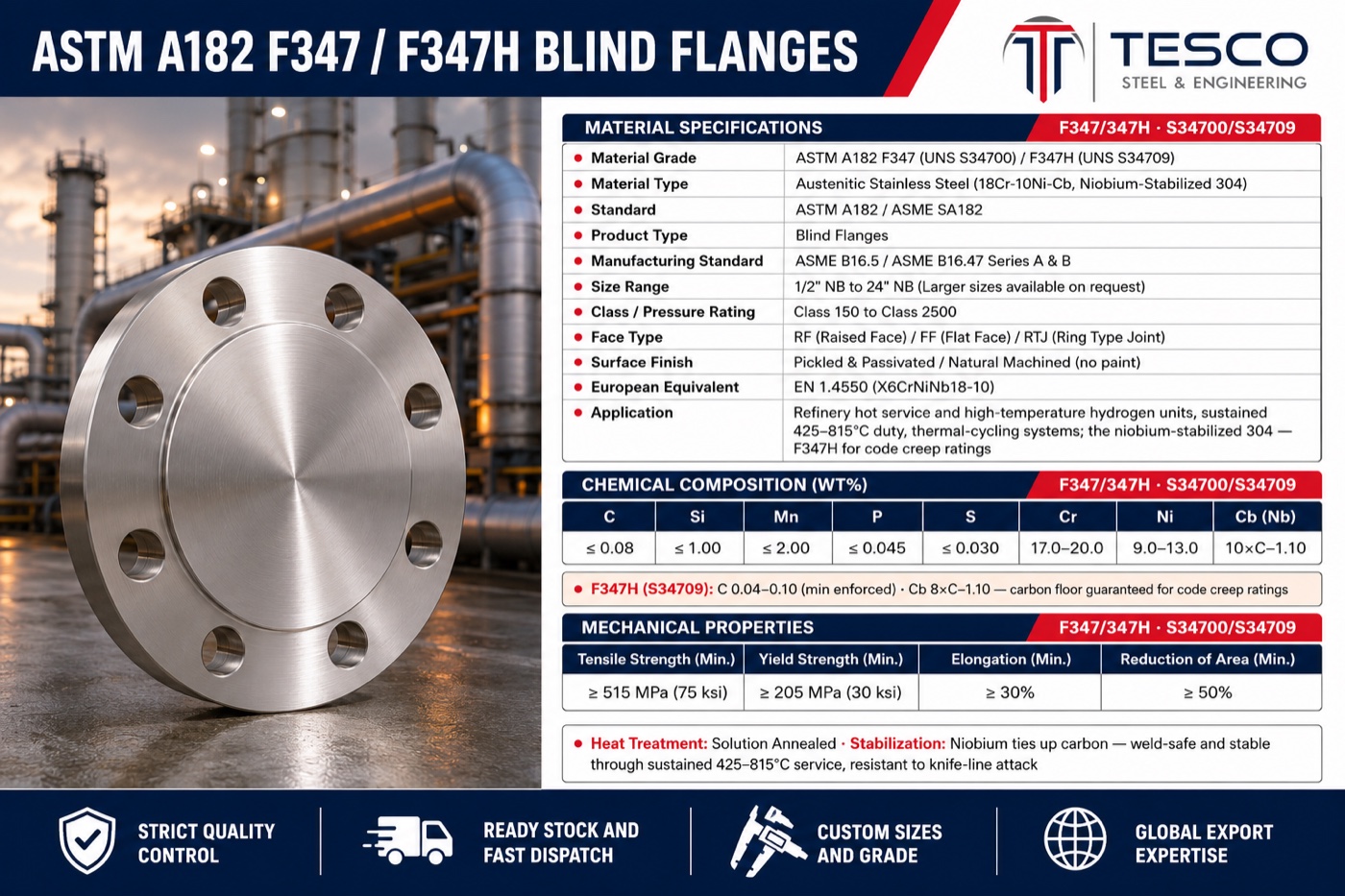
Tesco Steel & Engineering forges ASTM A182 F347 blind flanges — UNS S34700 / EN 1.4550, niobium-stabilised 304 — and the creep-rated F347H (S34709), to ASME B16.5 Class 150–2500 from ½″ to 24″ NB and to ASME B16.47 up to 60″. The aristocrat of the stabilised trilogy: niobium at 10×C forms the most heat-stable carbides of any stabilised 18-8 — nothing burns off across the arc (347 is the filler wire even for 321 systems), essentially no knife-line attack, and polythionic-SCC resistance through every refinery shutdown — the traditional grade of hydroprocessing, FCC and hot-hydrogen units, at the full 515/205 MPa. Hot duty with chlorides riding along: F316Ti. Hotter than stabilisation helps: F310. Facings: BLRF, BLFF or BLRTJ. Every lot with EN 10204 3.1/3.2 MTC. ISO 9001:2015, made in Mumbai, India — exported to 50+ countries.
ASTM A182 F347 · UNS S34700 · EN 1.4550F347H (S34709) Creep VariantNiobium-Stabilised 304Knife-Line & Polythionic-SCC ResistantThe Refinery Stabilised GradeASME B16.5 ½″–24″ · Class 150–2500RF · FF · RTJ FacingsEN 10204 3.1 / 3.2 · ISO 9001:2015
ASTM A182 F347 / F347H Blind Flanges — Specifications at a Glance
What is an ASTM A182 F347 Blind Flange?
The refinery's stabilised stainless. A solid forged disc of niobium-stabilised 304 (UNS S34700 / EN 1.4550) with no bore — F347H (S34709) where code creep ratings apply — closing pipes and nozzles in welded hot service: hydroprocessing, FCC, sulphur-bearing hot line classes, fired heaters. Niobium at 10×C (8×C for the H grade) locks the carbon into the most heat-stable carbides of any stabilised 18-8, so the steel cannot sensitize in operation — and cannot crack in the polythionic acids of shutdown. Full 515/205 MPa; no molybdenum — this is the hot-duty branch. Dimensions per ASME B16.5 / B16.47 in RF, FF and RTJ facings; EN 10204 3.1 certified.
Also searched as: SS 347 blind flange, 347H blind flange, 1.4550 blind flange, X6CrNiNb18-10 blind, S34700 / S34709 blind, columbium-stabilised blind, Cb-stabilised 304 blind, SA-182 F347 / F347H blind (the ASME boiler-code twins) — all covered on this page. See also the stainless steel hub, the stabilised siblings F321 / F316Ti, the H-family F304H / F316H, and the facing pages BLRF / BLFF / BLRTJ.
Why Niobium Is the Aristocrat's Stabiliser
Carbides That Never Let Go
Niobium carbides are the most heat-stable of any stabilised 18-8 — they hold their grip at the hottest end of the range, where titanium's begin to dissolve. Stabilisation that stays stabilised, at any temperature flange duty will ever see.
Nothing Burns Off Across the Arc
Titanium partly vaporises in welding; niobium transfers intact — which is why 347 is the filler wire even for 321 systems, and why 347 weld zones keep their full stabilised chemistry.
No Knife-Line Window
The narrow weld-adjacent zone that historically troubled titanium grades is essentially closed in 347 — the niobium re-precipitates fast enough to protect the re-melted band.
The Shutdown Insurance
Sulphide scale + air + moisture at turnaround = polythionic acids, which crack sensitized stainless within days. A grade that cannot sensitize cannot be cracked by them — the reason API-practice refinery line classes write 347 by habit.
F347 · F347H — and the Stabilised Trilogy
Variant
UNS
Carbon
Niobium
Specify For
F347
S34700
≤0.08%
10×C–1.10%
General stabilised hot duty — the refinery default
Hot duty that also carries chlorides; the European 1.4571
F347 / F347H Chemical Composition
Element
C
Si
Mn
P
S
Cr
Ni
Cb (Nb)
F347 (S34700)
≤0.08
≤1.00
≤2.00
≤0.045
≤0.030
17.0–20.0
9.0–13.0
10×C–1.10
F347H (S34709)
0.04–0.10
≤1.00
≤2.00
≤0.045
≤0.030
17.0–20.0
9.0–13.0
8×C–1.10
Niobium as a formula, not a range — ten times the carbon for F347, relaxed to eight times for F347H so a little carbon stays free to carry creep load. A certificate reading C 0.06% needs Cb ≥0.60% (F347) or ≥0.48% (F347H) — verified by arithmetic on every heat, read by PMI on every piece. Note the absences: no titanium, no molybdenum.
Mechanical Properties & The Service Span
Property
ASTM A182 F347 / F347H Requirement
Tensile Strength
≥ 515 MPa (75 ksi) — both variants
Yield Strength (0.2%)
≥ 205 MPa (30 ksi)
Elongation
≥ 30%
Reduction of Area
≥ 50%
Hardness
No A182 limit — typically soft as annealed
Condition
Solution annealed — mandatory
Service Span
Sustained 425–815°C stabilised duty; scaling ~870–900°C; code creep design above ~525°C on F347H allowables; hotter still — F310
ASTM A182 F347 / F347H Blind Flanges are available in the following specifications:
Material Grade
ASTM A182 F347 (UNS S34700); F347H (UNS S34709) creep-rated variant; EN 1.4550 / X6CrNiNb18-10 designation where required
Heat Treatment
Solution annealed — mandatory; condition stated on certificate
Size
1/2"NB to 24"NB per ASME B16.5; 26"–60" per ASME B16.47; EN 1092-1 to order
Class
150#, 300#, 400#, 600#, 900#, 1500#, 2500# — rated on the standard austenitic lines; H-grade allowables for creep design
Facings
Raised Face (BLRF), Flat Face (BLFF), Ring Type Joint (BLRTJ) with groove per B16.20
Service Span
Welded hot duty through 425–815°C; polythionic-SCC-exposed refinery units; wet chloride duty belongs to the molybdenum grades
Surface Finish
Pickled & passivated or natural machined — no paint; segregated stainless handling throughout
Modifications
NPT-tapped centre (test / vent / instrument), lifting provisions — machined & certified at the works
Testing
Tension & chemistry per heat — niobium checked against the 10×C / 8×C rule; PMI routine; IGC (A262) where specified
Certification
EN 10204 3.1 (standard) / 3.2 witnessed
Why F347 Blind Flanges Are Specified
The Refinery Line Class Says So
Hydroprocessing, FCC and sulphur-unit piping specs write 347 by long-standing API practice — the closure carries the same certificate as the pipe, through the same operate-hot, open-cold cycles.
Shutdown-Proof Metallurgy
Polythionic acid cracks sensitized stainless at turnaround; a grade that cannot sensitize cannot be cracked by it. That immunity is the specification's core logic — and it applies to the blind exactly as to the elbow beside it.
The Hottest Stabilised Work
Where even 321's titanium carbides begin to loosen their grip, niobium holds — and the F347H variant carries the ASME creep allowables for code-designed pressure parts above ~525°C.
Weld-Zone Integrity
No stabiliser burn-off, no knife-line window — the flange that will one day be welded to a spool keeps its full stabilised chemistry through the arc.
Three details buyers miss.Verify niobium by arithmetic: the certificate must show Cb ≥10×C (F347) or ≥8×C (F347H) — a range check is not enough; we run the calculation on every heat. The suffix decides the allowables: straight F347 and F347H differ in carbon floor and code creep ratings, not room-temperature strength — if the line class is designed above ~525°C, confirm which variant the stress tables assumed. Not a chloride grade: no molybdenum means wet salty duty starts at 316L and climbs the chloride ladder — 347's alloying is spent on heat and shutdowns, not brine; and heavily restrained niobium welds deserve a hot-cracking-aware procedure, a fabricator's note worth passing along.
How Our F347 / F347H Blind Flanges Are Manufactured
1
Forging — cut billet of the spectro-verified S34700 / S34709 heat — niobium confirmed against the 10×C or 8×C rule — is hot-forged into the solid disc blank with full heat traceability and segregated stainless handling.
2
Solution anneal — restoring the uniform austenite while the niobium carbides keep the carbon captured; furnace charts retained against the heat number.
3
Machining & facing — faces, OD and drilling to ASME B16.5 / B16.47; RF serrations, flat face or RTJ groove gauged per B16.20; NPT taps machined where ordered.
4
Testing — tension test and chemistry against the heat; PMI on every piece reads the niobium; intergranular-corrosion (ASTM A262) and other tests where specified.
5
Pickling & passivation — the clean paint-free chromium-oxide skin, with marking of standard, grade (H suffix where applicable), size, class and heat number.
6
Certification & packing — EN 10204 3.1 MTC (3.2 witnessed on request); faces protected, palletised or crated sea-worthy — no carbon-steel contact in transit.
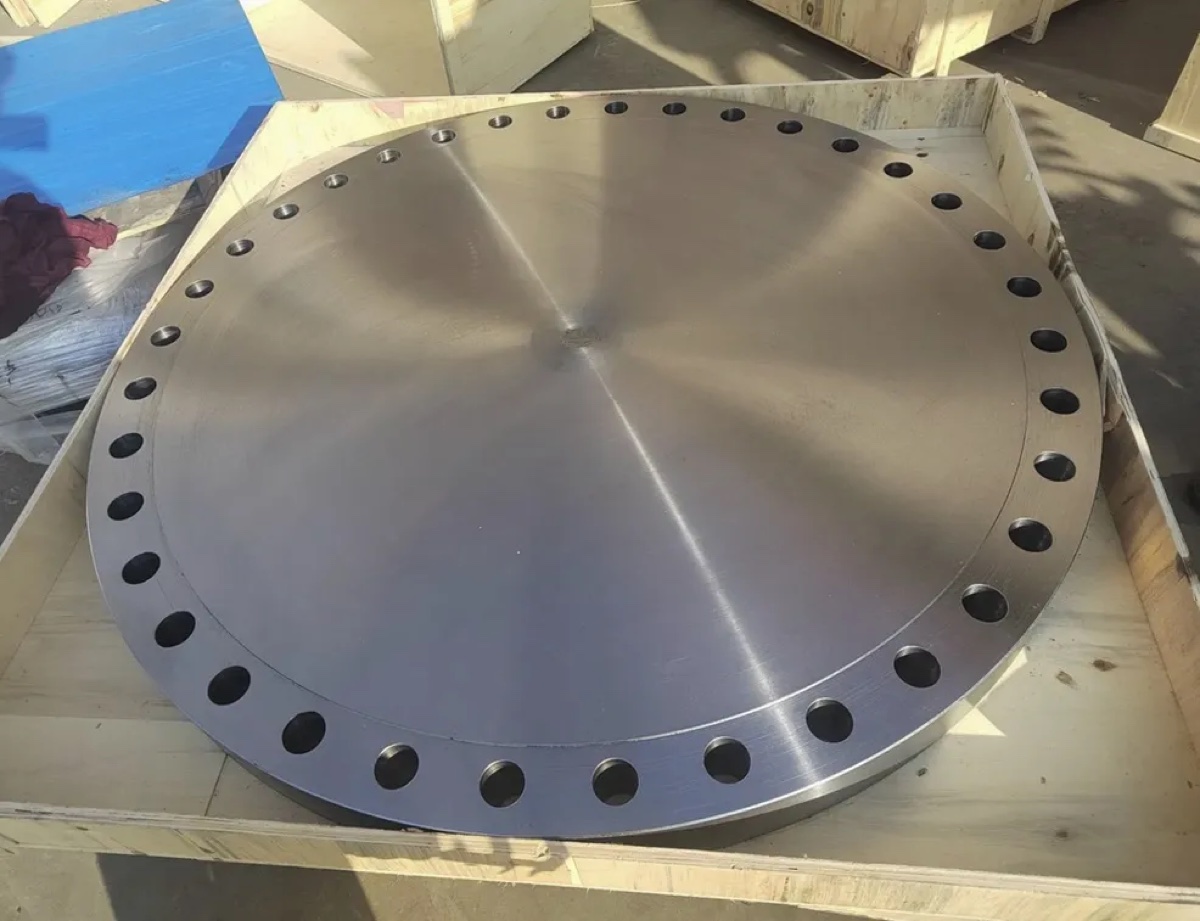
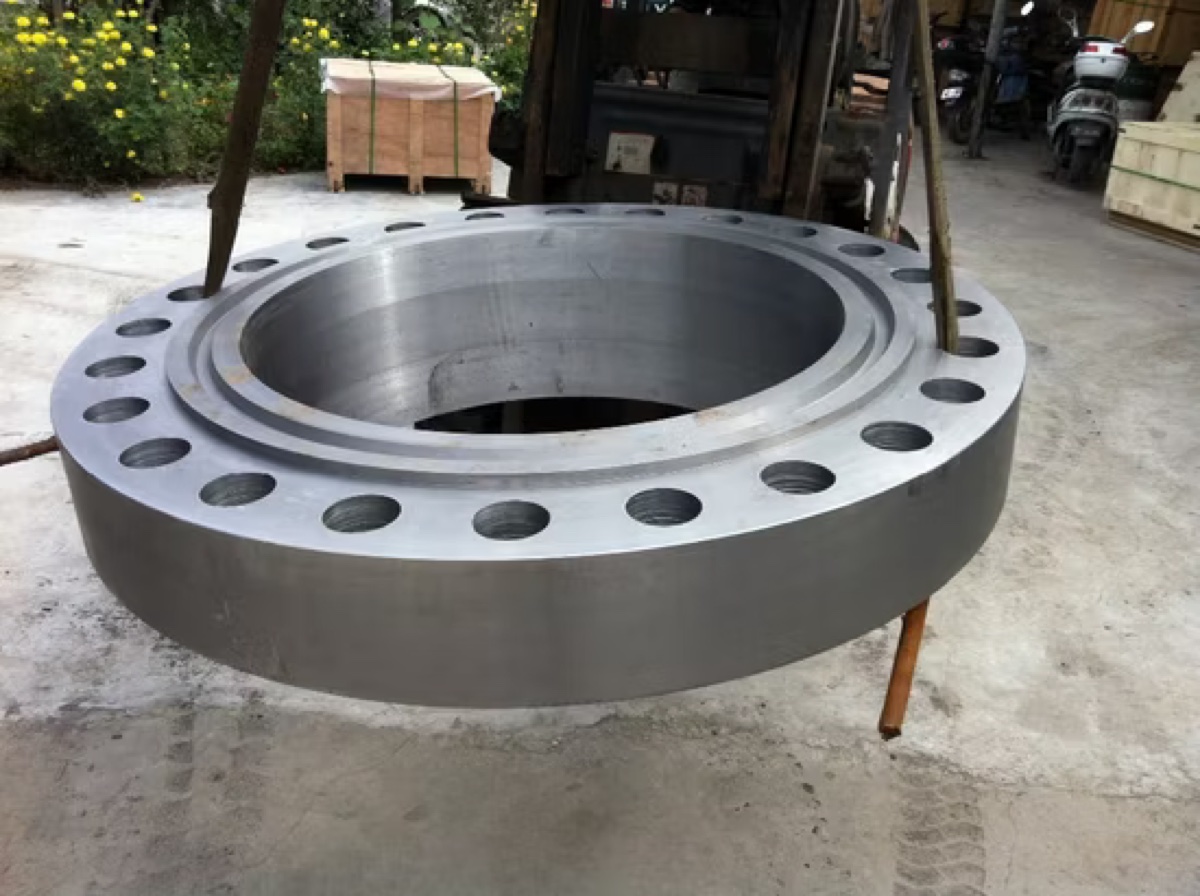
Where F347 / F347H Blind Flanges Are Used
Refinery country first: hydroprocessing and desulphurisation units, FCC circuits, sulphur-bearing hot line classes, fired heaters and hot headers — then high-temperature hydrogen service and thermal-cycling process systems wherever niobium's carbide stability earns its premium. Production below:
Large Machined Blind Flange — Crated for ExportLarge-Diameter Flange — Ring Groove Machined
F347 Blind Flange Dimensions
Blind dimensions are class-governed — identical across material grades. Full charts:
How to Specify & Order an F347 / F347H Blind Flange
Five elements — the variant suffix is the 347-specific one:
1
Size & standard — e.g. 4″ NB ASME B16.5, or the B16.47 series for 26″ and above.
2
Pressure class & facing — Class 150–2500; RF, FF or RTJ (with ring number) to match the mating flange.
3
Grade & variant — ASTM A182 F347, or F347H where the design code requires rated creep strength; EN 1.4550 designation where the project asks for it.
4
Service & certification — state temperature and any polythionic/IGC requirement (A262 practice); NPT tap size if a test blind; PMI or 3.2 witnessing as specified; EN 10204 3.1 standard.
An ASTM A182 F347 blind flange is a solid forged disc of niobium-stabilised austenitic stainless steel — UNS S34700, EN 1.4550, with the creep-rated F347H variant as UNS S34709 — drilled to the standard bolt pattern with no bore, used to close pipes and nozzles in welded hot service: refinery hydroprocessing and FCC units, fired-heater circuits and thermal-cycling systems. A niobium (columbium) addition ties up the carbon so the steel stays sensitization-proof through welding and through years inside the 425-815°C band. Dimensions follow ASME B16.5 from ½ inch to 24 inch and ASME B16.47 beyond, in raised face, flat face and ring joint facings.
What does niobium stabilisation do?
The same job as titanium in 321 — capturing carbon before chromium carbides can form at grain boundaries — done with a heavier, steadier element. Niobium carbides are the most heat-stable of any stabilised 18-8: they hold their grip at the hottest end of the service range, they do not burn off across a welding arc, and they leave essentially no window for the knife-line attack that historically shadowed titanium grades. The carbon is locked from the first anneal, and the chromium stays in solution protecting the steel — permanently, at any temperature the grade will ever see in flange duty.
347 or 321 — why choose the niobium grade?
347 is the aristocrat of the stabilised pair. Its niobium carbides stay stable where titanium's begin to dissolve, so stabilisation holds at the hottest end; it is essentially immune to knife-line attack beside welds; and nothing burns off across the arc — which is why 347 is the filler wire even for 321 systems. The price is cost and stock: niobium is dearer than titanium and 347 forgings are less commonly warehoused. 321 wins on economy and availability for exhaust-and-heater duty; 347 wins where refinery specifications, hydrogen service or the hottest stabilised work set the rules.
What is F347H and when is it specified?
The creep-rated variant — UNS S34709, carbon controlled at 0.04-0.10% with the minimum enforced, and niobium relaxed to 8×C so enough carbon stays free to carry creep load. It is the H-grade logic applied to the niobium base: a guaranteed carbon floor and established ASME elevated-temperature allowables for pressure parts designed above roughly 525°C — the standard material for FCC and hot-hydrogen flange work designed to code. Straight F347 covers general stabilised duty; specify the H suffix when the design code demands rated creep strength. We forge both.
What does the niobium formula 10×C mean?
Niobium dosed to the carbon it must capture. A182 requires columbium (niobium) at no less than ten times the carbon content, capped at 1.10% — enough to stabilise every atom of carbon with margin. For F347H the multiplier relaxes to 8×C, deliberately leaving a little carbon free for creep strength while still protecting the grain boundaries. A certificate reading C 0.06% therefore needs Cb ≥ 0.60% as F347, or ≥ 0.48% as F347H. Like the titanium grades, it is an element verified by arithmetic — and our PMI reads the niobium on every piece.
What is the chemical composition of ASTM A182 F347 and F347H?
F347: carbon ≤0.08%, silicon ≤1.00%, manganese ≤2.00%, phosphorus ≤0.045%, sulphur ≤0.030%, chromium 17.0-20.0%, nickel 9.0-13.0%, columbium (niobium) 10×C to 1.10% — UNS S34700. F347H differs in two entries: carbon 0.04-0.10% with the minimum enforced, and columbium at 8×C to 1.10% — UNS S34709. No molybdenum in either — the chloride ladder is a different family — and no titanium: niobium alone does the stabilising here.
What are the mechanical properties of F347 blind flanges?
Identical for both variants: tensile strength 515 MPa (75 ksi) minimum, yield strength 205 MPa (30 ksi) minimum, elongation 30% minimum and reduction of area 50% minimum, solution annealed, with no hardness limit in A182. Stabilisation costs nothing mechanically — full standard austenitic numbers and rating lines. What separates the variants is not the room-temperature table but the hot one: F347H's enforced carbon floor buys it the ASME creep allowables that code design above ~525°C runs on.
What temperature range does an F347 blind flange cover?
The stabilised territory: welded, then worked hot through the 425-815°C sensitization band, with scaling limits around 870-900°C in oxidising service. Below the band it behaves as a fine-grained 304 — cryogenic toughness included. For code-governed creep design above roughly 525°C, F347H carries the allowables. When temperature outruns stabilisation altogether and scale survival near 1000°C-plus becomes the question, the heat-ladder handoff is F310 — and hot duty that also carries chlorides belongs to F316Ti on the molybdenum branch.
Why do refineries specify 347 — what is polythionic acid SCC?
Because of what happens at shutdown, not just in operation. Sulphur-bearing hot units grow sulphide scale in service; when the unit cools and opens, that scale meets air and moisture and forms polythionic acids — which crack sensitized stainless along its grain boundaries, sometimes within days. The defence, written into API RP 571 practice, is a grade that cannot sensitize during years of hot operation: the stabilised 18-8s, with 347 the traditional choice in hydroprocessing, FCC and sulphur-unit line classes. A 347 closure holds that immunity through every operate-shutdown-inspect cycle of the unit's life.
Does F347 have any downsides?
A short, honest list. Niobium raises the alloy bill above 321, and 347 forgings are stocked more thinly outside refinery-supply channels, so lead times deserve a question at enquiry. Niobium-bearing weld metal can be prone to hot cracking in heavily restrained joints — a fabricator's consideration rather than a flange defect, managed by procedure. And like every non-molybdenum 18-8, wet chloride duty is not its game: the chloride ladder starts at 316L. In its home territory — hot, cycling, sulphur-bearing refinery service — none of these dent it.
A blind flange isn't welded — why specify 347?
Because sensitization is a service phenomenon, and so is what follows it. A closure on a hydroprocessing or FCC line spends years inside the sensitizing band, then faces polythionic acid at every shutdown — arc or no arc, a non-stabilised blind would sensitize in place and crack when the unit opens. Add the standing system logic — one line-class material for certificates, weld procedures and the spool that may replace the blind at the next turnaround — and the niobium specification follows the closure exactly as it follows the pipe.
What facings are F347 blind flanges made with?
All three: raised face (BLRF) — the refinery default — flat face (BLFF) for mating flat-faced or lined equipment, and ring type joint (BLRTJ) for the high-pressure hydrogen services where 347 line classes and RTJ practice regularly meet, the ring chosen softer than the groove. Each facing has its own page on this site. Gasket systems are chosen for the temperature and the shutdown chemistry alike. NPT-tapped test and instrument blinds are machined and certified at the works.
Where are F347 and F347H blind flanges used?
Refinery country first: hydroprocessing and desulphurisation units, FCC circuits, sulphur-bearing hot line classes, fired-heater and hot-header systems — anywhere the operate-hot, open-cold cycle makes polythionic SCC a design case. Beyond refineries: high-temperature hydrogen service, thermal-cycling process systems, and the hottest stabilised duty where niobium's carbide stability earns its premium. F347 blinds close those systems as isolations, spare-nozzle blanks and tapped test points; F347H versions carry the code creep ratings where design demands them.
Which standards cover F347 and F347H blind flanges?
The material standard is ASTM A182 grade F347 (UNS S34700) with F347H (UNS S34709) as the creep-rated variant, ASME SA-182 as the boiler-code twin, and EN 1.4550 / X6CrNiNb18-10 as the European equivalent. Dimensions follow ASME B16.5 for ½"-24" and ASME B16.47 for 26"-60", rated on the standard austenitic lines. A complete specification reads: 'Blind Flange, RF, 4", ASME B16.5 Class 600, ASTM A182 F347' — or F347H where the design code requires it — and our EN 10204 certificates state it exactly that way, niobium content included.
Who manufactures ASTM A182 F347 blind flanges in India?
Tesco Steel & Engineering is an ISO 9001:2015 certified flange manufacturer based in Mumbai, India, forging ASTM A182 F347 / UNS S34700 / EN 1.4550 blind flanges — with the F347H (S34709) creep-rated variant to order — from ½" to 24" NB per ASME B16.5 in Classes 150-2500 and to 60" per ASME B16.47, solution annealed, pickled and passivated, PMI-verified with the niobium read on every piece and checked against the 10×C (or 8×C) rule, certified to EN 10204 3.1/3.2 on every lot, in raised face, flat face and ring joint facings — alongside F321, F316Ti, the F304 and F316 families, F310 and the full duplex and nickel-alloy blind ranges. Exported to more than 50 countries.