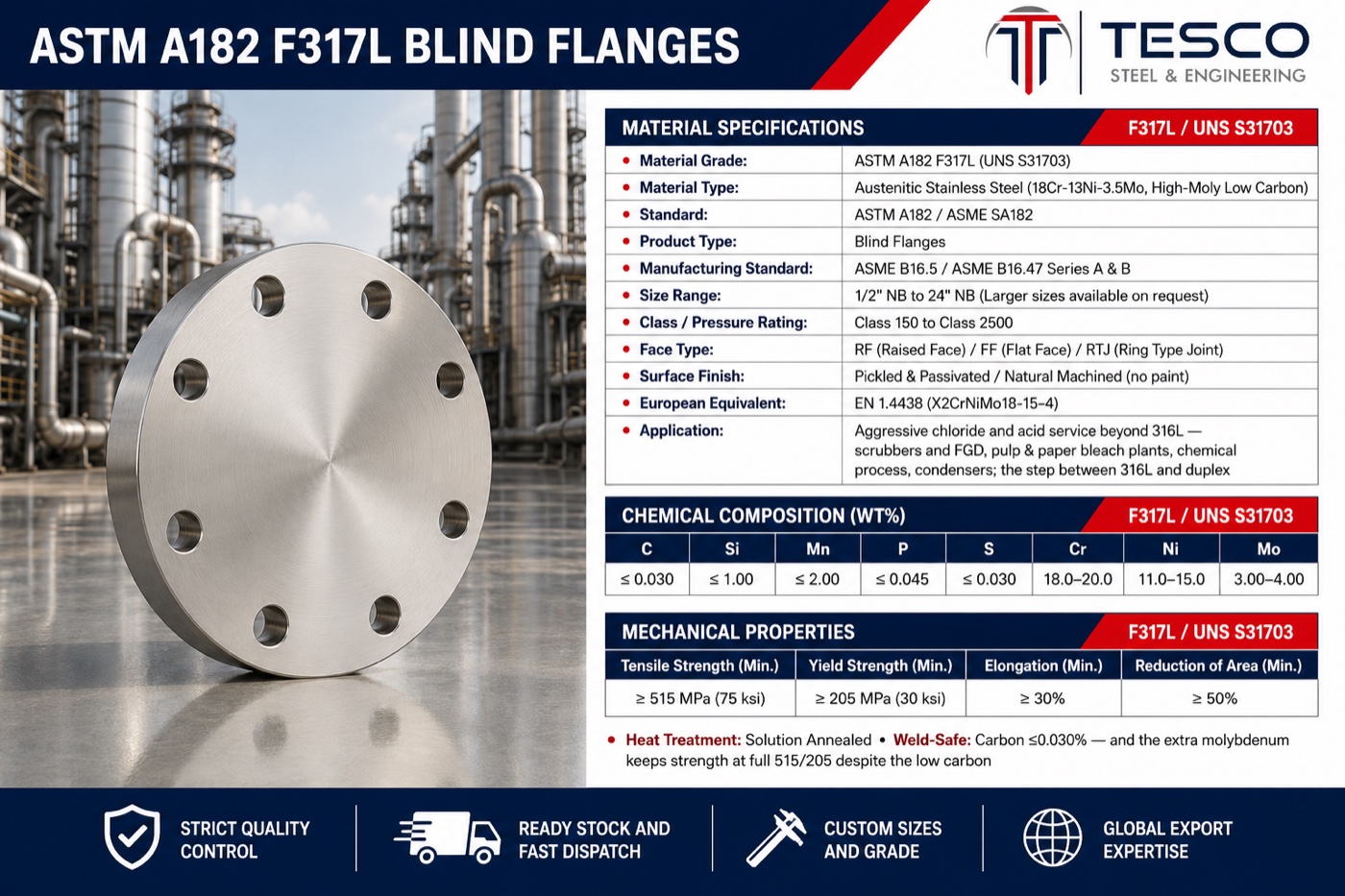
Tesco Steel & Engineering forges ASTM A182 F317L blind flanges — UNS S31703 / EN 1.4438, the high-molybdenum stainless — to ASME B16.5 Class 150–2500 from ½″ to 24″ NB and to ASME B16.47 up to 60″. When scrubber condensate, bleach chemistry or hot brine outruns 316L, this is the next rung: molybdenum raised to 3–4% and chromium to 18–20% carry pitting resistance to PREN ≈ 30, while carbon at ≤0.030% keeps every weld zone sensitization-proof — and unlike 316L, the heavier alloying holds strength at the full 515/205 MPa, the rare L grade with no strength tax. Beyond it: F51 duplex, super duplex, 254 SMO. Facings: BLRF, BLFF or BLRTJ. Every lot with EN 10204 3.1/3.2 MTC. ISO 9001:2015, made in Mumbai, India — exported to 50+ countries.
ASTM A182 F317L · UNS S31703 · EN 1.4438Molybdenum 3.00–4.00%PREN ≈ 30 — Beyond 316LWeld-Safe C ≤0.030%Full 515/205 Strength — No L PenaltyASME B16.5 ½″–24″ · Class 150–2500RF · FF · RTJ FacingsEN 10204 3.1 / 3.2 · ISO 9001:2015
ASTM A182 F317L Blind Flanges — Specifications at a Glance
What is an ASTM A182 F317L Blind Flange?
The step between 316L and duplex. A solid forged disc of high-molybdenum, low-carbon stainless (UNS S31703 / EN 1.4438) with no bore, closing pipes, valves and nozzles in chloride and acid service too aggressive for 316L: scrubbers and FGD, pulp & paper bleach plants, condensers, hard chemical process. Molybdenum 3.00–4.00% and chromium 18–20% score PREN ≈ 30; carbon ≤0.030% keeps welds sensitization-proof — at the full 515/205 MPa, with no L-grade strength cut. Dimensions per ASME B16.5 / B16.47 in RF, FF and RTJ facings; EN 10204 3.1 certified.
Also searched as: SS 317L blind flange, 1.4438 blind flange, X2CrNiMo18-15-4 blind, S31703 blind, high-moly stainless blind, FGD / scrubber blind flange, SA-182 F317L blind (the ASME boiler-code twin) — all refer to the product on this page. See also the stainless steel hub, the rungs around it — F316L below, F51 duplex above — and the facing pages BLRF / BLFF / BLRTJ.
One More Percent of Molybdenum — and a Free Lunch
The Molybdenum Step
316L carries 2–3% molybdenum; 317L carries 3–4%, with chromium raised to 18–20% alongside. On the PREN pitting index that is roughly 24 versus 30 — the difference between a grade that pits in scrubber condensate within seasons and one that sits comfortably in it.
The Weld-Safe Carbon
Carbon capped at 0.030% — the same L logic as 316L: nothing consequential left to precipitate at weld heat, every heat-affected zone sensitization-proof. The grade exists for welded corrosive systems, and its carbon spec says so.
The Free Lunch: Full Strength
316L pays for its low carbon with reduced 485/170 minimums. 317L doesn't — the extra molybdenum and chromium stiffen the austenite and pay carbon's bill, holding A182 minimums at the full 515/205 MPa. No dual-cert workaround, no lower rating line: the rare L grade with no strength tax.
Read it against 316L: two more points of chromium, a full extra point of molybdenum, nickel raised to hold the austenite against all that ferrite-promoting alloying. The certificate number that matters most is molybdenum at or above 3.00% — it separates a true 317L from an upgraded-on-paper 316L, and our PMI reads it on every piece.
Mechanical Properties & The Service Span
Property
ASTM A182 F317L Requirement
Tensile Strength
≥ 515 MPa (75 ksi) — full standard value; no L-grade reduction
Yield Strength (0.2%)
≥ 205 MPa (30 ksi)
Elongation
≥ 30%
Reduction of Area
≥ 50%
Hardness
No A182 limit — typically soft as annealed
Condition
Solution annealed — mandatory
Service Span
Cryogenic toughness at one end, ~425°C sustained at the other — its real home the wet, condensing, chloride-laden window in between
Pickled & passivated or natural machined — no paint; segregated stainless handling throughout
Modifications
NPT-tapped centre (hydrotest / vent / drain / gauge), lifting provisions — machined & certified at the works
Testing
Tension & chemistry per heat — molybdenum ≥3.00% verified; PMI routine; IGC (A262) where specified
Certification
EN 10204 3.1 (standard) / 3.2 witnessed
Why F317L Blind Flanges Are Specified
The Plant Outgrew 316L
Pitted 316L blinds at the first inspection are the classic trigger: the duty was always a molybdenum step above the spec. 317L is the direct upgrade — same fabrication habits, same austenitic behaviour, one more percent of the element that matters.
Austenitic to the End
The last rung before duplex keeps everything a stainless shop already knows: forgiving weld procedures, no 475°C embrittlement window, cryogenic-range toughness, drop-in compatibility with austenitic line classes and WPS libraries.
Full Strength, Low Carbon
The grade's quiet advantage: weld-safe ≤0.030% carbon at 515/205 MPa. No reduced rating line to design around, no 317/317L dual-cert rescue needed — though we supply dual-certified material on request.
Built for the Wet, Sour, Salty Window
FGD scrubbers, bleach plants and condensers live in condensing, chloride-laden, often acidic service — precisely the window PREN ≈ 30 was bought for, with flat-face variants for the FRP and rubber-lined equipment those plants run.
Three details buyers miss.Verify the molybdenum, not the label: the certificate must read Mo ≥3.00% — the one number separating 317L from a relabelled 316L; our PMI reads it on every piece. Pitting resistance is not SCC immunity: the extra molybdenum delays pitting and crevice attack, but hot concentrated chloride stress-corrosion cracking remains an austenitic weakness — that immunity is what duplex is for. Mind the crevice, not just the alloy: in condensing chloride service the gasket seat is the attack site — crevice-conscious gasket selection and proper bolt-up protect the molybdenum you paid for.
How Our F317L Blind Flanges Are Manufactured
1
Forging — cut billet of the spectro-verified S31703 heat — molybdenum confirmed at 3.00–4.00%, carbon under the 0.030% cap — is hot-forged into the solid disc blank with full heat traceability and segregated stainless handling.
2
Solution anneal — restoring the uniform austenite and dissolving any precipitates; furnace charts retained against the heat number.
3
Machining & facing — faces, OD and drilling to ASME B16.5 / B16.47; RF serrations, flat face or RTJ groove gauged per B16.20; NPT taps machined where ordered.
4
Testing — tension test and chemistry against the heat; PMI on every piece reads the molybdenum step; intergranular-corrosion (ASTM A262) and other tests where specified.
5
Pickling & passivation — the restored chromium-oxide skin the chloride service will test, with marking of standard, grade, size, class and heat number.
6
Certification & packing — EN 10204 3.1 MTC (3.2 witnessed on request); faces protected, palletised or crated sea-worthy — no carbon-steel contact in transit.
Where F317L Blind Flanges Are Used
Where chloride and acid duty outgrew 316L: FGD and scrubber systems, pulp & paper bleach plants, chemical and petrochemical process lines, condensers and evaporators, textile and dye chemistry, phosphoric and organic acid handling. Production below:
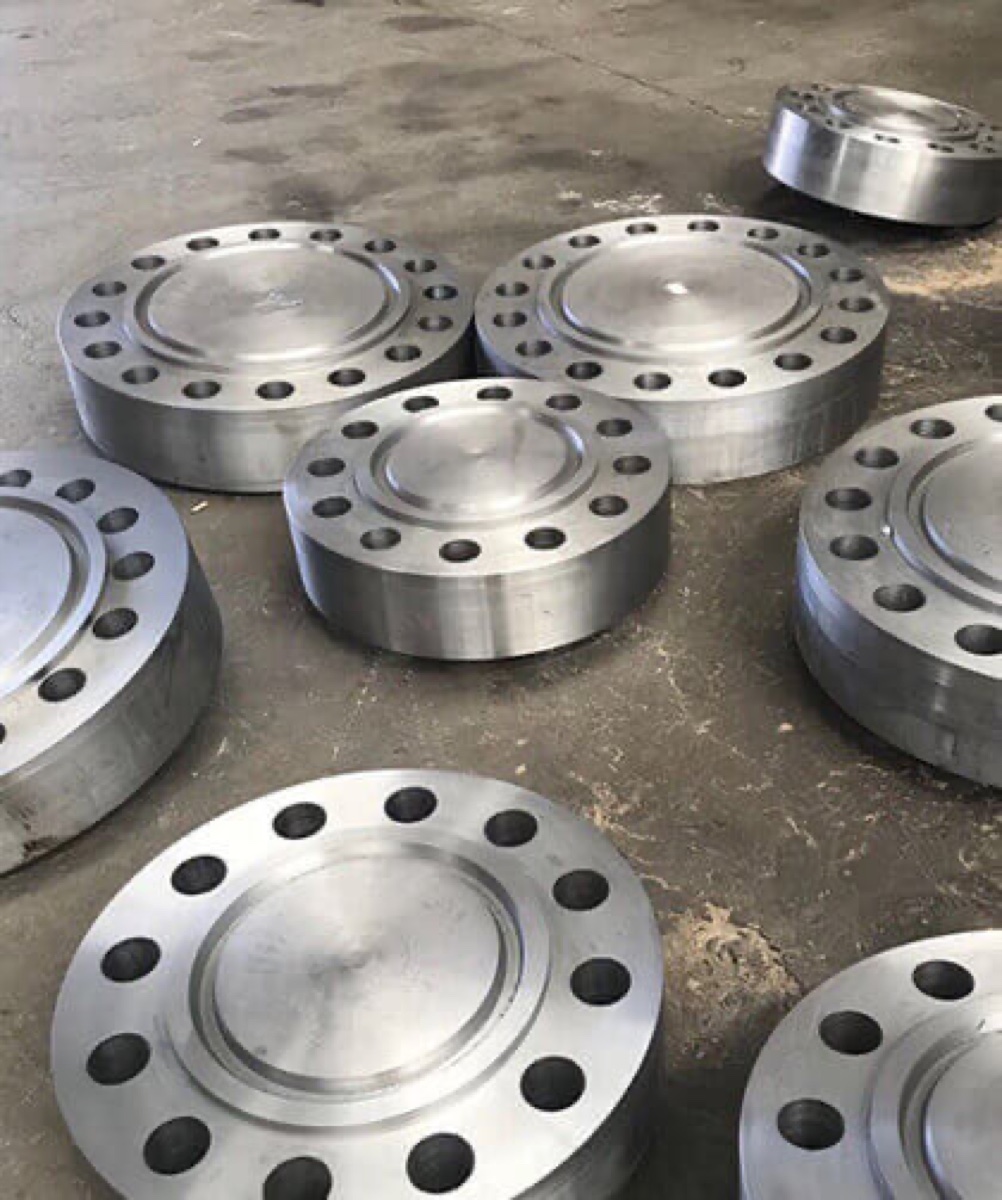
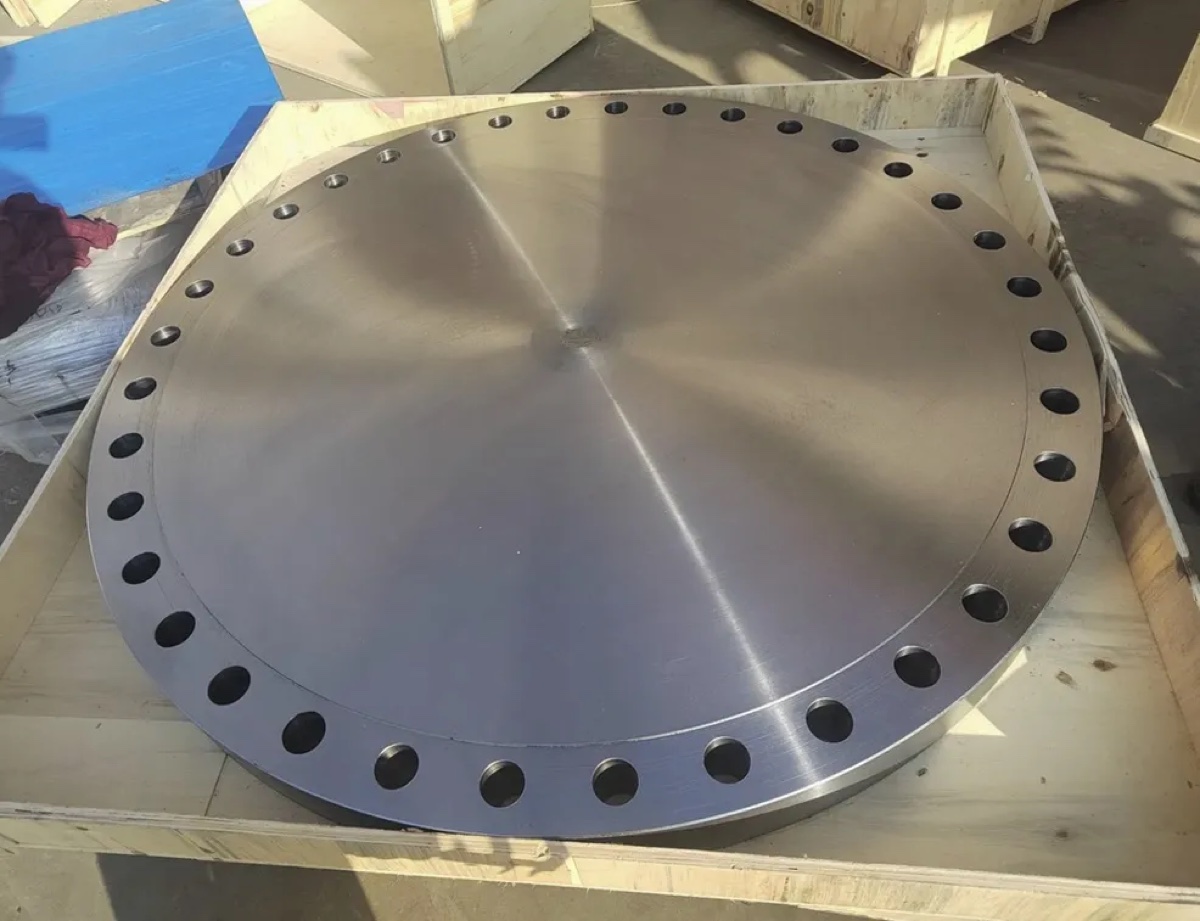
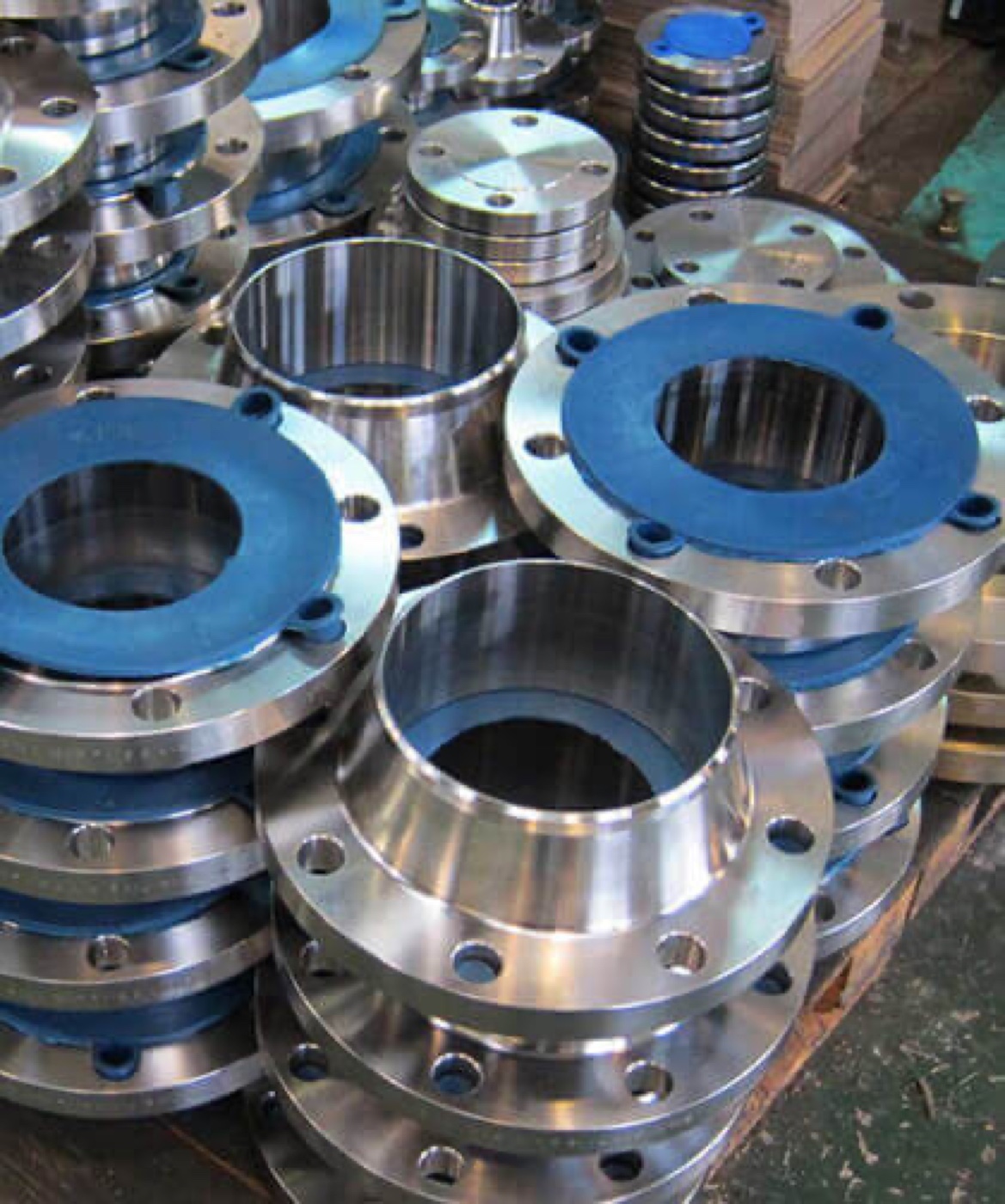
Machined Blind Flanges — On Our Shop FloorLarge Machined Blind Flange — Crated for ExportA182 F317L Weld Necks — Same Grade, In Stock
F317L Blind Flange Dimensions
Blind dimensions are class-governed — identical across material grades. Full charts:
Five elements — the molybdenum verification is the 317L-specific one:
1
Size & standard — e.g. 6″ NB ASME B16.5, or the B16.47 series for 26″ and above.
2
Pressure class & facing — Class 150–2500; RF, FF or RTJ (with ring number) to match the mating flange — flat face for FRP and lined scrubber equipment.
3
Grade — ASTM A182 F317L; state 317/317L dual certification or EN 1.4438 designation where the project requires it.
4
Modifications & certification — NPT tap size if a test blind; IGC (A262), PMI or 3.2 witnessing as specified; EN 10204 3.1 standard.
An ASTM A182 F317L blind flange is a solid forged disc of high-molybdenum, low-carbon austenitic stainless steel — UNS S31703, EN 1.4438 — drilled to the standard bolt pattern with no bore, used to close pipes, valves and vessel nozzles in chloride and acid service too aggressive for 316L: scrubbers and flue-gas desulphurisation, pulp and paper bleach plants, condensers and hard chemical process. Molybdenum at 3-4% is its reason to exist; carbon at ≤0.030% keeps welds sensitization-proof. Dimensions follow ASME B16.5 from ½ inch to 24 inch and ASME B16.47 beyond, in raised face, flat face and ring joint facings.
What does the extra molybdenum in F317L buy?
The next increment of chloride resistance. Molybdenum is the element that stops chloride pitting and crevice attack, and 317L carries 3.00-4.00% against 316L's 2.00-3.00% — with chromium also raised to 18-20%. On the PREN pitting index that alloying scores around 30, versus roughly 24-25 for 316L. In service terms: condensing chloride-laden gas, hot acidic liquor and crevice-prone bolted joints that pit 316L within seasons can sit within 317L's comfort zone — the classic reason scrubber and bleach-plant specifications step up to it.
What is the difference between F317L and F316L?
One molybdenum step, and one pleasant surprise. Both are low-carbon (≤0.030%) weld-safe grades; 317L carries a percent more molybdenum and two points more chromium, buying visibly better pitting and crevice resistance. The surprise is mechanical: 316L pays for its low carbon with reduced 485/170 MPa minimums, while 317L's heavier alloying holds the full 515/205 MPa — weld safety without the strength tax. Where 316L is the volume workhorse, 317L is the specified answer when the chloride or acid duty has already proven too much for it.
Why doesn't F317L lose strength like other L grades?
Because something else picks up the load. In 316L, removing carbon removes a potent strengthener and the minimums drop to 485/170 MPa. In 317L the extra molybdenum and chromium dissolved in the austenite stiffen the lattice — solid-solution strengthening — and pay carbon's bill: A182 keeps the grade at tensile ≥515 MPa and yield ≥205 MPa, the same minimums as standard 316. The practical consequences: no dual-certification workaround needed, no lower rating line, and flange ratings run on the standard austenitic curves.
Where does F317L sit on the chloride ladder?
On the rung between 316L and duplex. The ladder climbs by pitting resistance: 316L (PREN ~24) for everyday chloride duty; 317L (PREN ~30) when scrubber condensate, bleach chemistry or hot brine outruns it; duplex F51/F60 (PREN ~34) adding twice the strength; super duplex F53/F55 (PREN >40) for hot seawater; 254 SMO and nickel alloys beyond. 317L is the last purely austenitic rung before duplex — the natural step for plants that outgrew 316L but want familiar austenitic fabrication, welding and toughness behaviour rather than duplex's stricter rules.
What is the chemical composition of ASTM A182 F317L?
Carbon ≤0.030%, silicon ≤1.00%, manganese ≤2.00%, phosphorus ≤0.045%, sulphur ≤0.030%, chromium 18.0-20.0%, nickel 11.0-15.0%, molybdenum 3.00-4.00% — UNS S31703. Reading it against 316L: two more points of chromium, a full extra point of molybdenum, and nickel raised to hold the austenite against all that ferrite-promoting alloying. The certificate check that matters most is molybdenum at or above 3.00% — it is the number that separates a true 317L from an upgraded-on-paper 316L.
What are the mechanical properties of F317L blind flanges?
Tensile strength 515 MPa (75 ksi) minimum, yield strength 205 MPa (30 ksi) minimum, elongation 30% minimum and reduction of area 50% minimum, in the solution-annealed condition, with no hardness limit in A182. These are full standard-316 numbers — unusual generosity for a ≤0.030% carbon grade, courtesy of the molybdenum and chromium doing the strengthening instead. Ratings therefore run on the standard austenitic stainless pressure-temperature lines with no L-grade penalty to design around.
What about straight 317 — is dual certification available?
Straight 317 (UNS S31700) allows carbon to 0.08% and shares the 515/205 minimums, so a low-carbon heat that meets S31703 chemistry automatically satisfies S31700 as well — dual-certified 317/317L material is common and we supply it on request. In practice the L version dominates specifications: the whole point of the grade is welded corrosive duty, and low carbon protects the heat-affected zones. Since 317L already carries full strength, dual certification here is paperwork convenience rather than the rating rescue it is for 316/316L.
F317L or duplex F51 — how do I choose?
By what the plant values. Duplex F51 offers more PREN (~34), double the yield strength and better chloride-SCC resistance — often at comparable or lower alloy cost, nickel being expensive. 317L answers with austenitic virtues duplex cannot match: no 475°C embrittlement window, easier welding with forgiving procedures, full cryogenic-range toughness, and drop-in compatibility with austenitic line classes and existing WPS libraries. Retrofit closures into an austenitic plant favour 317L; new-build aggressive chloride systems engineered from scratch increasingly favour duplex. Both sit in our forge — the line class decides.
What temperature range does an F317L blind flange cover?
The standard austenitic span: cryogenic duty at one end — austenite stays tough to liquefied-gas temperatures — and roughly 425°C at the top for sustained service, above which creep-rated H-grades take over. Its real home is narrower and wetter: the condensing, chloride-laden, often acidic window where scrubbers and bleach plants live. One austenitic caveat carries over: like all its family, 317L remains susceptible to chloride stress-corrosion cracking in hot concentrated chloride service — the extra molybdenum delays pitting, not SCC; that immunity is duplex territory.
A blind flange isn't welded — why specify the L grade?
System uniformity, the same logic as every L specification. The blind lives in a line class written for the welded system around it; one material keeps certificates, welding procedures and later modifications simple. The blind ordered today may be replaced by a welded spool at the next revamp, and a bolted closure in scrubber service sees the same condensing chlorides as the pipe it blanks — so it needs the same 3-4% molybdenum regardless of whether an arc ever touches it. When the line class says 317L, the closure says 317L.
What facings are F317L blind flanges made with?
All three: raised face (BLRF) — the process-industry default — flat face (BLFF) for mating GRP, rubber-lined and FRP scrubber systems, common in exactly this grade's home territory, and ring type joint (BLRTJ) for high-pressure duty, the ring chosen softer than the groove. Each facing has its own page on this site. Crevice-conscious gasket selection deserves attention in chloride service — a poorly seated gasket creates the crevice the molybdenum was bought to resist. NPT-tapped test blinds are machined and certified at the works.
Where are F317L blind flanges used?
Where chloride and acid duty has outgrown 316L: flue-gas desulphurisation and scrubber systems, pulp and paper bleach plants, chemical and petrochemical process lines running hot acidic or high-chloride streams, condensers and evaporators, textile and dye chemistry, and phosphoric or organic acid handling. F317L blinds close those systems as isolations, spare-nozzle blanks and tapped test points — with the pickled, paint-free finish and the molybdenum certificate the service demands.
Which standards cover F317L blind flanges?
The material standard is ASTM A182 grade F317L (UNS S31703), with ASME SA-182 as its boiler-code twin and EN 1.4438 / X2CrNiMo18-15-4 as the European equivalent. Dimensions follow ASME B16.5 for ½"-24" and ASME B16.47 for 26"-60", rated on the standard austenitic lines — no L-grade reduction applies. A complete specification reads: 'Blind Flange, RF, 6", ASME B16.5 Class 150, ASTM A182 F317L' — and our EN 10204 certificates state it exactly that way, molybdenum content included.
Who manufactures ASTM A182 F317L blind flanges in India?
Tesco Steel & Engineering is an ISO 9001:2015 certified flange manufacturer based in Mumbai, India, forging ASTM A182 F317L / UNS S31703 / EN 1.4438 blind flanges from ½" to 24" NB per ASME B16.5 in Classes 150-2500 and to 60" per ASME B16.47 — solution annealed, pickled and passivated, PMI-verified with the 3-4% molybdenum read on every piece, certified to EN 10204 3.1/3.2 on every lot, 317/317L dual certification on request — in raised face, flat face and ring joint facings, alongside 317L weld necks and the full austenitic, duplex and nickel-alloy families. Exported to more than 50 countries.