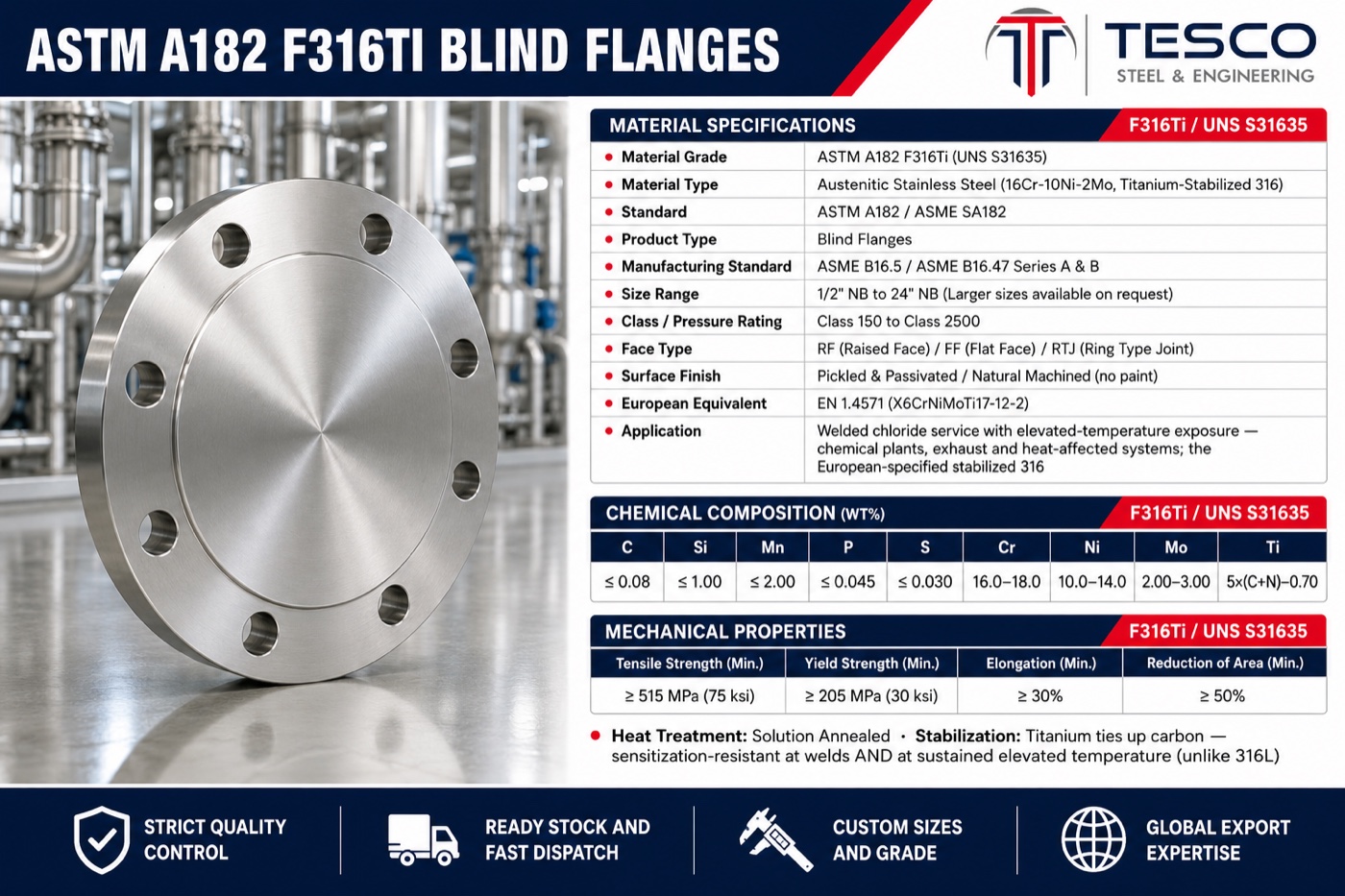
Tesco Steel & Engineering forges ASTM A182 F316Ti blind flanges — UNS S31635, the titanium-stabilised 316 that Europe knows as EN 1.4571 — to ASME B16.5 Class 150–2500 from ½″ to 24″ NB and to ASME B16.47 up to 60″. Where F316L solves weld sensitization by removing the carbon, F316Ti solves it by locking the carbon up: titanium dosed at 5×(C+N) forms its carbides first, so the chromium stays where corrosion resistance needs it — through welding and through a working life spent hot. The reward: full 515/205 MPa standard-316 strength, no L-grade rating penalty, stabilised service toward 550°C. Siblings: F316, F316H for code creep duty, duplex for seawater. Facings: BLRF, BLFF or BLRTJ. Every lot with EN 10204 3.1/3.2 MTC. ISO 9001:2015, made in Mumbai, India — exported to 50+ countries.
ASTM A182 F316Ti · UNS S31635 · EN 1.4571Titanium-Stabilised 316Weld-Safe at Full 515/205 StrengthStable in Sustained HeatThe European-Specified 316ASME B16.5 ½″–24″ · Class 150–2500RF · FF · RTJ FacingsEN 10204 3.1 / 3.2 · ISO 9001:2015
ASTM A182 F316Ti Blind Flanges — Specifications at a Glance
What is an ASTM A182 F316Ti Blind Flange?
The stabilised 316 — Europe's default. A solid forged disc of titanium-stabilised molybdenum stainless (UNS S31635 / EN 1.4571) with no bore, closing pipes, valves and nozzles in welded chloride service that also runs hot. Titanium dosed at 5×(C+N) locks the carbon into harmless titanium carbides, so neither welding nor sustained elevated temperature can sensitize the steel — while carbon stays at the standard ≤0.08% and the mechanicals stay at the full 515/205 MPa. Molybdenum 2–3% for chlorides, exactly as in F316. Dimensions per ASME B16.5 / B16.47 in RF, FF and RTJ facings; EN 10204 3.1 certified.
Also searched as: SS 316Ti blind flange, 1.4571 blind flange, X6CrNiMoTi17-12-2 blind, S31635 blind, Werkstoff 1.4571 flange, SA-182 F316Ti blind (the ASME boiler-code twin), titanium-stabilised 316 blind — all refer to the product on this page. See also the stainless steel hub, siblings F316 / F316L / F316H blind flanges, and the facing pages BLRF / BLFF / BLRTJ.
Two Answers to Sensitization — and What Titanium Buys
Weld heat drags stainless through the 425–815°C band where carbon steals chromium from the grain boundaries. The industry found two cures:
Remove the Carbon — the L Route
Cap carbon at 0.030% and there is nothing consequential to precipitate. Simple, and with modern melting, cheap — but strength drops to 485/170, and the protection is sized for welding heat, not for a working life parked inside the sensitization band. That story lives on the F316L page.
Lock the Carbon Up — the Ti Route
Keep standard carbon, add titanium at 5×(C+N): titanium forms its carbides preferentially, the carbon is captured from the start, and the chromium never leaves solution. Welding cannot sensitize it — and neither can years at elevated temperature.
What the Ti Route Buys
Full standard-316 mechanicals — 515/205 MPa, no lower rating line, no dual-cert workaround — plus stabilised corrosion resistance through sustained hot service toward 550°C. The price: a specialist, European-flavoured grade rather than a global commodity.
The 316 Carbon Family — Four Strategies
Grade
Carbon Strategy
Tensile / Yield
Built For
F316Ti (this page)
≤0.08% — locked up by Ti at 5×(C+N)
≥515 / ≥205 MPa
Welded + hot chloride duty; European specs (1.4571)
Choose by what the carbon must do: nothing (F316), disappear (F316L), be locked up (F316Ti), or work for its living (F316H). Molybdenum and its chloride resistance are common to all four — the carbon strategy is the entire difference between their certificates.
F316Ti Chemical Composition (UNS S31635)
Element
C
Si
Mn
P
S
Cr
Ni
Mo
Ti
Weight %
≤0.08
≤1.00
≤2.00
≤0.045
≤0.030
16.0–18.0
10.0–14.0
2.00–3.00
5×(C+N)–0.70
The titanium column is the signature — a formula, not a range: at least five times the combined carbon and nitrogen, capped at 0.70%. Enough to capture every atom of carbon, never so much that it degrades the steel. Note carbon stays at the standard ≤0.08% — stabilisation, not removal, is this grade's answer.
Mechanical Properties & The Service Span
Property
ASTM A182 F316Ti Requirement
Tensile Strength
≥ 515 MPa (75 ksi) — full standard-316 value, no L-grade penalty
Yield Strength (0.2%)
≥ 205 MPa (30 ksi)
Elongation
≥ 30%
Reduction of Area
≥ 50%
Hardness
No A182 limit — typically soft as annealed
Condition
Solution annealed — mandatory
Service Span
Chloride duty from ambient into sustained elevated temperature — European practice toward 550°C; code creep design above ~525°C favours F316H
ASTM A182 F316Ti Blind Flanges are available in the following specifications:
Material Grade
ASTM A182 F316Ti (UNS S31635); EN 1.4571 / X6CrNiMoTi17-12-2 designation on certificate where the project requires it
Heat Treatment
Solution annealed — mandatory; condition stated on certificate
Size
1/2"NB to 24"NB per ASME B16.5; 26"–60" per ASME B16.47; EN 1092-1 to order
Class
150#, 300#, 400#, 600#, 900#, 1500#, 2500# — rated on the standard-316 stainless lines
Facings
Raised Face (BLRF), Flat Face (BLFF), Ring Type Joint (BLRTJ) with groove per B16.20
Service Span
Welded chloride duty from ambient into sustained elevated temperature (~550°C European practice); continuous seawater excluded (duplex territory)
Surface Finish
Pickled & passivated or natural machined — no paint; segregated stainless handling throughout
Modifications
NPT-tapped centre (hydrotest / vent / drain / gauge), lifting provisions — machined & certified at the works
Testing
Tension & chemistry per heat — titanium checked against the 5×(C+N) rule; PMI routine; IGC (A262) where specified
Certification
EN 10204 3.1 (standard) / 3.2 witnessed — dual ASTM/EN designation on request
Why F316Ti Blind Flanges Are Specified
The European Line Class Says So
DIN/EN piping specs and two generations of European chemical plants standardised on 1.4571 as their default 316 — projects inheriting those specs meet them with F316Ti forgings, certificate reading both designations.
Weld-Safe Without the Strength Tax
The L grade pays 485/170 for its weld safety; the Ti grade pays nothing — full 515/205, standard rating lines, stabilisation included.
Stabilised When the Service Itself Is Hot
Low carbon protects against welding heat; titanium protects against years inside the 425–815°C band. Flue-gas, exhaust-side and hot chemical duty is where the distinction pays.
Molybdenum Retained
Unlike 321 — the stabilised 304 — F316Ti keeps the 2–3% molybdenum, covering hot duty that also carries chlorides or aggressive process chemistry.
Three details buyers miss.Verify titanium by arithmetic: the certificate must show Ti ≥ 5×(C+N) — a range check is not enough; we run the calculation on every heat. Not the pharma-polish grade: titanium carbide stringers are harmless on a gasket facing but visible on mirror finishes — validated polished systems specify 316L. Ti solves heat's corrosion problem, not its strength problem: for code-governed creep design above ~525°C the allowables belong to F316H — and continuous seawater remains duplex territory, titanium or not.
How Our F316Ti Blind Flanges Are Manufactured
1
Forging — cut billet of the spectro-verified S31635 heat — titanium confirmed against the 5×(C+N) rule, molybdenum confirmed in range — is hot-forged into the solid disc blank with full heat traceability and segregated stainless handling.
2
Solution anneal — restoring the uniform austenite while the titanium carbides keep the carbon captured; furnace charts retained against the heat number.
3
Machining & facing — faces, OD and drilling to ASME B16.5 / B16.47; RF serrations, flat face or RTJ groove gauged per B16.20; NPT taps machined where ordered.
4
Testing — tension test and chemistry against the heat; PMI on every piece reads the titanium as well as the molybdenum; intergranular-corrosion (ASTM A262) and other tests where specified.
5
Pickling & passivation — the restored chromium-oxide skin, with marking of standard, grade (ASTM and EN designations where required), size, class and heat number.
6
Certification & packing — EN 10204 3.1 MTC (3.2 witnessed on request); faces protected, palletised or crated sea-worthy — no carbon-steel contact in transit.
Where F316Ti Blind Flanges Are Used
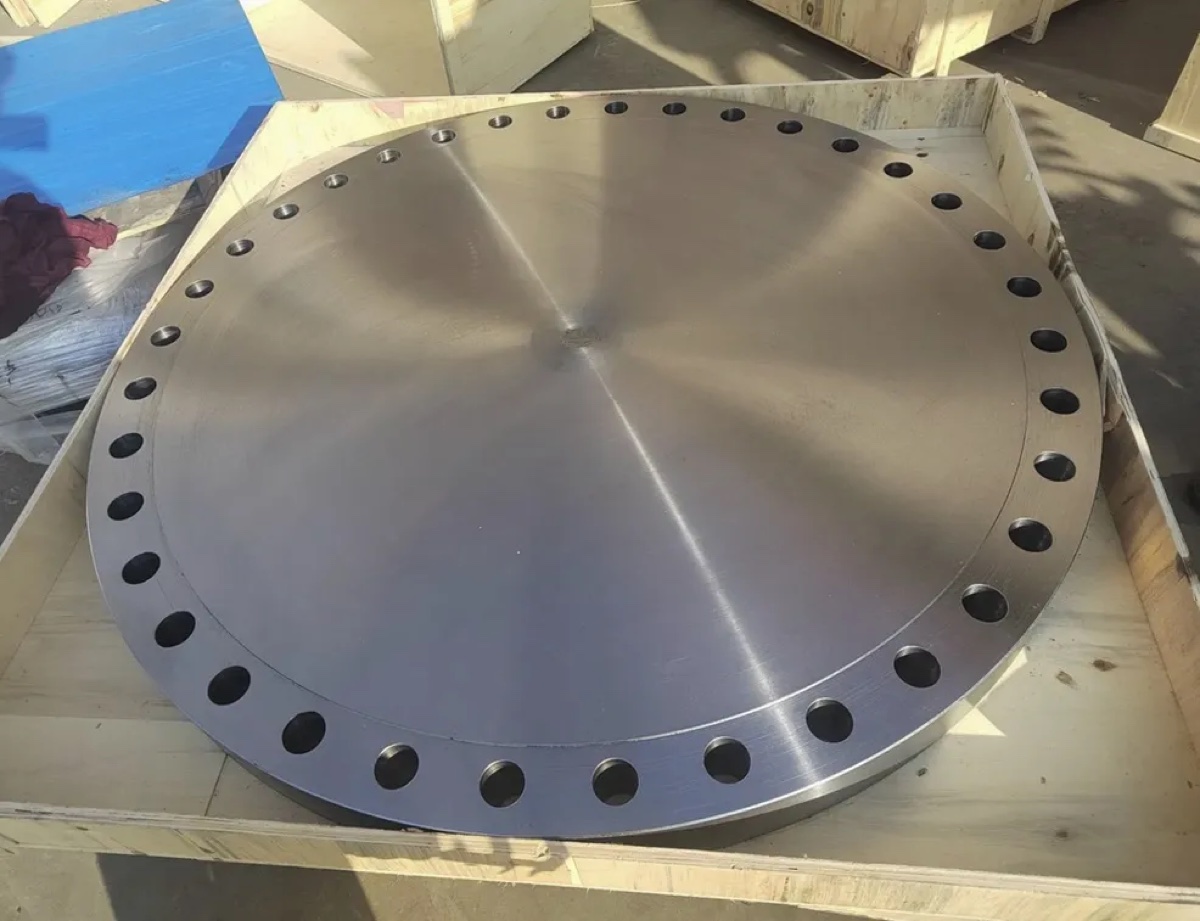
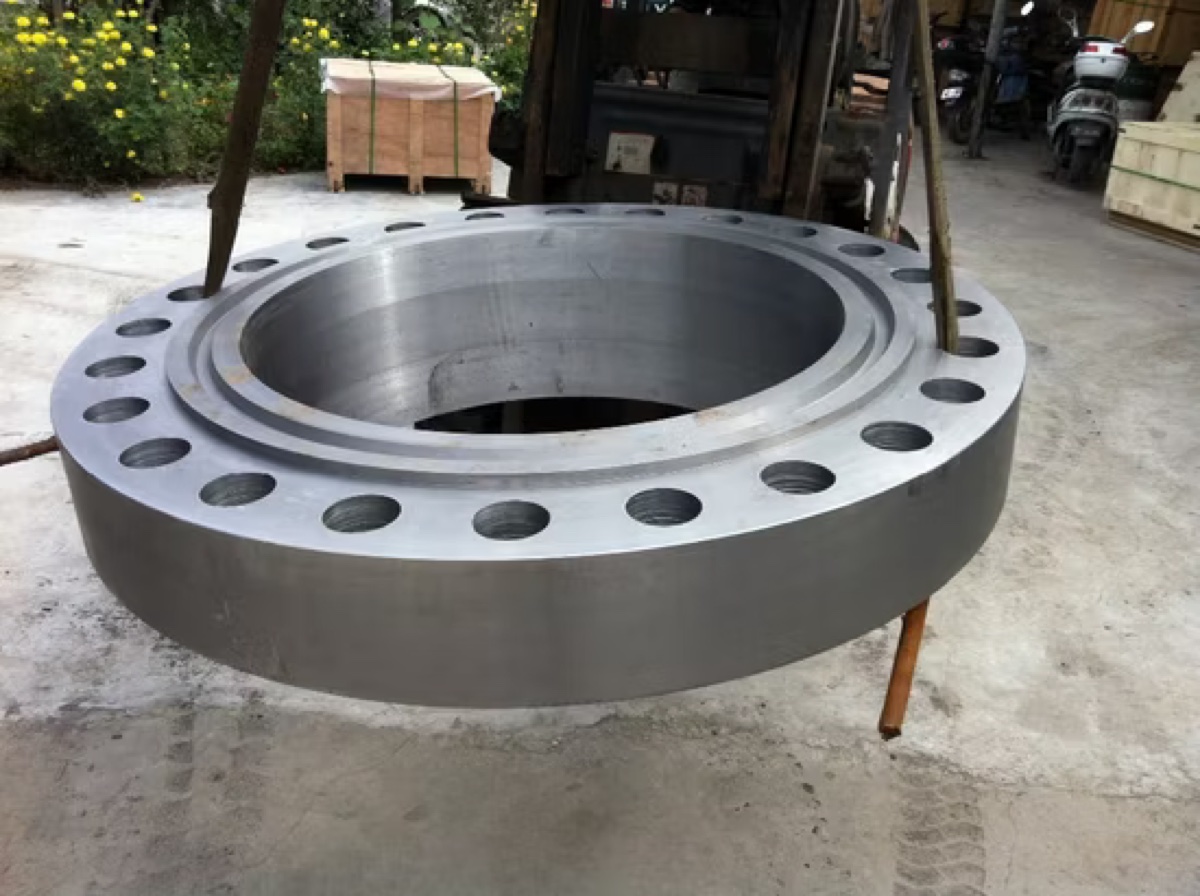
Where European specs meet hot corrosive duty: chemical and petrochemical plants built to DIN/EN material standards, flue-gas and exhaust-side systems with condensing chlorides, hot organic-acid and dye chemistry, elevated-temperature process piping, marine-adjacent hot systems. Production below:
Large Machined Blind Flange — Crated for ExportLarge-Diameter Flange — Ring Groove Machined
F316Ti Blind Flange Dimensions
Blind dimensions are class-governed — identical across material grades. Full charts:
Example: “Blind Flange, RF, 4″ NB, ASME B16.5 Class 150, ASTM A182 F316Ti (EN 1.4571), EN 10204 3.1 — 10 pcs.” Quotations normally within 24 hours with price, unit weight and delivery.
An ASTM A182 F316Ti blind flange is a solid forged disc of titanium-stabilised molybdenum stainless steel — UNS S31635, the European workhorse 316 known as EN 1.4571 — drilled to the standard bolt pattern with no bore, used to close pipes, valves and vessel nozzles in welded chloride service that also sees elevated temperature. A small titanium addition ties up the carbon so neither weld zones nor hot service can sensitize the steel. Dimensions follow ASME B16.5 from ½ inch to 24 inch and ASME B16.47 beyond, in raised face, flat face and ring joint facings.
What does titanium stabilisation actually do?
It gives carbon something better to bond with. Sensitization happens when carbon precipitates as chromium carbides in the 425-815°C range, stripping chromium from the grain boundaries that need it. Titanium forms its own carbides far more readily than chromium does, so the carbon is locked up as harmless titanium carbide from the start and the chromium stays in solution doing its corrosion-resistance job. Welding can heat the steel as it likes — there is no free carbon left to cause trouble.
F316L and F316Ti both solve sensitization — what is the difference?
Two routes to the same destination. F316L removes the carbon (≤0.030%) — simple and, with modern melting, cheap — but it sacrifices strength, and its protection suits welding heat rather than a working life spent hot. F316Ti keeps standard carbon and ties it up with titanium instead, so it retains the full 515/205 MPa mechanicals and stays stabilised through sustained elevated-temperature service. Welded-then-hot duty favours Ti; welded-and-ambient duty is L territory, which is why L became the global default and Ti the specialist.
Why is 316Ti so common in European specifications?
History with good reasons behind it. German and wider European chemical-plant practice standardised on Werkstoff 1.4571 decades ago, when low-carbon melting was expensive and stabilisation was the practical route to weld-safe stainless — and the grade earned its reputation across two generations of plants. European line classes, DIN/EN piping specifications and many EPC material standards still name 1.4571 as their default 316. When an international project inherits a European spec, F316Ti is how that requirement is met in A182 forgings.
What does the titanium content formula 5×(C+N) mean?
The titanium is dosed to the job, not to a fixed window. Every atom of carbon and nitrogen needs titanium to lock it up, so A182 requires titanium at no less than five times the combined carbon and nitrogen content — enough to stabilise all of it with margin — capped at 0.70% so excess titanium does not degrade the steel. A certificate reading C 0.05% and N 0.04% therefore needs titanium of at least 5 × 0.09 = 0.45%. It is the one element on the certificate verified with arithmetic rather than a range.
What are the mechanical properties of F316Ti blind flanges?
The full standard-316 numbers: tensile strength 515 MPa (75 ksi) minimum, yield strength 205 MPa (30 ksi) minimum, elongation 30% minimum and reduction of area 50% minimum, solution annealed, with no hardness limit in A182. This is the quiet advantage over F316L — weld safety with no strength penalty, no lower rating line, no dual-certification workaround. The stabilised grade rates like standard 316 because, mechanically, it is standard 316.
What temperature range does an F316Ti blind flange cover?
Its home ground is precisely the range that troubles other 316s: service into and through the 425-815°C sensitization band, where the titanium keeps the structure stabilised — European practice runs 1.4571 comfortably to around 550°C and beyond. It serves ambient and cold chloride duty like any 316 as well. For code-governed creep design above roughly 525°C, note that ASME allowables and H-grade rules favour F316H: titanium solves the corrosion side of heat, the H grade solves the strength side.
How do F316, F316L, F316Ti and F316H differ?
One chemistry, four carbon strategies. F316 (≤0.08% C) is the general-purpose grade. F316L (≤0.030%) removes carbon for weld safety and pays in strength. F316Ti (≤0.08% plus titanium) keeps the carbon but neutralises it — weld-safe at full strength, stable in sustained heat. F316H (0.04-0.10%, minimum enforced) keeps carbon deliberately free and working for creep strength. The molybdenum chloride resistance is common to all four; choose by what the carbon must do — nothing, disappear, be locked up, or work.
Does F316Ti have any downsides?
Honest ones, which is why L took over general duty. Titanium carbides can show as fine hard stringers on a machined surface — cosmetic on a gasket facing, but the reason mirror-polished pharmaceutical surfaces prefer 316L. A narrow zone beside welds could historically suffer knife-line attack, though modern welding practice makes it rare. And outside European-influenced markets it is a less commonly stocked grade, so availability deserves a question mark at enquiry stage. None of this outweighs its advantages when the duty is welded, chloride-bearing and hot.
A blind flange isn't welded — why specify Ti at all?
The same system logic behind every stabilised or low-carbon specification. The forged blind never sees an arc, but it lives in a line class written for the whole system — pipe, fittings and flanges welded together, and in this grade's case probably hot. One material of construction keeps certificates, welding procedures and later modifications simple; the blind may be replaced by a welded spool tomorrow; and a plant built to a European spec expects 1.4571 across the board at audit. When the line class says 316Ti, the closure says 316Ti.
316Ti or 321 — aren't they the same idea?
The same trick on different bases. 321 is titanium-stabilised 304 — no molybdenum — the classic grade for hot oxidising duty such as exhaust systems and heater components. 316Ti is titanium-stabilised 316 — molybdenum retained — for hot duty that also carries chlorides or aggressive process chemistry. If the hot service has no chloride question, 321 is the economical stabilised answer; when the certificate must show both molybdenum and stabilisation, 316Ti is the one grade that covers both.
What facings are F316Ti blind flanges made with?
All three: raised face (BLRF) — the process-industry default — flat face (BLFF) for mating GRP and lined systems, and ring type joint (BLRTJ) for high-pressure duty, the ring chosen softer than the groove. Each facing has its own page on this site. The forging is common to all three; the mating flange governs the choice, and for RTJ the ring number follows from size and class. NPT-tapped test blinds are machined and certified at the works.
Where are F316Ti blind flanges used?
Wherever European-written specifications meet welded, hot, corrosive duty: chemical and petrochemical plants built to DIN/EN material standards, flue-gas and exhaust-side systems with condensing chlorides, hot organic-acid and dye chemistry, elevated-temperature process piping, and marine-adjacent hot systems. F316Ti blinds close those lines for isolations, future connections and tapped test points, with the pickled paint-free finish and the 1.4571 paperwork European-audited plants expect.
Which standards cover F316Ti blind flanges?
The material standard is ASTM A182 grade F316Ti (UNS S31635), with ASME SA-182 as its boiler-code twin and EN 1.4571 / X6CrNiMoTi17-12-2 as the European equivalent — the designation many projects actually write. Dimensions follow ASME B16.5 for ½"-24" and ASME B16.47 for 26"-60", rated on the standard-316 stainless lines. A complete specification reads: 'Blind Flange, RF, 4", ASME B16.5 Class 150, ASTM A182 F316Ti (EN 1.4571)' — and our EN 10204 certificates state it exactly that way.
Who manufactures ASTM A182 F316Ti blind flanges in India?
Tesco Steel & Engineering is an ISO 9001:2015 certified flange manufacturer based in Mumbai, India, forging ASTM A182 F316Ti / UNS S31635 / EN 1.4571 blind flanges from ½" to 24" NB per ASME B16.5 in Classes 150-2500 and to 60" per ASME B16.47 — solution annealed, pickled and passivated, PMI-verified with the titanium and molybdenum read on every piece, titanium content checked against the 5×(C+N) rule, certified to EN 10204 3.1/3.2 on every lot — in raised face, flat face and ring joint facings, alongside F316, F316L, F316H, the F304 family, duplex and nickel-alloy blinds. Exported to more than 50 countries.