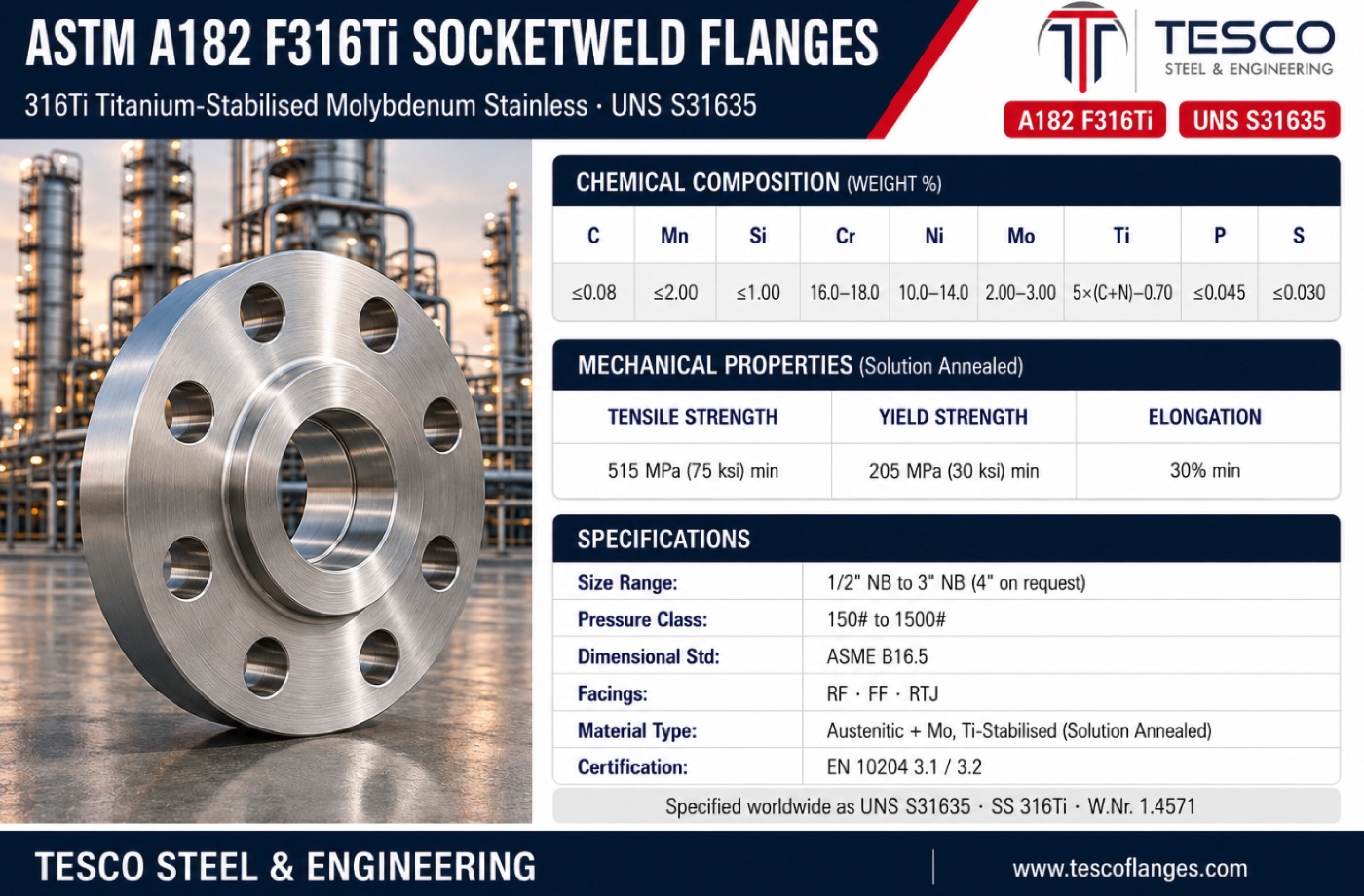
Tesco Steel & Engineering manufactures ASTM A182 F316Ti socketweld flanges — the titanium-stabilised 316: UNS S31635, W.Nr. 1.4571 — to ASME B16.5 from ½″ to 3″ NB in Classes 150–1500, with EN 1092-1 patterns to order. The titanium is the older cure for weld sensitization: it ties carbon up as harmless titanium carbide before chromium can — so the weld zone keeps its corrosion resistance and the grade keeps plain 316's full 515/205 MPa strength, where 316L pays with 485/170. This is the 316 that Europe writes — the DIN-heritage “V4A” of German chemical plant — and the grade you need when matching continental equipment or EU-engineered piping classes, plus the honest niche where it wins on merit: hot corrosive duty around 400–550 °C. Same 2–3% Mo as plain 316; the stabilised siblings F321 and F347 tell the 304-side story. Facings: SWRF, SWFF, SWRTJ. Every lot with EN 10204 3.1/3.2 MTC. ISO 9001:2015, made in Mumbai, India — exported to 50+ countries.
A182 F316Ti · UNS S31635 · W.Nr. 1.4571Titanium-Stabilised — Ti ≥5×(C+N)Full 316 Strength + Weld ImmunityThe European “V4A” StandardNo Preheat — No PWHT515 / 205 MPa · 30% ElongationASME B16.5 ½″–3″ · Class 150–1500EN 10204 3.1 / 3.2 · ISO 9001:2015
ASTM A182 F316Ti Socketweld Flanges — Specifications at a Glance
What is an ASTM A182 F316Ti Socketweld Flange?
The stabilised 316 in the small-bore pattern. A forged titanium-stabilised austenitic flange (ASTM A182 F316Ti / UNS S31635 / W.Nr. 1.4571) with a machined socket: pipe seated square by geometry, one external fillet weld — no preheat, no PWHT — through-bore matched to the pipe schedule. Ti ≥5×(C+N) locks carbon up as titanium carbide, so the weld zone cannot sensitize while the grade keeps plain 316's full strength: tensile ≥515 MPa, yield ≥205 MPa, elongation ≥30%. Same Mo 2.00–3.00% chloride credentials as plain 316. Sized by ASME B16.5 at ½″–3″ NB, Classes 150–1500, EN 1092-1 to order; EN 10204 3.1 on every lot.
Also searched as: 1.4571 socket weld flange, V4A socket weld flange, SS 316Ti SW flange, S31635 SWRF flange, titanium stabilised stainless flange — all the same product family. Related pages: the facings — SWRF / SWFF / SWRTJ — the socketweld hub, the other F316Ti types — blind, weld neck, slip-on, threaded — the siblings F316 / F316L / F321 / F347 socketweld, and the stainless steel hub.
Stabilisation came first — perfected in Europe before low-carbon melting was economic — and keeps the carbon's strength while removing its danger. Modern melting made the L-grades cheap, and they took most of the world's new specifications; Europe kept its stabilised habit, and hot corrosive duty keeps the stabilised case alive on merit.
What the Titanium Buys
Weld Immunity at Full Strength
The L-grades pay 30/35 MPa for their immunity; 316Ti keeps plain 316's 515/205 because the carbon stays — chaperoned, not removed.
The European Passport
W.Nr. 1.4571 is continental chemical plant's default stainless — the “V4A” of German practice. Matching European equipment and EU piping classes is this grade's standing franchise.
The Hot Corrosive Niche
Around 400–550 °C in corrosive process duty, the L-grades surrender allowable stress and plain grades risk sensitizing in service — the stabilised grade holds both lines at once.
Everything 316 Does, Kept
Same 2–3% molybdenum, same PREN ~24–26, same cryogenic toughness, same no-preheat, no-PWHT welding — stabilisation adds a chaperone, not a trade-off.
ASTM A182 F316Ti Chemical Composition (UNS S31635)
Element
C
Mn
Si
Cr
Ni
Mo
Ti
P
S
Weight %
≤0.08
≤2.00
≤1.00
16.0–18.0
10.0–14.0
2.00–3.00
5×(C+N)–0.70
≤0.045
≤0.030
Read the two signatures together: the carbon ceiling is plain 316's full 0.08% — the stabilised grade keeps its carbon, unlike the L — and the titanium formula scales the chaperone to the carbon it must lock up: at least five times the combined C+N, capped at 0.70%. The molybdenum stays: 316Ti is a 316 through and through. Ti-to-carbon ratio verified per heat; PMI on every piece.
Mechanical Properties (Solution Annealed)
Property
ASTM A182 F316Ti Requirement
Tensile Strength
≥ 515 MPa (75 ksi) — the full plain-316 number, kept
Yield Strength (0.2%)
≥ 205 MPa (30 ksi) — where 316L drops to 170, the stabilised grade holds
Elongation
≥ 30% — the austenitic signature
Condition
Solution annealed — stabilising anneal available for aggressive service
Temperature Span
Cryogenic (no transition) through the 400–550 °C hot corrosive band — the stabilised grade's home territory
Strength Escalation
Chloride + strength duty → the duplex family at 450–550 MPa yield
ASTM A182 F316Ti Socketweld Flanges are available in the following specifications:
Material Grade
ASTM A182 F316Ti (UNS S31635), W.Nr. 1.4571 — certificates carry the European designation where documentation requires it
Heat Treatment
Solution annealed — furnace records certified; stabilising anneal for aggressive service on request
Size
1/2"NB to 3"NB per ASME B16.5; 4″ and larger to order; EN 1092-1 / DIN-heritage patterns to order — often the reason this grade is bought
Class
150#, 300#, 600#, 900#, 1500# (900# shares 1500# dimensions in most sizes); 2500# and PN ratings on request
Facings
Raised Face (SWRF), Flat Face (SWFF), Ring Type Joint (SWRTJ) with groove per B16.20
Bore
Socket bore to pipe OD; through-bore matched to pipe schedule (Sch 10S/40S dominate stainless systems)
Welding
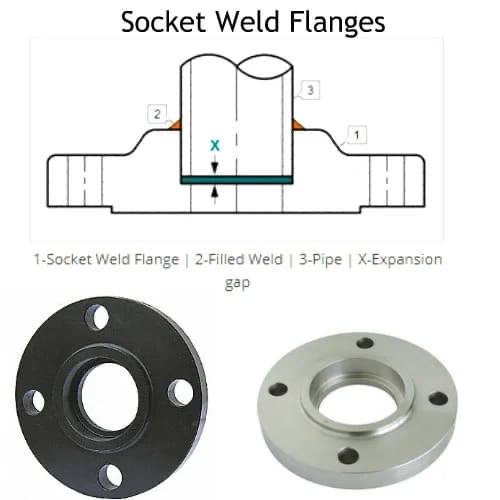
Single external fillet with 1/16″ expansion gap; 316L or 318-type filler (titanium transfers poorly across the arc); no preheat, no PWHT
Service Span
European-specified plants; hot corrosive duty 400–550 °C; cryogenic-capable; chloride limits are plain 316's — honest notes below
Surface Finish
Pickled or natural machined — stainless-dedicated handling, no carbon-steel contact
Testing
Tension & chemistry per heat; Ti-to-carbon ratio verified; PMI on every piece; socket depth and bore gauged
Certification
EN 10204 3.1 with solution-anneal records (standard) / 3.2 witnessed
Specification Notes — Getting 316Ti Sockets Right
Four honest notes.Outside Europe and hot service, 316L has largely won: modern melting made the L-grade cheaper and its titanium-free microstructure polishes better — bioprocess standards specify 316L, not Ti — so specify 316Ti where the plant, the equipment or the temperature says so, not by default. The chloride limits are plain 316's: titanium appears nowhere in the PREN formula — the coast, not the sea, and SCC above ~60 °C still points to the duplex family. Knife-line attack is the stabilised family's own footnote: rare in practice, managed by weld sequencing and — in aggressive service — a stabilising anneal; ask for it on the order where the duty warrants. And filler is not matching-Ti: titanium burns off in the arc — 316L or niobium-stabilised 318-type consumables are correct practice, stated on our WPS guidance with every supply.
How Our A182 F316Ti Socketweld Flanges Are Manufactured
1
Forging — cut billet of the spectro-verified S31635 heat — titanium-to-carbon ratio confirmed — is hot-forged into the flange blank with full heat traceability and segregated stainless handling.
2
Solution annealing — sets the clean austenitic structure with titanium carbides distributed; furnace charts retained against the heat number; stabilising anneal added where ordered.
3
Machining — faces, OD and drilling to ASME B16.5 or EN 1092-1 on stainless-dedicated stations — the titanium carbides make 316Ti marginally more abrasive on tooling than plain 316: sharp inserts and disciplined feeds; socket counterbore and depth gauged piece by piece, through-bore matched to the ordered schedule.
4
Facing — RF serrations, flat face or RTJ groove per B16.20.
5
Testing & marking — tension and chemistry per heat; PMI on every piece; laser-marked with grade, size, class, schedule and heat number — 1.4571 added where European documentation requires.
6
Certification & packing — EN 10204 3.1 MTC with solution-anneal records (3.2 witnessed on request); packed sea-worthy with no carbon-steel contact.
Where ASTM A182 F316Ti Socketweld Flanges Are Used
Wherever the plant speaks 1.4571: European-engineered chemical works and their worldwide subsidiaries, German OEM equipment matches and spares, DIN-heritage piping classes, hot corrosive process small bore in the 400–550 °C band (hot organics, sulphur-bearing streams), and EU-project utility systems where the site standard is the stabilised grade. Production below:
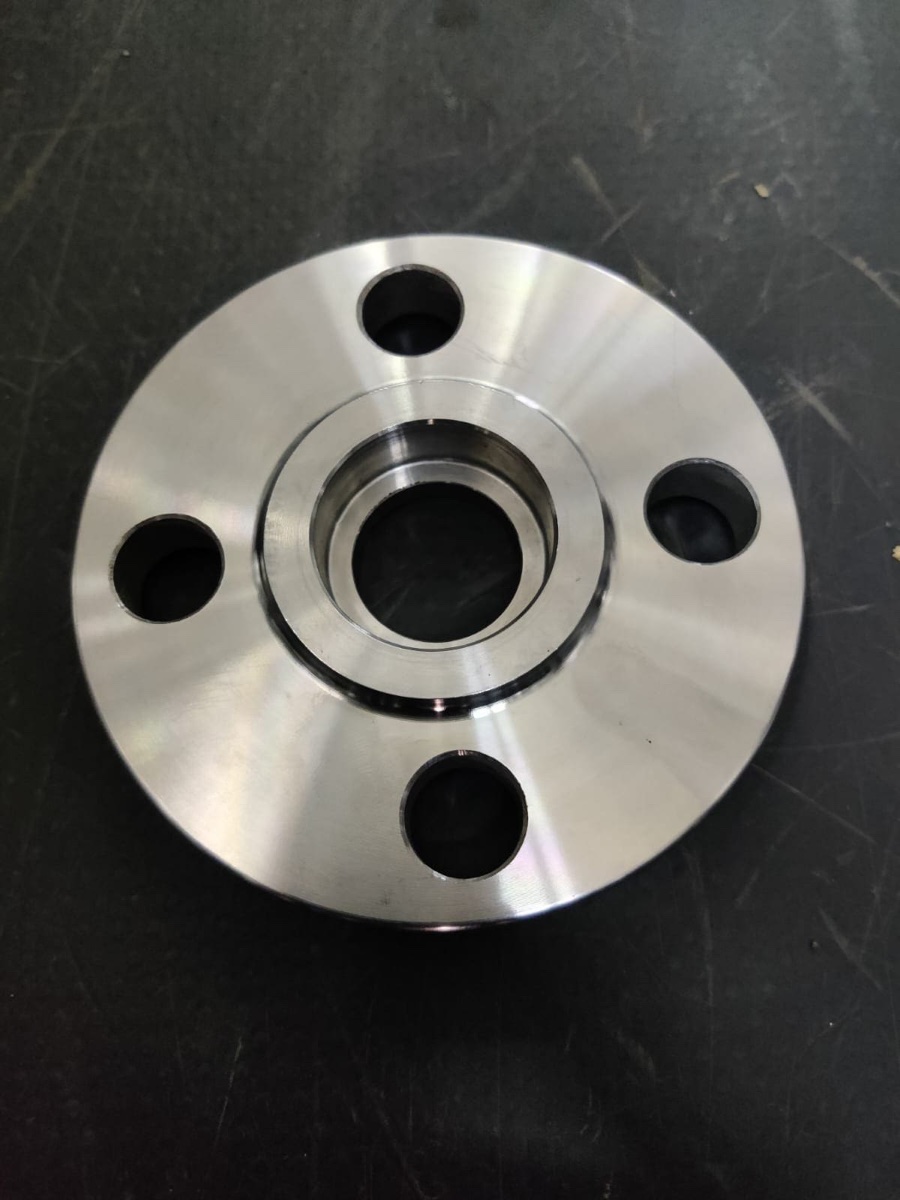
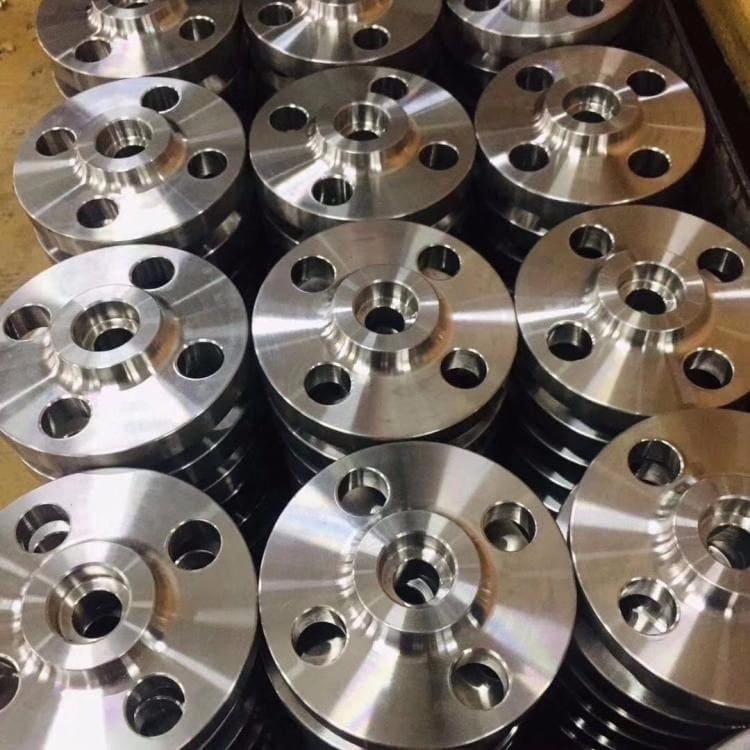
Stainless Socket Weld Flange — Socket Bore Visible, Our WorksSocket Weld Flanges — Machined Batch, Ready for DispatchThe Socket Weld Joint — Note the Expansion Gap (X)
A182 F316Ti Socketweld Flange Dimensions
Socket weld flange dimensions are class-governed per ASME B16.5 — identical across material grades (pressure-temperature ratings follow the austenitic group); EN 1092-1 dimensions per that standard where ordered. Full ASME charts:
How to Specify & Order an A182 F316Ti Socketweld Flange
Six elements — and if you are matching European equipment, say so:
1
Size & standard — e.g. 1″ NB ASME B16.5, or DN25 EN 1092-1 Type 11 for continental equipment matches.
2
Pressure class & facing — 150#–1500# or PN rating; SWRF (the default), SWFF or SWRTJ with ring number.
3
Pipe schedule — Sch 10S, 40S or 80S: the through-bore is matched to the pipe ID.
4
Grade line as written — F316Ti, UNS S31635 or W.Nr. 1.4571 all name the same metal; the certificate carries the designations your documentation uses. Stabilising anneal called out for aggressive service.
5
Certification — EN 10204 3.1 with solution-anneal records (our standard) / 3.2 witnessed, PMI as applicable.
An ASTM A182 F316Ti socketweld flange is a forged titanium-stabilised austenitic stainless steel flange — 316 chemistry with a deliberate titanium addition, UNS S31635, W.Nr. 1.4571 — whose back carries a machined socket: the pipe end seats inside, self-aligned square to the face, and is secured with a single external fillet weld. The titanium is the older cure for weld sensitization: it ties carbon up as harmless titanium carbide before chromium can, so the fillet weld's heat-affected zone keeps its corrosion resistance while the grade keeps plain 316's full strength. Dimensioned to ASME B16.5 for ½" to 3" NB in Classes 150 to 1500, in raised face, flat face and ring joint facings — the 316 that Europe writes as 1.4571.
What does the titanium in 316Ti actually do?
It gets to the carbon first. Weld sensitization happens when carbon finds chromium in the 450-850°C band and precipitates as chromium carbide, stripping the grain boundaries of the element that holds the passive film. Titanium forms its carbide at higher temperatures and more eagerly than chromium does — so a deliberate dose, at least five times the combined carbon and nitrogen content, locks the carbon up as harmless titanium carbide before the danger band is ever reached. The chromium stays in solution, the film stays intact, and the weld zone needs no protection. It is the same problem the L-grades solve by removing carbon — solved instead by chaperoning it, which is why the stabilised grades keep the full-carbon strength the L-grades give up.
Why is 316Ti the European grade?
History and habit, both respectable. Stabilisation was the original industrial cure for weld decay — perfected in Europe decades before argon-oxygen decarburisation made low-carbon melting cheap — and German DIN practice built its stainless world around the stabilised grades: 1.4571 became the continental default for chemical plant, so ubiquitous that German engineers call heavy-duty stainless simply V4A, meaning exactly this metal. The specifications, the installed base and the reflexes persist: European OEM equipment arrives flanged in 1.4571, EU-engineered projects write it into piping classes, and anyone matching or extending that plant needs F316Ti by name. That is the grade's modern franchise — and why an Indian manufacturer exporting worldwide keeps it in the forging programme.
What is the chemical composition of ASTM A182 F316Ti (UNS S31635)?
Carbon ≤0.08%, manganese ≤2.00%, silicon ≤1.00%, chromium 16.0-18.0%, nickel 10.0-14.0%, molybdenum 2.00-3.00%, titanium at least five times the combined carbon-plus-nitrogen content up to 0.70% maximum, phosphorus ≤0.045%, sulphur ≤0.030%. Read the two signatures together: the carbon ceiling is plain 316's full 0.08% — the stabilised grade keeps its carbon, unlike the L — and the titanium formula scales the chaperone to the carbon it must lock up. The molybdenum stays at 2.00-3.00%: 316Ti is a 316 through and through, with the same chloride credentials. Chemistry is verified per heat, the titanium-to-carbon ratio checked, and everything travels on the EN 10204 3.1 MTC.
What are the mechanical properties of A182 F316Ti socketweld flanges?
In the solution-annealed condition A182 requires tensile strength 515 MPa (75 ksi) minimum, yield strength 205 MPa (30 ksi) minimum and elongation 30% minimum — the full plain-316 numbers, and that is the stabilised grade's quiet advantage: 316L buys its weld immunity by dropping to 485/170, while 316Ti gets the same immunity free of charge because the carbon stays in the metal, chaperoned rather than removed. Where a specification wants both the plain grade's allowable stresses and as-welded corrosion resistance in one named grade — rather than via dual certification — the stabilised grade is the classical answer, and European piping classes use it exactly that way.
F316Ti or F316L — how do I decide?
Both solve weld sensitization; the decision is context. Choose F316Ti when the specification or the plant already speaks it — 1.4571 equipment matches, DIN-heritage piping classes, European OEM spares — or when the duty combines corrosion with sustained heat, where the stabilised grade's full strength and higher temperature standing outlast the L. Choose 316L for new specifications outside that world: modern melting made it cheaper, its cleaner titanium-free microstructure polishes better — the reason bioprocess standards specify L, not Ti — and its supply chain is deeper. The honest summary: outside Europe and hot service, 316L has largely superseded 316Ti in new work, while the installed European base keeps 316Ti permanently in demand. We forge both; name the grade line and the certificate will match it.
What is the temperature range of F316Ti socketweld flanges?
This is the niche where the stabilised grade still wins on merit. Downward, the austenitic structure keeps its toughness to cryogenic temperatures — no transition, as for the whole family. Upward is the point: the L-grades surrender allowable stress as temperature climbs because their carbon is gone, while 316Ti keeps plain-316 strength and its titanium carbides stay stable through the intermediate hot band — sustained service around 400-550°C in corrosive process duty is the classical 1.4571 territory: hot organic chemistry, sulphur-bearing streams, refinery-adjacent chemical plant. Above that band the conversation changes to the H-grades and heat-resistant alloys; below it, the choice returns to economics. State the design temperature and the quotation will point honestly.
Does the titanium change 316Ti's chloride resistance?
No — the chloride credentials are plain 316's, unchanged. Pitting resistance lives in chromium, molybdenum and nitrogen — PREN ≈ Cr + 3.3×Mo + 16×N — and titanium appears nowhere in that formula: 316Ti sits at the same PREN of roughly 24-26 as its unstabilised sibling. So the family's honest limits carry over word for word: the coast, not the sea — continuous warm seawater crevice duty defeats it, and the socket's own gap is a crevice; chloride stress corrosion cracking above roughly 60°C runs on the austenitic structure regardless of stabilisation. Where those limits bind, the escalation is the duplex family and super duplex — their socketweld pages carry the story.
Does 316Ti have any weld caveat of its own?
One, worth knowing and rarely governing: knife-line attack. In a narrow band right against the fusion line, weld heat can dissolve the protective titanium carbides; if that band is then reheated into the sensitizing range — a later pass, a nearby repair — the freed carbon can form chromium carbide in a razor-thin line before titanium recaptures it. The classical answer is sensible weld sequencing and, in aggressive service, a stabilising anneal; in ordinary process duty the phenomenon is a textbook footnote rather than a field problem, and the socket weld's single small fillet gives it little room to arise. Filler practice: 316L or niobium-stabilised 318-type consumables — titanium itself transfers poorly across the arc, so matching-Ti filler is not the method.
How is an F316Ti socketweld flange welded?
With the austenitic family's easy rules and one consumable note. Geometry is standard: pipe bottomed in the socket, withdrawn 1/16" (1.6 mm) to leave the expansion gap, single external fillet weld. No preheat, no PWHT; stainless housekeeping — dedicated brushes and tooling, no carbon-steel contamination — and moderate heat input against distortion. The consumable: titanium does not survive the arc well, so filler is either 316L (low carbon protects the deposit by the other mechanism) or the niobium-stabilised 318 type where a stabilised deposit is specified — niobium transfers where titanium will not. Weld sequencing keeps the fusion-line band away from reheating in aggressive service. Our flanges arrive solution annealed with furnace records.
What facings are A182 F316Ti socketweld flanges made with?
All three, each with its own page on this site: raised face (SWRF) — the default, with PTFE or graphite spiral wound gaskets by service — flat face (SWFF) for GRP, lined and cast equipment mates, and ring type joint (SWRTJ) for the rarer high-pressure stainless duty, with soft iron or stainless rings per the class. European-pattern mates are routine for this grade: EN 1092-1 Type 11/B1 and DIN-heritage drillings are machined to order alongside the ASME patterns, which is often exactly why F316Ti is being bought. Stainless bolting deserves anti-galling attention — coated or dissimilar-grade fasteners and thread lubricant are standard practice. NPT-tapped variants are machined and certified at the works.
What sizes and pressure classes do F316Ti socketweld flanges come in?
ASME B16.5 standardises socket weld flanges from ½" to 3" NB in Classes 150, 300, 600, 900 and 1500 — Class 900 sharing Class 1500 dimensions in most small-bore sizes — with 4" and Class 2500 made to order; EN 1092-1 patterns in DN15-DN80 are forged to order for the European-specified plants where this grade lives. Stock concentrates in Classes 150 and 300. Put the pipe schedule on the enquiry — Sch 10S and 40S dominate stainless systems, and the through-bore is matched to the pipe ID so the joint presents no step to flow. B16.5 pressure-temperature ratings for the austenitic group govern the limits; our quotations state them per class.
What details are needed to get an accurate F316Ti socketweld flange quotation?
Six elements plus commercial terms: (1) size and standard — ½" to 3" NB ASME B16.5, or the EN 1092-1/DN equivalent if matching European equipment; (2) pressure class — 150 to 1500, or PN rating; (3) facing — SWRF, SWFF or SWRTJ with ring number; (4) the pipe schedule — Sch 10S, 40S or 80S, so the through-bore matches the pipe ID; (5) the grade line as written — F316Ti / UNS S31635 / W.Nr. 1.4571 all name the same metal, and the certificate will carry the designations the specification uses; (6) certification — EN 10204 3.1 with solution-anneal records (our standard) or 3.2 witnessed, PMI as applicable. Add quantity and destination and we return price, weight and delivery — normally within 24 hours.
Is F316Ti stocked or made to order?
Honestly: mostly to order, and quickly. The global stainless small-bore market has consolidated on 316L, so 316Ti flange stock is thin everywhere outside continental Europe — but the grade is a routine forging for us: certified S31635 heats are held with our stainless bar and billet, and a socket weld flange programme runs through the same stations as our 316/316L production with only the heat number changing. Typical lead times for ½"-3" socket weld flanges run days to a few weeks by quantity, with EN 10204 3.1 certification carrying the 1.4571 designation European documentation expects. For urgent equipment matches, say so on the enquiry — small lots can usually be expedited.
Who manufactures ASTM A182 F316Ti socketweld flanges in India?
Tesco Steel & Engineering is an ISO 9001:2015 certified flange manufacturer based in Mumbai, India, producing ASTM A182 F316Ti socket weld flanges from ½" to 3" NB (larger and EN 1092-1 patterns to order) in Classes 150-1500 — each forged from certified S31635 heats with the titanium-to-carbon ratio verified, solution annealed with furnace records, machined on stainless-dedicated stations with gauged socket depth and schedule-matched bore, PMI-checked and laser-marked with grade, size, class, schedule and heat number. Supplied with EN 10204 3.1/3.2 certification carrying the W.Nr. 1.4571 designation where European documentation requires it — alongside the F316/F316L, F321, F347 and full stainless socketweld range this series covers. Exported to more than 50 countries.