ASTM A182 F316Ti Weld Neck Flanges — Titanium-Stabilized SS 316Ti (1.4571)
Tesco Steel & Engineering forges ASTM A182 F316Ti weld neck flanges in stainless steel 316Ti — UNS S31635, better known across Europe as Werkstoff Nr. 1.4571 — from 1/2″ NB to 56″ NB, in ASME B16.5 Class 150–2500 and the full EN 1092-1 / DIN PN range this grade is usually ordered in. Titanium locks the carbon into stable carbides, so welded joints resist sensitization at full 316 strength — with 316's 2–3% molybdenum still guarding against chlorides and process acids. The default stainless of European chemical plant specifications, mating A312 TP316Ti and EN 10216-5 1.4571 pipe. Supplied pickled & passivated with IGC ASTM A262, PMI and EN 10204 3.1/3.2 on request. ISO 9001:2015, made in Mumbai, India — exported worldwide.
A182 F316Ti · UNS S31635 · 1.4571
Ti-Stabilized · Weld-Safe
2–3% Mo · Full 316 Strength
1/2″ – 56″ NB
Class 150 – 2500 · PN 2.5 – 400
European Spec Favourite
ISO 9001:2015 · Exported Worldwide
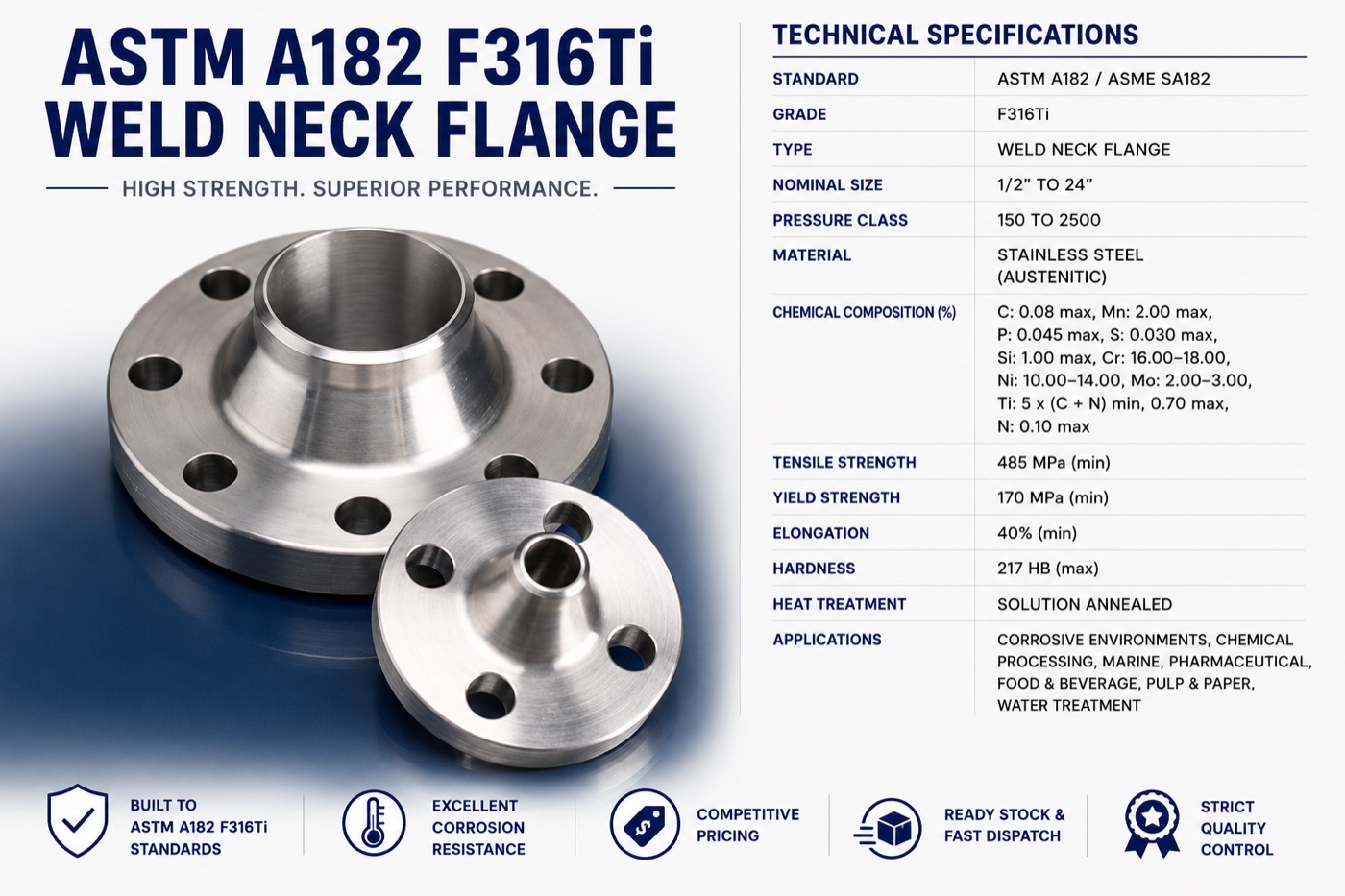
ASTM A182 F316Ti Weld Neck Flange — Stainless Steel 316Ti (UNS S31635 / 1.4571), Technical Specifications
What is an ASTM A182 F316Ti Weld Neck Flange?
ASTM A182 F316Ti is the forged-flange grade of stainless steel 316Ti (UNS S31635 / 1.4571) — 316's 16Cr-12Ni-2Mo chemistry with a titanium addition of at least 5×(C+N). The titanium ties carbon into stable carbides, so welded joints cannot sensitize — the same protection 316L buys with low carbon, achieved instead by stabilization, at full 316 strength. An F316Ti weld neck flange pairs that metallurgy with a long tapered hub butt-welded to the pipe, bore matched to schedule, joint fully radiographable.
Two roads lead away from weld decay: 316L removes the carbon; 316Ti locks it up. The Ti route keeps standard 316's 515 MPa tensile floor and holds its protection through extended service at 400–550 °C — squarely in the sensitization zone — which is why the European chemical industry standardized on 1.4571 decades ago and still writes piping classes around it.
Its stabilized siblings complete the picture: 321 is titanium-stabilized 304 (no molybdenum, for clean hot service), and 347 stabilizes with niobium. When the service combines corrosive chemistry with welding or intermediate heat, 316Ti is the stabilized grade to hold the line.
Also searched as: 1.4571 flange, X6CrNiMoTi17-12-2 flange, SS 316Ti weld neck flange, UNS S31635 flange, 316Ti WNRF flange, SA182 F316Ti flange — all refer to the product on this page.
Chemical Composition of ASTM A182 F316Ti
| C | Mn | Si | P | S | Cr | Mo | Ni | N |
|---|
| 0.080 max | 2.00 max | 0.75 max | 0.045 max | 0.030 max | 16.00-18.00 | 2.00-3.00 | 10.00-14.00 | 0.10 max |
Values in weight %. S31635 additionally requires the grade's defining titanium at 5×(C+N) minimum up to 0.70% max — enough to lock every carbon atom into stable TiC and keep chromium at the grain boundaries where corrosion resistance lives. Every certificate demonstrates the stabilization ratio.
Mechanical Properties of ASTM A182 F316Ti
| Tensile Strength, MPa | Yield Strength, Min, MPa | Elongation % min. | Hardness Rockwell HRB | Hardness Brinell HB |
|---|
| 515 | 205 | 30 | 95 max | 205 max |
Minimums per ASTM A182 — the full strength of standard 316, not the reduced 485/170 of the L grade: stabilization protects the welds without giving up the numbers. The solution-annealed condition is documented on every certificate.
Equivalent Grades of ASTM A182 F316Ti
| Standard | Werkstoff Nr. | UNS | JIS | BS | GOST | AFNOR | EN |
|---|
| SS 316Ti | 1.4571 | S31635 | SUS 316Ti | 320S31 | 08Ch17N13M2T | Z6CNDT17‐123 | X6CrNiMoTi17-12-2 |
The 1.4571 designation is how most enquiries for this grade arrive. System partners: A312 TP316Ti pipe, EN 10216-5 1.4571 seamless tube and A240 316Ti plate. Stabilized siblings: 321 (Ti, no Mo) and 347 (Nb).
ASTM A182 F316Ti Weld Neck Flange Specifications
| ASTM A182 316Ti Weld Neck Flanges are available in the following specifications: |
|---|
| Size | 1/2"NB to 56"NB |
| Class | 150#, 300#, 400#, 600#, 900#, 1500#, 2500# |
| Sch (Schedule) | XS, XXS, STD & Schedule 20, 40, 80, 160 |
| Pressure Ratings | PN 2.5 - PN 400 |
| Standards | ASME B16.5, ASME B16.47, EN 1092-1 Type 11, DIN 2631–2635, BS 4504 |
| Condition | Solution Annealed; titanium-stabilized (Ti ≥ 5×(C+N)) |
| Other Services | Pickling & passivation on ASTM A182 316Ti Weld Neck Flanges
Sand Blasting on ASTM A182 316Ti Weld Neck Flanges
Shot Peening on ASTM A182 316Ti Weld Neck Flanges
IGC (ASTM A262) & PMI testing
Project-specific marking, wrapping & export packing |
Why 316Ti — the Stabilized Route to Weld Safety
Weld-Safe Without Losing Strength
Titanium locks the carbon, so joints resist sensitization at full 316 strength — 515 MPa tensile, not the L grade's 485.
Protection That Survives Heat
In extended service at 400–550 °C — the sensitization zone — stabilization keeps working where low carbon alone runs out of margin.
Molybdenum Still on Duty
316's 2–3% Mo guards against chloride pitting and process acids — the corrosion resistance that separates 316Ti from its no-Mo sibling 321.
The 1.4571 of European Specs
German and wider EU chemical plant piping classes are written around this grade — we forge it to EN 1092-1 and DIN patterns as readily as ASME B16.5.
Full Stabilized Family
316Ti, 321, 321H and 347 from one forge — whichever stabilized grade the specification names, the paperwork and bevels arrive matched.
Welding 316Ti — Stabilized Base, 318 Filler
316Ti welds with standard austenitic practice — moderate heat input, no preheat, no PWHT — with one consumable subtlety: titanium does not transfer reliably across the welding arc, so stabilized joints use niobium-stabilized 318 filler (ER318), or 316L filler where the specification allows. Either keeps the weld metal sensitization-safe; the stabilized base metal protects the heat-affected zone — which is where the grade does its real work.
High-polish note: the titanium carbides that stabilize the grade show up as fine hard inclusions, limiting mirror finishes. For validation-driven, high-polish pharma lines,
316L is usually the better choice; for process-side chemical duty, 316Ti serves without compromise.
Where ASTM A182 F316Ti Weld Neck Flanges Are Used
European-specified plants lead: wherever a piping class reads 1.4571 — chemical and petrochemical process lines, fertilizer and urea services, dye and textile chemistry. Heat exchangers running warm corrosive media, flue and exhaust systems, pulp and paper, and marine equipment built to European standards complete the range. The large-diameter flange below is our own production, packed for dispatch:
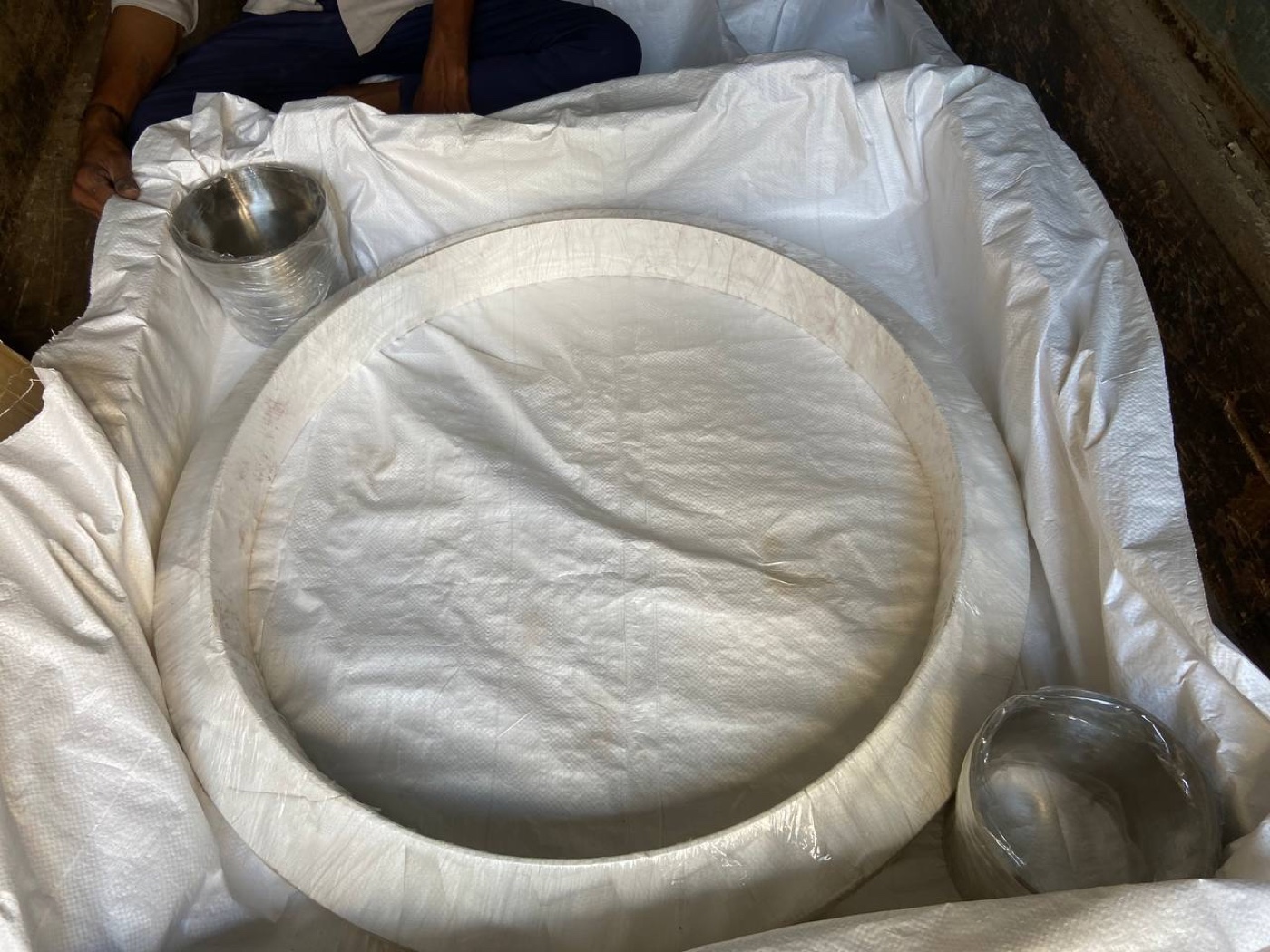
Large-Diameter F316Ti Flange — Wrapped & Packed for Dispatch
ASTM A182 F316Ti Weld Neck Flange Dimensions
F316Ti weld neck flanges share their dimensions with every other material in the same class — OD, thickness, hub, bore, bolt circle and bolting per the standard tables. Full ASME B16.5 charts:
European PN dimensions — this grade's home turf — are published on the EN 1092-1 Type 11, DIN 2631–2635 and BS 4504 pages.
Price List & How to Order
Stainless pricing tracks nickel and molybdenum plus the certification scope, so we quote live with a stated validity rather than publish a static list. To get a firm quotation, usually within 24 hours:
1
List your requirement — size (NB or DN), class or PN, standard (ASME B16.5 / B16.47 / EN 1092-1 / DIN / BS), grade (F316Ti / 1.4571), pipe schedule or wall thickness, and quantity.
2
Add the testing scope — IGC ASTM A262, 3.2 witness, PMI, or project specifications.
ASTM A182 F316Ti Weld Neck Flanges — Frequently Asked Questions
What is an ASTM A182 F316Ti weld neck flange?
It is a weld neck flange forged from ASTM A182 grade F316Ti — titanium-stabilized stainless steel 316Ti, UNS S31635, better known across Europe as 1.4571. Titanium ties up carbon as stable carbides so welded joints resist sensitization, while the grade keeps 316's molybdenum and full strength. The long tapered hub is butt-welded to the pipe with the bore matched to the pipe schedule, giving a radiographable, fatigue-resistant joint in the European chemical industry's default stainless.
What does titanium stabilization actually do?
It removes the raw material for weld decay. Sensitization happens when carbon combines with chromium at grain boundaries during welding or hot service, stripping the metal of its corrosion protection. Titanium is a stronger carbide former than chromium, so with Ti held at five times the carbon-plus-nitrogen content, the carbon is already locked up as harmless titanium carbides — the chromium stays in solution and the joint stays corrosion-resistant, with no post-weld anneal.
What is the difference between 316Ti and 316L?
Two solutions to the same sensitization problem. 316L removes the carbon (0.030% max); 316Ti locks it up with titanium. The L grade is cleaner and polishes better — the choice for high-purity and pharmaceutical finishes. The Ti grade keeps full 316 strength (515 versus 485 MPa tensile) and holds its stabilization advantage in extended service at 400 to 550 °C, where an L grade's protection is only as good as its low carbon. European specifications historically favour 316Ti; ASME-world specifications favour 316L — we forge both.
What is the difference between 316Ti and 321?
Both are titanium-stabilized austenitics; the difference is molybdenum. 321 is stabilized 304 — no molybdenum — built for high-temperature strength in clean environments like aircraft exhausts and hot air systems. 316Ti is stabilized 316, keeping the 2-3% molybdenum that resists chloride pitting and process acids. When the service combines corrosive chemistry with welding or intermediate heat, 316Ti is the stabilized grade to specify.
Why do European specifications call for 1.4571?
History and habit with good metallurgy behind them: German and wider European chemical plant standards standardized on titanium-stabilized grades decades ago, and 1.4571 (X6CrNiMoTi17-12-2) became the region's workhorse stainless — specified in Stahlschlüssel-based piping classes, EN 1092-1 flange standards and countless plant specifications. An enquiry that arrives as '1.4571 flange to EN 1092-1' is exactly this product; we forge it to both ASME and EN dimensional standards.
What temperature range can F316Ti flanges be used in?
From cryogenic — austenitics have no ductile-brittle transition — up to about 550 °C in continuous service, where the stabilization earns its keep: extended time at 400 to 550 °C sits squarely in the sensitization zone that titanium neutralizes. European sources rate 1.4571 with useful strength values to 550 °C, above which the dedicated H grades and heat-resistant 310 family take over.
What are the equivalent designations for A182 F316Ti?
SS 316Ti in general usage; UNS S31635; Werkstoff Nr. 1.4571 (EN X6CrNiMoTi17-12-2); JIS SUS 316Ti; BS 320S31; GOST 08Ch17N13M2T; and AFNOR Z6CNDT17-123. Its system partners share the chemistry: A312 TP316Ti pipe, EN 10216-5 1.4571 seamless tube and A240 316Ti plate. An enquiry in any of these designations is quoted as the same material.
What is the chemical composition of ASTM A182 F316Ti?
Per our supply practice: carbon 0.080% max, manganese 2.00% max, silicon 0.75% max, phosphorus 0.045% max, sulphur 0.030% max, chromium 16.00 to 18.00%, molybdenum 2.00 to 3.00%, nickel 10.00 to 14.00% and nitrogen 0.10% max — plus the grade's defining titanium addition, required at five times the carbon-plus-nitrogen content up to 0.70% max, which locks the carbon into stable carbides.
What are the mechanical properties of A182 F316Ti flanges?
Minimum tensile strength 515 MPa (75 ksi), minimum yield strength 205 MPa (30 ksi) and minimum elongation 30%, with hardness typically limited to 95 HRB / 205 HB. Unlike the low-carbon route to weld safety, stabilization keeps the full strength of standard 316 — one of the practical reasons European designers preferred it.
Which pipe grades do F316Ti weld neck flanges mate with?
ASTM A312 TP316Ti seamless and welded pipe on ASME projects, and EN 10216-5 / 10217-7 grade 1.4571 pipe on European ones — the same chemistry under two standards. Butt-weld fittings follow in A403 or EN 10253 equivalents. The weld neck bore is machined to the pipe schedule or wall thickness you state, so the bore runs flush through the joint.
How are 316Ti flanges welded to pipe?
Standard austenitic practice — moderate heat input, no preheat, no PWHT — with one consumable subtlety: titanium does not transfer reliably across the welding arc, so the standard filler for stabilized joints is niobium-stabilized 318 (ER318), or 316L filler where the specification allows. Either keeps the weld metal sensitization-safe; the stabilized base metal protects the heat-affected zone, which is where the grade does its real work.
Is 316Ti suitable for high-polish pharmaceutical service?
With a caveat: the titanium carbides that give the grade its stabilization show up as fine hard inclusions, which limit the mirror finishes achievable compared with clean 316L. For validation-driven, high-polish hygienic lines, 316L is usually the better choice; for the process side of chemical, textile and fertilizer plants — where corrosion resistance and weldability matter more than surface cosmetics — 316Ti serves without compromise.
What testing and certification do you supply with F316Ti flanges?
Every lot ships with EN 10204 3.1 mill test certificates covering chemical analysis — including titanium and the stabilization ratio — mechanical properties and the solution-anneal record, with 3.2 certification witnessed by Lloyd's, DNV, BV or TÜV on request. We also offer intergranular corrosion testing to ASTM A262, PMI verification and hydrostatic or hardness testing to project specifications, with full heat-number traceability.
Where are ASTM A182 F316Ti weld neck flanges used?
European-specified chemical and petrochemical plants above all — anywhere a piping class reads 1.4571 — plus fertilizer and urea services, dye and textile chemistry, pulp and paper, heat exchangers running warm corrosive media, exhaust and flue systems, and marine equipment built to European standards. If the drawing says X6CrNiMoTi17-12-2, this is the flange.
What sizes and standards do you manufacture F316Ti weld neck flanges in?
From 1/2 inch NB to 56 inch NB: ASME B16.5 Class 150 to 2500 up to 24 inch, ASME B16.47 above, and — fittingly for this grade — the full European range, PN 2.5 to PN 400 to EN 1092-1 Type 11, DIN 2631-2635 and BS 4504. Raised face is standard, ring joint on request, and every bore is machined to the mating pipe schedule from Sch 10 through XXS.
Do you keep A182 F316Ti weld neck flanges in stock? What is the lead time?
Common European-project sizes in Class 150/300 and PN 16/40 rotate through regular production, with popular items often available from stock — the large-diameter flange photographed on this page is our own packed production. Larger diameters, higher classes and witness-tested lots are forged to order, typically in 3 to 5 weeks. Prices track nickel and molybdenum, so quotations carry a validity period.
What information should I include in an F316Ti flange enquiry?
Six things: size (NB or DN), pressure class or PN rating, dimensional standard (ASME B16.5, B16.47 or EN 1092-1/DIN/BS), grade (F316Ti / 1.4571), pipe schedule or wall thickness, and quantity. Add any testing scope — IGC ASTM A262, 3.2 witness, PMI — and the facing if other than raised face. With these details we return a firm quotation, usually within 24 hours.
Do you export ASTM A182 F316Ti flanges outside India?
Yes — 316Ti demand is led by European-specified projects, and Tesco Steel & Engineering, an ISO 9001:2015 certified manufacturer based in Mumbai, ships F316Ti / 1.4571 flanges to chemical, fertilizer and process plants across Europe, the Middle East, Africa, Southeast Asia and the Americas. Flanges travel pickled, face-protected and seaworthy-packed, with full heat-number and test traceability.

